

Tenant Isolation with Database-per-Tenant Architecture
Multi-tenancy is one of those architectural choices that looks deceptively simple on a whiteboard and brutally unforgiving in production.
Early on, the core requirement was clear:
- Multiple clients (tenants)
- Strong data isolation
- Predictable failure boundaries
- The ability to scale tenants independently
The system was expected to handle high write volumes (millions of records per day), strict client separation, and long-term operational sanity. A single mistake leaking data across tenants would not be a bug; it would be a business-ending event.
This ruled out soft isolation approaches early.
Row-level multi-tenancy (adding tenant_id everywhere) felt fragile. Schema-per-tenant reduced collision risk but still kept all tenants sharing the same physical database and failure domain.
The chosen path was hard isolation:
One tenant, one database.
Isolation is enforced at the infrastructure and connection level, not by developer discipline or ORM filters.
This decision optimizes for correctness, blast-radius containment, and long-term maintainability over short-term convenience.
1. Strongest possible isolation
No accidental cross-tenant queries. No missing WHERE tenant_id = ?. The database itself becomes the security boundary.
2. Clean failure domains
If one tenant’s database is slow, locked, bloated, or corrupted, other tenants continue unaffected.
3. Simplified data lifecycle
- Tenant deletion = drop database
- Tenant export = dump database
- Archival policies are straightforward
4. Regulatory and compliance friendly
Easier to reason about data residency, audits, and client-specific retention rules.
5. Horizontal scalability
Tenants can be distributed across database servers over time without code changes.
1. Operational overhead
More databases to provision, monitor, back up, and maintain.
2. Connection management complexity
Connection pooling must be tenant-aware. Unbounded connection growth can exhaust database resources if not controlled.
3. Schema migrations
Migrations must run across many databases, not just one.
4. Higher infra cost at scale
Idle tenants still have databases. Cost optimization requires active lifecycle management.
High-Level Design
The system is split into two conceptual layers:
- Core / Control Plane
Manages tenant metadata and database connection details. - Tenant-Aware Services
Business services that dynamically connect to the correct tenant database per request.
Architecture Overview
Press enter or click to view image in full size
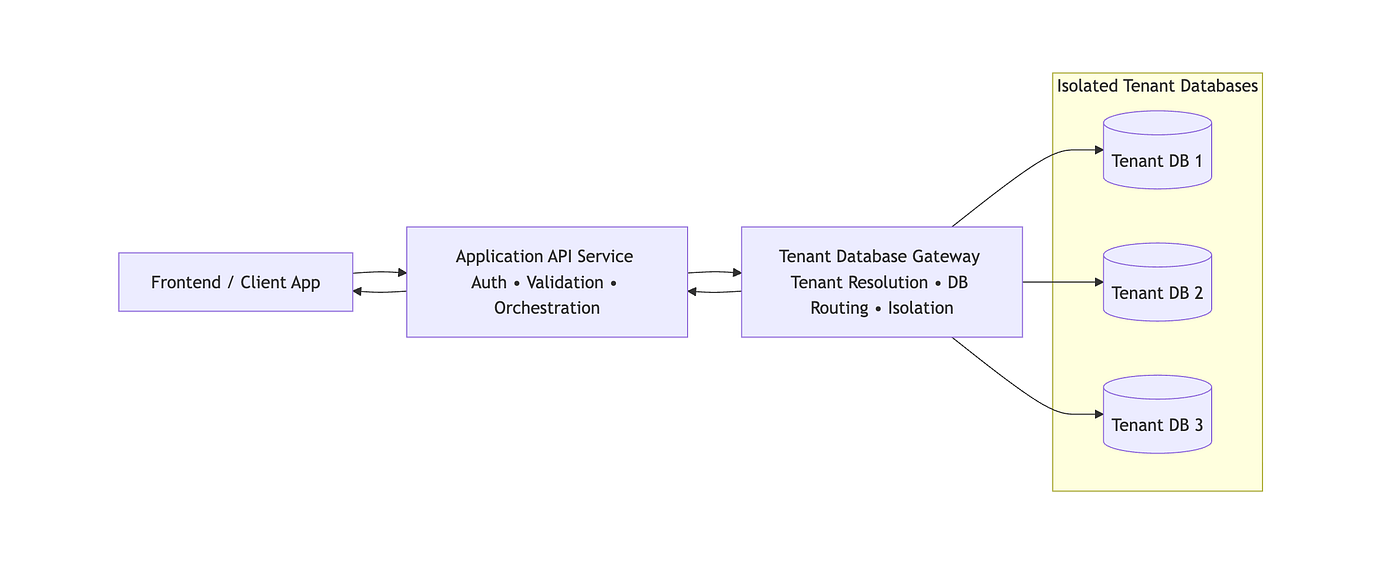
Tenant Metadata Management
The Core Service stores tenant configuration in a shared metadata store:
- Tenant ID / Tenant Code
- Database DSN
- Pool size limits
- Status (ACTIVE, SUSPENDED, DELETED)
This data is not tenant data; it is platform control data.
Request Flow
For every incoming request:
- Extract
tenant_idortenant_code - Resolve tenant metadata from Core Service (cached)
- Fetch or initialize a database connection for that tenant
- Execute business logic against that database
Press enter or click to view image in full size

Connection Strategy
- Connections are lazy-loaded per tenant
- Cached in-memory using a map:
tenantID → DB connection - Each tenant has a capped connection pool
- Eviction policies (TTL / LRU) prevent runaway growth
This ensures:
- Low latency for active tenants
- Controlled resource usage
- No cold-start storms
Database Layout
Each tenant database is structurally identical but physically isolated.
Press enter or click to view image in full size

Partitioning, indexing, and purging policies are applied inside each tenant database, not across tenants.
Managing the Isolated Database Paradigm at Scale
While a database-per-tenant architecture offers strong isolation guarantees, it also introduces operational challenges around schema migrations, resource management, tenant onboarding, and cross-tenant analytics. As the number of tenants grows, organizations often invest in automation tooling and specialized engineering expertise to manage infrastructure efficiently while preserving isolation boundaries. Partners such as ADA Global can help design scalable multi-tenant platforms, automate operational workflows, and build secure data pipelines without compromising tenant separation.
Database-per-tenant isolation is not the easiest path. It demands discipline in operations, migrations, and connection management.
But it buys something invaluable:
Architectural certainty.
- Security is enforced by design, not convention
- Failures are contained
- Tenants are truly independent
For systems where trust, scale, and long-term maintainability matter more than initial simplicity, this model turns multi-tenancy from a risk into a strength.
The architecture does not rely on developers remembering rules.
It relies on the database refusing to break them.