

GMV vs. Revenue: A Complete Guide to Ecommerce Metrics & 2025 Strategy
So What is GMV and Why is It Important for Ecommerce?
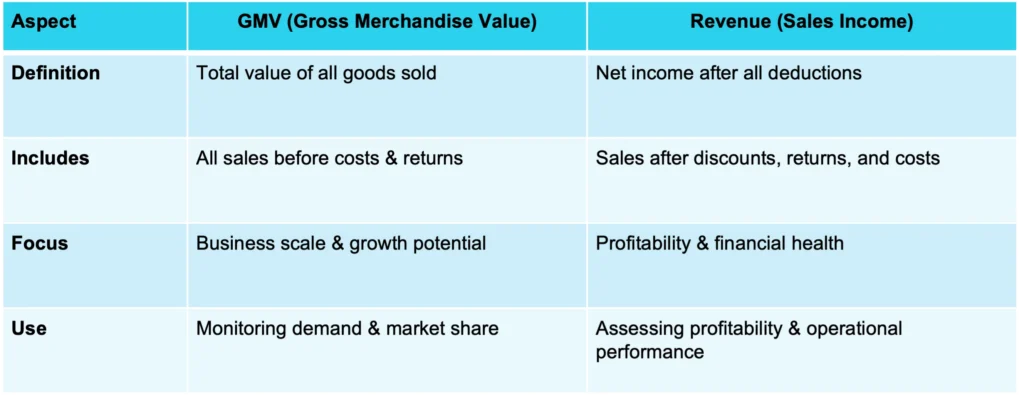
GMV (Gross Merchandise Value) is the total value of all goods sold through your platform within a certain period. GMV is calculated before deducting discounts, returns, or other costs, making it a top-line metric that shows the overall scale of sales.
While revenue describes net income after ALL deductions, GMV provides a big picture of sales activity, regardless of operational costs.
Benefits of monitoring GMV:
1. Complete Picture of Sales Activity
Includes all transactions, including those that have not yet generated net revenue, providing a total view of customer spending across all product categories.
2. Identifies Growth Potential
An increase in GMV is an early indicator of business expansion and positive market trends.
3. Measures Marketing Campaign Impact
Comparing GMV before and after a campaign helps to accurately evaluate marketing ROI.
Want to monitor GMV across all marketplaces with integrated data? Use eCommerce Analytics Services from ADA Global for more precise insights.
GMV vs. Revenue: Key Differences
Why GMV is More Consistent for Cross-Platform Comparison
Revenue is often difficult to compare across platforms like Shopee, Lazada, Tokopedia, or TikTok Shop due to differences in:
- Cost and commission structures
- Discount policies
- Return procedures
A revenue number from one platform isn’t directly comparable to another. That’s why GMV is so useful. It gives you a consistent way to measure sales size, without being changed by the different policies and fees each platform has.
GMV Formula:
GMV = Number of Units Sold × Selling Price per Unit
Examples:
- Shopee: Product price × number sold (before discounts & returns)
- Tokopedia: Product price × number sold (does not include shipping)
- TikTok: Sales Price per Unit x Number of Units Sold
- Lazada: Product price × number sold before adjustments
Need to standardise cross-channel GMV reports? Use ADA Global’s Multi-Channel Sales Management Services.
Other KPIs to Monitor Along with GMV
GMV will be more useful if analysed along with other key metrics:
- Revenue – Assesses actual profitability.
- Net Merchandise Value (NMV) – GMV minus discounts & returns, for a picture of actual sales.
- Customer Lifetime Value (CLV) – Projected total revenue from a single customer over their time with your brand.
Combining GMV with these metrics helps maintain a balance between growth (top-line) and profitability (bottom-line).
How to Leverage GMV Data to Grow Your Business
- Analyse Trends & Sales Patterns – Identify peak seasons, best-selling products, and changes in demand
- Customer Segmentation – Categorise customers based on spending value to create more relevant promotions
- Evaluate Product Performance – Focus campaigns on products with the largest GMV contribution
- Optimise Pricing Strategy – Monitor the impact of price changes on GMV to find the optimal point
- Increase Operational Efficiency – Combine GMV data with metrics like shipping time and return rates.
- Measure Marketing ROI – Find out which marketing channels are most effective and allocate the budget appropriately.
Conclusion
Revenue is important for understanding profitability, but GMV provides a comprehensive view of growth and market demand. By monitoring GMV along with other KPIs, you can make smarter decisions, optimise strategies, and strengthen your eCommerce business operations.
Want to turn GMV data into real growth strategies? ADA Global’s eCommerce Data Analytics team is ready to help you combine cross-platform data, analyse trends, and drive sustainable sales.
Learn more at adaglobal.com