
Vibe Coding in 2026: The Honest Guide for Developers Who Actually Ship Things

Post
Insights

Vibe Coding in 2026: The Honest Guide for Developers Who Actually Ship Things

An honest take on vibe coding in 2026 — what works, what doesn’t, and how pragmatists can actually ship more without getting lost in the hype by Pavan Kumar, ADA Global.

Let me be upfront about something: I was skeptical of vibe coding for longer than I should have been. 

The name didn’t help. “Vibe coding” sounds like something a startup founder says right before they demo a product that crashes. And the early discourse around it was exhausting — half the takes were “AI will replace developers,” the other half were “this is just fancy autocomplete,” and both camps were missing what was actually interesting about it. What changed my mind wasn’t a blog post. It was watching a project manager on my team — someone who could barely write a api call — build a working internal dashboard in an afternoon using Claude Code. Not a perfect dashboard. Not one I’d put in front of customers. But real, functional, connected to our actual database, doing useful things. That took me a while to process. 

So here’s what vibe coding actually is, what it’s good for, and where it will quietly wreck your project if you’re not paying attention. 

What’s Actually Happening When You “Vibe Code”

The core shift is about where your mental energy goes. Normal development forces you to hold two things in your head at once: what you’re trying to build and how to express it in code. Those are genuinely different cognitive tasks, and switching between them constantly is expensive — it’s part of why programming is tiring in a way that’s hard to explain to non-programmers. 

Vibe coding offloads the “how” to a model. You stay in the “what.” That’s the whole thing, really. The rest is details. 

Andrej Karpathy named it in early 2025, describing it as a mode where you guide AI through a conversational loop rather than writing implementation yourself. The framing caught on because it described something people were already experiencing but hadn’t articulated. Not because it was new, exactly — developers have been using AI autocomplete for years — but because the capability had crossed some threshold where the workflow genuinely changed. 

Here’s the part that took me a while to internalize: vibe coding doesn’t eliminate bugs, it changes what kind of bugs you get. Traditional coding gives you implementation bugs — off-by-one errors, null pointer exceptions, that kind of thing. Vibe coding mostly eliminates those. What you get instead are specification bugs: you described something slightly wrong, the model interpreted it literally, and now you have technically correct code that does the wrong thing. That’s actually harder to catch if you’re not looking for it. 

2 The Iteration Cycle (And Where It Actually Breaks)

Here’s the loop everyone describes: prompt → generate → test → refine → repeat. Fine. That’s accurate but not very useful on its own. What’s more useful is knowing exactly where each stage goes sideways. 

Stage 1 — Intent 

The quality of everything downstream depends on how clearly you describe the goal. Not just what you want, but what you explicitly don’t want, what constraints apply, and what “this is working correctly” looks like. Vague goals produce code that’s technically plausible but wrong in ways that are annoying to diagnose. 

Stage 2 — Generation 

Don’t just run it. Read it first. I know that sounds obvious but most people skip this step because the code looks reasonable and they’re in a hurry. Look specifically for: hardcoded values that should be config, library choices you didn’t intend, error handling that silently swallows failures, and anything that looks like the model made an assumption about your infrastructure. 

Stage 3 — Execution and observation 

Run the happy path, then immediately break it. Empty inputs. Null values. What happens when the third-party service returns a 503? What does the error actually look like to whoever’s calling this? I’ve seen a lot of vibe-coded APIs that return a 200 with an error message in the body. That’s a choice. Probably not the one you wanted. 

Stage 4 — Feedback 

This is where most people leave a lot on the table. “It’s broken, fix it” is not a useful prompt. What you said, what happened, and what you expected are three different things — give the model all three. “The endpoint returns HTTP 200 when the record doesn’t exist. It should return 404 with a JSON body containing an error field and a human-readable message.” That gets fixed in one pass. “It’s broken” starts a negotiation. 

The doom loop 

You’ll know you’re in it when the model fixes one thing and breaks another, and you’ve been going back and forth for 45 minutes on what should have been a 10-minute problem. This happens for two reasons. Either your original spec was ambiguous enough that the model made structural assumptions that are now load-bearing, or the conversation has gotten long enough that earlier context is getting dropped from the window. 

The fix — and I say this from experience of not doing it for too long — is to stop, write a clean summary of where things stand, and start a fresh session. It feels like giving up. It’s almost always faster. 

Writing Prompts That Don’t Produce Garbage

The leverage here is enormous. A mediocre prompt and a good prompt can produce outputs that are genuinely miles apart. 

Lock in your environment upfront 

The model doesn’t know your stack unless you tell it. And if you don’t tell it, it’ll guess — usually toward whatever is most common in its training data, which may not be what you’re using. 

What works: 

“Node.js 20, Express, TypeScript in strict mode. Raw SQL via the pg library — no ORMs. Route handlers should be thin; business logic goes in a separate service layer.” 

What produces something generic you’ll have to rewrite: 

“Make me an API.” 

Describe what users do, not how code should work 

Tell the model what the system should do from the perspective of someone using it, then let it figure out implementation. If you describe the implementation, you’re just dictating code through a slower interface. 

“When someone submits a job application, the system should reject files that aren’t PDFs or exceed 5MB, store accepted files in object storage, and trigger an async notification to the recruiter. Every failure mode should return a structured error — no silent swallowing.” 

Tell it what’s off-limits 

Negative constraints are underused and very effective. The model responds well to explicit prohibitions. 

“This endpoint has no authentication. Never trust anything in the request body for permission decisions. Resolve the user’s access rights server-side from the session token only. I don’t care how the caller says they’re authorized.” 

Ask it to rat itself out 

Before running anything non-trivial, ask the model to flag its own decisions: 

“Before I run this — what assumptions did you make that I should know about? Specifically around error handling, anything stateful, and anything that’ll behave differently locally versus in production.” 

You will catch things this way. Not every time, but often enough that it’s worth the habit. 

Technical Patterns That Actually Matter

Context files — use them, seriously 

Most AI coding agents support a persistent context file in your repo root. Claude Code uses CLAUDE.md, Gemini CLI uses GEMINI.md, Cursor has its own version or the latest one rules all AGENTS.md. This file gets loaded with every session. If you don’t have one, you’re re-explaining your entire stack at the start of every conversation like some kind of groundhog day for developers. 

Mine for a recent Go project looked like: 

Stack: Go 1.22, Chi router, PostgreSQL 16, Redis for caching 

Error handling: Always return errors explicitly. No panic outside of main().  

Logging: Structured only, via slog. No fmt.Println anywhere in production paths. 

SQL: Parameterized queries. Always. I don’t want to see string formatting in a query ever. 

Testing: Table-driven tests. Use testify/assert. Mock external dependencies. 

Takes 20 minutes to write. Saves that 20 minutes on every subsequent session. 

Build in layers, review at each one 

For anything non-trivial, don’t ask for the whole feature at once. Ask for the data model. Review it. Ask for the service layer. Review it. Ask for the API handlers. Review those. Each layer is a checkpoint. Misalignments caught at the data model layer cost almost nothing to fix. Misalignments caught after you’ve wired everything together cost a lot. 

Type contracts first 

For anything that crosses a boundary — API responses, event payloads, database schemas — ask for the type definitions before any implementation. In TypeScript, that’s interfaces or Zod schemas. In Go, structs with json tags. In Rust, the type system handles this almost automatically. Having a firm contract before implementation prevents a whole category of bugs that are genuinely unpleasant to track down. 

Tests at the same time, not after 

Ask for unit tests alongside the implementation, not as a follow-up. When the model writes both together, the tests tend to reflect what the code is supposed to do. Tests added after the fact tend to just describe what the code does — which is less useful and sometimes outright wrong. 

Pin your dependencies 

The model will reach for latest if you don’t specify. This is fine until it isn’t. Specify major versions for anything where stability matters, either in a context file or directly in the prompt. I’ve been burned by this. Generated code using a library API that changed in the past three months is annoying to debug when you don’t know that’s the problem. 

Tools: What They’re Actually For

All-in-one platforms — Lovable, Bolt, Replit 

Fast. No setup. Good for validating whether an idea is worth pursuing before you commit to building it properly. The tradeoffs: you’re in their environment, extraction is harder than advertised, and — this is real — recent security research found thousands of apps on these platforms accidentally exposing sensitive data because the default visibility settings weren’t what users assumed. Not a reason to avoid them. A reason to understand what you’re deploying before you deploy it. 

Terminal agents — Claude Code, Gemini CLI 

These live in your actual project. They understand your file structure, can run commands, and operate in your environment rather than theirs. Harder to start with, much better for real work. This is what I use for anything that needs to be maintained. 

IDE tools — Cursor, Cody 

These sit inside your editor and help at the file level. Less about driving end-to-end generation, more about making your existing workflow faster. Good if you want AI assistance without changing how you fundamentally work. 

My honest take: start with an all-in-one platform if you’re exploring something new and have no existing codebase. Move to an agent when you’re building something real. 

Where It Will Quietly Ruin You

Security 

This one keeps me up at night a little. The model was trained on a lot of code. Including a lot of insecure code. Patterns like JWTs in localStorage, missing authorization checks on internal routes, CORS configs that are technically “works” but shouldn’t — these show up in generated code because they’re common in training data. Anything with a security surface needs a human review from someone who knows what bad looks like. 

Performance 

The model optimizes for “works and is readable” before it optimizes for fast. That’s usually the right priority for a prototype. It’s the wrong priority for a high-throughput pipeline or a latency-sensitive endpoint. The model can help you understand where bottlenecks are. It won’t automatically write cache-efficient code or think carefully about memory allocation. 

Architectural consistency over time 

This one sneaks up on you. Each individual piece of generated code might be reasonable. But across many sessions, patterns drift. One module handles errors one way, another does it differently. Nobody enforced consistency because nobody was thinking across sessions. For a prototype, who cares. For something you’ll modify in six months — you’ll care. You’ll care a lot. 

Concurrency and distributed systems 

Race conditions are hard for humans to reason about. They’re harder for models. Generated concurrent code tends to handle the obvious paths and miss the subtle failure modes. I wouldn’t trust vibe-coded distributed logic without a very careful manual review. This is not where you save time. 

The Part Nobody Likes to Hear

The developers I’ve seen get the most out of vibe coding are not the ones who use it to avoid understanding what they’re building. They’re the ones who already understand software systems reasonably well, and use vibe coding to move faster on the parts that don’t require their judgment. 

That’s a different story than “anyone can build anything now.” Both things can be true: the barrier to getting something working is genuinely lower, and your ability to build something good still depends heavily on your ability to recognize when what you got isn’t good enough. 

What does change — and this part I think is underappreciated — is the cost of being wrong. When a prototype takes four hours instead of four days, you can try more ideas, kill bad ones faster, and spend your real effort on the problems that actually need you. 

That’s not nothing. That’s actually a lot. 

Scaling beyond the “vibe” while “vibe coding” allows us to prototype at lightning speed, moving from a cool prototype to an enterprise-grade application requires robust data architectures and secure deployment pipelines. To truly unlock the business value of these AI-generated systems, organizations are partnering with end-to-end digital transformation experts like ADA Global to integrate advanced data engineering, AI analytics, and scalable cloud infrastructure.  

What’s Actually Happening When You “Vibe Code”
The Iteration Cycle (And Where It Actually Breaks)
Writing Prompts That Don’t Produce Garbage
Technical Patterns That Actually Matter
Tools: What They’re Actually For
Where It Will Quietly Ruin You
The Part Nobody Likes to Hear
Get in touch

Tenant Isolation with Database-per-Tenant Architecture

Post
Insights

Tenant Isolation with Database-per-Tenant Architecture

Database Isolation by Dheeraj Dalabanjan
Why This Was Done

Multi-tenancy is one of those architectural choices that looks deceptively simple on a whiteboard and brutally unforgiving in production.

Early on, the core requirement was clear:

  • Multiple clients (tenants)
  • Strong data isolation
  • Predictable failure boundaries
  • The ability to scale tenants independently

The system was expected to handle high write volumes (millions of records per day), strict client separation, and long-term operational sanity. A single mistake leaking data across tenants would not be a bug; it would be a business-ending event.

This ruled out soft isolation approaches early.

Row-level multi-tenancy (adding tenant_id everywhere) felt fragile. Schema-per-tenant reduced collision risk but still kept all tenants sharing the same physical database and failure domain.

The chosen path was hard isolation:

One tenant, one database.

Isolation is enforced at the infrastructure and connection level, not by developer discipline or ORM filters.

This decision optimizes for correctness, blast-radius containment, and long-term maintainability over short-term convenience.

Pros & Cons
1 Pros

1. Strongest possible isolation
No accidental cross-tenant queries. No missing WHERE tenant_id = ?. The database itself becomes the security boundary.

2. Clean failure domains
If one tenant’s database is slow, locked, bloated, or corrupted, other tenants continue unaffected.

3. Simplified data lifecycle

  • Tenant deletion = drop database
  • Tenant export = dump database
  • Archival policies are straightforward

4. Regulatory and compliance friendly
Easier to reason about data residency, audits, and client-specific retention rules.

5. Horizontal scalability
Tenants can be distributed across database servers over time without code changes.

2 Cons

1. Operational overhead
More databases to provision, monitor, back up, and maintain.

2. Connection management complexity
Connection pooling must be tenant-aware. Unbounded connection growth can exhaust database resources if not controlled.

3. Schema migrations
Migrations must run across many databases, not just one.

4. Higher infra cost at scale
Idle tenants still have databases. Cost optimization requires active lifecycle management.

How It Was Done

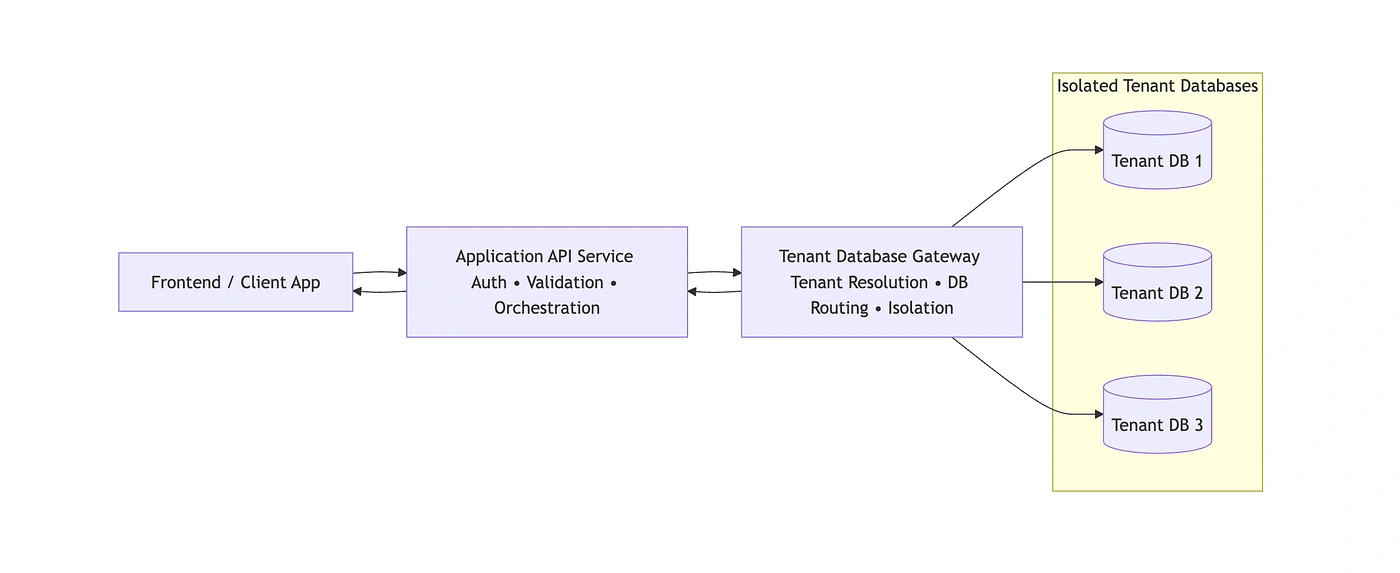
High-Level Design

The system is split into two conceptual layers:

  1. Core / Control Plane
    Manages tenant metadata and database connection details.
  2. Tenant-Aware Services
    Business services that dynamically connect to the correct tenant database per request.

Architecture Overview

Press enter or click to view image in full size

HLD — Tenant Isolation

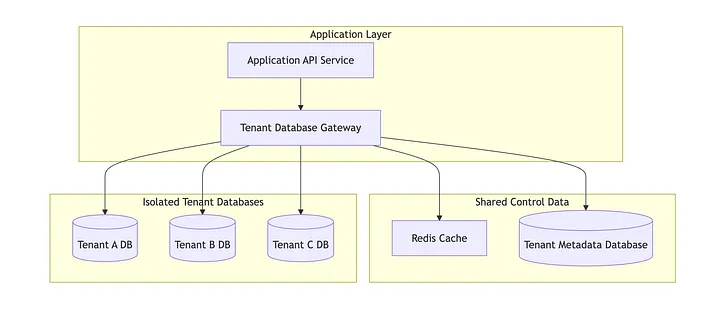
Tenant Metadata Management

The Core Service stores tenant configuration in a shared metadata store:

  • Tenant ID / Tenant Code
  • Database DSN
  • Pool size limits
  • Status (ACTIVE, SUSPENDED, DELETED)

This data is not tenant data; it is platform control data.

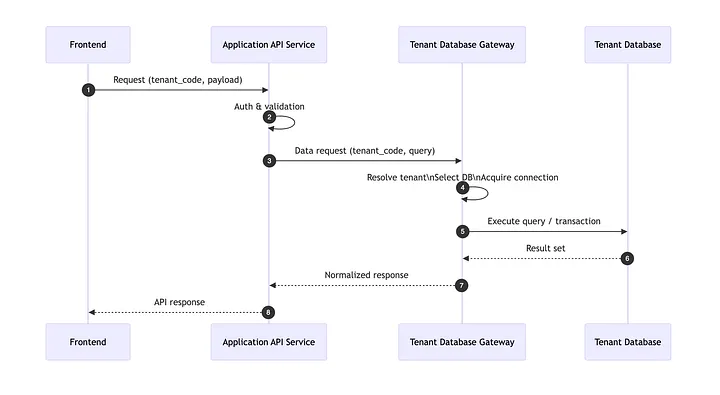
Request Flow

For every incoming request:

  1. Extract tenant_id or tenant_code
  2. Resolve tenant metadata from Core Service (cached)
  3. Fetch or initialize a database connection for that tenant
  4. Execute business logic against that database

Press enter or click to view image in full size

Request Flow

Connection Strategy

  • Connections are lazy-loaded per tenant
  • Cached in-memory using a map: tenantID → DB connection
  • Each tenant has a capped connection pool
  • Eviction policies (TTL / LRU) prevent runaway growth

This ensures:

  • Low latency for active tenants
  • Controlled resource usage
  • No cold-start storms

Database Layout

Each tenant database is structurally identical but physically isolated.

Press enter or click to view image in full size

Database Layout

Partitioning, indexing, and purging policies are applied inside each tenant database, not across tenants.

Managing the Isolated Database Paradigm at Scale

While a database-per-tenant architecture offers strong isolation guarantees, it also introduces operational challenges around schema migrations, resource management, tenant onboarding, and cross-tenant analytics. As the number of tenants grows, organizations often invest in automation tooling and specialized engineering expertise to manage infrastructure efficiently while preserving isolation boundaries. Partners such as ADA Global can help design scalable multi-tenant platforms, automate operational workflows, and build secure data pipelines without compromising tenant separation.

Conclusion

Database-per-tenant isolation is not the easiest path. It demands discipline in operations, migrations, and connection management.

But it buys something invaluable:

Architectural certainty.

  • Security is enforced by design, not convention
  • Failures are contained
  • Tenants are truly independent

For systems where trust, scale, and long-term maintainability matter more than initial simplicity, this model turns multi-tenancy from a risk into a strength.

The architecture does not rely on developers remembering rules.

It relies on the database refusing to break them.

Why This Was Done
Pros & Cons
How It Was Done
Conclusion
Get in touch

5 Benefits of One-Time Password for Business

5 Benefits of One-Time Password for Business
Post
Insights

5 Benefits of One-Time Password for Business

What Are One-Time Passwords (OTP)?

One-time passwords (OTPs) have emerged as a crucial tool in the world of digital security and authentication. In an era where data breaches and cyber threats are rising, businesses are turning to OTPs as a reliable means of protecting sensitive information and ensuring secure transactions.

In this article, we will delve into the world of OTPs, exploring what they are, how they work, and, most importantly, the substantial benefits of OTPs to businesses. So, let’s dive in and uncover the five significant advantages of OTP implementation in business!

What Are One-Time Passwords (OTP)?

One-time passwords, commonly called OTPs, are fundamental to modern digital security. These passwords serve as a dynamic and highly secure means of authentication in an increasingly interconnected world.

Unlike traditional static passwords, which remain unchanged until the user decides to modify them, OTPs are temporary and unique for each authentication attempt. They provide an additional layer of security by requiring users to enter a new code each time they log in or perform a transaction.

The core principle behind OTPs is their one-time usability. When a user initiates an authentication process, the system generates a unique OTP and sends it to the user through their registered mobile number, email address, or other designated channels. This OTP is valid for a brief duration, often just a few minutes, after which it becomes obsolete. Once used, the OTP cannot be employed again, making it exceptionally resilient to hacking attempts.

The dynamic nature of OTPs adds a significant level of security to various online activities, including logging into accounts, confirming financial transactions, and accessing sensitive information. By utilising OTPs, businesses can fortify their security measures and safeguard their digital assets against unauthorised access and cyber threats.

How Does OTP Work?

How Does OTP Work?

Understanding the inner workings of one-time passwords (OTPs) is essential to appreciating their role in enhancing security. The mechanism behind OTPs is ingenious and effective, making them a vital tool in digital authentication.

1. Generation of a Unique OTP

The OTP process begins when a user attempts to log in to an account or perform a transaction that requires authentication. At this point, the system generates a single-use OTP. This code is randomly generated and consists of a sequence of numbers or characters, making it highly unpredictable and challenging to guess.

2. Delivery to the User

Once generated, the OTP is delivered to the user through a secure channel. Common delivery methods include SMS messages, email messages, dedicated mobile apps, or even hardware tokens. The chosen method depends on the business’s security policies and user preferences.

3. Limited Validity Period

OTPs have a limited lifespan, typically lasting just a few minutes. This time constraint adds an extra layer of security because it means that even if an attacker intercepts the OTP, they have only a short window to use it before it becomes invalid.

4. User Authentication

To complete the authentication process, the user must enter the OTP received into the designated login or transaction page field. The system compares the entered OTP with the generated one and sends it to the user. If they match, the user is granted access or allowed to proceed with the transaction. If not, the authentication fails.

5. Single-Use Security

The defining feature of OTPs is that they are single-use. Once employed for authentication, an OTP cannot be used again. This characteristic makes OTPs extremely secure, as even if an attacker obtains a previously used OTP, it will be useless.

6. Protection Against Unauthorised Access

OTPs are highly effective in safeguarding accounts and transactions. Even if someone can acquire a user’s password or other login credentials, they still require the current OTP to gain access. This added layer of protection is instrumental in preventing unauthorised access to sensitive data.

In summary, the operation of OTPs revolves around generating unique, time-sensitive codes that are delivered to users for authentication. Their one-time use, limited validity period, and secure delivery methods make OTPs a formidable tool in the fight against cyber threats and unauthorised access. Businesses can employ OTPs to bolster security and provide their users with a reliable means of safeguarding their digital identities and transactions.

Benefits of OTP Implementation in Business

Benefits of OTP Implementation in Business

Implementing one-time passwords (OTPs) in a business environment offers a range of significant advantages that contribute to enhanced security, user experience, and compliance with data protection regulations. Let’s explore these benefits in detail:

1. Enhanced Security

One of the foremost benefits of OTP implementation is its enhanced security. Businesses can thwart many common security threats by requiring users to enter a unique OTP for each authentication attempt. Even if an attacker obtains a user’s password or login credentials, they still need the current OTP to gain access. This dynamic layer of security significantly reduces the risk of unauthorised access and data breaches.

2. Protection Against Phishing

OTPs are a formidable defence against phishing attacks, a prevalent tactic cybercriminals employ. Phishing attempts typically involve tricking individuals into revealing their passwords or sensitive information. With OTPs, the attacker would still require the OTP for access even if a user unknowingly divulges their login credentials. This added layer of security helps safeguard businesses and their customers against phishing threats.

3. Compliance with Regulations

In an era of stringent data protection regulations, businesses must demonstrate their commitment to safeguarding customer data. OTP implementation can aid in compliance with these regulations. By using OTPs for user authentication and transaction verification, companies can enhance data security and build customer trust, which contributes to an improved overall customer experience driven by better data management.

4. User-Friendly Authentication

While OTPs offer robust security, they are also user-friendly. Unlike complex password requirements that frustrate users, OTPs are typically short and easy to enter. This simplifies the authentication process, reducing the likelihood of forgotten passwords and the need for frequent password resets. A seamless user experience can enhance customer satisfaction and retention.

5. Cost-Effective Security

Implementing strong security measures can be costly, especially for smaller businesses. However, OTPs offer a cost-effective solution. They don’t require extensive infrastructure or expensive hardware. OTPs can be delivered through widely accessible channels such as SMS, email, or dedicated mobile apps, making them affordable for businesses of all sizes. This cost-effectiveness allows businesses to bolster their security without straining their budgets.

In conclusion, implementing one-time passwords (OTPs) is crucial to fortifying your business’s security infrastructure. The benefits of enhanced security, protection against phishing, regulatory compliance, user-friendly authentication, and cost-effectiveness make OTPs a compelling choice.

Leverage WhatsApp Business Solution with ADA Asia

Leverage WhatsApp Business Solution with ADA Asia

As you look to embrace this cutting-edge security solution, consider taking your customer experience to the next level with ADA’s WhatsApp Business Solutions. Connect more effectively with your customers on WhatsApp and elevate your customer experience by harnessing the power of WhatsApp chatbots.

With ADA, you can double agent productivity and boost sales conversions, all through the convenience of WhatsApp. Take advantage of this opportunity to enhance both security and customer engagement. Get started with ADA’s WhatsApp Business Solution today! Contact us to find out how our service can help you expand the capabilities of your business.

Frequently Asked Questions (FAQs) about Benefits of OTP

Frequently Asked Questions (FAQs) about Benefits of OTP

How Is OTP Used for Secure Payments?

In the realm of online and mobile payments, security is of paramount importance. One-time passwords (OTPs) have become a linchpin in ensuring secure financial transactions, offering a robust defence against fraud and unauthorised access. Let’s delve into how OTPs are effectively utilised to enhance the security of payments.

1. Initiating the Payment

When a customer initiates an online payment, whether for purchasing goods or services or conducting a financial transaction, the process begins as usual. They select the items they wish to purchase or specify the transaction details.

2. User Verification

When confirming the payment, the system prompts the user for an OTP. This OTP is sent to the user’s registered mobile number or email address, depending on their preference and the payment platform’s configuration.

3. Receiving the OTP

The user receives the OTP via the chosen delivery method, often as a text message (SMS) on their mobile phone. This OTP is unique and time-sensitive, adding a layer of security to the payment process.

4. Entering the OTP

To proceed with the payment, the user enters the OTP into the designated field on the payment page. This step ensures that the person making the payment is the account holder and has access to the registered contact information.

5. Authentication and Approval

The system verifies the entered OTP against the one it generated and sent to the user. If the OTPs match and are within the valid timeframe, the payment is authenticated, and the transaction is approved. The transaction is declined if a mismatch or the OTP has expired, safeguarding against unauthorised access.

6. Secure Completion

With a successfully authenticated OTP, the payment is securely processed. The user can confidently complete their purchase or financial transaction, knowing that the OTP has provided additional protection.

7. Single-Use Security

Importantly, the OTP used for the payment is single-use and cannot be used again. This means that even if a malicious actor obtains the OTP, it will be useless for future transactions, making OTP-based payments highly secure.

Using OTPs for secure payments significantly reduces the risk of fraudulent transactions. Even if an attacker can acquire the user’s payment details, they still require the OTP for each transaction sent directly to the user. This multi-factor authentication process adds a robust layer of security, giving businesses and customers peace of mind when conducting online and mobile payments.

What Are One-Time Passwords (OTP)?
How Does OTP Work?
Benefits of OTP Implementation in Business
Leverage WhatsApp Business Solution with ADA Asia
Frequently Asked Questions (FAQs) about Benefits of OTP

Role of Data Analytics in Social Media Marketing

Role of Data Analytics in Social Media Marketing
Post
Insights

Role of Data Analytics in Social Media Marketing

What is Data Analytics and How Is It Used in Social Media Marketing?

Data analytics has become an essential aspect of social media marketing. By using data analytics tools, businesses can gain insights into their audience’s behaviour and preferences, measure the success of their campaigns, and adjust their strategies accordingly. In this blog post, we will discuss some of the recommended strategies and tools for data analytics in social media marketing.

What is Data Analytics and How Is It Used in Social Media Marketing?

Data analytics refers to the process of collecting, processing, analysing, and interpreting data to extract valuable insights, patterns, and trends. It involves various techniques and tools to transform raw data into actionable information, enabling informed decision-making and improved business outcomes.

In the context of social media marketing, data analytics is used to gather and analyse data from social media channels to enhance marketing strategies. It helps marketers understand their audience’s demographics, behaviours, and preferences, allowing for the creation of targeted content and personalised advertising campaigns.

By tracking key metrics such as engagement rates, click-through rates, and conversion rates, you can measure the effectiveness of your campaigns, optimise ad spend, and improve your channel strategies through a well-defined media strategy that aligns targeting, channel selection, and performance optimisation.

How Data Analytics Can Help Social Media Marketing

How Data Analytics Can Help Social Media Marketing

Data analytics plays a pivotal role in social media marketing, helping businesses gather, interpret, and leverage data to enhance their social media strategies and achieve specific marketing goals. Here’s an in-depth look at the role of data analytics in social media marketing:

1. Audience Insights

Data analytics allows businesses to gain a deep understanding of their social media audience. By analysing demographic information, interests, behaviours, and engagement patterns, marketers can create detailed audience personas. These insights help in tailoring content, messaging, and ad targeting to resonate with specific segments of the audience.

2. Content Strategy

Data analytics aids in evaluating the performance of social media content. Marketers can track metrics like engagement rates, click-through rates, shares, and comments to identify what types of content are most effective. This information guides content creation and optimisation, ensuring that content aligns with audience preferences.

3. Posting Schedule Optimisation

Social media analytics provide insights into when your audience is most active. By analysing data on the best times to post, businesses can schedule content to maximise visibility and engagement. This strategy ensures that posts reach the right audience when they are most likely to be online.

4. Ad Performance

Social media advertising relies heavily on data analytics. Marketers can monitor ad campaigns in real time, tracking key metrics like click-through rates, conversion rates, and return on ad spend (ROAS). This data helps in optimising ad targeting, budget allocation, and creative elements to achieve the desired advertising goals.

5. Competitor Analysis

Data analytics enables businesses to assess their competitors’ social media performance. By comparing metrics like follower growth, engagement rates, and content strategies, marketers can identify opportunities and adjust their own strategies to stay competitive within their industry.

6. Customer Support and Engagement

Social media analytics tools help businesses monitor conversations about their brand and industry in real time. This allows for timely responses to customer inquiries, complaints, and feedback, enhancing customer support and engagement. Tracking sentiment analysis can also help gauge customer satisfaction.

7. Campaign ROI Measurement

Social media campaigns generate data that can be used to measure return on investment (ROI). By comparing campaign costs to the revenue generated or leads acquired, businesses can assess the effectiveness of their social media marketing efforts. This data-driven approach informs budget allocation for future campaigns.

8. Influencer Marketing

Data analytics assists in identifying and evaluating potential influencers for partnerships. Marketers can analyse an influencer’s audience demographics, engagement rates, and credibility to determine if they align with the brand’s target audience and values.

9. Trend Analysis

Social media analytics help businesses stay current with industry trends and consumer sentiment. By monitoring trending topics and hashtags, marketers can identify opportunities to participate in conversations, create relevant content, and engage with a wider audience.

10. A/B Testing

Data analytics allows for A/B testing of different social media strategies, from ad variations to post formats. Marketers can experiment with different elements and analyse the data to determine which strategies yield the best results.

In conclusion, data analytics is the backbone of effective social media marketing. It empowers businesses to make data-driven decisions, refine strategies, engage with audiences more effectively, and ultimately achieve their marketing objectives on social media platforms.

How to Use Social Media Analytics Effectively

How to Use Social Media Analytics Effectively

To be able to maximise the power of data analytics, you have to prepare your implementation strategy carefully. Here is a guide to implementing data analytics in social media marketing:

Strategy 1: Set goals and KPIs

Before starting any social media marketing campaign, it is crucial to define your goals and key performance indicators (KPIs). This will help you determine which metrics to track and how to measure the success of your campaign. Some of the common KPIs for social media marketing include engagement rates, click-through rates (CTR), and conversion rates.

Strategy 2: Monitor and Analyse your Social Media Metrics

Once you have set your goals and KPIs, it’s time to start monitoring and analysing your social media analytics. Social media platforms like Facebook, Twitter, and Instagram offer built-in analytics tools that allow you to track your metrics in real time. These tools provide you with valuable insights into your audience’s behaviours, such as the time they are most active on social media, the type of content they engage with, and their demographic information.

Strategy 3: Use Third-Party Analytics Tools

In addition to the built-in analytics tools offered by social media platforms, there are also several third-party analytics tools that can help you gain even more insights into your audience’s behaviour. Some popular third-party analytics tools for social media marketing include Hootsuite, Buffer, and Sprout Social.

These tools provide you with a comprehensive view of your social media metrics across multiple platforms, allowing you to track your KPIs more effectively. They also offer features such as social listening, which allows you to monitor mentions of your brand on social media and respond to customer feedback real time.

Strategy 4: A/B Testing

A/B testing involves testing two variations of the same campaign to see which one performs better. For example, you could test an aspect in your social visual, email, or website to find out the preferred angle or tone. The aspect could be either the subject line, image used, call to action, or even the content to see which one generates more clicks or conversions.

A/B testing allows you to optimise your campaigns for better performance, and it can also help you identify which elements of your campaigns resonate most with your audience. Furthermore, it allows you to make the necessary improvements to boost engagement, cut down bounce rates, and enhance conversion rates. To perform A/B testing, there are various free and paid tools that you could use, such as HubSpot, Google Optimize, Optimizely, and more.

Strategy 5: Offline Tracking

Another metric you could track is the footfall of your outlets or competitors’ outlets. At ADA, we help clients to track footfall by means of geofencing desired points of interest (POI) or outlets and monitor footfall trend month-on-month via IFA (identifier for advertisers) in smartphones. For post campaigns, besides tracking engagement, CTR, and conversion online, it is an added advantage to be able to track offline footfalls, in comparison to footfall and cross-visitation of competitors’ outlets.

For instance, we worked with an oil & gas client to monitor footfall at petrol stations in Malaysia. To measure post campaigns performance, we mapped out campaign periods (including client’s and competitor’s campaigns) and found out who the visitors were, which petrol brands they supported, and when they visited them. Combining online and offline tracking enables our client to gain better insights and make impactful strategies to drive growth.

Social Media Analytics Metrics You Need to Pay Attention

Social Media Analytics Metrics You Need to Pay Attention

The use of analytical data would be incomplete without a specific focus. In this case, you must determine what metrics you want to measure in your social media marketing campaign.

You don’t have to measure all the metrics described, but most of them are commonly used to measure social media marketing success.

Here are some of the metrics that you can look into:

1. Engagement Rate

Engagement rate is the level of interaction your content receives from your audience such as likes, comments, and shares. A high engagement rate indicates that your content is resonating with your audience, fostering community, and encouraging interaction.

2. Click-Through Rate (CTR)

CTR is the percentage of people who click on a link or CTA in your post. It is a crucial metric for evaluating the effectiveness of your content in driving traffic to your website or landing page. A higher CTR often indicates compelling content and effective call-to-action strategies.

3. Conversion Rate

Conversion rate tracks the percentage of users who complete a desired action, such as making a purchase, signing up for a newsletter, or downloading an ebook after clicking on a social media post or ad. It directly reflects the impact of your social media marketing on lead generation and sales.

4. Reach and Impressions

Reach represents the total number of unique users who have seen your content, while impressions measure the total number of times your content has been displayed. Monitoring these metrics helps you gauge the visibility and exposure of your posts and campaigns.

5. Follower Growth

Tracking the growth of your social media followers over time is essential for assessing your brand’s online presence. Steady growth can indicate that your content and engagement strategies are resonating with your target audience.

6. Social Share of Voice (SOV)

SOV measures your brand’s presence and influence compared to competitors within your industry or niche. Analysing your SOV helps you understand your market share on social media platforms and identify opportunities for growth.

7. Social Media Sentiment

Sentiment analysis evaluates the tone and sentiment of social media mentions related to your brand. It helps you gauge public perception and identify areas that may require reputation management or improvement in your social media strategies.

8. Share of Traffic and Leads

Monitoring the percentage of website traffic and leads generated from social media channels provides insights into the contribution of social media to your overall marketing efforts. It helps you allocate resources effectively and prioritise social media platforms.

By regularly monitoring and analysing these relevant metrics, social media marketers can refine their strategies, allocate resources effectively, and drive better results in their campaigns. These metrics provide valuable insights into the customer journey, brand perception, and the overall impact of social media marketing efforts on business objectives.

Make Informed Business Decisions with Data Analytics

Make Informed Business Decisions with Data Analytics

Data analytics is an essential aspect of social media marketing that can help you gain insights into your audience’s behaviour and preferences, measure the success of your campaigns, and adjust your strategies accordingly. By using the strategies and tools discussed in this blog post, you can optimise your social media marketing campaigns for better performance and achieve your goals more effectively.

Leverage the power of data analytics and AI with ADA to gain deeper insights into your audience’s behavior and preferences. Measure the success of your social media campaigns and optimize your strategies for better performance and achieve your marketing goals. Contact us today to learn how we can help strengthen your social media marketing efforts.

What is Data Analytics and How Is It Used in Social Media Marketing?
How Data Analytics Can Help Social Media Marketing
How to Use Social Media Analytics Effectively
Social Media Analytics Metrics You Need to Pay Attention
Make Informed Business Decisions with Data Analytics

Predictive Analytics in Ecommerce: A Complete Guide 2026

Post
Insights

Predictive Analytics in Ecommerce: A Complete Guide 2026

Every year, ecommerce brands lose millions from stockouts and wasted discounts. What if you could predict what your customers want, months before they even know it themselves?

Predictive analytics has emerged as the compass that helps businesses anticipate what customers want, when they’ll want it, and how best to deliver it. This shift from reactive to proactive strategies is reshaping the industry. Where merchants once relied on historical data to explain what already happened, predictive analytics now uses AI-driven models to reveal what’s about to happen. That difference translates directly into sharper campaigns, optimised resources, and more satisfied customers.

In this article, we explore the models, applications, and future trends of predictive analytics in ecommerce, providing a practical guide for retailers aiming to achieve sustainable growth and digital transformation.

What is Predictive Analytics in Ecommerce?

At its core, predictive analytics applies data, statistical models, and machine learning to forecast outcomes and behaviours. Unlike descriptive analytics (which explains what happened), predictive analytics tells you what is likely to happen next and what you should do about it.

It works by combining structured data (trends such as sales records, pricing, and inventory levels) with unstructured signals (customer reviews, social sentiment, browsing behaviour). Together, these streams create foresight that drives everything from smarter promotions to optimised supply chains.

The explosion of big data from omnichannel shopping habits to real-time competitor signals simply means predictive analytics is no longer reserved for tech giants like Amazon or Netflix. Today, even mid-sized ecommerce brands can harness these tools to stay competitive.

Why Ecommerce Retailers Can’t Afford to Ignore Predictive Analytics

Relying on gut instinct or outdated systems is no longer viable in today’s hyper-competitive market. Predictive analytics empowers retailers to make faster, data-driven decisions that prevent costly mistakes and capture emerging opportunities in real time. The risks of sticking with legacy systems or intuition-driven planning are severe:

  • Overstocking and waste

Seasonal lines that don’t sell fast enough tie up working capital and end in heavy markdowns.

  • Stockouts and lost sales

Customers don’t forgive “out of stock” notices. Each missed sale erodes loyalty.

  • Inefficient promotions

Blind discounting inflates customer acquisition costs (CAC) without lifting retention.

  • Slow reaction times

By the time manual reports reveal a trend, competitors have already moved.

How Predictive Analytics Works: Key Models and Data Sources

To unlock the full potential of predictive analytics in eCommerce, it’s essential to understand the models and data that make it work. While the technical details can be complex, the practical takeaway is clear: the right models, powered by clean data, translate directly into smarter business decisions.

Key Models in Practice

  • Time-Series Forecasting

Models such as ARIMA, Prophet, or LSTM analyze historical sales patterns to anticipate seasonal peaks, promotional surges, or abrupt shifts in buying behavior.

  • Regression Models

These models extend beyond sales data, incorporating external variables such as competitor pricing, marketing campaign performance, and even weather conditions. The outcome is a holistic view of the factors driving demand and conversions.

  • Hierarchical Forecasting

Particularly valuable for retailers managing extensive SKU portfolios, this approach ensures that SKU-level predictions align with broader category-level objectives, maintaining both accuracy and strategic consistency.

Data Streams: Structured and Unstructured

Predictive analytics relies on two complementary data streams:

  • Structured Data

This includes quantifiable information such as sales history, pricing, promotions, and inventory levels. Structured data forms the backbone of demand forecasting and stock management.

  • Unstructured Data

Sources such as customer reviews, social media sentiment, influencer activity, and behavioral signals (e.g., browsing habits or cart abandonment) provide critical context. These insights reveal customer intent and shape purchasing decisions in ways structured data alone cannot capture.

Taken together, structured and unstructured data streams offer not only predictive forecasts but also the contextual “why” behind consumer behavior, enabling retailers to act with precision and confidence.

Putting Predictive Analytics into Practice

Understanding the theoretical foundations of predictive analytics is only the first step; the real value lies in its application across day-to-day eCommerce operations. The following use cases illustrate how predictive models can be embedded into core business processes to drive measurable outcomes.

1. Demand Forecasting

A fashion retailer uses LSTM time-series models to predict demand for seasonal collections. Instead of overstocking winter jackets, the brand aligns inventory levels with predicted spikes in colder regions, minimizing excess stock while meeting local demand.

2. Dynamic Pricing

An electronics store monitors competitor pricing and customer demand in real time. Predictive regression models adjust product prices daily, balancing profit margins with competitiveness. This enables the brand to capture sales during major promotional events such as Singles’ Day or Black Friday without eroding margins.

3. Personalised Recommendations

An online beauty brand uses session-based collaborative filtering to recommend products. If a customer browses moisturizers but leaves without purchasing, the system predicts purchase intent and later recommends a customised bundle (e.g., moisturizer and serum) via email. This strategy increases both conversion rates and average order value.

4. Churn Prevention

A subscription-based meal delivery service identifies customers at risk of cancellation by analyzing patterns such as reduced logins, skipped orders, or declining engagement. Predictive churn models trigger automated retention offers such as discounts or personalised meal plans before the customer makes the decision to leave.

5. Inventory Optimisation

A global marketplace predicts SKU-level demand across multiple regions. Hierarchical forecasting reconciles category-level predictions with local buying behavior, ensuring warehouses are stocked strategically. This reduces costly cross-border shipping and accelerates delivery times.

How Amazon Uses Predictive Analytics

Amazon faces one of the most complex forecasting challenges in the world, predicting demand across more than 400 million products. As Jenny Freshwater, Vice President of Traffic & Marketing Technology (and former VP of Forecasting), explains: “No amount of human brain power can forecast at that scale on a daily basis.” Traditional systems like manual logs or legacy computing software simply cannot handle this level of complexity.

During the Covid-19 pandemic, sales of toilet paper increased by 213%. While no model could have predicted the pandemic itself, Amazon’s forecasting systems adapted quickly to the new demand signals, helping the company restock efficiently and maintain customer trust during a critical moment.

By embedding predictive analytics into its workflows, Amazon has moved beyond reactive decision-making. The company consistently anticipates consumer needs, adjusts its inventory and supply chain strategies in real time, and sustains a competitive advantage by adapting faster than its rivals.

How Predictive Analytics Drives Sales and Improves Customer Experience

The power of predictive analytics lies in its ability to bridge two critical goals: boosting revenue and enhancing customer satisfaction.

On the sales side, predictive models optimize pricing strategies, improve demand forecasts, and increase conversion rates through more relevant product recommendations. By unifying data and applying AI forecasting, businesses can see powerful results. For example, ADA helped a global grocer achieve 136% ROI, a 15% forecast accuracy uplift, and significant revenue growth.

On the customer experience side, predictive analytics enables brands to move beyond generic interactions. Customers receive timely, personalised recommendations that reflect real-time preferences, while fulfilment becomes faster and more reliable through optimised inventory allocation. Churn prediction adds another layer of value, allowing businesses to intervene before customers disengage, ultimately strengthening loyalty and retention.

In essence, predictive analytics creates a win-win: businesses maximize efficiency and profitability, while customers enjoy a shopping experience that feels intuitive, personalised, and reliable.

Future Trends of Predictive Analytics in Ecommerce

  • Real-time AI-driven decision-making at scale

The next wave is predictive models embedded directly into operations.This allows continuous adjustments to pricing, campaigns, and inventory in real time. ADA’s Intelligent Commerce solution is a real example: it integrates predictive analytics across marketing, supply chain, and finance functions to deliver unified, actionable insights instantly.

  • Hyper-Personalisation

Personalisation is going deeper. Predictive models will stitch together data across web, mobile apps, social platforms, and offline touchpoints to offer consistent, context-aware recommendations. The emphasis is shifting from “what you might like” to “what you will want next, right now”, enabled by real-time inference and multi-channel orchestration.

  • Growth in Southeast Asia & Emerging Markets

Emerging markets like Southeast Asia will see accelerated adoption of predictive analytics due to growing eCommerce penetration and mobile-first consumers. As ADA Global’s 2025 insights highlight, the ability to translate raw customer signals into real-time actions is what will allow Southeast Asian retailers to compete on a global stage while staying hyper-relevant locally.

Conclusion: Predictive Analytics as the Growth Catalyst

Today, predictive analytics is no longer a nice-to-have, it is the backbone of competitive eCommerce. By turning historical and real-time data into foresight, businesses can anticipate demand, personalize customer experiences, optimize pricing, and streamline supply chains. The result is a shift from reactive decision-making to proactive, AI-driven growth strategies. Retailers who embrace predictive analytics will not only protect their margins but also unlock sustainable, scalable growth in an increasingly crowded digital marketplace.

At ADA, we partner with retailers to operationalise predictive analytics from demand forecasting to hyper-personalisation and real-time pricing. Our end-to-end data and AI ecosystem ensures predictions become business outcomes, not just numbers on a dashboard.

Contact the ADA team today to transform your eCommerce strategy with predictive insights that scale.

The Impacts of TikTok Shop on Traditional Retail

The impacts of TikTok Shop on traditional retail
Post
Insights

The Impacts of TikTok Shop on Traditional Retail

The Impact of Ecommerce on Traditional Retailers

You heard it right, we’re not here to talk about Kesha’s viral debut single, TiK ToK but the burgeoning social media app by ByteDance that has taken the commerce industry by storm – TikTok.

In recent years, TikTok has emerged as one of the most prominent social media platforms, especially among younger generations. Owing to its concise video format and the predisposition to spark viral trends, it has evolved into a nucleus for entertainment, education, and purchases. However, in addition to its social and cultural impact, TikTok is also transforming the eCommerce landscape, posing a challenge to traditional retail models. In this blog post, we will explore the impact of TikTok eCommerce on traditional retail, and how this trend is reshaping the way we shop.

In August 2021, TikTok launched its own eCommerce feature. Also known as TikTok Shop, creators can add links to products in their videos. Users can now purchase products directly from TikTok without having to leave the app. This has opened a new world of opportunities for businesses and influencers, who can now monetise their TikTok content and generate sales in real-time. In fact, many businesses are now using TikTok as a marketing tool to reach new audiences, showcase their products, and drive traffic to their eCommerce sites. With more than 1 billion active users worldwide, TikTok has joined Meta in becoming a significant player in social commerce.

  • The impact of ecommerce on traditional retailers
  • Challenges of TikTok Shop
active users on TikTok in the Southeast Asia region

Over billions of active users on TikTok in the Southeast Asia region in the past six months
Source: data.ai

The Impact of Ecommerce on Traditional Retailers

There is no doubt that ecommerce platforms, such as TikTok shop, have a huge influence on traditional retailers.

Ecommerce has massively changed the way people go from finding products to transacting. Here are some of the impacts of ecommerce on traditional retail that business owners should understand:

1. Disruption of traditional retail models

In the past, retail was dominated by physical stores, which relied on having on-site locations and traditional advertising methods to attract customers. However, with the rise of eCommerce, more and more customers are turning to online shopping, andthis trend has only accelerated with the COVID-19 pandemic.

TikTok eCommerce takes this one step further, by allowing customers to purchase products directly from the app in the comfort of their homes. This has posed a significant challenge to traditional retailers, who now must compete with the convenience and accessibility of TikTok eCommerce.

For example, a customer may see a product they like on TikTok and decide to buy it on the spot, rather than waiting to visit a physical store or searching for the product online. If businesses do not have a strong online presence or use trending social media platforms like TikTok, they are at risk of losing out on potential high-value customers.

2. Establishment of new business models and revenue streams

TikTok is created based on the concept of social sharing, whereby users create and share content with their followers. This aspect has fostered the advent of a new type of influencer – TikTok influencer. Such influencers amass a vast following and thus, have the power to influence their followers’ buying decisions.

Many businesses are now partnering with influencers and creators on TikTok, who can promote their products to their followers and drive sales. This has led to the emergence of a new type of eCommerce, known as “influencer commerce”, which leverages the power of social media to drive sales. In fact, many influencers are now becoming entrepreneurs, by launching their own eCommerce businesses and using TikTok as a marketing tool.

3. Increased relevance of content recommendations

The algorithm of TikTok is designed to feed users with content that resonates with them. This spell out the advantage that businesses and influencers should make use of by creating engaging and relevant content so that they have a higher chance of reaching a wider audience. This spearheaded the materialisation of new trends, such as the unboxing of product videos, that have become popular among users.

Although the unboxing trend started in the early 2000s on YouTube, they’re mostly centred around gaming and electronic items. Nonetheless, this trend is resuming its popularity, especially for luxury goods because it is now being leveraged by a new generation of TikTok creators. In fact, this #unboxing hashtag has garnered 44.3 billion views on TikTok since 2018. Here’s a tip for luxury and fashion brands: ensure the legitimacy of your merchandise unboxing in your video so that you can attract the younger generation of consumers!

4. Options to compare product

If people used to do window shopping by walking from one store to another, then the advent of ecommerce such as TikTok Shop has changed that.

Besides being able to make transactions online, consumers now have the convenience of doing product comparisons online through modern eCommerce marketing strategies that optimise customer experience and decision-making journeys.

In addition to comparing product types or quality, consumers can now also compare product prices very easily.

All this convenience will certainly have an impact on physical visits to retail stores because all the information that consumers need is almost all available online.

5. Demand for faster shipping

The advent of online shopping has created a new need for speedy delivery. Companies must adapt by changing their supply chain strategies to accommodate these consumer needs.

This change in strategy also creates new logistics and fulfilment challenges for traditional retailers. For example, studies show that many online consumers want their goods to arrive in no more than 2 days. While the majority of consumers say they will not shop at a place where deliveries are delayed up to 3 times.

6. 24/7 Availability

One of the biggest impacts of ecommerce on mortar and brick stores is probably 24/7 availability. Ecommerce platforms, such as TikTok Shop, allow stores to be open for a full day. The presence of technologies like Chatbot can also help stores to serve customers when human agents are not available.

Traditional retail stores may be able to stay open for a whole day, but it will definitely have an impact on operational costs as it requires more people to split the work shifts.

Challenges of TikTok Shop

Challenges of TikTok Shop

Despite the positive influence on businesses and consumers, it is important to note that TikTok Shop is not insusceptible to challenges.

1. Trust and Authenticity

With so many businesses and influencers promoting products on TikTok, it can be difficult for customers to ascertain the authenticity of the products that are being promoted or sold. This has led to an upswing of fake products and scams on the platform, undermining customer trust and damaging the reputation of businesses and creators.

2. Limited Audience Targeting

While TikTok has a massive user base, it may not be the best platform for targeting specific audiences. For example, if you are selling products that are primarily targeted towards older adults like Baby Boomers and Gen X, TikTok may not be the best platform to reach them as the app primarily targets audiences that are much younger such as millennials and Gen Zs.

3. Competing with Influencers

TikTok is a platform that is dominated by influencers, and they often have a lot of influence over their followers’ purchasing decisions. As a result, it can be challenging for a retail business on TikTok to compete with them without having other influencers promote your brand on their platform.

4. Relatively High Content Creation Cost

TikTok is a platform that relies on video. The cost of creating a video itself is relatively higher than the cost of creating other types of content, such as articles on a website or images on social media like Instagram. The need to post regularly can also make TikTok’s content creation costs even higher.

Therefore, businesses that still have a relatively low marketing budget may find it difficult to sell on TikTok.

Leverage TikTok Shop to Elevate Your Business to the Next Level

Leverage TikTok Shop to Elevate Your Business to the Next Level

The emergence of TikTok eCommerce has transformed the shopping experience of consumers and posed a challenge to traditional retail models. Its potential to disrupt conventional retail and create new business models is both invigorating and tricky for businesses and influencers alike. Nevertheless, a judicious approach towards TikTok eCommerce is essential, with an emphasis on maintaining authenticity and reliability amongst businesses and creators to foster lasting customer relationships. As TikTok continues to grow in popularity, it is likely that its impact on eCommerce and retail will only continue to grow.

Curious about how you can leverage this social platform for your brand or business? Contact our eCommerce growth experts today.

The Impact of Ecommerce on Traditional Retailers
Challenges of TikTok Shop
Leverage TikTok Shop to Elevate Your Business to the Next Level

How Customer Data Platforms (CDPs) Power Growth in the Retail Sector

Post
Insights

How Customer Data Platforms (CDPs) Power Growth in the Retail Sector

Have you ever wondered why, despite collecting vast amounts of customer data, your marketing campaigns still miss the mark?

You’re not alone. 44% of marketers say they struggle with fragmented data scattered across multiple databases, making it nearly impossible to deliver the kind of personalised experiences customers now expect. Many retailers struggle with fragmented information spread across various channels that prevents them from seeing a clear, unified picture of their customers. Without that single view, opportunities for stronger loyalty, smarter promotions, and more informed decision-making are often lost.

This is where a Customer Data Platform (CDP) comes in. A customer data platform for retail businesses solution centralises, unifies, and manages customer data from multiple sources to create comprehensive customer profiles. In the retail sector, it provides businesses with a complete view of their customers, enabling more targeted marketing, improved retention, and sustainable growth. By working with unified data, retailers can strengthen engagement and loyalty programmes while ensuring every interaction feels more relevant.

How CDPs Benefit the Retail Sector

Retailers today generate huge amounts of data from websites, mobile apps, loyalty schemes, email campaigns and in-store systems. Without a way to bring this data together, valuable insights remain hidden and customer experiences stay fragmented.

A retail CDP solves this challenge by serving as a central hub that gathers customer data from every online and offline touchpoint.  This includes online purchases, point-of-sale transactions, customer support interactions, social engagement and third-party sources. It then organises, cleans and unifies this information into individual customer profiles, and forms a unified customer view that serves as a reliable source of truth for marketing and engagement

With the rise of AI-driven personalisation and tighter privacy regulations, building this unified data foundation is no longer optional, it’s now the cornerstone of competitiveness. Retailers that embrace a unified retail data strategy through a modern, omnichannel-capable CDP can unlock richer insights, deliver consistent engagement across channels, and ensure compliance without sacrificing personalisation.

This process matters because it creates a single, accurate source of truth about each customer. Retailers can see patterns that would otherwise go unnoticed, such as repeat purchasing behaviour or signs that a customer may be about to leave. With this clarity, marketing and operations teams can plan actions based on real evidence rather than guesswork.

The benefits extend beyond marketing teams. Product managers gain a clearer view of demand trends, helping them choose which products to stock or promote. Customer service teams can personalise support by accessing a customer’s complete history. Senior decision-makers can forecast more accurately and allocate budgets more effectively.

In short, a Customer Data Platform for retail businesses doesn’t just store data, it transforms scattered information into actionable intelligence. This unified approach allows retailers to deliver more relevant offers, strengthen loyalty programmes, reduce churn and make smarter operational decisions across the business.

Overcoming CDP Implementation Challenges in Retail 

Even with the right strategy, implementing a CDP e-commerce solution can be challenging when deeper organisational silos exist. Data is often scattered across regions, systems, and teams, the result of years of growth without clear integration or governance. This leads to inconsistent data quality, duplicated records, and fragmented customer journeys that limit the effectiveness of the CDP solution.

Technology alone cannot fix data silos. The real issue often lies in alignment between marketing, IT, and operations. A successful retail CDP strategy depends on collaboration and shared ownership of data governance, ensuring every department contributes to and benefits from a unified customer view.

When these problems are identified early, retailers can take proactive steps to address them before they affect performance. This may include setting clear data standards, developing a cross-department integration plan, and selecting a CDP service that can connect seamlessly to existing systems. Early action makes it far easier to ensure a smooth rollout and minimise disruption.

If the issues are discovered later, such as when campaigns begin to underperform or customers start receiving inconsistent messages, recovery is still possible. It typically involves a structured clean-up phase where data is audited, duplicate records are removed, and a phased integration approach is implemented. The key to long-term success is a strong data governance framework that aligns IT, marketing, and operations teams around a shared goal of delivering consistent, personalised experiences.

Regardless of timing, there are three essential steps to overcoming these challenges:

  • Choose a scalable CDP that supports multiple data sources.
  • Strengthen collaboration to improve accuracy and trust.
  • Enforce privacy and compliance to maintain customer confidence.

Together, these steps represent retail CDP integration best practices that turn data challenges into strategic advantages.

Key CDP Use Cases in Retail

1. Personalised Marketing Campaigns

How it works: A CDP gathers purchase history, browsing behaviour and customer preferences from every channel and builds a unified profile for each shopper. This data allows marketing teams to craft messages, offers and promotions that directly match what individual customers are most likely to respond to.

Example: A fashion retailer can identify customers who frequently browse but rarely buy, then send them targeted discounts on the items they view most often. With AI-powered insights from CDPs”, these campaigns can also be automated and optimised in real time, improving conversion rates and reducing ad waste.

2. Omnichannel Customer Engagement

How it works: By combining data from physical stores, e-commerce sites, mobile apps and email, a CDP creates a consistent customer identity across all channels. This makes it possible to deliver the same message and level of service regardless of where the customer interacts.

Example: A homeware brand uses its CDP to recognise a customer who browses products online and then visits the store. Staff can instantly access the customer’s browsing history and recommend matching items in person, creating a seamless shopping experience.

3. Loyalty and Rewards Optimisation

How it works: A CDP analyses loyalty programme data alongside purchase behaviour and engagement patterns. This enables retailers to adjust reward tiers, timing and incentives based on what motivates each customer segment.

Example: A supermarket chain notices that a group of customers regularly buy premium products but rarely redeem loyalty points. By offering tailored double-point promotions on those items, it encourages repeat spending and deeper loyalty.

4. Product Recommendations and Upselling

How it works: Using real-time behavioural data, CDPs generate product suggestions linked to each customer’s purchase history and interests. These insights can be applied online, in email campaigns or even in-store via staff devices.

Example: An electronics retailer can automatically recommend compatible accessories after a customer buys a new phone. AI-enabled product recommendation engines with CDPs can refine suggestions with every interaction, maximising relevance and upsell opportunities.

5. Customer Segmentation for Targeted Offers

How it works: A CDP allows for dynamic segmentation by blending demographic, transactional and behavioural data. Retailers can quickly identify high-value groups, new customers or at-risk segments and address each with a specific marketing message.

Example: A beauty brand uses its CDP to create a segment of customers who purchased skincare products within the last three months. It then sends those customers a personalised trial offer for a new complementary product, resulting in higher take-up rates.

6. Reducing Churn with Predictive Analytics

How it works: Some CDPs include predictive models that flag customers likely to reduce their spending or leave entirely. Retailers can then take proactive measures to re-engage them.

Example: A subscription box company sees that a segment of customers has reduced their order frequency. With an AI-powered CDP, it automatically triggers a personalised offer to re-engage the group, improving retention and protecting revenue.

7. Inventory and Demand Planning Insights

How it works: By analysing aggregated purchase patterns and customer interest trends, a CDP can reveal which products are gaining or losing popularity. This helps retailers plan stock levels and forecast demand with greater accuracy.

Example: A sports retailer notices through its CDP that a new line of trainers is trending among a certain age group before sales peak. It increases orders in time to meet the surge in demand, reducing stockouts and lost sales.

Real-World Example: How Zalora Uses Data to Power Retail Success

A strong example from Southeast Asia is Zalora’s Southeast Asia Trender Report 2022. As one of the region’s leading online fashion retailers with over 59 million monthly visits, Zalora taps into extensive customer transaction and behavioural data collected through its platform. It uses these insights to help brands understand shifting preferences, purchase behaviour and emerging retail trends across diverse, mobile-first markets.

This data-driven approach powers hyper-personalisation, targeted marketing and accurate trend forecasting, illustrating how a unified view of customer data can drive better experiences and stronger results. The report is publicly available and offers a clear example of how Asian retailers are already using integrated data to transform marketing and customer engagement, even if they do not specifically refer to it as a CDP. For retailers seeking a customer data platform case study, it serves as a strong demonstration of what effective data integration can achieve.

As more Southeast Asian retailers adopt CDP frameworks, the competitive advantage will shift from access to insight, from who has data to who uses it best.

Mapping Out a CDP Strategy for Retail

Retailers that successfully embed a CDP into their operations often see transformational results. By moving from scattered, inconsistent information to a unified customer view, they are able to deliver experiences that feel personal at scale, strengthen loyalty programmes, and make smarter inventory and marketing decisions. In highly competitive markets, this capability can be the difference between incremental growth and a real step change in performance.

To achieve this, retailers need more than just the technology. They need a clear, deliberate strategy. A CDP is most effective when it is aligned with the business’s wider objectives and supported by consistent processes across departments. When implemented correctly, it becomes not only a source of customer insights but also a driver of operational efficiency and long-term value.

The most successful approaches typically follow four key steps:

  • Define clear goals linked to business priorities. Start by identifying what you want the CDP to achieve, such as increasing customer lifetime value, improving campaign effectiveness or gaining better demand forecasts. Goals provide a benchmark for measuring success.
  • Integrate customer data from all relevant sources. Bring together data from online and offline interactions, loyalty schemes, support channels and third-party sources. Make sure the data is accurate, complete and compliant with privacy regulations to ensure the insights are reliable.
  • Use insights to execute personalised campaigns and consistent engagement across channels. With a unified customer view, marketing teams can deliver offers and content that resonate, while customer service teams can provide informed support across every touchpoint.
  • Continuously measure results and refine tactics using real-time analytics. Monitoring outcomes allows you to adapt campaigns, optimise incentives and adjust operations to maintain impact over time.

Conclusion

Retailers that follow these steps can expect tangible benefits: higher conversion rates, stronger repeat purchase behaviour, more effective loyalty programmes and better demand planning. Over time, a CDP strategy can shift customer relationships from transactional to truly personalised, creating a competitive advantage that is difficult for others to replicate.

True transformation does not come from adding another system. It happens when data, people, and purpose work in alignment. Retailers that establish clear objectives, enforce strong data governance, and activate insights in real time will define the next era of customer experience.

The future of retail growth will belong to those who use better data and make it unified, governed, and AI-ready.


At ADA, our AI-Powered Customer Data Platform solutions help retailers integrate, govern and optimise their data so they can deliver measurable results from day one.

By taking this step now, retailers can move from fragmented data and missed opportunities to a future of stronger loyalty, higher growth and truly personalised customer experiences.

Get in touch with ADA today.

ADA and Opptra Partner to Bring Hasbro and Other Powerhouse Global Consumer Brands to Asia’s Ecommerce Market

Post
News

ADA and Opptra Partner to Bring Hasbro and Other Powerhouse Global Consumer Brands to Asia’s Ecommerce Market

ADA partners with Opptra to bring Hasbro and global brands into SEA’s ecommerce market, combining AI insights with regional expertise for scale. Learn more!

Singapore, 10 October 2025 – ADA, the leading independent Data and AI company and Asia’s largest integrated digital commerce player, has partnered with Opptra, a global commerce company enabling the expansion of leading consumer brands into Asia. The strategic collaboration has already brought Hasbro, one of the world’s most iconic toy and entertainment brands, into Southeast Asia’s fast-growing ecommerce market, with many more global powerhouse brands soon to follow, accelerating their digital-first growth across the region.

The collaboration unites ADA’s digital, data, and AI capabilities with Opptra’s portfolio of global brands and category expertise. As Southeast Asia’s digital economy continues its rapid rise this partnership creates a powerful bridge for international brands to tap into the region’s massive ecommerce opportunity.

Through the partnership, ADA will manage and operate flagship marketplace stores for Opptra’s global brand portfolio, providing a full suite of ecommerce growth services including digital store operations, AI-powered prediction for scale and efficiency, marketing, creative, and analytics solutions. The collaboration aims to go beyond growing brands’ presence across marketplaces, but also to lay the groundwork for direct-to-consumer and omnichannel expansion. Together, ADA and Opptra will onboard and grow leading global brands across key categories including toys, electronics, baby care, and general merchandise.

Southeast Asia is one of the world’s most exciting digital commerce frontiers,” said Srinivas Gattamneni, CEO at ADA.“ Our partnership with Opptra will bring global brands into the region’s digital marketplaces today, and in the long run, transform how they connect, sell, and grow through data, AI, and technology. Together, we’re building a foundation for sustained digital growth that extends beyond marketplace into direct-to-consumer, conversational AI, and next-generation customer experiences.”

At Opptra, we’ve always believed that global brands can win in Asia if they get two things right: understanding each market deeply and executing locally with precision,” said Ranjit Babu, CEO at Opptra, Electronics and General Merchandise.“ Partnering with ADA helps us do both, and at scale. Together, we can help brands reach millions of young, digital-first consumers across Southeast Asia quickly, efficiently, and with real impact.”

The partnership’s first milestone, bringing Hasbro into Southeast Asia, marks the beginning of a broader journey. With a strong pipeline of global brands across multiple categories, ADA and Opptra are set to expand their collaboration, deepening their role in shaping the region’s digital commerce and transformation landscape.

-End of Release-

About ADA

ADA is the data and AI company that designs, builds, and scales trusted AI-powered commerce experiences that drive measurable outcomes, combining AI Identity & Trust, AI-Powered Personalisation & Commerce, and AI-Ready Data Stack Enablement Solutions. Headquartered in Singapore and Malaysia, and operating across 14 markets with a 1,000-strong team serving 1,500 clients across Retail, CPG, BFSI, and more, ADA helps enterprises unlock value from data and transform marketing and commerce with data, AI, and technology.

Learn more: www.adaglobal.com

Media Relations
Klara Grintal
Chief Marketing Officer, ADA
klara.grintal@adaglobal.com

About Opptra

Opptra is an AI-native franchising and licensing partner dedicated to launching and scaling global brands across Asia. Founded with the backing of Binny Bansal, co-founder of Flipkart, Opptra blends deep domain expertise with advanced technology and a consolidated global supply chain. The company offers end-to-end capabilities including digital brand building, sourcing and manufacturing, and future-ready distribution. With an ecommerce-first approach and omnichannel technology, Opptra empowers brands to penetrate markets swiftly and efficiently.

Learn more: www.opptra.com

How to Use Customer Data Platforms (CDP) for Ecommerce Personalization

Post
Insights

How to Use Customer Data Platforms (CDP) for Ecommerce Personalization

Every ecommerce brand wants to make shopping feel personal,  yet few truly succeed. Despite investing in marketing, promotions and technology, customers are often met with generic offers, irrelevant emails and fragmented journeys. The result is lower engagement, reduced loyalty and lost revenue.

The truth is, most retailers don’t have a personalisation problem, they have a data problem. Personalisation fails when customer data lives in silos, updates slowly, or lacks the consistency needed to reflect real customer behaviour. Without a reliable data foundation, even the most advanced AI models or marketing automations can’t deliver the contextual relevance customers expect. This is where Customer Data Platforms (CDPs) come in. Rather than just another marketing tool, a CDP serves as the connective tissue powering intelligent commerce. It unifies customer information from every channel into a single, usable view, enabling brands to deliver targeted experiences that feel seamless, timely, and relevant. But personalisation is not just about sending the right email. It is about building trust, improving lifetime value and moving beyond one-size-fits-all campaigns.

But adopting a CDP isn’t just about technology; it’s about building the right data foundation to turn insight into action, and shifting from campaigns that speak to audiences, to conversations that speak to individuals.

Stages of Customer Data Maturity

Although all customer data solutions share the same ultimate goal of unifying and activating customer data, every retailer is at a different stage of data maturity.  The real question is: where is your organisation on its journey from data collection to data-driven personalisation? Broadly, customer data solutions can be viewed across four maturity stages with Customer Data Platforms (CDPs) sitting at the core bridging insight and activation

1. Data Integration Systems  – Building the Foundation 

These focus on collecting data from multiple sources such as websites, apps, CRM and loyalty systems, and merging them into a single customer profile. They are ideal for businesses that struggle with fragmented data and need a strong foundation before moving into analytics or campaigns.

2. Analytics-Driven Services – Turning Data into Insight

Once data is unified, analytics-driven services provide insights: who your customers are, what they want and what they are likely to do next. They excel at segmentation and predictive analytics, making them a good fit for retailers ready to optimise their targeting and forecast trends.

3. Campaign Execution Services – Turning Insight into Action

These are designed to act on insights in real time by triggering personalised marketing campaigns across email, SMS, apps and websites. They are perfect for brands focused on outreach, engagement and retention. But when built on incomplete data, they can do more harm than good by amplifying inconsistencies instead of relevance.

4. Enterprise-Grade Solutions – Scaling with Trust and Governance

For large retailers with complex needs, enterprise-grade systems offer scalability, robust security, advanced compliance features and deep integration with other business systems. They are suited for organisations managing millions of records across multiple geographies.

Each of these categories sits under the same umbrella of customer data solutions but solves a different problem. Choosing the right one depends on whether your priority is building the data foundation, gaining insights, activating campaigns or scaling securely. When selecting among top customer data platforms, knowing which category you need is critical.

Core Features That Power Ecommerce Customer Data Solutions

Behind every truly personalised shopping experience is a powerful data foundation, not just the right tools, but the right capabilities working together. These features work together to create the backbone of personalisation.

1. Identity Resolution – Building the Single Source of Truth

This capability recognises and merges data from multiple touchpoints such as mobile, desktop, in-store and email to build a single view of each customer. This “single customer view” is the backbone of personalisation. Without it, personalisation efforts remain fragmented and inaccurate.

2. Segmentation – From Demographics to Intent

Traditional segmentation stops at demographics; modern CDPs go deeper, grouping customers dynamically based on behaviour, purchase patterns and engagement signals. This makes campaigns more precise, such as targeting high-value customers with exclusive offers or sending timely reminders to lapsed shoppers.

3. Real-Time Data Processing – Keeping Personalisation Relevant

In today’s e-commerce landscape, relevance has a shelf life of seconds. Customer behaviour changes constantly. Real-time processing ensures that profiles are updated immediately, so the recommendations or offers a shopper sees today reflect their latest actions, not outdated information.

4. AI-Driven Recommendations – Turning Data into Experience

Machine learning is where insights become action. It analyses vast amounts of data to predict what customers might want next. This could be suggesting complementary products, personalising homepage content or recommending loyalty rewards likely to motivate purchase.

Together, these features turn raw information into actionable insights and automated personalisation at scale, a capability often associated with leading CDP platforms.

Applications of Customer Data Solutions in Ecommerce Personalisation

Once a strong data foundation is in place, the power of a Customer Data Platform (CDP) for ecommerce becomes tangible. Personalisation powered by customer data services can be applied across many areas of the online shopping experience. Here are some of the most common examples.

1. Personalised Product Recommendations

An online fashion retailer uses browsing history and past purchases to recommend outfits that complement items already in a customer’s basket. This increases average order value through cross-selling.

2. Dynamic Website and App Content

A beauty brand shows personalised banners on its homepage, promoting skincare routines based on a visitor’s previous purchases and preferences, creating a more relevant shopping journey.

3. Email and SMS Personalisation and Targeting

A pet supply store sends follow-up emails timed to when customers typically reorder dog food, boosting repeat purchases and retention.

4. Abandoned Cart Recovery with Tailored Offers

A home décor shop sends a discount code on the exact lamp a customer left in their cart, prompting them to complete the purchase.

5. Loyalty and Retention Campaigns Based on Behaviour

A subscription box service identifies its most active subscribers and offers them early access to new products, while also re-engaging at-risk customers with special renewal offers.

6. Lookalike Audience Building for Acquisition

A sports equipment retailer analyses its top customers’ profiles and then syncs these high-value segments to ad platforms, where algorithms identify similar prospects for targeting. This enables more efficient acquisition and mirrors a capability often supported by leading CDPs.

Across industries, brands applying these practices report higher order values, lower cart abandonment and stronger long-term customer loyalty.

Challenges and Best Practices When Implementing Customer Data Personalisation

Many retailers underestimate the complexity of personalisation. Ignoring the real challenges can lead to costly mistakes. Some of the most common pain points include:

1. Fragmented and Inconsistent Data

Retailers often underestimate how legacy systems quietly sabotage personalisation. Customer information is often spread across multiple systems such as e-commerce websites, mobile apps, CRM, email marketing and loyalty schemes. Without proper integration, data becomes duplicated, outdated or incomplete. This results in inaccurate profiles and ineffective targeting.

Principle: Data unification before activation. 

Every successful CDP implementation is built on the journey toward a single, trusted view of the customer. The one that consolidates, cleanses and governs data before it reaches any marketing layer.

2. Compliance and Privacy Risks

With regulations like GDPR and other data protection laws, collecting and using customer data incorrectly can lead to legal penalties and reputational damage. Many retailers lack clear processes for consent management and secure data handling.

Principle: Compliance is not a checklist, it’s a trust strategy. 

Retailers that integrate privacy by design, audit data flows regularly, and make consent management visible don’t just avoid risk; they build loyalty through integrity.

3. Siloed Teams and Poor Adoption

Marketing, IT and customer experience departments often work separately. This makes it difficult to share insights and coordinate campaigns. We often see brands rush to adopt advanced CDPs without first aligning on shared goals or KPIs, resulting in inconsistent execution and underused capabilities.

4. Slow or Outdated Data Processing

If customer data updates only once a day or once a week, recommendations and campaigns become irrelevant by the time they reach the customer. Real-time interactions require systems capable of instant updates.

Principle: Real-time intelligence drives real-time engagement.

Modern CDPs for ecommerce process updates instantly, allowing brands to react to intent as it happens, not after it fades.

5. Overly Complex Implementations

Jumping straight into enterprise-scale personalisation without a phased plan can overwhelm teams, delay results and waste budget.

Principle: Maturity is built in phases, not leaps.

Start with the use cases that bring visible impact such as abandoned cart recovery, replenishment reminders, or loyalty reactivation. Then scale into predictive and AI-driven personalisation as your data foundation strengthens.

With these practices in place, customer data personalisation moves from a difficult, risky undertaking to a powerful driver of growth and customer satisfaction.

Conclusion

Ecommerce personalisation isn’t just about knowing what to recommend next, it’s about knowing your customer well enough to act on that insight instantly and responsibly. That level of intelligence doesn’t come from more marketing tools, but from a stronger data foundation.

With a modern customer data solution for ecommerce, brands can turn fragmented data into a powerful engine for engagement, loyalty and growth.

Ecommerce personalisation succeeds when it’s built on a strong data foundation, not just more technology. The real advantage comes from data maturity: connecting strategy, infrastructure, and execution through a single, trusted view of the customer.

Forward-thinking retailers are already moving this way, using customer data strategies powered by AI to turn insight into real-time engagement.

At ADA, we help businesses build that foundation, from unifying data, ensuring governance, and activating intelligence across every channel. The result is scalable, AI-driven personalisation that turns every interaction into a moment of value.

11 CRM Implementation Challenges and How to Solve Them

11 CRM Implementation Challenges and How to Solve Them

Post
Insights

11 CRM Implementation Challenges and How to Solve Them

Why is CRM Implementation Important for Your Business?

Customer Relationship Management (CRM) implementation can be a game-changer for your business. It’s the bridge that connects you to your customers, enabling you to build lasting relationships and boost your bottom line. However, the path to successful CRM implementation is laden with challenges.

In this article, we will delve into the 11 CRM implementation challenges businesses often face and provide practical solutions to overcome them. By the end of this article, you’ll be well-equipped to take your CRM implementation to the next level.

Why is CRM Implementation Important for Your Business?

Before we dive into the challenges and solutions, it’s crucial to understand the significance of CRM implementation for your business.

CRM implementation is essential for several reasons:

  • Customer insight: CRM systems provide valuable insights into customers’ behaviour, preferences, and needs. This data empowers you to tailor your products and services to meet customer demands effectively.
  • Efficient communication: CRM allows for efficient communication with customers, ensuring they receive the right messages at the right time. This personalisation leads to higher customer satisfaction and loyalty.
  • Sales and marketing alignment: A well-implemented CRM system bridges the gap between your sales and marketing teams. This alignment ensures that your sales efforts are more targeted and effective.
  • Data centralisation: CRM consolidates customer data in one place, making it accessible to all relevant team members. This centralisation improves decision-making and customer service.
  • Increased productivity: Automation and streamlining of processes through CRM increase productivity. Your team can focus on high-value tasks, leading to cost savings and improved efficiency.

Now that we’ve established the importance of CRM implementation, let’s explore why some businesses fail in this endeavour.

Why Does CRM Implementation Not Working?

Why Does CRM Implementation Not Working?

CRM implementation can be a bumpy road, and there are several common reasons why it did not achieve the desired outcome:

  • Lack of clear objectives: Failing to define clear goals for your CRM implementation can lead to confusion and disarray. You must know what you want to achieve, whether it’s increasing sales, improving customer service, or enhancing marketing efforts.
  • Poor data quality: CRM relies heavily on data. Inaccurate or incomplete data can lead to incorrect decisions and poor customer experiences. It’s crucial to regularly clean and update your data to ensure its quality.
  • Resistance to change: People are often resistant to change. If your team is not on board with the new CRM system, its implementation will likely fail. Effective training and communication can help overcome this challenge.
  • Lack of user adoption: Even if your team is not resistant to change, they might not fully adopt the CRM system. This can happen if the system is too complex or lacks user-friendliness. It’s important to choose a CRM system that is easy to use and to train your team adequately.
  • Inadequate integration: Your CRM system should seamlessly integrate with your existing tools and systems. Inadequate integration can lead to inefficiencies and data silos.
  • Insufficient planning: Proper planning is essential for CRM implementation. Rushing into the process without adequate preparation can lead to costly mistakes and delays.
11 CRM Implementation Challenges and How to Overcome Them

11 CRM Implementation Challenges and How to Overcome Them

Now that we’ve identified the common reasons for CRM implementation failure, let’s delve into the 11 implementation challenges and how to overcome them.

1. Choosing the Right CRM Software

Selecting the appropriate CRM software is the cornerstone of a successful implementation. The wrong choice can lead to inefficiencies, increased costs, and user dissatisfaction.

To overcome this challenge, it’s crucial to conduct in-depth research, considering factors such as scalability, user-friendliness, integration capabilities, and alignment with your business needs.

2. Data Migration and Clean-Up

Transferring existing data into the CRM system can be a daunting task. Inaccurate or incomplete data can lead to incorrect decisions and hinder effective customer relationship management.

To overcome this challenge, meticulous planning and data cleaning are necessary. Ensure data quality by updating and cleaning records before migration, and create a backup to prevent data loss.

3. Setting Clear Objectives

Unclear objectives can lead to confusion and disarray among team members. To overcome this challenge, it’s vital to define specific, measurable, and achievable objectives. Ensure that all team members understand these objectives and how they relate to their roles in the CRM system.

4. User Adoption

Getting your team on board with the new CRM system can be challenging, especially if there is resistance to change. To overcome this challenge, thorough training and ongoing support are essential.

Address any concerns or resistance from team members and ensure the CRM system is user-friendly, making it easier for your team to embrace the change.

5. Integration with Existing Systems

Inadequate integration with existing tools and systems can result in inefficiencies and data silos. To overcome this challenge, work closely with IT experts to ensure seamless integration. Test the integration thoroughly before full implementation to avoid potential issues.

6. Data Security

Data breaches can be disastrous, leading to a loss of customer trust and legal complications. To overcome this challenge, invest in robust data security measures. This should include encryption, access controls, and regular security audits to safeguard sensitive customer information.

7. Budget Constraints

Underestimating the cost of CRM implementation can hinder the process. To overcome this challenge, it’s crucial to identify all potential expenses, including software costs, training, and ongoing maintenance.

Create a realistic budget for these costs to prevent budget constraints from affecting your CRM project.

8. Analyse Customer Feedback

Ignoring customer feedback can result in poor customer experiences and hinder the success of your CRM implementation. To overcome this challenge, regularly gather and analyse customer feedback.

Use this input to make necessary improvements and adjustments to your CRM system, ensuring it remains customer-centric.

9. Provide Training and Support

Comprehensive training and ongoing support are essential for user satisfaction. To overcome this challenge, provide continuous training and support to ensure your team can effectively use the CRM system.

Address any issues promptly and maintain open lines of communication to enhance user confidence.

10. Proper Measurement and Analysis

Proper measurement and analysis are essential for tracking progress and making data-driven decisions. To overcome this challenge, establish key performance indicators (KPIs) and regularly assess the performance of your CRM system.

Make necessary adjustments based on the data collected, ensuring continuous improvement.

11. Resolving Technical Issues

Technical issues can arise during CRM implementation, leading to delays and disruptions. To overcome this challenge, have a dedicated IT support team or partner with a reliable IT service provider.

Their expertise can help swiftly address and resolve technical issues, minimising downtime and ensuring a smooth implementation.

Elevate Your CRM Implementation to the Next Level with ADA Asia

Elevate Your CRM Implementation to the Next Level with ADA Asia

To take your CRM implementation to the next level and experience the benefits of world-class customer relationship management, consider partnering with ADA Asia. Our CRM solutions are customisable to your business requirements.

We understand that every business is unique, and we’ll work closely with you to ensure our CRM system aligns with your goals and objectives. This level of customisation ensures that your CRM system is a perfect fit for your organisation, helping you maximise its potential.

We prioritise the integration of our CRM system with your existing tools and systems. This ensures that your CRM operates smoothly within your existing infrastructure, minimising any disruptions and data silos. Our technical experts will work with you to guarantee a seamless integration process.

Contact us to find out how our service can help you expand the capabilities of your business.

Frequently Asked Questions (FAQs) about CRM Implementation Challenges

Frequently Asked Questions (FAQs) about CRM Implementation Challenges

Common Challenges in Implementing a CRM System

Businesses often encounter several common challenges when implementing a CRM system. These include choosing the right CRM software that aligns with their needs and objectives, ensuring a smooth data migration process, setting clear and measurable goals for CRM implementation, and gaining user adoption, as employees may resist change.

Additionally, integrating the CRM system with existing tools and systems, safeguarding customer data through robust security measures, and managing the budget effectively is vital.

How to Ensure Data Security during CRM Implementation

Data security is a paramount concern during CRM implementation. To ensure the security of customer data, businesses must invest in robust measures.

This includes implementing encryption to protect data in transit and at rest, establishing strict access controls to limit data access to authorised personnel only, and conducting regular security audits to identify vulnerabilities.

Additionally, businesses should comply with relevant data protection regulations, such as GDPR in the UK, to safeguard customer information.

How to Effectively Measure the Success of CRM Implementation

Measuring the success of CRM implementation is essential for continuous improvement. To do so, businesses should establish key performance indicators (KPIs) that align with their objectives.

These KPIs may include metrics like customer acquisition cost, customer retention rates, sales growth, and customer satisfaction scores. Regularly tracking and analysing these KPIs provides valuable insights into the effectiveness of the CRM system.

Businesses should also encourage feedback from users and customers, making necessary adjustments based on their input.

CRM implementation is a critical step towards enhancing customer relationships and driving business growth. However, it comes with its share of challenges.

By choosing the right CRM software, focusing on data migration and clean-up, setting clear objectives, ensuring user adoption, integrating with existing systems, prioritising data security, and managing your budget effectively, you can overcome these challenges and make the most of your CRM system.

Don’t forget to stay customer-centric, regularly gather feedback, and invest in training and support. With the right approach, your CRM implementation can lead to improved customer relationships and increased profitability.

Why is CRM Implementation Important for Your Business?
Why Does CRM Implementation Not Working?
11 CRM Implementation Challenges and How to Overcome Them
Elevate Your CRM Implementation to the Next Level with ADA Asia
Frequently Asked Questions (FAQs) about CRM Implementation Challenges