
How AI Transforms Healthcare: Risk Prediction to Clean Claims

Post
Insights

How AI Transforms Healthcare: Risk Prediction to Clean Claims

What If AI Could Reshape Healthcare?

This is no longer science fiction, this is healthcare’s reality in Southeast Asia alone, healthcare spending is projected to soar from USD 420 billion in 2023 to USD 740 billion by 2030, while AI in healthcare SEA is expanding at over 30% annually. The opportunity is immense, but so is the challenge. This explosive growth means healthcare providers face a critical decision: scale AI responsibly, or risk wasted investments.

The real question is not whether AI can transform healthcare, but whether organisations have the strong healthcare data foundation required to unlock its potential. Without high-quality, well-governed data, even the most advanced AI solutions fall short, leaving efficiency gains and revenue opportunities unexploited.

The Visible Challenge: Why AI Falls Short in Healthcare

Every healthcare executive knows the pain: data scattered across hospitals, labs, insurers, and regulators creates a fragmented system where no single source tells the whole story.

For all the promise of AI, many healthcare organisations struggle to see consistent results. The issue is rarely the algorithms, it is the data behind them.

Today, patient information is trapped within fragmented ecosystems. Hospitals, diagnostic labs, insurers, and national health systems each hold parts of the puzzle, but rarely in a unified way.

On top of that, issues like incomplete records, inconsistencies, and duplicates make the data unreliable from the start

The outcome? Predictive models trained on weak data deliver unreliable insights, eroding clinical trust and stalling ROI. Instead of driving smarter decisions, whether in predicting patient risks or ensuring accurate claims, AI risks becoming another expensive, short-lived experiment. These are the very healthcare data challenges that must be solved before AI can deliver lasting impact.

What is predictive analytics in healthcare?

Predictive analytics in healthcare uses patient data and AI models to forecast outcomes,  from disease risk and hospital readmissions to treatment effectiveness and fraud detection.

Despite these challenges, leading healthcare organisations are showing how predictive analytics in healthcare is becoming the engine of modern care, creating measurable value across the system:

  1. Patient risk and deterioration prediction enables earlier intervention, reducing readmissions and optimising bed utilisation. For example, AI can analyse vital signs and lab results in real time to flag when a patient in recovery is at risk of sepsis or cardiac arrest. Clinicians can then act before the condition escalates, preventing an ICU transfer and keeping hospital beds available for others.
  2. Population health management identifies at-risk groups, allowing for preventive strategies that reduce treatment costs. For instance, predictive models can flag communities with rising diabetes or hypertension rates. Health systems can then launch targeted screening or lifestyle intervention programmes, catching conditions early and lowering the long-term burden on the system.
  3. Resource optimisation helps hospitals forecast demand, improving staffing and inventory efficiency. AI can use seasonal patterns and local event data to predict patient surges, such as seasonal events like haze-related respiratory surges common in Southeast Asia. Hospitals can then adjust their staffing schedules, stockpile ventilators and oxygen, and avoid the bottlenecks that often overwhelm emergency departments.
  4. Insurance risk assessment and clean claims improve risk scoring, tailor coverage plans, and strengthen fraud detection, reducing disputes and payment delays. For example, AI can cross-check claims data with patient records to ensure that procedures billed actually occurred, flagging suspicious patterns like duplicate submissions. This not only reduces fraud but also speeds up claims approval for genuine patients, improving trust between insurers, providers, and members.

Predictive analytics in healthcare is no longer a “nice-to-have”, it is now essential in healthcare. From preventing patient deterioration to processing clean claims, the value is clear. But these results are only possible with the right healthcare data foundation. The data must be unified across systems, governed for quality and compliance, and trusted by both clinicians and administrators. Without this, even the best predictive models cannot deliver reliable outcomes.

The Limitation of Predictive Analysis No One Talks About

Here lies the uncomfortable truth. Across Southeast Asia, healthcare organisations are pouring millions into AI tools without addressing the data problem first.

Take the example of predictive readmission models. If the patient records being fed into the model are incomplete or inconsistent, for instance, if a patient’s medication history is recorded in one system but missing from another, the algorithm will deliver flawed predictions. The result is that doctors lose trust in the tool, patients miss out on timely interventions, and hospitals fail to see the promised efficiency gains.

The same applies to insurance claims. Without proper governance, duplicate or misclassified records can create errors in risk scoring or flag false positives for fraud. Claims get delayed, disputes increase, and instead of saving money, insurers end up adding costs and frustrating customers.

The reason is simple: data governance is often an afterthought. Information stays scattered across different systems, creating errors and inconsistencies that weaken trust in AI results. And when the predictions don’t work, AI takes the blame. But the real problem isn’t the algorithm, it’s the poor-quality, unmanaged data it depends on.

Until this limitation is addressed, investments in AI will continue to under-deliver, and the technology itself risks being seen as overhyped and less impactful than it truly is.

The New Standard: A Data-First Strategy

To unlock predictive analytics at scale, healthcare organisations need to flip the approach. Rather than starting with AI, they must adopt a data-first strategy, and this is where ADA differentiates itself. Healthcare leaders are realising that AI success depends less on the algorithm and more on the foundation beneath it. ADA sees this foundation as four pillars: interoperability, governance, scalability, and security

  • Unified data pipelines create a single source of truth across hospitals, labs, insurers, and regulators.

  • Governance-first design ensures quality, compliance, and security are embedded from the outset.

  • Scalable architecture future-proofs operations for advanced AI, precision medicine, and even cross-border health exchanges.

  • Interoperability at the core enables seamless data sharing across fragmented systems and devices.

This is ADA’s strength. We deliver not just AI capabilities, but the end-to-end, governed healthcare data foundation that makes predictive healthcare possible, sustainable, and trusted.

Building the Data Foundation: From Patient 360 to Hospital Command Center

Before AI delivers on its promise, the real work is in bringing all the data together. At ADA we’ve designed two key platforms, the Hospital Command Center and Patient 360 via Data Accelerator that underpin our predictive and governance capabilities.

The Building Blocks: What Powers ADA’s Healthcare AI

  • Clinical Data: Admissions, discharges, readmissions; ER wait times and triage scores; diagnosis and treatment records.
  • Operational Data: Bed occupancy & availability; staff scheduling and workload; equipment and medicine stock usage.
  • Administrative Data: Financial performance metrics; resource utilisation; hospital-wide KPIs.
  • External Data Integration: Standards-based ingestion via HL7, FHIR and REST APIs connecting labs, pharmacies and national health records.

How does it all come together?

  • Canonical data models (CDMs) to unify structured and unstructured input: IoT sensors (patient monitoring), EMR systems, logs and clinical notes.
  • Governed, curated datasets for reliable healthcare KPIs and analytics-ready assets.
  • Real-time pipelines and dashboards that deliver a unified source of truth for clinical, operational and administrative users.

Turning Data Into Impact

  • For the Hospital Command Center, real-time dashboards monitor bed occupancy, staff capacity and discharge planning. Predictive intelligence flags patient inflow/outflow trends and readmission risk. Automation and resource optimisation lead to measurable operational efficiency gains.

  • For Patient 360 / Data Accelerator, providers gain one unified view of each patient across systems. Prebuilt pipelines accelerate time-to-value. Data quality and governance improve markedly. Analytics scale across both clinical and operational decision-making.

And Powering All Of This: AI Accelerators

  • Hospital Command Center platform: ML modules for readmission prediction, triage scoring, clinical decision support, resource optimisation; predictive analytics for ER wait-times and outcomes; automated data cleansing, validation and enrichment.

  • Data Accelerator: Upcoming AI/ML automation for source-to-CDM mapping, synthetic data generation for testing and demo use-cases; embedded governance and quality checks via canonical models and config-driven transformations.

With these data foundations firmly established, healthcare organisations are positioned to advance from predictive intelligence to the next phase of innovation. The integration of governed, interoperable, and analytics-ready datasets not only enables immediate operational and clinical gains but also creates the necessary infrastructure for emerging AI capabilities.

Generative AI: The Next Frontier

While predictive analytics in healthcare drives today’s gains, generative AI (GenAI) is rapidly emerging as the next frontier. A recent McKinsey survey found that 85% of healthcare leaders, from payers to health systems, are already exploring or implementing GenAI capabilities.

Key trends are shaping adoption:

  • Rapid implementation: Most organisations are moving beyond proofs of concept, progressing to real-world deployments. Early adopters are already seeing measurable impact, while laggards risk falling behind.

  • Partnerships over in-house builds: 61% of organisations are pursuing partnerships with vendors or hyperscalers, reflecting the complexity of building GenAI capabilities alone. Hyperscalers, in particular, bring critical expertise in data management and scale.

  • Focus on efficiency and engagement: Early GenAI use cases are streamlining administrative workflows, boosting clinical productivity, and improving patient engagement. These efficiencies create space for providers to focus on higher-value patient care.

  • Positive ROI: Among those who have implemented solutions, 64% report quantifiable positive returns, underscoring both the maturity and business case for GenAI in healthcare.

Still, the opportunities come with risks. Evolving regulations, compliance challenges, and internal capability gaps demand governed, interoperable, and value-driven strategies, the very areas where ADA’s data-first approach provides an advantage. With strong foundations, GenAI can move beyond back-office efficiencies into quality-of-care innovations that reshape patient experiences and define the future of healthcare AI.

The Future of Healthcare AI in Southeast Asia

The future of healthcare AI in Southeast Asia will not be defined by who adopts AI first, but by who builds the strongest data foundations. Those who invest today will lead in predictive care, precision medicine, and population health, delivering better outcomes for patients while improving efficiency and growth.

The stakes are clear: weak foundations lead to wasted AI spend, compliance gaps, and erosion of trust. Strong foundations, on the other hand, unlock scalable AI impact, governed and secure systems, and trusted adoption across clinicians and insurers.

The message is clear. The future of SEA healthcare depends on reliable, governed data foundations. And this is where ADA can help.

With our end-to-end solutions spanning data collection, organisation, analytics, and predictive as well as generative AI, we enable healthcare organisations to make informed decisions faster, reduce costs, and improve patient experiences. Contact ADA today to start building a data foundation your AI can truly trust.

Data-First AI in Healthcare: Unlocking Personalised Care

Post
Insights

Data-First AI in Healthcare: Unlocking Personalised Care

Healthcare stands at a turning point. The sector is under immense pressure to harness artificial intelligence (AI) not as a distant possibility, but as an urgent necessity. The familiar phrase rings true: AI will not replace doctors, but those who work effectively with AI will outpace those who do not. This reflects a profound shift where clinical expertise, supported by intelligent systems, becomes the benchmark of modern medicine. The rise of AI in healthcare in Southeast Asia exemplifies this transformation, but its success depends not on algorithms alone, but on a strong foundation of healthcare data governance and predictive analytics in healthcare.

The promise is immense. Globally, the healthcare AI market is projected to reach USD 200 billion by 2030 (Statista), with Southeast Asia among the fastest-growing regions for adoption. Yet, the real challenge is often overlooked: AI is only as effective as the data it relies on. Without a well-governed healthcare data foundation of accurate and reliable data, even the most advanced systems cannot deliver the improvements that healthcare so urgently requires.

Solving Data Silos in Healthcare Systems

The warning signs often appear before the root cause is understood. Healthcare providers may notice delays in diagnosis, inconsistencies in patient records, or inefficiencies in operations, yet struggle to identify why these issues persist. What sits beneath many of these challenges is not a lack of clinical expertise or medical technology, but the way data is managed, highlighting gaps in data maturity in healthcare.

In most healthcare organisations, data lives in silos:

  • Electronic Medical Records (EMRs)
  • Insurance claims
  • Connected medical devices
  • Imaging systems

Electronic Medical Records, insurance claims, connected medical devices, and imaging systems each hold valuable information, but they rarely communicate with one another. This fragmentation prevents clinicians from seeing the complete picture of a patient’s health, making decision-making slower and sometimes less accurate.

The impact is felt on multiple levels. Patients, who increasingly expect care tailored to their individual needs, can be left frustrated when their care providers only see partial information. For organisations, the risks are equally significant. Disconnected data increases the likelihood of fraud going undetected, regulatory requirements being missed, and resources being wasted on redundant or inefficient processes.

To meet modern expectations and deliver safe, effective, and personalised care, healthcare must address this challenge directly. The priority is not simply to collect more data, but to unify and govern it in a way that makes it accessible, reliable, and actionable across the entire system of care.

Predictive Analytics in Healthcare: From Data to Foresight

For many healthcare providers, the first wave of digital transformation has already taken place. Records have been digitised, and basic systems provide snapshots of recent information through visual summaries and reports. This represents progress, but it is also a limitation. Static dashboards are like looking in the rear-view mirror: they tell you what has already happened but cannot predict what lies ahead.

The next step is predictive analytics in healthcare.  This approach moves beyond describing the past to forecasting what is likely to happen in the future. By applying statistical models and machine learning techniques to unified data, predictive systems can highlight patterns that are invisible to the human eye and alert clinicians or administrators before an issue escalates.

The potential applications of predictive models in healthcare are far-reaching.

  • Identifying patients at risk of developing post-surgical complications, so care teams can intervene earlier and prevent costly readmissions

This shift from reactive care to proactive prevention is not optional; it is the natural evolution of healthcare in a data-driven world. Predictive analytics equips providers with foresight, helping them not only to improve patient outcomes but also to manage costs, reduce inefficiencies, and build trust with patients who expect care that is anticipatory rather than delayed.

Despite the clear benefits, adoption remains uneven. Many organisations still struggle with the technical and operational barriers of implementing predictive systems, such as integrating data across departments, ensuring its quality, and aligning staff to new ways of working. These challenges reflect a deeper issue: healthcare AI often suffers from “fragile AI”,  predictive systems trained on fragmented or low-quality data that cannot be trusted in critical settings.

This points to a deeper issue: if predictive analytics depends on trust, then healthcare must first solve the Data Trust Problem.

The Data Trust Problem in Healthcare AI

If predictive analytics depends on trust, what exactly is missing? The answer is the data trust problem. Healthcare data today is fragmented, inconsistent, and often unreliable, making it unfit for powering life-critical AI. Hospitals, labs, insurers, and regulators each hold pieces of the puzzle, but rarely in a unified, interoperable form. The result is that AI systems, no matter how advanced, inherit the weaknesses of the data they are trained on.

Build, Scale, and Automate

The promise of predictive analytics in healthcare cannot be realised without a stronger foundation. Many organisations have already seen the limitations of AI models that deliver inconsistent results or fail to reflect the realities of clinical practice. The issue is rarely the technology itself, but the quality and governance of the data it depends on.

Trust, therefore, is central to progress. Clinicians, patients, and regulators are right to demand clarity and reliability from AI-driven insights. This is why ADA frames healthcare’s AI journey through its Data Maturity Curve: Build, Scale, Automate.

This is where a new standard is taking shape, built on three essential stages: Build, Scale, and Automate.

  • Build: Consolidate and govern data across the ecosystem into a secure, trusted source of truth. This is the foundation stage, where ADA helps providers move from fragmented records to unified, reliable data.

  • Scale: With solid foundations, predictive analytics can be applied with confidence. At this stage, providers begin to uncover trends, forecast risks, and improve care quality. On the data maturity curve, this is the point where organisations evolve beyond basic reporting and optimisation into advanced, predictive systems — and ADA has guided many providers through this progression.

  • Automate: Once predictive systems are reliable, automation allows healthcare to achieve efficiency at scale. From fraud detection to personalised care plans, automation not only streamlines operations but also gives clinicians more time to focus on what matters most: patient care. ADA has been at the forefront of helping providers implement these intelligent automation services (the higher end of the data maturity curve) in ways that build long-term resilience.

Each stage builds on the one before it, forming a pathway that transforms data from a fragmented liability into an enabler of progress. This structured journey reflects the data maturity curve that many organisations now find themselves navigating. ADA’s leadership in guiding providers along this path shows how healthcare can advance towards a future where trustworthy data fuels predictive, proactive, and patient-centred care.

Conclusion

The path to better healthcare is no longer optional; it is essential. The next decade will not be about whether hospitals adopt AI, but about which health systems can turn their data into a trusted asset fast enough to keep pace with rising patient demand, stricter regulations, and cost pressures.

Organisations that move deliberately through the stages of Build, Scale, and Automate will not just improve efficiency, they will set the standard for predictive, patient-centred care in Southeast Asia’s rapidly evolving healthcare landscape.

The real future of AI in healthcare is not defined by breakthrough algorithms, but by the resilience of the data foundation beneath them. Those who invest early in trustworthy, governed data will unlock AI that is reliable, explainable, and future-proof, while those who hesitate risk building fragile systems that collapse under real-world pressure.

ADA is already helping healthcare providers turn disconnected data into a reliable foundation for smarter, more sustainable AI. To take the first step towards this new standard, get in touch with ADA today.

Top 4 CRM Models That Can Help You Boost Customer Loyalty

Top 4 CRM Models That Can Help You Boost Customer Loyalty
Post
Insights

Top 4 CRM Models That Can Help You Boost Customer Loyalty

Understanding CRM Model

Amidst fierce competition, businesses are seeking innovative approaches to bolster customer loyalty and drive profitability. Customer Relationship Management (CRM) has emerged as a crucial element in achieving these goals. In this article, we will explore the concept of CRM models and delve into the top four CRM models that can impact a company’s customer loyalty and profitability.

Understanding CRM Model

A CRM model is a structured framework that facilitates an organisation’s understanding of its customers and guides the implementation of strategies to manage and nurture customer relationships. It serves as a blueprint that outlines the processes, technologies, and methodologies necessary to acquire, retain, and grow a loyal customer base.

A well-designed CRM model enables companies to streamline customer interactions, provide personalised experiences, anticipate their needs, and resolve issues promptly. It empowers businesses to make data-driven decisions, leading to more efficient marketing campaigns, improved customer service, and increased customer satisfaction.

Companies should align their business objectives with customer-centric practices to implement a successful CRM model. This involves the integration of various departments, such as marketing, sales, and customer service to create a unified approach towards delivering exceptional customer experiences.

Top 4 CRM Models for Boosting Customer Loyalty and Profitability

Top 4 CRM Models for Boosting Customer Loyalty and Profitability

Let’s explore four of the most impactful CRM models that have proven to be effective in enhancing customer loyalty and driving profitability:

1. IDIC Model

The IDIC CRM model, proposed by Francis Buttle, stands for Identity, Differentiate, Interact, and Customise. This model focuses on understanding customers at a granular level and tailoring interactions to meet their needs.

  • Identify: The first step involves identifying and segmenting customers based on various criteria, such as demographics, preferences, and buying behaviour. This segmentation allows companies to create targeted marketing campaigns and personalised offers.
  • Differentiate: Once customers are identified, the next step is to differentiate them based on their value and potential for the business. Not all customers have the same significance, and this step helps prioritise resources to focus on high-value customers.
  • Interact: Interacting with customers is a critical aspect of the IDIC model. Companies must engage with their customers through multiple channels, such as social media, email, or phone, to build meaningful relationships and gather valuable feedback.
  • Customise: Lastly, the IDIC model emphasises the importance of customisation. Companies should tailor their products, services, and interactions to cater to individual customer preferences, enhancing customer satisfaction and loyalty.

2. QCI Model

The QCI model, which stands for Quick, Complete, and Informed, is a customer-focused CRM model that centres on rapid issue resolution and efficient customer service.

  • Quick: Customers expect prompt responses to queries and issues in today’s fast-paced world. The QCI model emphasises the need for quick issue resolution to enhance customer satisfaction and loyalty.
  • Complete: Resolving customer issues effectively requires providing comprehensive solutions. The QCI model encourages customer service representatives to address all aspects of a problem to prevent recurring issues and ensure complete customer satisfaction.
  • Informed: Customer service representatives should be well-informed and equipped with the knowledge to address customer inquiries accurately. This approach fosters confidence in the company’s capabilities and expertise.

3. Payne’s Five Process Model

The Five Process Model, developed by Adrian Payne, focuses on five core processes that contribute to effective CRM implementation:

  • Strategy development: This process involves defining the CRM strategy, aligning it with the overall business strategy, and setting clear objectives.
  • Value creation: The second process revolves around creating value for customers by understanding their needs and preferences and delivering products or services that fulfil those requirements.
  • Multichannel integration: Customers interact with companies through various touchpoints in today’s omnichannel world. The multichannel integration process ensures seamless and consistent experiences across all channels.
  • Performance assessment: Measuring the effectiveness of the CRM strategy is crucial. This process involves evaluating key performance indicators (KPIs) to monitor customer satisfaction and the overall success of CRM initiatives.
  • Information management: The final process focuses on managing customer data effectively. Accurate and accessible customer information allows companies to make informed decisions and improve their CRM efforts continually.

4. CRM Value Chain

The CRM Value Chain model draws inspiration from Michael Porter’s Value Chain concept and applies it to CRM processes. It consists of five primary stages:

  • Customer Portfolio Analysis: Customer Portfolio Analysis helps your sales and marketing teams identify the star performers, your most significant customers. It starts by gathering data on everyone and then calculates their value based on purchases, profitability, and loyalty. Finally, you group them based on value and relationship potential, prioritising resources for your star customers.
  • Build Customer Intimacy: After identifying your most significant customers, start building relationships with them as if you want to be their best friend. You gather deep insights into their needs, wants, and even pain points. Then, you personalise everything: special offers, communication, and even early access to new products. Anticipate their needs with proactive service and remember their preferences. Most importantly, listen actively and use their feedback to improve.
  • Build Your Network: This stage is beyond the technicalities of your CRM strategy. To be able to satisfy the needs of your most valuable customers, you will certainly need a lot of help, from suppliers, investors, technology experts, and others. The bottom line; you have to network with people relevant to your most valuable customers to be able to fulfil their needs and expectations.
  • Value Proposition Development: Once you know who your most valuable customers are and have built a network to fulfil their needs, it’s time for you and your network to work together to build a value proposition to attract potential customers similar to and retain your most valuable customers.
  • Managing Customer Relationship: The last step of this CRM model is to maintain a good relationship with the customer. The previous steps, from identifying to building a value proposition, are steps to build and initiate relationships with customers. In maintaining relationships with customers, make sure you stick to the values you hold and offer because the customers you have come to you because of those values.

In conclusion, a robust CRM model is essential for any company aiming to enhance customer loyalty and drive profitability. By implementing the right CRM model, businesses can gain valuable insights into their customers, deliver personalised experiences, and optimise their operations for maximum customer satisfaction.

The IDIC model emphasises personalised interactions, the QCI model focuses on efficient issue resolution, Payne’s Five Process Model provides a comprehensive approach to CRM implementation, and the CRM Value Chain streamlines customer-focused processes. Each model has unique strengths and can be tailored to suit specific business requirements.

When choosing a CRM model, companies should consider their objectives, resources, and customer base carefully. Moreover, successful CRM implementation requires commitment and collaboration across all departments to create a customer-centric culture that permeates the entire organisation.

By adopting a well-suited CRM model and aligning it with their business goals, companies can establish long-lasting customer relationships, foster loyalty, and drive sustainable profitability in today’s dynamic business landscape.

Discover All-in-One Marketing Technology Solutions for Your Business with ADA

Discover All-in-One Marketing Technology Solutions for Your Business with ADA

Customer Relationship Management (CRM) is crucial in understanding and managing customer interactions, enabling businesses to foster lasting relationships and drive growth. When combined with Full Funnel Marketing Management, companies can unlock powerful capabilities that propel their business to new heights of success.

Furthermore, companies can create a competitive advantage in today’s dynamic business landscape by comprehending customers better, delivering personalised experiences, and optimising marketing efforts through data-driven insights. ADA’s innovative CRM software and a customer-centric approach form a powerful duo that paves the way for sustainable business success. Contact us to learn more about how ADA’s all-inclusive marketing solutions can benefit the operations of your business.

Understanding CRM Model
Top 4 CRM Models for Boosting Customer Loyalty and Profitability
Discover All-in-One Marketing Technology Solutions for Your Business with ADA

7 Steps How to Choose Marketing Channels for Business

7 Steps How to Choose Marketing Channels for Business
Post
Insights

7 Steps How to Choose Marketing Channels for Business

Why Is Marketing Channel Strategy Important?

Choosing the right marketing channels for your business can be a game-changer. It’s not just about throwing darts at a board and hoping for the best. Instead, it requires careful consideration, strategic planning, and a deep understanding of your target audience. In this guide, we’ll walk you through seven crucial steps on how to choose marketing channels to help you navigate and make informed decisions that drive real results for your business.

Why Is Marketing Channel Strategy Important?

Marketing channel strategy is crucial for businesses because it determines how they reach and engage with their target audience. Here’s why it’s so important:

  • Audience Targeting: Different marketing channels attract different demographics and audiences. A well-defined channel strategy allows businesses to target their messaging to the right audience segments, increasing the chances of engagement and conversion.
  • Resource Allocation: Resources such as time, budget, and manpower are finite. A strategic approach to marketing channels helps businesses allocate these resources effectively, focusing on channels that offer the highest return on investment (ROI) and avoiding wasted efforts on channels that don’t resonate with their audience.
  • Brand Consistency: Consistency is key to building a strong brand identity. By carefully selecting and managing marketing channels, businesses can ensure that their messaging and brand storytelling remain consistent across all touchpoints, reinforcing brand recognition and trust among their audience.
  • Maximising Reach: Different channels have different reach potentials. A well-thought-out channel strategy allows businesses to maximise their reach by leveraging a mix of channels that collectively cover a broad spectrum of their target audience, ensuring that no potential customer goes unnoticed.
  • Adapting to Consumer Behaviour: Consumer behaviour is constantly evolving, especially in today’s digital age. A flexible channel strategy enables businesses to adapt to changing consumer preferences and trends, ensuring that they stay relevant and continue to meet their audience’s needs effectively.
Types of Marketing Channels for Business

Types of Marketing Channels for Business

Marketing channels are the pathways through which businesses connect with their target audience, promote their products, and drive sales. Here are some of the key types of marketing channels commonly used by businesses:

1. Social Media

Social media platforms such as Facebook, X, Instagram, and LinkedIn offer businesses the opportunity to engage directly with their audience. These platforms enable businesses to share content, run targeted ad campaigns, and leverage influencer partnerships to reach a broader audience.

Social media marketing is highly interactive, allowing real-time communication and fostering meaningful customer interactions.

2. Email Marketing

Despite the emergence of newer marketing channels, email marketing remains a reliable and cost-effective method to connect with customers. Businesses can use email marketing to nurture relationships, deliver promotions, and keep customers informed about new products and offers.

Email marketing allows for personalisation and segmentation, ensuring that messages are tailored to the recipient’s interests and preferences.

3. Content Marketing (Blogs, Articles)

Content marketing focuses on creating valuable and relevant content to attract and retain a target audience. Through blog posts, articles, videos, and infographics, businesses can showcase their expertise, educate their audience, and build brand credibility.

Content marketing also plays a crucial role in search engine optimisation (SEO), as high-quality content can improve website ranking and visibility.

4. Search Engine Optimisation (SEO)

SEO involves optimising a website’s content, structure, and meta-tags to improve its ranking on search engine result pages. By appearing higher in search results, businesses can increase their website’s visibility, attract organic traffic, and enhance brand exposure.

SEO is a cost-effective marketing channel that targets quality traffic and helps businesses compete effectively in the online marketplace.

5. Pay-Per-Click (PPC) Advertising

PPC advertising allows businesses to display ads on search engines or other websites and pay only when users click on the ad. Platforms such as Google Ads and Microsoft Advertising enable businesses to target specific audience segments and achieve immediate visibility.

PPC advertising provides quick results, precise targeting options, and easy measurement of campaign performance.

6. Direct Mail

Direct mail involves sending physical mail, such as letters, postcards, or catalogues, to targeted recipients. This marketing channel is highly personalised and tangible, making it effective for targeting specific geographic areas or demographics.

Direct mail campaigns can include personalised offers, loyalty programmes, or event invitations, helping businesses engage with customers offline.

7. TV

Television advertising remains a popular marketing channel for reaching a wide audience and building brand visibility. TV ads allow businesses to showcase their products or services to diverse demographics and leverage the power of visual storytelling.

While TV advertising can be expensive, it offers a wide reach and high impact, making it suitable for mass marketing campaigns.

These are just a few examples of the many marketing channels available to businesses. The key is to select the channels that best align with your business goals, target audience, and overall marketing strategy.

7 Crucial Steps on How To Choose Marketing Channels for Businesses

7 Crucial Steps on How To Choose Marketing Channels for Businesses

Choosing the right marketing channels for your business can significantly impact your overall success and growth. Here are seven crucial steps to help you navigate the process effectively:

1. Define Your Goals

Start by clearly defining your marketing goals. What do you aim to achieve with your marketing efforts? Whether it’s increasing brand awareness, driving website traffic, generating leads, or boosting sales, having specific and measurable goals will guide your channel selection process.

2. Know Your Audience

Understand your target audience inside out. Conduct thorough market research to identify their demographics, interests, preferences, and pain points. Knowing your audience intimately lets you choose marketing channels that resonate with them and effectively communicate your message.

3. Evaluate Channel Relevance

Not all marketing channels are created equal; what works for one business may not work for another. Evaluate the relevance of each channel to your target audience and business objectives. Consider factors such as reach, engagement potential, cost-effectiveness, and alignment with your brand values.

4. Conduct Competitive Analysis

Keep a close eye on your competitors and analyse their marketing strategies. Which channels are they using? Are they seeing success with certain platforms or tactics? While you don’t want to copy your competitors outright, their strategies can provide valuable insights into what works in your industry and where you should focus your efforts.

5. Test and Iterate

Don’t be afraid to experiment with different marketing channels and tactics. Set up small-scale tests to gauge the effectiveness of each channel and iterate based on the results. Monitor key metrics such as conversion rates, click-through rates, and return on investment (ROI) to identify which channels are delivering the best results for your business.

6. Create a Multi-Channel Strategy

Consider adopting a multi-channel marketing approach instead of putting all your eggs in one basket. Diversify your marketing efforts across multiple channels to reach a wider audience, mitigate risk, and maximise your chances of success. However, be mindful not to spread yourself too thin – focus on channels that align with your goals and resonate with your audience.

7. Monitor and Optimise Performance

Once you’ve selected your marketing channels and launched your campaigns, the work doesn’t stop there. Continuously monitor the performance of each channel and optimise your strategies based on real-time data and insights. Be prepared to pivot if certain channels underperform or if new opportunities arise.

By following these seven crucial steps, you can make informed decisions that drive tangible results for your business and ensure that your marketing efforts are strategic, effective, and aligned with your overall goals.

Choosing the right marketing channels for your business is not just about picking the most trendy options. It’s a strategic decision that requires careful consideration of your goals, target audience, and overall marketing strategy.

By following the seven crucial steps outlined in this guide – defining your goals, knowing your audience, evaluating channel relevance, conducting competitive analysis, testing and iterating, creating a multi-channel strategy, and monitoring and optimising performance, you can make informed decisions that drive tangible results for your business.

Remember that the marketing landscape is constantly evolving, and what works today may not work tomorrow. Stay agile, be willing to experiment, and adapt your strategies based on real-time data and insights. By continuously refining your approach and leveraging the right mix of marketing channels, you can maximise your reach, engagement, and ultimately, your success.

Elevate Your Marketing Performance on Various Marketing Channels with ADA

Elevate Your Marketing Performance on Various Marketing Channels with ADA

To maximise the performance of every marketing channel and achieve significant growth impact, your business needs more than just an understanding of how to choose them. You also need to ensure that each marketing channel continues to deliver the best results for your business. This is where ADA’s Performance Marketing Services come in.

We specialise in helping businesses elevate marketing performance across various channels. Whether it’s social media, email marketing, content marketing, SEO, PPC advertising, or any other channel, we have the expertise and technology to drive real results for your business.

Contact us today and learn more about ADA’s Performance Marketing Services and discover how we can help you maximise your marketing impact and achieve your business goals.

Why Is Marketing Channel Strategy Important?
Types of Marketing Channels for Business
7 Crucial Steps on How To Choose Marketing Channels for Businesses
Elevate Your Marketing Performance on Various Marketing Channels with ADA

9 Steps to Build and Maintain Customer Loyalty

9 Steps to Build and Maintain Customer Loyalty
Post
Insights

9 Steps to Build and Maintain Customer Loyalty

What is Customer Loyalty?

Acquiring new customers is undoubtedly important, especially in today’s competitive business landscape. However, equally, if not more crucial, is retaining the customers you already have. Customer loyalty is the lifeblood of any successful enterprise, as it ensures a steady revenue stream and amplifies your brand’s reputation through word-of-mouth marketing. So, the question arises: How can you maintain customer loyalty in an ever-evolving marketplace?

In this article, we’ll explore effective strategies to help you nurture and sustain customer loyalty, creating a solid foundation for long-term success. Whether you run a small business or a large corporation, this information can be applied to strengthen your customer relationships and boost your bottom line.

What is Customer Loyalty?

Customer loyalty refers to a customer’s willingness and inclination to consistently choose and support a particular brand, product, or service despite competing market alternatives. It represents customers’ deep-seated commitment and emotional attachment towards a business or brand.

Customer loyalty is not automatic and must be earned through consistently delivering high-quality products or services, exceptional customer experiences, and building trust. Loyalty programs, personalised marketing, excellent customer service, and a strong brand identity and storytelling strategy are approaches businesses use to cultivate and maintain customer loyalty.

Loyal customers are precious to businesses as they can significantly contribute to revenue, profitability, and sustainability. Furthermore, they can become brand advocates, actively promoting the brand and influencing others, which can lead to acquiring new customers.

What are The 5 Stages Of Customer Loyalty?

What are The 5 Stages Of Customer Loyalty?

Customer loyalty is a journey that unfolds in five distinct stages, each representing a crucial step in building lasting relationships with your customers. Let’s delve into these stages to understand the process of cultivating customer loyalty:

1. Reach

In the first stage, “Reach,” businesses aim to expand their brand’s visibility and attract potential customers. This involves creating awareness about your products or services through marketing efforts, advertising, social media presence, and content marketing. The goal is to reach a broad audience and capture their attention, making them aware of your brand’s existence and what it offers.

2. Acquisition

Once you’ve grabbed the attention of potential customers, the next stage is “Acquisition.” Here, the focus shifts to turning these prospects into actual customers. This involves engaging them further, providing valuable information, and convincing them to make their first purchase. Strategies like targeted advertising, compelling offers, and an optimised website can help convert interested prospects into paying customers.

3. Conversion

“Conversion” is the stage where a customer makes their initial purchase. It’s essential to ensure a smooth and positive buying experience, as this sets the tone for their future interactions with your brand. Offering exceptional customer service and delivering on your promises helps build trust and satisfaction.

4. Retention

Once a customer has made their first purchase, the goal shifts to “Retention.” This stage is all about keeping customers engaged and encouraging repeat business. You can achieve this by providing ongoing value, personalised recommendations, loyalty programs, and consistent communication. Happy and satisfied customers are more likely to return and continue their relationship with your brand.

5. Loyalty

The final stage, “Loyalty,” represents the pinnacle of customer relationships. At this point, customers make repeat purchases and become advocates for your brand. They actively promote your products or services, refer others, and remain loyal despite competition. Building and maintaining this level of loyalty involves consistently delivering outstanding experiences, listening to customer feedback, and nurturing a sense of community around your brand.

How to Build and Maintain Customer Loyalty?

How to Build and Maintain Customer Loyalty?

Building and maintaining customer loyalty is crucial for long-term business success. Here are seven key strategies to help you achieve this:

1. Build an Exceptional Customer Service Team

Building and maintaining customer loyalty is a long, difficult, but sometimes neglected part of business. To build and maintain customer loyalty, you need a team of specialists who understand what they need to do and are great at their job.

You can start by creating a playbook which contains a set of rules that your customer service team must follow to give exceptional customer service. It can include the things they should say when greeting customers, how they should handle a certain question, and who they need to reach to help them solve customers’ problems.

While accuracy is important, speed is also an integral part of exceptional customer service. Implement technologies, such as chatbot or utilise platforms such as WhatsApp to help your team manage customers’ questions and/or requests promptly.

2. Quality Products or Services

Consistently deliver high-quality products or services that meet or exceed customer expectations. Quality builds trust and encourages repeat business.

3. Personalisation

Tailor your marketing and interactions to existing customers preferences. Personalised experiences make customers feel valued and understood, fostering a stronger emotional connection.

4. Loyalty Programs

Implement loyalty programs that reward customers for their repeat business. Offer incentives like discounts, exclusive access, or points that can be redeemed for future purchases.

5. Regular Communication

Stay in touch with your customers through various channels, such as email newsletters, social media, and personalised offers. Keep them informed about new products, special promotions, and relevant content.

6. Feedback and Improvement

Encourage customer feedback and actively use it to improve. Show customers that their opinions matter and that you’re committed to enhancing their experience.

In collecting feedback, make sure you answer feedback from customers, even if it’s bad feedback.

By answering all the feedback that your customers give, you can show that your company really cares about customers and will continue to strive to make better products for them.

7. Consistent Branding

Maintain a strong and consistent brand identity that customers can recognise and trust. Consistency in branding helps build brand loyalty over time.

8. Partnering with Another Company

Partnering with another relevant company is a great way to cultivate customer loyalty. Partnering with other brands can help you deliver more value to customers and in the end increase customer satisfaction.

For example, if you own a laptop brand, partnering with keyboards, audio, or other relevant laptop accessories is a good way to deliver value to your business. You can bundle your product with another’s product to create a special offer for your customers.

You do not always have to partner with a for-profit company. You can, for example, do a partnership with a charity. Gen Z especially, has a strong preference for brands that do action for social good.

9. Utilise CRM Tools

Customer relationship management (CRM) tools can help your company to amplify the steps described above.

For example, you can identify your long-time customers and give them special gifts to celebrate their loyalty.

Then, data from CRM can help you personalise your communication. You can do things as simple as addressing customers by name, knowing when they open messages or emails from you, and determining the content you offer them according to where they are in the customer journey.

Why is Customer Loyalty Important?

Why is Customer Loyalty Important?

Customer loyalty is vital for businesses for several compelling reasons:

1. Revenue Growth

Loyal customers spend more and frequently purchase, contributing significantly to a company’s revenue. Their consistent business helps stabilise cash flow and can lead to long-term financial success.

2. Cost Efficiency

Acquiring new customers can be up to five times more expensive than retaining existing ones. Loyal customers require fewer marketing resources and lower acquisition costs, boosting profitability.

3. Word-of-Mouth Marketing

Loyal customers become brand advocates who recommend your products or services to friends and family. Positive word-of-mouth marketing can effectively attract new customers without additional marketing spend.

4. Resilience to Competition

Customers loyal to a brand are less likely to be swayed by competitive offers or promotions. They are more resistant to switching, providing a protective barrier against market competition.

5. Feedback and Improvement

Loyal customers are often willing to provide valuable feedback, helping a business identify areas for improvement. This feedback loop can lead to product enhancements and better customer experiences.

In summary, customer loyalty drives both short-term and long-term business success by increasing revenue, reducing costs, and fostering a positive brand reputation that attracts new customers. It’s a cornerstone of sustainable growth and profitability for any company.

To take your customer loyalty efforts to the next level and enhance your Customer Relationship Management (CRM), consider leveraging the services offered by ADA Asia. We specialise in optimising customer relationships and can help you create a strategy that fosters lasting customer loyalty. Don’t miss the opportunity to strengthen your business – explore ADA Asia’s services today and unlock the full potential of customer loyalty.

What is Customer Loyalty?
What are The 5 Stages Of Customer Loyalty?
How to Build and Maintain Customer Loyalty?
Why is Customer Loyalty Important?

10 Technologies to Help Your Marketing Effort

Post
Insights

10 Technologies to Help Your Marketing Effort

What is Marketing Technology?

In today’s rapidly evolving business landscape, staying ahead in the marketing world is not just about creativity and strategy but also about harnessing technology’s power. Integrating technology into marketing efforts has become a necessity rather than an option. We will explore the various technologies that support the marketing function and how they can significantly enhance your marketing efforts.

What is Marketing Technology?

Marketing technology, often called “MarTech,” encompasses various tools and platforms designed to streamline, automate, and improve marketing activities. These technologies aid businesses in understanding their target audience, optimising their marketing strategies, and ultimately driving better results.

What are the 8 Benefits of Using Marketing Technology?

What are the 8 Benefits of Using Marketing Technology?

Before we delve into the specific technologies, let’s first understand the significant advantages of incorporating marketing technology into your business:

1. Enhanced Customer Insights

Marketing technology allows businesses to collect, process, and analyse vast amounts of data related to customer behaviour, preferences, and demographics. This data allows companies to gain a deeper understanding of their target audience.

With enhanced customer insights, businesses can create more accurate buyer personas and tailor their marketing strategies accordingly. For example, knowing which products or content resonate most with specific customer segments enables businesses to deliver more relevant and personalised experiences.

2. Improved Customer Engagement

Marketing technology tools facilitate multi-channel customer communication, including email, social media, websites, and mobile apps. By leveraging these platforms, businesses can engage with their audience more effectively.

Personalisation and automation features allow for timely and relevant interactions, significantly enhancing customer engagement. When customers feel that a brand understands their needs and communicates accordingly, it fosters stronger relationships and increases customer loyalty.

3. Streamlined Marketing Operations

Marketing technology automates various marketing tasks and processes, reducing the manual workload for marketing teams. For example, email marketing automation can schedule and send emails, segment lists, and track responses without human intervention.

This streamlining of operations saves time and minimises the risk of errors. It allows marketing professionals to focus on strategic and creative aspects of their work, leading to more effective campaigns and better results.

4. Data-Driven Decision-Making

Marketing technology provides real-time data and analytics access, enabling businesses to make informed decisions swiftly. This data-driven approach helps optimise marketing strategies, as decisions can be based on concrete insights rather than guesswork.

For instance, analysing website traffic and conversion rates allows marketers to adjust their tactics, allocate resources effectively, and identify areas for improvement. Data-driven decision-making enhances agility and adaptability in a dynamic marketplace.

5. Cost Efficiency

By automating repetitive marketing tasks and optimising processes, marketing technology contributes to cost efficiency. Businesses can reduce operational costs related to manpower, resources, and time. For instance, automated email campaigns can reach a large audience without manual sending and tracking.

Cost savings can be reinvested into other marketing efforts or used to improve overall profitability. The result is a higher return on investment (ROI) from marketing initiatives.

6. Competitive Advantage

Staying up-to-date with the latest marketing technologies gives businesses a competitive edge. It allows them to adopt innovative strategies and tactics that outperform competitors relying on traditional marketing methods.

By leveraging the capabilities of marketing technology, companies can differentiate themselves in the market, attract a wider audience, and gain market share. This competitive advantage is essential in today’s fast-paced and digitally-driven business environment.

7. Scalability

Marketing technology solutions are designed to scale with the needs of startups or large enterprises. As a business grows, these tools can adapt to accommodate increased workloads, expanded customer bases, and evolving marketing strategies.

This scalability ensures that marketing efforts remain efficient and effective as the company expands, without a complete overhaul of marketing processes.

8. Measurable Results

Marketing technology provides robust analytics and reporting capabilities that enable businesses to track the performance of their marketing campaigns and initiatives. Key performance indicators (KPIs) can be monitored in real-time, allowing marketers to assess the success of their efforts.

Measurable results provide valuable insights into what works and doesn’t, facilitating continuous improvement. Businesses can adjust their strategies, allocate resources wisely, and make data-backed decisions to achieve better marketing outcomes.

10 Marketing Technologies That Every Company Must Know

10 Marketing Technologies That Every Company Must Know

Now that we understand the benefits, let’s explore ten essential marketing technologies that every business should be aware of:

1. Customer Relationship Management (CRM) Systems

CRM systems are software platforms designed to manage and streamline interactions with customers and potential customers. They enable businesses to store, track, and analyse customer data, including contact information, communication history, and purchase history.

CRM systems enhance customer relationships by providing a centralised view of customer interactions, helping businesses personalise communication and tailor their marketing strategies to individual needs.

2. Email Marketing Software

Email marketing software is a tool that facilitates the creation, delivery, and tracking of email campaigns. It allows businesses to send targeted emails to their subscribers, automate email sequences, and analyse the performance of email campaigns.

Email marketing is a powerful way to nurture leads, engage customers, and drive conversions by directly delivering relevant content and promotions to recipients’ inboxes.

3. Social Media Management Tools

Social media management tools assist businesses in scheduling, publishing, and monitoring content across various social media platforms. These tools simplify managing multiple social media accounts, enabling businesses to engage with their audience, respond to comments, and track social media performance metrics. Effective social media management enhances brand visibility and engagement.

4. Content Management Systems (CMS)

Content Management Systems (CMS) facilitate digital content creation, including the editing, and publishing of digital content, particularly on websites and blogs. Popular CMS platforms like WordPress and Drupal make it easy for businesses to manage their online content.

CMS systems allow for efficient content creation, editing, and organisation, enabling businesses to maintain fresh, engaging web content.

5. Search Engine Optimisation (SEO) Tools

SEO tools are essential for optimising online content to improve its visibility on search engines like Google. These tools help businesses analyse keywords, track rankings, and identify opportunities for improving website content and structure.

Effective SEO can increase organic traffic to a website, resulting in more qualified leads and potential customers.

6. Pay-Per-Click (PPC) Advertising Platforms

PPC advertising platforms like Google Ads and Bing Ads allow businesses to create targeted paid advertising campaigns. Advertisers pay a fee each time a user clicks on their ad.

PPC advertising allows for precise audience targeting, which is closely aligned with strategies such as location-based marketing that focus on reaching users based on geography.

7. Marketing Automation Software

Marketing automation software automates repetitive tasks and workflows, such as lead nurturing, email marketing, and customer segmentation. These tools enable businesses to deliver personalised content at the right time, score leads, and trigger automated responses based on customer behaviour.

Marketing automation increases efficiency and ensures that leads are effectively nurtured throughout the customer journey.

8. Analytics and Data Visualisation Tools

Analytics and data visualisation tools provide businesses with the means to collect, analyse, and present website and marketing performance data. Platforms like Google Analytics and Tableau offer insights into website traffic, user behaviour, and conversion rates.

Visualising data allows businesses to make informed decisions, optimise marketing strategies, and identify areas for improvement.

9. Chatbots and AI-Powered Customer Support

Chatbots and AI-powered customer support solutions use artificial intelligence to provide instant customer responses and support on websites and messaging platforms.

They can answer frequently asked questions, assist with product inquiries, and even complete transactions. These technologies enhance customer service by providing 24/7 support and freeing up human agents for more complex tasks.

10. Augmented Reality (AR) and Virtual Reality (VR)

Augmented Reality (AR) and Virtual Reality (VR) technologies are gaining traction in marketing. AR enhances the real-world environment with digital overlays, while VR creates immersive virtual experiences.

Businesses can use AR and VR for interactive product demonstrations, virtual store tours, and engaging marketing campaigns. These technologies provide unique and memorable experiences that captivate customers and drive brand engagement.

In conclusion, understanding and effectively utilising various technologies that support marketing is imperative for businesses in the digital age. The benefits are clear: enhanced customer insights, improved engagement, streamlined operations, data-driven decisions, cost efficiency, a competitive edge, scalability, and measurable results.

To remain competitive and relevant, businesses must embrace these technologies and stay open to ongoing advancements in the marketing technology landscape.

Build and Expand Your Brand Awareness with Full Funnel Marketing Management Services from ADA Global

Build and Expand Your Brand Awareness with Full Funnel Marketing Management Services from ADA Global

To harness your marketing technology and data-driven strategies to their full potential, consider partnering with experts like ADA Global. ADA Global specialises in Full Funnel Marketing Managements ervices, helping businesses build and expand brand awareness and marketing strategies through data-driven optimisation. By optimising operations, enhancing customer experiences, and driving business growth, we can empower your business to thrive in today’s digital marketplace.

Contact us to find out how our service can help you expand the capabilities of your business.

What is Marketing Technology?
What are the 8 Benefits of Using Marketing Technology?
10 Marketing Technologies That Every Company Must Know
Build and Expand Your Brand Awareness with Full Funnel Marketing Management Services from ADA Global

Telling your brand’s story: strategies for effective marketing

Telling your brand's story: strategies for effective marketing
Post
Insights

Telling your brand’s story: strategies for effective marketing

Identify your brand’s story

Storytelling has been a fundamental part of human communication since the beginning of time. While facts and figures may be informative, through stories, we have shared our experiences, passed down knowledge, and entertained each other. In recent years, storytelling has become increasingly important in marketing to connect with audiences on a deeper level.

At its core, marketing is about communication. Brands must communicate their value proposition, unique selling points, and brand identity to potential customers. However, in today’s world of constant advertising and information overload, it’s becoming harder and harder to cut through the noise and capture people’s attention. Here’s where storytelling comes in.

By telling a story, brands can create an emotional connection with their audience. Stories are more engaging and memorable than simple facts and figures. They can help to humanise a brand and make it more relatable. When a customer feels emotionally invested in a brand, they are more likely to trust it, recommend it, and become a loyal customer.

So, how can brands use storytelling to connect with their audience? Below are some tips:

Identify your brand’s story

Every brand has a story to tell. Your story should be authentic and unique, highlighting what makes your brand stand out from the competition. It could be the story of how the brand was founded, the story of a particular product or service, or the story of a customer who has been positively impacted by the brand. To tell this story, you should focus on creating interesting characters and a compelling plot to draw customers’ attention. Identify what makes your brand unique and compelling and use this as the basis for your storytelling. For example, the outdoor apparel brand Patagonia is known for its commitment to environmental sustainability. Their brand story focuses on their mission to protect the planet, and they frequently use storytelling to communicate this message. In their film “The Fisherman’s Son,” Patagonia tells the story of Ramón Navarro, a Chilean surfer who is fighting to protect the coastline from development. The film highlights Patagonia’s commitment to environmental conservation while also showcasing their products in action.

Use a narrative structure  

Use a narrative structure 

Every story has a beginning, middle, and end. Use this structure to create a narrative that takes your audience on a journey. Start with a problem or challenge that your audience can relate to, introduce your brand as the solution, and show how your product or service has made a positive impact on people’s lives. One example of a brand that does this well is Airbnb. In their “Belong Anywhere” campaign, Airbnb uses storytelling to show how their platform allows people to connect with each other and experience new cultures. In their video “Wall and Chain”, Airbnb tells the story of two musicians, one from Mexico and one from the United States, who meet through Airbnb and form a deep connection despite their different backgrounds. The video uses a narrative structure to draw the audience in and create an emotional connection with the brand.

Be authentic

Be authentic 

Authenticity is critical when it comes to storytelling. People can tell when a brand is being disingenuous. Your story should be true to your brand and your values. Don’t try to create a false narrative that doesn’t align with your brand identity. One example of a brand that does this well is Dove. Dove’s “Real Beauty” campaign focuses on promoting body positivity and self-acceptance. Their videos and advertisements feature real women of all ages, shapes, and sizes, rather than professional models. This authenticity has helped Dove create a strong emotional connection with their audience and drive brand loyalty.

Use visuals and other multimedia  

Use visuals and other multimedia 

Visuals, videos, and other multimedia can help to bring your story to life and create a more immersive experience for the audience. One great example of a brand that does this well is Coca-Cola. Coca-Cola’s “Share a Coke” campaign used storytelling to create a sense of connection and community around their product. The campaign featured personalised Coke bottles with people’s names on them, encouraging customers to share a Coke with someone they care about. Coca-Cola used a variety of multimedia, including videos and social media, to promote the campaign and create a sense of excitement around the personalised bottles.

Engage with your audience 

Engage with your audience

Finally, don’t forget to engage with your audience. Use social media and other channels to invite feedback, answer questions, and continue the conversation. This will help to build a community around your brand and create a sense of connection and loyalty. For example, Glossier’s Instagram account features user-generated content and encourages followers to share their own stories and experiences with the brand. This engagement has helped Glossier build a strong community of loyal customers and advocates.

Connecting with your audience effectively 

Connecting with your audience effectively

The art of storytelling is a powerful tool for brands looking to connect with their audience. By identifying your brand’s story, using a narrative structure, being authentic, using visuals and other multimedia, and engaging with your audience, you can create a powerful emotional connection that will help drive loyalty and advocacy.

Not sure what’s the best way to tell your brand’s story? Contact us for effective marketing and engagement strategies!

Identify your brand’s story
Use a narrative structure
Be authentic
Use visuals and other multimedia
Engage with your audience
Connecting with your audience effectively

ADA and AWS Strengthen Strategic Partnership as AWS Malaysia Region Launch Drives Future Cloud Possibilities

Post
News

ADA and AWS Strengthen Strategic Partnership as AWS Malaysia Region Launch Drives Future Cloud Possibilities

ADA partners with Opptra to bring Hasbro and global brands into SEA’s ecommerce market, combining AI insights with regional expertise for scale. Learn more!

Kuala Lumpur, August 27, 2024 – ADA, a leader in digital, data, and AI-driven business transformation across Asia, has announced plans to deepen its partnership with AWS by doubling down on its Data and AI vertical. The focus will be on expanding Data Engineering capabilities in Malaysia, particularly in Cloud Implementation on Amazon Web Services’ (AWS). This strategic initiative is a response to AWS’s recent launch of the AWS Asia Pacific (Malaysia) Region.

AWS recently announced the launch of the AWS Asia Pacific (Malaysia) Region. This strategic move provides enterprises and other stakeholders with greater options for running their applications and serving end users from AWS data centers located in Malaysia. The new AWS Region offers customers the ability to run workloads and securely store data in Malaysia while delivering services to end users with even lower latency.

Since 2022, ADA and AWS have been building a strategic partnership that reflects a long-term commitment to meeting the growing demand for Cloud Services in Malaysia and across the Asia Pacific region – a demand that ADA, in collaboration with AWS, is well-prepared to fulfill.

Regionally, ADA has deep expertise in Data Analytics and Engineering solutions, as well as in implementing Customer Data Platforms (CDP), which transform marketing and digital commerce for enterprises by creating data and AI-driven outcomes. The partnership with AWS is crucial in bringing these outcomes to life for ADA’s growing customer base, and ADA is proud to be recognized as one of AWS’s key partners in the region.

“We’re thrilled about the launch of AWS’s Infrastructure Region in Malaysia,” said Srinivas Gattamneni, CEO of ADA. “This launch aligns perfectly with our strategy to double down on Data Analytics, Engineering, and CDP services across Asia. It strengthens our ability to transform our clients’ marketing and commerce through strategic data services. Our multifaceted partnership with AWS underscores ADA’s commitment to leveraging premier technologies to drive digital transformation in Malaysia and the broader region.”

ADA has built numerous successful solutions on AWS Cloud, such as revolutionizing customer engagement for Malaysia’s leading integrated food operator by delivering a comprehensive solution for unified customer data. By implementing a state-of-the-art Customer Data Platform (CDP) built on AWS Cloud, ADA consolidated first-party and third-party data into a singular, cohesive view. This enabled the creation of precise customer segments and the automation of real-time marketing campaigns.

Additionally, ADA’s advanced data analysis addressed the client’s key business challenges, including identifying common traits among dormant customers, setting a new standard for personalized customer experiences.

In addition to the solutions ADA is building on AWS Cloud for their clients, ADA is introducing a suite of data solutions to AWS Marketplace. These offerings provide enterprises with direct access to strategic data sets and AI models  grounded in ADA’s deep expertise in ecommerce and digital marketing, as well as a thorough understanding of common customer challenges in these areas:

  • AI Accelerators: ADA will offer a set of proprietary AI models on AWS Marketplace, specifically designed to address key client challenges in ecommerce and marketing. These readily-available models will help ensure speed to market while delivering outcomes.
  • Data Solutions: ADA will provide sample sets of its proprietary XACT data segments on AWS Marketplace, available for free. These data segments are designed to help clients enhance their segmentation strategies and delve deeper into location insights and analytics, enabling more robust retail strategies.

With AWS officially establishing its presence in Malaysia, new opportunities arise for enterprises ready to turn their data into action – opportunities that ADA is uniquely positioned to help them seize.

-End of the Release-

About ADA

ADA offers a comprehensive suite of services that empower enterprises and brands to bolster digital marketing, sales transformation, and data transformation across Asia. The company has a multi-faceted, data-driven approach that encompasses:

The company’s dual headquarters are in Singapore and Malaysia. Notably, ADA’s shareholders include industry giants like Softbank, Axiata, Mitsui, and Sumitomo Corporation.

For more information about ADA and its AI CoPilots, please visit www.adaglobal.com or contact the ADA team.

Contact:

Klara Grintal

Head of Brand and Customer Experience

klara.grintal@ada-asia.com

GMV vs. Revenue: A Complete Guide to Ecommerce Metrics & 2025 Strategy

GMV vs. Revenue: A Complete Guide to Ecommerce Metrics & 2025 Strategy
Post
Insights

GMV vs. Revenue: A Complete Guide to Ecommerce Metrics & 2025 Strategy

So What is GMV and Why is It Important for Ecommerce?

So What is GMV and Why is It Important for Ecommerce?

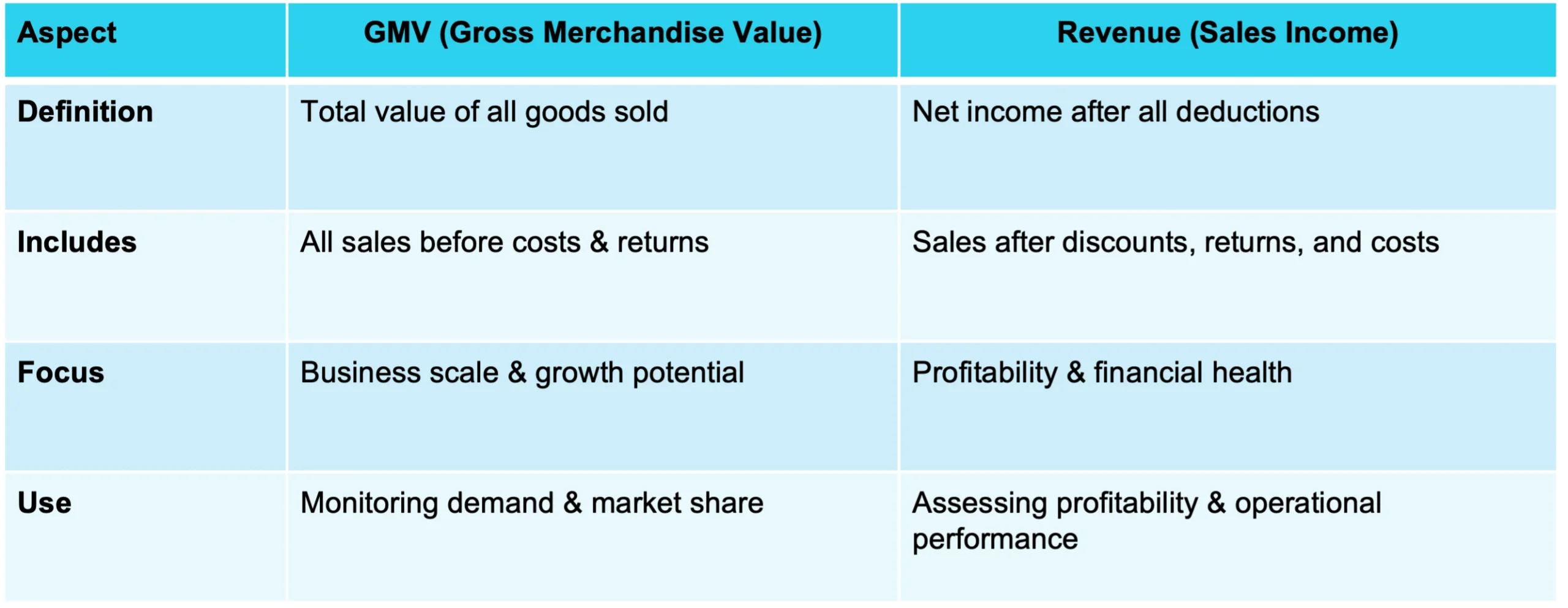
GMV (Gross Merchandise Value) is the total value of all goods sold through your platform within a certain period. GMV is calculated before deducting discounts, returns, or other costs, making it a top-line metric that shows the overall scale of sales.

While revenue describes net income after ALL deductions, GMV provides a big picture of sales activity, regardless of operational costs.

Benefits of monitoring GMV:

1. Complete Picture of Sales Activity‍

Includes all transactions, including those that have not yet generated net revenue, providing a total view of customer spending across all product categories.‍

2. Identifies Growth Potential‍

An increase in GMV is an early indicator of business expansion and positive market trends.‍

3. Measures Marketing Campaign Impact‍

Comparing GMV before and after a campaign helps to accurately evaluate marketing ROI.

Want to monitor GMV across all marketplaces with integrated data? Use eCommerce Analytics Services from ADA Global for more precise insights.

GMV vs. Revenue: Key Differences

GMV vs. Revenue: Key Differences


Why GMV is More Consistent for Cross-Platform Comparison

Why GMV is More Consistent for Cross-Platform Comparison

Revenue is often difficult to compare across platforms like Shopee, Lazada, Tokopedia, or TikTok Shop due to differences in:

  • Cost and commission structures
  • Discount policies
  • Return procedures

A revenue number from one platform isn’t directly comparable to another. That’s why GMV is so useful. It gives you a consistent way to measure sales size, without being changed by the different policies and fees each platform has.

GMV Formula:

GMV = Number of Units Sold × Selling Price per Unit

Examples:

  • Shopee: Product price × number sold (before discounts & returns)
  • Tokopedia: Product price × number sold (does not include shipping)
  • TikTok: Sales Price per Unit x Number of Units Sold
  • Lazada: Product price × number sold before adjustments

Need to standardise cross-channel GMV reports? Use ADA Global’s Multi-Channel Sales Management Services.

Other KPIs to Monitor Along with GMV

Other KPIs to Monitor Along with GMV

GMV will be more useful if analysed along with other key metrics:

  • Revenue – Assesses actual profitability.
  • Net Merchandise Value (NMV) – GMV minus discounts & returns, for a picture of actual sales.
  • Customer Lifetime Value (CLV) – Projected total revenue from a single customer over their time with your brand.

Combining GMV with these metrics helps maintain a balance between growth (top-line) and profitability (bottom-line).

How to Leverage GMV Data to Grow Your Business

How to Leverage GMV Data to Grow Your Business

  • Analyse Trends & Sales Patterns – Identify peak seasons, best-selling products, and changes in demand
  • Customer Segmentation – Categorise customers based on spending value to create more relevant promotions
  • Evaluate Product Performance – Focus campaigns on products with the largest GMV contribution
  • Optimise Pricing Strategy – Monitor the impact of price changes on GMV to find the optimal point
  • Increase Operational Efficiency – Combine GMV data with metrics like shipping time and return rates.
  • Measure Marketing ROI – Find out which marketing channels are most effective and allocate the budget appropriately.
Conclusion

Conclusion

Revenue is important for understanding profitability, but GMV provides a comprehensive view of growth and market demand. By monitoring GMV along with other KPIs, you can make smarter decisions, optimise strategies, and strengthen your eCommerce business operations.

Want to turn GMV data into real growth strategies? ADA Global’s eCommerce Data Analytics team is ready to help you combine cross-platform data, analyse trends, and drive sustainable sales.

Learn more at adaglobal.com

So What is GMV and Why is It Important for Ecommerce?
Why GMV is More Consistent for Cross-Platform Comparison
Other KPIs to Monitor Along with GMV
How to Leverage GMV Data to Grow Your Business

From Guesswork to Growth: On-the-Go Sales Intelligence for Modern CPG & FMCG

Data & AI
White Paper

From Guesswork to Growth: On-the-Go Sales Intelligence for Modern CPG & FMCG

Is your field sales team wasting time on outdated routes, disconnected tools, and missed opportunities?

This exclusive thought leadership dives deep into the unseen challenges faced by modern field sales teams and reveals why outdated methods and rigid tools are holding you back. Discover how to move beyond guesswork and empower your teams with the precise, on-the-go intelligence needed to capture every market opportunity.

Download our thought leadership now.

This thought leadership covers:

  • The true cost of outdated field sales strategies
  • Why your current tools are failing you
  • The critical gap between fixed information and dynamic usefulness
  • A new standard for sales intelligence

Download Now

Lead the next era of data-driven AI