
2026 Guide: Fixing Supply Chain Visibility Gaps in India’s CPG Sector with AI

Post
Blogs

2026 Guide: Fixing Supply Chain Visibility Gaps in India’s CPG Sector with AI

Bridging the Visibility Gap in Modern CPG Supply Chains

India’s CPG market is growing faster than most supply chains can handle. Valued at approximately USD 245 billion in 2024, it is projected to reach around USD 1.1 trillion by 2033. This growth exposes operational cracks quickly.

A 2018 KPMG India study highlights a key issue. More than half of Indian organizations still lack end-to-end supply chain visibility. This leaves planners, sales, and logistics teams with partial or outdated data, causing drifting forecasts, delayed inventory decisions, and reactive operations.

Indian retail structure complicates matters: Kirana stores coexist with modern trade chains and online marketplaces, each with different behaviours and data reporting. Unifying this into real-time insights is essential to reduce demand volatility and excess stock.

Today, supply chain visibility in India is no longer an operational nice-to-have. It determines how quickly a business can respond to change, protect margins and stay relevant. The logic is simple and familiar to anyone who has run operations. If you cannot see what is happening, you cannot plan what to do next.

Key Impacts of Visibility Gaps:

●     Forecasts based on incomplete data lead to 15-20% overstock in volatile regions.

●     Stockouts or excess inventory contribute to 10-15% expiry losses in categories like beauty and dairy.

●     Logistics delays and reactive fixes cost CPG firms millions annually.

●     Reduced trust in data erodes decision-making confidence.

Where Visibility Breaks Down

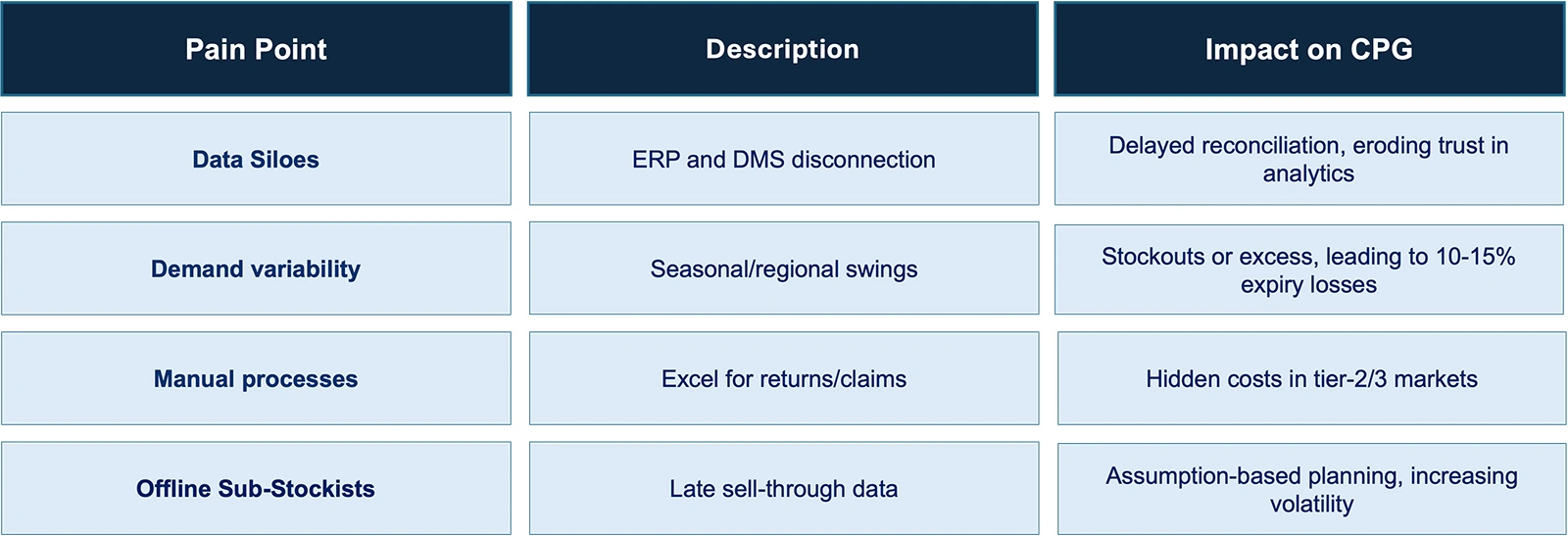
In most CPG organizations, the issue is nota lack of data. It is that the data does not connect.

ERP systems (handling purchasing and inventory) often are isolated from DMS (tracking distributor sales and stock), varying by region and partner. This forces days of manual reconciliation.

This remains one of the most persistent challenges in supply chain visibility for CPG companies.

Demand variability makes matters worse. Seasonal and regional swings are part of daily reality. Hair oil is a good example. Demand rises in North India during winter but softens in humid southern regions. When visibility is weak, forecasting teams tend to smooth these patterns into averages. The outcome is predictable. Too much stock in some locations and stockouts in others.

Expiry and liquidation losses follow. Beauty and personal care brands such as Dabur and Emami lose significant value each year due to expired or unsold products. The root cause is usually the same. Batch-level inventory is not visible across the full distribution network, so risk is spotted only when it is too late to act.

Manual work compounds the problem. Many mid-sized FMCG companies still use Excel to manage returns, claims, and credit notes. These spreadsheets slow down finance teams and hide the true cost of serving each channel.

Tier-2/3 markets add opacity: Offline sub-stockists deliver late or incomplete sell-through data, forcing assumption-based planning.

Why Reporting Is Not Visibility

To cope, many organizations add reporting layers on top of existing systems. It helps with tracking, but it does not solve the core problem.

Excel-based trackers and basic BI dashboards cannot support CPG supply chain visibility at scale. They depend on delayed uploads and manual consolidation, which makes them unsuitable for fast-moving environments.

Inconsistent data definitions make things worse. When SKUs, locations, and distributor hierarchies are defined differently across systems, central reporting becomes a clean-up exercise. Overtime, confidence in supply chain data analytics erodes because teams no longer trust what they see.

Timing is another issue. Weekly or monthly updates force reactive behaviour. By the time a stock issue or excess inventory appears in a report, the financial impact has already occurred.

Summary: Reporting vs. True Visibility

Traditional reporting tells you what happened (e.g., a stockout occurred). True visibility reveals why it happened (e.g., delayed replenishment due to distributor delays or demand spikes) unlocking proactive, AI-era decisions that prevent issues before they impact margins.

Making Data Useful, Not Just Visible

The next stage of FMCG supply chain visibility starts with a simple principle. Data must be aligned before it can be acted on.

A single data layer that connects product, location, and time across the organization is now essential. Without it, teams continue to debate numbers instead of making decisions.

Modern solution services build on this foundation by applying intelligence. AI models analyze multiple signals together, including sales trends, inventory levels, expiry timelines, and broader economic indicators. This helps planners understand not just what is happening, but why it is happening.

Agentic AI goes one step further. Instead of waiting for manual intervention, the system initiates actions on its own. Replenishment quantities adjust when demand shifts. Expiry risks trigger early liquidation. Reconciliation issues are flagged automatically rather than discovered weeks later.

ADA’s CPG Supply Chain Intelligence solution embodies this approach, seamlessly connecting ERP systems (SAP,Oracle, Microsoft Dynamics 365), DMS platforms (Botree, Field Assist, Bizom),and ecommerce channels (Amazon, Flipkart, Blinkit).

ADA Capabilities Breakdown:

●     Unifies disparate systems for real-time, end-to-end data integration across distributors and retailers.

●     Enables regional Generative AI forecasting at distribution centers and distributor levels.

●     Automates batch-wise expiry tracking, it is critical for dairy and beauty categories and to minimize losses.

●     Streamlines reconciliation, reducing manual credit note validation.

●     Optimizes inventory with replenishment recommendations for slow-moving or regional SKUs.

This enables Gen AI forecasting at both the regional distribution centre and distributor levels. It supports batch-wise expiry tracking, which is critical for dairy and beauty categories. Automated reconciliation reduces manual credit note validation. Inventory optimization logic provides real-time data integration for distributors and retailers, including replenishment recommendations for slow-moving or regional SKUs.

Together, these capabilities demonstrate how to improve supply chain visibility in FMCG environments that operate at scale.

Conclusion

For CPG brands managing large general trade networks and thousands of SKUs, supply chain visibility is not about producing more reports. It is about control. When real-time supply chain data is unified and available across the network, teams stop reacting to problems after the fact and start managing the business with intent. Inventory decisions improve, expiry losses fall, and service levels become more predictable.

India’s digital ecosystem is accelerating this shift. UPI-scale infrastructure, ONDC integration, and broader ERP and DMS adoption are driving supply chain digitization, making organizations increasingly data-rich but still insight-poor. The companies that close this gap will be the ones that turn supply chain data analytics into timely, operational decisions rather than retrospective analysis.

Over the next few years, AI-led, self-correcting systems will move from pilots to standard practice. Stockouts, expiry risks, and delivery delays will increasingly be identified early and resolved through automated actions. This evolution will redefine FMCG supply chain visibility inIndia, but it still starts with a solid foundation of integrated data.

Key Takeaways for 2026:

●     Unify data for proactive decisions.

●     Leverage AI to cut risks by 20-30%.

●     Embrace digitization amid ONDC and UPI growth.

ADA supports CPG and FMCG organizations asa long-term solution partner in building that foundation. By enabling real-time data integration for distributors and retailers, ADA helps teams establish true end-to-end CPG supply chain visibility and act on it with confidence.

For organizations looking to improve forecasting accuracy, reduce inventory risk, and regain control across complex distribution networks, the next step is clear. Make the supply chain visible with a partner like ADA.

Inventory Optimisation for Indian CPG Supply Chains

Post
Blogs

Inventory Optimisation for Indian CPG Supply Chains

The New Inventory Optimisation Standard Indian CPG Leaders Are Building for 2026

Inventory is no longer a back-office “numbers exercise” of replenishment cycles; it is the strategic lever for unit economics in the 2025-2026 Indian market. In practice, it shapes some of the most important outcomes in a CPG business, from revenue protection and cash flow to service reliability and customer trust.

Even small inefficiencies add up quickly. Out-of-stock days can reduce potential revenue by 5% to 10%. At the other end of the spectrum, carrying too much inventory brings its own cost, typically 20%to 30% of inventory value each year once storage, handling, financing, and obsolescence are considered. Wastage compounds the issue further, with a meaningful share of stock lost to expiry, overproduction, or misaligned distribution.

The Death of the “One-Size-Fits-All” Model

In 2025, a singular inventory strategy is a liability. Leading CPG players are now adopting a Tri-Modal Inventory Orchestration approach to address the three distinct speeds of the Indian market:

  • The Q-Comm Sprint: Using AI to manage hyper-local dark stores where stock-outs are measured in minutes, not days.
  • The Kirana Pulse: Leveraging AI to bridge the data gap in unorganized retail, predicting “Next-Gen” orders for millions of small shops.
  • The Rural Reach: Optimizing long-haul logistics for Tier 3+ cities where infrastructure remains the primary bottleneck.

Understanding Inventory Optimization as a Capability

At its core, inventory optimization is about making informed trade-offs. It is the discipline of holding the right inventory, in the right locations, at the right time, while keeping cost and risk under control.

Rather than relying on broad buffers or fixed safety stock, inventory optimization uses data-led forecasting, reorder logic, and buffer strategies that reflect real demand patterns and supply constraints.This allows organizations to respond to variability with precision instead of excess.

When applied consistently, this approach improves cash flow by reducing unnecessary stock, while also supporting higher service levels. It also strengthens resilience. By understanding where inventory is exposed to risk, whether from long lead times, demand variability, or limited shelf life, businesses gain more control over outcomes. This is particularly relevant for inventory management CPG India operations, where scale, channel diversity, and distributor-led networks add complexity.

Where Inventory Optimization Commonly Breaks Down

Despite its importance, many organisations struggle to optimize inventory in practice. A common issue is limited visibility into stock age and expiry. Without reliable batch, lot, and expiry tracking, FIFO and FEFO principles are difficult to enforce consistently. Inventory can age unnoticed across warehouses and distributors, leading to shortened shelf life, forced discounting, and write-offs.

Visibility challenges often extend beyond expiry. Disconnected systems across manufacturing, distribution, and retail make it difficult to see inventory holistically. Teams may know how much stock exists, but not where it is most needed or how quickly it is moving. This lack of clarity leads to stock outs and overstocking, a pattern that ties up working capital while still disappointing customers.

These inventory visibility challenges are rarely caused by a single failure. They are usually the result of fragmented data, manual processes, and decisions made without timely feedback from the ground.

Why Traditional Approaches Struggle to Keep Up

Most legacy DMS, SFA, and ERP environments were designed to record transactions, not to continuously optimize decisions.They provide structure and control, but often lack the responsiveness needed in fast-moving, multi-channel environments.

In general and modern trade, this can result in replenishment cycles that are slow to adapt, forecast assumptions that drift from reality, and inconsistent OTIF performance. In ecommerce and direct-to-consumer channels, the challenge is compounded by the need to synchronise inventory across multiple systems, increasing the risk of a mismatch between available and actual stock.

These approaches tend to address issues after they occur. Without predictive inventory analytics and SKU-level demand forecasting, organizations are left reacting to outcomes rather than shaping them. Over time, this makes it difficult to reduce inventory cost CPG India businesses continue to carry while still protecting service levels.

The gap between legacy systems and the new standard is clear:

What a More Effective Approach Looks Like

A more effective approach to inventory optimization starts with a strong data foundation and a data-first mindset. This does not require replacing existing systems, but rather connecting and enhancing them so decisions are based on a shared view of reality.

With integrated inventory optimization systems, organizations gain visibility into batch-wise stock age and expiry, allowing near-expiry inventory to be identified early. This enables timely actions, such as adjusting distribution or triggering liquidation, before value is lost. Brands adopting these data-first, AI-driven systems are seeing expiry write-offs reduced by up to 30%, overall inventory costs drop 20–30%, and holding costs fall 15–25% (McKinsey, ToolsGroup, and industry benchmarks 2024–25). Slow-moving SKUs can be managed more deliberately through smarter purchase order decisions, reducing holding costs while improving cash flow predictability.

Replenishment also becomes more adaptive. Instead of fixed rules, AI-driven workflows learn from demand signals, lead times, and movement patterns. Orders adjust as conditions change, reflecting actual consumption rather than static plans. Assortment and stock movement decisions are continuously refined to balance inventory across locations.

AI in inventory management supports this process by enabling timely notifications and actions to flow back into enterprise systems through ERP integration forFMCG environments. This helps ensure that insights lead to execution, not just analysis, and strengthens data-driven supply chain optimization efforts.

Conclusion

Inventory management in India CPG is gradually shifting from static, ERP-centred planning towards more dynamic, intelligence-led orchestration. Advances in demand sensing, multi-echelon optimization, warehouse automation, and generative AI for decision support are expanding what is possible.

In distributor-heavy markets such as India, these capabilities are particularly valuable. They help organizations manage complexity without relying solely on manual intervention or excess buffers.

By 2027, leaders will run near-autonomous networks; laggards will still chase expiry losses. The gap is widening now.

This evolution is not about removing human judgment. It is about supporting it with better information, clearer trade-offs, and faster feedback.

To strengthen your inventory optimization and supply-chain capabilities, contact ADA. Our team works alongside CPG brands and distributors to build connected, AI-driven inventory systems grounded in strong data foundations. If you’re ready to move beyond ERP-centric planning and accelerate your shift toward intelligent, autonomous inventory management, ADA is here to help.

AI-Driven Demand Forecasting in India’s FMCG Supply Chain

Post
Blogs

AI-Driven Demand Forecasting in India’s FMCG Supply Chain

The New Demand Forecasting Standard India’s FMCG Giants Are Quietly Adopting In Their Supply Chains

India’s retail market is racing toward USD 1.4 trillion by 2026, but over 80% of FMCG volume still flows through general trade channels with almost zero digital visibility.

The result? Tens of thousands of  crores annually in stock-outs and excess inventory alone. (Nielsen-IAMAI 2024).

At the same time, AI adoption in supply chain digitisation in India is accelerating. The use of AI in supply chain management is growing by more than 30% each year, yet only a small share of consumer brands apply it effectively to their forecasting processes. Many continue to rely on fragmented datasets and static spreadsheets.

As the market matures, demand forecasting for FMCG will no longer operate as a quiet back-office function. 2026 will separate the category leaders from the laggards. The winners will treat demand forecasting as strategic intelligence, not a back-office ritual.

Limitations of Current Forecasting Approaches

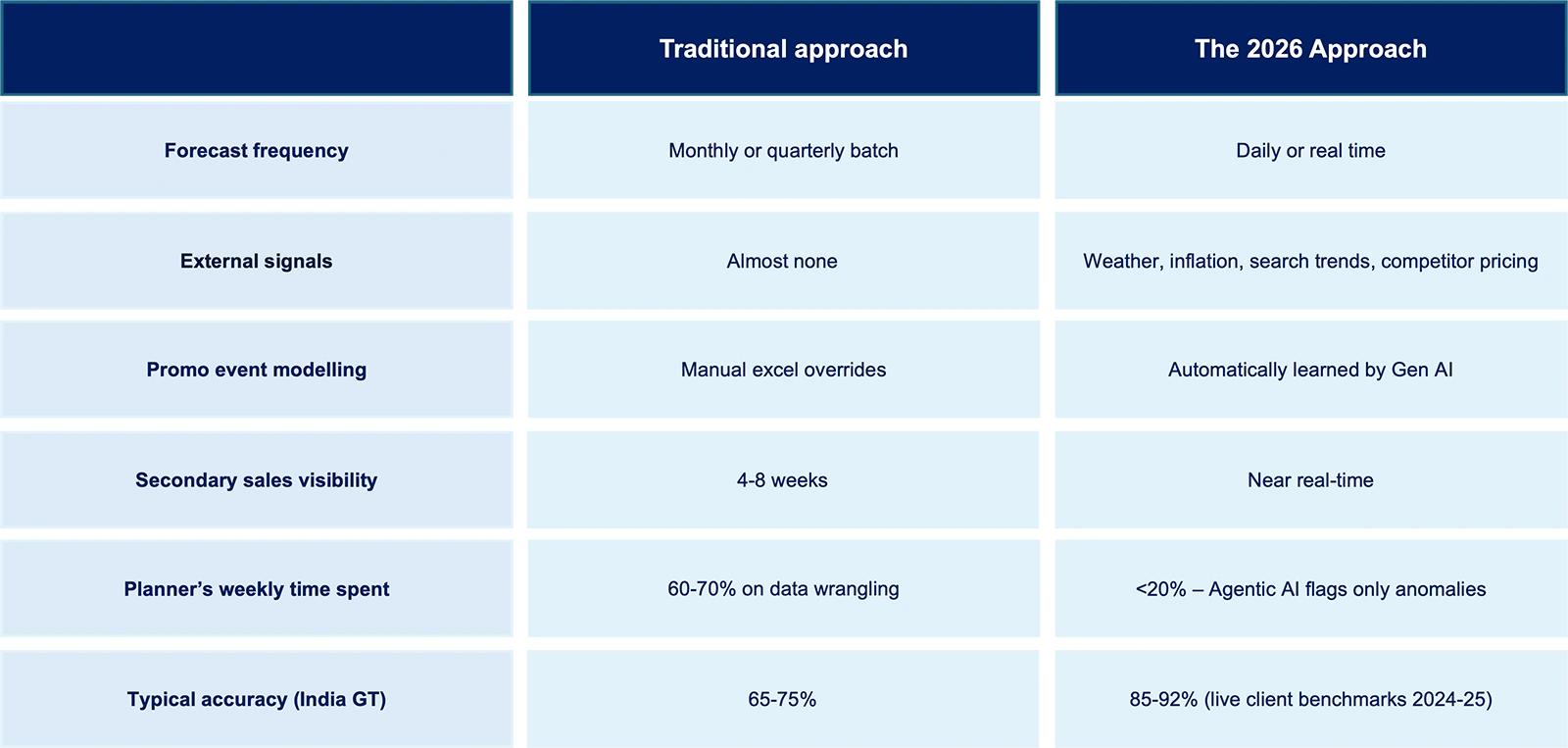
Traditional forecasting methods struggle to keep pace with the complexity of the modern CPG supply chain in India. Legacy systems were not designed for today’s speed, variety, and volatility. They often overlook important demand drivers such as inflation, heat waves, local events, search trends, and competitor pricing.

1. The static forecasting model fails to adapt

Many forecasting systems run in monthly or quarterly batches. These static models do not react quickly to rapid changes such as unexpected heat, festive pre-loading, flash e-commerce events, or supply disruptions. When demand moves faster than the planning cycle, the forecast becomes outdated before it is even applied.

2. Manual planning creates errors and version mismatch

A large share of planning teams still operate in spreadsheets. They run parallel versions of forecasts, apply judgment-based overrides, and circulate files through email. This causes version mismatches, delays, and manual errors. More importantly, it prevents organisations from building a truly data-first supply chain strategy.

3. Demand and supply planning remain disconnected

In many FMCG organisations, demand planning and supply planning continue to function as separate processes. Forecasts are created without visibility into real-time capacity constraints, production bottlenecks, or stock availability at different nodes. As a result, the forecast signal rarely aligns with operational realities. Supply teams then produce based on lagged shipment data rather than real demand. This increases stock-outs in some regions while building excess inventory in others.

These structural limitations create an environment where traditional practices cannot support the level of precision required today. They set the stage for the business challenges that follow.

The New Standard for Forecasting

A new approach to forecasting has emerged, powered by AI in supply chain management and deeper data integration. Instead of fragmented, channel-specific datasets, modern forecasting relies on unified visibility from regional distribution centres through distributors, retailers, and finally consumers.

1. Multi-tier forecasting for end-to-end clarity

A multi-tier forecasting model creates a connected view across general trade, modern trade, and e-commerce. It aligns demand signals from the warehouse, distributor, retailer, and consumer levels. This provides a clearer and more accurate representation of market movement and reduces reliance on shipment-based approximations.

2. Gen AI enhances accuracy and responsiveness

Gen AI systems incorporate external datasets such as weather patterns, inflation indicators, macroeconomic reports, and competitor pricing trends. They learn from past patterns, including returns, out-of-stock periods, and promotional behaviour. The forecast adjusts dynamically, enabling more responsive planning even in volatile environments.

3. Data harmonisation as the foundation

A strong data foundation supports every modern forecasting approach. This includes harmonising data across ERP, DMS, CRM, and marketplace systems. A unified taxonomy allows consistent SKU-level and region-level prediction. It also allows brands to fully unlock AI use cases in the FMCG supply chain.

4. Agentic AI for autonomous monitoring

Agentic AI systems track anomalies in real time and prompt planners when deviations occur. They can trigger automated replenishment or initiate a review process when sudden spikes or drops appear. This reduces the burden on planning teams and supports a more agile planning cycle.

Together, these advancements can deliver improvements of up to 20 to 30 percent in forecasting accuracy, while reducing stock-outs and lowering inventory holding effort.

The ADA Difference: We Start Where Everyone Else Skips 

Most AI-driven forecasting solutions assume that data is already clean, connected, and reliable. In the reality of Indian FMCG operations, this is rarely the case. Disparate systems, inconsistent identifiers, and incomplete data streams are the norm, not the exception.

That is why every ADA engagement starts with building a strong data foundation. While often overlooked, this step is critical. It is the difference between a marginal improvement in forecast accuracy and a step-change impact.

One harmonised data spine

We stitch together every source you actually have like SAP, Marg, BeatRoute, Bizom, OkCredit, CRM, Amazon/Flipkart Seller Central, 3PL portals, even WhatsApp order screenshots into a single, consistent SKU–region–channel taxonomy. No more “Parle-G 82 g” appearing as 47 different names.

Agentic layer that only works on clean data

Once the foundation is rock-solid, the Gen AI and autonomous agents switch on detecting anomalies, adjusting promo lift, and triggering replenishment without human touch.

The brands we partner with don’t buy a tool. They get a co-built, future-proof demand-sensing backbone that becomes their single biggest competitive advantage.

Conclusion

Demand forecasting is undergoing a permanent shift as FMCG and CPG brands move from reacting to market trends to anticipating them. As we look toward 2026, forecasting will evolve into a live data ecosystem where every distributor, warehouse, retailer, and channel feeds continuous insight back to the brand.

When forecasting becomes integrated, dynamic, and data-led, it delivers meaningful business impact. It reduces wastage, improves on-shelf availability, and accelerates decision-making. Brands that invest in stronger forecasting today will be better positioned to adapt, compete, and grow in a rapidly changing market.

To begin strengthening your forecasting capabilities, contact ADA. Our team works alongside brands to build connected, future-ready demand systems grounded in strong data foundations. If you’re ready to move beyond traditional forecasting and accelerate your shift to intelligent planning, ADA is here to help.

How ADA + Snowflake Intelligence Redefines Speed in ASEAN Customer Decisions

Post
Blogs

How ADA + Snowflake Intelligence Redefines Speed in ASEAN Customer Decisions

From Weeks of Waiting to Second of Knowing

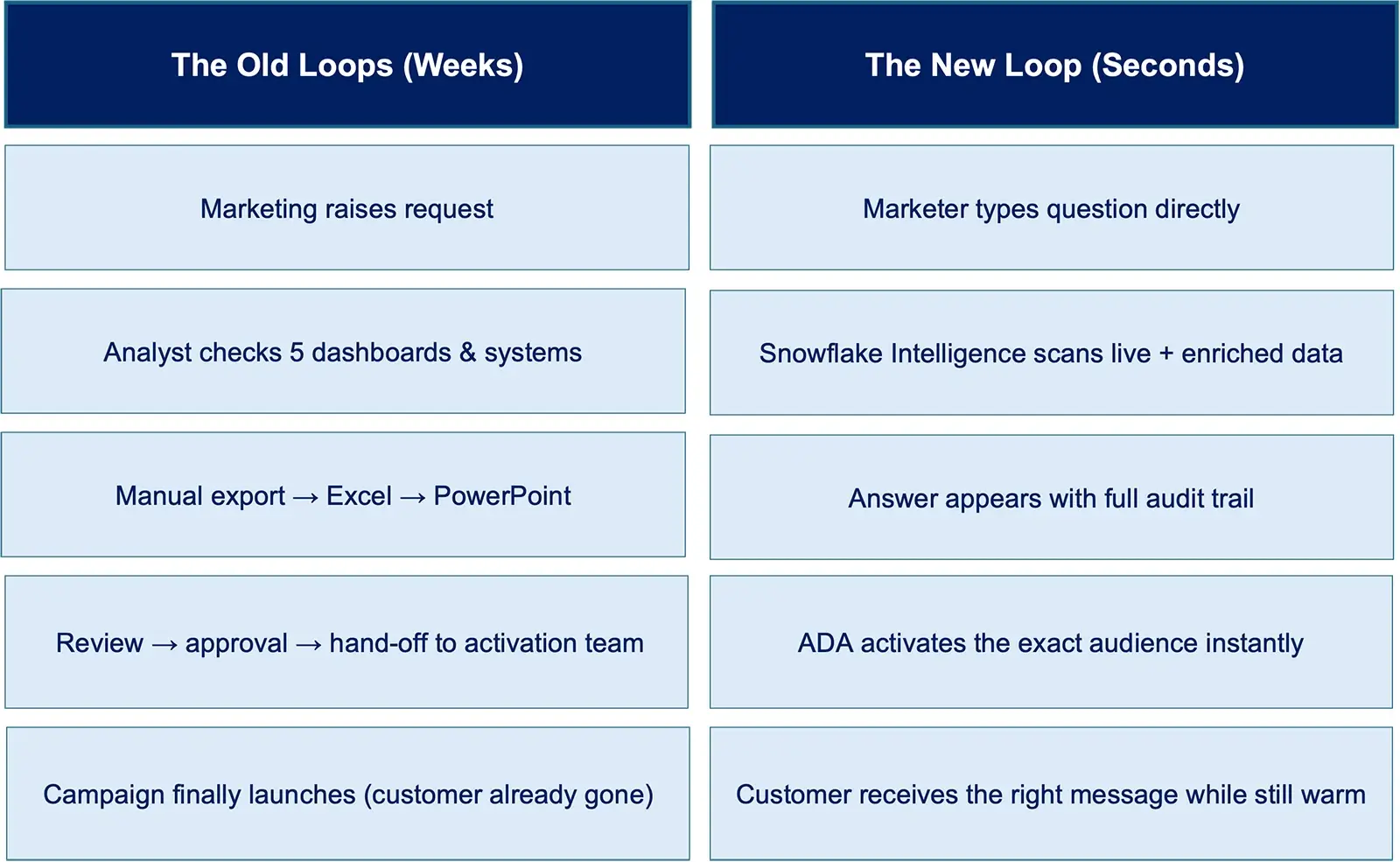
In every ASEAN enterprise, the same frustrating loop has been playing for years. Marketing or CX team: “Which customers in Indonesia are likely to churn this month?”

  • ‍Sends email to data team​  ‍
  • Data analyst pulls yesterday’s dashboard (already outdated)​  ‍
  • Runs queries across 5 systems​  ‍
  • Builds a PowerPoint​  ‍
  • Sends to project lead → marketing lead → regional head​
  • ‍Two weeks later, someone finally gets an answer​

​​→ By then, the customer has already left.

That loop just died.​     ​

The New Speed: Ask → Know → Act

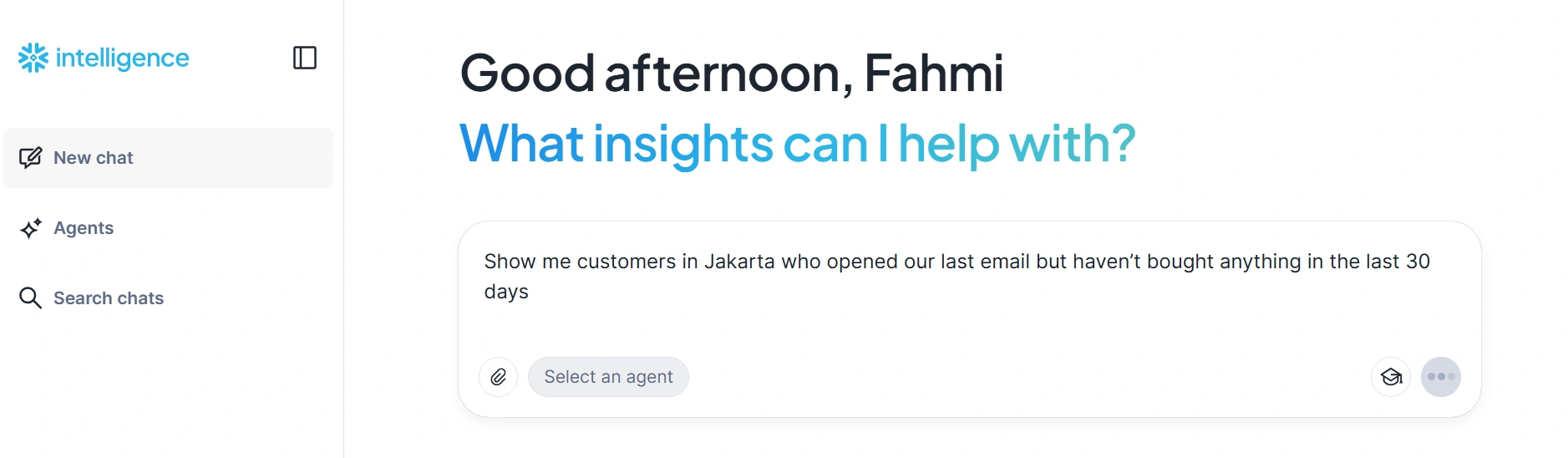
What if, instead of waiting two weeks for a simple audience, any marketer could open a chat box and ask in plain English: “Show me customers in Jakarta who opened our last email but haven’t bought anything in the last 30 days.”

And 15 seconds later, get a clean, governed, ready-to-use list delivered straight back? No tickets. No back-and-forth with analysts. No outdated dashboards.

That better way is here today. It’s called Snowflake Intelligence, powered by Cortex, and it lives natively inside your existing Snowflake environment.

How Snowflake Intelligence Works

  1. Any authorised user like marketer, country manager, CX lead, or even the CEO can simply type or speaks a question in natural language.
  1. The agent, fine-tuned with your company’s glossary and business terms, instantly understands the intent and local context.
  1. It securely scans every table it has been granted access to.
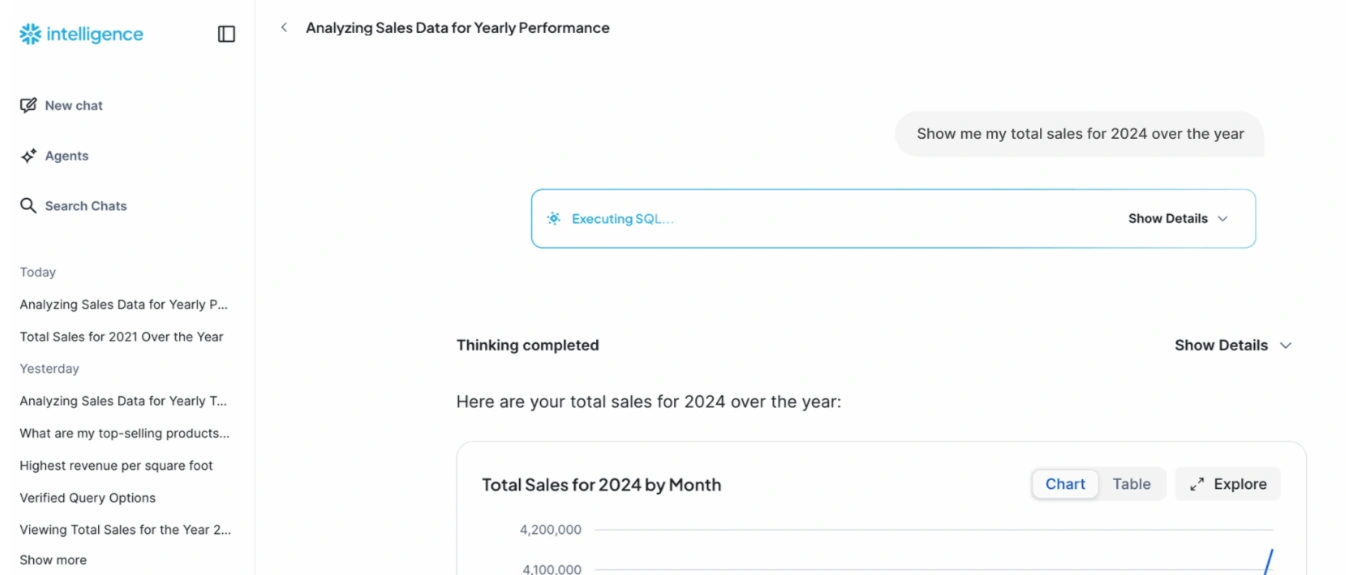
  1. Behind the scenes, it generates clean, production-ready SQL.
  1. Seconds later, it returns the exact audience list or insight, fully governed, auditable, and compliant.

Insight that used to take weeks now takes seconds.

Snowflake Intelligence: How enterprises are adopting it right now

  1. Activate the Intelligence Suite: Turn on Cortex AI, Copilot, Snowflake ML, and Document AI, and assign the right permissions in your Snowflake account.
  1. Make Your Data Truly Intelligent: Ingest all enterprise sources and build clean semantic models so AI agents understand your exact business context (products, customers, campaigns, KPIs).
  1. Deliver Instant Wins with Cortex AI Functions: Use built-in LLM capabilities like summarization, sentiment analysis, classification, translation, and embeddings, directly inside SQL. No code, no pipelines, immediate ROI.
  1. Build & Run Production-Grade ML Natively: Train, validate, deploy, and monitor forecasting, propensity, or recommendation models entirely inside Snowflake. No data movement, no external clusters.
  1. Launch AI Agents & Conversational Analytics: Create custom Cortex Agents for automated workflows and roll out Snowflake Copilot so every marketer, analyst, and executive can ask questions in plain English and get accurate answers in seconds.

Why This Speed Is Only Possible with ADA + Snowflake Intelligence

  1. ADA has already done the hard pre-work

We transformed raw transactional mess into clean, AI-ready customer spines long before Snowflake Intelligence arrived.

  1. ADA’s enrichment lives natively in your Snowflake

No ETL delays, the ASEAN consumer graph, digital behaviour, and propensity models are already there, updated daily.

  1. ADA closes the loop instantly

When Intelligence returns a governed segment, ADA can trigger the retention flow in minutes through pre-built, secure integrations. This isn’t an incremental improvement.

It’s the difference between managing your business with yesterday’s report and steering it with real-time, governed intelligence that immediately translates insight into customer action.

Get started in 30 Minutes, not 30 Days

We’ll connect to your Snowflake, let your team type real questions, and show the insight-to-action loop in action. Let’s kill the old loop together.

Understanding Total Cost of Messaging Ownership for Better ROI

Post
Blogs

Understanding Total Cost of Messaging Ownership for Better ROI

Total Cost of Messaging Ownership: The Real Measure of Value in Business Messaging

Organisations tend to struggle with balancing the cost and effectiveness of their business messaging.

Now, procurement teams often find themselves comparing price-per-message rates or platform fees, only to realise later that these numbers do not reflect the true value or impact of their communication systems. Hidden inefficiencies, fragmented vendor management, and compliance risks can quietly offset what initially seems like cost savings. This gap has widened because business messaging is no longer a simple volume game, but now involves technology integrations, AI-driven customer journeys, and more complex operational requirements that introduce costs far beyond the message rate itself.

This is more than a budgeting issue. Business messaging plays a direct role in how customers experience a brand, how efficiently teams operate, and how reliably compliance is maintained. When messaging systems are evaluated correctly, they can become a strategic advantage that improves customer engagement, strengthens trust, and drives measurable returns. When handled poorly, however, even small inefficiencies can scale into significant operational and reputational costs.

For example, implementing a CPaaS (Communications Platform as a Service) solution typically means integrating it with your marketing automation, CRM, and billing systems, where each one adds its own integration cost well before the first customer interaction even happens.

To avoid these challenges, procurement leaders need a more complete view of messaging performance. When evaluations focus only on unit costs, it becomes difficult to see how communication systems influence wider business outcomes. This narrow approach often leads to short-term savings but long-term inefficiencies. And importantly, these inefficiencies can be felt immediately, not sometime in the future, thus making it critical for procurement teams to eliminate surprises and gain full visibility upfront. Staying informed through expert insights and modern evaluation methods is crucial for maintaining the optimal balance between cost, compliance, and return on investment.

True cost efficiency lies not only in reducing expenses but in understanding how each conversation contributes to business results. The Total Cost of Messaging Ownership (TCMO) framework provides this broader perspective, connecting cost, ROI, and compliance to reveal the real value behind every interaction.

Understanding Total Cost of Ownership (TCO)

TCO is a framework that encourages organisations to look beyond the initial purchase price and consider the full cost of an investment over its entire lifecycle. This includes usage, maintenance, training, upgrades, and eventual replacement. By viewing ownership through this wider lens, businesses gain a clearer understanding of the true financial impact of their decisions.

The goal of TCO is to help organisations see the complete picture rather than rely on what appears to be the lowest-cost option today. This mindset leads to decisions that are more sustainable, efficient, and aligned with long-term growth.

This same principle applies directly to business messaging. The Total Cost of Messaging Ownership (TCMO) framework extends TCO thinking and reveals the full financial and operational implications of running messaging at scale.

Traditional cost assessments tend to focus on the most visible expenses, such as message rates or platform fees. While important, these reflect only one part of the investment. The TCMO framework expands this view with four key dimensions that together define the real cost of business messaging.

Direct Messaging Costs

Direct messaging costs refer to measurable expenses like price per message and platform fees. These are often simple to calculate, yet they can become fragmented across regions, channels, and vendors. When organisations consolidate their messaging through a unified, global solution, contracting becomes more consistent and per-unit costs often decrease, creating a more manageable and predictable cost structure.

Indirect Tech Costs

Indirect tech costs arise from managing vendors, integrations, and ongoing technical support. These costs are frequently overlooked because they are spread across multiple teams and systems. Challenges such as coordinating different providers, duplicated integrations, or siloed data can inflate operational overhead. Using a single, integrated ecosystem for messaging, technology, and analytics reduces these inefficiencies and supports smoother day-to-day operations.

Scaling AI Costs

As organisations adopt AI to personalise experiences and automate journeys, the cost of scaling AI becomes increasingly important. Beyond AI model licences and usage-based pricing, hidden costs can arise through usage overruns, model retraining, or infrastructure sprawl. A unified AI platform helps simplify cost planning by providing predictable pricing and eliminating unexpected surcharges, making AI adoption more controlled and cost-effective.

Compliance Costs

Compliance costs relate to safeguarding data, meeting regulatory obligations, and ensuring proper reporting when incidents occur. In addition to hosting and data governance, organisations face the risk of fines, downtime, or audit-related disruptions. A messaging framework built on recognised certifications and regional regulations reduces this risk and helps maintain business continuity in environments where compliance expectations are high.

When these four dimensions are viewed together, procurement teams gain a more comprehensive understanding of their messaging ecosystem. The TCMO framework helps leaders look beyond surface-level cost comparisons and focus on how messaging contributes to both financial efficiency and business performance.

Procurement shouldn’t only measure the cost of messages but also the return generated from conversations. This perspective encourages organisations to uncover hidden costs early, prevent inefficiencies from scaling, and reinvest savings into areas that deliver long-term value. By applying the TCMO framework, leaders can ensure that every interaction contributes meaningfully to business objectives.

To put this into practice, organisations can start by assessing how they perform across these four dimensions. With tools such as the industry-specific TCMO Benchmark and ROI Simulation, procurement teams gain the clarity needed to make confident, evidence-based decisions and ensure nothing in their messaging strategy is overlooked.

Conclusion

The cost of business messaging should never be viewed in isolation. It is not simply about cutting costs but about uncovering how every interaction contributes to brand trust, customer satisfaction, and long-term business growth. By adopting a Total Cost of Messaging Ownership mindset, organisations can transform their business messaging from a basic operational expense into a measurable source of strategic value.

ADA’s trusted communication solutions help organisations eliminate hidden costs, simplify integrations, and gain instant clarity across their messaging ecosystem. With deep expertise in TCMO and a proven approach to uncovering real-world savings, ADA ensures businesses stay compliant, efficient, and fully in control.‍

If your organisation is ready to rethink its business messaging strategy, contact ADA today to discover how their proven services can help you build a messaging ecosystem that drives measurable results and lasting value.

One API to Authenticate Them All: The Future of Frictionless Authentication with ADA Verify

Post
Blogs

One API to Authenticate Them All: The Future of Frictionless Authentication with ADA Verify

One API to Authenticate Them All: The Future of Frictionless Authentication with ADA Verify

Digital services require users to verify their identity at many points, whether logging in, recovering an account, completing a payment, or accessing sensitive information. These checks are important for security, but common methods often introduce friction.

OTPs sent through SMS or voice can be delayed, fail to deliver, or be exposed to manipulation. According to industry security guidance, such as the NCSC, SMS has increasingly become a weak link due to SIM swapping, social engineering, and vulnerabilities in telecom signalling protocols. Regulations are also changing, increasing the pressure on organisations to stay compliant. Meanwhile, users expect quick, smooth access and may drop off when the process feels slow or complicated.

Organisations face the same strain. High verification drop-offs reduce conversions, weaken satisfaction, and affect long-term engagement. Managing traditional OTP systems requires fraud protection, routing management, compliance work, and number pool maintenance, creating additional cost and complexity. These efforts become even harder as SMS delivery costs rise globally and carrier filtering grows stricter, issues highlighted across multiple industry analyses discussing the hidden cost of SMS OTPs.

These challenges have pushed many organisations to explore frictionless authentication, a modern approach that securely verifies identity in the background while reducing interruptions. The goal is to simplify the experience without compromising security.

This is the purpose of ADA Verify. It streamlines authentication by offering one API that supports intelligent, unified verification across channels, removing the need to manage multiple vendors or fragmented systems.

What Is Frictionless Authentication?

Frictionless authentication validates identity quietly in the background, reducing manual steps such as entering passcodes. It aligns with modern identity systems designed to provide stronger security and a faster, easier experience for users.

The Problem with the “Old” Standard

Traditional authentication methods, especially SMS OTPs and password-heavy flows, have become one of the biggest friction points in today’s digital journeys. Every added step slows users down, and multi-step authentication is still a major driver of drop-offs, with abandonment rates often reaching around 30% during sign-up or checkout.

Passwords remain one of the most painful parts of the experience. Nearly 7 in 10 people struggle to remember them, and 40% use more than 11 passwords across their daily digital life. This constant password fatigue adds friction, slows down onboarding, and erodes trust in the process.

When authentication feels like work, users leave. When it feels seamless, they stay,  and they convert. This is exactly why the old OTP-only standard struggles to meet the expectations of today’s digital consumer.

The Friction Factor

According to Martechvibe, 60% of Users Abandon Transactions Due To Authentication Frustration. Every extra moment in a digital journey affects conversion. Multi-step authentication often causes noticeable user drop-off during registration or checkout. In today’s competitive market, losing a meaningful portion of potential customers right at the start is far from ideal.

The Cost of Fragmentation

From a product and engineering perspective, things aren’t any easier. Supporting global authentication often means dealing with a patchwork of vendors, one SMS provider for Southeast Asia, another for WhatsApp worldwide, and a few more for smaller regions. This kind of fragmentation creates integration headaches, inconsistent data, and higher costs due to inefficient routing and failover setups.

How ADA Verify Redefines the Standard

ADA Verify does not replace an SMS gateway. Instead, it enhances your identity systems by offering one API that supports silent verification, intelligent fallback, and AI-driven routing. It acts as an orchestration layer that balances speed, security, and user experience.

ADA Verify evaluates every authentication attempt in real time to determine the fastest and most secure path available.

1. The “Seamless” First Step: Zero-Friction Authentication

When a user begins authentication, ADA Verify first tries carrier-based verification using secure mobile network operator connections. This background cryptographic check uses the mobile data network.

No input needed, no switching apps, and no OTPs exposed to interception. The process is instant, allowing users to log in effortlessly.

2. Intelligent Fallback and Orchestration

If silent verification cannot be completed, ADA Verify activates an intelligent fallback process. Instead of defaulting to SMS, it compares channels such as WhatsApp, SMS, Telegram, or Viber based on:

  • Enterprise preferences
  • User behaviour and preferred channels
  • Regional communication patterns

This ensures the most reliable and familiar method is used for each user.

3. Powered by AI-Driven Decisioning

At the heart of ADA Verify is ADA’s proprietary AI-driven orchestration engine, the “brain” that keeps everything running smartly. Static routing rules break when carrier routes change or when networks experience downtime. ADA’s engine is dynamic, continuously learning from millions of authentication attempts.

It analyses real-time signals, including delivery success rates, latency metrics, and conversion data. This continuous loop allows the engine to predict the optimal path for every attempt, resulting in delivery success rates that consistently exceed 90%,  a figure traditional providers struggle to match.

Industries That Benefit From Frictionless Authentication

A wide range of sectors gain measurable value from reducing verification friction:

Financial Services

Banks, fintechs, and payment providers rely heavily on secure digital identity. Faster authentication reduces drop-offs during sign-ups, transaction approvals, and account recovery.

E-commerce

Retailers and marketplaces use frictionless authentication to reduce cart abandonment and protect against fraudulent purchases, while keeping the buying journey smooth.

Telecommunications

Mobile network operators play a dual role in digital identity: they are both providers of the underlying technology and end-users of authentication solutions. By enabling or adopting frictionless verification, they can reduce fraud, strengthen customer trust, and unlock new identity-driven revenue opportunities.

Healthcare

Online portals, telehealth systems, and patient records require secure but accessible authentication to ensure both safety and usability.

Travel and Mobility

Ride-hailing, ticketing, and booking services benefit from less friction during account creation and high-risk transactions.

Digital Services and Apps

Any service with frequent logins or content access controls can achieve higher retention when identity checks run smoothly in the background.


Beyond Authentication: The Future of Digital Identity

Digital identity is shifting from manual, user-driven actions toward background verification supported by secure networks and authenticated devices. Several trends are shaping the future:

  • Security remains a top priority, especially for sectors dealing with transactions or sensitive data.

  • User experience is increasingly important, as businesses link friction to customer churn.

  • Passwordless systems are becoming more widely adopted, using biometrics, passkeys, and encrypted device-based verification.

  • Telecommunications providers are expected to strengthen their role in authentication, using their network visibility to deliver secure digital identity services.

  • Multi-channel verification continues to evolve, ensuring reliable backup methods when silent checks are not possible.

Organisations are moving toward identity systems that work anywhere, anytime, with minimal disruption to the user.

Potential Extensions in Frictionless Authentication

ADA Verify isn’t just solving today’s authentication challenges, it’s laying the groundwork for a complete Digital Identity Assurance Layer. Our roadmap looks beyond verification alone and tackles the wider set of identity challenges that businesses face.

Here’s what’s coming next:

  • KYC & SIM Swap Verification

In future releases, we’ll tap into telco connections to enable real-time SIM Swap detection. Verify not just the device, but the actual identity behind the number. Prevent impersonation and account takeovers.

  • Risk Scoring

Evaluate user trustworthiness based on behaviour, device patterns, and network signals.

  • Persistent User Identity

We’re also working toward helping enterprises unify identity data across devices so the user on an Android phone and the same user on an iPad are recognized as one high-value customer.

As digital identity continues to evolve, ADA Verify provides a scalable, modern foundation that can grow with new use cases and future telco-driven features.

Conclusion: A Strategic Advantage for Real Business Growth

Upgrading your authentication system isn’t just a technical move, it’s a strategic one. Customers expect every digital interaction to be fast, effortless, and secure, and frictionless authentication is how organisations meet those expectations. By reducing reliance on OTP-only methods and introducing silent, real-time checks, businesses can deliver smoother experiences, strengthen fraud prevention, and minimise operational strain. Industry studies make this clear: authentication is no longer just a security issue, it is a customer experience issue, directly tied to loyalty, abandonment rates, and brand trust.

ADA Verify brings all of this together in one unified solution. It gives modern businesses what they truly need: a single API that authenticates users seamlessly, without the friction, complexity, or hidden costs of traditional OTP systems. With Verify, you unlock easier onboarding, higher conversions, stronger security measures, and a scalable foundation for long-term digital growth.

Contact ADA today to integrate ADA Verify and turn your authentication process into a real competitive advantage.

Predictive Analytics in Ecommerce: A Complete Guide 2026

Post
Blogs

Predictive Analytics in Ecommerce: A Complete Guide 2026

Every year, ecommerce brands lose millions from stockouts and wasted discounts. What if you could predict what your customers want, months before they even know it themselves?

Predictive analytics has emerged as the compass that helps businesses anticipate what customers want, when they’ll want it, and how best to deliver it. This shift from reactive to proactive strategies is reshaping the industry. Where merchants once relied on historical data to explain what already happened, predictive analytics now uses AI-driven models to reveal what’s about to happen. That difference translates directly into sharper campaigns, optimised resources, and more satisfied customers.

In this article, we explore the models, applications, and future trends of predictive analytics in ecommerce, providing a practical guide for retailers aiming to achieve sustainable growth and digital transformation.

What is Predictive Analytics in Ecommerce?

At its core, predictive analytics applies data, statistical models, and machine learning to forecast outcomes and behaviours. Unlike descriptive analytics (which explains what happened), predictive analytics tells you what is likely to happen next and what you should do about it.

It works by combining structured data (trends such as sales records, pricing, and inventory levels) with unstructured signals (customer reviews, social sentiment, browsing behaviour). Together, these streams create foresight that drives everything from smarter promotions to optimised supply chains.

The explosion of big data from omnichannel shopping habits to real-time competitor signals simply means predictive analytics is no longer reserved for tech giants like Amazon or Netflix. Today, even mid-sized ecommerce brands can harness these tools to stay competitive.

Why Ecommerce Retailers Can’t Afford to Ignore Predictive Analytics

Relying on gut instinct or outdated systems is no longer viable in today’s hyper-competitive market. Predictive analytics empowers retailers to make faster, data-driven decisions that prevent costly mistakes and capture emerging opportunities in real time. The risks of sticking with legacy systems or intuition-driven planning are severe:

  • Overstocking and waste

Seasonal lines that don’t sell fast enough tie up working capital and end in heavy markdowns.

  • Stockouts and lost sales

Customers don’t forgive “out of stock” notices. Each missed sale erodes loyalty.

  • Inefficient promotions

Blind discounting inflates customer acquisition costs (CAC) without lifting retention.

  • Slow reaction times

By the time manual reports reveal a trend, competitors have already moved.

How Predictive Analytics Works: Key Models and Data Sources

To unlock the full potential of predictive analytics in eCommerce, it’s essential to understand the models and data that make it work. While the technical details can be complex, the practical takeaway is clear: the right models, powered by clean data, translate directly into smarter business decisions.

Key Models in Practice

  • Time-Series Forecasting

Models such as ARIMA, Prophet, or LSTM analyze historical sales patterns to anticipate seasonal peaks, promotional surges, or abrupt shifts in buying behavior.

  • Regression Models

These models extend beyond sales data, incorporating external variables such as competitor pricing, marketing campaign performance, and even weather conditions. The outcome is a holistic view of the factors driving demand and conversions.

  • Hierarchical Forecasting

Particularly valuable for retailers managing extensive SKU portfolios, this approach ensures that SKU-level predictions align with broader category-level objectives, maintaining both accuracy and strategic consistency.

Data Streams: Structured and Unstructured

Predictive analytics relies on two complementary data streams:

  • Structured Data

This includes quantifiable information such as sales history, pricing, promotions, and inventory levels. Structured data forms the backbone of demand forecasting and stock management.

  • Unstructured Data

Sources such as customer reviews, social media sentiment, influencer activity, and behavioral signals (e.g., browsing habits or cart abandonment) provide critical context. These insights reveal customer intent and shape purchasing decisions in ways structured data alone cannot capture.

Taken together, structured and unstructured data streams offer not only predictive forecasts but also the contextual “why” behind consumer behavior, enabling retailers to act with precision and confidence.

Putting Predictive Analytics into Practice

Understanding the theoretical foundations of predictive analytics is only the first step; the real value lies in its application across day-to-day eCommerce operations. The following use cases illustrate how predictive models can be embedded into core business processes to drive measurable outcomes.

1. Demand Forecasting

A fashion retailer uses LSTM time-series models to predict demand for seasonal collections. Instead of overstocking winter jackets, the brand aligns inventory levels with predicted spikes in colder regions, minimizing excess stock while meeting local demand.

2. Dynamic Pricing

An electronics store monitors competitor pricing and customer demand in real time. Predictive regression models adjust product prices daily, balancing profit margins with competitiveness. This enables the brand to capture sales during major promotional events such as Singles’ Day or Black Friday without eroding margins.

3. Personalised Recommendations

An online beauty brand uses session-based collaborative filtering to recommend products. If a customer browses moisturizers but leaves without purchasing, the system predicts purchase intent and later recommends a customised bundle (e.g., moisturizer and serum) via email. This strategy increases both conversion rates and average order value.

4. Churn Prevention

A subscription-based meal delivery service identifies customers at risk of cancellation by analyzing patterns such as reduced logins, skipped orders, or declining engagement. Predictive churn models trigger automated retention offers such as discounts or personalised meal plans before the customer makes the decision to leave.

5. Inventory Optimisation

A global marketplace predicts SKU-level demand across multiple regions. Hierarchical forecasting reconciles category-level predictions with local buying behavior, ensuring warehouses are stocked strategically. This reduces costly cross-border shipping and accelerates delivery times.

How Amazon Uses Predictive Analytics

Amazon faces one of the most complex forecasting challenges in the world, predicting demand across more than 400 million products. As Jenny Freshwater, Vice President of Traffic & Marketing Technology (and former VP of Forecasting), explains: “No amount of human brain power can forecast at that scale on a daily basis.” Traditional systems like manual logs or legacy computing software simply cannot handle this level of complexity.

During the Covid-19 pandemic, sales of toilet paper increased by 213%. While no model could have predicted the pandemic itself, Amazon’s forecasting systems adapted quickly to the new demand signals, helping the company restock efficiently and maintain customer trust during a critical moment.

By embedding predictive analytics into its workflows, Amazon has moved beyond reactive decision-making. The company consistently anticipates consumer needs, adjusts its inventory and supply chain strategies in real time, and sustains a competitive advantage by adapting faster than its rivals.

How Predictive Analytics Drives Sales and Improves Customer Experience

The power of predictive analytics lies in its ability to bridge two critical goals: boosting revenue and enhancing customer satisfaction.

On the sales side, predictive models optimize pricing strategies, improve demand forecasts, and increase conversion rates through more relevant product recommendations. By unifying data and applying AI forecasting, businesses can see powerful results. For example, ADA helped a global grocer achieve 136% ROI, a 15% forecast accuracy uplift, and significant revenue growth.

On the customer experience side, predictive analytics enables brands to move beyond generic interactions. Customers receive timely, personalised recommendations that reflect real-time preferences, while fulfilment becomes faster and more reliable through optimised inventory allocation. Churn prediction adds another layer of value, allowing businesses to intervene before customers disengage, ultimately strengthening loyalty and retention.

In essence, predictive analytics creates a win-win: businesses maximize efficiency and profitability, while customers enjoy a shopping experience that feels intuitive, personalised, and reliable.

Future Trends of Predictive Analytics in Ecommerce

  • Real-time AI-driven decision-making at scale

The next wave is predictive models embedded directly into operations.This allows continuous adjustments to pricing, campaigns, and inventory in real time. ADA’s Intelligent Commerce solution is a real example: it integrates predictive analytics across marketing, supply chain, and finance functions to deliver unified, actionable insights instantly.

  • Hyper-Personalisation

Personalisation is going deeper. Predictive models will stitch together data across web, mobile apps, social platforms, and offline touchpoints to offer consistent, context-aware recommendations. The emphasis is shifting from “what you might like” to “what you will want next, right now”, enabled by real-time inference and multi-channel orchestration.

  • Growth in Southeast Asia & Emerging Markets

Emerging markets like Southeast Asia will see accelerated adoption of predictive analytics due to growing eCommerce penetration and mobile-first consumers. As ADA Global’s 2025 insights highlight, the ability to translate raw customer signals into real-time actions is what will allow Southeast Asian retailers to compete on a global stage while staying hyper-relevant locally.

Conclusion: Predictive Analytics as the Growth Catalyst

Today, predictive analytics is no longer a nice-to-have, it is the backbone of competitive eCommerce. By turning historical and real-time data into foresight, businesses can anticipate demand, personalize customer experiences, optimize pricing, and streamline supply chains. The result is a shift from reactive decision-making to proactive, AI-driven growth strategies. Retailers who embrace predictive analytics will not only protect their margins but also unlock sustainable, scalable growth in an increasingly crowded digital marketplace.

At ADA, we partner with retailers to operationalise predictive analytics from demand forecasting to hyper-personalisation and real-time pricing. Our end-to-end data and AI ecosystem ensures predictions become business outcomes, not just numbers on a dashboard.

Contact the ADA team today to transform your eCommerce strategy with predictive insights that scale.

How AI Transforms Healthcare: Risk Prediction to Clean Claims

Post
Blogs

How AI Transforms Healthcare: Risk Prediction to Clean Claims

What If AI Could Reshape Healthcare?

This is no longer science fiction, this is healthcare’s reality in Southeast Asia alone, healthcare spending is projected to soar from USD 420 billion in 2023 to USD 740 billion by 2030, while AI in healthcare SEA is expanding at over 30% annually. The opportunity is immense, but so is the challenge. This explosive growth means healthcare providers face a critical decision: scale AI responsibly, or risk wasted investments.

The real question is not whether AI can transform healthcare, but whether organisations have the strong healthcare data foundation required to unlock its potential. Without high-quality, well-governed data, even the most advanced AI solutions fall short, leaving efficiency gains and revenue opportunities unexploited.

The Visible Challenge: Why AI Falls Short in Healthcare

Every healthcare executive knows the pain: data scattered across hospitals, labs, insurers, and regulators creates a fragmented system where no single source tells the whole story.

For all the promise of AI, many healthcare organisations struggle to see consistent results. The issue is rarely the algorithms, it is the data behind them.

Today, patient information is trapped within fragmented ecosystems. Hospitals, diagnostic labs, insurers, and national health systems each hold parts of the puzzle, but rarely in a unified way.

On top of that, issues like incomplete records, inconsistencies, and duplicates make the data unreliable from the start

The outcome? Predictive models trained on weak data deliver unreliable insights, eroding clinical trust and stalling ROI. Instead of driving smarter decisions, whether in predicting patient risks or ensuring accurate claims, AI risks becoming another expensive, short-lived experiment. These are the very healthcare data challenges that must be solved before AI can deliver lasting impact.

What is predictive analytics in healthcare?

Predictive analytics in healthcare uses patient data and AI models to forecast outcomes,  from disease risk and hospital readmissions to treatment effectiveness and fraud detection.

Despite these challenges, leading healthcare organisations are showing how predictive analytics in healthcare is becoming the engine of modern care, creating measurable value across the system:

  1. Patient risk and deterioration prediction enables earlier intervention, reducing readmissions and optimising bed utilisation. For example, AI can analyse vital signs and lab results in real time to flag when a patient in recovery is at risk of sepsis or cardiac arrest. Clinicians can then act before the condition escalates, preventing an ICU transfer and keeping hospital beds available for others.
  2. Population health management identifies at-risk groups, allowing for preventive strategies that reduce treatment costs. For instance, predictive models can flag communities with rising diabetes or hypertension rates. Health systems can then launch targeted screening or lifestyle intervention programmes, catching conditions early and lowering the long-term burden on the system.
  3. Resource optimisation helps hospitals forecast demand, improving staffing and inventory efficiency. AI can use seasonal patterns and local event data to predict patient surges, such as seasonal events like haze-related respiratory surges common in Southeast Asia. Hospitals can then adjust their staffing schedules, stockpile ventilators and oxygen, and avoid the bottlenecks that often overwhelm emergency departments.
  4. Insurance risk assessment and clean claims improve risk scoring, tailor coverage plans, and strengthen fraud detection, reducing disputes and payment delays. For example, AI can cross-check claims data with patient records to ensure that procedures billed actually occurred, flagging suspicious patterns like duplicate submissions. This not only reduces fraud but also speeds up claims approval for genuine patients, improving trust between insurers, providers, and members.

Predictive analytics in healthcare is no longer a “nice-to-have”, it is now essential in healthcare. From preventing patient deterioration to processing clean claims, the value is clear. But these results are only possible with the right healthcare data foundation. The data must be unified across systems, governed for quality and compliance, and trusted by both clinicians and administrators. Without this, even the best predictive models cannot deliver reliable outcomes.

The Limitation of Predictive Analysis No One Talks About

Here lies the uncomfortable truth. Across Southeast Asia, healthcare organisations are pouring millions into AI tools without addressing the data problem first.

Take the example of predictive readmission models. If the patient records being fed into the model are incomplete or inconsistent, for instance, if a patient’s medication history is recorded in one system but missing from another, the algorithm will deliver flawed predictions. The result is that doctors lose trust in the tool, patients miss out on timely interventions, and hospitals fail to see the promised efficiency gains.

The same applies to insurance claims. Without proper governance, duplicate or misclassified records can create errors in risk scoring or flag false positives for fraud. Claims get delayed, disputes increase, and instead of saving money, insurers end up adding costs and frustrating customers.

The reason is simple: data governance is often an afterthought. Information stays scattered across different systems, creating errors and inconsistencies that weaken trust in AI results. And when the predictions don’t work, AI takes the blame. But the real problem isn’t the algorithm, it’s the poor-quality, unmanaged data it depends on.

Until this limitation is addressed, investments in AI will continue to under-deliver, and the technology itself risks being seen as overhyped and less impactful than it truly is.

The New Standard: A Data-First Strategy

To unlock predictive analytics at scale, healthcare organisations need to flip the approach. Rather than starting with AI, they must adopt a data-first strategy, and this is where ADA differentiates itself. Healthcare leaders are realising that AI success depends less on the algorithm and more on the foundation beneath it. ADA sees this foundation as four pillars: interoperability, governance, scalability, and security

  • Unified data pipelines create a single source of truth across hospitals, labs, insurers, and regulators.

  • Governance-first design ensures quality, compliance, and security are embedded from the outset.

  • Scalable architecture future-proofs operations for advanced AI, precision medicine, and even cross-border health exchanges.

  • Interoperability at the core enables seamless data sharing across fragmented systems and devices.

This is ADA’s strength. We deliver not just AI capabilities, but the end-to-end, governed healthcare data foundation that makes predictive healthcare possible, sustainable, and trusted.

Building the Data Foundation: From Patient 360 to Hospital Command Center

Before AI delivers on its promise, the real work is in bringing all the data together. At ADA we’ve designed two key platforms, the Hospital Command Center and Patient 360 via Data Accelerator that underpin our predictive and governance capabilities.

The Building Blocks: What Powers ADA’s Healthcare AI

  • Clinical Data: Admissions, discharges, readmissions; ER wait times and triage scores; diagnosis and treatment records.
  • Operational Data: Bed occupancy & availability; staff scheduling and workload; equipment and medicine stock usage.
  • Administrative Data: Financial performance metrics; resource utilisation; hospital-wide KPIs.
  • External Data Integration: Standards-based ingestion via HL7, FHIR and REST APIs connecting labs, pharmacies and national health records.

How does it all come together?

  • Canonical data models (CDMs) to unify structured and unstructured input: IoT sensors (patient monitoring), EMR systems, logs and clinical notes.
  • Governed, curated datasets for reliable healthcare KPIs and analytics-ready assets.
  • Real-time pipelines and dashboards that deliver a unified source of truth for clinical, operational and administrative users.

Turning Data Into Impact

  • For the Hospital Command Center, real-time dashboards monitor bed occupancy, staff capacity and discharge planning. Predictive intelligence flags patient inflow/outflow trends and readmission risk. Automation and resource optimisation lead to measurable operational efficiency gains.

  • For Patient 360 / Data Accelerator, providers gain one unified view of each patient across systems. Prebuilt pipelines accelerate time-to-value. Data quality and governance improve markedly. Analytics scale across both clinical and operational decision-making.

And Powering All Of This: AI Accelerators

  • Hospital Command Center platform: ML modules for readmission prediction, triage scoring, clinical decision support, resource optimisation; predictive analytics for ER wait-times and outcomes; automated data cleansing, validation and enrichment.

  • Data Accelerator: Upcoming AI/ML automation for source-to-CDM mapping, synthetic data generation for testing and demo use-cases; embedded governance and quality checks via canonical models and config-driven transformations.

With these data foundations firmly established, healthcare organisations are positioned to advance from predictive intelligence to the next phase of innovation. The integration of governed, interoperable, and analytics-ready datasets not only enables immediate operational and clinical gains but also creates the necessary infrastructure for emerging AI capabilities.

Generative AI: The Next Frontier

While predictive analytics in healthcare drives today’s gains, generative AI (GenAI) is rapidly emerging as the next frontier. A recent McKinsey survey found that 85% of healthcare leaders, from payers to health systems, are already exploring or implementing GenAI capabilities.

Key trends are shaping adoption:

  • Rapid implementation: Most organisations are moving beyond proofs of concept, progressing to real-world deployments. Early adopters are already seeing measurable impact, while laggards risk falling behind.

  • Partnerships over in-house builds: 61% of organisations are pursuing partnerships with vendors or hyperscalers, reflecting the complexity of building GenAI capabilities alone. Hyperscalers, in particular, bring critical expertise in data management and scale.

  • Focus on efficiency and engagement: Early GenAI use cases are streamlining administrative workflows, boosting clinical productivity, and improving patient engagement. These efficiencies create space for providers to focus on higher-value patient care.

  • Positive ROI: Among those who have implemented solutions, 64% report quantifiable positive returns, underscoring both the maturity and business case for GenAI in healthcare.

Still, the opportunities come with risks. Evolving regulations, compliance challenges, and internal capability gaps demand governed, interoperable, and value-driven strategies, the very areas where ADA’s data-first approach provides an advantage. With strong foundations, GenAI can move beyond back-office efficiencies into quality-of-care innovations that reshape patient experiences and define the future of healthcare AI.

The Future of Healthcare AI in Southeast Asia

The future of healthcare AI in Southeast Asia will not be defined by who adopts AI first, but by who builds the strongest data foundations. Those who invest today will lead in predictive care, precision medicine, and population health, delivering better outcomes for patients while improving efficiency and growth.

The stakes are clear: weak foundations lead to wasted AI spend, compliance gaps, and erosion of trust. Strong foundations, on the other hand, unlock scalable AI impact, governed and secure systems, and trusted adoption across clinicians and insurers.

The message is clear. The future of SEA healthcare depends on reliable, governed data foundations. And this is where ADA can help.

With our end-to-end solutions spanning data collection, organisation, analytics, and predictive as well as generative AI, we enable healthcare organisations to make informed decisions faster, reduce costs, and improve patient experiences. Contact ADA today to start building a data foundation your AI can truly trust.

How to Use Customer Data Platforms (CDP) for Ecommerce Personalization

Post
Blogs

How to Use Customer Data Platforms (CDP) for Ecommerce Personalization

Every ecommerce brand wants to make shopping feel personal,  yet few truly succeed. Despite investing in marketing, promotions and technology, customers are often met with generic offers, irrelevant emails and fragmented journeys. The result is lower engagement, reduced loyalty and lost revenue.

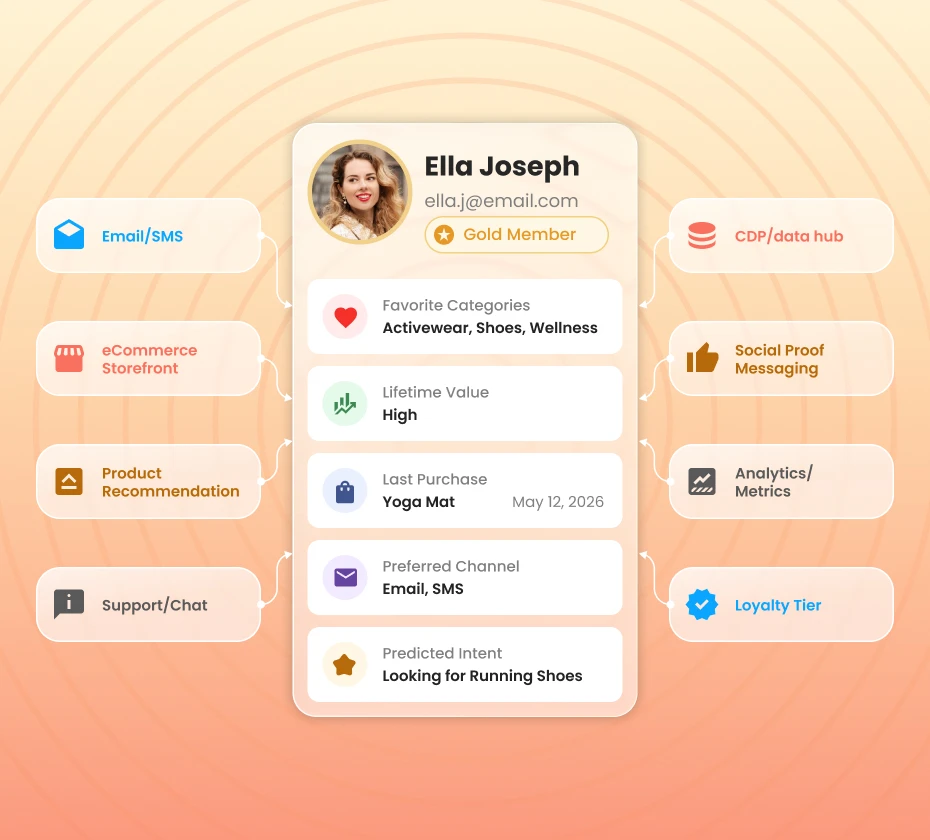
The truth is, most retailers don’t have a personalisation problem, they have a data problem. Personalisation fails when customer data lives in silos, updates slowly, or lacks the consistency needed to reflect real customer behaviour. Without a reliable data foundation, even the most advanced AI models or marketing automations can’t deliver the contextual relevance customers expect. This is where Customer Data Platforms (CDPs) come in. Rather than just another marketing tool, a CDP serves as the connective tissue powering intelligent commerce. It unifies customer information from every channel into a single, usable view, enabling brands to deliver targeted experiences that feel seamless, timely, and relevant. But personalisation is not just about sending the right email. It is about building trust, improving lifetime value and moving beyond one-size-fits-all campaigns.

But adopting a CDP isn’t just about technology; it’s about building the right data foundation to turn insight into action, and shifting from campaigns that speak to audiences, to conversations that speak to individuals.

Stages of Customer Data Maturity

Although all customer data solutions share the same ultimate goal of unifying and activating customer data, every retailer is at a different stage of data maturity.  The real question is: where is your organisation on its journey from data collection to data-driven personalisation? Broadly, customer data solutions can be viewed across four maturity stages with Customer Data Platforms (CDPs) sitting at the core bridging insight and activation

1. Data Integration Systems  – Building the Foundation 

These focus on collecting data from multiple sources such as websites, apps, CRM and loyalty systems, and merging them into a single customer profile. They are ideal for businesses that struggle with fragmented data and need a strong foundation before moving into analytics or campaigns.

2. Analytics-Driven Services – Turning Data into Insight

Once data is unified, analytics-driven services provide insights: who your customers are, what they want and what they are likely to do next. They excel at segmentation and predictive analytics, making them a good fit for retailers ready to optimise their targeting and forecast trends.

3. Campaign Execution Services – Turning Insight into Action

These are designed to act on insights in real time by triggering personalised marketing campaigns across email, SMS, apps and websites. They are perfect for brands focused on outreach, engagement and retention. But when built on incomplete data, they can do more harm than good by amplifying inconsistencies instead of relevance.

4. Enterprise-Grade Solutions – Scaling with Trust and Governance

For large retailers with complex needs, enterprise-grade systems offer scalability, robust security, advanced compliance features and deep integration with other business systems. They are suited for organisations managing millions of records across multiple geographies.

Each of these categories sits under the same umbrella of customer data solutions but solves a different problem. Choosing the right one depends on whether your priority is building the data foundation, gaining insights, activating campaigns or scaling securely. When selecting among top customer data platforms, knowing which category you need is critical.

Core Features That Power Ecommerce Customer Data Solutions

Behind every truly personalised shopping experience is a powerful data foundation, not just the right tools, but the right capabilities working together. These features work together to create the backbone of personalisation.

1. Identity Resolution – Building the Single Source of Truth

This capability recognises and merges data from multiple touchpoints such as mobile, desktop, in-store and email to build a single view of each customer. This “single customer view” is the backbone of personalisation. Without it, personalisation efforts remain fragmented and inaccurate.

2. Segmentation – From Demographics to Intent

Traditional segmentation stops at demographics; modern CDPs go deeper, grouping customers dynamically based on behaviour, purchase patterns and engagement signals. This makes campaigns more precise, such as targeting high-value customers with exclusive offers or sending timely reminders to lapsed shoppers.

3. Real-Time Data Processing – Keeping Personalisation Relevant

In today’s e-commerce landscape, relevance has a shelf life of seconds. Customer behaviour changes constantly. Real-time processing ensures that profiles are updated immediately, so the recommendations or offers a shopper sees today reflect their latest actions, not outdated information.

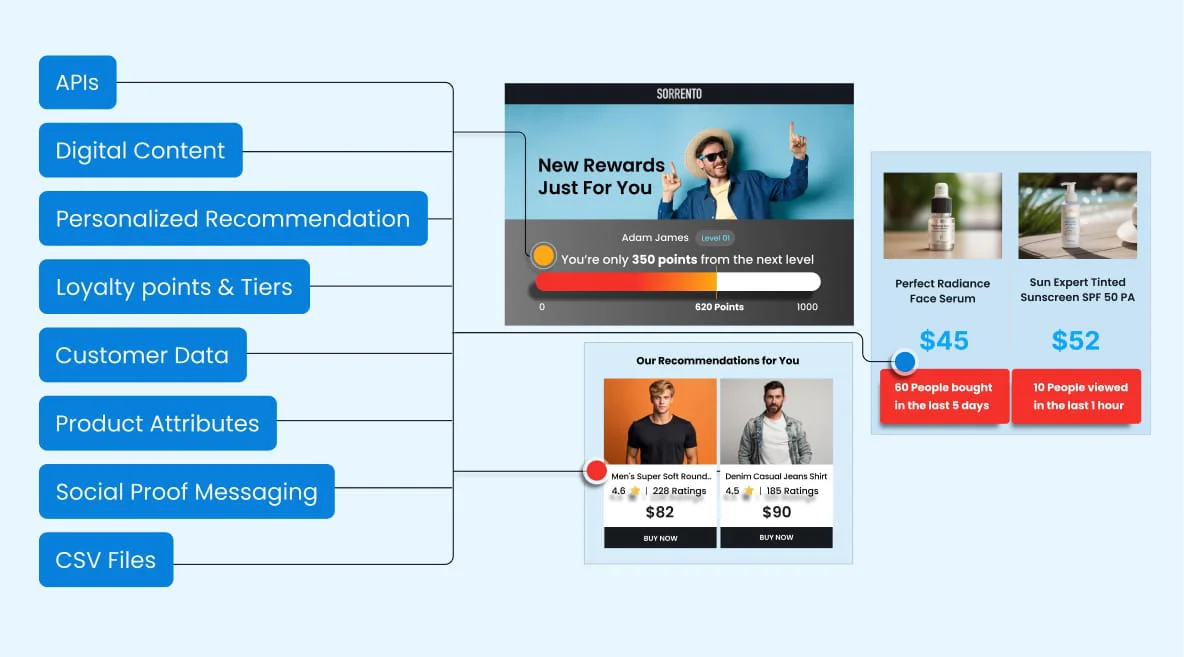
4. AI-Driven Recommendations – Turning Data into Experience

Machine learning is where insights become action. It analyses vast amounts of data to predict what customers might want next. This could be suggesting complementary products, personalising homepage content or recommending loyalty rewards likely to motivate purchase.

Together, these features turn raw information into actionable insights and automated personalisation at scale, a capability often associated with leading CDP platforms.

Applications of Customer Data Solutions in Ecommerce Personalisation

Once a strong data foundation is in place, the power of a Customer Data Platform (CDP) for ecommerce becomes tangible. Personalisation powered by customer data services can be applied across many areas of the online shopping experience. Here are some of the most common examples.

1. Personalised Product Recommendations

An online fashion retailer uses browsing history and past purchases to recommend outfits that complement items already in a customer’s basket. This increases average order value through cross-selling.

2. Dynamic Website and App Content

A beauty brand shows personalised banners on its homepage, promoting skincare routines based on a visitor’s previous purchases and preferences, creating a more relevant shopping journey.

3. Email and SMS Personalisation and Targeting

A pet supply store sends follow-up emails timed to when customers typically reorder dog food, boosting repeat purchases and retention.

4. Abandoned Cart Recovery with Tailored Offers

A home décor shop sends a discount code on the exact lamp a customer left in their cart, prompting them to complete the purchase.

5. Loyalty and Retention Campaigns Based on Behaviour

A subscription box service identifies its most active subscribers and offers them early access to new products, while also re-engaging at-risk customers with special renewal offers.

6. Lookalike Audience Building for Acquisition

A sports equipment retailer analyses its top customers’ profiles and then syncs these high-value segments to ad platforms, where algorithms identify similar prospects for targeting. This enables more efficient acquisition and mirrors a capability often supported by leading CDPs.

Across industries, brands applying these practices report higher order values, lower cart abandonment and stronger long-term customer loyalty.

Challenges and Best Practices When Implementing Customer Data Personalisation

Many retailers underestimate the complexity of personalisation. Ignoring the real challenges can lead to costly mistakes. Some of the most common pain points include:

1. Fragmented and Inconsistent Data

Retailers often underestimate how legacy systems quietly sabotage personalisation. Customer information is often spread across multiple systems such as e-commerce websites, mobile apps, CRM, email marketing and loyalty schemes. Without proper integration, data becomes duplicated, outdated or incomplete. This results in inaccurate profiles and ineffective targeting.

Principle: Data unification before activation. 

Every successful CDP implementation is built on the journey toward a single, trusted view of the customer. The one that consolidates, cleanses and governs data before it reaches any marketing layer.

2. Compliance and Privacy Risks

With regulations like GDPR and other data protection laws, collecting and using customer data incorrectly can lead to legal penalties and reputational damage. Many retailers lack clear processes for consent management and secure data handling.

Principle: Compliance is not a checklist, it’s a trust strategy. 

Retailers that integrate privacy by design, audit data flows regularly, and make consent management visible don’t just avoid risk; they build loyalty through integrity.

3. Siloed Teams and Poor Adoption

Marketing, IT and customer experience departments often work separately. This makes it difficult to share insights and coordinate campaigns. We often see brands rush to adopt advanced CDPs without first aligning on shared goals or KPIs, resulting in inconsistent execution and underused capabilities.

4. Slow or Outdated Data Processing

If customer data updates only once a day or once a week, recommendations and campaigns become irrelevant by the time they reach the customer. Real-time interactions require systems capable of instant updates.

Principle: Real-time intelligence drives real-time engagement.

Modern CDPs for ecommerce process updates instantly, allowing brands to react to intent as it happens, not after it fades.

5. Overly Complex Implementations

Jumping straight into enterprise-scale personalisation without a phased plan can overwhelm teams, delay results and waste budget.

Principle: Maturity is built in phases, not leaps.

Start with the use cases that bring visible impact such as abandoned cart recovery, replenishment reminders, or loyalty reactivation. Then scale into predictive and AI-driven personalisation as your data foundation strengthens.

With these practices in place, customer data personalisation moves from a difficult, risky undertaking to a powerful driver of growth and customer satisfaction.

Conclusion

Ecommerce personalisation isn’t just about knowing what to recommend next, it’s about knowing your customer well enough to act on that insight instantly and responsibly. That level of intelligence doesn’t come from more marketing tools, but from a stronger data foundation.

With a modern customer data solution for ecommerce, brands can turn fragmented data into a powerful engine for engagement, loyalty and growth.

Ecommerce personalisation succeeds when it’s built on a strong data foundation, not just more technology. The real advantage comes from data maturity: connecting strategy, infrastructure, and execution through a single, trusted view of the customer.

Forward-thinking retailers are already moving this way, using customer data strategies powered by AI to turn insight into real-time engagement.

At ADA, we help businesses build that foundation, from unifying data, ensuring governance, and activating intelligence across every channel. The result is scalable, AI-driven personalisation that turns every interaction into a moment of value.

How Customer Data Platforms (CDPs) Power Growth in the Retail Sector

Post
Blogs

How Customer Data Platforms (CDPs) Power Growth in the Retail Sector

Have you ever wondered why, despite collecting vast amounts of customer data, your marketing campaigns still miss the mark?

You’re not alone. 44% of marketers say they struggle with fragmented data scattered across multiple databases, making it nearly impossible to deliver the kind of personalised experiences customers now expect. Many retailers struggle with fragmented information spread across various channels that prevents them from seeing a clear, unified picture of their customers. Without that single view, opportunities for stronger loyalty, smarter promotions, and more informed decision-making are often lost.

This is where a Customer Data Platform (CDP) comes in. A customer data platform for retail businesses solution centralises, unifies, and manages customer data from multiple sources to create comprehensive customer profiles. In the retail sector, it provides businesses with a complete view of their customers, enabling more targeted marketing, improved retention, and sustainable growth. By working with unified data, retailers can strengthen engagement and loyalty programmes while ensuring every interaction feels more relevant.

How CDPs Benefit the Retail Sector

Retailers today generate huge amounts of data from websites, mobile apps, loyalty schemes, email campaigns and in-store systems. Without a way to bring this data together, valuable insights remain hidden and customer experiences stay fragmented.

A retail CDP solves this challenge by serving as a central hub that gathers customer data from every online and offline touchpoint.  This includes online purchases, point-of-sale transactions, customer support interactions, social engagement and third-party sources. It then organises, cleans and unifies this information into individual customer profiles, and forms a unified customer view that serves as a reliable source of truth for marketing and engagement

With the rise of AI-driven personalisation and tighter privacy regulations, building this unified data foundation is no longer optional, it’s now the cornerstone of competitiveness. Retailers that embrace a unified retail data strategy through a modern, omnichannel-capable CDP can unlock richer insights, deliver consistent engagement across channels, and ensure compliance without sacrificing personalisation.

This process matters because it creates a single, accurate source of truth about each customer. Retailers can see patterns that would otherwise go unnoticed, such as repeat purchasing behaviour or signs that a customer may be about to leave. With this clarity, marketing and operations teams can plan actions based on real evidence rather than guesswork.

The benefits extend beyond marketing teams. Product managers gain a clearer view of demand trends, helping them choose which products to stock or promote. Customer service teams can personalise support by accessing a customer’s complete history. Senior decision-makers can forecast more accurately and allocate budgets more effectively.

In short, a Customer Data Platform for retail businesses doesn’t just store data, it transforms scattered information into actionable intelligence. This unified approach allows retailers to deliver more relevant offers, strengthen loyalty programmes, reduce churn and make smarter operational decisions across the business.

Overcoming CDP Implementation Challenges in Retail 

Even with the right strategy, implementing a CDP e-commerce solution can be challenging when deeper organisational silos exist. Data is often scattered across regions, systems, and teams, the result of years of growth without clear integration or governance. This leads to inconsistent data quality, duplicated records, and fragmented customer journeys that limit the effectiveness of the CDP solution.

Technology alone cannot fix data silos. The real issue often lies in alignment between marketing, IT, and operations. A successful retail CDP strategy depends on collaboration and shared ownership of data governance, ensuring every department contributes to and benefits from a unified customer view.

When these problems are identified early, retailers can take proactive steps to address them before they affect performance. This may include setting clear data standards, developing a cross-department integration plan, and selecting a CDP service that can connect seamlessly to existing systems. Early action makes it far easier to ensure a smooth rollout and minimise disruption.

If the issues are discovered later, such as when campaigns begin to underperform or customers start receiving inconsistent messages, recovery is still possible. It typically involves a structured clean-up phase where data is audited, duplicate records are removed, and a phased integration approach is implemented. The key to long-term success is a strong data governance framework that aligns IT, marketing, and operations teams around a shared goal of delivering consistent, personalised experiences.

Regardless of timing, there are three essential steps to overcoming these challenges:

  • Choose a scalable CDP that supports multiple data sources.
  • Strengthen collaboration to improve accuracy and trust.
  • Enforce privacy and compliance to maintain customer confidence.

Together, these steps represent retail CDP integration best practices that turn data challenges into strategic advantages.

Key CDP Use Cases in Retail

1. Personalised Marketing Campaigns

How it works: A CDP gathers purchase history, browsing behaviour and customer preferences from every channel and builds a unified profile for each shopper. This data allows marketing teams to craft messages, offers and promotions that directly match what individual customers are most likely to respond to.

Example: A fashion retailer can identify customers who frequently browse but rarely buy, then send them targeted discounts on the items they view most often. With AI-powered insights from CDPs”, these campaigns can also be automated and optimised in real time, improving conversion rates and reducing ad waste.

2. Omnichannel Customer Engagement

How it works: By combining data from physical stores, e-commerce sites, mobile apps and email, a CDP creates a consistent customer identity across all channels. This makes it possible to deliver the same message and level of service regardless of where the customer interacts.

Example: A homeware brand uses its CDP to recognise a customer who browses products online and then visits the store. Staff can instantly access the customer’s browsing history and recommend matching items in person, creating a seamless shopping experience.

3. Loyalty and Rewards Optimisation

How it works: A CDP analyses loyalty programme data alongside purchase behaviour and engagement patterns. This enables retailers to adjust reward tiers, timing and incentives based on what motivates each customer segment.

Example: A supermarket chain notices that a group of customers regularly buy premium products but rarely redeem loyalty points. By offering tailored double-point promotions on those items, it encourages repeat spending and deeper loyalty.

4. Product Recommendations and Upselling

How it works: Using real-time behavioural data, CDPs generate product suggestions linked to each customer’s purchase history and interests. These insights can be applied online, in email campaigns or even in-store via staff devices.

Example: An electronics retailer can automatically recommend compatible accessories after a customer buys a new phone. AI-enabled product recommendation engines with CDPs can refine suggestions with every interaction, maximising relevance and upsell opportunities.

5. Customer Segmentation for Targeted Offers

How it works: A CDP allows for dynamic segmentation by blending demographic, transactional and behavioural data. Retailers can quickly identify high-value groups, new customers or at-risk segments and address each with a specific marketing message.

Example: A beauty brand uses its CDP to create a segment of customers who purchased skincare products within the last three months. It then sends those customers a personalised trial offer for a new complementary product, resulting in higher take-up rates.

6. Reducing Churn with Predictive Analytics

How it works: Some CDPs include predictive models that flag customers likely to reduce their spending or leave entirely. Retailers can then take proactive measures to re-engage them.

Example: A subscription box company sees that a segment of customers has reduced their order frequency. With an AI-powered CDP, it automatically triggers a personalised offer to re-engage the group, improving retention and protecting revenue.

7. Inventory and Demand Planning Insights

How it works: By analysing aggregated purchase patterns and customer interest trends, a CDP can reveal which products are gaining or losing popularity. This helps retailers plan stock levels and forecast demand with greater accuracy.

Example: A sports retailer notices through its CDP that a new line of trainers is trending among a certain age group before sales peak. It increases orders in time to meet the surge in demand, reducing stockouts and lost sales.

Real-World Example: How Zalora Uses Data to Power Retail Success

A strong example from Southeast Asia is Zalora’s Southeast Asia Trender Report 2022. As one of the region’s leading online fashion retailers with over 59 million monthly visits, Zalora taps into extensive customer transaction and behavioural data collected through its platform. It uses these insights to help brands understand shifting preferences, purchase behaviour and emerging retail trends across diverse, mobile-first markets.

This data-driven approach powers hyper-personalisation, targeted marketing and accurate trend forecasting, illustrating how a unified view of customer data can drive better experiences and stronger results. The report is publicly available and offers a clear example of how Asian retailers are already using integrated data to transform marketing and customer engagement, even if they do not specifically refer to it as a CDP. For retailers seeking a customer data platform case study, it serves as a strong demonstration of what effective data integration can achieve.

As more Southeast Asian retailers adopt CDP frameworks, the competitive advantage will shift from access to insight, from who has data to who uses it best.

Mapping Out a CDP Strategy for Retail

Retailers that successfully embed a CDP into their operations often see transformational results. By moving from scattered, inconsistent information to a unified customer view, they are able to deliver experiences that feel personal at scale, strengthen loyalty programmes, and make smarter inventory and marketing decisions. In highly competitive markets, this capability can be the difference between incremental growth and a real step change in performance.

To achieve this, retailers need more than just the technology. They need a clear, deliberate strategy. A CDP is most effective when it is aligned with the business’s wider objectives and supported by consistent processes across departments. When implemented correctly, it becomes not only a source of customer insights but also a driver of operational efficiency and long-term value.

The most successful approaches typically follow four key steps:

  • Define clear goals linked to business priorities. Start by identifying what you want the CDP to achieve, such as increasing customer lifetime value, improving campaign effectiveness or gaining better demand forecasts. Goals provide a benchmark for measuring success.
  • Integrate customer data from all relevant sources. Bring together data from online and offline interactions, loyalty schemes, support channels and third-party sources. Make sure the data is accurate, complete and compliant with privacy regulations to ensure the insights are reliable.
  • Use insights to execute personalised campaigns and consistent engagement across channels. With a unified customer view, marketing teams can deliver offers and content that resonate, while customer service teams can provide informed support across every touchpoint.
  • Continuously measure results and refine tactics using real-time analytics. Monitoring outcomes allows you to adapt campaigns, optimise incentives and adjust operations to maintain impact over time.

Conclusion

Retailers that follow these steps can expect tangible benefits: higher conversion rates, stronger repeat purchase behaviour, more effective loyalty programmes and better demand planning. Over time, a CDP strategy can shift customer relationships from transactional to truly personalised, creating a competitive advantage that is difficult for others to replicate.

True transformation does not come from adding another system. It happens when data, people, and purpose work in alignment. Retailers that establish clear objectives, enforce strong data governance, and activate insights in real time will define the next era of customer experience.

The future of retail growth will belong to those who use better data and make it unified, governed, and AI-ready.


At ADA, our AI-Powered Customer Data Platform solutions help retailers integrate, govern and optimise their data so they can deliver measurable results from day one.

By taking this step now, retailers can move from fragmented data and missed opportunities to a future of stronger loyalty, higher growth and truly personalised customer experiences.

Get in touch with ADA today.