
Predictive Analysis 101: Smarter Forecasting, Faster Decisions

Post
Insights

Predictive Analysis 101: Smarter Forecasting, Faster Decisions

Ever feel like you are always on a reactive mode, never quite seizing ripe opportunities in your business? Perhaps you are drowning in unreliable data, operating blind and without any actionable insight.

But what if you could cut through all the fog, the noise and uncertainty? What if predictive data analytics could help you anticipate your customer needs, optimise your business operation, and actually outpace your competitors?

Well, the most powerful predictive analytics won’t just illuminate the path forward, they strategically constrain your future. Think beyond simple forecasting. Advanced predictive models don’t just tell you what might happen; they reveal the hidden boundaries of your possible futures based on current trajectories and constraints.

This guide serves as a practical resource to harness its capabilities. Be it a large corporation or small business start-up, predictive analytics help replace uncertainty with data-driven foresight. And, by effectively converting historical data into actionable insights, businesses can develop a powerful strategic asset for competitive advantage.

The promise of predictive analytics is clear, yet many businesses find the journey from raw data to actionable foresight challenging. True data transformation isn’t just about deploying a model; it requires a seamless, end-to-end data ecosystem that consistently delivers reliable, strategic insights, bridging the gap between possibility and tangible business value.

Let’s decode it together.

What is Predictive Analytics?

Predictive analytics is a branch of advanced analytics that uses historical data, statistical algorithms, and machine learning techniques to identify the likelihood of future outcomes. It moves beyond descriptive analytics (what happened) and diagnostic analytics (why it happened) to provide actionable forecasts about what will happen. However, effectively translating this capability into tangible business value requires more than just algorithms – it demands a deep understanding of data quality, model deployment, and strategic integration

For a business, this capability is transformative. It allows leaders to:

  • Anticipate Market Trends: Understand shifting customer demands and behaviors.
  • Mitigate Financial Risks: Identify the probability of events like loan defaults or fraudulent transactions.
  • Optimize Operations: Forecast inventory needs, plan for equipment maintenance, and allocate resources efficiently.

Here are some examples of Predictive Analytics Use Case and how leading sectors use it to their advantage:

  1. HR Departments: Used to predict employee flight risks by analyzing employee sentiment and performance data. This allows targeted retention efforts.
  2. Healthcare: Used in hospitals to predict outcomes from different patients. This could include, patient history or risk or patient readmission.
  3. Supply chain Leaders: Walmart for instance uses predictive analytics to forecast demand with uncanny accuracy. This helps them minimise stock outs and excess inventory.
  4. Finance Institutions: They rely on predictive models for real time fraud detection and precise credit scoring. This helps safeguard assets and optimise lending.
  5. Energy: The firms avert costly downtime through predictive maintenance. For instance, they can analyse sensor data to fix equipment before it fails.

How Predictive Analytics Work

Predictive analytics helps transform raw data into foresight. Here are steps on how it works:

1. Define the goal

Helps answer questions such as, ‘what specific future outcome do you want to predict?’ This could be customer churn, equipment failure or even a sales forecast. Begin with a specific, measurable goal. For example, “Reduce customer churn by 15%” or “Improve inventory forecasting accuracy by 30%.”

2. Aggregate and Prepare the Data

This is often the most critical and complex phase. It involves collecting relevant historical data from diverse sources (CRM, ERP, IoT sensors, web logs), followed by rigorous cleansing, transformation, and structuring into a usable format. Without a solid, clean data foundation, even the most advanced models will falter, making this a non-negotiable step for reliable predictions.

3. Develop and Train the Model

Here, you select and build the most appropriate statistical or machine learning model based on your defined goal, the nature of your data, and the type of outcome you aim to predict. This crucial choice lays the groundwork for all subsequent insights; a mismatch here can lead to misleading predictions or missed opportunities. Choosing the right “engine” for your insights is paramount for accurate, meaningful predictions.

Common model types include:

  • Classification Models: For categorising outcomes into distinct groups (e.g., identifying high-risk loan applicants or predicting customer churn).
  • Regression Models: For forecasting continuous numerical values (e.g., predicting future sales revenue or customer lifetime value).
  • Time Series Models: For sequential data collected over time, ideal for spotting trends, seasonality, and making future projections (e.g., website traffic, demand changes).
  • Clustering Algorithms: To discover hidden patterns by grouping similar data points without predefined labels, invaluable for customer segmentation or anomaly detection.

Once selected, the chosen model is then “fed” your prepared historical data. This training process allows the model to learn patterns and relationships from past outcomes, preparing it to make predictions on new, unseen data.

4. Validate and Test

This step involves rigorously testing its predictive power using new datasets it hasn’t seen before. Refinements are made as needed to ensure its reliability and practical utility before deployment.

5. Deploy and Predict

Once validated, the model is integrated into your existing business workflows. This is when it begins generating real-time predictions that can directly inform daily decision-making, moving your operations from reactive guesswork to proactive strategy.

6. Monitor and Refine

Continuously retrain your models with new data to maintain their accuracy, as performance can degrade as market conditions change. That’s because market conditions and customer behaviors evolve rapidly, it may cause inaccuracy if the models are regularly retrained with new data.

What Is the Difference Between Predictive Analytics and Prescriptive Analytics?

These two terms are often used interchangeably, thus causing confusion. However, both have distinct purposes. Think of one as the engine and the other the driver.

So, what is predictive analytics? It’s the (engine) that focuses on forecasting future possibilities. It identifies a future risk or opportunity, thus answering questions such as ‘what is likely to happen if this current trend happens? For example, it can predict which customers are at the highest risk of churning in the next quarter.

Prescriptive analytics (driver) on the other hand, goes an extra mile into recommending the best actions to take based on those predictions. For instance, ‘what should we do about it?’ Using the previous example, it might recommend a specific retention offer for each high-risk customer to maximise the chance they will stay.

Predictive analytics provides the essential foresight that makes effective prescriptive actions possible. We recognize that true strategic advantage comes from seamlessly connecting these two – providing not just ‘what will happen,’ but also ‘what to do about it,’ ensuring predictions drive concrete, measurable outcomes.

The Pitfall of Choosing the Wrong Model: When Analytics Go Astray

Even with pristine data and clear objectives, the journey to impactful predictive analytics can falter at a critical juncture: choosing the wrong model. This isn’t merely a technical misstep; it’s a strategic pitfall that can lead to misleading predictions, wasted resources, and a corrosive loss of trust in your data initiatives.

The vast landscape of predictive models—from regression to classification, time series to clustering—each serves a unique purpose. Applying the right “engine” to the right business challenge is paramount. A mismatch, however subtle, can send your analytics efforts veering off course.

Consider these common scenarios where a seemingly minor model misstep can have significant real-world consequences for businesses:

  • The Seasonal Sales Blind Spot: An ecommerce business uses a simple linear regression model for seasonal sales peaks, ignoring crucial holiday trends. This leads to overstocking during slow periods and frustrating stock outs during peak demand, directly harming profitability.
  • Misinterpreting Customer Behavior: A bank uses a basic regression model to predict loan default (a “yes/no” outcome), rather than a classification model. This produces ambiguous scores, leading to inconsistent loan approvals and a rapid erosion of trust in the data, causing staff to abandon the analytics initiative.
  • Suboptimal Operations: A manufacturing plant relies on a simplistic model for predictive maintenance, ignoring real-time sensor data needed for advanced time series analysis. This results in unexpected, costly equipment failures, production halts, and missed deadlines.

These scenarios underscore a critical truth: predictive analytics thrives not just on data, but on applying the right analytical lens for valuable foresight. A one-size-fits-all approach to modeling often leads to frustratingly misleading predictions, rather than the competitive edge you seek.

So, how do businesses consistently overcome these complex challenges to build genuinely reliable and impactful predictive capabilities?

From Pitfalls to Proficiency: Embracing Seamless Predictive Solutions

As we’ve explored, the journey to impactful predictive analytics is fraught with common pitfalls, particularly when a mismatched model leads to misleading predictions and operational setbacks. These are not merely technical glitches; they are symptoms of fragmented data strategies and a lack of integrated foresight. The true challenge isn’t just building a model, but ensuring it consistently delivers accurate, actionable insights directly into the hands of decision-makers.

This is precisely where the concept of seamless integration emerges as the ultimate differentiator – it’s the bridge from potential pitfalls to sustained competitive advantage. Seamless integration means more than just connecting systems; it signifies a holistic approach where:

  • Your Data Flows Intelligently: From disparate sources, data is expertly engineered, cleansed, and prepared, ensuring it’s always ready to fuel the right models.
  • Models Are Not Isolated Assets: The chosen predictive models (perfectly aligned with your goals, preventing the “wrong model” pitfall) are designed to fit directly into your operational workflows, making predictions an organic part of daily business.
  • Foresight Becomes Action: Predictions are not just numbers; they are delivered in real-time, within the tools and dashboards your teams already use, driving proactive decisions without manual intervention.
  • Continuous Value is Guaranteed: The entire pipeline – from data ingestion to model output – is monitored and optimised, ensuring accuracy doesn’t degrade over time, and adjustments are made proactively to maintain relevance.

At ADA, our thought leadership is rooted in this end-to-end philosophy of seamless integration. We understand that preventing the “wrong model” pitfall, avoiding suboptimal operations, and fostering trust in analytics demands a partner who can connect every dot in the data value chain.

Key Takeaways

  • Predictive analytics forecasts future probabilities using historical data and sophisticated models.
  • It fundamentally differs from prescriptive analytics, which recommends actions.
  • Core techniques include regression, classification, clustering, and machine learning.
  • Benefits span revenue growth, risk reduction, operational efficiency, and superior customer experiences.
  • Success requires clear use cases, quality data, the right tools, and expertise. Tools like ADA’s solutions make implementation smoother and more scalable.
  • Real-world applications prove its transformative power across industries.

Predictive Analytics FAQs for Business

  1. Do I need massive amounts of data for predictive analytics to work?
    Not necessarily. Quality comes first, more than sheer volume. Thus, start with relevant, clean data for your specific use case. A focused dataset can still yield powerful insights when paired with the right models and infrastructure.
  1. How accurate are predictive analytics models?
    Accuracy varies based on model choice, complexity of the problem and your data quality. No model is 100% perfect, but even a 70-80% accuracy could drive significant value over guesswork. At ADA, we help clients to select and validate the right model for your business objective.
  1. Is predictive analytics only useful for large corporations?
    Absolutely not! Cloud platforms and user-friendly tools make predictive analytics readily accessible to mid-sized businesses.
  1. How long does a predictive analytics implementation take?
    A simple project can yield results in weeks. Complex enterprise deployments take months.
  1. What internal skills are needed to run predictive analytics?
    While data scientists are ideal, business analysts with training and the right tools can handle many tasks. Partnering with experts bridges the gap with ease.

Conclusion

The ability to accurately forecast future outcomes is no longer a luxury, it is a core component of modern business strategy. Businesses that effectively harness predictive analytics are better positioned to navigate uncertainty, optimise performance, and create sustainable growth.

The defining challenge for most leaders is not whether to adopt these capabilities, but how to do so efficiently without a protracted implementation timeline. At ADA, we address this challenge with a true end-to-end solution.

Our expertise spans the entire data value chain: from unifying data collection and structuring data organisation, to delivering advanced data analytics and deploying predictive AI. This comprehensive capability is the foundation of our turnkey solutions, which deploy rapidly to deliver actionable insights from day one.

Contact us now to begin transforming your data into a strategic asset!

10 Proven Ecommerce Promotion Strategies to Boost Sales and Revenue

Post
Insights

10 Proven Ecommerce Promotion Strategies to Boost Sales and Revenue

1. Free Shipping (Threshold-Based or Sitewide)

How and Why It Works:
Free shipping removes one of the biggest barriers to purchase, helping to reduce basket abandonment. Threshold-based free shipping encourages customers to add more items to reach the minimum spend, increasing average order value (AOV). Sitewide free shipping, on the other hand, simplifies the decision-making process by eliminating unexpected fees altogether.

Example:
Amazon offers free shipping on orders over $25, encouraging customers to add extra items to qualify.

What to Avoid:

  • Setting thresholds that are far above the average order value
  • Ignoring the impact on margins when shipping costs are absorbed
  • Adding shipping fees late in the process, which creates frustration

Tips for Success:

  • Position free shipping thresholds just above your average order value to drive upsells
  • Communicate shipping policies clearly and early
  • Use sitewide free shipping during key holidays to maximise conversions

2. Limited-Time Flash Sales or Deal of the Day

How and Why It Works:
Flash sales create urgency and scarcity, prompting quick decisions from shoppers who fear missing out. These ideas for promotions generate short bursts of traffic and are effective at converting hesitant buyers.

Example:
Sephora’s “Deal of the Day” encourages daily check-ins as customers look for limited-time offers.

What to Avoid:

  • Overusing flash sales, which trains customers to wait for discounts
  • Poorly communicating the sale duration, leading to confusion
  • Frequent sales that weaken brand perception

Tips for Success:

  • Build anticipation by promoting sales in advance through email and social channels
  • Use countdown timers to make urgency visible and credible
  • Focus discounts on specific, high-impact products rather than across the board

3. First-Order “Welcome” Discount

How and Why It Works:
A first-order discount lowers the barrier to entry for new customers, encouraging trial while also building your email list. This marketing promotion idea can be highly effective for acquisition.

Example:
New customers get 15% off their first purchase after subscribing to its newsletter.

What to Avoid:

  • Offering discounts so large that they undermine profitability
  • Allowing discounts to be used repeatedly
  • Forcing signups without a clear and immediate benefit

Tips for Success:

  • Deliver welcome offers instantly after signup to capture interest
  • Set expiry dates to create urgency
  • Keep redemption simple with automatic discounts or easy codes

4. BOGO, Multi-Buy and Quantity Breaks

How and Why It Works:
Buy One, Get One (BOGO) deals and tiered discounts encourage larger purchases. They also help clear inventory while being one of the best eCommerce offers for high-margin items.

Example:
CVS Pharmacy often runs BOGO promotions on health and beauty items, increasing sales volume.

What to Avoid:

  • Applying BOGO to low-margin products
  • Making rules overly complex
  • Offering deals on clearance stock not intended for fast turnover

Tips for Success:

  • Clearly display the savings customers will enjoy
  • Focus promotions on strong-margin products
  • Use tiered discounts to motivate higher spending

5. Product Bundles to Lift AOV

How and Why It Works:
Bundling complementary items enhances perceived value and convenience while increasing average order value. Customers see ready-made solutions, not just individual products.

Example:
Dollar Shave Club offers bundles of razors, blades and shaving cream at a discounted price, encouraging larger purchases.

What to Avoid:

  • Bundling unrelated or slow-moving products
  • Applying discounts so steep that they erode margins
  • Failing to promote bundles prominently

Tips for Success:

  • Group naturally related products together
  • Balance discounts to remain profitable
  • Feature bundles on key site pages to maximise visibility

6. Gift with Purchase (GWP)

How and Why It Works:
A free gift adds perceived value without heavy discounts. This marketing promotion idea motivates customers to increase spend while leaving a positive impression.

Example:
Clinique offers travel-sized products free with orders over $50, boosting average basket size.

What to Avoid:

  • Giving irrelevant or low-value gifts
  • Providing costly items without setting a minimum spend
  • Failing to explain the qualification clearly

Tips for Success:

  • Choose gifts that are desirable and relevant to your audience
  • Set spend thresholds to increase order size
  • Promote the offer widely and clearly across your site

7. Loyalty Rewards and Referral Incentives

How and Why It Works:
Rewards programmes encourage repeat purchases through points or perks, while referral incentives leverage existing customers to bring in new ones. Both approaches strengthen customer lifetime value.

Example:
Starbucks Rewards offers points for purchases and bonuses for referrals, boosting both frequency and acquisition.

What to Avoid:

  • Making the reward structure too complicated
  • Allowing rewards to expire without reminders
  • Overlooking referral fraud risks

Tips for Success:

  • Keep rewards simple and achievable
  • Offer exclusive perks or early access to make programmes attractive
  • Provide easy-to-use referral tools with clear benefits

8. Abandoned-Basket and Exit-Intent Offers

How and Why It Works:
Targeting customers who leave without completing their purchase helps recover lost sales. Timely offers or reminders address hesitation and nudge them to return.

Example:
Wayfair uses exit-intent pop-ups with discounts, as well as abandoned-basket emails, to re-engage potential buyers.

What to Avoid:

  • Sending too many messages or intrusive pop-ups
  • Offering discounts so steep that they cut too deeply into profit
  • Sending generic, impersonal reminders

Tips for Success:

  • Send personalised recovery emails within an hour
  • Use exit-intent offers such as free shipping or small discounts
  • Include product images and details to jog memory

9. Seasonal and Holiday Campaigns

How and Why It Works:
Tying promotions to seasonal moments or holidays creates relevance and urgency. Customers are more motivated to buy when offers align with current needs or occasions.

Example:
Macy’s runs back-to-school promotions with targeted discounts, driving seasonal demand.

What to Avoid:

  • Launching too late and missing peak shopping windows
  • Using generic campaigns that lack emotional connection
  • Discounting too heavily, damaging margins

Tips for Success:

  • Plan campaigns early and align creative to the season
  • Use themed visuals and copy that connect emotionally
  • Combine offers such as free shipping with a percentage discount

10. Influencer, Affiliate Promo Codes and Social Giveaways

How and Why It Works:
identifies the best eCommerce offers for your business context, helps you optimise pricing, personalise offers and allocate resources to maximise ROI. With continuous tracking and actionable recommendations, ADA ensures every marketing promotion idea is data-driven and performance-focused.

With ADA’s technology and strategic guidance, businesses can move beyond guesswork to run smarter, data-driven promotions that increase revenue while protecting margins. This ensures promotional efforts not only deliver short-term sales uplifts but also build long-term customer loyalty and sustainable growth.

Ready to unlock the full revenue potential of your eCommerce promotions?

Partner with ADA to harness tailored strategies, expert support and impactful ideas for promotions that deliver measurable results. Influencers and affiliates help brands reach targeted audiences with authentic endorsements. Promo codes enable tracking, while giveaways build excitement and expand reach.

Example:
A fitness apparel company partners with micro-influencers who share unique promo codes, increasing sales and followers.

What to Avoid:

  • Working with influencers who lack audience alignment
  • Running campaigns without clear KPIs
  • Overusing giveaways, which can dilute brand value

Tips for Success:

  • Vet influencers carefully to ensure relevance
  • Create exclusive, trackable codes
  • Encourage sharing through engaging social giveaways

How to Choose the Right Promotion and Measure Its Effectiveness

The most effective promotions are not chosen at random but carefully designed to balance profitability, inventory priorities and customer behaviour. Measuring impact is just as important as execution, ensuring that promotions genuinely grow revenue instead of simply shifting sales or cutting into margins.

Selecting the Right Promotion

  1. Consider Your Margin
    Choose promotions that protect profitability. High-margin products can support deeper discounts or BOGO deals, while low-margin or commodity items are better suited to offers such as free shipping or gift-with-purchase. Always evaluate the expected margin impact before launching.

  2. Evaluate Inventory Levels
    Promotions are a powerful tool for managing stock. Use flash sales or multi-buy offers to clear excess inventory, but avoid heavy discounts on popular items that sell well at full price. Bundling slow-moving products with bestsellers can increase appeal without hurting profits.

  3. Understand Your Audience
    Tailor promotions to different customer segments. First-time buyers may respond strongly to welcome discounts, while returning customers are often motivated by loyalty rewards, bundles or exclusive perks. Analysing purchasing patterns helps ensure offers meet expectations and resonate.

Measuring Lift and Avoiding Cannibalisation

  1. Track Incremental Sales Lift
    Compare promotional sales against historical baselines. True lift means attracting new customers or higher spend per order, not simply shifting the timing of purchases.

  2. Monitor AOV and Customer Acquisition Cost (CAC)
    Ensure promotions drive meaningful improvements. For example, a free shipping threshold that raises order size by 20 per cent with minimal margin impact is a positive outcome.

  3. Segment Customers for Cannibalisation Analysis
    Determine whether promotions are attracting new customers or simply encouraging existing ones to make purchases earlier at a discount. Use A/B testing or control groups for reliable insights.

  4. Avoid Common Pitfalls
    Too many discounts, or those applied too broadly, can train customers to delay purchases. Instead, use exclusivity such as first-time buyer offers or bundles to create value without undermining full-price sales.

Conclusion

Promotions are some of the most powerful levers for accelerating eCommerce growth when used strategically. From free shipping and flash sales to loyalty rewards and influencer campaigns, each tactic provides distinct ways to attract, engage and retain customers. The key lies in selecting the right promotion ideas for your margin and inventory position, executing them with precision, and measuring impact carefully to ensure incremental revenue without cannibalisation.

This is where ADA’s expertise becomes invaluable. By combining advanced analytics and artificial intelligence, ADA uncovers customer insights and behavioural predictions.

Financial Services Reimagined: How AI-Powered Messaging Transforms Financial Services

Post
Insights

Financial Services Reimagined: How AI-Powered Messaging Transforms Financial Services

Here’s a glimpse into Kristina’s morning. She’s scrolling through WhatsApp over coffee when a notification pops up from her bank. Not a generic “Check your balance!” blast, but a personalized carousel showing three loan options perfectly in sync with her financial profile: a personal loan at 0.8%, car financing for the sedan she’s been researching online, and a home renovation loan that aligns with her recent property searches. She taps the auto loan option, chats with an AI bot that already has her financial history logged on to its system, completes her application in a single thread, and gets pre-approved – all before finishing her coffee.

Meanwhile, across town, Mark is dealing with his credit card inquiry the old-fashioned way, calling the fax line, waiting on hold whilst elevator music plays, explaining his situation to three different people, and getting transferred again. By lunch time, he’s irritated and considers switching providers. Kristina and Mark represent two sides of the customer experience revolution happening right now. One company has the upper edge, while the other is still living in reminiscence of the past.

Numbers Tell: The Financial Services Industry’s Messaging Revolution

It is not uncommon for businesses to pivot their entire customer communication strategy, with WhatsApp emerging as the most popular channel of choice. Over the years, WhatsApp has grown to unprecedented levels, reaching over 3 billion¹ MAUs globally, making it the most widespread messaging platform. Additionally, messaging boasts a 98%open rate compared to email’s 20%, a significant advantage often overlooked². With the rise of digitalization, the Financial Services industry has also adapted, as 83% of users open WhatsApp daily³. However, the Financial Services journey is multidimensional. Banks need more than just seamless user experience. They require secure interactions capable of handling complex financial transactions while ensuring full regulatory compliance.

Specialized Solutions for the Financial Services Use Cases

Financial Services represents one of the most complex technological environments, driven by stringent regulatory frameworks and compliance requirements from national and international financial authorities. Oftentimes, generic messaging platforms fall short in serving financial institutions due to limitations such as an inability to meet regulatory compliance standards, inadequate handling of complex financial transactions such as loan applications and credit assessments, poor integration capabilities with core Financial Services systems, and lack of personalization for deploying financial services.

ADA addresses these industry-specific challenges by developing purpose-built solutions that directly target Financial Services’s operational requirements and regulatory landscape. Our platform is engineered to evolve alongside the dynamic nature of financial services, ensuring banks can deliver secure, compliant, and personalized customer experiences at scale.


The Four Pillars of Financial Services-Focused Messaging AI

Carousel Templates: Financial Marketing Made to Convert

ADA’s carousel templates transform financial marketing into personalized guidance. Customers receive curated product showcases based on Financial Services history and behavioral indicators. Banks can display a variety of financial products, special deals, and customized loan options in a single, eye-catching carousel format thanks to this feature. Within the same messaging interface, customers can easily navigate through various interest rates, loan terms, and exclusive offers, resulting in an engaging and immersive experience that drives higher customer engagement and conversion rates.


WhatsApp Voice Call: End-to-End Support Standby 24/7

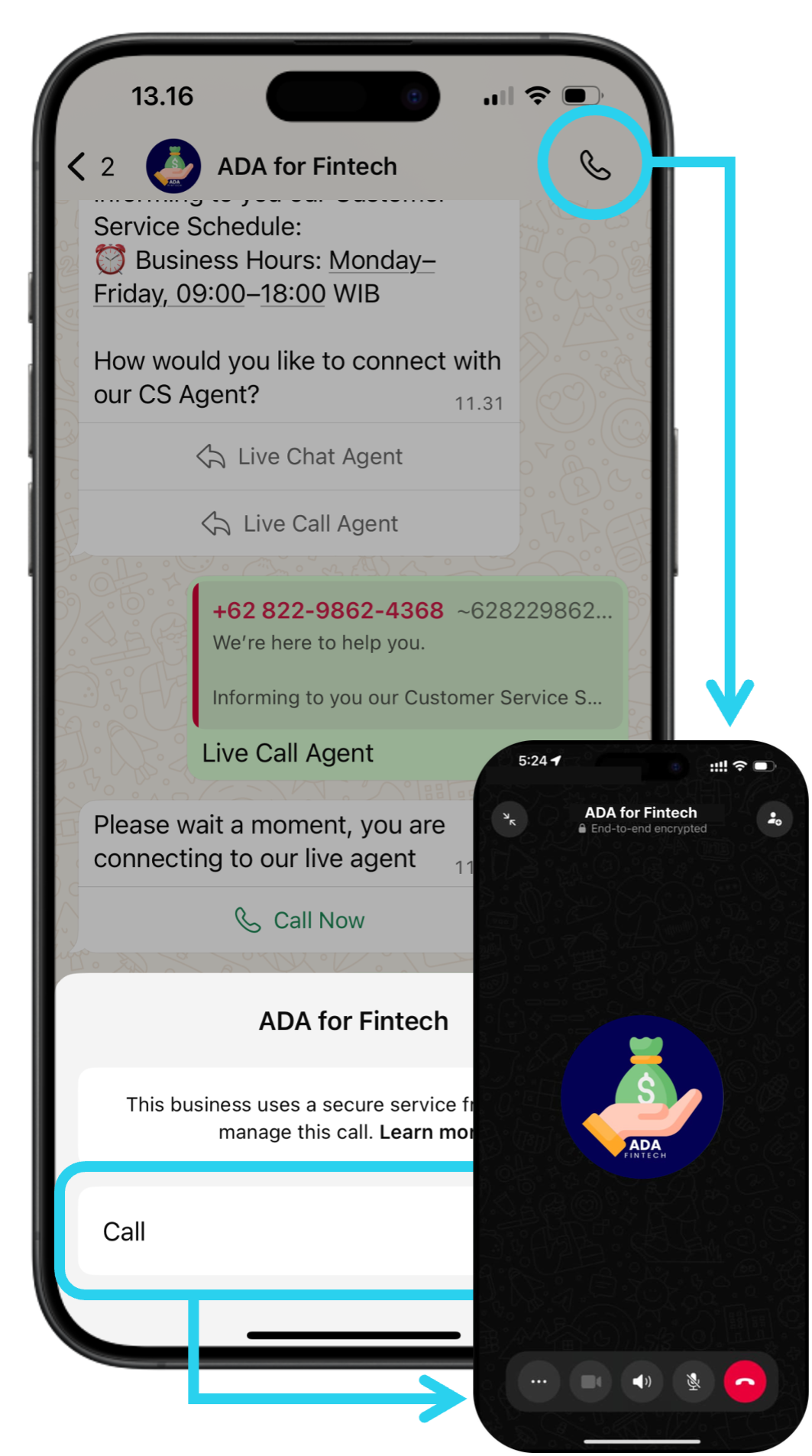
ADA’s WhatsApp Voice Call Integration enables VoIP communication directly within the platform, offering a cost-effective alternative to pricey number services. The cloud-based solution supports both inbound customer-initiated calls for complex Financial Services inquiries and outbound agent calls with proper permission protocols, all featuring Meta’s verified caller ID for enhanced trust. This keeps entire conversations in one thread for faster resolution while combining voice capabilities with media features like carousels and call-to-action buttons, driving higher conversion rates in Financial Services.

Generative AI: Financial Conversations that Read the Room

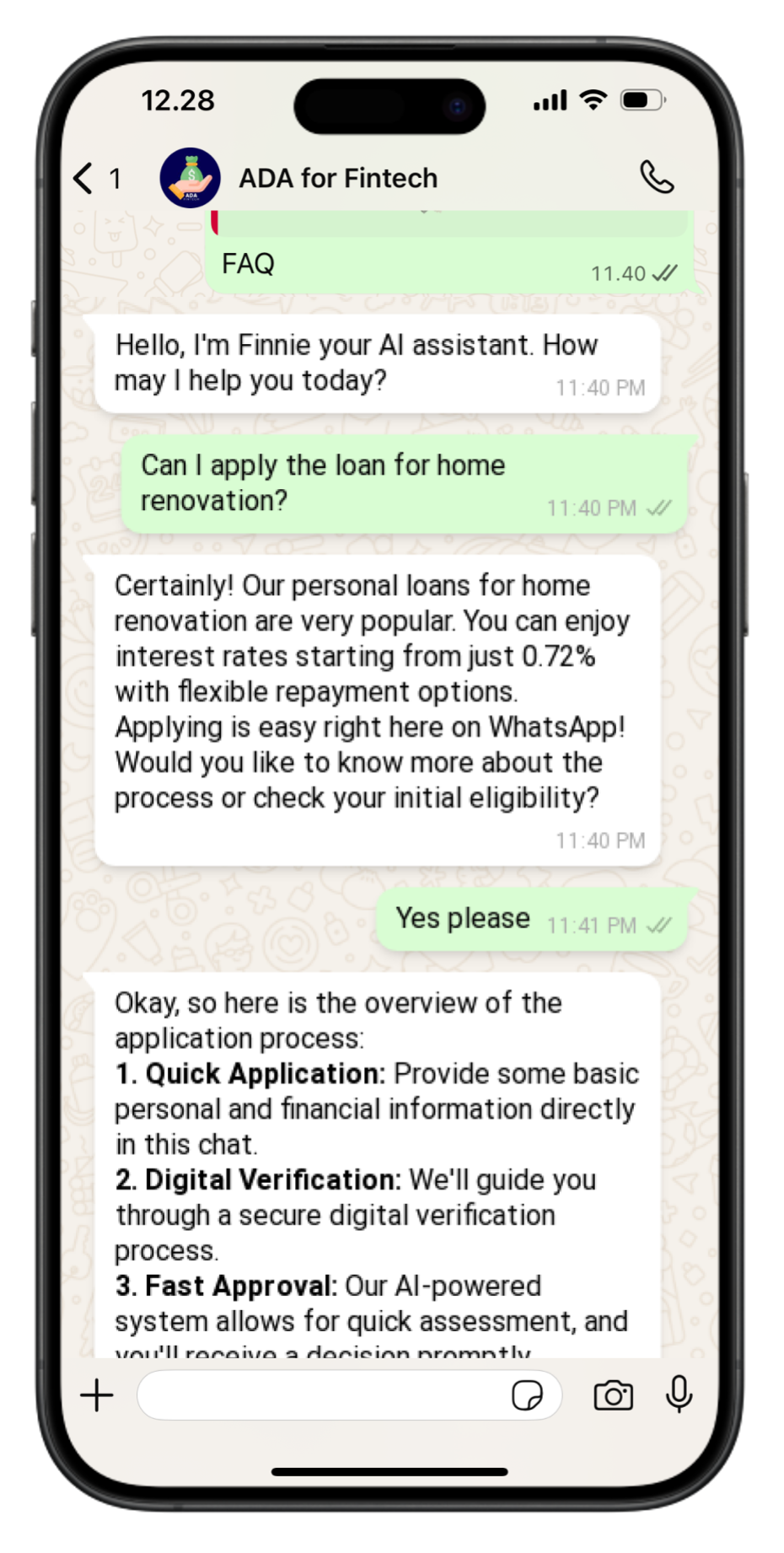
ADA’s AI-powered FAQ system doesn’t just provide mere template responses, but it understands conversation context, maintains dialogue flow, and delivers relevant answers based on customer inquiries. The system intelligently handles complex FinancialServices requests from loan applications, financial services, to account transactions, while maintaining regulatory compliance. This automation ensures customers receive immediate assistance around the clock, while redirecting complex queries to human agents if deemed necessary. This method of messaging has significantly boosted response times and improved overall customer satisfaction.

WhatsApp Flow: Streamlined Financial Services Processes

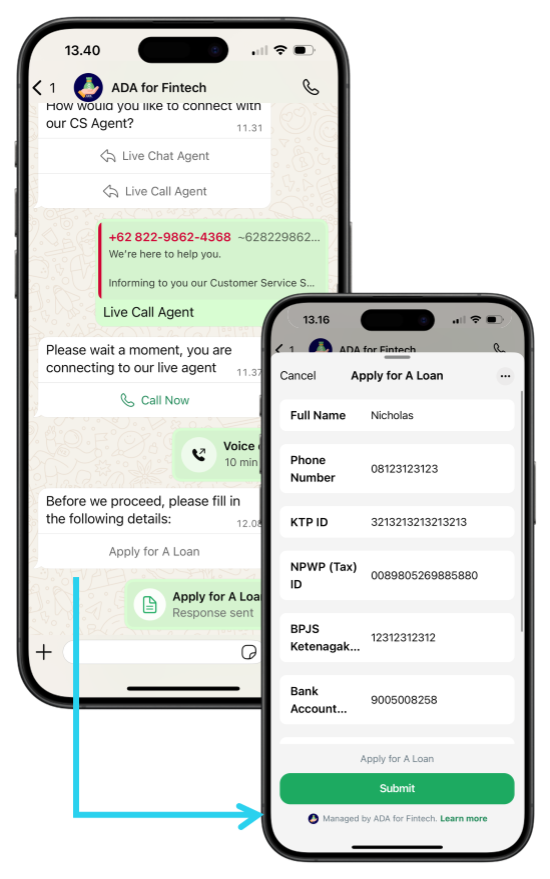
WhatsApp flow keeps the biodata collection process integrated in a single thread so customers can provide their personal financial information through an encrypted messaging channel. This integration eliminates the need for multiple platform switches, reduces application abandonment rates, and ensures all customer data is collected and processed in accordance with Financial Services regulations while maintaining the convenience of familiar messaging platforms. For example, a loan application that traditionally required branch visits, black on white forms, and extensive processing now happens entirely within WhatsApp. Customer scan start the application, upload documents using their personal devices, receive real-time status updates, and get approval notifications all without leaving the chat.

While carousel templates,AI-powered responses, WhatsApp Voice Call, and WhatsApp flow represent the visible aspects your business can implement, the real differentiator lies inADA’s comprehensive platform built to cater to Financial Service’s needs. Our strength in solutioning means we understand the exact touchpoints that drive growth for financial institutions and construct the perfect messaging journey to maximize every interaction. So, you might be asking yourself, what makes ADA different?

1.    Strength in Solutioning. We understand the touchpoints that drive growth for your business and design the perfect messaging journey.

2.    Enterprise-grade Platform. 99.9%uptime, 5million+ of secure messages daily at enterprise scale

3.    Local Excellence. Dedicated teams on the ground for faster support, deeper market understanding, and adherence to local regulations

4.    Meta Premier Partner. Priority support and early access to new rollouts and Beta programs.

5.    Seamless Integrations. Works with100+ tools such as Shopify, Salesforce, Zoho, Zendesk, and more.

6.    Completely Secure. ISO 27001:2022certified, flexible hosting, and enterprise-grade authentication controls.

Closing

Technology alone doesn’t solve the challenges in Financial Service. What matters is delivering experiences that customers trust and regulators approve. ADA blends deep financial services expertise with conversational AI that works within the realities of your business, from encrypted loan applications to compliant onboarding flows. That means less friction for your team and more confidence for your customers.

In this new era of Financial Services, the institutions that thrive will be those that make every customer interaction feel as effortless as Kristina’s morning coffee routine, efficient, impactful, and personalized to your needs.

Test it for yourself today, talk to our sales team.

References

¹Statista. (2025). WhatsApp Monthly ActiveUsers Report.

²WhatsApp Business. (2022). Using WhatsApp toAchieve Your Business Goals. WhatsApp Business.https://business.whatsapp.com/blog/use-whatsapp-business-goals

³Gallabox. (2025). Latest WhatsApp BusinessStatistics and Trends in 2025. Gallabox.com. https://gallabox.com/blog/whatsapp-business-statistics

Redefining Fraud Detection in BFSI: Why Generative AI is the New Standard

Post
Insights

Redefining Fraud Detection in BFSI: Why Generative AI is the New Standard

Fraud in the banking, financial services and insurance (BFSI) sector is no longer what it used to be. It’s faster, more elusive, and increasingly powered by artificial intelligence. Deepfakes, synthetic identities, and AI-generated scams have emerged, often evading traditional rule-based detection.

Yet, many organisations are still relying on manual reviews and outdated fraud prevention measures, struggling to keep up with threats that change day by day. The result is a growing gap between the nature of modern fraud and the systems designed to stop it.

We’re reaching a turning point where the scale and complexity of AI fraud detection in BFSI demands more than just incremental change. The question now is not whether generative AI will redefine fraud detection in BFSI, but whether businesses and consumers are prepared for what comes next.

Business Challenges 

Fraud detection has always been a high-stakes game. A missed incident can lead to severe financial loss, regulatory scrutiny, and customer fallout. But when systems are too strict and wrongly flag genuine activity, they can cause just as much harm.

This often leads to frustrated customers, delayed transactions, and a slow loss of trust. In many cases, it becomes too easy to cross the line between being careful and creating unnecessary friction.

The nature of fraud has changed. Fraudsters now use generative AI in financial services to fake identities, forge documents, and create lifelike deepfakes. These attacks happen quickly, on a large scale, and often come from many directions at once.

Yet many businesses are still relying on static rules and siloed systems that lack real-time visibility. This creates blind spots across operations, and these vulnerabilities are being exploited more frequently.

Meanwhile, internal teams are increasingly under pressure. Manual fraud reviews and compliance checks have become time-consuming and difficult to sustain. As case volumes rise and regulatory demands grow more complex, businesses find themselves allocating more resources just to stay afloat. The results are often inconsistent, and the operational cost continues to climb.

Outdated systems may create the appearance of control, but often confuse rigidity with safety. False positives become routine, causing unnecessary delays for legitimate users and damaging the customer experience. Rising expectations around Anti-Money Laundering (AML) and Know Your Customer (KYC) compliance only add to the strain, increasing the risk of operational errors, regulatory findings, and customer churn. These challenges are not just the result of evolving threats. They are symptoms of systems that have not kept up with AI in fraud detection and prevention. To move forward, businesses first need to understand why their current approach is no longer effective and what signs to look for before small inefficiencies turn into systemic vulnerabilities.

Traditional Systems Are Falling Behind

Many fraud detection systems in use today were built for a different kind of threat landscape. Most are based on static rules or pre-trained machine learning models, which work reasonably well for known attack patterns. But modern fraud is anything but predictable. It evolves quickly, often in ways these systems were never designed to handle. As a result, they struggle to detect unfamiliar tactics, missing the subtle context and complexity that define today’s AI-driven fraud.

The core problem is that traditional systems are not flexible. They follow fixed rules and need manual updates to handle new risks. So when new types of fraud appear, like synthetic identities or deepfakes, rule-based engines and static models often miss them until rules are updated. As a result, businesses have to rely on people to catch what the system overlooks, which slows everything down and puts more pressure on teams.

Fragmentation is another common challenge. In many businesses, fraud detection capabilities are spread across departments, channels, or business units. Without integration, insights remain trapped in silos. This makes it harder to see patterns across the organisation or respond quickly when incidents occur. Blind spots emerge, and teams are left reacting instead of staying ahead.

If your fraud response feels reactive, overly dependent on manual review, or inconsistent across teams and systems, it may be time to re-evaluate. These are strong indicators that the current setup is no longer equipped to support scalable, proactive AI in fraud detection and prevention.

The Limitations Are Costly

The biggest weakness in traditional fraud systems is not just that they are outdated. They were never designed to keep up with an opponent that evolves. In today’s environment, that opponent is generative AI, and the legacy systems in place simply cannot match its pace or intelligence.

Current systems operate on predefined rules or old data models. As a result, they can only detect what they already know. This reactive posture creates critical blind spots, especially as fraud becomes more dynamic, creative, and unpredictable.

Scalability is another mounting concern. As transaction volumes grow and fraud techniques become increasingly complex, manual and semi-automated processes begin to collapse under the weight. What once worked for smaller volumes now introduces operational bottlenecks, delays, and missed risks at scale. Businesses are left in a position where they cannot grow confidently because their systems cannot grow with them.

Compliance is also becoming harder to manage. Regulatory expectations continue to shift, and interpreting these changes manually increases the risk of falling out of step. More than 60% of wealth managers are already utilising generative AI in financial services to support their compliance functions. Businesses that rely solely on manual reviews or fragmented systems are falling behind—not just in efficiency, but in regulatory readiness.

All of this reflects a deeper issue. Traditional fraud systems are not just falling short. They are actively holding businesses back from the agility, scale, and intelligence required in today’s landscape. The inability to fight AI with AI has become the defining limitation of current fraud strategies—and the reason generative AI fraud detection is no longer optional.

A Generative AI Approach That Works for BFSI

Addressing modern fraud threats requires more than incremental upgrades. It calls for a new standard—one that replaces rigid detection methods with systems that learn, adapt, and improve.

Generative AI offers exactly that. It can interpret complex regulatory frameworks, detect emerging fraud patterns, and understand behavioural context in real time. The result is fewer false positives, smarter anomaly detection, and faster responses to evolving threats. By analysing both structured and unstructured data, these systems can flag unfamiliar typologies and predict risks such as deepfakes or synthetic accounts before they escalate.

It also helps streamline compliance by analysing regulatory texts, mapping them to internal policies, and flagging potential considerations for expert review. With human oversight guiding final decisions, this approach reduces the lag between regulatory change and implementation, improving both efficiency and assurance.

These benefits are already visible in practice. Leading financial institutions have reported tangible results, such as fewer account validation rejections and stronger fraud prevention, while also enhancing the customer experience.

What sets ADA apart is not just the technology, but the way it is delivered. Rather than offering an off-the-shelf product, ADA takes a consultative, end-to-end approach. It starts with a deep understanding of each organisation’s risk landscape, operational realities, and growth objectives. From there, solutions are tailored and seamlessly integrated across existing systems, ensuring both immediate effectiveness and long-term sustainability. This approach ensures businesses are equipped with solutions that evolve with them, not just for them.

It is a strategic transformation, not just a technical one. One that demands continuous model optimisation, cross-functional alignment, and a shared commitment to evolving with the threat landscape.

For BFSI businesses looking to close the gap between risk and response, ADA’s generative AI solution doesn’t just offer improvement. It offers measurable gains in precision, speed, and scalability.

Conclusion

By now, it’s clear that the biggest risks in fraud prevention aren’t just from outside threats. They also come from using outdated systems that can’t keep up with the speed, complexity, and intelligence of modern fraud.

Many of today’s challenges stem from not embracing newer, more adaptive approaches. Legacy systems create blind spots, waste resources, and increase the risk of regulatory penalties, customer dissatisfaction, and financial loss.

The businesses that will stay ahead are those that recognise the need to evolve and take meaningful steps forward. Generative AI in financial services is no longer a distant idea, it’s already making a difference in how organisations approach fraud detection, compliance, and customer trust.

The real question is no longer if you should upgrade your fraud prevention strategy, but how soon.

To explore how ADA’s services can support smarter, more proactive approaches to risk and compliance in the BFSI sector, visit our core service pages or explore our latest insights. The future of fraud prevention begins with the right knowledge—and the right partner.