

From Conversations to Outcomes: How Business Messaging Is Becoming Agentic
TL;DR: From Conversations to Business Outcomes
- Conversational AI for business is moving beyond answering questions. AI-powered conversations can now provide recommendations, resolve problems, transact, and deliver measurable outcomes.
- AI-powered customer engagement turns regular customer interactions into opportunities to personalize experiences, recover lost sales, and drive conversions.
- Agentic business messaging brings customer data, intelligence, and real-time decisions into conversations, enabling experiences that adapt to customer intent.
- From banking and travel to retail and daily essentials, AI agents can assist in making decisions, create personalized promotions for each customer, and allow customers complete transactions without forcing customers to start over.
- Making agentic messaging work at scale requires more than AI. it requires Unified data, faster responses, cost efficiency and clear guardrails to determine whether it delivers results.
- The starting point is not a complete transformation. Rather, it is one high-value customer journey that is tied to the correct data and then evaluated based on actual business results.
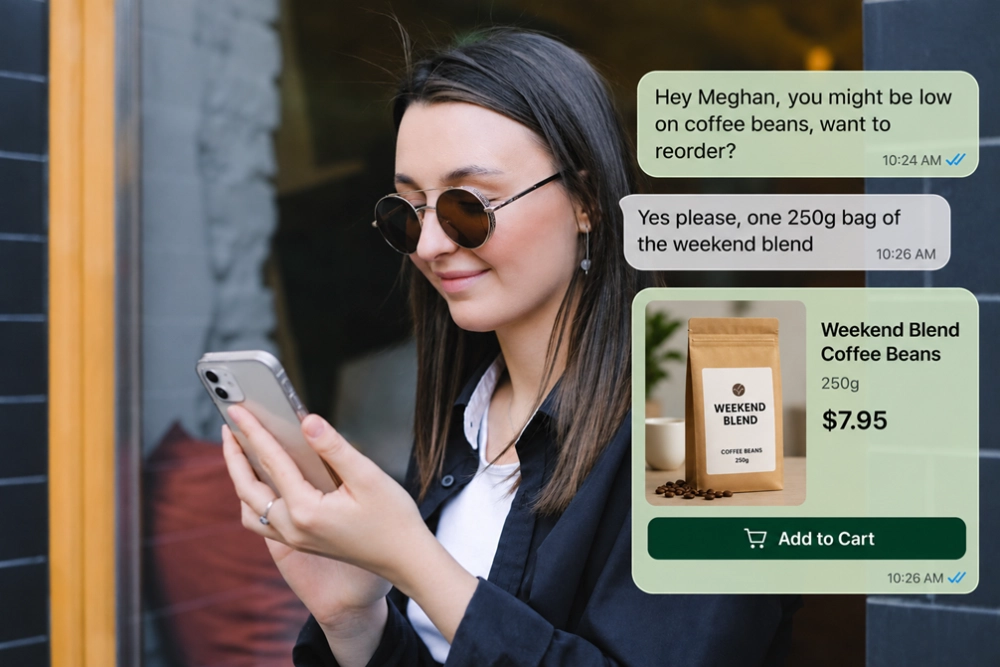
The next era of customer engagement will be owned by brands that unify data and intelligence for conversational messaging.
Let’s start with how we begin our day: we wake up, check notifications, emails, messages. Often, even before leaving the bed.
A similar routine plays out before we slip into sleep.
Encompassing over 63% of total retail eCommerce, mobile commerce surpasses USD 2.5 trillion in revenue, and will continue to climb, given that people across the globe spend 40% of their waking hours on mobiles.
Yet, most businesses still use them as megaphones, a broadcast device for ads that are skipped or ignored most of the time.
Evolution of Business Messaging
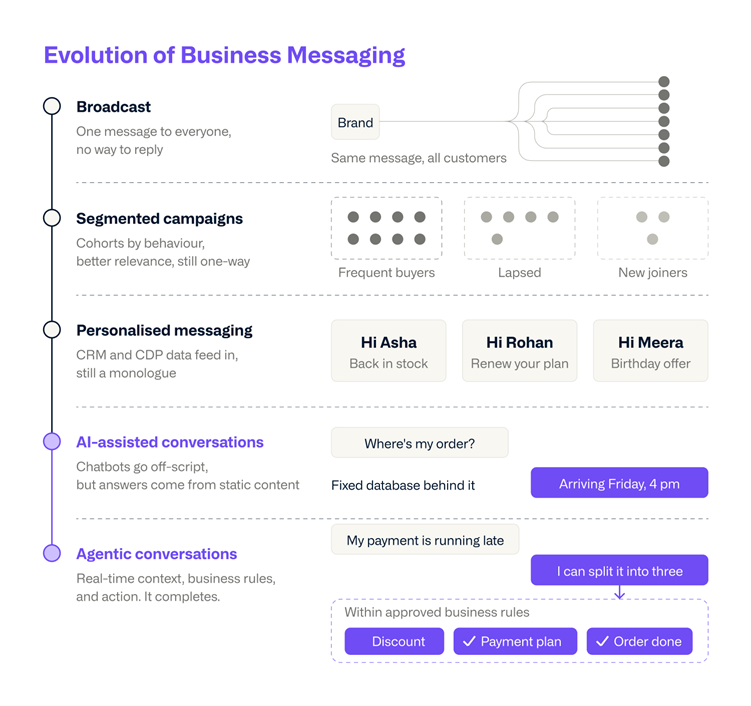
How Conversational AI Is Transforming Customer Engagement
Underneath the technology, a bigger shift is happening. Think about how you search today: a query no longer ends at a website, it turns into a conversation. That conversation surfaces products, ideas and experiences you were not looking for.
Customers now expect the same from brands. For businesses facing rising acquisition costs, this is an opportunity. A customer who arrives to return a product or raise a complaint is not just a service ticket. It’s a moment that creates an additional customer touchpoint. That moment is a chance to recommend, resolve and re-engage. AI-powered customer engagement brings these touchpoints together, turning everyday conversations into opportunities to resolve, recommend and convert.
Business messaging is evolving beyond answering customer queries to enabling personalized interactions, real-time decisions and measurable outcomes. This changes how experiences get built. Conversion rate optimisation assumes you can map a customer’s path from page to page. . The experience has to generate itself in the moment, which is only possible if the agent has access to the right data.
Conversational AI for Business: Agentic Messaging Use Cases

Banking – The Proactive Upgrade
Conversational intelligence allows banks to provide multi-pronged assistance and low-friction upsell or category add-ons to existing and new customers.
For instance,
Then, optimizing and personalizing the offer in real-time based on the purchase power, discount inclination, and other customer behaviour
No forms, no branch visit. Countless hours saved across the customer pool and minimal friction.
Partner Offers – A Seamless Handoff Across Channels
Co-branded partner offers form another interesting use case for conversational intelligence for business messaging.
Suppose the banking customer profile also qualifies for a co-branded partner offer from a travel company.
With built-in conversational intelligence, she can seamlessly move across channels, like WhatsApp and partner websites without context and identity change, greeted by name, with arelevant offer already applied, and a highly-personalized travel plan customized in real-time as per her preferences.
Setting budget, adding meals, specific flight preferences, and maybe even hotel bookings.
One conversation, two channels, no repeating herself.
Retail: Reviving Abandoned Carts

Despite being the major shopping channel, the abandoned carts keep being a menace for mobile commerce. While the nudges and push notifications keep getting bulk-swiped by the customers, a conversational ping from the shopping agent serves as a distinct reminder.
Retailers can show the exact items, size and colour a shopper has put in the cart. The voice agent can pull options from the catalogue rather than sending the shopper to a dropdown, suggest a matching bag or cap and offer a two-part instalment plan with additional perks like discounts, when customer opts for a payday purchase completion.
The checkout happens inside the chat. A lost sale becomes a bigger basket.
Daily Essentials – Natural and Unscripted Ordering
Shopping for the customer, adding items, customizing for special requests, occasions, and deal sizes, adjusting for budgets, and then offering substitutes in real-time – conversational intelligence can transform the way people shop forever and like never before.
Going beyond showing options and displaying the weekly or hourly deals, the agentic shopping stemming from conversational messaging can serve intelligent recommendation, factor in nuances, and help retailers deliver seamless and friction-less shopping experiences without bombarding the shoppers with hundreds of notifications and annoying reminders.
Sales, services, and experiences – delivered in aggregated manner.
The Readiness Gap
While the promise of increased revenue, higher customer satisfaction and unparalleled experiences is enticing, the implementation costs and outcome anxiety continue to create friction.
Studies reveal that roughly 72% of brands in the APAC region say they are actively onboarding agentic partners. However, it is projected that around 40% of agentic AI projects will be abandoned by 2027 because costs are unclear and stakeholders are concerned about the scale of token usage. Finally, around 80% of businesses report no tangible impact from their AI projects.
This is the gap ADA bridges.
From Experimentation to Enterprise-Scale Deployments – What It Takes to Get It Right
From what we have seen delivering hundreds of millions of customer journeys, three principles stand out.
1 Data Unification
Customer identity, behaviour, consent, product catalogue, pricing and supply chain data must feed the conversation.
2 Optimizing the Experience
Latency matters. A reply that takes too long, or a bot that cannot be interrupted, breaks the spell. Getting this right takes careful decisions about what data to load into the model, when, and what to cache.
3 Designing for Cost
Optimising latency and token usage go hand in hand. Efficient agents are not just faster; they are what keeps a project alive past the CFO’s review.
4 Set the Guardrails, Then Give Autonomy
Agents need clear boundaries, such as the discount they can offer or the payment terms they can approve, so they can resolve requests without escalating every one.
Getting Started with Agentic Business Messaging
You do not need to rebuild everything at once. Start with one high-value journey where intent is already visible: cart abandonment, product upgrades, renewals, collections or after-sales. Connect the data that journey needs, define what the agent is allowed to decide, and measure against a business metric, such as conversion, revenue or cost to serve, rather than engagement alone.
Messaging has already earned its place as the channel customers prefer. The brands that win next will be the ones whose conversations do more than answer questions. It is an intelligent, always-on conversation, built on the right infrastructure from day one.
