
Best Practices for Scaling Email Personalization: A Practical Guide to Open-time Relevance, Faster Execution, and Higher ROI
Most retail email programs start with good intentions and a simple setup: a welcome series, weekly promotional messages, and a few lifecycle automations. Then the brand grows. The catalog expands, promotions become more complex, and the customer base stops behaving like a single audience. That is when “email personalization” turns into a stressful phrase.
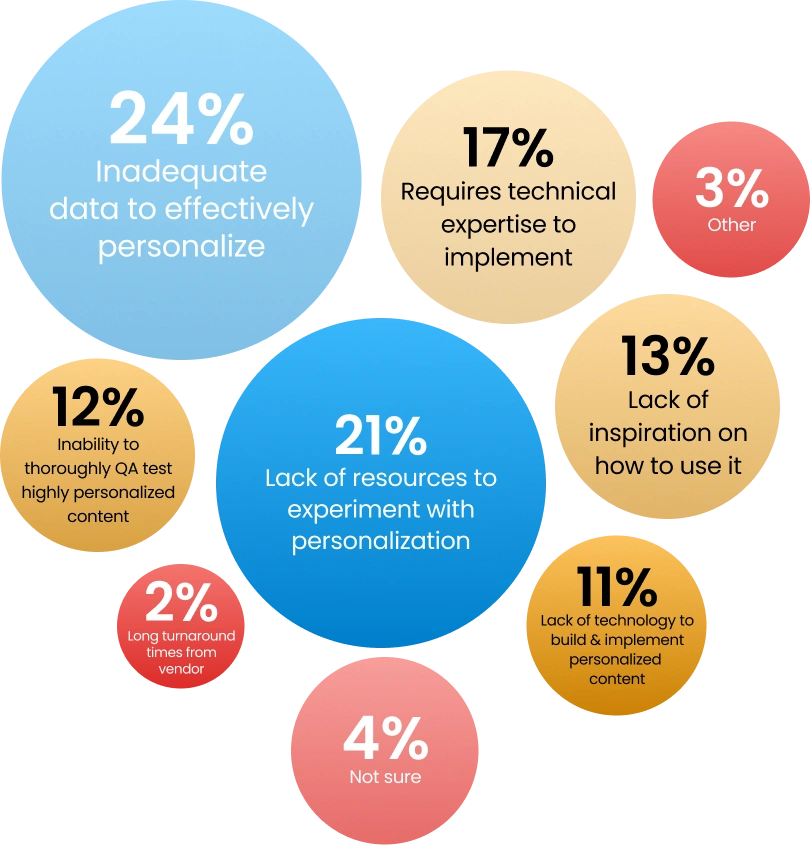
This is why scaling email personalization matters. As per the State of Email Innovations Report, 95% of marketers say they personalize email in some form, yet only 3% use live or real-time dynamic content. The biggest blockers to effective email personalization are familiar: inadequate data (24%), lack of resources (21%), and lack of inspiration (13%).
What do you find challenging about personalizing emails?
Let’s consider the journey of a fast-growing fashion retailer. In year one, the team ships quickly because everything is simple. In year two, the brand adds loyalty tiers, in-store pickup, regional offers, and bigger seasonal campaigns. Suddenly, the same email needs multiple email personalization versions:
- New subscriber vs first-time buyer
- Discount shopper vs full-price loyalist
- In-stock vs limited inventory
- Region A vs Region B
- Opened yesterday vs lapsed for 45 days
Most teams respond by creating more segments and more templates. That works for a quarter, then collapses under its own weight. But the question remains: How to Scale Email Personalization?
The hidden cost of email personalization at scale is not ideation. It is operations: how many variations you can produce without losing accuracy, speed, or brand control.
To address this question, we have curated this guide to help you scale without breaking your team, with the objective of building a system that enables repeatable, resilient, and measurable personalization across your email program. You will learn how to scale email content, segmentation, timing, and real-time relevance, including open-time email personalization.
What Scaling Email Personalization Means for Retailers
Scaling email personalization is not about more segments. Scaling means you can deliver relevance across more customers, more moments, and more product realities, while still shipping on time.
In retail, email personalization at scale usually shows up in three places:
Coverage: You want email personalization to exist beyond newsletters, into welcome series, browse, cart, post-purchase, replenishment, win-back, loyalty, and store-related journeys.
Accuracy: The more your offers and catalogs change, the more risky static content becomes. If a customer opens late, you do not want them to see a promo that ended or items that are out of stock.
Velocity: You want the email team to launch more campaigns and more variants without depending on IT for every change.
Best Practices for Scaling Email Personalization
1. Build a strong email-ready data foundation
Email personalization fails when the data is either unreliable or inaccessible. You do not need a perfect CDP to start scaling email personalization. You need a smaller, consistently available, and clearly defined set of data.
Use the right mix of data types:
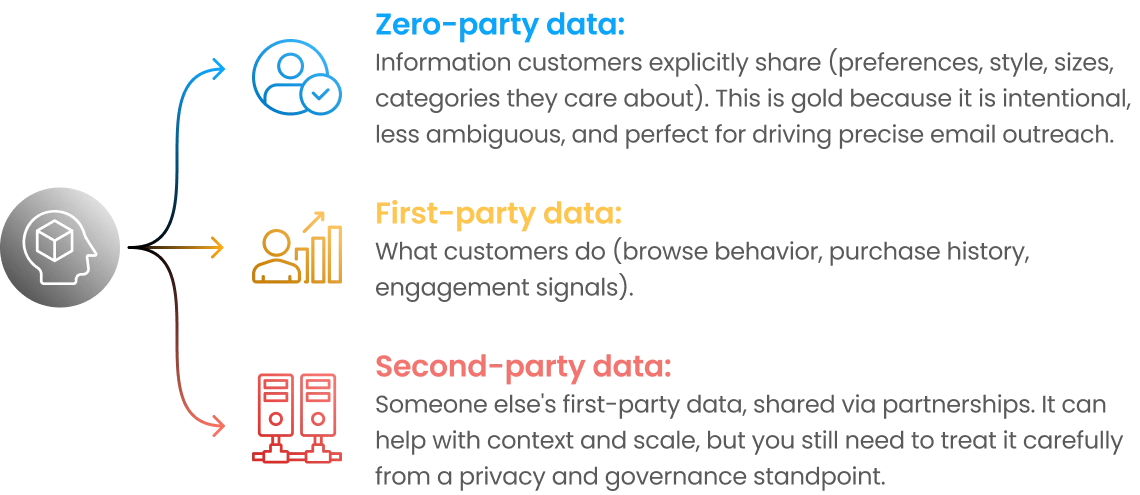
Make data email-ready:
- Define a small set of high-leverage attributes that most campaigns can reuse (category affinity, last product viewed, loyalty tier, preferred store, replenishment cadence, discount sensitivity).
- Standardize naming and formats. One lifecycle_stage is better than five versions of the same idea.
- Decide which signals are real-time versus daily batch. Your team needs to know what can change between send and open.
2. Know your audience better than they know themselves
Once you have the right data, you can start strengthening email personalization across your campaigns. You do not have to radically change your email marketing strategy to do this. Instead, work on emails you are already sending and how you can add personalization variants based on the information you know about past purchases, browsing behavior, or customer support interactions. Create segments for each of your audiences. You can start by segmenting customers vs prospects.
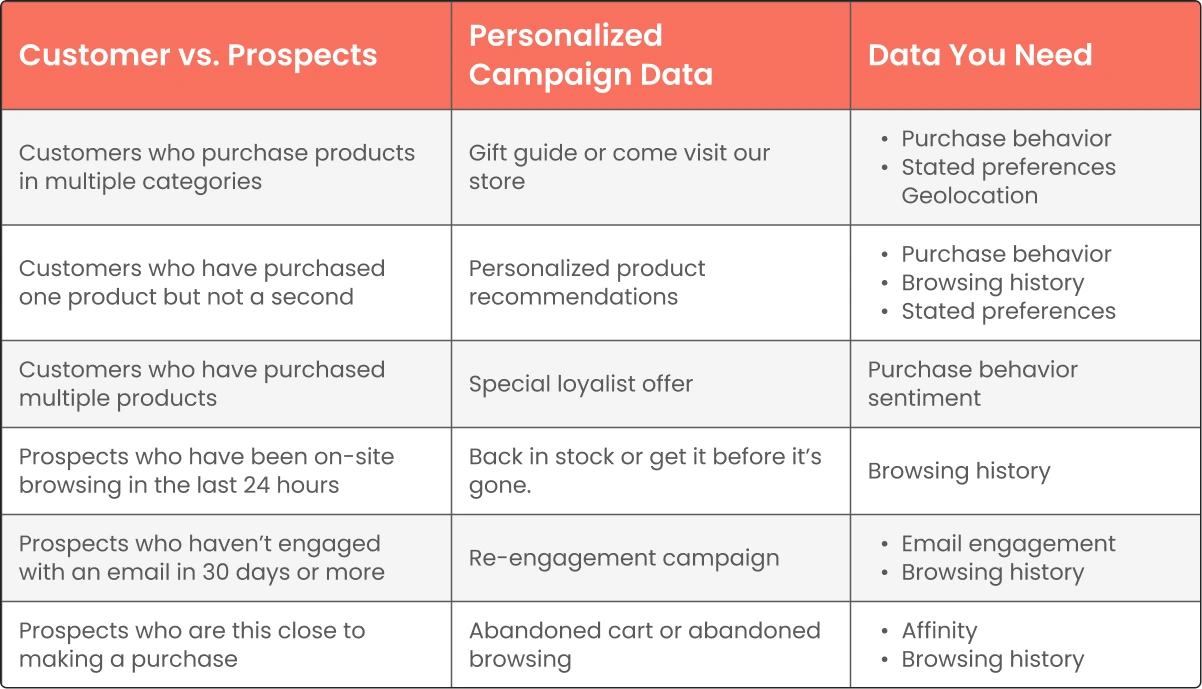
3. Treat the welcome series as your email personalization training ground
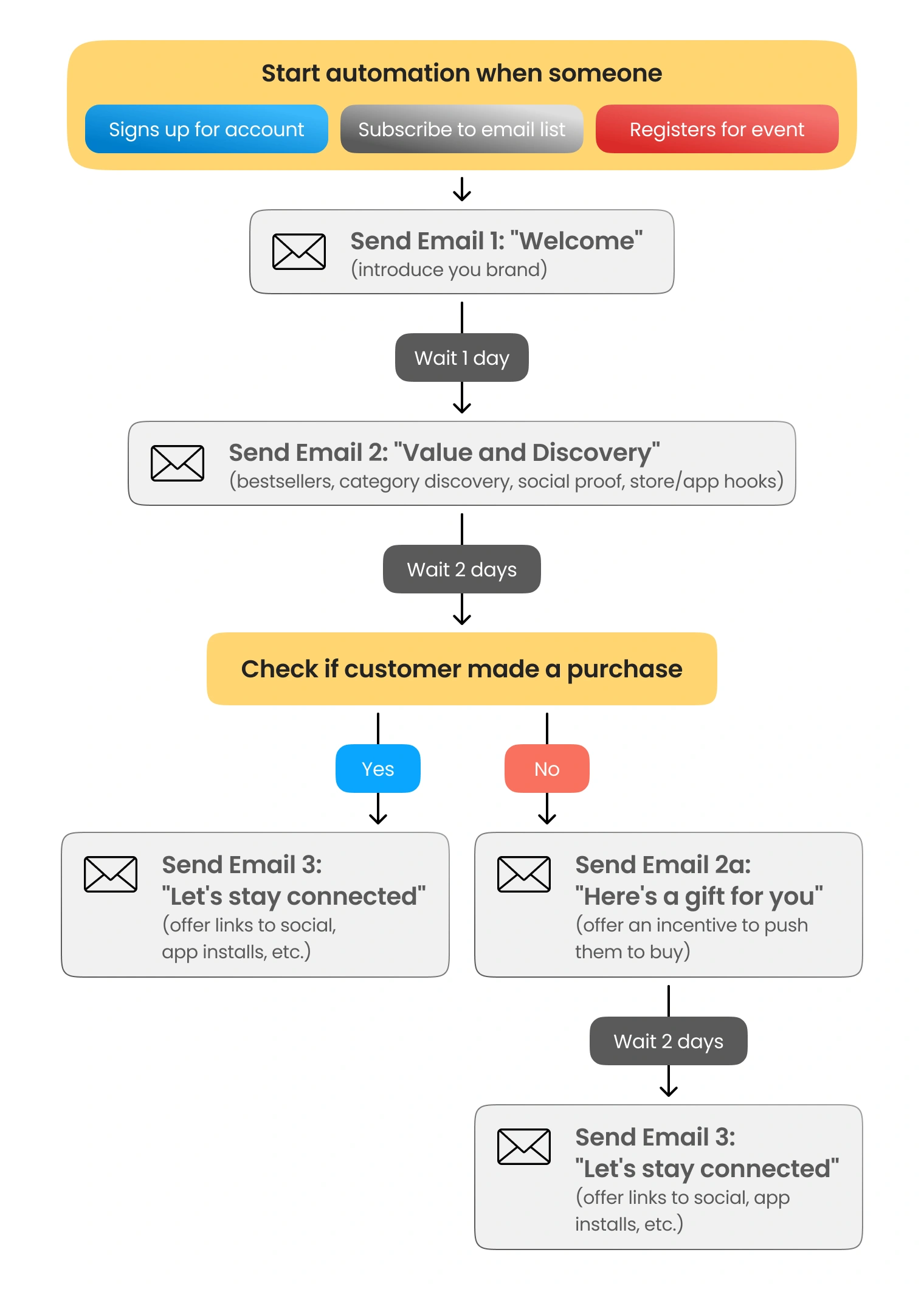
If you want to scale email personalization, your welcome and onboarding flows are the safest places to build the muscle. The audience is large, the intent is fresh, and the cost of getting email personalization mostly right is lower than in sensitive win-back programs.
Here’s a three part email blueprint:
- Email 1 (immediate): Set expectations — what you send and how often. Keep it clean and brand-forward.
- Email 2 (day 1): Show strongest value proof: bestsellers, category discovery, social proof, store or app hooks.
- Email 3 (conditional): Branch based on behavior.
- If they have purchased or meaningfully engaged, deepen the relationship (app, loyalty, social).
- If they have not: offer a clear next step (incentive, category quiz, preference capture).
4. Add live and real-time elements where they matter
Retailers want real-time experiences, but they start too big. A more sustainable approach is to pick one or two high-impact moments where freshness clearly affects conversion. This is where open-time email personalization comes into play. Content is rendered when the customer opens the email, just as when you hit send. This matters because inbox time is not the same as send time.
Where open-time email personalization delivers value:
Where it is often not worth it:
Pricing and promo accuracy
Show the latest price, not the send-time price.
Inventory-aware messaging
Hide out-of-stock items automatically, or swap in alternatives.
Contextual urgency
Countdown timers that reflect the actual time remaining.
Social proof messaging
Live popular right now cues, ratings, or activity indicators.
Recommendations that match current intent
What they browsed recently, what is trending in their preferred category.
5. Personalize timing and frequency, not just content
Teams often obsess over email personalization and ignore a simpler lever: when and how often you show up.
A scalable email personalization approach:
- Engaged subscribers: can handle higher frequency and more experimental content.
- New subscribers: keep cadence steady and predictable while you learn preferences.
- At-risk groups: reduce pressure, increase relevance, and ask for confirmation of preferences.
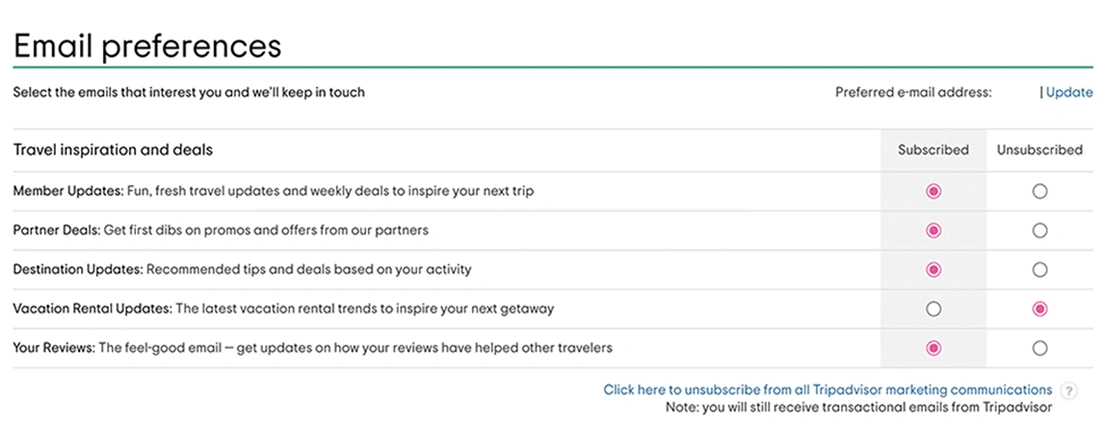
The above image shows a clear layout where subscribers can choose the content categories they want, and update preferences instead of opting out entirely. Preference centers lower unsubscribe rates and give you cleaner intent data that improves future email personalization.
6. Privacy and trust are part of the email personalization experience
Scaling email personalization without trust is short-term thinking. The most sustainable email personalization programs treat privacy as a feature, not a constraint. If email personalization feels creepy or opaque, customers disengage or opt out. If email personalization feels helpful and transparent, customers tolerate more frequency and share better signals.
Make it concrete:
- Be clear about consent and how data supports email personalization.
- Offer granular controls (content types, frequency, data usage levels where relevant).
- Keep records of consent and honor deletion or anonymization requests.
- Favor first-party data because it is typically more reliable and easier to govern than opaque third-party sources.
- Value exchange lens: customers should understand what they get in return for sharing preferences.
People do not opt out because email personalization exists. They opt out because it feels creepy, excessive, or inaccurate.
How Algonomy (now part of ADA) Active Content Helps Teams Scale Email Personalization Faster
Most email teams do not struggle with email personalization ideas. They struggle with execution: getting the right data into the right creative, fast, without adding manual production work and QA risk.
Algonomy’s (now part of ADA) Active Content helps by turning personalization into a repeatable email content system. Instead of rebuilding campaigns for every audience and scenario, teams can design reusable dynamic modules that pull from multiple sources, then render the most relevant version for each customer. That matters when product availability changes, promotions end, or the customer opens later than expected.
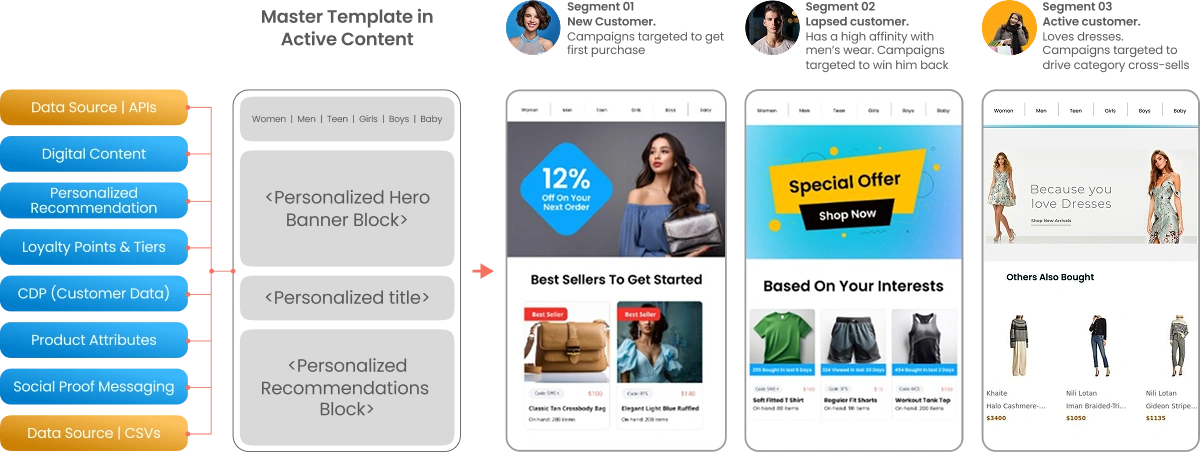
It is especially useful for open-time personalization, where content freshness can make the difference between a nice message and one that was actually helpful. Active Content also reduces reliance on IT for day-to-day personalization changes, enabling marketers to iterate faster while maintaining brand control and fallbacks.
If you want to see what personalization looks like in your email lifecycle programs, request a demo and map the first high-impact journey to an open-time experience.
FAQs
What is the quickest way to scale email personalization?
Standardize reusable content modules (hero, product grid, offer, urgency, loyalty), then deploy them across multiple journeys. Reuse scales faster than creating new segments.
How do I avoid over-segmentation?
Use lifecycle as your backbone and add only one layer of behavior. If a segment needs multiple qualifiers to make it work, you probably need a better content block, not a new segment.
When should I use open time email personalization?
Use it when content can become inaccurate between send and open, such as due to inventory changes, price changes, or time-bound promos. Skip it for evergreen storytelling.
What are the most common mistakes email teams make with email personalization?
Over-segmentation, no fallback logic, one-off creative production, and measuring only clicks instead of downstream outcomes like conversion and revenue per send.
400+ Retailers & Brands Across the World Trust ADA