

Predictive Customer Analytics: Turn Customer Signals into Proactive Decisions

A customer about to churn leaves a trail of signals. These show up weeks earlier in clicks, tickets, and abandoned carts. But most teams only connect the dots after the customer is gone.
Predictive customer analytics allows you to respond before you’ve lost the customer. ADA applies machine learning and one of over 150+ proprietary models to customer data to forecast what each customer will do next, so your team can act while there is still an opportunity to change the outcome.
This guide covers what predictive customer analytics is, how it works, the models and use cases behind it, and why prediction only pays off when it’s wired into decisioning.
TL;DR: Predictive customer analytics
Predictive customer analytics combines historical and real-time customer data with statistical modeling and machine learning to forecast what customers will do next.
- What it predicts: Churn risk, purchase likelihood, lifetime value, product affinity, and next best action.
- How it works: Unifies the data, builds the models, score severy customer, activates the scores, and retrains continuously.
- Where it earns its keep: Retention, conversion, personalization, segmentation, campaign prioritization, and cross-sell.
- What makes it pay off: Connect predictions to a customer intelligence platform that turns each signal into an action that has an impact on your business.
What Is Predictive Customer Analytics?
Predictive customer analytics is the practice of using customer data and machine learning to predict future customer behavior. Instead of asking “what happened?”, it asks, “what is likely to happen next, and to whom?” The output is usually a signal or probability attached to each customer, such as a 78% likelihood to churn within 30 days. These predictive customer insights help marketing, sales, and service teams act before an outcome occurs.

Core Components of Predictive Customer Analytics
- Unified customer data: a single view combining transactions, behavior, engagement and service history.
- Predictive models: algorithms trained to recognize patterns that may eventuate in specific outcomes.
- Customer scores: Probabilities for churn, purchase, value or next best action.
- Activation layer: channels and tools that turn scores into action.
- Feedback loop: measurement that keeps models accurate over time.
What Role Does Predictive Analytics Play in Customer Analytics?
Predictive analytics is the stage of customer analytics that shifts teams from explaining the past to predicting the future. It sits third in a four-stage maturity journey:
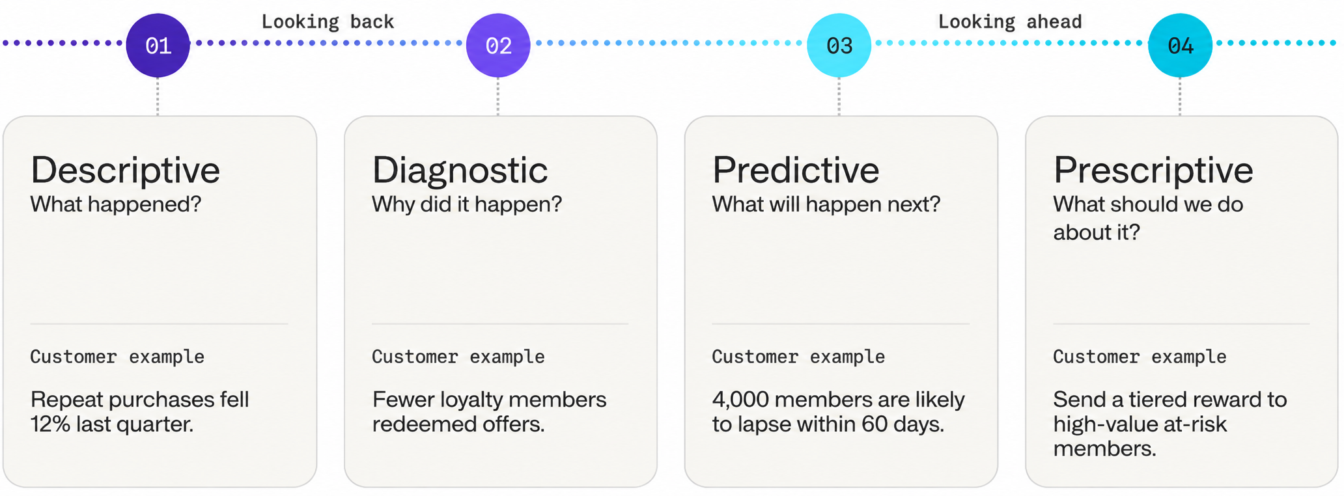
Descriptive and diagnostic analytics establish context, but they are backward-looking. Predictive analytics adds foresight, and prescriptive analytics converts that foresight into a recommended action. Mature organizations use all four together, with predictive models acting as the bridge between insights and decisioning.
How Does Predictive Customer Analytics Work?
Predictive customer analytics works by transforming raw data to measurable action in five repeatable steps:
1 Collect and Prepare Customer Data
Data is pulled from CRM, web, app, point-of-sale, marketing and service systems. Identities are consolidated, so the same customer is recognized across channels. Records are then cleaned, standardized, and enriched into a unified profile.
2 Identify Signals and Build Predictive Models
Analysts will identify signals that tend to precede an outcome, such as declining visit frequency before churning. Machine learning models train on historical data to learn these patterns and validate against samples.
3 Score Customers and Identify Likely Outcomes
The trained model assigns each customer a probability or value score, for example churn risk, purchase propensity, or predicted lifetime value. Scores are refreshed on a schedule or in real time as new behavior arrives.
4 Activate Predictions Across Customer Experiences
Scores flow into segments, journeys, and channels. A high churn score might trigger a retention offer, while high purchase intent might prioritize a product recommendation or a sales follow-up.
5 Measure, Learn and Refine
Teams compare predicted outcomes with actual results, run control groups to prove lift and retrain models as customer behavior shifts. This loop keeps accuracy and business impact high.
What Types of Predictive Customer Models Are Used?
The most common predictive customer models forecast churn, purchase intent, value and next best action. Each answers a different business question:
Most businesses start with one or two high-impact models, usually churn and propensity, then expand. Customer behavior prediction is most reliable when several models work together, for example combining churn risk with CLV to decide which at-risk customers deserve the strongest retention investment.
Key Use Cases of Predictive Customer Analytics
Predictive customer analytics delivers the most value in situations where timing and relevance decide the outcome, for example:
Predict and Prevent Customer Churn
Predictive analytics for customer churn flags customers whose behavior resembles past leavers, such as fewer logins, lower spend or rising complaints. Teams can then intervene with service recovery, loyalty rewards, or tailored offers. Resolving customer retention is far cheaper than winning customers back after they leave.
Increase Conversion with Purchase Propensity
Propensity models rank customers by their likelihood to buy. Marketing focuses on spend on high-intent audiences, and sales teams prioritize warm leads, lifting conversion while reducing wasted impressions.
Personalize Products, Offers and Experiences
Affinity and next-best-action models predict what each customer wants next. This powers personalized recommendations, content and offers, improving predictive analytics customer experience outcomes across web, app, email and store.
Build Smarter Customer Segments
Traditional segments group customers by who they are. Predictive segments group them by what they are likely to do, such as “high value, rising churn risk”, which makes targeting far more precise.
Prioritize Campaigns and High-Value Customers
Combining CLV with propensity scores shows where the budget earns the highest return. Teams can protect top customers, nurture rising ones, and avoid over-investing in low-value audiences.
Improve Cross-Sell, Upsell and Re-Engagement
Predictive behavior marketing identifies the right product and moment to extend a relationship. For example, a leading bank achieved a 255% cross-sell conversion lift using CDP-powered micro-segmentation. Lapsed customers can also be re-engaged at the point they are most likely to respond.
What Are the Benefits of Predictive Customer Analytics?
The main benefit of predictive customer analytics is that it lets businesses act on customer needs before they become problems or missed opportunities. Specific benefits include:
- Proactive retention: at-risk customers are identified early, while there is still time to change the outcome.
- Higher marketing ROI: budget shifts toward audiences most likely to convert, reducing spending on low-intent prospects.
- More relevant experiences: offers, content and recommendations reflect each customer’s likely next need.
- Greater customer lifetime value: timely cross-sell, upsell and loyalty actions extend and deepen relationships.
- Smarter resource allocation: sales, service and marketing teams focus effort on the customers who matter most.
- Faster, more confident decisions: teams rely on probabilities rather than gut feel or lagging reports.
- Deep customer analytics at scale: models surface patterns across millions of interactions that no analyst could spot manually.
Together, these benefits are compounded. A business that predicts churn, prioritizes value and personalizes engagement does not just react faster; it builds a customer experience that consistently feels timely and relevant, which strengthens loyalty and revenue over time.
Why Prediction Alone Is Not Enough
A prediction creates value only when it changes what a business does. Knowing that a customer has a 70% chance of churning is useful, but it does not tell you what to do to prevent this churn. Should you offer a discount? Call them? Fix a service issue or do nothing at all?
This is where most businesses stall. Scores sit in dashboards; analytics teams build models that marketing never uses, and channel teams continue running static campaigns.
To make a real business impact, predictions must connect to three things:
- Decision logic that weighs risk, value, eligibility and cost to choose the next best action.
- Real-time activation that delivers that action in the right channel at the right moment.
- Closed-loop measurement that proves which actions result in incremental improvements.
This is why a customer intelligence solution should unify data, prediction and activation in one flow. Without that connection, even accurate models deliver little business impact.
What Data Is Needed for Predictive Customer Analytics?
Predictive customer analytics needs unified, consented first-party data, ideally enriched with external context. The most useful data types are:
| Data type | Examples | Helps predict |
|---|---|---|
| Transactional | Purchases, order value, frequency, returns | CLV, propensity, churn |
| Behavioral | Web and app sessions, clicks, searches, cart activity | Purchase intent, affinity |
| Engagement | Email opens, campaign responses, loyalty activity | Responsiveness, re-engagement |
| Service | Support tickets, complaints, call center notes | Churn risk, satisfaction |
| Profile | Demographics, location, tenure, preferences | Segmentation, eligibility |
| Third-party enrichment | Socio-economic, mobility or interest signals | Gaps in first-party profiles |
Volume matters less than quality. Data must be accurate, updated regularly, and linked to the same customer identity across channels. Clear consent and governance are also essential, both for regulatory compliance and for customer trust.
What Are the Biggest Challenges in Predictive Customer Analytics?
The biggest challenge in predictive customer analytics is rarely algorithms. It is the data, adoption and execution:
- Fragmented data: customer records spread across CRM, commerce, loyalty and service systems make a single view difficult.
- Poor data quality: duplicates, gaps and outdated records weaken model accuracy.
- Model drift: customer behavior changes with seasons, prices and markets, so models degrade without regular retraining.
- Lack of explainability: business teams hesitate to act on scores they cannot understand or justify.
- Disconnected activation: predictions stay in dashboards because they are not wired into campaign and channel tools.
- Skills gaps: many teams lack the data science and engineering capacity to build, deploy and maintain models.
- Privacy and compliance: consent, data residency and fair use rules must be built in from the start.
Overcoming these challenges usually requires both technology and expertise. Customer intelligence consulting can help organizations unify data, prioritize the right use cases and operationalize models faster.
From Predictive Analytics to AI Decisioning
AI decisioning is the next step after predictive analytics: it uses predictions to automatically choose and trigger the best action for each customer in real time.
Where predictive analytics answers “what is likely to happen?”, AI decisioning answers “what should we do now, for this customer, in this channel?” It combines multiple model scores, business rules and goals such as margin or retention, then selects the next best action and learns from every response.
For example, instead of sending every at-risk customer the same discount, an AI decisioning engine might offer a high-value customer a service call, a price-sensitive customer a targeted voucher and a low-value customer no incentive at all.
This turns predictive customer analytics from a reporting capability into an always-on engine generating proactive, personalized decisions at scale.
Predictive Customer Analytics FAQs
What is an example of predictive customer analytics?
A telecom provider analyzes usage, billing and support data to score each subscriber’s churn risk. Subscribers with rising risk and high lifetime value automatically receive a personalized retention offer before their contract ends, reducing churn and protecting revenue.
Is predictive customer analytics the same as machine learning?
No. Machine learning is one of the techniques used in predictive customer analytics. Predictive customer analytics is a broader business practice, covering data preparation, modeling, scoring, activation, and measurement. Some predictive models also use traditional statistical methods such as regression.
What is the difference between predictive analytics and prescriptive analytics?
Predictive analytics forecasts what is likely to happen, such as which customers will churn. Prescriptive analytics recommends what to do about it, such as which offer or channel will best retain each customer. Prescriptive analytics build predictive outputs.
What is the difference between predictive customer analytics and traditional reporting?
Traditional reporting looks backward, summarizing past sales, engagement, or churn. Predictive customer analytics looks forward, estimating each customer’s future behavior so teams can act before outcomes occur. Reporting explains performance; prediction helps change it.
