

Frequently Bought Together: Increase AOV with Product Bundling and Cross-Selling

A shopper adds a camera to their cart. Do they also need a memory card, a spare battery, and a case? Most do, but many won’t think to look.
Frequently bought together recommendations close that gap by showing the items people usually buy with the product they are viewing. When done well, they make shopping easier and increase average order value (AOV).
The objective of this blog is to examine how “frequently purchased together” works, how to create product bundles, where to position these bundles on your website, and how to assess their effectiveness.
TL;DR: Frequently Bought Together
Frequently Bought Together recommendations show products customers typically purchase with the product they are currently viewing. FBTs can help increase the size of a customer’s shopping basket from just one product to multiple products, thereby increasing the average order value.
The most effective FBTs use both order data and each customer’s browsing and purchase history to provide personalized product suggestions. To assess how well your FBTs are performing, you should monitor the average order value (AOV), attach rate, and incremental revenue.
What is Frequently Bought Together in Ecommerce?
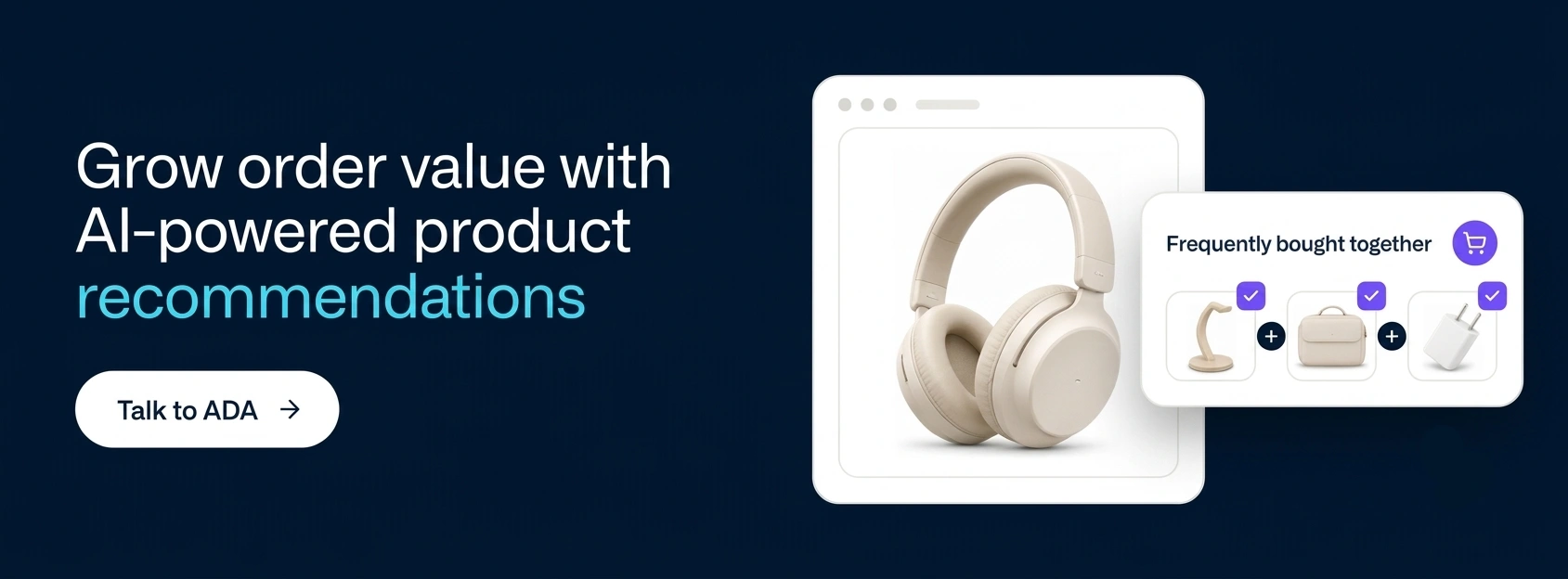
Frequently bought together is a type of product recommendation. It shows items that other shoppers have often bought in the same order as the product someone is viewing.
Think of a phone and a screen protector, a tent and a sleeping bag, or pasta and a jar of sauce. Each pairing comes from real buying behavior, not guesswork.
You’ll usually see it as a small widget on the product page, often with an “Add to cart” button.
The idea isn’t new. McKinsey estimated that 35% of what consumers buy on Amazon comes from product recommendations (McKinsey, 2013). Today, shoppers expect this kind of help as a standard experience.
And for retailers, it means more revenue from the same traffic and a natural way to get accessories and lesser-known products seen.
How Does a Frequently Bought Together Algorithm Work?
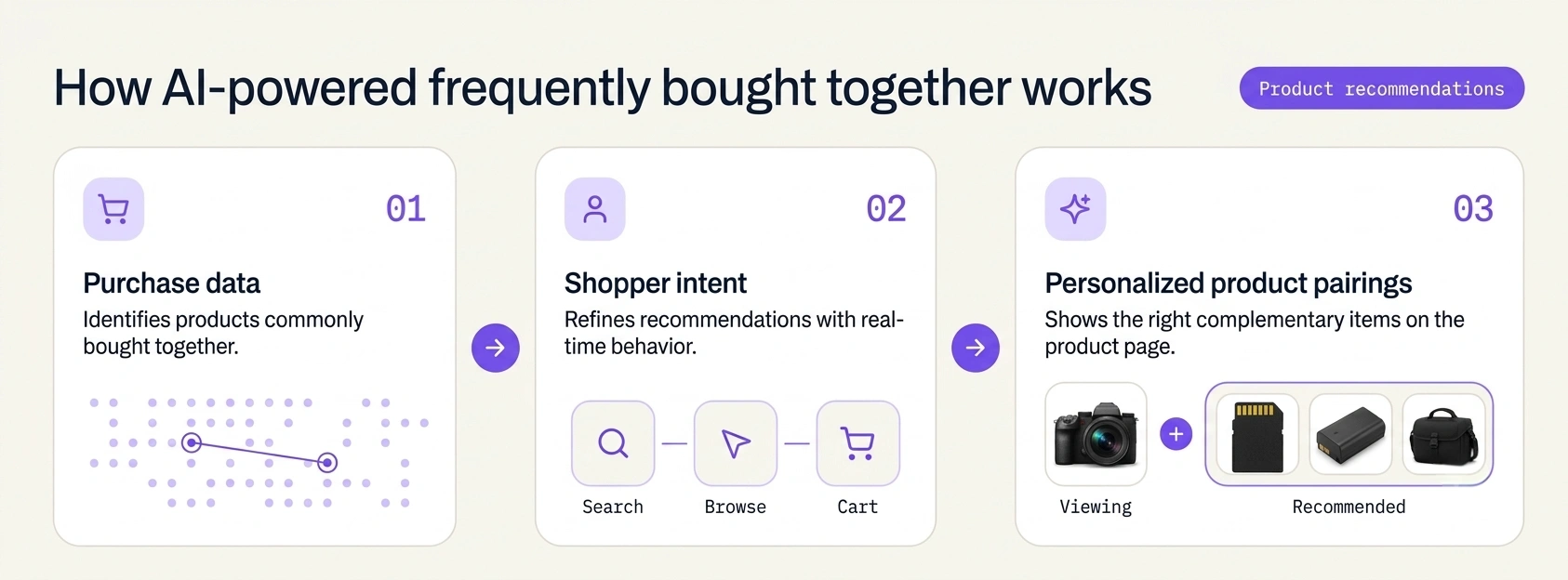
A frequently bought together algorithm finds products that people buy together more often than you’d expect by chance. There are two main approaches.
Purchase History and Product Affinity
The simplest version examines all of your orders to determine the frequency with which two products were purchased together. It filters out bestsellers that already appear in many baskets, so a popular item isn’t suggested for everything. What’s left is a ranked list of genuine pairings for each product.
AI-Powered Recommendations and Real-Time Personalization
AI adds a second layer: what the shopper is doing right now. What they’ve viewed, searched for, and added to the cart all shape the suggestions, so a first-time visitor and a loyal customer can see different items on the same page. AI can also suggest pairings for new products that don’t yet have sales history.
Search is the clearest signal of all. ADA offers a site search tool, Find™, and a product recommendation engine, Recommend™. Used together, they share what they learn about each shopper, so the product page knows what the shopper searched for. Someone who looked up “waterproof hiking jacket” sees matching trousers and a rain cover, not more jackets.
How Does Frequently Bought Together Increase Average Order Value?
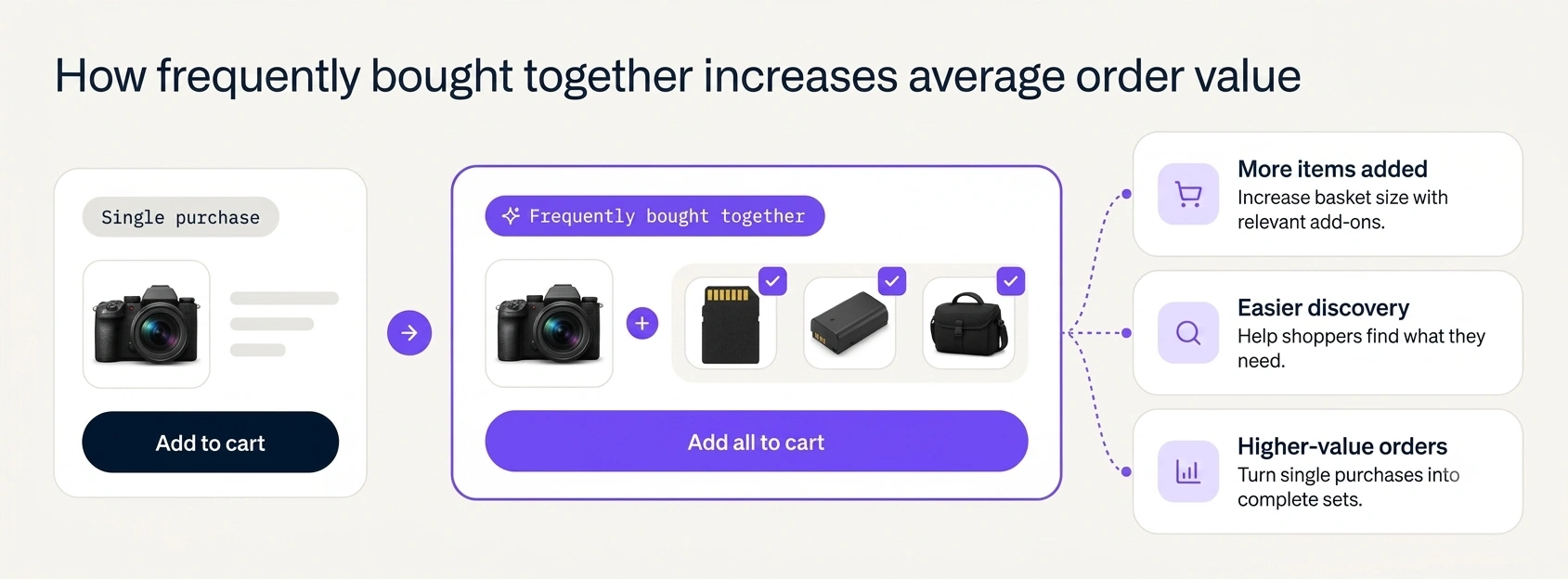
Frequently Bought Together increases AOV in three ways: it adds relevant items to the basket, helps shoppers find products they didn’t know they needed, and turns single purchases into better-value sets. Let’s look at each in detail.
Increase Basket Size Through Relevant Cross-Selling
Every accepted suggestion adds another item to the order. A shopper buying a tent might add pegs and a groundsheet without a second thought.
Improve Product Discovery and Shopping Convenience
Many shoppers don’t know an accessory exists, or forget it until the product arrives. FBT shows those items at the right moment. Isn’t it easier to add the right charger now than to find out later it’s missing?
Encourage Higher-Value Purchases with Bundled Offers
Bundles offer customers a single package containing multiple products. Customers will be more likely to buy the entire package (bundle) than just one product if they are offered a bundle discount, free shipping, or a free gift.
Frequently Bought Together vs. Product Bundling, Cross-Selling, and Upselling
All four aim to grow order value, but they work in different ways.
FBT suggests pairings based on data. Bundling packages items into one offer. Cross-selling adds related items. Upselling
offers a better version of the same item.
| Concept | What is it | Example | Business objective |
|---|---|---|---|
| Frequently bought together | Shows items often bought with the viewed product, based on order data | A laptop page suggests a mouse and a laptop sleeve | Raise attach rate and AOV with proven pairings |
| Product bundling | Sells several items as one package, often at a set price | A skincare set with cleanser, serum, and moisturizer | Sell more units per order and make choosing easier |
| Cross-selling | Suggests related or complementary items | A jacket page suggests a scarf and gloves | Increase the number of items per order |
| Upselling | Suggests a higher-value version of the same product | A 128 GB phone page suggests the 256 GB model | Increase the value of a single item |
In practice, frequently purchased together is one form of cross-selling, and its pairings are often the starting point for bundles.
How to Create Frequently Bought Together Bundles
Three steps take you from raw order data to bundles that sell.
Identify Complementary Products Using Purchase Data
Start with order history. Find products that often appear in the same order, then check whether each pairing makes sense to a shopper. Bring in your merchandisers too. They know which items must work together, such as a printer and its matching ink.
Choose Between Manual, Rule-Based, and AI-Powered Bundles
Manual bundles are hand-picked by your team. They give full control but don’t scale. Rule-based bundles follow logic such as “same brand” or “compatible with”. AI-powered bundles learn from data and update on their own. The strongest approach combines them.
With Recommend™, merchandisers set their rules once, and the AI handles the rest: pairings are based on what shoppers actually buy and browse, sold-out items drop out as stock changes, and the best-performing strategy is selected and scaled without manual intervention.
Set Bundle Pricing, Discounts, and Merchandising Rules
Determine if the bundle requires a discount, and then test each option before making a commitment. Finally, create the rules that ensure all recommended products are commercially viable.
In Recommend™, your team can set rules for margin, stock, and brand without any coding and apply different rules to different pages or customer groups.
How to Implement Frequently Bought Together in an Ecommerce Store
Implementing FBT takes three stages: choose a solution, decide where recommendations appear, and test before you scale.
Select a Product Recommendation Solution
Choose a tool that works with your ecommerce platform and always knows what’s in stock. Your team should be able to change the rules themselves, without waiting on developers.
ADA’s Recommend™ is built this way: merchandisers set rules and can see why each suggestion appeared, so they can trust the results and fine-tune them.
Place Recommendations Across the Shopping Journey
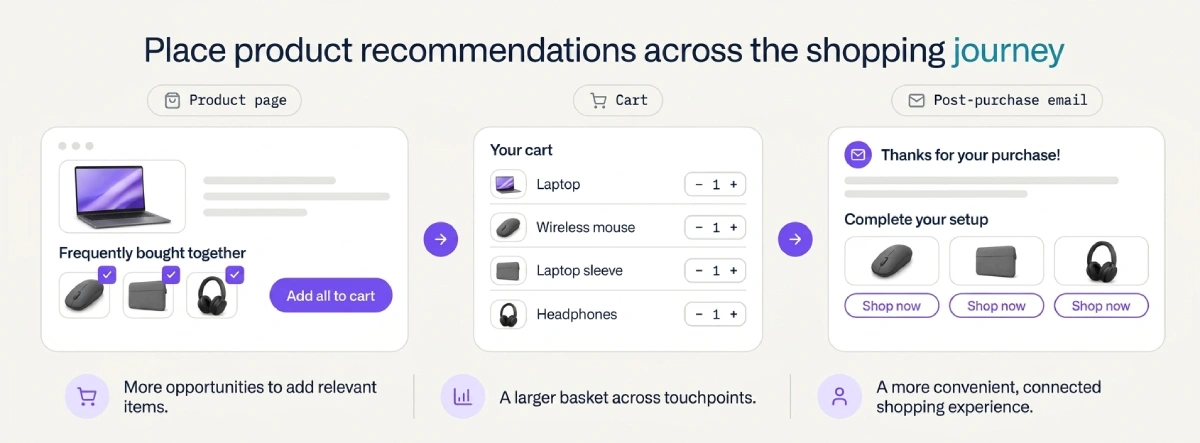
The most logical first step is to begin at your product pages. Small, inexpensive cross-sell opportunities should be placed in the shopping cart and at checkout. Post-purchase email follow-ups can offer customers additional products related to their recent purchases.
However, try to avoid placing large or expensive cross-sells on your checkout page, as they may slow the purchase.
Emails are where many teams leave money on the table. ADA’s Active Content pulls in updated recommendations every time an email is viewed. Therefore, all pricing and product availability stay current and relevant to the customers.
Configure, Test, and Launch Product Bundles
Split visitors into random groups and show each group a different experience. An A/B test uses two groups, and a multivariate test (MVT) uses three or more. One group can see no FBT widget at all, so you know exactly what the widget adds.
Start with high-traffic categories. Tests need enough traffic, or enough time, to give a reliable answer, and a test in a small, quiet category can take a long while to show results.
Recommend™ lets you test almost every part of your setup: merchandising rules, widget placements, recommendation strategies, and the KPIs you optimize for.
For example, you could boost your own-brand products for half your visitors, check the effect on margin after a set period, and roll the rule out if it works. Or you could show one group four widgets on the homepage and another group two.
Best Practices for Frequently Bought Together Recommendations
The best frequently purchased together experiences feel helpful, not salesy. These practices keep them that way.
- Keep it short: Two or three suggestions are easier to act on than eight.
- Make adding easy: One click should add the whole set, with the total price shown.
- Get compatibility right: A case that doesn’t fit the phone costs you a return and the shopper’s trust.
- Show proof: A “popular with this item” cue reassures shoppers that the add-on is worth it. ADA’s Social Proof Optimize picks the right message for each shopper and shows it only when the data backs it up.
- Personalize: Returning shoppers shouldn’t keep seeing items they’ve already bought or ignored.
- Refresh regularly: Seasons, trends, and new launches change what people buy together.
- Test the wording: “Complete the set” may work better than “Frequently bought together” in some categories.
How ADA Global Enables Smarter Product Bundling with AI
Most stores run recommendations, reviews, and email as separate tools. The product page doesn’t know what the shopper just searched for, and the follow-up email doesn’t know what they nearly bought.
ADA’s personalization suite reads each shopper’s intent only once and uses it at every step.
Personalize Cross-Selling with Recommend™
Recommend™ is what connects everything. It uses search intent from Find™, your merchandising rules, and real-time inventory to determine which products will be suggested.
Social Proof Optimize will provide additional confidence in your product recommendations, and Active Content will allow you to send out a similar package of products in post-purchase emails.
Since all three of these systems are based on the same consumer data, the group of products a shopper views on the product page will also appear in their email inbox.
Create Contextual Product Collections with Ensemble AI
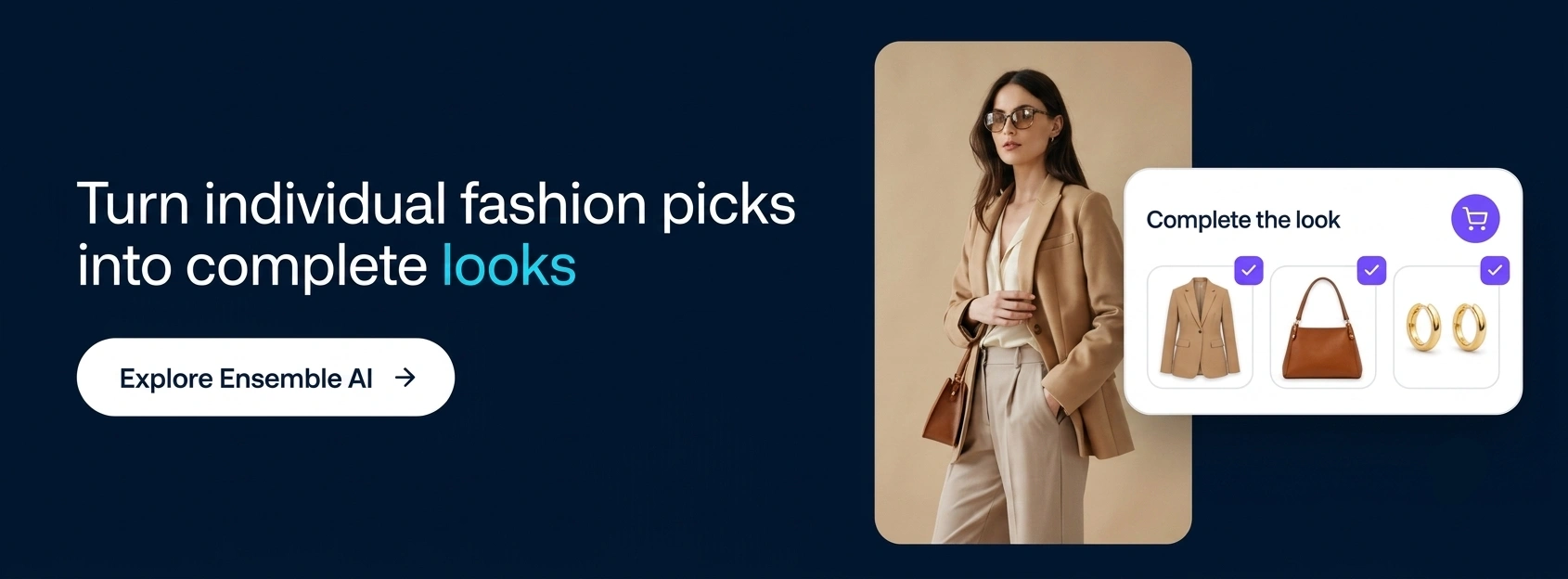
For fashion retailers, Ensemble AI works as an AI stylist. It builds complete outfits from your whole catalog and tailors them to each shopper’s taste. A shopper viewing a dress sees shoes and a bag that suit their style, not a row of similar dresses.
How to Measure Frequently Bought Together Performance
Track these five metrics to measure the performance of frequently purchased together:
| Metric | What it shows | How to calculate |
|---|---|---|
| Average order value (AOV) | Whether orders are getting bigger | Total revenue/ number of orders |
| Bundle attach rate | How often shoppers add suggested items | Orders with an FBT item/ orders with the main product |
| Recommendation conversion rate | How often FBT clicks turn into purchases | Purchases from FBT/ FBT clicks |
| Incremental revenue | Extra revenue caused by FBT | Test group revenue − control group revenue |
| Revenue per visitor (RPV) | The overall value of each visit | Total revenue/ number of visitors |
Watch margin and return rates too. A bundle that lifts AOV but drives returns isn’t a win.
Conclusion: Turn Relevant Product Recommendations into Higher-Value Orders
Frequently bought together works because it answers a question every shopper has: what else do I need?
Answer this question by using your own customer order history, show shoppers what others who made similar purchases chose, and use a test to determine if one option performs better than another.
Next, personalize each of those options so that every time a shopper looks at a bundle, they feel like it was selected just for them.
Frequently Asked Questions About Frequently Bought Together
What products are frequently purchased together?
Common pairings include phones and cases, laptops and bags, printers and ink, shoes and socks, and recipe ingredients such as pasta and sauce. The right pairings for your store depend on your catalog and your customers, so base them on your own order data.
Can you create frequently bought together bundles without discounts?
Yes. If the items genuinely belong together, convenience is often reason enough. Many shoppers will add a matching case or cable at full price because it saves them from having to look for it later.
Where should frequently bought together recommendations appear?
The most effective way to begin using Frequently Bought Together (FBT) is on product pages, since this is where customers make purchase decisions. After implementing FBT on product pages, expand its usage to other areas of your website such as the shopping cart, checkout process, and email follow-ups.
How is AI-powered frequently bought together different from manual bundling?
Manual bundles are fixed sets your team picks and updates by hand. AI-powered FBT learns from orders and shopper behavior, updates itself, and can show different suggestions to different people. That makes it much easier to cover a large catalog.
