

AI Personalization: How AI Creates Individualized Customer Experiences at Scale

Shoppers can tell when an eCommerce site understands them and notice even more quickly when it doesn’t. They search for “breathable running shoes” and get generic best-sellers. A week later, they receive an email for a product they have already bought. Each moment may seem small, but together, they cost retailers sales before the shopper even reaches the checkout.
AI personalization addresses this by learning exactly what each customer is looking for, then adapting search results, product listings, website content, and communication based on those needs at scale.
This guide explains how it works, where it applies in retail, and how to build a strategy that grows and delivers over time.
TL;DR: AI Personalization
AI personalization uses machine learning to customize each shopper’s experience in real time, based on behavior, product context, and customer history. Unlike rule-based personalization, it does not depend on manually built segments. It learns from all interactions and adjusts automatically.
In eCommerce, AI personalization works best when connected across the customer journey. All aspects of the experience (search results, recommended products, website content, social proof, etc.) should be relevant to the customer’s search or purchase intent. This helps them complete purchases faster and return for more.
The result is higher revenue per visit and lifecycle marketing that improves with every engagement.
What Is AI Personalization?
AI personalization is the use of artificial intelligence to decide, for each individual, which products, content, offers, and messages to show, and when. It draws on signals such as searches, clicks, purchases, device, and stated preferences, then predicts what the person is most likely to want next.
The key difference from earlier approaches is scale and speed. A merchandising team can write rules for a handful of segments. AI for personalization can make a separate decision for every shopper, on every page, in every session, and update it as soon as behavior changes.
In retail and eCommerce, AI powered personalization influences everything from search result rankings and products displayed on category pages to product recommendations, messaging that builds purchase confidence, and the content of subsequent emails or push notifications.
AI Personalization vs Traditional Personalization: What Changes?
Traditional personalization operates on predefined rules. Teams group shoppers into segments, such as “returning customers in London”, and give them a fixed experience. This works on a small scale but becomes difficult to manage as product catalogs, channels, and audiences grow. Rules become outdated, segments overlap, and updates require manual effort.
AI powered personalization uses models that continuously learn from shopper behavior. Unlike traditional segmentation, AI for personalized customer experiences understands what each shopper is looking for and adapts their experience in real time. It can also personalize for anonymous visitors from their first interaction without them having to log in.
The biggest difference is how everything works together. AI personalization uses the same shopper intent to deliver a consistent, relevant experience across channels.
Let’s look at the key differences below.
| Traditional Personalization | AI Personalization | |
|---|---|---|
| How it works | Fixed rules and segments | Learns from live behavior |
| Personalization level | Segment level | Individual level |
| Anonymous visitors | Generic experience | Personalized after the first interaction |
| Updates | Requires manual updates | Adjusts in real time |
| Channel coordination | Channels work separately | Connects across channel |
| Measurement | By surface or campaign | Tied to revenue per visit, AOV, and revenue per send |
How Does AI Personalization Work?
AI personalization operates as a continuous loop: identify signals, make decisions, take actions, and learn.
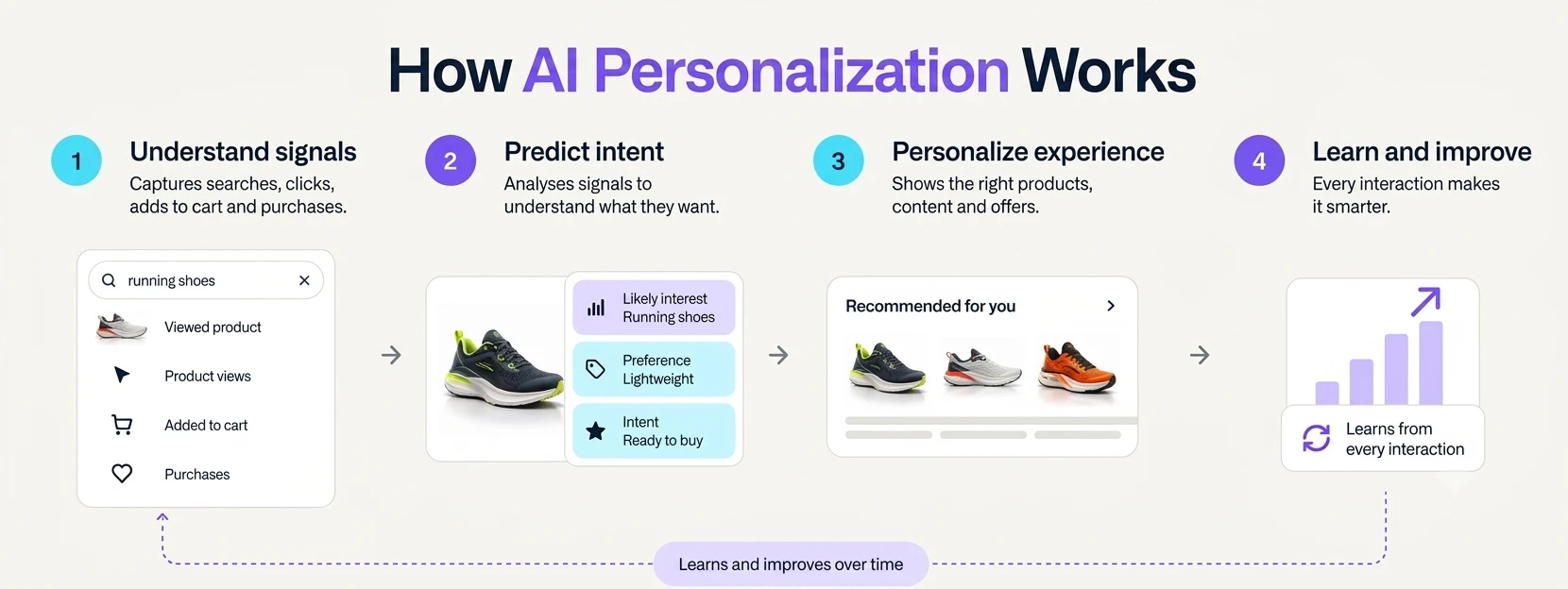
Understand Customer Signals
Every time a customer engages, AI is learning. When they search for items, they express their intentions. When they view products, add them to the shopping cart, and buy items, they are telling AI about their preferences.
The context surrounding their visits provides AI with more information about them (e.g., whether they are a new visitor, the type of device they are using, etc.) and how we acquired them as a visitor (e.g., via advertising).
Customer data is as important as product data. Both are used to determine what products should be displayed to them. Data such as product attributes, prices, product availability, and margins are also used to determine which products to present to them.
Predict Intent and Decide the Next Best Experience
When a customer has a single profile across channels, AI for personalization can anticipate the customer’s goal and select the experience that best suits that goal. This could include changing how a category page ranks items, offering an accessory that complements the item selected, or displaying a guided product finder.
Activate and Continuously Learn
The decision is delivered to the right touchpoint: search results, product pages, cart, homepage content, or an email rendered at the moment of open. Responses (clicks, purchases, exits) provide additional data to the customer’s profile. Testing software will automatically compare various strategies and determine which strategy generates more revenue. Therefore, performance continues to improve without constant adjustment.
Where Is AI Personalization Used in Retail and Commerce?
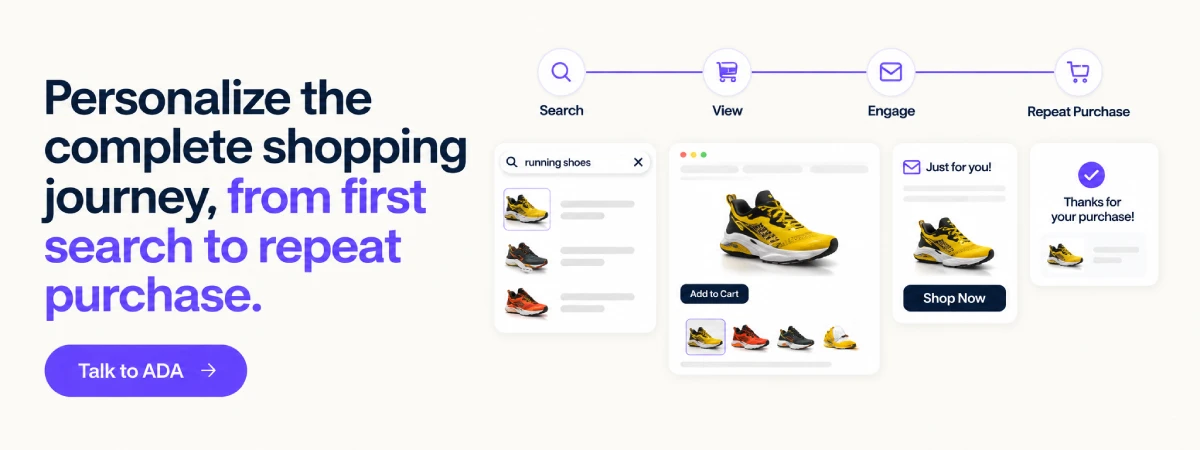
The most effective implementations treat these use cases as stages of one journey, with each stage passing what it learns to the next.
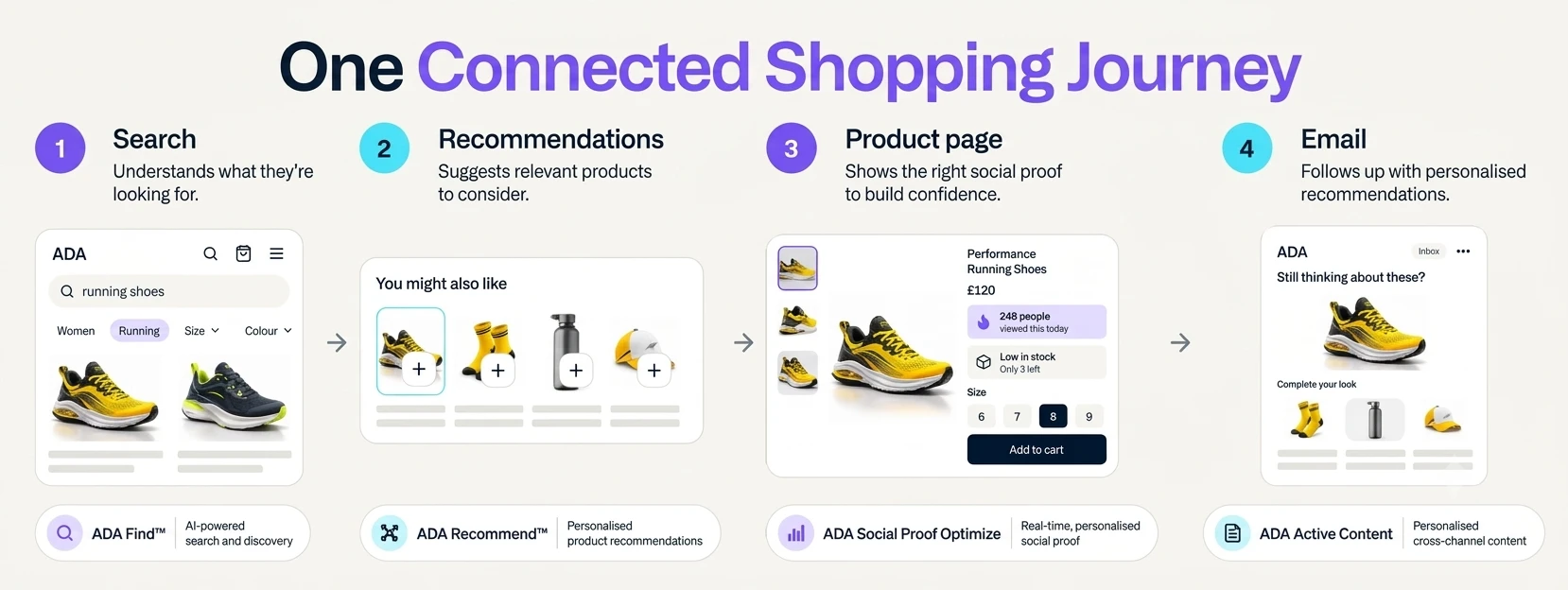
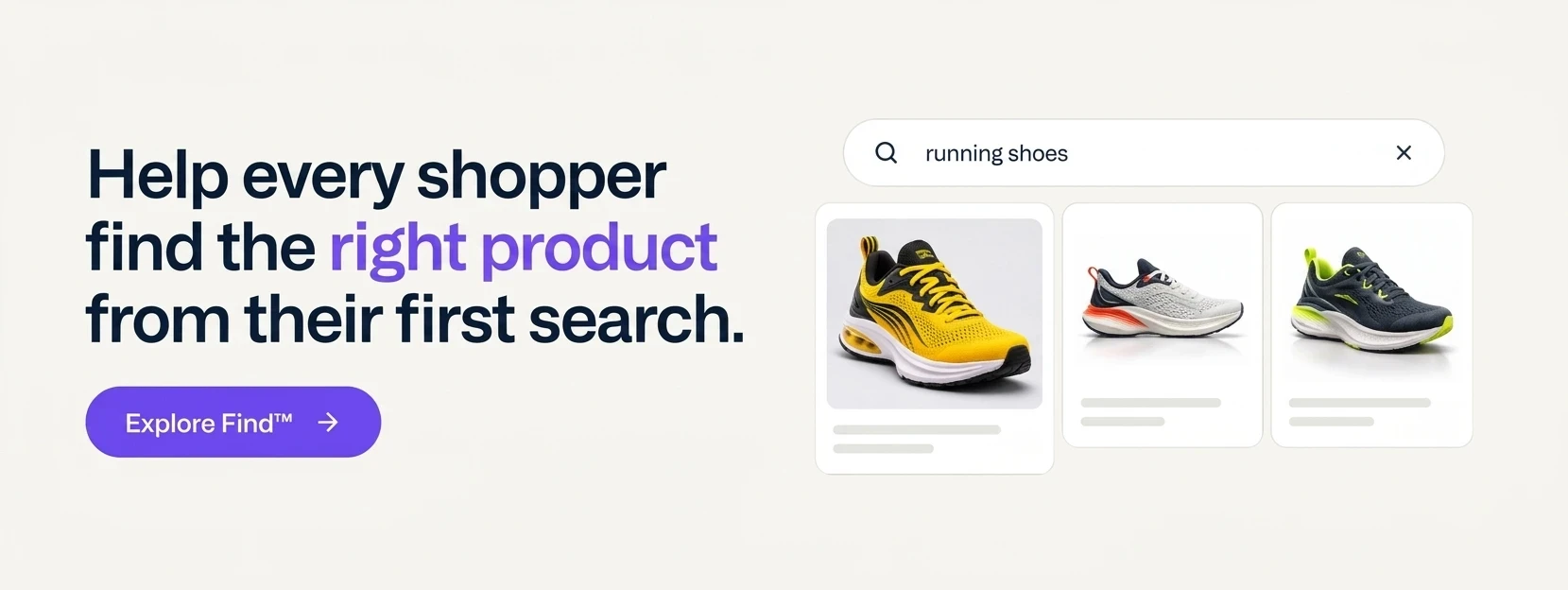
Personalized Search and Product Discovery
Personalized search utilizes semantic analysis to understand the user’s intent when they type in descriptive searches like “comfortable workwear for summer”, corrects spelling errors, finds synonyms, and modifies the search results based on the user’s initial query. The customer’s search query also influences how products are displayed on product category pages and product filters, and automatic product catalog enhancement ensures that all products are findable.
At ADA, Find™ brings these capabilities together. It interprets natural language, personalizes results from the first interaction, and enriches catalog data automatically for both B2C and B2B retailers.
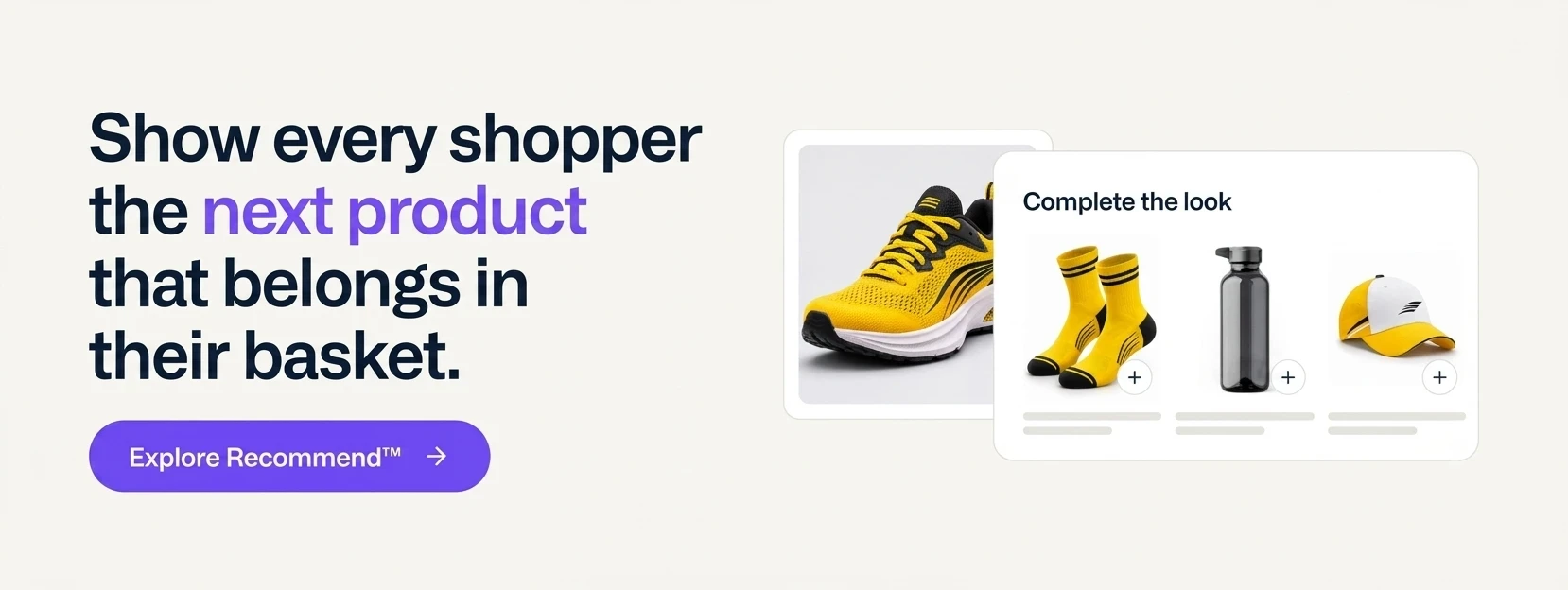
Product Recommendations and Next-Best Offers
Recommendations work best when they know what the shopper just searched for. Someone who searched for a specific laptop should see a compatible charger, bag, and warranty on the product page, not loosely similar laptops. AI recommendations use the same shopper profile as search to apply cross-sell, compatibility, and bundle logic, and adapt as the basket changes. In fashion, they can go further and assemble complete, personalized outfits.
At ADA, Recommend™ brings these capabilities together. It uses intent from search and browsing to drive attachment across product pages, cart, and homepage, with merchandiser controls for margin, brand, and stock.
Dynamic Content and Messaging
Banners, editorial tiles, and guided flows such as gift or product finders can adapt to each shopper. Guided journeys capture what shoppers share, such as budget, recipient, or skin type, and use it to return relevant products.
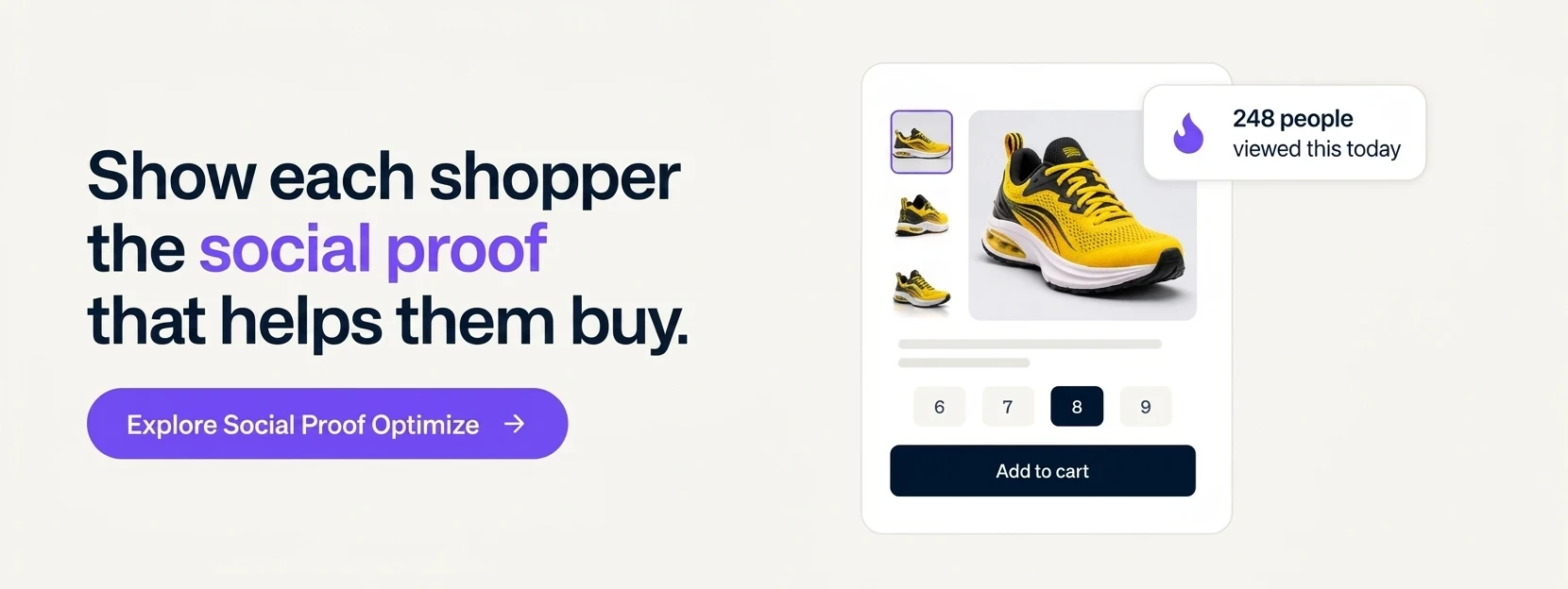
Trust signals can be personalized too, showing the reassurance most likely to matter to each shopper, based on real data and without manufactured urgency.
At ADA, Recommend™ powers these interactive journeys, turning what shoppers share into relevant products. Social Proof Optimize adds personalized trust signals.
At Swedish sports retailer Stadium, adding social proof to item pages led to a 17.3% lift in revenue per visit.
Cross-Channel Customer Experiences
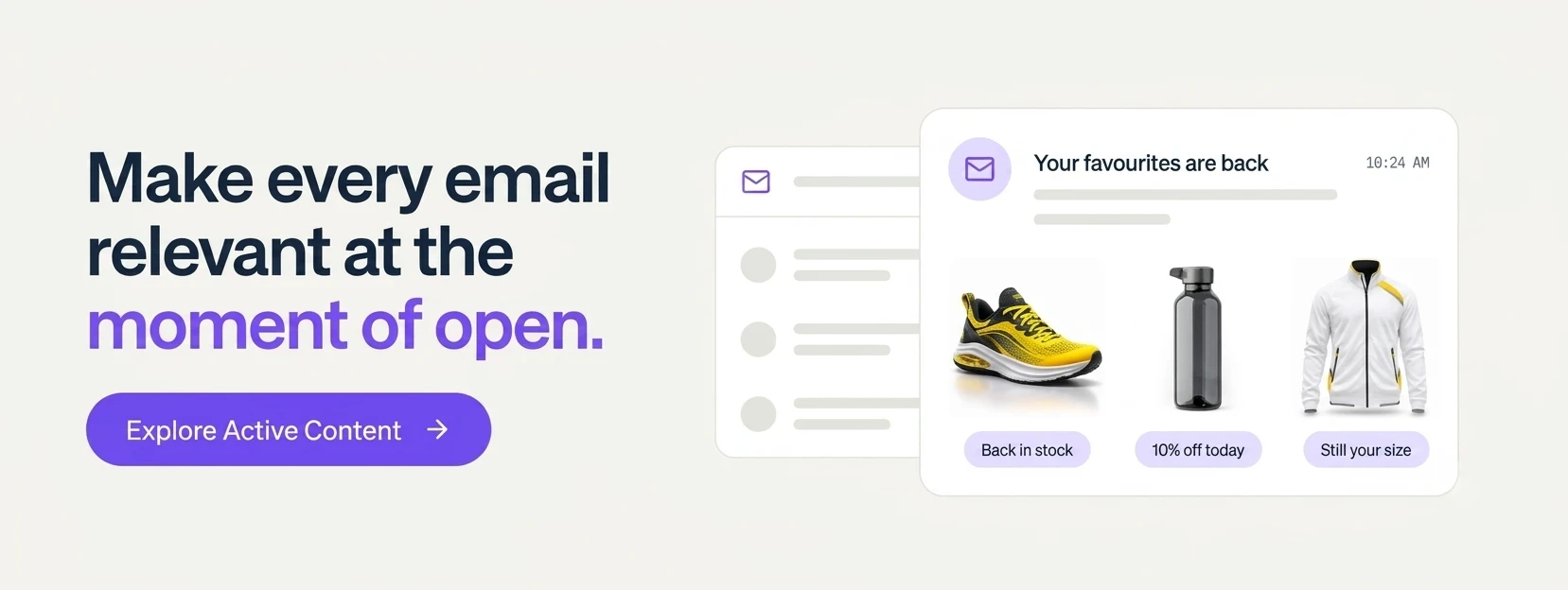
This is where lifecycle marketing comes together. Open-time personalization brings on-site knowledge into emails, pushes, SMS, and messaging applications. AI personalization marketing renders products, prices, and inventory at the time of opening, so your customer receives only the most up-to-date and relevant offers and updates. Each click returns the shopper to a site that already knows them, and each visit makes the next message more relevant.
At ADA, Active Content powers this AI personalization marketing layer and works with the email platforms retailers already use.
For one US big-box retailer, open-time recommendations lifted browse abandonment email revenue by 66% and cart recovery revenue by 46%.
What Data Does AI Personalization Need?
AI personalization needs three types of data.
- Behavioral data shows what shoppers do: searches, product views, add-to-carts, purchases, and email clicks.
- Product data describes what is being sold: attributes, price, inventory, and margins.
- Customer context adds who the shopper is: new or returning, stated preferences, loyalty status, and consent.
What Are the Biggest Challenges with AI Personalization?
The biggest challenges are rarely about the algorithms. They are about how personalization is set up.
Fragmented systems are the most common problem. Many retailers run recommendations, content personalization, trust signals, and lifecycle messaging on separate engines, each having its own logic and data. The product page does not know what the shopper searched for, and the email does not know what happened on site. Shoppers experience the gap even if they cannot name it.
Poor catalog data can reduce the effectiveness of the most sophisticated models. A second problem is lack of visibility: retailers need to understand the reasoning behind a particular strategy being used by the system; the signals that caused that strategy to fire; the sales generated as a result; and the ability to maintain their own margins and brand identity.
Lastly, personalization should be conducted in accordance with privacy and consent, utilizing only the data that customers have consented to provide.
How Is Agentic AI Changing Personalization?
Agentic AI takes personalization a step further by helping shoppers make decisions and complete purchases. For example, instead of simply showing search results, an AI shopping assistant can understand a request like “I need an outfit for a summer wedding”, ask relevant questions, and recommend a complete outfit that shoppers can buy.
In order for the above to happen, retail businesses will have to provide their AI-powered agents with accurate product information, shopper data, and current inventory levels. Retailers should focus on building this foundation by connecting shopper intent, product data, and personalization across every customer touchpoint.
Suggested Read: Ecommerce Personalization
How to Build an Effective AI Personalization Strategy
An effective strategy starts small, proves value, and expands along the shopper journey.
- Find the biggest leak. Identify where revenue is lost: shoppers who search and leave, product pages with low attachment, or emails whose revenue per send has plateaued.
- Set clear KPIs. Tie each stage to a business measure, such as revenue per visit for discovery, AOV and attachment rate for product pages, and revenue per send for lifecycle.
- Build on one profile. Make sure every new capability reads from and writes to the same shopper profile, so search intent informs recommendations and on-site behavior informs email.
- Keep the existing stack. Your commerce platform, ESP, and CDP stay in place. AI personalization works as the coordination layer between them.
- Expand along the journey. Once the first stage shows results, extend to the next, so each addition makes the others more effective.
Suggestef Read: Top Ecommerce Personalization Software
Conclusion
Today, AI personalization is more than just recommending products and segmenting email lists; it is now about using a common knowledge of shopper intent to make decisions at all points in the customer journey.
As a result, shoppers can find what they need faster, receive more relevant product recommendations, and get communications that reflect their actual behavior rather than a fixed schedule.
Retailers should take a practical approach: identify where they are losing the most revenue, measure the impact, and prioritize improvements accordingly.
ADA’s Digital Experience Personalization (DXP) suite is built for this approach. Find™, Recommend™, Social Proof Optimize, and Active Content share one shopper profile, so intent captured in search shapes product pages, trust signals, and lifecycle messages. Retailers can start with one capability, prove its impact, and add the next without replacing their existing commerce platform or ESP.
Frequently Asked Questions About AI Personalization
What is the difference between AI personalization and hyper-personalization?
AI personalization covers any use of AI to customize experiences. Hyper-personalization is a more granular form of it: decisions made at the individual level, in real time, using live behavioral and contextual data. An email that re-renders prices and stock each time it is opened is one example.
What are some examples of AI personalization in ecommerce?
Examples of this include: searching the internet and finding products that are relevant to you, recommending related items on a product page, a search tool for finding specific items within a category of many products, showing reviews/ratings based on your interests, creating clothing ensembles using AI, and sending abandonment emails with personalized product suggestions. When these types of tools are used together, they can learn from one another.
Can AI personalization work for anonymous or first-time visitors?
Yes, AI personalization uses a person’s initial interaction (e.g., search queries, clicked links, viewed product categories) to adapt to them; then, if they return via email or log in later on, AI connects their previous session to their user profile.
How is generative AI different from predictive AI in personalization?
Predictive AI estimates what a shopper is likely to want, such as the next product they will buy. Generative AI creates content, such as product descriptions, catalog attributes, or message variations. The strongest personalization combines both: predictive systems decide what to show, and generative models help create it.
