
Understanding Consumer Behaviour in the Digital Era

Personalisation
Blogs

Understanding Consumer Behaviour in the Digital Era

What is Consumer Behaviour?

Consumer behaviour in the digital era has undergone significant transformations. With the widespread adoption of technology and the internet, consumers have access to a wealth of information and choices. This shift has revolutionised how individuals interact with brands and make purchasing decisions. To thrive in this evolving landscape, businesses must understand and adapt.

Consumer behaviour studies how individuals, groups, or organisations decide and utilise resources to satisfy their needs and wants. It encompasses various psychological, social, and cultural factors that shape the decision-making process. Understanding consumer behaviour is crucial for businesses as it helps them identify and respond to customer needs effectively.

How did Consumer Behaviour change in the Digital Era?

Consumer behaviour has undergone significant changes in the digital era, driven by advancements in technology and the widespread adoption of the internet. Let’s explore some key ways in which consumer behaviour has evolved in response to the digital revolution:

1. Empowered Decision-Making

In the digital era, consumers can access abundant information at their fingertips. They can easily research products, compare prices, read reviews, and gather insights before purchasing. This easy access to information has empowered consumers to make more informed choices.

Consumers no longer have to rely solely on advertisements or sales pitches but can instead rely on authentic user reviews and recommendations. As a result, businesses need to focus on building a positive online reputation, providing transparent and accurate information, and ensuring the quality of their products or services.

2. Rise of Online Shopping

The digital era has witnessed a significant shift towards online shopping. eCommerce platforms have made it convenient for consumers to browse and purchase products from the comfort of their homes. Online retailers offer various choices, competitive prices, and personalised recommendations based on consumer preferences and past purchases. This shift has posed challenges for traditional brick-and-mortar stores, prompting them to establish their online presence or adopt omnichannel strategies to stay competitive.

3. Influence of Social Media

Social media has emerged as a powerful influence on consumer behaviour. Consumers often seek recommendations and opinions from their peers on social media before purchasing. Influencers with a significant following and expertise in specific niches can also sway consumer opinions and preferences. Businesses have recognised the impact of social media and are actively leveraging these platforms to engage with their target audience, build brand awareness, and drive sales.

4. Mobile Dominance

Smartphones have become integral to consumers’ lives, transforming how they interact with brands. Mobile devices offer convenience and accessibility, allowing consumers to browse, shop, and interact with businesses anytime, anywhere. As a result, businesses must optimise their websites and online experiences for mobile devices to ensure seamless navigation, fast loading times, and a user-friendly interface. Mobile apps have also gained popularity, providing personalised experiences and enhancing customer loyalty.

5. Personalisation and Customisation

The digital era has ushered in an era of personalised experiences. Businesses can leverage consumer data and advanced analytics to understand individual preferences and tailor their offerings accordingly. Personalisation goes beyond addressing customers by name; it involves curating product recommendations, delivering relevant content, and providing customised promotions based on previous interactions and purchase history. This focus on personalisation helps businesses enhance customer satisfaction, build stronger relationships, and foster loyalty in an increasingly competitive market.

Challenges for Businesses in Adapting to Digital Consumer Behaviour

Consumer behaviour in the digital era as described above brings some new problems for companies. Here are some challenges that businesses should look out for in navigating the changing consumer behaviour in the digital era:

1. Constantly Changing Platforms

New digital platforms and social media networks seem to emerge regularly. Businesses must adapt to these platforms and understand where their target audience is most active. Staying updated on platform changes, algorithms, and features can be overwhelming.

2. Information Overload

Consumers are inundated with information and content daily. Cutting through the noise and grabbing their attention is a challenge. Businesses must create compelling, relevant, and personalised content to stand out.

3. Privacy Concerns

Consumers are increasingly concerned about their privacy online. Stricter data protection regulations, like GDPR, have changed how businesses can collect and use customer data. Companies must navigate these regulations while still personalising their marketing efforts.

4. Customer Expectations

Consumers expect immediate responses to their inquiries and personalised experiences. Meeting these expectations requires real-time monitoring and responsive customer service.

5. Global Competition

The digital era has made it easier for businesses to reach a global audience, but it has also increased competition around the world. Standing out in a crowded market requires innovative and strategic marketing approaches.

6. Analytics and Data Complexity

In order to understand consumer behaviour in the digital age, data plays an important role. However, managing and making sense of vast amounts of data can be challenging. Businesses need the right tools and expertise to analyse data effectively and use it to inform decision-making.

7. Sustainability and Social Responsibility

Consumers increasingly expect businesses to be environmentally and socially responsible. Companies must align their marketing efforts with their sustainability initiatives to meet these expectations.

Navigating these challenges in the face of evolving consumer behaviour requires businesses to be agile, data-driven, and customer-centric. Adapting to changing technology and consumer preferences while maintaining ethical and responsible marketing practices is essential for success in the digital era.

How Your Business Can Adapt to Consumer Behaviour in the Digital Age?

To thrive in the digital age and effectively connect with consumers, businesses must adapt their strategies to align with evolving consumer behaviour. Let’s explore ten key strategies that businesses can employ to adapt and succeed in the digital era:

1. Develop a Strong Online Presence

Establishing a strong online presence is crucial for reaching and engaging digital consumers. This includes creating a user-friendly website, optimising it for search engines (SEO), and utilising social media platforms to connect with the target audience. Regularly updating online content and maintaining a consistent brand image across digital channels helps build consumer trust and credibility.

2. Embrace eCommerce

With the rise of online shopping, businesses should consider integrating eCommerce into their operations. Setting up an online store enables customers to browse and purchase products at any time conveniently. Offering secure payment options and a seamless checkout process enhances the customer experience and encourages repeat purchases.

3. Leverage Social Media Marketing

Social media platforms provide an excellent opportunity for businesses to connect directly with their target audience. Developing a comprehensive social media strategy involves identifying the platforms most relevant to the business and its target market, creating engaging content, and actively interacting with followers. Leveraging social media advertising and influencer collaborations can further amplify brand visibility and reach.

4. Optimise Mobile Devices

Given the dominance of mobile devices, businesses must optimise their online presence for mobile users. This involves adopting responsive web design, ensuring fast loading times, and providing a seamless mobile browsing experience. Mobile optimisation extends to emails, ads, and other digital marketing assets, ensuring they are designed to be mobile-friendly and visually appealing on smaller screens.

5. Utilise Data Analytics

Leveraging data analytics allows businesses to gain valuable insights into consumer behaviour and preferences. By analysing data from website analytics, social media metrics, and customer interactions, businesses can identify patterns, trends, and areas for improvement. This data-driven approach helps make informed decisions and tailor marketing strategies to meet consumer needs effectively.

6. Personalise the Customer Experience

Personalisation is key to enhancing the customer experience in the digital age. Utilise data and customer profiles to deliver personalised recommendations, targeted offers, and relevant content. Personalisation extends beyond product recommendations and can include personalised email marketing campaigns, customised landing pages, and tailored customer support experiences.

7. Foster Online Reviews and Testimonials

Online reviews and testimonials have a significant impact on consumer decision-making. Encourage satisfied customers to leave reviews and testimonials on review platforms, social media, and your website. Whether positive or negative, responding to reviews demonstrates your commitment to customer satisfaction and helps build trust with potential customers.

8. Engage with Influencers

Influencer marketing has become an effective way to reach and engage digital consumers. Identify influencers relevant to your industry and target audience, and collaborate with them to promote your products or services. Influencers can provide authentic recommendations, increase brand visibility, and drive traffic to your business.

9. Provide Exceptional Customer Service

Digital consumers expect prompt and personalised customer service. Utilise various communication channels, such as live chat, social media messaging, and email, to provide timely and helpful assistance to customers. Aim for quick response times, effectively address customer inquiries and concerns, and go the extra mile to provide a positive customer experience.

10. Stay Agile and Adapt

Consumer behaviour in the digital era is constantly evolving. Stay informed about the latest trends, emerging technologies, and changes in consumer preferences. Continually monitor and analyse the effectiveness of your digital marketing efforts, gather feedback from customers, and be ready to adapt and refine your strategies accordingly.

Understanding and adapting to consumer behaviour in the digital era is crucial for businesses aiming to thrive in today’s competitive landscape. By embracing digital strategies, optimising mobile devices, leveraging social media, and personalising the customer experience, businesses can effectively connect with their target audience and build lasting relationships. However, navigating the complexities of the digital age can be challenging. That’s why it’s essential to partner with the right solutions provider.

Get Your Business Up to Speed with ADA

When you choose ADA Global as your go-to Marketing Services solution, your company may maximise the marketing process’s potential, and boost your company’s performance. Using ADA Global can help you to build better marketing strategies for businesses, from data-driven approach to personalized marketing. Furthermore, ADA Global is a leading digital marketing agency that provides cutting-edge solutions and expertise to help businesses thrive in the digital landscape. Contact ADA Global today and take your business to new heights!

Table Of Contents
What is Consumer Behaviour?
How did Consumer Behaviour change in the Digital Era?
Challenges for Businesses in Adapting to Digital Consumer Behaviour
How Your Business Can Adapt to Consumer Behaviour in the Digital Age?
Get Your Business Up to Speed with ADA

16 Benefits of CRM to Improve Customer Relationship

Data & AI
Blogs

16 Benefits of CRM to Improve Customer Relationship

What is a Customer Relationship Management (CRM) System?

Before diving into the advantages of CRM, it’s crucial to understand what a CRM system entails. Customer Relationship Management (CRM) system is a software solution that consolidates and manages customer data, interactions, and communications across multiple touchpoints. It serves as a central hub where businesses can store and access information about their customers, track sales activities, and analyse data for strategic decision-making.

What are the Benefits of Using a Customer Relationship Management (CRM) System?

Bridging the gap between businesses and their customers, a Customer Relationship Management (CRM) system presents various advantages that can elevate customer interactions. Let’s explore the 15 key benefits of incorporating a CRM system into your business operations:

1. Enhanced Customer Information Management

One of the primary benefits of a CRM system is its ability to centralise and organise customer information effectively. By consolidating contact details, purchase history, preferences, and more, businesses can ensure that all customer-facing teams can access accurate and up-to-date data. This streamlined approach to customer information management lays the groundwork for better customer interactions.

2. Visualising Data

Reading and understanding data can be a difficult activity, especially when the amount of data your business has is huge. With CRM, you can turn that pile of data into a visual that your employees can easily understand.

CRM can show customer information such as purchase history when the customer last interacted with the company, and what questions the customer has asked. With a better understanding of the data, your company will certainly be able to make better decisions regarding customers.

3. Improved Customer Service

Comprehensive customer profiles provided by customer relationship management software can help your business to improve customer service. Business can deliver top-notch customer service. Armed with a 360-degree view of each customer’s preferences and past interactions, customer service representatives can offer personalised support, address queries promptly, and resolve issues more efficiently. This personalised approach goes a long way in boosting customer satisfaction and fostering long-term loyalty.

4. Streamlined Sales Processes

CRM solutions empower sales teams with automation and streamlining capabilities, revolutionising their sales processes. From lead generation to closing deals, CRM software can automate repetitive tasks, track sales activities, and manage pipelines effectively. This newfound efficiency allows sales representatives to focus on building relationships and closing deals, resulting in increased revenue and productivity.

5. Enhanced Marketing Strategies

Harnessing the power of customer data, CRM systems open the doors to more targeted and personalised marketing campaigns. By analysing customer behaviour and preferences, marketing teams can tailor their messages and offerings to suit specific segments, significantly improving engagement and conversion rates. This data-driven marketing approach optimises marketing efforts and maximises the return on investment.

6. Improved Cross-Selling and Upselling Opportunities

Understanding customer buying patterns is key to unlocking cross-selling and upselling opportunities. CRM systems enable businesses to identify complementary products or services that align with each customer’s preferences and history. By presenting relevant offers at the right time, businesses can increase the average order value and boost revenue without aggressive sales tactics.

7. Increased Customer Retention and Loyalty

Strong customer relationships are the bedrock of customer retention and loyalty. With a CRM system, businesses can nurture these relationships effectively through personalised interactions, timely follow-ups, and proactive customer service. By making customers feel valued and understood, businesses reduce customer churn and increase the lifetime value of each customer.

8. Better Sales Forecasting and Reporting

CRM does not only help marketing teams, but also sales teams to do their job better and more efficiently. Accurate sales forecasting is crucial for effective resource allocation and planning. CRM systems provide real-time insights into sales performance, helping businesses make data-driven decisions and set achievable sales targets. Sales representatives can better track their progress and identify areas for improvement, leading to more consistent and reliable revenue forecasts.

9. Improved Team Collaboration

CRM systems promote seamless collaboration among different teams by providing shared access to customer data and communication history. This collaborative approach ensures that marketing, sales, and customer service teams are on the same page to meet customers’ needs and expectations. By breaking down silos, businesses can provide a unified customer experience across all touchpoints.

10. Enhanced Customer Segmentation

Understanding the diverse needs of customers is vital for effective marketing. CRM systems enable businesses to segment their customer base based on various factors, such as demographics, behaviour, and purchase history. Businesses can craft highly targeted marketing campaigns that resonate with each segment by categorising customers into specific groups.

11. Automated Task Management

CRM systems streamline business processes through task automation. Repetitive and time-consuming tasks, such as sending follow-up emails or updating customer records, can be automated, freeing employees’ time to focus on more strategic and value-added activities. This automation strategy leads to improved efficiency and ensures essential tasks are not overlooked.

12. Mobile Access to Customer Data

In the age of mobile workforces, access to customer data on-the-go is crucial. Modern CRM systems offer mobile applications, empowering sales and customer service teams to access critical customer information anytime. This mobile accessibility ensures seamless customer interactions, even when employees are out of the office.

13. Data Security and Privacy

Customer data is sensitive information and must be protected from unauthorised access. CRM systems have robust security features that safeguard customer information, ensuring compliance with data protection regulations. Businesses build customer trust and credibility by prioritising data security and privacy.

14. Improved Customer Insights

CRM systems provide valuable insights into customer behaviour, preferences, and buying habits. By analysing this data, businesses gain a deeper understanding of their customers’ needs and expectations. These insights help tailor products, services, and marketing strategies to meet customer demands better.

15. Integration with Other Business Tools

CRM systems can integrate seamlessly with other essential business tools, such as email marketing platforms, social media, and accounting software. This integration streamlines processes, eliminates data silos, and enhances overall business efficiency. Businesses can operate more cohesively, leveraging the strengths of various tools to optimise their operations.

16. Scalability and Flexibility

As businesses grow, so do their CRM requirements. CRM systems offer scalability and flexibility to accommodate changing business needs. Whether handling an increasing customer base or integrating with new technologies, a robust CRM system can adapt to support a company’s growth journey.

In a nutshell, incorporating a Customer Relationship Management (CRM) system into your business brings numerous benefits that revolutionise customer interactions and pave the way for sustainable growth. From streamlined processes to personalised customer experiences, CRM systems empower businesses to foster stronger relationships and make data-driven decisions. Embrace the power of CRM, and watch your business thrive in the realm of exceptional customer relationship management.

Embracing ADA’s Customer Relationship Management can be a game-changer for your business, unlocking a world of possibilities for delivering personalised customer experiences. Our CRM platform helps you drive growth by streamlining your marketing processes, allowing you to focus on more important tasks. With a centralised system to manage your customer information, contact us now to start improving lead management and target your marketing efforts for maximum conversions today!

Frequently Asked Questions (FAQs) about Benefits of CRM

1. What is the impact of CRM in business?

The impact of CRM in business can be seen in the number of customer retention and higher customer lifetime value. CRM can help marketing and sales teams to identify high value customers and their behaviour and preferences. That information plays a vital role in helping companies gain new customers and retain customers to keep making purchases.

2. How does CRM impact marketing?

CRM can help marketing teams to create personalised content by providing relevant data about customers. Customer data from CRM can be used by the marketing team to identify customers’ wants, difficulties, and other relevant matters. The marketing team can then use this information to create content that addresses these issues and makes customers or potential customers feel understood and interested in trying or buying your business products or services.

3. How does CRM improve productivity?

CRM can increase productivity by eliminating the need for you to perform menial tasks, such as data entry. In addition, CRM can also provide you with all the data you need regarding your customers so that you can strategise and take action faster with accurate data.

Table Of Contents
What is a Customer Relationship Management (CRM) System?
What are the Benefits of Using a Customer Relationship Management (CRM) System?
Frequently Asked Questions (FAQs) about Benefits of CRM

How Optimization Managers Can Harness ‘User Affinity Sorting’ to Fine-tune Their eCommerce Personalization Strategies

Digital Experience Personalization
Blogs

How Optimization Managers Can Harness ‘User Affinity Sorting’ to Fine-tune Their eCommerce Personalization Strategies

Laura Wishingrad, Product Manager (Personalization) at ADA Global, talks about a new Recommend™ feature that allows for testing multiple attribute-based personalization strategies.

Recommend™, ADA Global’s personalized product recommendation platform, offers optimization managers a way to test how different affinity-based personalization strategies influence how shoppers interact with product recommendations.

The platform allows for the exploration of various sorting approaches, such as sorting products based on a shopper’s affinity toward brands or their affinity toward color.

This feature offers a dual advantage: firstly, optimization managers can A/B test the different sorting methods against each other, and secondly, they can employ unique sorting techniques in specific scenarios.

For example, they have the flexibility to sort by brand affinity on their website while simultaneously applying color affinity sorting in their email campaigns. This versatility enables them to glean valuable insights into how their shopper base reacts to various affinity-based sorting strategies.

User Affinity Configuration – How It Works

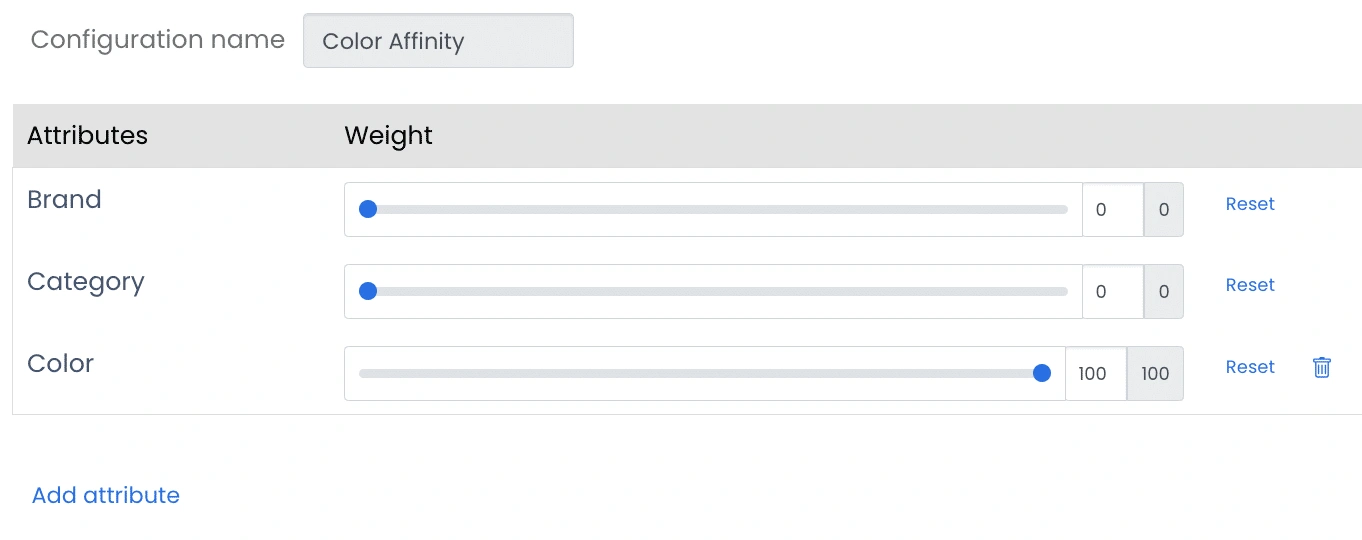
A User Affinity Configuration can be used to re-order product recommendations based on the shopper’s propensity toward specific attributes present in the product catalog. These attributes could be related to brands, categories, or any other characteristic associated with the products.

Each attribute within the configuration is assigned a distinct weighting, reflecting its relative importance. In the example below, we are using only the Color attribute to define the affinity.

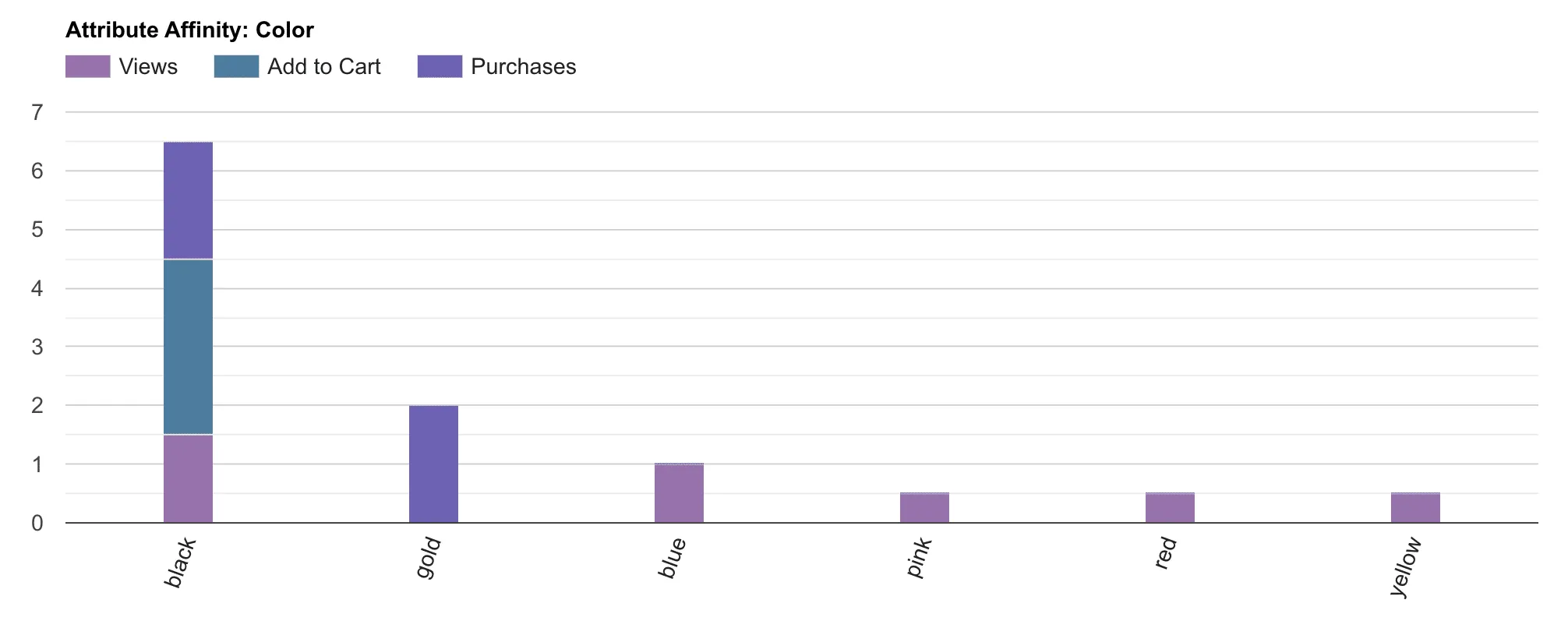
When a shopper interacts with the platform, their real-time customer profile (UPS) is analyzed to generate affinity scores for each defined attribute within the User Affinity Configuration. These scores are determined based on the products that the shopper has engaged with or purchased in the past.

In the example below from an apparel website, the shopper has a strong affinity toward black products and a medium affinity toward gold products.

To leverage the power of User Affinity Sorting in their recommendations, optimization managers can create custom strategies using Configurable Strategies. By selecting the User Affinity Sort option, recommended products can be re-ranked based on how well they align with the affinity scores for each shopper. This re-ranking process ensures that the products most closely matching a shopper’s affinity are given priority, allowing for a highly personalized ecommerce experience recommendations.

Also read: Why Consumer Electronics E-tailers are Betting Big on Commerce Personalization

Creating Multiple User Affinity Configurations

The flexibility of Recommend™ extends further by enabling the creation of multiple User Affinity Configurations, enabling optimization managers to focus on different product attributes of interest. For example, they can create one User Affinity Configuration centered around brand affinity and another focused on color.

Then, using Configurable Strategies, the optimization manager can specify which User Affinity Configuration is used for each strategy, allowing them to create different recommendation strategies that sort the recommendations based on differing affinity configurations. This allows for in-depth analysis and comparison of the performance and shopper response associated with each attribute.

In summary, Recommend™ empowers optimization managers to experiment with and compare various personalization strategies using User Affinity Sorting.

By leveraging User Affinity Configurations and Configurable Strategies, optimization managers can gain insights into the shopper base’s preferences and tailor personalized product recommendations based on specific attributes like brand or color.

Learn more about Recommend™ or request a demo to see the platform in action.

Table Of Contents
User Affinity Configuration – How It Works
Creating Multiple User Affinity Configurations

Reducing Inventory the Smart Way with Retail Artificial Intelligence

Merchandising and Supply Chain
Blogs

Reducing Inventory the Smart Way with Retail Artificial Intelligence

The Inventory Dilemma We All Face

You know that feeling when you open your closet and find it crammed with clothes you never wear? Well, that’s a bit like how traditional inventory management works. Imagine you run a retail store, and you’re stocking up on products, hoping they’ll fly off the shelves. But often, they don’t. You’re left with piles of unsold merchandise, and guess what? That’s money tied up in items that are just taking up space.

Now, let’s get down to some facts. According to a study by The Retail Owner, excessive inventory can gobble up a whopping 25-32% of your operating expenses. That’s a pretty penny, right? So, what’s the solution? It’s all about reducing inventory intelligently.

The Trouble with Guesswork

Traditional inventory management often relies on guesswork and gut feelings. You order products based on your instincts or past experiences, and sometimes, those instincts lead you astray. Imagine ordering a mountain of hot chocolate, soup, or baking ingredients products, only to have an unseasonably warm winter. Oops! Now you’re left with a load of unsold products gathering dust.

In fact, according to RTS food wastage across retail stores is as high as 30% contributing to inventory write-offs, due to the inability to sell items at full price. Yikes, right? That’s where reducing inventory with the help of AI-powered replenishment optimization comes into play.

Learn more about the problem with current forecasting frameworks.

The Perils of Out-of-Stock Woes

Picture this scenario: You’re a customer, excited to purchase a specific product online. You head to your favorite e-commerce site, only to find that it’s out of stock. Frustrating, isn’t it? Now, flip the script. You’re the business owner, and your customers are experiencing these out-of-stock woes. It’s not a good look.

Did you know that 42% of shoppers will head to a competitor if an item they want is out of stock? That’s nearly half of your potential sales walking out the door! This is where AI steps in to forecast inventory demand prediction accurately and replenish your stores, ensuring you don’t run out of popular items while reducing inventory of slow-moving ones.

The Space Conundrum

Imagine you run a small warehouse. It’s cozy, but not spacious. Traditional inventory management might fill it to the brim with goods, leaving little room to move. But then you receive a large order, and suddenly, you’re playing a game of warehouse Tetris, trying to fit everything in. It’s like trying to squeeze one more sweater into an overstuffed suitcase—it just won’t work.

In the world of warehousing, every square foot is valuable real estate. Did you know that optimizing your warehouse space can lead to a 20-50% reduction in carrying costs? That’s more room for your team to work efficiently and less clutter to navigate. Retail inventory optimization solution can help you achieve this while reducing inventory to just what you need.

Wrapping It Up

Traditional inventory management can be a real headache, causing financial losses, out-of-stock nightmares, and space constraints. It’s like trying to find a needle in a haystack without a magnet. But don’t worry! The solution to these challenges lies in embracing AI-powered replenishment optimization.

By reducing inventory intelligently, you can save money, meet customer demands, and make the most of your valuable space. So, say goodbye to the guessing game and hello to a smarter, more efficient way of managing your inventory.

Learn why your replenishment optimization framework might be ineffective.

Reducing Inventory with AI-Powered Replenishment Planning

If you’ve been in the game long enough, you know that juggling inventory can sometimes feel like trying to solve a Rubik’s Cube blindfolded. But what if I told you there’s a magical tool in town that’s transforming the supply chain landscape? Enter AI-powered replenishment – the real game-changer for supply chains!

The Old Inventory Conundrum

In the good ol’ days (well, not that good), managing inventory was like trying to predict the weather in a tropical rainforest. You could have too much, leading to wasted storage space and cash tied up in goods. Or you could have too little, risking lost sales and angry customers. It was a real Goldilocks situation – finding that “just right” level of inventory was a constant headache.

AI Steps In to Save the Day

But wait, cue the superhero music because here comes AI to the rescue! Artificial Intelligence, the tech marvel that’s shaking up industries left and right, has set its sights on the supply chain. It’s like having a super-smart sidekick who’s amazing at predicting what you need, when you need it.

Imagine a solution that powers your category planners to effortlessly generate thousands of precise replenishment planning solutions for each store, category, and channel with just a click of a button.

Demand forecasts that feed into your replenishment planning are based not just on historical sales data but also on other influencing parameters: internal factors such as advertising campaigns and promotions, and external factors such as local weather and public holidays.

And the calculations are done at a much more granular level than standard systems are able to do: retailers can determine the effect of each parameter on each SKU in each store (and in each distribution center, where relevant) on a daily basis.

Moreover, order proposals are generated every 24 hours by intelligently taking into account supply-chain constraints such as supplier delivery times, expiration dates and minimum or maximum order quantities.

This isn’t just a utopian idea, but rather a concrete reality that retailers are rising to. Solutions such as Order Right are revolutionizing the way retailers plan replenishment.

Say Goodbye to Overstock and Understock

You know that feeling when you walk into a store, and there’s an entire wall of unsold items that seem to have been gathering dust since the ’90s? That’s overstock, and it’s an inventory manager’s worst nightmare. AI helps you avoid this catastrophe by predicting exactly how many barbeque sauces you’ll need and when, reducing the chances of overstocking.

On the flip side, no one likes to tell a customer, “Sorry, we’re all out of that product.” That’s understock, and it’s equally cringe-worthy. AI’s got your back here too, ensuring you have just the right amount of inventory to meet customer demands and keep them smiling.

Time to Get Agile

Picture this: your supply chain is as agile as a gymnast doing cartwheels. That’s the power of AI-powered replenishment. It adapts on the fly, responding to sudden changes in demand or supply chain disruptions. No more sweating bullets when a supplier’s shipment gets delayed or when demand spikes unexpectedly. AI has your inventory’s back, always.

Learn about the 9 best practices in replenishment planning every retailer must know.

Implementing AI-Driven Inventory Reduction: A Simple Guide

So, you’ve heard all the buzz about AI-powered inventory reduction and how it can save you money while improving your supply chain’s efficiency. You’re excited to jump on the AI bandwagon, but you’re not quite sure where to start. Don’t worry; we’ve got your back! In this section, we’ll break down the steps to successfully implement AI-driven inventory reduction.

1 Get Your Team on Board

You might be the captain of this ship, but it’s essential to have your crew on board. You-sentences like, “You can’t do it alone,” hold true in this scenario. Convince your team that AI isn’t here to replace them but to make their lives easier. Share success stories from other companies that have embraced AI for inventory reduction. Make them excited about the possibilities. After all, teamwork makes the dream work.

2 Choose the Right AI Solution

AI isn’t a one-size-fits-all solution, so you need to find the right fit for your business. Start by evaluating your current inventory management processes and identifying pain points. Then, look for AI-driven tools such as Order Right to address those specific challenges. Consider factors like scalability, user-friendliness, and integration with your existing systems. Remember, it’s about reducing inventory without causing chaos.

3 Data, Data, Data!

AI thrives on data, so make sure you have a robust data strategy in place. Collect historical data on your inventory levels, demand patterns, and supplier performance. You-sentences like, “You need a treasure trove of data,” emphasize the importance of this step. Without quality data, AI won’t be able to make accurate predictions. It’s like trying to bake a cake without flour; it just won’t work.

4 Start Small, Scale Smart

Don’t try to overhaul your entire inventory management system overnight. Start with a small pilot project to test the waters. You-sentences like, “You’re not running a marathon; it’s more like a sprint,” remind you to take it slow. Monitor the results closely and make adjustments as needed. Once you see the benefits of AI-driven inventory reduction, you can gradually expand its scope. Think of it as growing your inventory reduction garden – one plant at a time.

5 Train Your Team

Introducing AI into your supply chain means your team needs to learn how to work with it. Provide training and support to ensure they understand the new tools and processes. You-sentences like, “You’re not alone in this; we’ve got your back,” create a sense of camaraderie. Encourage your team to ask questions and share their experiences. Learning together can be a fun and rewarding journey.

6 Celebrate Your Wins

Don’t forget to celebrate your successes along the way. When you see improvements in your inventory levels and cost savings, acknowledge them. You-sentences like, “You’ve earned it,” remind you to take a moment to pat yourself on the back. Share the good news with your team and let them know that their hard work is paying off. Celebrations, big or small, can boost morale and keep everyone motivated.

Discover how a Middle Eastern grocery retailer reduced inventory levels by 21% with Order Right.

Final Verdict

In conclusion, implementing AI-driven inventory reduction successfully doesn’t have to be a daunting task. It’s all about getting your team on board, choosing the right AI solution, harnessing the power of data, starting small, training your team, embracing continuous improvement, and celebrating your wins. You’ve got this! Remember, reducing inventory is about working smarter, not harder. So, go ahead and take that first step towards a more efficient and cost-effective supply chain.

Learn more: Grocery Replenishment Has Evolved: 9 Things Every Retailer Must Know

Table Of Contents
The Inventory Dilemma We All Face
The Trouble with Guesswork
The Perils of Out-of-Stock Woes
The Space Conundrum
Wrapping It Up
Reducing Inventory with AI-Powered Replenishment Planning
The Old Inventory Conundrum
AI Steps In to Save the Day
Say Goodbye to Overstock and Understock
Time to Get Agile
Implementing AI-Driven Inventory Reduction: A Simple Guide
Final Verdict

WhatsApp OTP for Instant Verification Process

Personalisation
Blogs

WhatsApp OTP for Instant Verification Process

What is OTP (One Time Password)?

The verification process is an important part of business. Verification can ensure that both the customer and the business are carrying out the transaction safely. To help the verification process, businesses can implement Whatsapp OTP (One Time Password).

Here is a guide on WhatsApp OTP:

One-Time Password, or OTP, is a unique code generated by a separate device or service, typically a mobile app. It is used as a security measure to authenticate a user’s identity and prevent unauthorised access to sensitive information or systems.

OTP is increasingly common in online banking, eCommerce, and other applications where security is critical. Normally, these passwords are sent via SMS or, in some cases, email. Nowadays, companies have found a way to incorporate WhatsApp as an app in which their users can receive their OTP.

How to Use WhatsApp OTP?

With the use of the WhatsApp Business Platform, companies can now have communication with their customers that is both secure and convenient in both directions. This method requires the user to have a WhatsApp account linked to their phone number, and the OTP is sent to the WhatsApp account instead of the conventional SMS or email.

To utilise WhatsApp for instant OTP authentication, the user first starts the login process on the relevant application or website, which triggers a request to be sent to their registered phone number. The user subsequently receives a notification via WhatsApp that includes the necessary OTP code to finalise the login process. This not only applies to account registration but other aspects as well such as account recovery and validation of integrity.

To help you better understand WhatsApp OTP, here’s a quick guide on how to implement WhatsApp OTP in your business:

1 1. Verify WhatsApp Business Account

Before you can use WhatsApp OTP, ensure that your business has a verified WhatsApp Business Account. This involves confirming your WhatsApp phone number and business details with WhatsApp. Follow WhatsApp’s guidelines for business verification.

2 Create Facebook Business Manager Account

Now that you have a WhatsApp business account, you need to create a Facebook Business Manager account.

Log into your Facebook account then log into Facebook Business Manager (https://business.facebook.com/) and connect to your WhatsApp Business Account.

3 Use WhatsApp API

WhatsApp OTP is typically integrated using the WhatsApp Business API. This API allows you to send automated messages, including OTP, to users. To access the WhatsApp Business API, you’ll need to apply for and be approved by WhatsApp. Follow WhatsApp’s guidelines and requirements for API access.

4 Send Test OTP Messages

Thoroughly test the OTP generation and delivery process. Verify that users receive OTP promptly and can use them effectively. Test for various scenarios, including user errors and edge cases.

5 Verify the OTP

After the user enters the OTP received, use the WhatsApp API to verify it. If the code received is correct, the user can proceed to the next stage.

If it is incorrect, display an error message and direct the user to try again.

By following these steps and maintaining a focus on security, privacy, and user experience, your business can effectively utilise WhatsApp OTP for various purposes, from user authentication to transaction verification, while ensuring a secure and seamless customer journey.

WhatsApp OTP Use Case Examples

1 Account Verification

WhatsApp One-Time Passwords (OTP) can be used in various business cases to enhance security, authentication, and communication. Here are several example scenarios where WhatsApp OTP can be employed:

Businesses can use WhatsApp OTP to verify user accounts during the registration process. Users receive a one-time code via WhatsApp to confirm their identity, ensuring that only authorised individuals can access their accounts.

2 Two-Factor Authentication (2FA)

Implementing WhatsApp OTP as part of a two-factor authentication process adds an extra layer of security to user logins. After entering their username and password, users receive an OTP on WhatsApp, which they must input to gain access to their accounts.

3 Password Reset

When users forget their passwords, businesses can send them a WhatsApp OTP to verify their identity before allowing them to reset their passwords. This prevents unauthorised access to accounts during the password recovery process.

4 Transaction Confirmation

For financial institutions and e-commerce platforms, WhatsApp OTP can be used to confirm high-value transactions. Users receive an OTP to verify and approve significant financial actions, adding an extra level of security for sensitive transactions.

5 Identity Verification for Customer Support

Customer support representatives can request users to provide a WhatsApp OTP to verify their identity before discussing account-specific or confidential information. This ensures data privacy and protects against unauthorised access.

6 Appointment and Reservation Confirmation

Service-based businesses, such as healthcare providers and restaurants, can send OTP to customers via WhatsApp to confirm appointments, reservations, or bookings. This reduces the likelihood of no-shows and enhances operational efficiency.

7 Access to Secure Documents or Content

Companies can use WhatsApp OTP to grant access to secure documents, exclusive content, or premium features within their applications or websites. This ensures that only authorised users can access restricted resources.

8 Reward Redemption

Loyalty programs and promotions can use WhatsApp OTP to validate the redemption of rewards or discounts. Users must enter a valid OTP to claim their rewards, reducing the risk of fraudulent redemptions.

9 Event Registration

Event organisers can employ WhatsApp OTP to confirm registrations and ticket.

10 Secure File Sharing

Businesses sharing confidential documents or files with clients or partners can use WhatsApp OTP to grant access. The OTP ensures that only authorised individuals can view or download the files.

WhatsApp OTP provides a secure and user-friendly method of authentication and verification across various business scenarios, improving security, user trust, and the overall customer experience.

How WhatsApp OTP Differ from Traditional SMS OTP

1 Delivery Channel

WhatsApp OTP and SMS OTP (One-Time Password) are both methods of authentication and verification, but they differ in several key ways

The most fundamental difference is the channel used for delivery. WhatsApp OTP is delivered via WhatsApp messages while SMS OTP is sent through traditional text messages. WhatsApp OTP leverages a popular messaging app, whereas SMS OTP relies on the mobile network’s SMS infrastructure.

2 International Reach

WhatsApp OTP relies on internet connectivity, which makes it accessible to users with a data connection, regardless of their location. SMS OTP, while widely available, may face challenges with international SMS delivery and potential delays in certain regions.

3 Reliability and Delivery Rates

SMS OTP generally has higher delivery rates and reliability compared to WhatsApp OTP. SMS messages have a better chance of reaching users, even in areas with poor internet connectivity. WhatsApp messages may not be delivered if the user’s phone is offline or if they have opted out of receiving messages from unknown contacts.

4 Integration

Integrating WhatsApp OTP typically requires using the WhatsApp Business API or third-party services, which may involve a more complex setup. SMS OTP integration can be simpler and is often supported directly by mobile carriers or SMS gateway providers.

In summary, WhatsApp OTP and SMS OTP serve similar purposes but differ in terms of the delivery channel, international reach, reliability, and integration methods. Businesses should consider their specific needs and audience preferences when choosing between these two authentication methods.

Benefits of Using WhatsApp for Instant OTP Authentication

1 Enhanced Security

One of the primary benefits of using WhatsApp-based OTP is the enhanced security it provides. WhatsApp uses end-to-end encryption to protect messages sent between users. This means that the message is encrypted on the sender’s device and can only be decrypted on the recipient’s device, making it more difficult for third parties to intercept or access the OTP code. SMS and email-based OTP codes, on the other hand, are sent in plain text and can be intercepted or read by third parties.

2 Convenience

WhatsApp-based OTP is more convenient for users because it eliminates the need to have access to their SMS or email account to receive the OTP code. This can be particularly useful when travelling, as the user may not have access to their phone network or email. With WhatsApp-based OTP, if the user has access to the internet, they can receive the OTP code through their WhatsApp account.

Switching to WhatsApp for Instant OTP Authentication

With ADA, you can boost your security and streamline authentication with WhatsApp OTP. Take advantage of real-time delivery, end-to-end encryption, and enhanced user convenience to protect your information and customer engagement. Get started with ADA’s WhatsApp Business Solution today! Contact us to find out how our service can help you expand the capabilities of your business.

Table Of Contents
What is OTP (One Time Password)?
How to Use WhatsApp OTP?
WhatsApp OTP Use Case Examples
How WhatsApp OTP Differ from Traditional SMS OTP
Benefits of Using WhatsApp for Instant OTP Authentication
Switching to WhatsApp for Instant OTP Authentication

What Is Content Planning and How to Get It Right

Data & AI
Blogs

What Is Content Planning and How to Get It Right

What Is Content Planning?

Content planning is the backbone of a successful digital marketing strategy. In a world inundated with information, creating and curating content that stands out and resonates with your target audience is paramount. However, it’s not just about churning out content; it’s about planning, strategising, and executing effectively.

In this comprehensive guide, we’ll explore what content planning is and how to do it right. Whether you’re a seasoned content creator or just starting, these insights will help you sharpen your content planning skills and make your mark in the digital landscape. Let’s get started!

Content planning is the pivotal process of strategically mapping your content creation and distribution efforts to achieve specific goals and objectives. The compass guides your content marketing journey, ensuring that every piece of content serves a purpose and contributes to your overarching digital strategy.

Why Content Planning is Important for Your Business?

Content planning might seem like an extra step, but it’s the secret sauce for creating content that resonates and achieves your goals. Imagine cooking a gourmet meal without a recipe – you might throw some ingredients together, but there’s no guarantee it’ll be delicious or even edible. Content planning is like your recipe, ensuring your content is well-structured, targeted, and delivers value. Here’s why it matters:

1. Focus and Clarity

It defines your “why” and “what” by aligning content with your overall strategy and target audience. You’ll know exactly what topics to tackle, what format to use, and where to publish it, avoiding aimless content creation.

2. Efficiency and Consistency

It saves time and resources by eliminating last-minute scrambles. You can schedule content in advance, ensuring a steady flow and keeping your audience engaged. Plus, it helps maintain consistent brand messaging and voice.

3. Targeted Impact

Planning lets you research your audience’s needs and interests. This ensures your content speaks their language, addresses their pain points, and ultimately drives them towards your desired action, whether it’s a purchase, a subscription, or simply brand awareness.

4. Data-Driven Decisions

Analysing the performance of your planned content allows you to see what resonates and what flops. This data guides future planning, helping you refine your strategy and create even more impactful content.

5. Teamwork and Collaboration

A content plan acts as a roadmap for everyone involved, fostering collaboration and ensuring everyone is on the same page. This is especially crucial for larger teams or when working with external creators.

In essence, the main purpose of content planning is to ensure that your content aligns with your business or personal objectives and resonates with your target audience. It’s about delivering the right message, to the right people, through the right channels, at the right time. Content planning is the blueprint that transforms random acts of content creation into a well-structured, purpose-driven content strategy.

In a digital age saturated with content, content planning is the key to standing out, connecting with your audience, and achieving your business objectives. It is the foundation of a successful content marketing strategy, ensuring that every piece of content contributes meaningfully to your brand’s digital growth and success.

How to Do Content Planning the Right Way

Effective content planning is not just about going through the motions; it’s about doing it correctly. To help you master this essential process, let’s break it down into ten key steps:

1. Define Your Goals and Objectives

Defining your goals and objectives is the foundational step in content planning. It’s about setting a clear direction for your content marketing efforts. Your goals include increasing brand awareness, driving website traffic, generating leads, boosting sales, or educating your audience.

When you define your objectives, you create a roadmap that guides the entire planning process. These goals should be Specific, Measurable, Attainable, Relevant, and Time-bound (SMART). For example, rather than stating, “Increase brand awareness,” you might set a goal like, “Increase brand awareness by 20% within six months through a targeted content marketing campaign.”

2. Identify Your Target Audience

Understanding your target audience is crucial for content planning. You must create content that resonates with the people you want to reach. Beyond basic demographic information, create detailed buyer personas that include their preferences, pain points, and behaviours. For instance, if you’re targeting young professionals interested in eco-friendly products, you must create content that aligns with their values and lifestyle choices.

3. Determine Your Content Types and Channels

Not all content is suitable for every purpose or platform. It’s important to choose the right content types and distribution channels that align with your goals and audience. For example, if your goal is to provide in-depth industry insights, whitepapers or ebooks may be the most suitable content type.

Similarly, you might distribute these through your website, email newsletters, or professional forums to reach a B2B audience effectively. Your choice of content formats and channels will significantly impact how your message is received and engaged with by your audience.

4. Establish a Timeline

Creating a timeline or editorial calendar is essential for maintaining consistency in your content production and distribution efforts. Your timeline should include key milestones, including content creation, editing, publishing, and promotion schedules.

This ensures that your content is released at optimal times and maintains a steady flow, keeping your audience engaged. For instance, if you’re running a blog, you can publish one well-researched post every week and promote it on social media on specific days.

5. Plan Your Content Topics

Choosing the right topics is fundamental for engaging your audience. While brainstorming content ideas, consider the interests of your target audience, keyword research, and industry trends. This research should guide your content topics, ensuring that they are not only relevant but also likely to attract your audience’s attention.

For example, suppose you’re in the fitness industry. In that case, you might identify trends related to home workouts and create content that addresses the unique challenges and solutions associated with this trend.

6. Assign Responsibilities

Content planning often involves collaboration with team members or external contributors. Assigning responsibilities ensures that everyone knows their role in the content creation process. It streamlines your workflow and minimises confusion. For example, in a content team, one member might be responsible for conducting research, another for writing, and another for editing. Clearly defined roles help keep the content production process efficient and organised.

7. Create Content Template

Templates for content planning are like pre-built toolboxes for your ideas. Preparing them beforehand saves you time and mental energy, streamlining the entire content creation process. It provides a clear structure, outlining key elements like title, keywords, target audience, and content type.

This clarity helps you stay focused and prevents rambling or forgetting crucial aspects. Think of it as a map guiding your content journey. Using templates also establishes a consistent look and feel for your content, fostering brand recognition. They also act as efficiency boosters, eliminating the need to reinvent the wheel each time. You simply adapt the template to your specific topic, saving precious time for content creation itself.

In essence, content planning templates are your secret weapons for organisation, efficiency, and impactful communication. They empower you to create high-quality content consistently, saving you time and effort while achieving your content goals.

8. Develop High-Quality Content

Quality is paramount in content creation. Allocating time and resources for thorough research, well-written content, professional editing, and engaging design is essential. High-quality content not only captures the attention of your audience but also builds trust and authority in your niche. To maintain quality, it’s necessary to follow best practices in content creation, which may include thorough fact-checking, expert interviews, and visual elements that enhance the content’s value.

9. Distribute Your Content

Creating great content is only half the battle; the other half ensures it reaches your target audience. Effective content distribution is key. Use the selected distribution channels, such as social media, email marketing, or content syndication, to share your content. Distributing content strategically across various platforms maximises its reach and impact. It’s not just about publishing; it’s about promoting and engaging your audience through these channels.

10. Define Your Metrics

Metrics are the compass by which you navigate your content planning process. Identify key performance indicators (KPIs) that are relevant to your goals. These metrics help you assess the success of your content. For instance, if your goal is to generate leads, you might track conversion rates, click-through rates, and form submissions on your website. By defining these metrics, you’ll have a clear way to measure and evaluate your content’s performance.

11. Analyse Your Results

Content planning is an ongoing, iterative process. Regularly analysing the performance of your content against your defined metrics is essential. It’s not enough to create and distribute content; you must also measure its impact. Analysing results lets you make informed decisions about what’s working and what needs improvement. This data-driven approach ensures that your content planning efforts remain relevant and effective as you adapt and refine your strategy.

In conclusion, mastering the art of content planning is your gateway to digital marketing success. The ten crucial steps we’ve explored in this guide will help you navigate the intricate world of content creation, ensuring that every piece of content serves a purpose and contributes to your overarching objectives. Whether you’re looking to increase brand awareness, engage your target audience, or drive sales, effective content planning is the key to unlocking these goals.

But why navigate this journey alone? ADA, your Creative and Digital Growth Partner, is here to offer you a helping hand. Leveraging cutting-edge AI, automation, and technology-powered workflows, ADA’s flagship product ensures the delivery of high-quality content and the seamless operational flow required for a successful digital strategy.

Take advantage of the opportunity to elevate your content planning game and achieve your digital marketing goals with the support of ADA, your Creative and Digital Growth Partner. The future of content planning is here, and it starts with us. Contact us today to explore how we can help you thrive in the digital landscape. Your success is just a click away!

Table Of Contents
What Is Content Planning?
Why Content Planning is Important for Your Business?
How to Do Content Planning the Right Way

Big Data Analytics: Challenges and Opportunities

Data & AI
Blogs

Big Data Analytics: Challenges and Opportunities

Big Data Challenges for Business

The application of big data to businesses brings both benefits and challenges. The challenges for big data applications in business generally include things like data processing and infrastructure challenges.

Here are some of the challenges in applying big data technology to your business:

1 Data quality

Poor data quality will lead to poor insights and bad decisions. One of the biggest challenges in implementing big data analytics is making sure your business only process the best data possible.,

As the data sets grow larger, ensuring data quality becomes even more harder and critical. Errors or inconsistencies in data can lead to flawed analysis and unreliable conclusions. To overcome such issues, a few approaches can be taken, such as correcting information and repairing the original data source to resolve any data inaccuracies.

2 Storage and infrastructure

It can be challenging to store, manage, and process vast quantities of data effectively. Businesses need to invest in the appropriate infrastructure and storage solutions to enable effective data management of large amounts of data without performance-related issues. As a preventive measure, businesses can make use of cloud hosting to improve data storage.

3 Data privacy and security

With the increase in data breaches and cyber-attacks as well as the continuous use of non-encrypted information, safeguarding data privacy and security has emerged as a critical imperative for businesses. It’s crucial to implement robust security measures to protect sensitive data from unauthorised access or theft.

4 Data governance

Big data analytics involves multiple stakeholders across various departments. Ensuring that data is managed consistently and transparently across the organisation can be daunting. To deal with such matters, implementing data governance policies and procedures can help mitigate this issue.

5 Data Integration and Multiple Data Sources

Multiple sources and integration hurdles present significant challenges in the realm of big data for several reasons. First, the sheer volume of data generated from various sources can overwhelm an organisation. Different data sources may use distinct formats, structures, and technologies, making it challenging to integrate them into a cohesive dataset. This diversity of data can lead to inconsistencies and inaccuracies in analysis if not managed properly.

Moreover, integrating data from multiple sources often requires a significant investment in infrastructure, tools, and skilled personnel. These integration hurdles can strain an organisation’s resources and may pose compatibility issues between existing systems and new data sources.

6 No One-size-fits-all Solution

The absence of a one-size-fits-all solution represents a significant challenge in the context of big data. Big data is a diverse field, encompassing a wide range of industries, use cases, and data types. What works effectively in one scenario may not apply universally to all. This variability creates challenges because there is no single technology, approach, or tool that can address the diverse needs and objectives of every big data application.

For instance, the analytical methods and infrastructure required for processing healthcare data may differ significantly from those needed for financial data or e-commerce data. Each domain necessitates tailored solutions to accommodate its unique data structures, compliance regulations, and objectives. Consequently, organisations often find themselves in the complex task of selecting and adapting different technologies and strategies to meet their specific big data requirements.

Moreover, the rapid evolution of big data technologies and the constant influx of new data sources make it challenging to settle on a static, one-size-fits-all solution. What was effective yesterday may become outdated tomorrow, requiring continuous adaptation and innovation to stay competitive.

7 Variety of The Tools

Selecting the right tools and platforms in the realm of big data represents a significant challenge due to the sheer diversity of available options and the evolving nature of the field. Big data encompasses a vast array of data types, from structured to unstructured, and it is generated at different velocities and volumes across various industries and applications. Each specific use case may require tailored tools and platforms to effectively capture, store, process, and analyse the data.

Moreover, the landscape of big data technologies is constantly evolving. New tools and platforms are regularly introduced, and existing ones are updated to keep pace with the growing demands of big data applications. This rapid evolution makes it challenging for organisations to select the right technologies that not only meet their current needs but are also scalable and adaptable to future requirements.

8 Sheer Volume of Data

Big data is not only big in name. Huge data volume is one of the core challenges in the field of big data. With the exponential growth in digital data generation, organisations are now dealing with massive datasets that can range from terabytes to petabytes and beyond.

This vast volume of data presents multiple challenges. First and foremost is the issue of data storage and management. Storing such large datasets efficiently and cost-effectively requires sophisticated infrastructure, often involving distributed and scalable storage solutions.

Secondly, processing and analysing huge data volumes can be time-consuming and resource-intensive. Traditional data processing tools and methods may not be capable of handling the scale and complexity of big data, necessitating the use of specialised technologies, like distributed computing frameworks and parallel processing.

Additionally, the sheer volume of data can lead to information overload, making it difficult to extract meaningful insights. Effective data mining, analysis, and visualisation become critical to distil actionable information from the vast amount of raw data.

Benefits of Big Data for Business

The challenges and complex processes that you have to face in implementing big data technology will pay itself off with the benefits that your business will get.

Here are some of the benefits of applying big data technology to your business:

1 Improved decision-making

Big data analytics can provide businesses with valuable insights that can guide decision-making processes. Through data analysis, businesses can identify patterns and trends that can help them make more informed and data-driven decisions.

2 Enhanced customer experience

Big data analytics can help businesses gain a deeper understanding of their customers’ behaviour, preferences, and needs. This knowledge can serve as a valuable resource to help businesses personalise their marketing strategies, product offerings, and customer service, ultimately enhancing overall customer experience.

3 Increased efficiency and productivity

Big data analytics can be used to streamline manual processes and foster ongoing improvements in operational performance, thereby reducing the time and effort required to complete tasks. This can lead to increased efficiency and productivity, allowing businesses to focus on more strategic initiatives.

4 Competitive advantage

Big data analytics can provide businesses with a competitive advantage by uncovering insights and opportunities that competitors may not have discovered before. By leveraging big data analytics, businesses can innovate and differentiate themselves from their competitors in the marketplace.

At ADA, we have worked across verticals to lay out building blocks for businesses to make the best use of their data for decision-making, optimisation, and monetisation. We have also further enriched app users’ data for a deeper understanding of the users.

Harness the Power of Data Analytics

Big data analytics presents both challenges and opportunities for businesses. Although significant difficulties arise from issues related to data quality, storage, security, and governance, companies that can conquer these obstacles can reap several benefits, including better decision-making, enhanced customer experience, improved efficiency and productivity as well as competitive edge. With the right investment in technology, talent, and processes, big data analytics can become a potent means for businesses to drive growth and success in today’s data-oriented world.Is your company equipped with the data and insights you need for decision-making? Curious about how your business can benefit from data analytics? That’s where ADA’s Data & AI comes in. Our services are designed to help businesses transform data into strategic action through advanced analytics, AI, and tech solutions. Contact us and leave us your queries and we will get back to you!

Frequently Asked Questions (FAQs) about Big Data Analytics

What Does 5 V’s of Big Data Refer to?

The 5 V’s of big data refer to five key characteristics that define the challenges and opportunities associated with large and complex datasets. These V’s are:

  1. Volume: Volume refers to the massive size of the data. Big data involves datasets that are massive in scale, often beyond the capacity of traditional database systems to handle.
  2. Velocity: Velocity is the speed at which data is generated, collected, and processed. With the increasing pace of data generation from various sources like social media, sensors, and online transactions, dealing with data in real-time or near-real-time becomes crucial.
  3. Variety: Variety can be understood as the many types of data. Big data can come in various types or formats, including structure, such as databases, semi-structured, such as zipped files, and unstructured data, such as text and images. Managing and making sense of this diverse data landscape is a challenge.
  4. Veracity: Veracity can be understood as the quality and reliability of the data. Big data often involves dealing with data from uncertain sources, and ensuring the accuracy and trustworthiness of the data is a significant concern.
  5. Value: Ultimately, the goal of big data is to extract value and insights from the massive volume, velocity, variety, and veracity of data. Businesses and organisations aim to turn this data into actionable information that can lead to better decision-making, innovation, and improved outcomes.

These 5V’s serve as a framework for understanding the complexity and dimensions of big data, guiding how businesses and data professionals approach the management, analysis, and extraction of value from large and diverse datasets.

Is Big Data A Problem or Opportunity?

Big data can be viewed as both a challenge and an opportunity.

On one hand, the sheer volume, velocity, variety, and veracity of data present significant challenges in terms of storage, processing, and analysis. Handling such massive datasets can strain traditional infrastructure and require sophisticated technologies. Ensuring data security and accuracy also becomes a concern.

However, on the other hand, big data represents a tremendous opportunity. The vast amount of information available can be leveraged to gain valuable insights, inform strategic decision-making, and drive innovation. Businesses can perform big data analysis to understand customer preferences, predict trends, and enhance operational efficiency.

Is Big Data the Future of Analytics?

Big data can be considered the future of analytics. The increasing volume, velocity, and variety of data generated in our digitally connected world provide an unprecedented opportunity for businesses and organisations.

Big data analytics enables the extraction of valuable insights, patterns, and trends that were previously challenging to discern. The ability to process and analyse vast datasets in real-time or near-real-time allows for more informed decision-making and a deeper understanding of customer behaviours and market dynamics.

As technology continues to advance, and businesses recognise the importance of data-driven strategies, big data is expected to play a central role in shaping the future of analytics, driving innovation, and unlocking new possibilities across various industries.

Big Data Challenges for Business
Benefits of Big Data for Business
Harness the Power of Data Analytics
Frequently Asked Questions (FAQs) about Big Data Analytics

AI-Powered Replenishment Planning for Retail Inventory

Merchandising and Supply Chain
Blogs

AI-Powered Replenishment Planning for Retail Inventory

Replenishment planning is a crucial aspect of grocery retail. It involves ensuring that shelves are stocked with the right products in the right quantities at the right time.

In today’s dynamic market, demand planners and supply chain managers have to deal with a new set of challenges such as volatile demand, supplier unpredictability, missing historical data, and various supply chain disruptions.

Moreover, they still need to do their everyday job – planning and balancing inventory across stores for all SKUs, meeting their customers’ expectations, and outperforming competitors.

Before the pandemic, demand and supply planners were accustomed to using reliable historical sales data. It was the same data showing similar patterns and seasonal trends year after year. Further, consumer behavior and the supply chain itself was rather predictable. Suppliers’ lead time was more or less stable. All of this made demand and supply chain planning much easier than it is now.

Nearly 90% of North American grocery shoppers say they have changed their shopping behaviors in some way since the pandemic began. – Mckinsey Survey

The pressure to maintain availability across stores, categories, and channels despite these challenges forces managers to look for new solutions, such as AI-powered ones, to help them play by these changing rules and succeed in this new reality.

In fact, according to Gartner, 60% of Chief Supply Chain Officers are expected to make faster, more accurate, and consistent decisions often in real time.

The Role AI Can Play in Smart Replenishment Planning

The traditional approach to replenishment planning involves manual forecasting based on historical sales data, which can lead to inaccurate demand forecasts and overstocking or stockouts.

Further, replenishment plans are typically manually modified to accommodate supply chain factors such as lead time, minimum order quantity, etc.

However, with the current unpredictability of demand and supply chains, such an exercise can easily become error-prone leading to larger problems like unforeseen stock outs and increasing inventory costs.

This is where Artificial Intelligence comes in.

The use of automation technologies such as artificial intelligence (AI) is expected to increase significantly in the next few years, with the potential to improve efficiency and reduce costs – Mckinsey State of Grocery Report

With AI-powered replenishment planning solutions, grocery retailers can now optimize inventory levels and reduce waste, thereby improving profitability and enhancing customer experience.

One of the key benefits of AI-powered replenishment planning solutions is their ability to provide accurate demand forecasting.

By analyzing historical sales data, current trends, and other factors (even weather patterns), these solutions can predict customer demand with a high degree of accuracy. This enables businesses to order the right amount of inventory, reducing the risk of overstocking or stockouts.

Another advantage of AI-powered replenishment planning solutions is their ability to optimize inventory levels.

By analyzing demand forecasts and other data, these solutions can identify which products are selling well and which ones are not. This enables businesses to adjust their inventory levels accordingly, reducing waste and improving profitability.

AI-powered replenishment planning solutions can also help businesses manage their supply chain more efficiently.

By automating many of the processes involved in ordering and receiving inventory, these solutions can free up staff time and reduce the risk of errors. This can result in faster turnaround times, more accurate order fulfillment, and improved customer satisfaction.

In the grocery industry, replenishment planning is especially important due to the perishable nature of many products.

AI-powered solutions can help businesses manage their perishable inventory more effectively, ensuring that products are sold before they spoil. This can reduce waste and improve profitability, while also ensuring that customers have access to fresh, high-quality products.

Therefore, implementing a replenishment planning solution powered by AI is becoming increasingly essential for grocery retailers to streamline their operations and stay competitive.

ADA Global’s Order Right is one such solution that leverages AI to provide grocery retailers with accurate demand forecasting, inventory optimization, and automated replenishment.

The solution uses hand-crafted ML-based algorithms curated specifically for retail to accurately predict demand at store, channel, and category level, and optimize orders to achieve category objectives and reduce supply chain costs.

The outcome: accurate, adaptive, and effective order plans every time in just a few clicks.

Benefits of AI-powered Replenishment Planning

1 Accurate Demand Forecasting:

AI-powered solutions can analyze data from various sources, such as historical sales data, weather data, and social media trends, to provide retailers with accurate demand forecasting. This helps retailers order the right products in the right quantities and avoid stockouts or overstocking.

2 Inventory Optimization:

AI-powered solutions can help grocery retailers optimize their inventory levels by identifying slow-moving or non-performing products, reducing waste, and improving profitability.

3 Automated Replenishment:

With AI-powered solutions, retailers can automate the replenishment process, reducing the manual effort required for forecasting and ordering.

4 Enhanced Customer Experience:

By ensuring that shelves are always stocked with the right products, grocery retailers can provide customers with a better shopping experience, thereby improving customer loyalty and retention.

5 Improved Profitability:

AI-powered solutions can help grocery retailers reduce waste, optimize inventory levels, and improve customer experience, leading to improved profitability.

In conclusion, replenishment planning is a critical aspect of grocery retail, and AI-powered solutions like ADA Global’s Order Right can help retailers optimize their operations, improve profitability, and enhance customer experience.

By leveraging AI, grocery retailers can gain accurate demand forecasting, inventory optimization, and automated replenishment capabilities, enabling them to stay ahead of the competition and meet the evolving demands of customers.

Also read: Grocery Replenishment Has Evolved: 9 Things Every Retailer Must Know

Want to learn more? Request a demo.

Table Of Contents
The Role AI Can Play in Smart Replenishment Planning
Benefits of AI-powered Replenishment Planning

Personalization Challenges: Solution for 1to1 Model Failures

Digital Experience Personalization
Blogs

Personalization Challenges: Solution for 1to1 Model Failures

Conventional wisdom has maintained that Personalization Utopia can be obtained by 1-1 Individualization. Sounds like a novel idea, but the reality for eCommerce executives is that it is not only difficult to achieve, it is simply not scalable. Thus, these initiatives eventually never take off and often find a home in the archives of failed plans.

Why is it so hard? What can retail leaders do to get close and what can technology do to assist?

Well for starters, cross-functional alignment is absolutely needed to determine the KPI impact. If there is a new program to reduce churn, eCommerce needs to lay out the strategy, corporate provides content, legal approves the media, merchants agree on categories that may be impacted, and lastly, the CFO approves the budget.

Many times, somewhere, one of these key links goes missing, and the programs never take off or never realize their full potential.

Most companies are quick to jump into initiatives like Improved Search when only 10% of the users use search. What about the 90% that don’t? And if browsing is key, then start with browse. Then, work your way to clearly understand the user’s journey.

You will be surprised with the results of the exercise. And don’t just rely on the eCommerce team – pull in your merchants (buyers) into the conversation. It shapes their demand planning too!

While popular initiatives take precedence, it is crucial to focus on YOUR business and see what makes sense to start from! So what gives? How does an eCommerce executive start? Here is a simple recipe for getting results fast!

  1. Identify the revenue or savings goals of the stated imperative – In fact, let the goal and the KPI drive the imperative, not the other way around! I have had dozens of executives and practitioners tell me they are locked in on a Customer Data Platform or a Client 360 or a Personalization/email initiative. But three questions in, I realize that the KPI goals were not clearly defined, participating teams were not identified, and the ability to measure, correct, and re-launch had no place in the slide show used!
  2. Find out the ability to attribute the exercise – aka build a Pro Forma for the ROI, NPV savings, or simply incremental Cash Flow. If the goal is to drive revenue, understand how you will measure specific impact so you don’t dilute other initiatives or worse, double-count benefits – that’s the worst case. Sounds basic, but I have been surprised before!
  3. Get to real-time audiences first – before you can personalize, you need to know who to go after. Then we can worry about how to get to them. Pulling in-store transactions can provide a world of insights because they are the best evidence of success. However, if they are not used to influence your online behavior then it’s not useful to anyone. Understand where your shoppers spend time and derive audience behavior to choreograph personalized customer experiences online.

In summary, as macroeconomic conditions create a lot of concerns on spend, it is imperative to go back to the basics of building a solid business case with a strong financial benefit tied to it.

The numbers are the easy part. Bringing cross-functional agreement along with user stories that are evidence-based (e.g. online conversions and store transactions) and justifiable in front of your CFO will drive success.

Companies that are willing to focus on the above will come out winning on the other side of the uncertainty because they invested in areas that matter the most – and not just because it ‘sounded right’.

Also read: The More You Personalize, the Better the Customer Experience – True or False?

Expert Opinion: Is Supply Chain Collaboration The New Frontier Of Growth In Retail?

Merchandising and Supply Chain
Blogs

Expert Opinion: Is Supply Chain Collaboration The New Frontier Of Growth In Retail?

The pandemic might be close to the end thanks to public health programs, inflation may be easing and supply chain disruptions may be on the wane. But 2023 is nevertheless going to be defined by uncertainty, according to Michelle Evans, Euromonitor International global lead of retail and digital consumer insights.

One of the main reasons for this is ever-evolving, shifting consumer priorities. While most retailers know the significance of front end systems that help them acquire customers effectively, a majority of them also realize the importance of supplier networks in improving profitability and maintaining customer loyalty.

Nothing is more frustrating for customers than not finding a product on the shelf. In the best case scenario it is a lost sales, the worst is a lost customer.

According to our internal survey, over 42% of out of stocks could be avoided with collaborative decision-making involving suppliers and partners. Moreover, scaling up supplier networks today requires retailers to re-tool themselves to be more efficient and effective across the supplier lifecycle processes.

No wonder then that supply chain collaboration today has become a hot topic of conversation in retail. While the term itself isn’t new, its definition has certainly changed. Most people confuse it with operational collaboration (such as supplier checking with retailers on status of invoice).

However, supply chain collaboration envisions a highly aligned and deeper relationship beyond daily transactions. It focuses on collaborative goals, communication, and activities that foster virtuous cycles that deliver strategic value to both supplier and retailer.

We ask our expert Manish Das, who has been at the helm of supply chain and retailer collaboration platform initiatives for several noteworthy retail clients, some of the most pertinent questions on the topic.

What does supply chain collaboration mean to a typical retailer? What has changed? Why should they care?

Even as the effects of the pandemic have slowed down, we’ve seen that consumer expectations have shifted irreversibly. What a retailer sells to consumers is sourced from suppliers. Unless you have a robust, agile, and responsive supplier network, you cannot respond swiftly to ever-changing consumer needs. It is as simple as that.

As most people in this business know, the secret to building an effective retail vendor collaboration is mutual trust and collaborative decision-making. A retailer not caring about supplier collaboration is one of the most counterproductive attitudes in retail.

While a retailer’s objective is to increase sales in a cost-effective manner, suppliers also intend to do the same. This leads to a zero sum game instead of a healthy collaboration.

What are the challenges that retailers face in supplier management and supplier collaboration ?

On the face of it, retail looks simple. Retailers stock shelves and consumers buy, but it’s not that simple, is it? In a way, retail appears simple thanks to complex solutions doing their job in the background.

Just to give you an example, a decent sized grocery store has approximately 10-15k different SKUs sourced from 300-400 suppliers. Now, collaborating with these 300-400 suppliers for replenishments, promotions, new product launches, etc. in store can become a nightmare unless you solve it by bringing seamless collaboration.

One of the key challenges in supplier management is to bring everything to one place. Sales, order, inventory optimization, promotions, item info, invoice, payments, etc. are few of the key entities where supplier visibility is required. In the context of quick replenishment, real-time collaboration becomes challenging. In a nutshell, the challenge is to be transactional as well as analytical at the same time.

What do you think is the biggest gap that retailers are looking to fill to tackle these challenges?

Progressive retailers are working towards changing the paradigm of their relationship with suppliers. Instead of approaching this relationship as buyer and seller, they are approaching their suppliers as stakeholders in the business with a common goal to improve business performance.

A supplier’s business growth will result in category growth. Now, to enable suppliers with the kind of transparency and visibility required, is a huge challenge for retailers and they are looking at technologies which can help them.

Talking about technology, what do you think are some of the technologies that can help streamline vendor processes?

Before 2020 (pre-covid), no one ever imagined that the entire organization will work and collaborate remotely. As always, technology stepped up real fast to deliver what we never thought would be possible just a few years back.

Supplier processes have always been fragmented across departments and stakeholders, almost operating in silos. There is a growing consensus amongst retail leaders that supplier collaboration solution will unlock the next wave of growth and profitability.

Given the scenario, top retailers realize that they need to re-tool themselves with a new age supplier collaboration platform that enables real-time and seamless exchange of information with thousands of suppliers. There is also a strong emphasis on the mobility aspect and overall cost structure of running procurement and supplier processes.

The end goal for most is to move to a much more consensus based decision-making for the benefit of both retailers and suppliers rather than relying on “each one on their own” approach.

Such a centralized and modern platform can help retailers realize great benefits. Some of the low-hanging fruits but highly impactful as well in my experience are getting new products faster on the shelves, optimizing store replenishment funded promotions, and streamlining accounts payables and receivables.

You talked about low-hanging fruits. Can you expand a bit more on the use cases you’ve come across that customers have shown great interest in?

Some use cases most of the customers are interested in are:

  • Getting product information directly from manufacturers.
  • Price book maintenance by suppliers.
  • Real-time visibility of purchase orders.
  • A central interface for supplier funded promotions, proof of performance, and most importantly sales, inventory, category, and competition insights at a granular level.

Providing insights to brands in itself opens up a Pandora’s box of possibilities. We are working with several retailers who have gone to the extent of monetizing it. This is completely unheard of in many retail circles, but we’ve actually been doing this for over 5 years now!

Also read: Why You Need to Rethink Supplier Collaboration

Why do you think a company like ADA Global is ideally suited to solve supply chain collaboration challenges?

We at ADA Global have been making an impact for retailers in this space for over a decade now. Our heritage in retail and deep domain expertise makes us not just a solution provider but also a partner in our client’s journey to go digital-first.

Across the globe, over 50,000 suppliers are using our platform for collaboration with retailers. Our supplier collaboration system Vendor Link has demonstrated success by impacting key KPIs for our customers, be it reducing cycle time of new product launch by 90% (from 12 weeks to 1 week), or reducing out-of-stock instances by 3%, or increasing rebate revenue by $2 million in a year or generating additional revenue of $1.8 million from data monetization.

Learn more about ADA Global’s Vendor Link.

Table Of Contents
What does supply chain collaboration mean to a typical retailer? What has changed? Why should they care?
What are the challenges that retailers face in supplier management and supplier collaboration ?
What do you think is the biggest gap that retailers are looking to fill to tackle these challenges?
Talking about technology, what do you think are some of the technologies that can help streamline vendor processes?
You talked about low-hanging fruits. Can you expand a bit more on the use cases you’ve come across that customers have shown great interest in?
Why do you think a company like ADA Global is ideally suited to solve supply chain collaboration challenges?