
The Importance of Data Analytics in Business Decision-Making

Data & AI
Blogs

The Importance of Data Analytics in Business Decision-Making

What is Data Driven Decision Making?

Data-driven decision making is a process in which organisations use data and analytical techniques to inform and guide their strategic, tactical, and operational choices. It’s about basing decisions on empirical evidence and insights extracted from data, rather than relying solely on intuition or experience. Data based decision making empowers organisations to make more informed, objective, and effective decisions, ultimately leading to improved outcomes.

The relationship between data-driven decision making and data analytics is essential. Data analytics plays a pivotal role in enabling data-driven decision making by providing the necessary tools and insights to extract meaningful information from the vast amounts of data that organisations generate and collect.

The Importance of Data Analytics for Business Decisions Making Process

Data analytics can provide valuable data insights for business decisions making such as identifying customer needs, optimising operational efficiency, improving marketing strategies, and helping business in data driven decision making.

To understand more, here is the full explanation:

1 Identifying customer needs and preferences

Data analytics can help businesses understand their customers’ needs and preferences by analysing their behaviours and interactions with the brand. For example, an eCommerce company can use data analytics to analyse their customer data including purchase history, search queries, and website interactions to gain valuable insights into what products their customers are interested in, their preferred payment methods, and the platforms they use to access the brand.

These actionable insights can help the company tailor their marketing and advertising efforts, product offerings, and user experience using eCommerce marketing strategies that focus on customer-centric optimisation and data-driven decision-making, ultimately leading to higher customer satisfaction and loyalty.

The beauty industry was badly affected during COVID-19, and our client, a Thailand cosmetic brand was no exception. With lockdowns, malls closure, and the difficulty to reconnect with the right audience, sales plunged. We utilised data visualisation and enrichment to get a clearer picture of what our client’s potential consumers were like. From the insights gathered, we identified three personas. Based on the personas, we created multiple hook messages, background images, and end scenes. The messages had been tailored to address the pain points of WFH and some common makeup mistakes that matched each persona. As a result, brand engagement increased by 156% and cost-per-click (CPC) decreased by 27%.

2 Optimising operations

With many mega players such as Apple and Starbucks offering omnichannel experiences to their target customers, it is wise for a company to not solely focus their budget on digital-driven initiatives but also invest in offline channels such as physical shops as well. Establishing a store at the right location requires one to consider multiple factors, such as footfall, the density of the target market, as well as the competitors in the same area. This is where data analytics can be exploited to determine the ideal locations for physical store setup.

Due to the fierce competition in Indonesia’s banking industry, our client, a local commercial bank ,wanted to identify the presence and distribution of Syariah banking competitors in a few key locations before opening a new branch. With ADA’s Location Planner, the bank was able to verify the customer behaviour of a certain location. Aside from identifying the non-performing branches for relocation, the insights gathered from the solution were integrated into their 5-year branch transformation blueprint.

3 Improving marketing strategies

Data analytics in marketing can help businesses improve their marketing strategies by providing insights into the effectiveness of their campaigns. For example, with data analytics, brands can view the performance of a social media campaign at a glance. By knowing the engagement rates, click-through rates, and conversions, you can tell the type of content your audiences enjoy, thereby using similar and effective tactics to drive sales. Based on this information, the marketing team can make data-driven decisions to optimise their campaigns and achieve better results.

Our client, an American footwear company, wanted the highest-ever single-day sales on Shopee Singapore and Malaysia during Super Brand Day (SBD) campaign. With consumer insights, we gathered insights about our potential target audience and “deal-seeking” online consumers. The creative strategy is a combination of “Branding” and “Promotion” led content with best-in-class assets to entice purchases. The results? We generated more than 20 times the traffic in both markets. Sales increased by 47 times in Singapore and 30 times in Malaysia.

4 Predicting trends and market changes

Data analytics can help businesses predict trends and market changes by analysing data on customer behaviours, industry trends, and economic indicators. For example, a retailer can use data analytics to track seasonal buying patterns, monitor social media trends, and analyse economic indicators to anticipate changes in consumer behaviours and adjust their product offerings and marketing efforts accordingly. This can help the retailer stay ahead and take advantage of new opportunities as they arise.

Though with a loyal fanbase, the business growth of a quick service restaurant (QSR) chain in Thailand plateaued without any major campaigns for the past two years. They conducted a survey and discovered that Thai consumers felt that the brand was not approachable. We extracted multiple data sets with a combination of tools: Audience Explorer to track real-time data; Location Analytics to gather footfall data; Consumer Profiling to understand consumers’ attributes and behaviours. These allowed us to predict the likelihood of a consumer purchasing from the said chain. We chose audiences with an affinity for food & dining, used geolocation data to pinpoint areas with a high footfall of competitor outlets, and served ads to audiences seen in those areas. To win new customers, we excluded those who have visited the QSR chain’s website with the new menu. The campaign turned out to be a success as daily sales increased by 12%.

5 Making data-driven decisions

Data analytics enables businesses to make data-driven decisions based on quantitative insights rather than intuition. For example, a financial services company can use data analytics to monitor customer spending patterns and identify potential fraud or unauthorised transactions. Based on this information, the company can make data-driven decisions to improve their fraud prevention efforts and protect their customers’ accounts. By making decisions based on data rather than intuition, businesses can reduce the risk of errors and make more informed decisions that lead to better outcomes.

As concern over the COVID-19 pandemic escalated, a transportation service leader in Indonesia, engaged with ADA to learn more about the mobility pattern and profiles of the commuters in various points of interest (POI), plus to validate several assumptions on their passenger segments. With the combination of Recency, Frequency, and Monetary (RFM) analysis, Point of Interest (POI) analysis, commuter density analysis, and data visualisation and enrichment, we discovered our client’s passengers were skewed towards business users and high affluence groups, and 13 out of the 60 POIs listed had the client’s taxi stand within reasonable reach. Data like this allowed our client to explore loyalty programmes and expansion opportunities to provide their services across the other 47 POIs, as well as optimising route planning to locate or relocate current transportation services.

How Your Business Can Become Data-Driven

Becoming a truly data-driven business involves a fundamental shift in how the organisation operates and makes decisions. It requires the integration of data and analytics into various aspects of the business, from strategy development to day-to-day operations. Here’s a detailed roadmap for how a business can become data-driven:

1 Define Clear Objectives

Start by identifying the business goals you want to achieve through data-driven decision making. Make sure that the objectives you set match your business overall strategy.

Whether it’s improving customer satisfaction, optimising supply chain operations, or increasing sales, having well-defined objectives will guide your data initiatives.

2 Cultivate Data Culture

Instil a culture where data is valued and utilised throughout the organisation. Encourage employees to seek data-driven solutions, and provide training to enhance data literacy. Ensure that decision-makers at all levels understand the benefits of data-driven approaches.

3 Data Collection and Integration

Establish robust data collection mechanisms. This includes identifying the relevant data sources, ensuring data quality, and integrating data from various systems across the organisation. At this stage, it’s a good idea to start investing in data tools and technology.

4 Data Warehousing and Storage

Create a central repository (data warehouse) for storing and organising your data. This enables easy access to the data by different teams while ensuring data consistency and security.

5 Data Analytics Capability

Develop or hire a skilled data analytics team. This team should be proficient in data analysis, statistical methods, machine learning, and data visualisation. They will be responsible for extracting insights from the data to support decision-making.

6 Identify Key Performance Indicators (KPIs)

Determine the KPIs that align with your business objectives. These metrics will be used to measure progress and success. Make sure the chosen KPIs are relevant, measurable, and tied to specific business outcomes.

7 Implement Data-driven Decision Making Process

Encourage decision-makers to base their choices on data insights. This might involve regular data review meetings, where data is presented and discussed before making critical decisions.

8 Data Visualization

Use data visualisation tools to make complex data more accessible and understandable. Dashboards and reports can help stakeholders track KPIs and understand trends at a glance.

9 Continuous Improvement

Data-driven processes should be dynamic. Continuously monitor and analyse results, and use this feedback loop to refine strategies and adapt to changing conditions.

10 Leadership Support

Leadership buy-in is crucial. Ensure that top executives champion the data-driven approach and allocate resources for data initiatives.

11 Data Privacy and Security

As you collect and use data, prioritise data privacy and security. Comply with relevant regulations (e.g., GDPR, CCPA) and implement robust security measures to protect sensitive data.

12 Collaboration

Foster collaboration between different teams within the organisation. Data-driven decision making should be a cross-functional effort, involving departments like marketing, operations, finance, and IT.

13 Stay Updated

The field of data analytics is continuously evolving. Stay updated on the latest tools, techniques, and trends to ensure your data initiatives remain effective.

By following this roadmap, businesses can transition from traditional decision-making processes to a more data-driven approach, leading to improved efficiency, better customer experiences, and a competitive edge in the market.

Stay Ahead of the Competition

Unlock the full potential of your business with ADA’s Data Analytics & AI services. By analyzing key data, we help you identify opportunities, and optimize your operations and strategies to stay ahead of the competition. Let ADA guide you in making informed decisions and communicating the value of data analytics to your audience. Contact us today!

Table Of Contents
What is Data Driven Decision Making?
The Importance of Data Analytics for Business Decisions Making Process
How Your Business Can Become Data-Driven
Stay Ahead of the Competition

Why You Need to Rethink Supplier Collaboration

Merchandising and Supply Chain
Blogs

Why You Need to Rethink Supplier Collaboration

In 2023, retail firms understand the impetus of matching the elevated pace of business while also responding to supply chain collaboration challenges with agility. In this new normal, suppliers have emerged not just as providers of goods but as strategic partners.

According to The Future of Procurement, Making Collaboration Pay Off, by Oxford Economics, about 65% of practitioners say that procurement at their company is becoming more collaborative and strategic with suppliers.

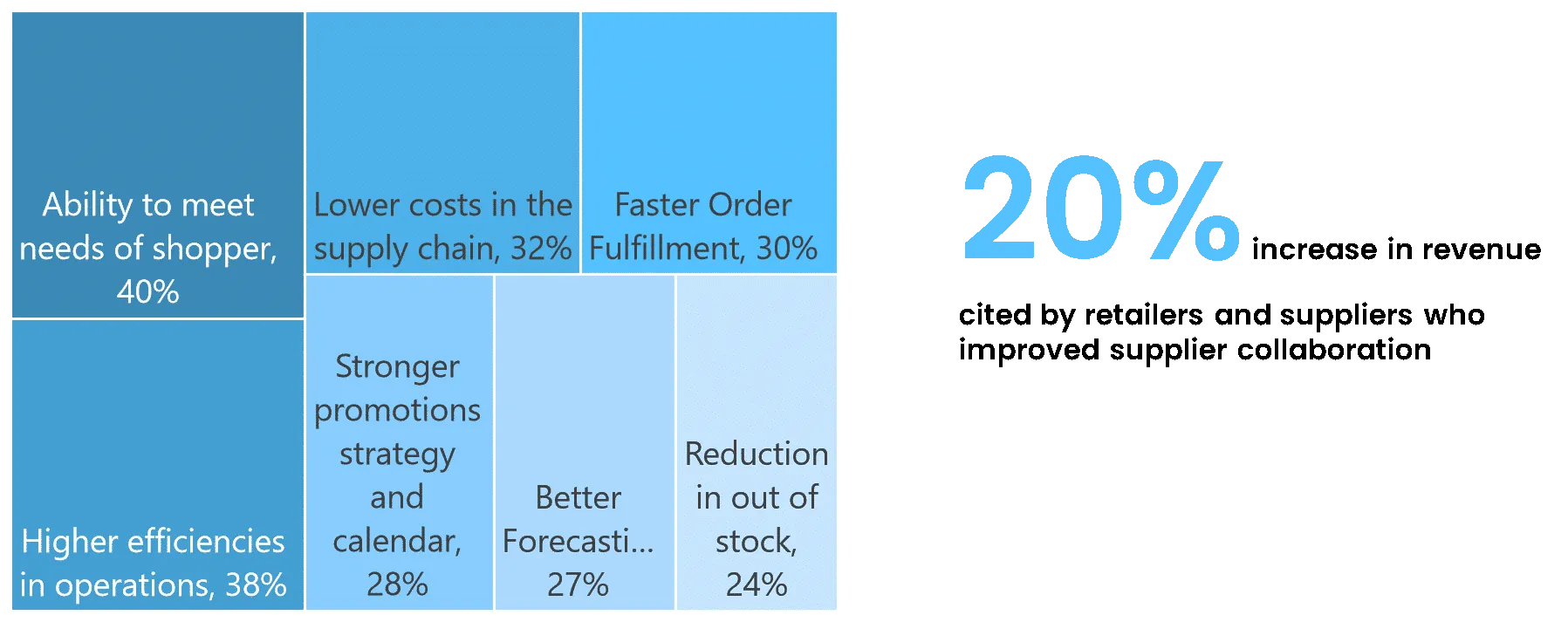
Moreover, retailers who invested in improving supplier collaboration have seen a 20% increase in revenue directly or indirectly, according to the Coresight Research survey of retailers, by Precima. Among some of the direct benefits received by these firms are lower costs in the supply chain (32%), faster order fulfillment (30%), and stronger promotions strategy and calendar (28%).

*source: Coresight Research survey of global grocery/CPG companies and retailers, by Precima, a Nielson company

Benefits of Investing in Better Supplier Collaboration

With retailer collaboration platform emerging as a primary key to unlock the next phase of growth in retail and drive synergies that are otherwise perceived as impossible within the confines of the traditional business, no retailer can ill afford to ignore it.

With that in perspective, here are the top challenges that retailers face today due to ineffective supplier collaboration.

Your Category Managers Are Burned Out Leading to Ineffective Planning

In most retailer setups, category managers are on their own to plan for demand, assortment, and inventory. Understanding all that is happening on the ground, translating it to requirements, and directing it to the right vendor completely takes up the bandwidth of category managers – denying them the opportunity to focus on more strategic affairs.

This is one of the leading causes why category managers have not been able to catch up with the fast-paced business retail has become today, leading to elevated levels of stock outs, wastage, margin erosion, and new product introduction failures.

According to our estimate, new product introduction failure rate due to supplier challenges for most retailers is as high as 25%.

Why? Because new product introduction is a very time-consuming process that involves several iterations of communications to onboard the product (and vendor in some cases). With category managers already struggling with adapting to fast-paced demand, they have little oversight on the various stages of new product introduction – often leading to delays and failures.

Most retailers have realized the value suppliers can bring and help ease this burden. When suppliers are part of your retail planning process, they are able to help category managers make the right decisions at the right time while also benefiting from them. It is in other words a Win-Win.

Not Achieving Optimum Pricing and Promotions Is Eating Away Your Margin

Managing a vast set of products across stores has its own challenges. One of the greatest challenges is setting the right price of the product. The cost price of a product changes with tax, geographical, and transportation factors.

In the absence of a track record of historical pricing, category managers do not have a reference they can use to make pricing decisions. Most category managers are forced into frantic communication with suppliers to determine the right price. Ultimately, this lack of transparency leads to suboptimal pricing, eating into your already thinning margins.

Another challenge is with regards to promotions and rebates. Retailers today face underutilization of retail vendor collaboration funded/co-funded promotions. The main culprit here is the siloed nature of communication that happens before a promotion is run and a lack of transparency on promotions performance.

As a result, suppliers don’t proactively initiate promotions. Even if they do run the promotions, they are unable to learn and adapt to run more effective campaigns.

Lack of a Single Source of Truth

Nothing is more detrimental to efficient operations than not having a reliable source of truth to measure and course correct. Unfortunately, retailers still rely on external teams to extract valuable business insights. By the time they get these reports and make sense of it, proverbially speaking the train has left the station.

Data collaboration and reporting form a key pillar to supplier performance. In the absence of quality data from retailers, suppliers are reluctant to collaborate and plan better. Their focus is solely on delivering orders, rather than larger objectives such as category growth. Retailers themselves don’t have reporting capabilities to track supplier performance and evaluate it from time to time.

There is therefore a strong merit in on-demand, persona-specific access to real-time insights and reports. The implications are far reaching, spanning across functions such as sales, category, inventory, assortment, demand planning, financial planning, and more.

Your Supplier Data and Process Is Fraught with Errors

In today’s fast-paced retail environment, building responsive and resilient supply chains depends on how tightly knit your supplier ecosystem is. Even though we live in the world of WhatsApp and Slack in our personal lives, collaboration with suppliers has yet to catch up.

Across a typical supplier lifecycle—onboarding suppliers, information management, onboarding product, creating order, generating invoice, running promotions, and more—there are multiple barriers to execution. The biggest of these barriers is a siloed chain of communication – not being able to take action at the right time.

As a result, most processes get delayed and require greater manual oversight. This not only leads to increased costs but also affects the morale of suppliers.

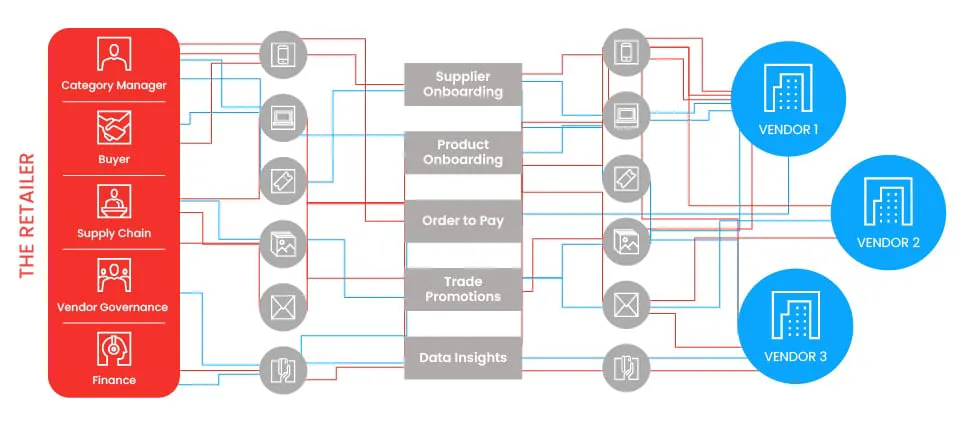
Traditional Supplier Collaboration Framework Is Highly Fragmented

Let us take an example of a simple Purchase Order (PO). PO raised by a buyer undergoes several changes in coordination with the supplier before it is converted to a Delivery Shipment Note (DSN).

These DSNs are then tallied with received goods by the warehouse manager. Invoices raised by suppliers are validated by the AP processor against POs and DSNs in coordination with the warehouse manager and the buyer.

Finally, the payment is processed to the supplier. As you can see, there are at least 5 participants in the entire process, but even today for most retailers the communication happens at best on one-on-one email, messages, and phone calls. This leads to delayed payments and excruciating audits which inadvertently affect business growth and profitability.

Also read: Expert Opinion: Is Supply Chain Collaboration The New Frontier Of Growth In Retail?

Achieve Cost Efficiency and Unlock Business Growth with Vendor Link – Retail’s Only End-to-end Supplier Collaboration Platform

Vendor Link helps retailers digitize and streamline end-to-end inventory optimization supplier collaboration processes, build seamless communication across supplier lifecycle, and elevate data insights and collaboration to a whole new level. It’s mobile first and data-science backed use cases help retailers save on operational costs and unlock top line improvements.

Learn more about Vendor Link here.

Table Of Contents
Your Category Managers Are Burned Out Leading to Ineffective Planning
Not Achieving Optimum Pricing and Promotions Is Eating Away Your Margin
Lack of a Single Source of Truth
Your Supplier Data and Process Is Fraught with Errors
Achieve Cost Efficiency and Unlock Business Growth with Vendor Link – Retail’s Only End-to-end Supplier Collaboration Platform

5 Reasons Why Your Store Replenishment Might Be Ineffective

Merchandising and Supply Chain
Blogs

5 Reasons Why Your Store Replenishment Might Be Ineffective

While marketing, merchandising, and buying take the center stage when one talks about retail planning and operations, what gets relatively less attention is the store replenishment optimization process.

How effectively you manage your store replenishment ultimately decides whether the product reaches the customer when she needs it. According to an estimate, it costs retailers over $1 trillion in lost sales due to stockouts. Between 70 and 90% of stockouts are caused by poor shelf replenishment planning solutions practices.

On the contrary, high inventory causes excessive inventory obsolescence, pilferage, and higher expenditure on maintenance, insurance, and taxes. The annual additional cost of holding excess inventory can be as high as 32%. In addition, excess inventory leads to margin erosion and increasing advertising costs.

As you might have guessed, no retailer can afford to ignore store replenishment processes as it has a major impact on profitability and sales. Building an effective and accurate replenishment optimization process improves sales and reduces store and supply chain costs.

Here are the top 5 reasons why your store replenishment planning might be ineffective.

You Rely on Static Long-term Demand Planning

For a large part of the retail era, demand planning based on historical data and human expertise has proven to be very effective. However, in today’s era, the demand complexities have increased manifold leading to elevated levels of forecasting errors. A major cause of this is the static one time forecasting framework that many retailers still use.

One of the best forecasting practices today is to build separate long-term demand planning and short-term demand sensing capabilities.

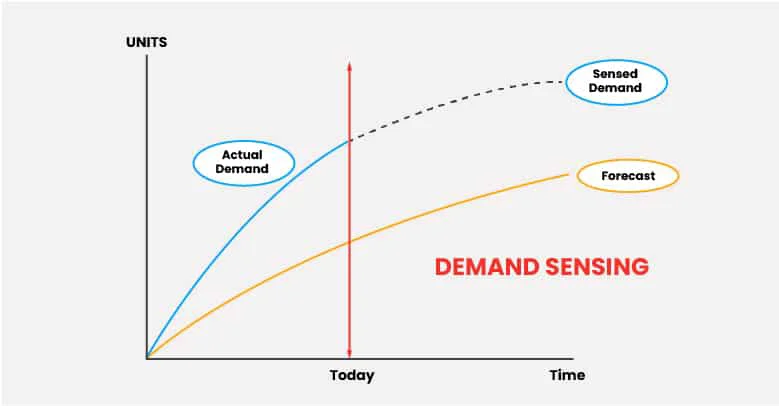
Demand sensing uses a range of dynamic demand predictors to forecast in the near term. It includes exogenous factors such as weather, temperature, holidays, etc. as well as internal factors such as promotions, pricing, inventory, etc. It usually uses ML-based algorithms to predict real-time demand. One such solution is ADA Global’s Order Right.

Although demand sensing and planning have different purposes, their relationship needs to be dynamic. For example, demand sensing capabilities can help you know well in advance when your long-term forecast is erroneous and accordingly offset it. Such an activity performed over time reduces the overall forecasting error and could potentially help you maintain high availability while reducing costs.

Demand forecasts can be course-corrected based on actual demand with demand sensing capabilities

You Treat Every Channel-Category-Store Combination the Same

Trends such as omnichannel, price, and convenience sensitive consumers and short product lifecycle have completely disrupted the retail scene. Today, every store, every channel, and every category behaves differently. One of the biggest mistakes that retailers make is treating them the same. This often leads to inconsistent experience for customers across channels and stores.

For example, even though your store might have enough supplies, an out-of-stock message on your site can put a serious damper on customer experience and may even result in lost sales.

In fact, there’s a 91% chance dissatisfied customers won’t do business with your brand again. Therefore, your retail replenishment software strategy should consider these nuances to be effective.

You Don’t Systemically Adapt to What Is Happening on the Shelf

Ask any store manager and they would tell you that what happens on the shelf ultimately decides store success. Nothing is more excruciating for a customer than to see empty shelves. One of the main reasons why it happens is because of the dynamic effects that play in your store.

For example, a promotion for one product can lead to decreased (Cannibalisation) or increased sales (Halo effect) for other products. Promotions is just one aspect. There are several more such as product placement, visual merchandising, pricing, new product launch, and more.

While your store managers are smart to figure out some of them, they might not have the bandwidth to keep a tab on these effects every time they happen. Hence, what is needed is a systemic approach to identifying these effects and course correcting in your ai replenishment plans.

Your Replenishment and Inventory Planning Is Not Optimized for Constraints (and Cost)

Planning is just half of the puzzle, the other half is the execution! As any learned and experienced supply chain expert would tell you, it’s all about the theory of constraints and most importantly economics.

Even if your replenishment planning is very accurately mapped to demand, it needs to be optimized for supply chain factors such as lead time, minimum order quantity, shelf life, expiration date, etc. This not only helps you meet store demand but also reduce costs such as shipping and handling costs, inventory optimization, ordering cost, shrinkage, etc.
Increasingly, retailers want to automate this process because of the complexities involved and the manual calculations required to get it right.

Your Supplier Collaboration Is Fragmented and Inefficient

According to research, about 10-30% of stock outs happen due to supplier shortages. One of the major reasons why it happens is because of lack of transparency and collaboration between retailer and vendor.

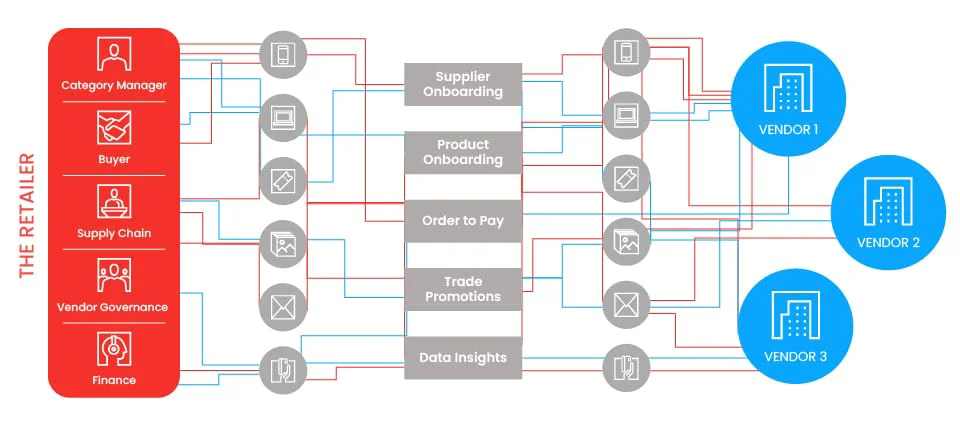
Most retail firms have realized this gap and are proactively working to create a unified supplier collaboration platform similar to Vendor Link that would integrate all vendor processes and enable seamless data sharing for better outcomes.

What this results in is a lack of collaborative planning and mutual trust leading to low fulfillment rate, longer lead times, and vendor dissatisfaction.

Most retail firms have realized this gap and are proactively working to create a unified platform similar to Vendor Link that would integrate all vendor processes and enable seamless data sharing for better outcomes.

Also read: AI-Driven Replenishment Planning: A Game-Changer for Retailers

In fact, retailers who improved their retail vendor collaboration cited a 20% increase in revenue.

Fragmented vendor collaboration and data sharing

1-click Intelligent Replenishment

Retail companies, especially with a large number of SKUs, need to relook at their replenishment strategy. One of the most effective ways of achieving accurate, efficient, and cost-effective automatic store replenishment is with the help of a demand-driven and business operations tailored system.

However, given the breadth and depth of categories that need to be managed, and supply chain complexities in today’s era, manual ordering has become very inefficient and expensive.

Therefore, there is a need for “a layer of super-human intelligence on top of existing ERP systems that optimizes store replenishment to account for complex demand patterns, while reducing supply chain costs and markdowns”. One such solution is ADA Global’s Order Right.

Order Right builds a layer of Artificial intelligence on top of your existing planning tool and optimizes your store replenishment by making smart ordering suggestions to reduce out of stock, improve margins, and cut down wastage.

It uses a library of ML-based algorithms curated specifically for retail scenarios to accurately predict inventory demand prediction at store, channel, and category level, and optimize orders to achieve category objectives and reduce supply chain costs.

Download Order Right Brochure here or schedule a demo.

Recommended Reading:

  1. Point Of View: Does AI Really Improve Retail Planning?
  2. Grocery Replenishment Has Evolved: 9 Things Every Retailer Must Know
  3. 9 Best Practices in Demand Forecasting for Grocery Retailers
Table Of Contents
You Rely on Static Long-term Demand Planning
You Treat Every Channel-Category-Store Combination the Same
You Don’t Systemically Adapt to What Is Happening on the Shelf
Your Replenishment and Inventory Planning Is Not Optimized for Constraints (and Cost)
Your Supplier Collaboration Is Fragmented and Inefficient
Recommended Reading:

A Buyer’s Guide for Customer Data Platform (CDP)

Omnichannel Marketing
Blogs

A Buyer’s Guide for Customer Data Platform (CDP)

The Customer Data Platform (CDP) industry has moved from muddled definitions to a more structured industry with clearly defined types that have been bucketed based on capability and use cases they support.

There has been a lot of activity in this industry with established vendors strengthening their capabilities and positioning in the market and an influx of new players with point solutions. While the build vs. buy debate continues, the decision is more lucid with many looking to buy ready-to-deploy CDPs.

CDPs Have Evolved into Categories Owing to the Breadth and Depth of Functionality

Before we jump into what we must look for in a Customer Data Platform to make the buying decision, let’s define the types of CDPs that are available in the market.

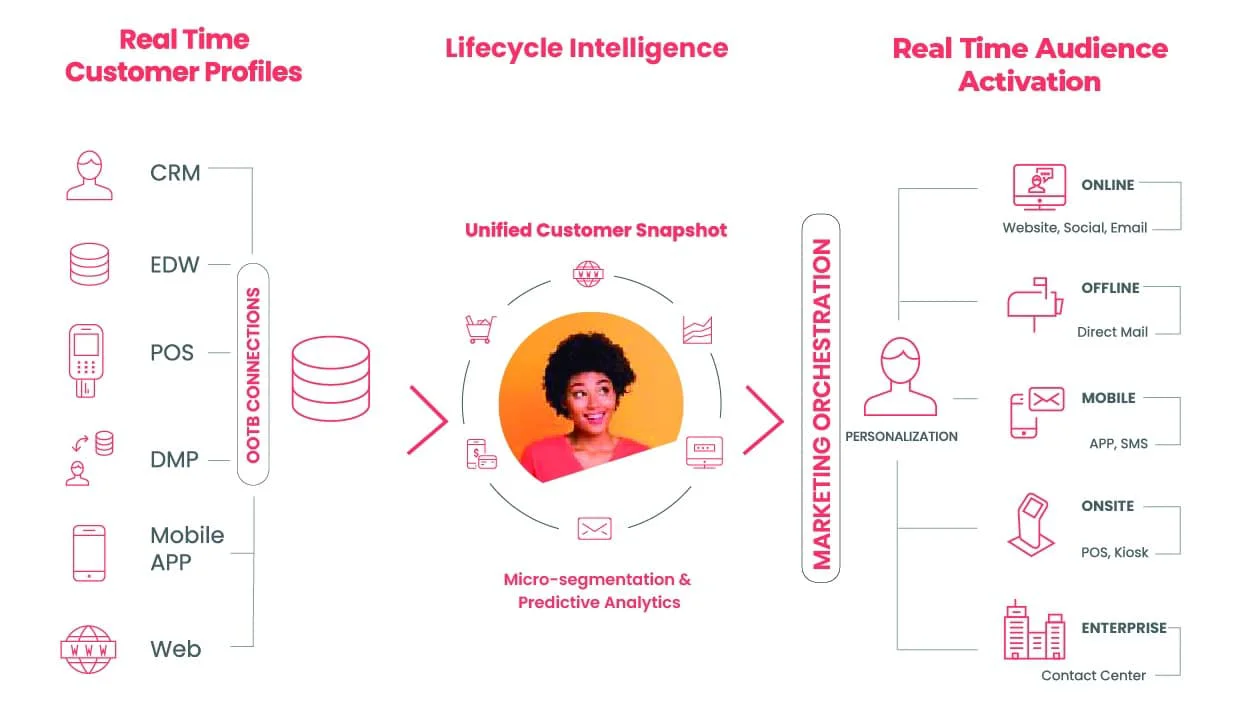
While CDPs started out with unifying customer data across systems, structuring the data for downstream analysis, they have evolved to become broader, integrated systems. CDPs enable data ingestion, segmentation and analytics, audience activation, and personalized omnichannel orchestration.

Based on the capabilities and functions, CDP Institute groups CDPs into the following categories:

  • Data CDP
    These systems gather customer data from source systems, link data to customer identities, assemble unified customer profiles, and store the results in a database available to external systems. This is the minimum set of functions required to qualify as a CDP under the CDP Institute’s definition.In practice, these systems can also extract audience segments and send them to external systems. Systems in this category often employ specialized technologies for data management and access. Some began as tag management or web analytics systems and retain considerable legacy business in those areas.
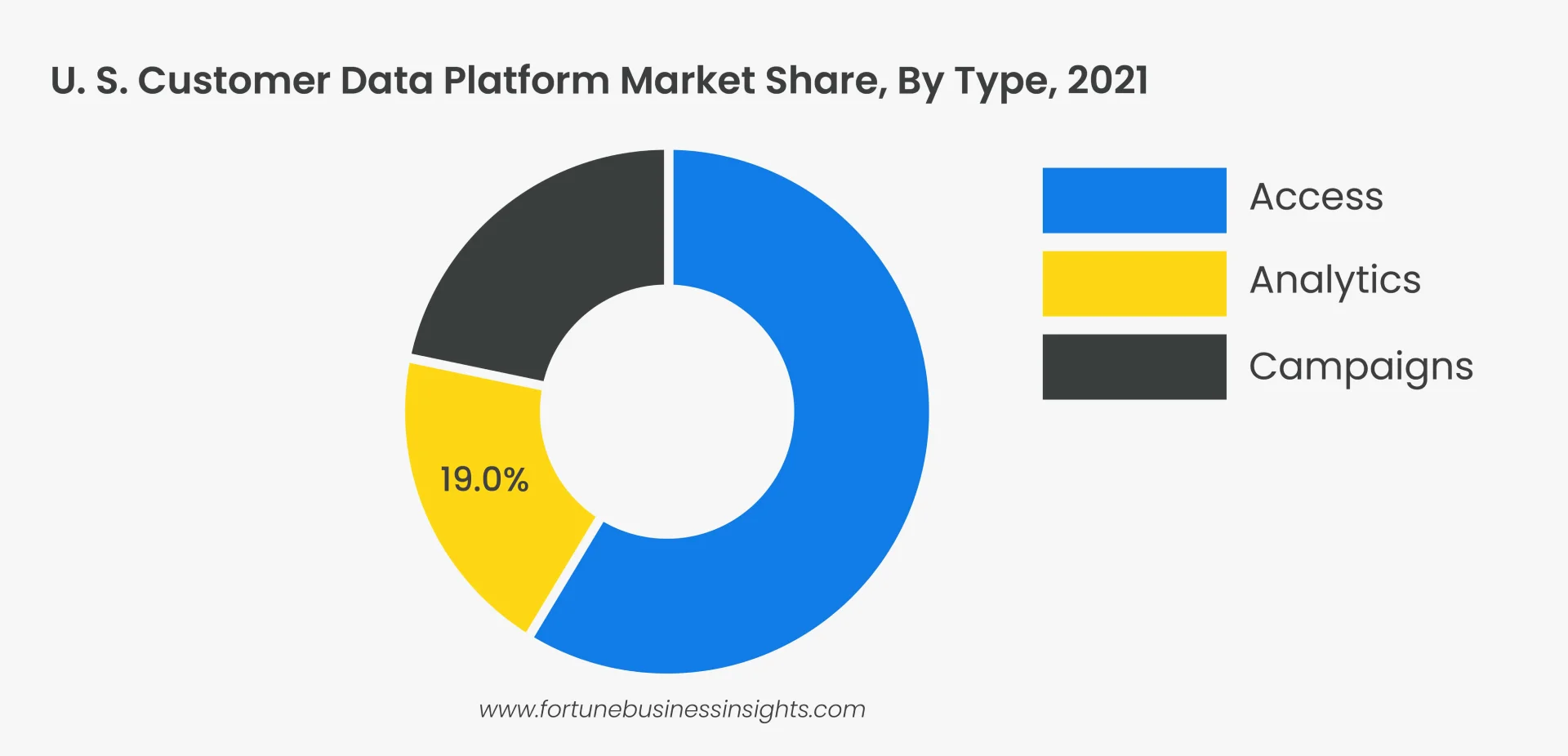
  • Analytics CDP
    These systems provide the features of a data CDP plus analytical applications. The applications always include customer segmentation and sometimes extend to machine learning, predictive modeling, revenue attribution, and journey mapping. These systems often automate the distribution of data to other systems.
  • Campaign CDP
    These systems provide data assembly, analytics, and customer treatments. What distinguishes treatments from segmentation is that treatments can be different for different individuals within a segment.Treatments may be personalized messages, outbound marketing campaigns, real-time interactions, or product or content recommendations. These systems often include features to orchestrate customer treatments across channels.
  • Delivery CDPThese systems provide data assembly, analytics, customer treatments, and message delivery. Delivery may be through email, website, mobile apps, CRM, advertising, or several of these. Products in this category often started as delivery systems and added CDP functions to support advanced analytics, personalization, or multi-channel campaigns.A Full-stack CDP Supports Data, Decisioning, and DeliveryA full-stack CDP caters to all use cases in a way that is specific to the industry. A CDP is a means to an end – with the end being contextually relevant engagement. A full-stack CDP would enable:
  • Streaming ingestion of demographic, transactional, behavioral, known and unknown customer data from online and offline systems.Identity resolution by creating a single, 360-degree view of the customer and a golden
    record by duplicating and enriching the data. Audience discovery and management with granular segmentation and advanced customer insights powered by micro-segments, segment analysis, churn, propensity and lifetime value analyses to drive next-best actions, and measure ROI with campaign and journey analytics.Real-time audience activation to drive hyper-personalized, journey-based marketing orchestration across online and offline channels and connect with customers in the moment.

Choosing the Right CDPThere is no one-size-fits-all solution to finding the right CDP. Choosing the most appropriate CDP is not about how feature-rich the CDP is but more about the need and the use cases you as a marketer are looking to address. Some of the key criteria to consider are:

  • Business Use Case Support
    Clarity of what problem you are looking to address or what gap you’re looking to fill is crucial to choosing the right CDP. This translates to use cases. One of them could be to break data silos. You have customer data flowing in from various ingress systems, from various touchpoints. You have all this data, but it is not in a form that you could make use of to win customers over.Another use case could be that you are not able to drive personalized engagement as you don’t possess deep insights on your customers. You don’t know what your customers’ affinities are, who is likely to churn, when or what offers would resonate with which customer. If you aren’t armed with these insights, your efforts to drive loyalty and improve basket size or visit frequency are unrealized.

    Mapping and prioritizing use cases are critical to determine if you need a CDP and what kind of CDP you need. Most CDPs support data unification while many don’t enable analytics or activation. Hence, it is important to understand the capabilities provided by each of the CDPs that you are evaluating to determine if the use cases are supported.Industry Understanding
    There are many generic CDPs in the market that cater to both B2B and B2C businesses. The capabilities vary hugely. While B2C requires granular individual customer profile data, B2B is about lead management and account data.

    Besides, the data structure and management needs of industry segments within B2C differ significantly too. The requirements of retail vs. banking vs. healthcare would be different. The AI layer that reads, understands, and analyzes this data needs to be trained on industry-specific data to be able to surface relevant decisioning intelligence.

    The analytics models, domain measures, and metrics considered need to cater to grocery, fashion, or QSR industries specifically. Considering this, CDPs that are specialized to cater to industry segments deliver faster time to value.Marketing Cloud vs. Best of Breed
    CDP is not an independent layer but a part of a larger suite of products. CDPs act as superchargers to existing MarTech tools like personalization, marketing automation, and journey orchestration solutions.

    The inflexible data management and profile unification features of marketing clouds were a major driver of marketer interest in CDPs from the beginning. These new modules aim to shift the integrated suite value proposition to a more open and flexible embrace of enterprise data, leveraging trusted relationships with CMOs and CIOs.

    Solutions emphasize customer data management and connecting customer profile data to orchestration and execution tools within their products. Connections to technologies outside of the integrated suite for activation and execution vary greatly from vendor to vendor.User-friendliness
    Data management has traditionally been the mainstay of the IT teams. But this is changing with end consumers of data increasingly showing interest in managing the data to leverage it for making informed decisions instantly.

    Same is the case with marketing. As they own the budget for customer data systems, it only makes sense for them to own the end-to-end process of ingesting, managing, and activating this data for their specific use cases. The budget owner owns the ROI too, removing bottlenecks and making the entire customer engagement process seamless.

    This brings us back to the usability of CDPs. Are they built for marketers?
    Many CDPs were built clunky, making it impossible for marketers to use without depending on IT teams. As the need for marketers to be self-sufficient surfaced, CDPs are increasingly focusing on improving the ease-of-use so that marketers could use the various functionalities of CDP end-to-end.

    This includes drag-and-drop data onboarding APIs, batch-loads and other methods, automated identity resolution, out-of-the-box analytics models eliminating the need for a Data Scientist to cull out segments or advanced analytics outputs, and out-of-the-box connectors to orchestration systems for seamless activation of audience for campaign purposes.

    All of this is built with a high level of automation and intelligence making it easy for the marketers to use it. This, hence, is a key consideration in your purchase decision-making.Connectors
    One of the core problems that marketers are looking to solve is unification of customer data that is sitting in various siloed systems. CDP is the go-to technology to address this issue by allowing direct data reading and automatic read extracts.

    However, it is important to evaluate the connector ecosystem that the CDP has built to ensure you are able to drive seamless integration with systems of record that are already in place in your organization.

    Automated data boarding, AI-powered data preparation, and schema-less data stores reduce the time and effort in CDP deployment.

    Likewise, integration into egress systems such as personalization engine, marketing automation, or journey orchestration systems is important as well. These systems connect directly to the CDP or to the audience extracted from the CDP that is in a format that can be used for campaigns and other communications.

    Hence, check for OOTB connectors to avoid custom integration. Know the data and the orchestration systems you need the CDP to connect so you are clear in your ask.

Start with Your Need Definition

The best place to start evaluating the need for CDP and what kind of CDP is by defining the detailed requirements. The next step is to chalk out the outcomes expected from the implementation of a CDP.

Table Of Contents
CDPs Have Evolved into Categories Owing to the Breadth and Depth of Functionality
Start with Your Need Definition

Point Of View: Does AI Really Improve Retail Planning?

Merchandising and Supply Chain
Blogs

Point Of View: Does AI Really Improve Retail Planning?

Demand and supply planning are often seen as the core activities for a retail organization. Simply put – it is all about placing the right product at the right place at the right time.

The planning that goes behind ensuring it is very complex and mostly manual. Most organizations rely on their category management and demand planning teams to make the right decisions such as what to put, in what quantities, at what time and where – consistently over time.

According to Mckinsey, applying AI-driven forecasting for retail planning can reduce errors by between 20 and 50%. That translates to a reduction in lost sales and product unavailability by up to 65%.

That is a significant value that retailers stand to miss out if they don’t adopt AI-driven technology in retail planning. While several retail leaders have wholeheartedly accepted AI as a strategic enabler for retail planning, many still believe that they are not ready.

“Too many companies still rely on manual forecasting because they think AI requires better-quality data than they have available. Nowadays, that’s a costly mistake.” – McKinsey

In this piece, we ask our expert Sankha Muthu Poruthotage to cut the clutter and tell us how AI translates to value on ground and who stands to benefit from it.

Sankha has decades of extensive experience in data science and ML engineering. He has spent the last several years of his career creating intelligent retail products by embedding ML algorithms to retail functions. At Ada Global, he plays the dual role of a product management leader and a consultant to clients.

What are some of the challenges that modern retailers face today?

Well, if you look at it broadly, the challenges can be categorized into two. Retailers obviously want to have more customers buying from them, and they want them to spend more money. It is all about increasing the market share and wallet share. So the challenges most retailers face revolve around customer acquisition, customer retention, upselling, and cross selling.

On the other side of the spectrum, you have the merchandise and supply chain optimization challenges. While getting customers to the store is the first challenge that retailers face, being able to serve them is a much more complex problem to solve simply because there are too many moving parts not under complete control.

The recent pandemic has exacerbated the situation as consumer behavior and preferences have irrevocably changed. Retailers today face complexities in several dimensions such as omnichannel retailing, value-oriented and convenience obsessed customers, new and fresh product launches, and volatile demand patterns.

As a result, retailers today are struggling to achieve optimal assortment, floor plans, replenishment planning solutions, and inventory plans with the pre-pandemic methods.

What are the biggest pain points that the industry faces when it comes to retail planning?

It is estimated that globally around $500 billion is lost due to wastage in retail. Wastage happens due to excess stock. On the other end, you have Out of Stock (OOS) which results in revenue losses and customer dissatisfaction. This is estimated to be even higher than the wastage at around $1 trillion annually in direct loss of sales.

There is an immediate impact on the P&L if OOS and wastages can be minimized. It can be as high as 10% increment on the operational profit. What most retailers realize is that these two are the biggest challenges in retail planning, and whoever aces this juggling act between the two extremes will eventually win the race.

What are the areas where AI has proven effective in dealing with these challenges?

AI is usually associated with cognitive abilities such as vision and voice. However, the underlying algorithms such as artificial neural networks and machine learning models can be used for many other use cases such as time series forecasting. Infact AI/ML models are proven to be very effective in areas such as demand forecasting.

The other main advantage of AI/ML models is that they can bring complex associations into light. I’m talking about pricing, promotions, events, weather, and even macro factors such as unemployment or consumer spending.

Once you have a good grasp of demand and how it reacts to these factors, it can lead to better optimal discount, promotion, and store replenishment strategies. Of course it needs a layer of optimization on top of forecasting which is very important to make things operationalized.

I’ll provide a simple example. A retailer and a supplier typically have a contractual agreement on the minimum order quantity. Hence, to make things operationalized, this parameter needs to be considered in the optimization layer. It is important to bring in the business parameters to automate these critical business functions.

What retail industries can benefit from use of AI in demand planning and replenishment?

I think most retailers with medium to large operations stand to benefit. However, in general, retailers who deal with perishable items will see greater benefits due to obvious reasons – they need to be more agile and accurate than others.

How long does it take to realize ROI from such an investment?

In my experience with clients, the ROI for demand planning solutions is very tangible. Our customers have seen almost instant improvement in metrics such as availability and wastage by using the solution.

As I mentioned earlier, combined impact on the P&L can be as much as 10%. And the investments are typically a fraction of it. So the return starts within a matter of a few months.

Demand Forecasting And Replenishment That Is Accurate, Robust, And Adaptive

The last two years have exposed many gaps in businesses, and this was especially true of demand and supply chain planning. Many retailers remain unprepared to address challenges such as frequent out of stocks, increasing inventory optimization costs and wastage that come with fresher newer products, omnichannel retail, and shifting consumer behavior.

Ada Global’s Forecast Right and Order Right have helped major retailers leapfrog to an intelligent, adaptive, and agile demand forecasting and automatic store replenishment framework that simply works, every time.

Forecast Right is an easy-to-use intelligent demand forecasting solution created specifically for grocery retail demand and supply chain planners. Its robust and AI/ML powered framework helps planners go granular and capture channel-store-category nuances in their forecasts, avoiding the trap of “one-size-fits-all” associated with some of the existing solutions in the market.

Order Right is an intelligent replenishment optimization solution that helps category managers generate accurate SKU-level order plans every time. It consumes accurate demand forecasts from Forecast Right and, unlike many existing solutions in the market, optimizes order plans for supply chain constraints and parameters such as MOQ, lead time, replenishment frequency, etc. using advanced AI/ML techniques. It also powers users with advanced features such as future stock predictions, day zero predictive alerts, and retail replenishment software risk-based order planning.

Also read: Navigating the Beauty Maze: AI’s Role in Retail and Supply Chain Planning

Learn more about Algnonomy’s Forecast Right and Order Right.

Table of Contents
What are some of the challenges that modern retailers face today?
What are the biggest pain points that the industry faces when it comes to retail planning?
What are the areas where AI has proven effective in dealing with these challenges?
What retail industries can benefit from use of AI in demand planning and replenishment?
How long does it take to realize ROI from such an investment?
Demand Forecasting And Replenishment That Is Accurate, Robust, And Adaptive

Is CDP the Answer to Your Data Woes?

Omnichannel Marketing
Blogs

Is CDP the Answer to Your Data Woes?

This question is more relevant than ever in the world of Digital Retail. While one would want to lean towards a yes, the answer isn’t that simple.

Retailers are building their digital programs around a Customer Data Platform or CDP. The utopian goal is to centralize all customer interactions (read browsing patterns and transactions) in one system. Doing so would solve all problems that arise as a result of siloed information.

The end state was clear – if I can unify all my customer data and glean insights from it, then orchestrating one-to-one personalization marketing engagement becomes a simple task.

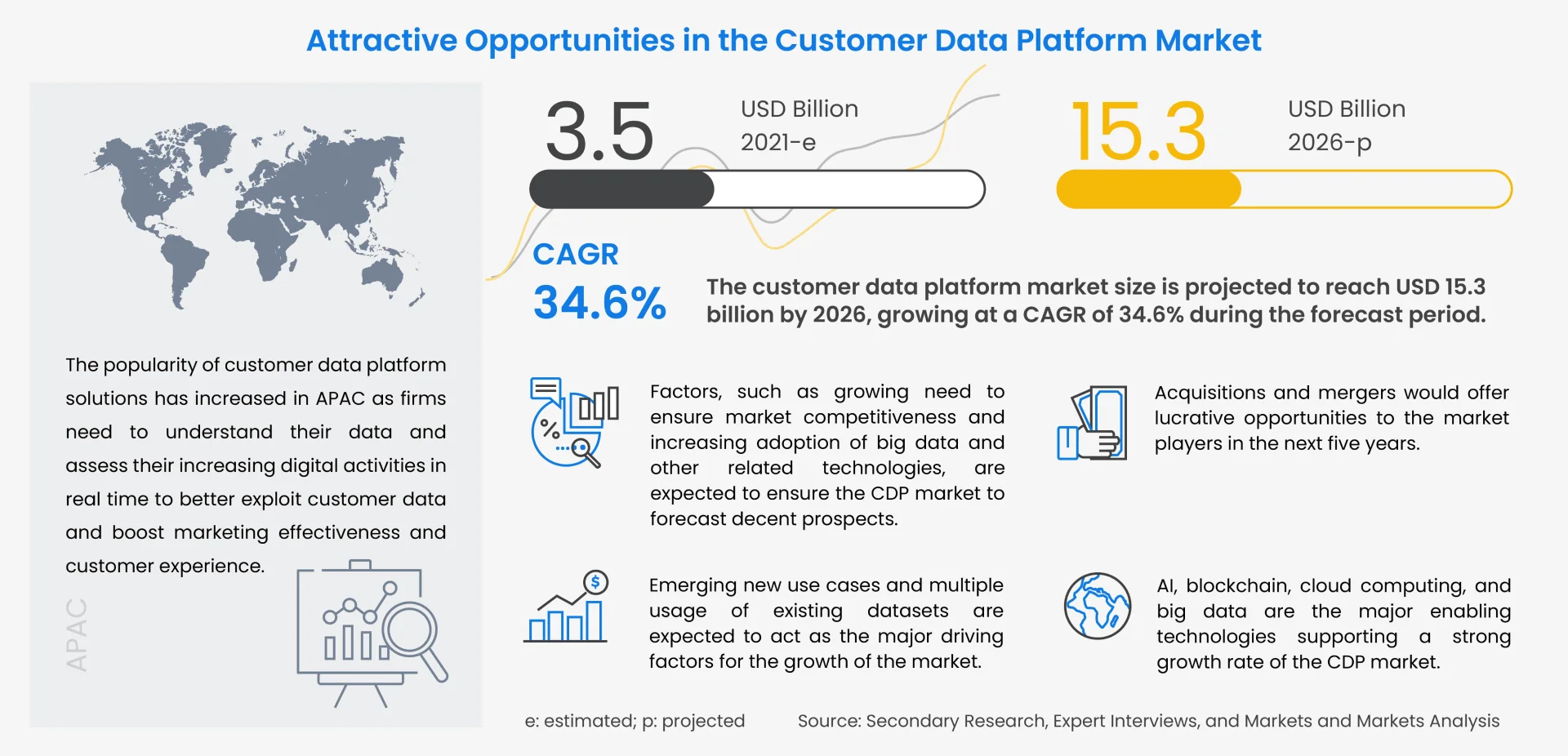
Reportedly, 88% of marketing teams are expected to invest in data-driven decisions, and they all seem to be betting on a CDP solution. With the CDP market growing rapidly at a CAGR expected at 34.6% until 2026, it’s no wonder that retail businesses are focused on getting CDP to solve their marketing teams’ data problem.

However, the reality is very different. Most senior leaders acknowledge the journey had the right intent, but the execution ended up falling short on the promises made. The reason was not a technical one. It was in clearly identifying the data strategy, the user stories it would influence, and last but not the least, executing on the outcomes of a CDP.

Most CDPs excel at providing insights into segments and near real time customer segmentation granular segments. Where they fail is to provide an easy way to operationalize those segments to drive business results.

So, where does the road take us? Well, it starts with asking the following questions:

  1. Will you drive the expected revenue lifts from the exercise?
  2. Will you improve the LTV of your clients?
  3. Will you be servicing the right segments?

Now let’s dive a little deeper into the items above to better understand the ‘how’.

How to Drive Revenue Lifts from a CDP

User stories? User stories? At risk of channeling my inner Jim Mora, they start and end with the personas defined by your journey mapping exercise (if you haven’t done one, I suggest you look at one) and the use cases for those personas – your highest LTV clients, your churn customers, your infrequent but steady customers, your advocates, etc.

Chalking out the key use cases that drive LTV allows you to concretize the actions and set goals for the organization. It also allows you to figure out gaps in your tech stack.

Yes, householding and identity resolution are needed. Now how are you leveraging them to build real time customer data profiles dynamic segments? Is there a gap between creating those segments in your retail customer data platform and delivering that ecommerce personalization experience online?

Well-written user stories allow you to follow the North Start and thus focus on what’s important.

How Do I Improve LTV?

Let’s begin with ‘Easier said than done’ – however, it’s been proven: start with best practices on conversions. Here is where AI plays a pivotal role in figuring out HOW to improve conversions.

Use pre-built models that use the individual’s past behavior (read browse and buy) and wisdom of crowds layered on top of one another to make personalized product recommendations. On average, our clients have seen 3–4% uplifts on strategic locations.

Then turn your attention to email. Is your current stack really impacting CTR? Chances are emails are not individualized. Test, repeat, and get better at new strategies. Work with your segmentation team to improve. Retailers are now spending more on Data Science than ever before. Leverage the ability to test and improve.

Are You Spending Your Energy on the Right Segments?

Modern day CDPs allow you to play around with all kinds of segment personalization rules. Love it. Now, how do we monetize that ability?

Implementing a CDP solution is not going to solve a business problem. Actionable goals do. Activation simply provides other systems the ability to leverage segments and perhaps orchestrate campaigns through the CDP capabilities. These are limited and not truly cross channel. So what gives?

Focus on stitching the segment definition to the execution. Go back to the use cases for the personas and see which ones have previously driven the best revenue/margin/KPI de jour and then align your campaign, dynamic content personalization, and goals to those segments. Personas are too high level. Have three sub-categories under personas and listen to what the engine recommends. That data doesn’t lie!

In summary, having a broader ecommerce personalization platform strategy allows better alignment of actions and technology to the well-defined user stories. Don’t hastily invest in tech. Rather, invest in a data strategy that drives individualized behaviors. Look for a solution that fills the gap rather than just buy a CDP and then figure out how to address the gaps.

Read this comprehensive guide to CDP to learn more about the technology and how to make it work for your business.

Table Of Contents
How to Drive Revenue Lifts from a CDP
How Do I Improve LTV?
Are You Spending Your Energy on the Right Segments?

Personalized Digital Experiences Across Touchpoints: The Key to Winning the Holiday Season in Today’s Digital World

Digital Experience Personalization
Blogs

Personalized Digital Experiences Across Touchpoints: The Key to Winning the Holiday Season in Today’s Digital World

Personalization has moved past the eCommerce world to include retail touchpoints across online and offline channels. Customers now demand to be met with personalized experiences on their turf and their terms. With traditional differentiation approaches such as strategic pricing and promotions no longer deemed ‘enough’, how can retailers stay relevant and champion the holiday season? The key is to provide contextual and personalized retail experiences at every point of interaction across the customer’s lifecycle.

Be Present Throughout the Shopping Process

The fundamental of getting omnichannel personalization right this holiday season begins with a clear understanding of the customer. When do they shop? Where do they shop? How do they shop? What influences their buying decisions? These are key questions that will help brands provide the right experience at the right stage.

To be relevant, brands must provide value to customers WHEN they require it the most.

Brands must be prepared to kickstart the holiday shopping experience early this year. According to Research 451, in a recent survey, 61% of customers stated that their holiday shopping expedition started in the months and weeks leading to the actual sales holidays, i.e., Black Friday/Cyber Monday.

With shopping already underway, brands need to recognize that customers will be in different stages of the buying process and mobilize triggered email marketing campaigns to meet them in their individual journeys.

Facilitate Real-time Omnichannel Interaction

Bolstered by advances in technology, customers now engage with brands over a plethora of channels. Brands must be present, listen, learn, and engage the customer with contextual interaction at each of these preferred touchpoints in real-time. Simply put, customers no longer want to search for product specifications, recommendations, or offers across platforms and devices, instead, they demand these interactions be personalized and tailored to meet them in each moment along their lifecycle.

Now, more than ever, to thrive in an already crowded and highly competitive landscape, such as retail, brands must provide value WHERE the customer requires it.

It is also important to acknowledge that customers engage and transact using a mix of devices. According to 451 Research, 66% of customers surveyed chose in-store as their preferred mode of shopping this holiday season, while 51%, 31%, and 27% of customers chose computer web browsers, mobile apps, and mobile web browsers respectively. Brands must provide a seamless and consistent ecommerce personalization solutions as customers transition across platforms and devices to guarantee positive outcomes.

Enable Seamless Buying Experiences

Customers want to shop based on convenience. In its paper, 451 Research found that while 56% of customers surveyed responded they plan to do their holiday shopping online, 44% stated they would prefer in-store shopping this year. This indicates a shift towards digital.

Customers want the option of online, offline, and even hybrid buying.

In fact, purchases made online that were then picked up either by the curbside or at the brick-and-mortar store increased by 52%.

With the path to purchase diverging, brands need to provide customers with options to complete their transactions and personalize each interaction thereof. For example, brands can provide information to facilitate a smooth and contactless pick-up experience and send real-time updates.

To gain a competitive advantage this holiday season, brands must provide value to customers HOW they require it. Below we discuss how they should go about this.

Build Trust to Scale Personalization

Data is key to personalizing the customer experience across touchpoints. To provide a contextual and personalized experience, brands must piece together first-party, second-party, and third-party data from multiple sources to create a real-time customer profile of the customer. It is this data that is leveraged and synthesized into actionable insights to provide the next best action and enhance the customer experience.

However, the challenge of data privacy and security can pose a hurdle to brands.

451 Research found that while 85% of customers preferred privacy over personalization, 43% strongly agree that context for how/why a business uses their data would make them more likely to share it.

To secure this crucial first-party data, brands must provide rewards such as social proof messages as incentives to improve the customer experience. Further, brands must be transparent about what data is being collected, why it is being collected, and how it is being used within the guidelines stipulated. Brands would also greatly benefit from giving customers the ability to manage their personal preferences.

Configure Personalized Customer Experiences

67% of customer experiences fail to meet customer expectations.

To win the holiday season, brands must bridge the gap between customer experience and expectation. With 9 out of 10 customers stating having a bad experience will make them less likely to shop with a brand in the future, it puts into perspective the pivotal importance for brands to understand what customers expect this holiday season.

According to 451 Research, customers’ expectations for the holiday season include product reviews, detailed product information and specs, convenient experience across online, offline, and in-store, better ecommerce search capabilities, convenient payment options, rich image and video content, personalized experience based on past purchases, and the ability to configure preferences.

To stay relevant and come out on top this holiday season, brands must personalize each expectation based on data (personal, behavioral, and transactional) to provide the right contextual experiences at the right time in each interaction along the customer journey.

Ensure Effective Digital Transformation Strategy

According to 451 Research, there is a correlation between customer experience emphasis and equity returns. With a $305B opportunity available to brands based on 451 Research’s customer experience measure, providing a one-to-one personalization across all touchpoints becomes pivotal. Yet, to bridge the gap between expectation and experience, brands must improve their digital strategy to be more contextualized and personalized. In its paper, 451 Research found that digitally driven businesses demonstrate a composite index that is 3X more effective than those that are lacking.

If personalized customer experience is to remain a priority, brands must adopt a digitally-driven approach. This would reflect customer experiences that according to 451 Research are:

  • Individualized and managed by algorithmic initiatives.
  • Leverage advanced ML and AI capabilities.
  • Harness real-time 360-degree customer data profiles.
  • Driven by cloud-based processes.
  • Managed end-to-end across the enterprise.

Also read: Why You Should Hyper-Personalize Customer Experiences

In summary, to capitalize on the season’s veritable goldmine, brands must ramp up their ecommerce personalization platform strategy to build on a solid and adept digital foundation. To truly stand out from the competition this holiday season, brands must invest in digital capabilities that enable real-time, omnichannel, intelligent personalization across touchpoints at scale.

Learn how Ada Global’s omnichannel personalization platform can help your business.

Table of Contents
Be Present Throughout the Shopping Process
Facilitate Real-time Omnichannel Interaction
Enable Seamless Buying Experiences
Build Trust to Scale Personalization
Configure Personalized Customer Experiences
Ensure Effective Digital Transformation Strategy

Consumer Electronics Etailers Embrace eCommerce Personalization

Digital Experience Personalization
Blogs

Consumer Electronics Etailers Embrace eCommerce Personalization

Consumer electronics is a rather crowded space with a swarm of brands trying to make their presence felt in every category — from wearables to televisions and headphones to laptops. Unless a shopper knows exactly what they’re looking to buy, consumers in this space often fall victim to ‘overchoice,’ a term coined by Alvin Toffler in his 1970 book Future Shock.

As the name suggests, the overchoice effect occurs when a buyer is overwhelmed by a large number of options available, often resulting in the person abandoning the decision-making altogether, or worse, taking their business elsewhere. For today’s consumers who seek instant gratification, experiencing this is a nightmare. And for a retailer, it’s bad for business.

In a bid to improve product discovery across shoppers’ digital commerce journeys, retailers have been investing heavily in personalization. According to a Forrester study, personalization ranked the highest among tech investments in 2021.

The same holds true for consumer electronics retailers. B.TECH is among Egypt’s top retailers in this category, with more than 100 stores and a growing online presence. The retailer saw a sharp increase in its ecommerce revenue in 2020, as consumers stayed home and relied on electronic devices for professional as well as social and entertainment needs.

That said, B.TECH realized that product discovery was a problem — it was important to surface relevant products with respect to each shopper and their current context. Doing so consistently is a surefire way of earning (and keeping) a shopper’s loyalty.

To individualize commerce experiences in real time and at scale, B.TECH deployed an AI-powered personalization engine. Let’s take a quick look at their personalization in action.

1 Category Page

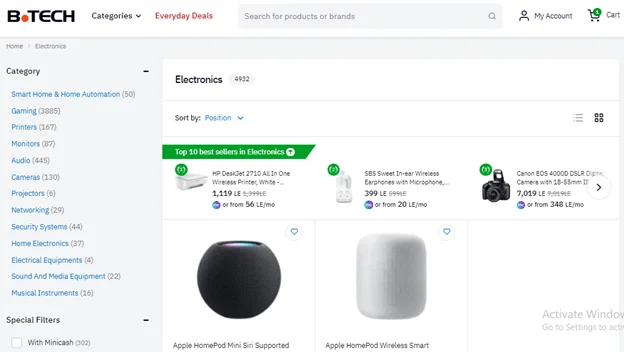
When a shopper visits a category page, it’s likely that they are in exploration mode and open to suggestions. The image below shows a merchandised placement for ‘Top 10 best sellers’ at the top of the electronics category page. This helps a shopper discover popular items they probably hadn’t considered exploring before. This approach also works well for new or unknown visitors for whom there is no data on behavior and preferences.

2 Product Detail Page

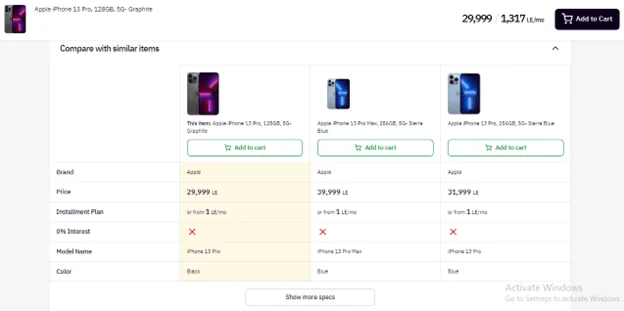
When a shopper visits an item page, they also see the option to ‘Compare with similar products.’ While this may be a common feature, what makes this more convenient is that the shopper can easily compare the specifications without having to visit each product page.

This placement uses advanced merchandising that enables relevant upsell and cross-sell recommendations based on the item being viewed, without the need for manual merchandising.

3 Add-to-Cart Page

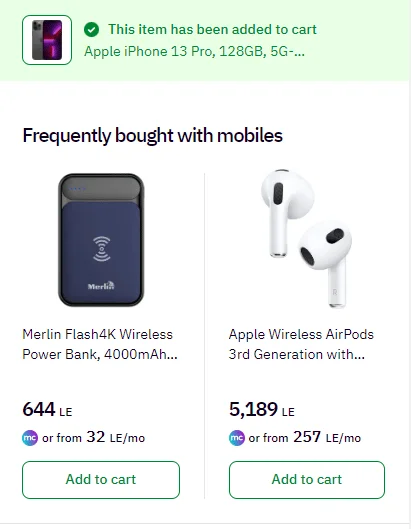
Upon adding an item to the cart, the shopper gets relevant cross-sell recommendations for accessories or products compatible with the main product, sparing the shopper the effort of searching for these items separately. For example, Wireless AirPods are recommended when an iPhone is added to the cart.

4 Cart Page

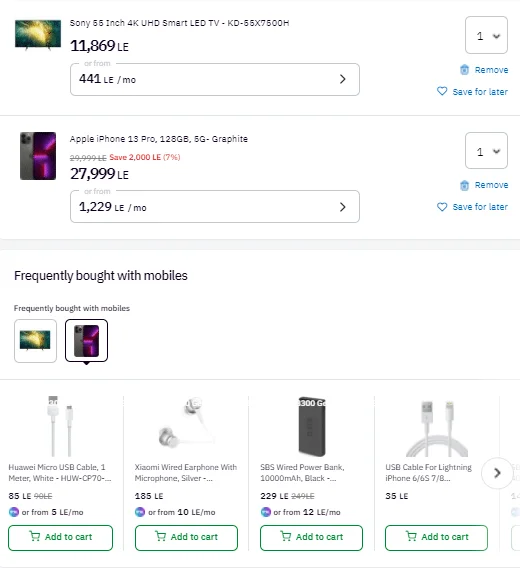
When the shopper proceeds to the cart page, the engine again reminds them of complementary items they might want to purchase along with the main product, without being pushy. But what’s unique about this recommendation block is that the shopper can switch between the items in the cart and view recommendations for each item separately.

And when a shopper empties their cart, instead of just an ‘Oops! Your cart is empty’ message, the engine suggests strong alternatives to the items the shopper deleted. These recommendations make sense as the shopper had a clear buying intent.

In addition to the aforesaid efforts, B.TECH delivers relevant recommendations on the home page as well based on a shopper’s search queries, previously viewed items, and items in their cart — making it easier for the shopper to pick up where they’d left off.

Product discovery is now a breeze for B.TECH’s customers. Since personalizing its web store, B.TECH has seen strong business results:

  • 18.6% of the sales from the website, mobile site and apps can be attributed to personalized recommendations driven by the engine (compared to 11% earlier)
  • 5% attributable revenue from cross-sell
  • 10X RPMV on the cart page

Another retailer that turned to personalization is Verkkokauppa.com. The company is among Finland’s largest online stores, with 65,000 SKUs in multiple categories, including consumer electronics.

Verkkokauppa moved from traditional commerce site search to self-learning, personalized search in order to solve pressing issues such as irrelevant search results and instances wherein a shopper sees a no-results page after making a search query.

To elaborate, when a shopper searches for ‘Apple’, the search could show all the available Apple products. But would this be relevant to the shopper? Probably not. Personalized search helped Verkkokauppa address this problem by using a strategy known as Wisdom of the Crowd (WOC).

WOC typically uses a machine learning algorithm that learns from the collective behavior of shoppers, their search queries and what product they view or purchase thereafter. It then uses this information to display search results that in all likelihood match the shopper’s intent. Shoppers who use search often have clear purchase intent, and personalized search helped the retailer convert these shoppers quicker.

In addition to search, Verkkokauppa also personalized other commerce touch points of product recommendations, browse or category pages and content. Here are the business outcomes they experienced as a result:

  • 31% higher conversions
  • More than a 24% increase in basket sizes
  • Over 25% attributable sales from product recommendations (up from 6% earlier)
  • Sessions involving search convert 5X more than the ones without search

In conclusion, it is paramount that retailers personalize every key touch point in the online shopping journey, including search, product recommendations, browse and content. Doing so will allow for a more holistic experience that customers expect today. Creating contextually relevant experiences consistently will also help retailers become top-of-mind brands at a time when customers are spoiled for choice and loyalty is hard to come by.

This article was first published on Retail TouchPoints.

Also read: Evolution of Ecommerce Personalization: A Look at Trends in 2024

How Machine Learning Improves Retail Demand Forecasting

Merchandising and Supply Chain
Blogs

How Machine Learning Improves Retail Demand Forecasting

Demand forecasting is the process of predicting how much demand your products will have over a specific period, based on historical and real-time data. It helps make the right procurement and supply decisions for the business and its customers.

As a retailer, demand forecasting must be routine for you, whether you sell 1,000 SKUs or 10 million. In fact, the higher the number of products you sell, online or offline, the more important it is that you forecast the demand for your products accurately for the upcoming months.

Why Is Demand Forecasting Essential in Retail?

Demand forecasting is essential for almost every activity from production or procurement planning to sales and marketing to assortment planning.

It is a critical BAU activity for several reasons, such as:

  • To balance product availability with minimal stock risk—cut down inventory optimization issues and wastage at the same time
  • To ensure you are able to procure the right amount of inventory required to meet customer requirements in the near future: both online and offline
  • For optimal retail inventory optimization solution and management and to avoid out-of-stock as well as excess or old stock scenarios
  • To understand which products are needed in approximately what quantity at each store
  • To know how much inventory your warehouses should store to meet consumer needs on your digital channels
  • For capacity management—ensuring that production/supply and in-store efficiency is aligned with the projected demand
  • To make supply chain management more efficient by helping you decide the inventory required for each product category and whether more or fewer suppliers would be needed at a time
  • To be able to create, produce, procure, or design new products to meet customer needs better
  • For planning production requirements and logistics, if you are a D2C brand that manufactures your own products
  • To be able to do assortment planning the right way so that products not being sold during a particular period do not take up key shelf spaces
  • To optimize cross-sell and upsell strategies around alternative and similar products
  • For optimization of product promotion campaigns and advertising spends, i.e. knowing which products to promote through discounts and offers and which not to
  • To reduce operational costs and increase profitability

What Are the Traditional Demand Forecasting Methods?

Once upon a time, demand forecasting was siloed to individual stores, and having one individual dedicated to tracking product movements and predicting requirements was enough.

But in the past decade, with different sales channels—multiple stores (many a times in different countries), websites, and apps—it is important to have an omnichannel outlook to forecasting.

The scale of omnichannel means that the amount of data—related to both product movement and customer behavior—is massive, which is beyond the scope of a few individuals and their spreadsheets.

Traditional demand forecasting solution methods consist of two key areas:

  1. Quantitative methods, which employ mathematical and statistical models to understand the trend and results. These include models such as Percentage Over Last Year, Moving Average, Linear Approximation, Exponential Smoothing, Lifecycle Modeling, Time-series Modeling, Regression Analysis, and Econometric Modeling.
  2. Qualitative methods, which are subjective and sociological methods of collecting information and applying ideas generated from them to the problem at hand. These include Market Research, Historical Analogy, Expert Opinions, Delphi Method, Panel Consensus, and Focus Groups.

Why Use Machine Learning for Demand Forecasting Instead of Traditional Methods

As is obvious, most traditional demand forecasting methods are manual in nature, relying on collecting information and analyzing them using spreadsheet formulae.

But when your retail data points run into millions and the variables that determine the demand for a product run into dozens, manual forecasting is simply time-consuming and prone to human error.

In addition, it is impossible to consolidate all data points and all kinds of different analytical models into a single spreadsheet or chart for a 360-degree view—inevitably, some factors get left out and siloed interpretations follow.

You might find one statistical model telling you that you need to stock up on baking essentials because it’s Thanksgiving. Another study tells you baking is falling out of fashion because people are working more and have less time for personal activities. And then, a third unknown factor of sudden bad weather drops out of nowhere. So, should you stock up on baking essentials or not, and how much?

9 Ways Retailers Can Benefit from Machine Learning in Demand Forecasting

Today’s retailers must have accurate demand forecasts in order to optimize every part of the chain of activities required to meet the day-to-day appetite for their products. The better forecasts you build, the more efficient each of your procurement, sales, and marketing processes will be.

And nothing can give you better data accuracy than machine learning-based software.

McKinsey notes that using ML and AI in demand forecasting and supply chain management can reduce errors by up to 50% and reduce lost sales and product unavailability situations by 65%. This can lower warehousing costs by up to 10% and administration costs by up to 40%.

These benefits are surely too good to pass up.

For starters, AI algorithms use a combination of the best of mathematical, statistical, and data science models. An ML-based forecasting software doesn’t simply apply past patterns within a business to predict future requirements; it evaluates each factor likely to impact demand in real time, and automatically gives you a constantly updated picture of sales, demand, and inventory.

Machine learning can process millions of data points in minutes, draw trends and insights across different dynamic conditions, and show you how each variable affects another and thereby the overall demand. It can find non-linear connections between variables, which are crucial for the best forecasting models.

Plus, these algorithms constantly learn from the data the software ingests. It is already trained on several forecasting models and historical data, and further training with real-time data strengthens its accuracy. This helps you automate the whole process and cut down on the human hours required for the task.

All this makes predicting demand through machine learning accurate, fast, and scalable, which, in turn, ensures efficiency in the entire supply-to-sales chain.

To summarize, using machine learning for demand forecasting can benefit you in the following nine ways:

  1. Process more data points than a human can
  2. Process data from more sources
  3. Process the data quickly
  4. Identify hidden trends and insights from the data
  5. Identify relationships between the variables that impact demand
  6. Generate accurate forecasts by factoring in several variables
  7. Automate and update the forecast in real time
  8. Make the forecasting system robust, scalable, and adaptable
  9. Save time, money, and resources by making every step of the supply-to-sales chain effective and efficient

Related Blogs

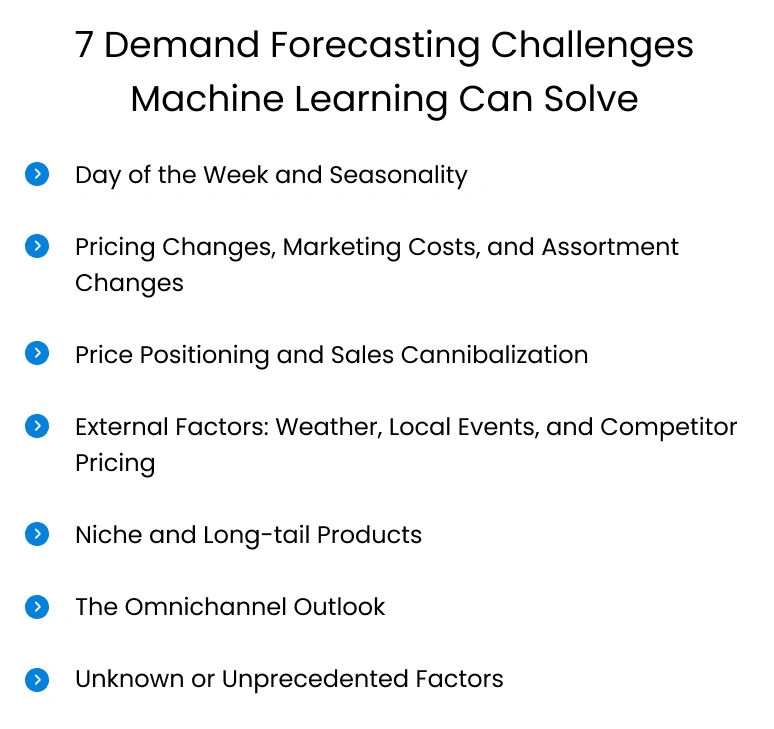
7 Demand Forecasting Challenges Machine Learning Can Solve

Let’s see how ML algorithms can help retailers deal with the many challenges that demand forecasting inherently presents.

1 Day of the Week and Seasonality

Weekday versus weekend sales and higher or lower sales of certain items in specific seasons are things every retailer contends with every day. A simple time-series modeling might help you determine these patterns easily.

However, machine learning’s accuracy comes from the fact that these clever algorithms find how these variables and demand are related. It also factors in other variables, such as offers, promotions, and weather, ensuring accuracy and giving you a 360-degree view of where your product’s demand would stand in the next few days or weeks or months.

2 Pricing Changes, Marketing Costs, and Assortment Changes

Offers, promotions, discounts, in-store display changes, and investment in online and offline marketing campaigns, can affect how the appetite for the product shapes up. It’s difficult to predict the impact each of these factors can have on demand, without some really complicated number crunching.

Machine learning can do the heavy lifting for you and accurately predict how a product’s price change can affect its demand. This helps not only in forecasting but also in understanding promotion forecasting, markdown optimization, assortment planning, and replenishment planning solutions management.

3 Price Positioning and Sales Cannibalization

The price difference of a product compared to other products in the same category also affects demand. For example, the highest priced product in the category may end up not getting sold at all.

Similarly, promotions and discounts of one product in a category could bring down the demand for other products in that category.

Keeping track of these phenomena for each category of products you sell can be back-breaking. However, ML algorithms learn from each piece of data, and therefore can give you a comprehensive view of factors impacting the demand of each product not only within itself, but also in relation to other products in the category.

4 External Factors: Weather, Local Events, and Competitor Pricing

Demand is sometimes heavily affected by external factors, such as weather, local crowd-pulling events, and pricing changes and promotions by competitors. Without machine learning-based automation, these things are almost impossible to be factored into inventory demand prediction.

ML algorithms can quickly and accurately map the relationships between weather and sales at a localized level, giving a granular outlook on the market for your products. They not only detect which product would be in demand during a weather pattern, but also tell you what product would not be needed.

The same goes for understanding how a big concert or game near the store or in a region can affect demand for certain products, or how promotions being run by competitors or new stores/online outlets can change footfall/traffic to your channels. You only need to feed the right data into the ML-based tool you use.

5 Niche and Long-tail Products

Many niche products have negligent sales data because barely a few units are sold each month. This leads to a scarcity of data on the item and unpredictable variations in demand patterns for the product.

Add external factors and cross-channel variables, and the output can actually become unreliable. However, robust and self-learning algorithms can cut out the noise, avoid overfitting, and arrive at close-to-accurate results for niche products as well.

6 The Omnichannel Outlook

Several forecasting challenges are often unique for in-store and online channels. Even within each channel and each store, there are variations depending on location, logistics, shelf space, personnel availability, etc.

Machine learning makes it possible for retailers to not only get an overview across stores and channels, but also look at the requirements of each individual store and channel.

Because of this, it can suggest internal stock movements easily. For example, say your Pittsford store has an excess stock of peanut butter and your Rochester store is running out of it. Your ML tool can make this information more visible. So, instead of urgently procuring fresh stock for Rochester, you can move some of the stock from Pittsford and meet the requirement quickly.

The same thing can be done cross-channel; the algorithms can suggest when excess store replenishment stock can be moved to the online inventory and vice versa.

7 Unknown or Unprecedented Factors

Machine learning algorithms also allow you to factor in unknown factors impacting demand. In 2020, for example, the pandemic was a sudden and unprecedented factor that changed consumer needs overnight. An E2open study found that amid the pandemic, real-time data and AI-powered analysis reduced forecast errors by over 33%.

ML software can add a tentative input in the forecasting model, making it ready to update the numbers within minutes of adding in a new datapoint. Retailers can also do what-if simulations to analyze how changes in variables can affect demand, so as to be prepared for unknown factors and reduce forecasting errors.

Unknown or unprecedented data can be best handled by a machine learning tool if it has real time customer data profiles processing capabilities. Inputs such as search trends, social media actions and hashtags, global and local news, and other non-linear and unstructured data help machine learning algorithms increase the accuracy and value of their output.

Time to Add Machine Learning to Your Demand Forecasting Process

Now that you know the immense benefits machine learning can bring to how you forecast demand, time to look at different ML-based software and get one for your business. ADA Global’s Forecast Right is one such AI-driven forecasting solution that is also easy to use.

Sounds interesting? Explore demand forecasting or Get a demo to decide for yourself.

Table Of Contents
Why Is Demand Forecasting Essential in Retail?
What Are the Traditional Demand Forecasting Methods?
Why Use Machine Learning for Demand Forecasting Instead of Traditional Methods
9 Ways Retailers Can Benefit from Machine Learning in Demand Forecasting
7 Demand Forecasting Challenges Machine Learning Can Solve
Time to Add Machine Learning to Your Demand Forecasting Process

The State of the Global CDP Market

Omnichannel Marketing
Blogs

The State of the Global CDP Market

Research suggests that about 40% of brands are exploring ways to expand their data-driven budgets in marketing. Realizing the true value and potential of data has been instrumental in the digital transformation of corporations, and most businesses are ostensibly data-driven today.

Marketing is one of the functions that is increasingly depending on data to personalize experiences for customers. However, data is only as useful as the tools and technologies used to augment it.

And hardly any platform enables businesses to squeeze every last ounce of value from customer data like a Customer Data Platform (CDP). Therefore, it comes as no surprise that the global CDP market, worth $3.5 billion in 2021, is projected to grow 5x at a compound annual growth rate (CAGR) of 34.6% by 2026.

CDP Market Share

To understand more about how the CDP market share is projected to grow, here are the trends based on region, sector, and type:

By Region

The CDP market has its most significant share of growth in North America, followed by Asia-Pacific and the European Union. Due to the high focus on technological advancement, the US accounts for 45% of companies building CDP solutions, 61% of employees working on CDP solutions, and 75% of funding. However, Asia-Pacific is expected to grow quickly, with the highest CAGR by 2026.

By Sector

Industry wise, CDP finds high usage in banking, financial services, and insurance (BFSI), retail and commerce, healthcare, IT and telecom, and hospitality sectors.

  • BFSI: With the growth of online banking in the past few years, this sector is making heavy investments in customer engagement and customer relationship management. Gartner suggests that conventional financial firms will become irrelevant by 2030, making it imperative for them to invest in customer experience technologies such as CDP.
  • Retail: The retail industry is leveraging customer data platforms to offer personalized omnichannel customer experiences. For example, if a customer wish lists a product on a brand’s online store and decides to purchase it from an offline store, the unified customer profile that is updated by a CDP in real time allows the brand to understand the customer’s current preferences and make relevant recommendations in store.
  • Healthcare: During the pandemic, the healthcare sector saw extremely high volumes of data flowing in and most customers required immediate treatments. With a CDP solution, hospitals can store that data centrally to view patients’ medical history and offer on-time personalized treatments.

By Type

Based on type, the CDP market is segmented into access, campaign, and analytics. While most marketers are still looking at data access, campaign CDP is getting traction because of its ability to activate audiences in real-time, presenting an opportunity for personalized marketing.

Meanwhile, the demand for analytics CDP is increasing due to automation of customer journey for optimized customer interaction and AI/ML-based modeling for increased personalization.

Factors Driving the Growth of the Global CDP Market

The growth of the global CDP market reflects the proliferation of engagement channels. Customers today switch between online and offline channels as they research products, complete transactions, and engage with various brands online.

In other words, customer data comes in from different sources and in different forms. It is imperative for businesses to make sense of all this data.

That’s where a customer data platform for retail comes in. The capabilities within CDP help collect and create a unified profile for each consumer, which enables businesses to keep track of their individual preferences in terms of products, services, or overall brand perception. Therefore, CDP solution helps businesses make sense of all the data they collect from their customers.

Let’s discuss the three critical reasons why more businesses, especially B2C companies, are adopting CDP to better leverage customer data.

1 Personalization in Consumer Experience

Most customers today have gotten used to personalized interactions and marketing, with nearly three out of four individuals actively expecting it from every business. Also, most consumers tend to become repeat customers of a brand that provides one-to-one personalization interactions and customer service.

Therefore, providing personalization is no longer a luxury but a necessity for businesses and marketers, making it imperative for businesses to use CDP for hyper-personalization. CDP supports personalization by providing a real time customer segmentation audience with a 360-degree view and insights of customers.

CDP gathers all kinds of data—behavioral, transactional, and demographic—before creating a dynamic, constantly evolving customer profile for each consumer. This profile gets updated with every customer interaction and enables businesses to send personalized emails and messages, provide targeted adverts, and offer other solutions tailored to customer needs.

2 Increased Emphasis on Data Security

Due to growing stringency in data protection laws across the world, such as the EU’s GDPR and China’s PIPL, businesses are expected to prioritize cyber security and data protection. Google is also phasing out third-party cookies soon to make data sharing more consensual for netizens.

CDP helps with managing opt-in and opt-out, right to forget and right to access, which is in compliance with regulations such as GDPR.

By capturing the first, second, and third-party data and providing the flexibility to adapt to changing regulations, CDP proves to be a superior consumer data management solution compared to other platforms, such as Data Management Platform (DMP), which primarily relies on third-party data. CDP helps improve the safety of personal customer data possessed by businesses, making it a major driver of the booming CDP market.

3 Omnichannel Experiences

With an increase in digitization, customers have become channel-agnostic. Therefore, it’s critical to deliver a consistent user experience even if a customer switches between online and offline channels.

Businesses must find a way to integrate offline and online channels so that consumers can seamlessly move through them and continue their journey without any friction. A CDP uses real time customer data profiles from across channels to deliver contextually relevant experiences to users across the channels of their choice.

4 Increased Technology Costs

The cost of software implementation and data augmentation is increasing in today’s data-driven marketing landscape. Marketers constantly seek ways to reduce these costs, and CDP offers a viable solution.

A CDP digitally manages several tasks, such as customer profile creation, data curation, user analysis, and more. Therefore, by implementing a one-stop solution to handle multiple marketing functionalities, marketers can save considerably on budgets.

5 Real-Time Contextual Engagement

Nearly all sectors in the world are saturated with intense competition. Amid such competition, the ability to tailor experiences as per a customer’s preferences and current context can be a big differentiator.

For instance, a quick-service restaurant sending a ‘Buy one, get one free’ offer to a person who usually buys a meal for one isn’t helpful. Instead, the person would appreciate an offer on their favorite meal. CDP helps marketers leverage such insights and make each real time customer engagement relevant and meaningful.

Elevate Your Brand’s Customer Experience with a CDP

Omnichannel dynamic content personalization experiences are more important than ever. With a paradigm shift in customer expectations, businesses across industries and geographies are investing in real-time customer data platforms.

However, to reap the benefits of CDP, you need to select the right service partner. Ada Global’s Real-time CDP enables contextually relevant engagement in the moment with capabilities around streaming data ingestion, unified customer profiles, and real-time audience activation.

Schedule a demo with our experts to learn how Ada Global can set your marketers up for success.

Table of Contents
CDP Market Share
Factors Driving the Growth of the Global CDP Market
Elevate Your Brand’s Customer Experience with a CDP