
Retail Customer Data Platform for Personalized Engagement

Omnichannel Marketing
Blogs

Retail Customer Data Platform for Personalized Engagement

A Customer Data Platform (CDP) is used to collate consumer data from diverse first, second, and third-party sources into a single central location. It records and distills your consumer interactions into unified identities, and provides insights that help you drive marketing content and offers that resonate with the individual customer.

Let’s dive deeper to understand how this works.

What CDP-based Identity Resolution Means

Recognizing who your customers are and understanding their affinities, needs, and motivations is critical in marketing. The faster you do so, the more relevant and individualized your services and communications become. Identity resolution is key to achieving this objective.

Identity Resolution, or ID Resolution, involves the combining of user information to create a unified profile based on the data obtained from diverse online and offline sources, stitching together known logins with anonymized user sessions.

This means that irrespective of whether a user is logged in to their account on an eCommerce website or not, through recognizable data such as IP address or device, a CDP solution can identify the user or the household and update and enrich the existing customer profile.

Further data enrichment (using third-party data) turns every unified customer profile into a comprehensive Golden Customer Record, which then serves as the single source of truth. This ensures that, at any given juncture, organizations have an always-evolving 360-degree customer view for better engagement and targeting at an individual and household level.
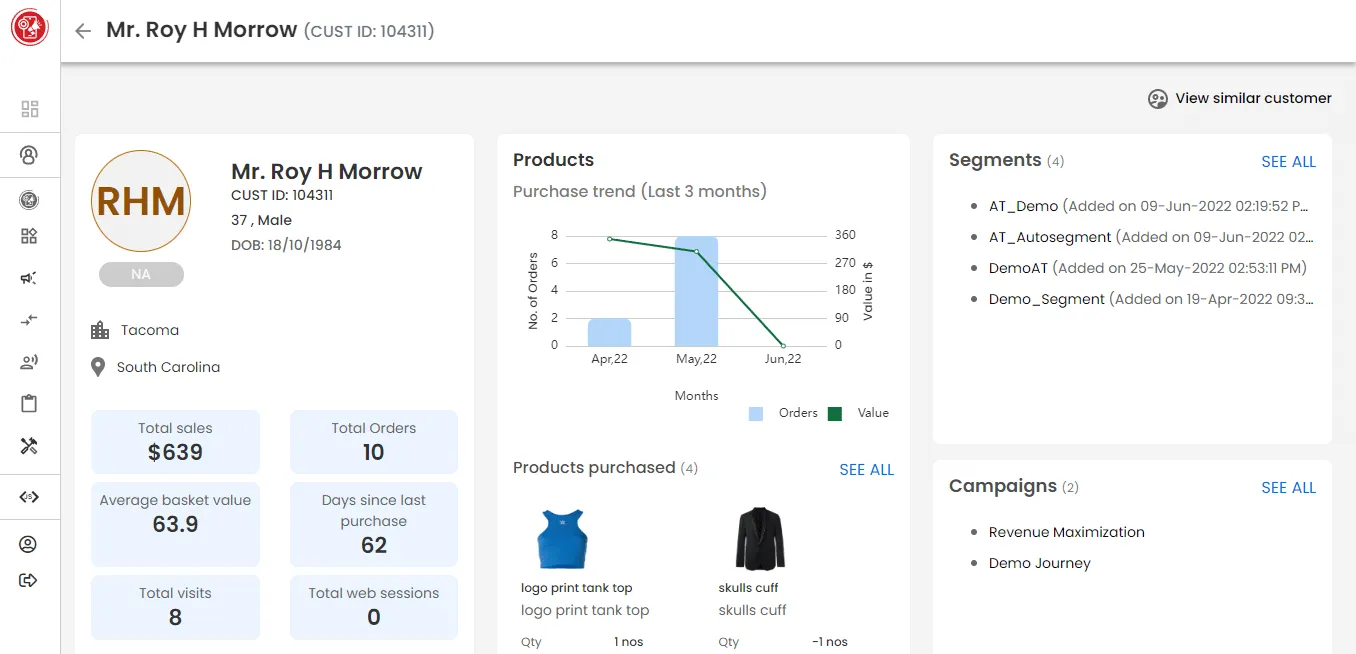
Golden Customer Record

How CDP Solution Creates Individual Customer Profiles

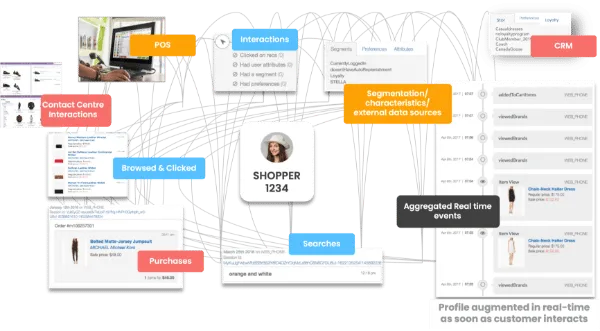
The process of profile-building initially involves the standardization of data from different touchpoints. These touchpoints include online and offline sources, such as web search, mobile app browses, communication between customers and CRM executives at physical stores, POS data, and social media engagement.

Data taken from such disparate sources are generally in different formats and sizes. A CDP converts them all into a common format – a process known as data standardization.

Before getting into the various ways in which a CDP can build individual profiles, one must know the unique types of data that a CDP collects. The most vital of these is first-party data, which is the information your customers give you voluntarily. For example, the phone number, email address, and location a user provides while using a newly-installed mobile app. Other examples include data from loyalty programs and purchase history.

Another important first-party user data is identity-based, which is how a user wants to be identified by people and companies. This includes their name and gender.

Behavioral data comes from tracking users’ online behavior, such as social media engagements and customer journeys on eCommerce websites (think search, page views, click-throughs). All this data is collected dynamically from different user sessions on your site or app, after which the CDP starts the identity resolution process.

Using a common identifier such as IP address, clusters of duplicate records are created and one surviving record overrides the rest. This process is called deduplication.

Some of the characteristics of ID resolution are:

  • Persistency of ID — the assigning of an identifier to a given individual and maintaining it even when some of their details, like their phone number and postal address, change.
  • Deterministic matching, which involves associating multiple identifiers belonging to a given person to a given shared ID during profile building.
  • Probabilistic matching, which involves associating different identifiers across different devices or accounts that appear to relate to a given person even when no deterministic match is there between them. Probability-based data collection and identification may involve machine learning and AI algorithms.

Profile building is an essential aspect of customer data management through CDP. Building evolving profiles enables businesses to adopt a dynamic and omnichannel customer engagement model in marketing.

How a CDP Solution Fosters Omnichannel Customer Engagement

Omnichannel customer engagement is one of the several benefits of employing a CDP for marketing in an age wherein the boundaries between multiple channels of communication are getting increasingly blurred.

Omnichannel engagement requires businesses to blend multiple channels for seamless transitions, a task that is made possible by CDPs. By arming you with 360-degree customer views and deep customer insights, a CDP helps you deploy the right offers and product recommendations to the right user at the right time—whether the user is on your app or website, or at the physical store.

Say a customer is looking for Mother’s Day gifts on a beauty website via desktop. A few hours later, they download the app on their phone and continue searching for a gift.

Instead of a fragmented experience where the user has to start all over again on the app, with a CDP-resolved unified customer profile, the app experience can be personalized to directly show the user products similar to what they were searching on the website or the most popular Mother’s Day gifts of the season, and even offer them an incentive to complete the purchase.

Such a personalized experience will ensure conversion and seamless customer engagement across channels.

How CDP Solution Enables Personalized Customer Experiences

Fragmented data is among the major challenges marketers face, making it difficult to paint a clear and complete picture of customers. As discussed earlier, a CDP resolves this issue by centralizing all customer data and creating Golden Customer Records that are updated in real time.

This eliminates instances in which marketers have to second-guess themselves when it comes to their audience’s personal likes, dislikes, needs, and desires at any given moment.

A CDP, therefore, provides insights to make hyper-personalization possible. Below are some examples.

1 Personalizing Contact Center Experiences

A CDP can collect customer information from online contact forms, emails, social media posts, offline letters, etc., and display it all in one place for a customer care executive.

This would enable the executive to recognize their doubts, queries, or grievances immediately without the customer having to explain the whole situation, be it a product quality issue or a concern related to delivery.

This saves time and results in quicker and more efficient query and grievance resolution, higher overall productivity among contact centers executives, and less duplication of information.

Customers appreciate it when a support executive recognizes them as a person and not just another customer. Further, such high-quality service significantly improves brand perception and loyalty.

2 Making Purchase Recommendations Based on Online Searches

Often, a customer may visit an eCommerce website, search for and view a product, but not complete the purchase.

A retail customer data platform can help you track this behavior. You may then send a personalized offer to the customer via email, recommending the product they had viewed.

And the next time the customer visits the store, the store associate can show them the same product and encourage them to complete their purchase. Such tailored engagements delight customers and take their buying experience to the next level.

3 Using Data’s Potential on Social Media

A CDP’s customer insights can be used to create value for a customer on their social media. For instance, shopping and browsing data can be leveraged on Instagram in the form of targeted ads and promotions to boost customer engagement and loyalty to the brand.

4 Driving Meaningful Engagement ‘In the Moment’

The customer intelligence that a CDP affords can be used to drive contextually relevant, real-time engagement on the right channel.

For example, a multi-brand conglomerate with a franchise of a leading coffee chain as well as a global baby care brand unifies data across both brands to get a single view of the customer.

Their CDP’s AI algorithms detect a pattern that a customer prefers a certain coffee and is a regular customer of the baby care brand as well. The algorithm also knows that the customer regularly purchases baby care products from Location A.

Using these insights, the franchise sends an SMS offer on coffee at an outlet in Location A, when the customer makes a purchase at the baby care outlet, for that desirable in-the-moment connect. This entices the customer to make a purchase, resulting in increased conversion rate and revenue.

Conclusion

In conclusion, the ability to resolve customer identities and create ever-evolving Golden Customer Records is key to enabling hyper-personalized omnichannel experiences. ADA Global’s Real-time CDP addresses this need. The platform is built for retail with online and offline data management capabilities. Further, it uses AI-ML algorithms to create micro-segments and uncover marketing opportunities throughout the customer lifecycle.

Request a demo here.

More Reading

Check out our in-depth guide on Real-time CDP to identify potential use cases for your business, success stories, and more.


Read Now
Table Of Contents
What CDP-based Identity Resolution Means
How CDP Solution Creates Individual Customer Profiles
How a CDP Solution Fosters Omnichannel Customer Engagement
How CDP Solution Enables Personalized Customer Experiences
Conclusion

CDP vs DMP vs CRM: What’s the Difference?

Omnichannel Marketing
Blogs

CDP vs DMP vs CRM: What’s the Difference?

Today’s consumers want highly personalized services and digital experiences. In fact, about 3 out of 4 users get frustrated when they do not get that convenience. Ecommerce personalization is, therefore, crucial in today’s eCommerce-dominated marketing landscape.

The key requirement for personalization is coherent customer data. There are many data management solutions that process and analyze customer data to help you create personalized marketing strategies, targeted ad campaigns, and optimal experiences for your customers.

The most popular of these data management solutions are:

CDP, CRM, and DMP all have a common modus operandi—analyzing and compiling data collected from multiple sources to create detailed customer profiles. These profiles are used to optimize and personalize products, services, adverts, customer relationships, and other marketing-based functions.

At the same time, these platforms also have some fundamental differences. You need to know these differences to be able to choose the solution that is best for your business. Choosing the ‘wrong’ solution can affect your business operations and ROI, as all three options can be expensive to implement.

Let’s delve deeper into each tool to understand the differences.

Retail Customer Data Platform: The All-round Marketing Solution

A CDP is used to aggregate customer data from a wide array of sources to create a coherent, comprehensive, and evolving profile for each customer. These sources include your website, mobile app, social media pages, Point of Sale (POS) systems, live chats, and email marketing systems, among others.

A CDP gathers first-party data from the channels it is connected to and the systems it is integrated with. The data can be of different types: behavioral, demographic, technographic, transactional, and more.

The platform uses this data to create real-time customer profiles and build a comprehensive customer database. It gives you a 360-degree, unified view of a customer.

More importantly, a CDP centralizes this database, making it accessible to other enterprise systems that handle different functions like demand forecasting, CRM, data analytics, marketing automation, personalization, marketing campaign creation, A/B testing, and dynamic content personalization.

All the while, the system keeps collecting new data to update millions of customer profiles seamlessly and simultaneously.

Data Management Platform: The Prospective Customer Magnet

DMPs are used to collect and organize data from first-, second-, and third-party sources to build individual customer profiles. The aggregated data can then be shared with other business or marketing technology systems.

The data is specifically used to drive targeted advertising and personalization on different digital channels. That doesn’t mean that a DMP independently manages customer data and creates advertising campaigns. It acts as an intermediate entity between data sources and the places where the content will be used.

Now, the key differences between a DMP customer profile and a CDP customer profile are:

  1. Both the data and profiles in DMPs are anonymized. These profiles are accessible to marketers not as identifiable individuals but only as customer segments.
  2. The data and profiles can be stored for a limited time only.

For instance, say a marketer is looking to create a targeted marketing campaign for a certain demographic of people. They can use the DMP to find data for the segment they want to target, such as the number of women below the age of 30 currently using a Samsung Galaxy phone.

Once the DMP system gathers and runs this data through various analytical tools, marketers can target the customers in that segment. All the individuals in a segment will receive the same marketing messages, emails, and adverts on social media pages or other online touchpoints.

As a result, where a CDP is geared more towards profiling and serving existing customers, the primary use of a DMP is winning prospective customers with data-driven online advertisements.

Customer Relationship Management (CRM) — The Relationship Optimizer

A CRM uses a series of data collection, management, and analytical tools to manage relationships with customers. This system uses AI and machine learning-based tools for pattern recognition and in-depth data analytics. Chatbots—which are essentially AI-powered customer service executives—are prime examples of CRM tech.

Where a DMP is primarily used for targeted advertising, CRM is associated with sales teams. One of the main uses of CRM is analyzing data in user reviews and feedback to develop better products over time.

Like CDP and DMP, this solution too dynamically gathers customer data, but the purpose is to evolve and improve the quality of services. You can employ CRM systems to simplify customer interactions, resolve post-purchase grievances, and optimize the functionality, reliability, and durability of products and services.

A CRM platform enables you to align your sales and marketing operations through integration with CDP, DMP, and other similar tools. You can achieve this by tracking individual customer journeys by sourcing first- and second-party customer data from feedback forms, surveys, responses to emails, activity on your website, call center communications, cookies, and others.

Due to today’s cutting-edge competition, many products and services have similar quality, capabilities, and functionalities. So, customer opinions and purchase decisions are formed based on their marketing interactions and overall experience with your business. CRM tools help optimize these interactions.

Key Differences Between CRM, CDP & DMP

As is clear, there are several overlapping aspects among the three solutions. However, there are five areas where the three are different:

1 Data sources

All three platforms can process first-, second-, and third-party data. First-party data refers to information received directly from customers, second-party data refers to others’ (such as a partner or reseller) first-party data, and third-party data comes from various sources such as browsers, devices, website cookies, and mobile apps. CRMs and CDPs mainly process first-party data, while DMPs focus on third-party data.

2 Data storage and retention

DMPs only store the data for specific periods, while CDPs and CRMs store the data indefinitely unless the customer or the business decides to wipe it off. The duration and amount of data that can be stored also depends on the platform’s pricing. However, all three systems must comply with data protection guidelines in the region they are in (such as GDPR in Europe).

3 Customer profiles

CRMs and CDPs process personally identifiable information (PII) to create identifiable customer profiles, while DMPs create anonymized customer profiles. CDPs can bring together and analyze PII in conjunction with anonymous third-party data to identify the individual and give you a 360-degree real time customer data profiles snapshot.
CRMs cannot track unidentified users, so customers’ unidentified digital journeys (where they do not sign in to the browser or website account, for example) cannot be unified with their known profile.

4 Who the tools are for

A CRM is primarily used by sales teams, a DMP by performance marketing teams, and a CDP is for any marketer or digital merchandiser.

5 Purpose of data collection

CRMs are used for customer relationship management, customer profile building, and helping the sales and marketing tools deal with feedback and product and service development. DMPs are specific to advertising and segment personalization.

Retail customer data platforms can be used to manage customer relationships and engagement levels, in targeted marketing and ad campaigns, for 1-to-1 personalization, whatever your need is. All this is possible because of its ability to build unified customer profiles that evolve with each interaction.

As you can see, CDP has the widest array of capabilities of the three. Therefore, a CDP can carry out the functions that form the basis of the core functionalities of DMP and CRM, apart from its own capabilities.

Also read: 5 marketing challenges a customer data platform cdp can solve

Why Businesses Must Have a CDP Solution

A CDP is a well-rounded customer data management solution for many reasons.

  • First, only a CDP helps you unify data collected from diverse sources, including your legacy databases and other digitized records, to relentlessly update real time customer engagement profiles in real time. You can also integrate CRMs and DMPs into a CDP to help augment its first-party customer data.
  • Second, the centralization of data lets you break down any existing data silos between different sub-departments within your marketing department. This lets employees and managers across the board participate in marketing-related strategizing, thereby making decision-making more balanced and data-driven.
  • Third, the 360-degree customer profile lets your business optimize marketing campaigns and other engagement efforts by enabling hyper-personalization for individual customers. After all, dynamic personalization not only improves customer retention over time, but also revenue by 5-15% and cost efficiency by 10-20%, according to McKinsey.
  • More than anything, a CDP helps you make the most of every interaction between you and your customers across every channel and touchpoint. A CDP is more than just a data collection and unification tool–it enables audience activation and campaign orchestration across different communication channels.

The above-mentioned capabilities make ADA Global’s Real-time CDP a trusted and reliable solution among major retailers and brands worldwide. It is built for retail with online and offline data management capabilities, and tracks customer behavior using over 1,200 out-of-the-box measures and dimensions.

Further, it uses AI-ML algorithms to create real time customer segmentation and uncovers marketing opportunities throughout the customer lifecycle.

Request a demo here.

Table Of Contents
Retail Customer Data Platform: The All-round Marketing Solution
Data Management Platform: The Prospective Customer Magnet
Customer Relationship Management (CRM) — The Relationship Optimizer
Key Differences Between CRM, CDP & DMP
Why Businesses Must Have a CDP Solution

Grocery Replenishment Has Evolved: 9 Things Every Retailer Must Know

Merchandising and Supply Chain
Blogs

Grocery Replenishment Has Evolved: 9 Things Every Retailer Must Know

Grocery retail has irrevocably changed. The last two years in particular have exposed many gaps in business. Predictive replenishment emerged as one of the major fault lines in the changed grocery retail environment with many retailers unprepared to address challenges such as frequent out-of-stocks, increasing inventory costs, wastage that comes with fresher and newer products, omnichannel nature of business, and shift in customer behavior.

Here are nine best practices for grocery replenishment that are fast catching on and can help you build a robust replenishment framework:

  1. A Good Demand Forecast Is Essential, However It Is Not the Only Critical Input
    A good replenishment planning solutions system must also factor in existing inventory balance, expiration dates, open orders, average lead time, minimum order quantity, standard ordering frequency, and other data points that are key to effective planning.
  2. Simulations Will Help to Hone Your Replenishment Strategy
    Both demand and supply-side fluctuations characterize your supply chain. Monte Carlo simulations can create thousands of different ‘what-if’ decisions to develop supply chain scenarios. These scenarios can help you optimize your resources (cost), improve customer service, and strengthen your competitive approach with a robust replenishment strategy.
  3. Leverage Optimization Algorithms to Get the Right Outcome Every Time
    Artificial Intelligence in ai replenishment planning has proven effective in dealing with large-scale multifactorial optimization. AI can do the heavy lifting of identifying predictors and best-fit models for demand forecasts, and optimizing order plans for supply chain factors.
  4. Factor in Supply-side Variations
    In the past few years, grocers have realized that disruption in supply is an emerging threat and needs a mitigation strategy. Providing for probabilistic treatment of supply-side variations in your replenishment framework can go a long way in achieving that.
  5. Collaborate With Your Supplier Base
    Your replenishment framework is as strong as the weakest link of your supply chain. Even the best replenishment planning framework will fail if the supplier collaboration is poor and cumbersome. Think of supplier integration as part of replenishment planning.
  6. Safeguard Against Risks With More Effective Guardrails
    While accounting for expected risks such as delays in lead time during holidays, you must also be prepared for unexpected events such as inclement weather, war, and epidemic/pandemic. Setting up dynamic guard rails such as minimum inventory optimization turnover period as opposed to static ones like minimum safety stock levels can safeguard your operations.
  7. Your Shelves Might Not Be Functioning The Way You Assume
    First In, First Out is a fair assumption for ambient products. However, for fresh food categories, it is probably the opposite. Being astute, buyers select produce, meat, fish, poultry, and dairy that show no signs of spoil. They might anticipate that the grocer has placed the oldest inventory at the front and reach further back of the display.When this behavior becomes a common practice, only dead stock remains on the grocer’s shelves. Hence, incorporating batch-wise stock balances and expiration dates in your retail replenishment software will avoid wastage and keep your shelf looking fresh.
  8. Set Proactive Alerts To Act Preemptively
    To ensure you order the right quantities at the right time, simplistic alerts such as the ones based on fixed pre-expiration timeline might not be good enough to react to grocery scenarios. Instead, a proactive notification based on a combination of factors—such as inventory demand prediction, stock balance, and product expiration— will help you course-correct in a timely fashion.
  9. Let People and Technology Augment Each Other
    While advanced technologies, such as AI and ML, augment the replenishment planning processes, there are certain limitations that are addressable only by human intervention. Make sure there are humans in the loop who can intervene as needed. People and technology augment each other well!

AI-powered Replenishment Planning Solution Tells You What, When & How Much to Order

Advanced technologies, such as AI and ML, bring revolutionary capabilities to the table across demand forecasting and automatic store replenishment – helping planners make snap yet faultless decisions every time.

One such solution is ADA Global’s Order Right, which helps planners shift their focus from tedious, manual number-crunching to 1-click intelligent order planning.

Order Right generates accurate SKU level order plans with its proprietary optimization algorithms that account for key supply chain and category factors such as shelf-life, lead-time, MOQ, etc. while constantly monitoring stock balance, sales, and demand predictions

Table Of Contents

Unpacking the First Real-time Customer Data Platform (CDP) Made for Retail

Omnichannel Marketing
Blogs

Unpacking the First Real-time Customer Data Platform (CDP) Made for Retail

Data is an immutable asset. One that has surpassed oil to become the most valuable resource in the world. Yet, in the age of analytics, it is just that – fuel. Much like fuel, it must be transformed to extract genuine value.

As Clive Humbly put it, “Data is the new oil. It’s valuable, but if unrefined, it cannot really be used. It has to be changed into gas, plastic, chemicals, etc., to create a valuable entity that drives profitable activity; so must data be broken down and analyzed for it to have value.”

Though infinitely available (unlike oil), the challenge most marketers face is the inability to effectively unify, analyze, and leverage retail customer analytics to drive decisioning and personalized customer engagement.

Customers are loyal to brands that acknowledge them as individuals. This makes the ability to hyper-personalize every customer engagement paramount for retail marketers.

To help marketers activate their audience in real-time with custom offers and cross-sell products along the customer journey, we are introducing our Real-time Customer Data Platform (CDP).

A hurdle most marketers encounter in their efforts to deliver personalized experiences is unstructured data silos. These inconsistencies in data become barriers to accessing a comprehensive view of the audience. Consequently, stakeholders are unable to identify, segment, or even market to the audience along their journey. This leads to bigger problems such as the inability to quantify performance and contain churn.

ADA Global’s retail customer data platform empowers marketers to unlock the full value that can be derived from data and orchestrate high-quality journey-based campaigns. Our CDP paves the way for data unification and intelligent decisioning through real-time audiences and delivery of one-to-one personalization engagement across online and offline channels. In addition, native integration with ADA Global’s Campaign tool enables marketers to deliver tailored omnichannel marketing campaigns across the customer journey.

How Real-time Customer Data Platform Works

Our API-based integration facilitates frictionless consolidation of the tool to existing systems at scale.

CDP’s array of connectors eliminates data silos with out-of-box batch and real-time integration that seamlessly centralizes data from any app or offline data store.

Anonymized customer profile data (including demographic, behavioral, and transactional) is captured and ingested in real-time from online, offline, first party, second party, and third party systems. This is then stitched together to create a unified customer profile that is updated with each customer interaction.

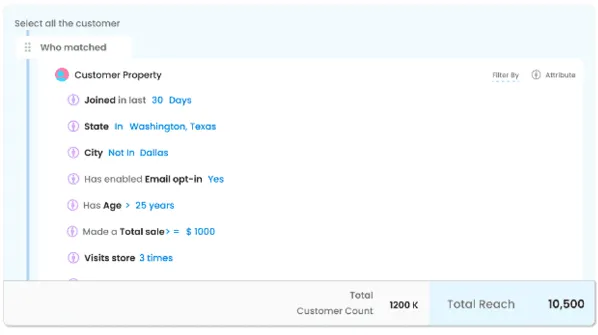
Profiles are dynamically real time customer segmentation using out-of-the-box models for churn, recency frequency, order value, engagement, etc. and the audience thus derived can be activated at scale.

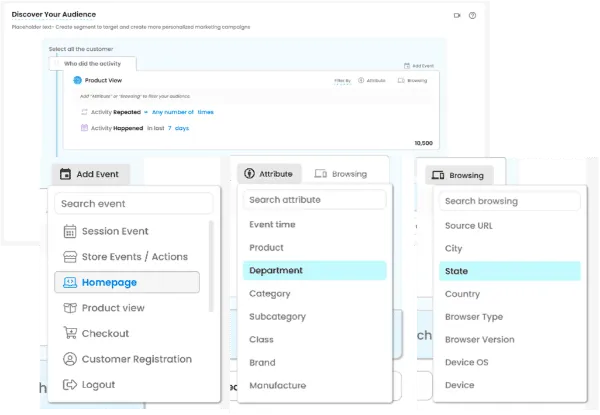
Audience Discovery helps marketers filter these segment lists using attributes or browsing information. Events can be added to further refine the audience to create granular segments for targeted engagement.

CDP’s Audience Manager creates, manages, and leverages the audience segment list to drive contextually relevant journey-based real time customer engagement in real-time across touchpoints.

Our diverse mix of connectors for outbound engagement empowers marketers and retailers to reach their audience across channels. This includes Email, SMS, Messengers, and Social.

Here are a few ways how marketers can leverage ADA Global’s CDP:

1 Real-time cross-channel profile updates

The real-time customer data platform enables dynamic updates to the real time customer profile with every interaction, both online and offline. Actionable algorithms enable real-time audience activation so marketers can deliver journey-based hyper-personalization in the moment.

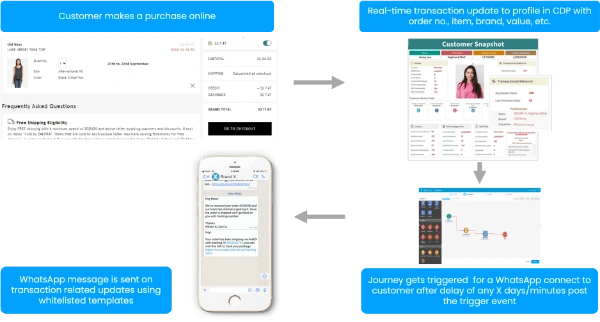
2 Real-time transaction communication on Whatsapp

Leveraging ADA Global’s Campaign tool, marketers can enable triggered email marketing at various event nodules. Marketers can determine triggers, and delays (days or minutes post the event), as well as choose from templates how they would like to communicate with their audience.

3 Proactive action to arrest churn

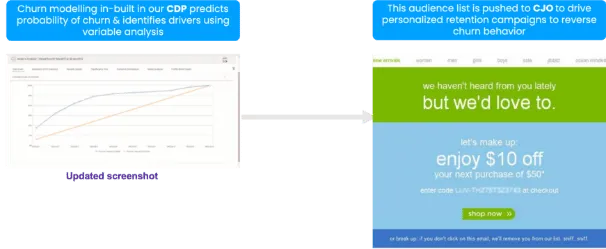
Churn modeling in-built into our CDP enables marketers to predict the probability of churn and identifies drivers which then can be leveraged to take corrective action. This audience list is then pushed to Campaign to initiate dynamic content personalization retention campaigns to reverse churn behavior.

There are a lot more use cases you can explore. Review the full list of power-packed features and learn how we can help you improve customer engagement, loyalty, and lifetime value. Or request a demo here.

Table Of Contents
How Real-time Customer Data Platform Works
Here are a few ways how marketers can leverage ADA Global’s CDP:

Best Practices to Boost Your Email Marketing Campaigns

Omnichannel Marketing
Blogs

Best Practices to Boost Your Email Marketing Campaigns

So, you put in the work, try to optimize where you see opportunity, and leverage new techniques. You’re excited about this email. Yet, you don’t see the results you were expecting.

It’s frustrating.

In today’s social-media driven world where everything is quick and easy, it is forgivable to assume that email marketing is past its glory days. Yet, this couldn’t be further from the truth.

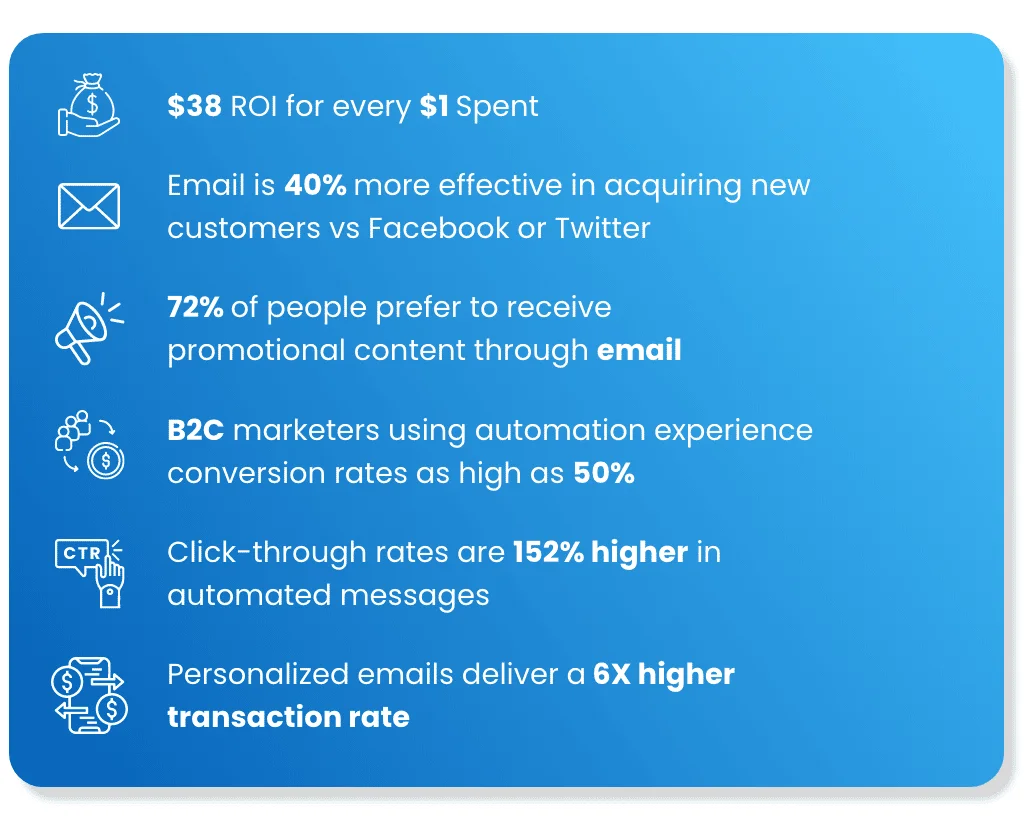
Marketers still vouch for email to deliver results and here’s why:

 Source: campaignmonitor.com

But the question remains – how do you improve your email marketing campaigns? Where do you start and how do you go about it?

In this blog, we will cover how you can make the most of your email channel and the best practices in deliverability, personalization, and dynamic content personalization.

Let’s dive right in.

When is the last time you saw an email that resonated with you? One that had you hooked right from the get-go. One that covertly but seamlessly navigated you to click on the CTA button. The brilliance of a well-crafted email that leads to conversions is its simplicity in encouraging action.

While there is no definitive formula to craft the perfect email, here are a couple of pointers to help get you started:

  • Focus on Your Key Objective For The Email: While it’s tempting to cram in as many ideas and offers in one email, it is important to hone in on one objective. This is the theme of your email around which everything else falls in place. Imagine crafting an email centered on trying a new holiday theme recipe. However, the email also includes content about passes to a concert. Confusing, right? Always begin with a clear objective. Your content and design must speak to this objective.
  • Maintain a 60% Text to 40% Image Ratio: It’s important to structure your email in a way that appeals to the reader. No one has the time to read chunks of text in an email. It is off-putting and can result in a dip in your KPIs. Conversely, an email laden with images can come across as too promotional. Maintain a healthy balance of text and image that conveys a message than a sell.
  • Keep Your Subject Line Short And to The Point: Your subject line should not exceed 41 characters or 8 words. This is the first interaction your audience will have with your email – if it doesn’t convey the message on the first read, the reader will most likely ignore the email.
  • Your Subject line, Content, And Visuals Need to be Aligned: Imagine a subject line that speaks of an exclusive summer offer, but the banner contains winter cues, while the main content holds information about an upcoming launch. It is haphazard. It will not translate. Nor will it meet its objective for the campaign. The messaging right from the subject line to the CTA must all be aligned.
  • Include a CTA in Every 3rd Fold of The Email: This draws attention back to your objective and keeps the reader engaged. This also aids in improving the conversion rate of the email.
  • Ensure Your Email is Responsive And Within the Recommended File Size: Bear in mind that your audience accesses and views your email on different devices. With over 60% of emails being opened on mobile devices, it is important to ensure that they are responsive and load with ease. The recommended file size is 80-100 kb.
  • Use Valid Links With UTM Tags: Ensure that the links used in your emails contain no typos or errors. It is especially important when your CTA links to a different landing page or sign-up sheet. An error in your link may cost you conversions. Remember to add UTM tags in your emails to track its progress across online platforms. Data is key – gather, analyze, and optimize to make the most of your email channel.

While the guidelines above will help you speak your message to your audience, it is also important to speak to your audience.

Here are three key factors to help you clinch gold in your email marketing efforts:

  1. Experiment With ai email personalization: Gone are the days when a cookie-cutter mass mailer did the trick. Your audience wants you to speak to them on a personal level. They want to form a bond with your brand. It is this connection that will drive engagement. Here is how you can experiment with personalization:
    • Lifecycle Email Campaigns – Based on the different life stages in your audience’s journey, create and share emails relevant to each segment. For example, share a welcome email as soon as someone subscribes to your newsletter. Or share an email reminding them about their cart. It is important to cultivate your relationship with your audience at each stage. Sharing emails at each nodule engages them and helps to motivate them along their lifecycle.
    • Always-on Campaigns – Share emails to your subscriber list based on their individual loyalty points accrued, offers based on past purchases, as well as festive offers to help keep them engaged with your brand.
  2. Drive engagement With dynamic content platform: The more relevant an email is to your audience, the more value you add to your campaign. Dynamic content empowers you to offer your audience a personalized experience at scale. The dynamic content you can leverage to increase the effectiveness of your campaign are::
    • Text – It is the most common and effective type of dynamic content facilitating personalization. You can personalize a line, a sentence, or even a paragraph to different subscribers. For instance, if you are a clothing brand, based on past purchases, you can create a dynamic paragraph on clothing and footwear that can be personalized for each audience segment.
    • Visual – You can change the image, GIFs, and videos based on the segments you target. You can also experiment with various visual elements based on your segment.
    • CTA – You can customize the size, shape, color, and text within your call to action to drive your click-through rate and result in conversions.
    • Offer – Include customer offers in your hyper-personalized email campaigns based on seasonality, gender, interests, available inventory optimization, timing, and other personalization variables. For instance, let’s assume you run an email campaign with an offer for shoes at a discounted price. Say this email resonated with the people from Japan (in the JST time zone) and they made use of the discounted price. Consequently this resulted in you running low on stock. The people in the Pacific Time zone have yet to view this email. This gives you a leeway to switch the offer with a discount on another product. So, when a person from the PST time zone views the email, they will see the new offer.
  3. Analyze and Enhance Deliverability: With elements of the email now in place, it’s time to dot your ‘i’s and cross your ‘t’s. Deliverability does have an impact on the performance of your triggered email marketing campaign. Here’s how you can avoid dips in your performance owing to low deliverability:
    • Authenticate – Ensure that your SPF, DKIM, and DMARC records are in place. This will help internet service providers verify that your mail server is authorized to share mass emails.
    • Monitor – Routinely check if your brand or sender ID figures on any blacklists. Review your brand’s score in senderscore (you want to fall in the 90-100 percentile), and errors in postmasters, to ensure that you are clear of any shortcomings. This will help ensure that your emails go out without a hitch.
    • Act – It is important to monitor and make changes as your campaigns progress. When you notice a spike in the number of unsubscribes, it is wise to reduce the frequency of emails being sent. This helps to sustain your sender reputation until you can adopt a different strategy. Routinely purge the ID with bounces and non-openers that show up after 180 days. This will help you maintain a healthy list and in turn healthy email campaign performance.

In summary, email continues to remain a robust and effective digital marketing tool. When executed the right way, a successful email marketing campaign can lead to a great customer experience and higher sales. The vast opportunities available with email give you the ability to experiment and improve as you go. Don’t be afraid to get creative with your emails (emojis add flair too!). In closing, always remember to adapt, test, and optimize!


Is Your Commerce Search Traditional and Not Personalized?

Digital Experience Personalization
Blogs

Is Your Commerce Search Traditional and Not Personalized?

Use this checklist to find out.

Do you understand various search behaviors?

Like most retailers, you are seeing a greater influx of visitors – both new and old. Over the past 24 to 30 months, there has been an appreciable shift in shopper expectations, needs, and behaviors. So, is your commerce search keeping up?

To analyze this better, let’s take a step back to understand visitor behavior. Even as your visitors traverse through various stages of their customer journey, they exhibit different behaviors in how they use commerce search. For example, visitors who know what they want demonstrate a very different pattern of searching compared to those that are not sure what they are looking for and need assistance or even those that are looking for a solution to address a challenge but don’t know how.

  1. Exact Search Terms – e.g., Configuration and model number of a gadget or a search such as ‘Sneakers made of recyclable material’ of a certain size and color from a particular brand.
  2. Search with abbreviations – e.g., 15’ or 15 ft or 3 Ounces or oz
  3. Misspelled words – Broccolli or Vaccum
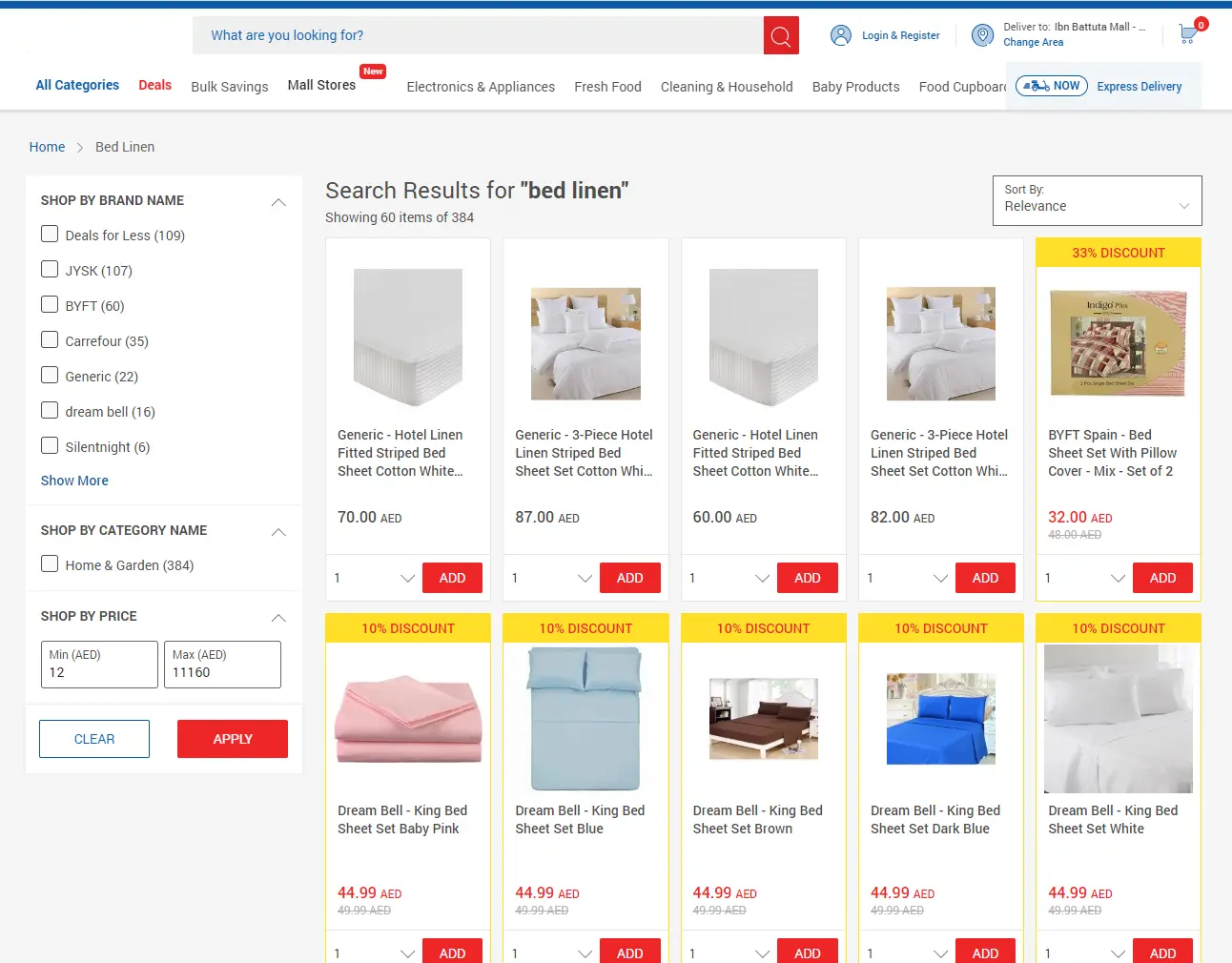
  4. Alternative words – Bed sheet or bed linen

  5. Plurals – Sunglasses or Shades
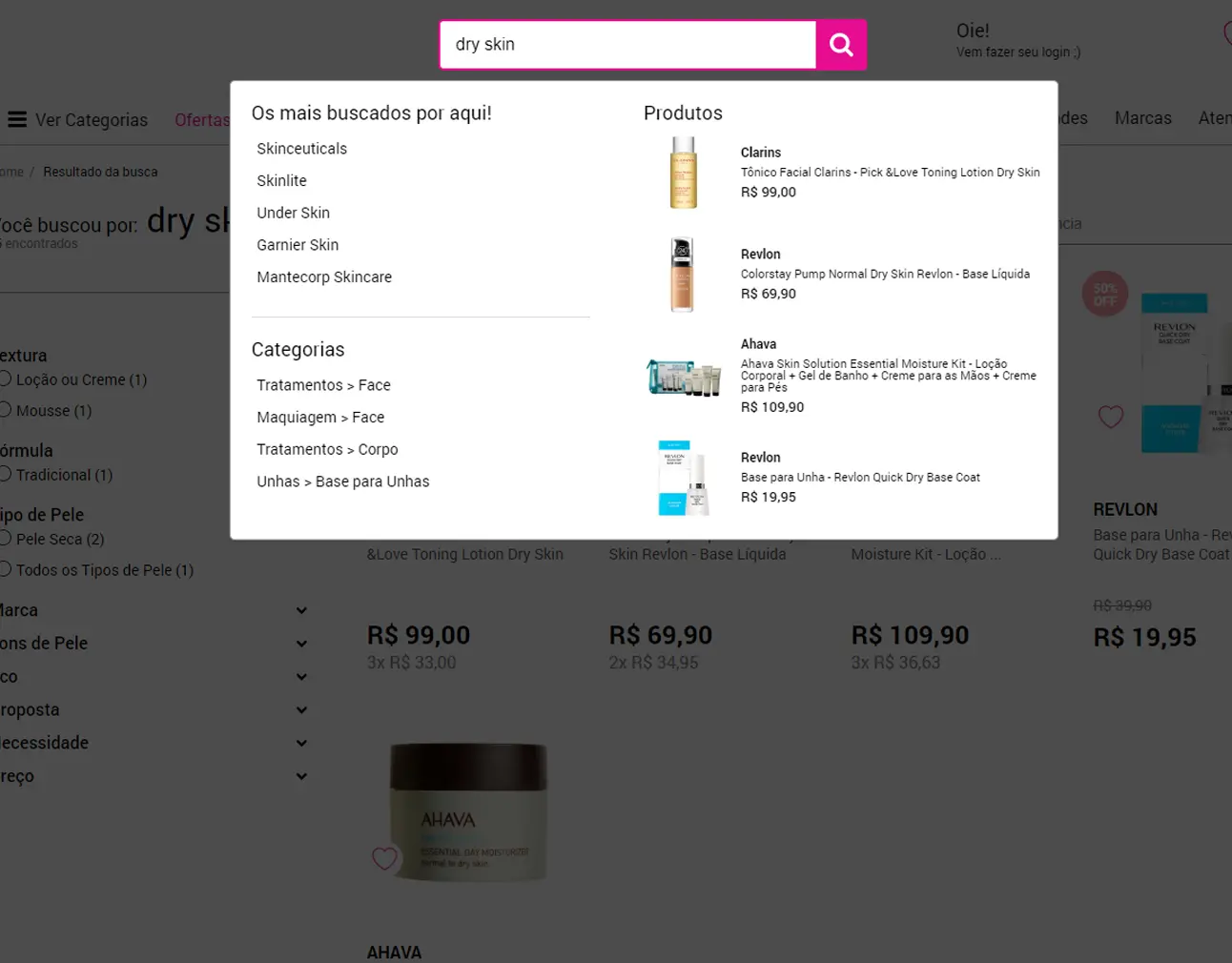
  6. Search terms based on a problem – ‘Dry skin’ instead of ‘body lotion’

    Are you able to home in on visitor intent?
  7. Shopper searches can reveal high intent signals. If you can pick them, you can dramatically improve the relevancy of your search results for the shopper and prevent ‘no results’ situations.

    Some terms are more important, e.g., 12″ sky blue sleeve (where 12″ is as important as the color of the product), ‘Organic’, ‘Gluten free’, etc.

  8. Your shoppers’ collective searches are revealing as well. They can help you determine associations between categories, products, and search terms. The best part is that algorithms that can self-learn can make these associations without you needing to write rules manually or change product data.

  9. A shopper’s affinity for custom attributes like style, pattern, size, color, or preference around brands and products can be understood not just from their current session but their history as well. Personalizing search based on this information can drive higher conversions.

    What are you doing to aid visitors to explore the most relevant products in your catalog?
  10. Sometimes, visitors are unsure as to what they want to purchase. This is your opportunity to guide, inspire, and even surprise them with meaningful yet interesting search results. This is what separates plain vanilla searches from personalized commerce searches.

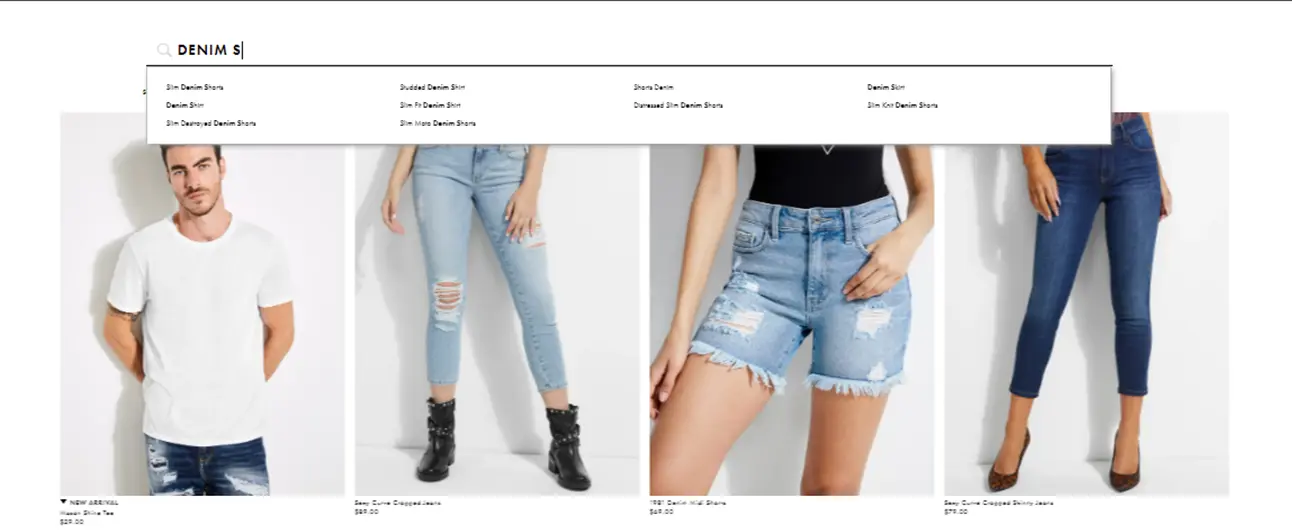
    As shoppers begin typing into the search box, you could predict what they may be looking for and provide some inspiration.

    Increasing search result relevancy with each keystroke makes for better experiences.

  11. When products need multiple dimensions for selection, contextual filters can help quickly narrow down results.

  12. With 70% of traffic coming from mobiles and the limited real estate that these devices afford, you need to be able to personalize commerce searches. You want users to find what they are looking for faster. And that means your search needs to be contextual and display the most relevant items at the top of the results. We use a metric called Findability to measure if shoppers are finding what they need.

In other words, commerce search must be simple, intuitive yet sophisticated. It must reduce the need for users to scroll or use filters, and thereby help them complete their journey quicker.

The commerce search box is the perfect ally for marketers and merchandisers in helping deliver the best experience and boost conversions without relinquishing control over aspects like stock counts, trade promos, and private label growth metrics.

Commerce search can be really potent for retailers if it’s personalized. So, how would you rate your commerce search based on these 12 points?

Learn how you can move from legacy, one-size-fits-all search to self-learning personalized search.

Experience Browser – Adding Intelligence to Web Personalization

Digital Experience Personalization
Blogs

Experience Browser – Adding Intelligence to Web Personalization

It is not just enough to know if personalization is working on your commerce site. Apart from displaying the right content or products to shoppers, you should also know why and how they are being shown. But do you?

As marketers aim to drive higher visitor engagement, delivering personalized customer experiences has always been a top priority. The more individualized the experience, the higher the engagement and better the conversions. By investing in artificial intelligence and machine learning for e-merchandising teams, companies want every website visitor to have their own unique experience, rather than defining a generic, one-size-fits-all experience.

AI solutions these days, rather most of them, are made for automation. They are not designed to build on existing capabilities and the accumulated intelligence internal to the business. There is also a definite lack of visibility into how they arrived at an outcome. Such ‘black box’ solutions are quite simple, and thus do not provide business controls, visibility, and extensibility, thereby limiting the companies from uncovering the best outcomes using AI.

Xen AI, through the Experience Browser, opens this “black box” and gives you visibility into how the system works, giving you unprecedented control over areas to improve and explore, test new possibilities, and deliver the best outcomes.

The Experience Browser: AI Transparency the Way You Always Wanted

Understanding why and how an optimal experience was selected for an individual is key to aid decision-making for business users. That is exactly what XB, or Experience Browser provides – a keen insight into how Xen AI is driving performance.

The XB UI sits on top of the customers’ websites and gives you actionable insights into how dynamic personalization experiences are being created. Traditional tools do not even come close to having such functionality.

An intuititve visual overlay enables business users to edit and audit AI decisions using a single click on aspects like unified customer profile, summary of recommendations, dynamic segments, rules involved, and strategy evaluation.

Picking Individuals From the Unified Customer Profile

All the interactions that any specific individual has had with your brand can be viewed through the XB. Since all the data does not include personally identifiable information, whatever analysis you conduct and insights you derive don’t step upon the privacy of your customers.

All searches, the different dynamic segments they belong to, declared and derived preferences and affinities, clicks, prior purchases, and standard geo-location data if shared are available at a single click.

For companies that run omnichannel businesses, matched real-time customer profile with offline and store purchases can be depicted by the XB.

Understand the Strategies Used to Drive Decisions on Every Placement

Multiple areas in any website can be personalized. These areas include, but not limited to, product placements, content personalization platform, search overlays, and promotional offers. Through the XB, one can easily understand why and how the decisions were taken by the Experience Optimizer, the heart of the Xen AI engine.

In short, multiple strategies are measured against one another in a competitive match by the Experience Optimizer and the best one is chosen as per the context in real-time. After applying the merchandising rules, the one-to-one personalization experience is determined for every customer.

Along with the strategies picked by the Experience Optimizer and the rule selection, the Experience Browser also shows the reason behind that particular selection and a progressively filtered result set.

Real-time Trends on the Website

At any given point in time, you can use the Experience Browser to view the product trends as they happen, in real-time, including views, clicks, and purchases on the website. Holiday or seasonal sales preparedness can benefit greatly from this.

In terms of products viewed but not purchased, the insight gained can help merchandising teams determine boost versus bury rules.

Deep Links to Experience Insights

The presentation of real time customer data profiles reporting and multi-dimensional analytics provided by the XB nicely complements the ADA Global dashboard. Easily accessible reports for sales attribution, slice-and-dice by segments, cohorts and more across key metrics – attributable sales, revenue per visitor, session, etc. are just a sample of the insights that you can derive from the XB.

Content Performance Rankings And More

Visualizing dynamic content personalization performance at a glance is really handy. This is also made possible by XB. Drilling down to details like which pieces are being used where and how much is the performance affected by any kind of placement change. In a few clicks, you can determine engagement as well as conversion through the XB. Understanding how much revenue flowed in due to a creative asset is a unique capability offered by the XB.

Experience Browser Is Imperative for Your Holiday Readiness Plan

Having visibility across your strategies and their efficiency in driving personalized product recommendations is key to generating more conversions. That is exactly what the XB helps you achieve. Club that with your holiday readiness initiatives and you have a recipe for success.

More Reading:

Check out our Guide to Omnichannel Personalization to learn how to integrate your online and offline channels and deliver a unified experience to consumers.

9 Best Practices in Demand Forecasting for Grocery Retailers

Merchandising and Supply Chain
Blogs

9 Best Practices in Demand Forecasting for Grocery Retailers

Download this article as a PDF

Grocery retail supply chains are getting more complex and unmanageable with traditional forecasting models. Matching supply with demand for a broad inventory that includes fresh and short shelf-life products on one end and ambient products on the other is not easy. Add to that the complexity that arises due to changing consumer behavior, who have started to incline towards convenience and price over brand loyalty. Yet traditional demand forecasting is still heavily reliant on constant monitoring and intervention from a supply chain expert.

Accurate and agile demand forecasting lies at the center of grocery retail’s customer-centric yet lean approach. Doing forecasting right has far-reaching benefits:

  • You reduce your wastage by better inventory demand prediction planning
  • Your displays look attractive and dynamic
  • Customers get fresher goods
  • You sell more by placing your product at the right place at the right time across channels

So, let’s look at nine secrets to improve your demand forecasting and take it to the next level.

Account for Dynamic Demand Forces With Multivariate Forecasting

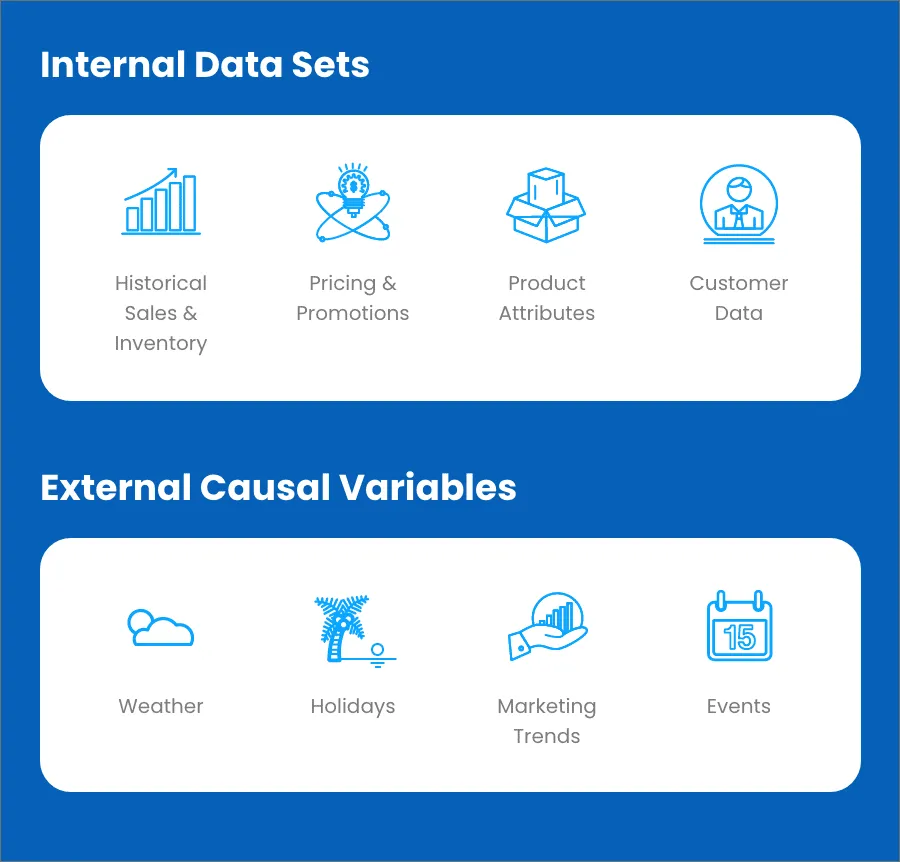
With price sensitivity and convenience changing the way consumers shop, the demand for products has become much more volatile and difficult to predict with simple models. It has therefore become imperative for grocers to enrich data and not simply rely on traditional data. For accurate forecasting, it’s crucial to account for external factors such as weather, holidays, events, social media, and news as well as internal factors such as promotions, advertising, visual merchandising, etc.

Let ML Do the Heavy-lifting and Help You Decide What Factors are the Most Important

With a huge range of internal and external causal variables affecting sales, every store, channel, and category combination behaves differently. One of the biggest mistakes that grocers make is to force-fit models without understanding the nuances that are at play.

In a multivariate framework, it is very difficult and cumbersome to determine the importance of each factor manually. ML algorithms, however, can help to sift through data and determine the effect of each factor. This can then feed in as an input for the planner to generate granular and accurate forecasts.

Go the Extra Mile on Forecast Accuracy With an Ensemble of Algorithms

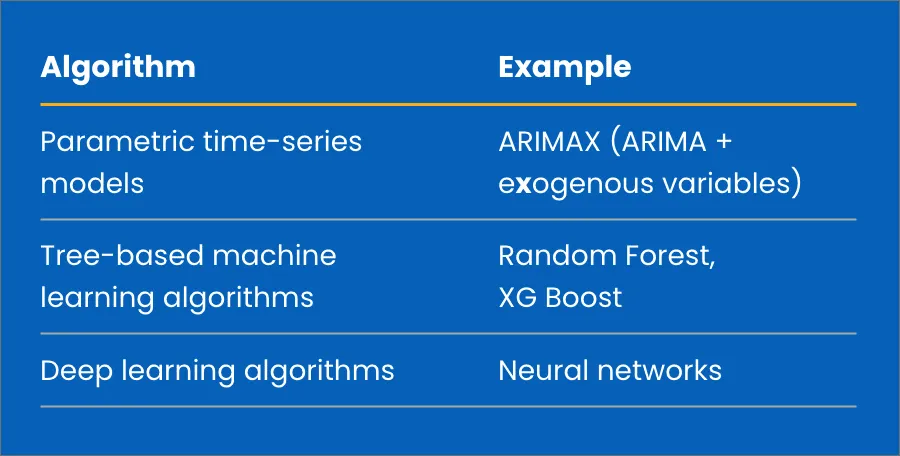
While forecasting sales of products, there is a slim chance that you will find a silver bullet algorithm that works for all products, locations, and situations. Therefore, champion grocers go the extra mile with an ensemble of algorithms that is customized based on the data. This ensures that grocers avoid over-fitting of models across product lines and achieve greater overall accuracy.

Adopt a Dynamic Approach to Fresh and Ambient Products With Business Objectives as Priority

From fresh goods wholesalers to grocery retailers, from high-end to price-driven supermarkets, convenience stores to cash-and-carry chains, it is clear that replenishment optimization teams walk a tightrope between spoilage costs and shelf presentation. This makes it important to get the balance right every time.

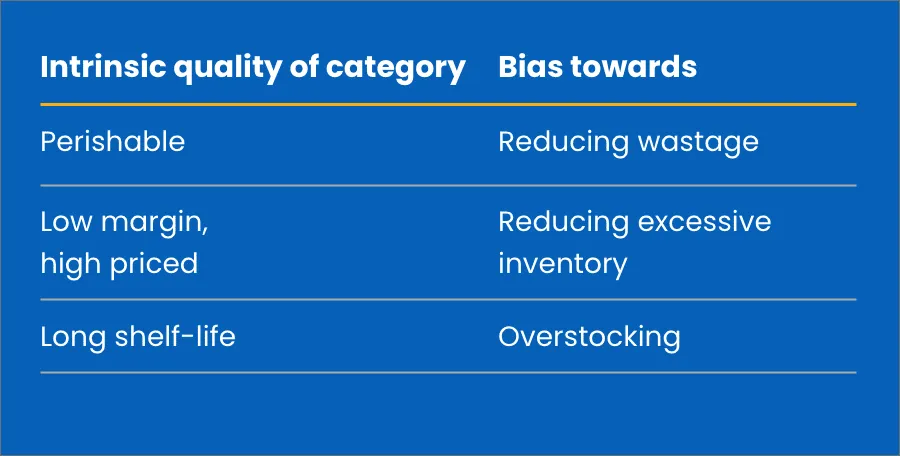
Error functions such as RMSE and MAD are powerful tools that can be used to select the best model by analyzing the prediction error. Such methods are indifferent to over-forecasting and under-forecasting. However, depending on where the product lies in the fresh to ambient spectrum, these functions can be tuned to treat over-forecasting and under-forecasting differently based on the business requirement and impact.

Tie Your Forecasting to Outcomes

What should be your forecasting accuracy? Should it be above 95%? Or 99%? The correct answer to this question is not so simple.

Most forecasting techniques aim to achieve the highest accuracy levels, giving very low importance to business outcomes. Tying your forecasting to outcomes such as reducing wastage, overstocking, or increasing availability has helped several leading retailers achieve great success even with forecasting accuracy as low as 70%.

Pro-actively Adapt to In-store Scenarios

While managing stocks at grocery stores, it is critically important for store managers to respond to what is happening on the shelf. For instance, a new product launch could lead to secondary effects on the demand for other products, which could range from an overstock situation in case of cannibalization to understock in case of multi-buy discounts. For true agile operations, business users should be able to swiftly identify and plan for such situations on a daily basis without the need of technical support.

Events that cause a secondary effect on other products:

  • Multi-buy discounts
  • Price change
  • Promotions
  • Advertising
  • Change in in-store display
  • Product launches and discontinuation
  • Macro-level scenarios such as weather, local events

Don’t Discount the Cannibalization Effect

The effect of promotions of products via price discounts, advertisements, display changes, etc. on the supply chain is one of the least studied topics but has huge implications. For example, the promotion of one product may have significant effects on the sales of other products that are not in promotion. Not accounting for this effect leads to suboptimal retail inventory optimization solution and ill effects like increase in spoilage or overstock. Promotion forecasts can go a long way to satisfy the increase in demand while mitigating the ill effects.

Sparse and Noisy Data Is the Norm, Not an Exception

With increased new product launches, fresh products, and increasingly complex channels, sparse and noisy data is a recurring theme across grocers worldwide. If you regularly face the roadblock of not having enough quality data for your planning needs, then it is time to look for a solution. Invest in a forecasting framework that uses data science techniques to deal with sparse and noisy data with ease.

Scalability Is Not Optional Anymore

Irrespective of you taking a top-down or a bottom-up approach to your demand planning, you will eventually have millions of demand forecasts at the SKU-store level. This planning is getting even more unmanageable due to changing consumer behavior and channel factors. Therefore, top grocers realize the importance of making sure that the system is scale-ready, both from a technical and user experience point of view.

In the ever-evolving, dynamic, and volatile grocery retail, your demand sensing and forecasting framework needs to be intelligent, agile, and scalable to be able to deal with the above-mentioned challenges. One such solution is ADA Global’s Forecast Right.

Forecast Right uses proprietary ML-based multivariate and algorithmic techniques to accurately and adaptively forecast demand. It is 100X faster and scalable than traditional forecasting solutions – 5-clicks is all it takes to generate 1000s of granular forecasts. Its proprietary AI provides tailor made feature engineering and model selection for demand forecasting and has a track record of improving forecast accuracy for over 90% of SKUs.

The output of a solution like Forecast Right can be plugged into various use cases. One such use case is replenishment planning solutions. Powered by Forecast Right, ADA Global’s Order Right generates accurate SKU-level order plans for even the most challenging categories – from fresh and seasonal to new and promoted products with ease. It does so by leveraging proprietary optimization algorithms that constantly monitor stock balance, sales and demand predictions while accounting for constraints such as shelf-life, lead-time, expiration date, minimum order quantity, minimum display stock, and automatic store replenishment constraints.

Also read: How Machine Learning Improves Retail Demand

Learn more about ADA Global’s Forecast Right and Order Right.

Table Of Contents
Account for Dynamic Demand Forces With Multivariate Forecasting
Let ML Do the Heavy-lifting and Help You Decide What Factors are the Most Important
Go the Extra Mile on Forecast Accuracy With an Ensemble of Algorithms
Adopt a Dynamic Approach to Fresh and Ambient Products With Business Objectives as Priority
Tie Your Forecasting to Outcomes
Pro-actively Adapt to In-store Scenarios
Don’t Discount the Cannibalization Effect
Sparse and Noisy Data Is the Norm, Not an Exception
Scalability Is Not Optional Anymore

How Algorithmic Testing Is Changing Marketers’ Experiments

Digital Experience Personalization
Blogs

How Algorithmic Testing Is Changing Marketers’ Experiments

The world of marketing has become way more defined and data-driven than it used to be. Multivariate tests and A/B tests, analytics, statistical significance, allocation of traffic, tweaking variables, refreshing, optimizing, and repeating – are now an integral part of every marketer’s life.

Clearly, testing has a huge bearing on the performance of campaigns and is the difference between running an optimized campaign versus a poor-performing one. Testing tools providers have built entire product lines around these, and you will find that they are constantly urging marketers to “test everything” and rightly so.

The world of retail is now too complex to tackle with manual testing. Manually tackling different flows of data for every individual is obviously not feasible. Adding more people to the testing team isn’t the answer. At the end of the day, the volume of data is too large and the value-add may be sub-optimal.

This begs the question: How can your business then provide tailored shopping experiences to customers without having to create discrete experiences manually for segments?

ADA Global steps in here with a range of native testing tools built specifically to address such concerns. These include traditional A/B and MVT tests, but in addition also have full-fledged continuous algorithmic testing and optimization.


What Is Algorithmic Testing?

Taking A/B testing and experimentation a notch or two higher, algorithmic testing uses data science with a continuous, always-on testing environment for improving conversions on the go.

It’s a critical need if your customer journey culminates with a purchase and you want to test conversions, especially on cart pages.


What Is Different About Algorithmic Testing?

As opposed to manual testing, algorithmic testing allows one to continuously test every variable, i.e., every digital transaction, while focusing on revenue conversion and at the same time, self-optimize to achieve the desired result via AI/machine learning, adapting at scale for every individual.

Algorithmic testing is one of the foundation stones of hyper-personalization.


How Algorithmic Testing Works

This works in two stages via an AI decisioning engine, known as the Experience Optimizer that is unique to ADA Global. While considering the context, the Experience Optimizer tests and picks the best experience for every individual automatically.

One can choose from over 150 strategies that have been tried, tested, and refined over time with outcomes specific to retail. ADA Global’s Xen AI consists of these strategies, and they are built using an ensemble of algorithms – including statistical, machine learning, and deep learning ones, like natural language processing or NLP.

In real-time, multiple strategies are tested against each other by the Experience Optimizer to determine the winner for any interaction. While doing that, it considers metrics like RPS, RPV, and CTR. It also tries out new content or other viable recommendation strategies that are relevant to each customer or visitor.

In its exploration mode, which is completely customizable by the business, the Experience Optimizer makes sure that results never hit any kind of ceiling, and continue to propagate over time.

New content or strategies can also be added into the mix by clients, and the Experience Optimizer can choose when they could be used given a situation.

ADA Global’s native A/B and MVT tools can be used by marketers to test out specific content, placements, strategies, rules, and even the merchandising of category and browse pages. These tests can then be targeted and accordingly, traffic can be allocated towards specific segments or all visitors. As opposed to traditional A/B testing tools, algorithmic tests treat each visitor uniquely.

Testing of strategies; optimization of metrics for different areas of the funnel; and testing of other configuration changes, campaigns, or promotions can also be done by clients.

The insights dashboard can be used to monitor results, or clients can even use the Experience Browser for the same. Results across multiple metrics are automatically shown, even if those metrics are not included by the user in their test. A variety of filters, including, but not limited to segments can be used to view the results. Outlier filtering can be used to measure the impact of outliers.

As the future of experimentation, algorithmic testing will operate alongside your regular A/B testing tools. It’s not like one can replace the other.

Learn about all the ways we can help your business drive hyper-personalized marketing at scale.

Content Personalization: ‘Experience Designer’ for eCommerce

Digital Experience Personalization
Blogs

Content Personalization: ‘Experience Designer’ for eCommerce

Creating content can be a daunting task, even for digital marketing organizations. The sheer number of variations you need to curate in order to target specific segments of customers in a data-driven manner makes the whole exercise quite cumbersome. Well, help is at hand – we are talking about Experience Designer to help you kickstart personalization of your content.

If you’re familiar with our personalization engine, you may be aware of the Experience Browser (XB), which is pioneering transparency in AI decisioning. Working with XB, the Experience Designer leverages Xen AI engine in order to identify the appropriate targets automatically and subsequently uses your existing content to create relevant campaigns.

Without the hassle of carrying out full tests, marketers can iterate and therefore distribute real data to the ones who are actually delivering the experience. This acts like a bridge between the marketing and commerce teams. Let’s dig a bit deeper into how this works.

Auto-discovery of Behavioral Segments

Segment creation is the most important aspect when it comes to targeting customers and creating personalized content. Since digital commerce is quite complex and volatile, extracting actionable and timely insights from data becomes a challenge. Let alone the time spent on it, even your entire analytics budget could be spent, and you would still not be able to fulfill your objectives. Auto-discovery of behavioral segments is a new feature that we have added to eliminate manual effort in the process of segment creation.

Through this feature of auto-discovery, Xen AI-driven machine learning algorithms replace costly and inefficient manual analytics to find new and more interesting behavioral segments, while also providing a web-based visual tool for reviewing and acting upon the insights generated.

Using this feature, you can easily discover segments based on any kind of filter, be it brand, category, or product. Furthermore, once identified, it becomes all the more easier to target said segments with highly personalized cross-sell campaigns and offers. For example, you can discover customers that convert but with low spends.

So, how does this auto-discovery work?

Using metrics like conversion rate, average order value, revenue per visitor, and the like, auto-discovery can cluster audiences together. After that, such clusters are filtered. Clusters are excluded if they have less than 10 percent of the overall paying audience. Also excluded are the clusters that have less than 5 percent (minor) positive or negative metrics variation when compared with the average audience metrics.

Assuming average conversion metrics, the remaining clusters are used to calculate the potential revenue as additional revenue.

Benefits of the Experience Designer

If you have used XB, you will find the Experience Designer to be quite familiar. It is a similar web-based tool that sits atop the web page on your browser, like an overlay, or a HUD, if you can relate to FPS games.

The Experience Designer can help marketers create, execute, and edit content-based placements and campaigns directly from the live web page, without needing to navigate to another tool or requiring the intervention of the IT team.

For marketers who wish to test, modify, or launch campaigns on the go, this tool can be a boon. Apart from giving the freedom to create campaigns fast, this tool also helps marketers realize the complete potency of the content in their libraries.

Once the segments are defined through auto-discovery, segment builder, or via the segment import tool for externally created ones, you would need to define the campaign/s for these audiences.

Now that you know what sort of fine-tuning you can achieve with audiences, you will be pleased to learn that the same kind of intuitiveness is also offered when designing a campaign. You can drill down to narrower targeting via metrics that were earlier just an unusable tag. Campaign design is rather effortless, with filters that allow for more specific control on the segment including subsets of monthly new or returning visitors, abandoned carts, infrequent loyalty members, etc.

After that, you would need to choose the content that is applicable from your existing library. This is then used by the Xen AI engine to continuously work towards optimizing for conversion or click-through goals.

Last but not the least, you choose where the placement would be on the website. All it takes are a few clicks – no coding required. There is an approval process that needs to be followed though, so your experiments are not pushed to production by an erring click.

And that’s all there is to it!

The Experience Designer helps bring in commerce data to understand conversions from content, and that is where digital marketers benefit the most. Why choose from among content and commerce when you can have the cake and eat it too?

Learn more on how ADA Global can help you strengthen your content personalization strategy.

Table Of Contents
Auto-discovery of Behavioral Segments
Benefits of the Experience Designer