

Holiday Email Marketing: Drive Engagement with Real-Time Content

The frenzy of holiday and festive shopping: wish lists across multiple websites, gift boards and saved discount codes. While shopping is all fun, getting holiday-special newsletters, promotions, and discount deals in your inbox, not so much…
There’s a short window to take advantage of festive season marketing. But static campaigns and one-size-fits-all marketing aren’t enough to keep up with a market moving at lightning pace.
When prices change by the hour and bestsellers sell out by the afternoon, the offer you built for the customer is wrong by the time a customer opens it. Brands that win are the ones that plan, personalize, and measure festive campaigns that stay accurate from send to open.
Here’s how to do it.
TL;DR: Holiday Email Marketing
Festive season marketing wins on relevance, not volume. Therefore, businesses must plan around clear goals and real-time segments, coordinate email, WhatsApp, social, and web, and personalize offers for each customer. Read how behavior-triggered automation brings back abandoned carts and lapsed buyers, and how email content that updates at the moment of open keeps prices, stock, and countdowns accurate. Explore AI solutions that help businesses understand intent and adjust campaigns in flight, measure incremental revenue, and turn seasonal buyers into year-round customers.
What Are Festive Marketing Campaigns?
Festive marketing campaigns are promotions built upon the buying peaks around holidays such as Christmas, Lunar New Year, Ramadan, Diwali, Black Friday, and marketplace events like 11.11 and 12.12.
Holiday email campaigns combine offers, creatives, and messaging to capture demand that spikes for a few weeks, then subsides.
Compression is the key factor that separates these campaigns from regular ones. Customers buy more, compare more, and decide faster. Gift buyers shop outside their usual categories and price ranges. With inventory and pricing shifting daily or even hourly, a campaign that fails to work along these dynamics sends the right message at the wrong moment, leading to missed revenue opportunities.
Why Personalization Matters in Festive Marketing
Festive season marketing clashes across brands and products as every brand lands in the inbox at once. Hence, generic and mass targeting blasts disappear into that noise, and only relevant messages get customer attention.
During festive or holiday shopping customer intent changes fast. So, the customer who was browsing for winter jackets last week may be shopping for a beach vacation outfit this week , or something else for their niece or pet the next week. Therefore, showing up in the inbox with a wrong or irrelevant offer such as a sold-out product, or an expired discount erodes customer trust at the exact moment customers are deciding where to spend.
Further, festive buyers include many new and lapsed customers, and learning about them and their buying preferences as quickly as possible gives you an edge over your competition. Tailoring the holiday email marketing to those details paves the way for customer loyalty and trust.
This is precisely why personalization matters more in this window.
Before we move ahead and dive deeper into personalization, it is important to note that effective festive personalization goes well past a first name in the subject line.
It is about showing each customer the offer, product, and message that fits them at that moment. That means drawing on what they have searched for, browsed, bought, and abandoned, the brands and categories they prefer, whether they are new or returning, where they live, and which channel they use, then matching it against what is in stock and on offer right now.
Let’s find out how you can plan a successful festive marketing campaign.
How to Plan a Successful Festive Marketing Campaign
Planning a successful festive season marketing campaign involves careful pre-launch planning and real-time optimization, so the message stays relevant to each customer.
Across all kinds of holiday or festive campaign planning, three core decisions are crucial for overall success.
#1 Define Campaign Goals and Target Audiences
Set one primary goal per campaign: new customer acquisition, higher average order value, clearance of seasonal stock, or reactivation of lapsed buyers. These goals should align with a specific set of parameters relevant to the specific audience.
Getting your audience segmentation right is also critical. Who are you targeting via the campaign – gift shoppers, loyal regulars, deal hunters, or one-time holiday buyers?
Each one of these segments needs different offers and different timing. ADA’s audience segmentation product Audience Manager, lets marketers build their own segments, use ready-made AI segments, or combine the two. It then shares those segments with your marketing platforms and channels, so the audience you define once is the audience every channel targets.
#2 Build Customer Segments Using Real-Time Data
Never build festive season marketing segments from last quarter’s data as the audience pool will be stale by launch day. A real-time retail CDP unifies online, in-store, app, and marketplace signals into one profile that updates as customers browse and buy.
Audience Manager also adds predictive scores, such as each customer’s likelihood to purchase, likelihood to churn, and lifetime value. The result is segments that shift with behavior, so a customer who just bought a gift leaves the “still shopping audience” before your next send.
#3 Align Channels, Offers, and Campaign Timing
Next, map the holiday or festive season into clear phases tied to the demand curve, purchase peaks, and times, such as teaser, early access, peak, last shipping date, and post-holiday.
Brainstorm to decide and finalize the channels for each phase, and tie them in a sequence for a drip sequence. Figure out which offer belongs where, so customers never see a bigger discount on WhatsApp than the one in their inbox.
Advanced solutions like Omnichannel Marketing enable retailers to run the holiday email marketing calendars from one place, sequencing messages by phase and suppressing customers who have already converted. With consistent offers, retailers can protect their margins and customer attention with coordinated timing.
Next, we outline some of the best festive season marketing campaign strategies.
Festive Marketing Campaign Strategies That Drive Conversions
#1 Personalize Festive Offers and Product Recommendations
A festive season gifting guide email showing the same 20 products to every shopper is just a smaller catalog, not a recommendation. Hence, if you want to deliver personalized festive offers and recommendations that increase average order value, steering clear of generic and mass-targeting campaigns is important. Personalizing manually on this scale is impossible.
ADA’s product recommendation engine, Recommend™, uses browsing, purchase, and contextual signals to recommend additional products for each customer across email, web, and app. This translates into recommendations featuring gift-appropriate items for someone buying for others, complementary products for repeat buyers, and in-stock alternatives when a bestseller sells out.
During peak season, teams can also set rules for margin, stock, and brand without coding, so the products in festive emails and on your website don’t push sold-out or low-margin items.

#2 Connect Email, WhatsApp, Social, and Web Campaigns
Even if you’ve got the attention of the customers with the right recommendations over email, there may be instances when it doesn’t close the sale.
For instance, a customer sees an Instagram ad, opens a promotional email, gets a reminder on WhatsApp, and checks out on the website.
It is important to treat all these switches as one journey, not four campaigns, with one customer profile and one offer logic across channels.
This includes intent. When a shopper starts a gift search on your website, the next email should continue it instead of starting over.
ADA’s open time content personalization tool, Active Content, keeps that experience consistent across messaging channels. You design the content once, and every email, WhatsApp, SMS, RCS, and app message you send pulls the same products, prices, and offers at the moment it’s opened. Each channel stays up to date.
Across Southeast Asia, where messaging apps are a primary shopping channel, WhatsApp frequently closes what email opened.
#3 Automate Abandoned Cart and Re-Engagement Campaigns
Holiday season marketing strategy should also plan for abandoned carts or re-engagement campaigns. During festive shopping, buyers compare prices and stores, so carts get left behind.
Behavior-triggered marketing responds to what a customer just did, not what the calendar says. Setting triggers for abandoned carts, browsed-but-not-bought products, price drops on viewed items, and back-in-stock alerts.
Active Content then fills those emails with fresh recommendations at the moment of open, so each reminder shows what is still in stock at today’s price.
ADA’s Social Proof Optimize can add real popularity or low-stock cues to the recommended products in the email, shown only when the live data backs them up.
For lapsed customers, make the season the reason to return, with a time-bound offer tied to what they bought before. It is important to note that timing matters: a reminder within hours beats a generic newsletter days later.
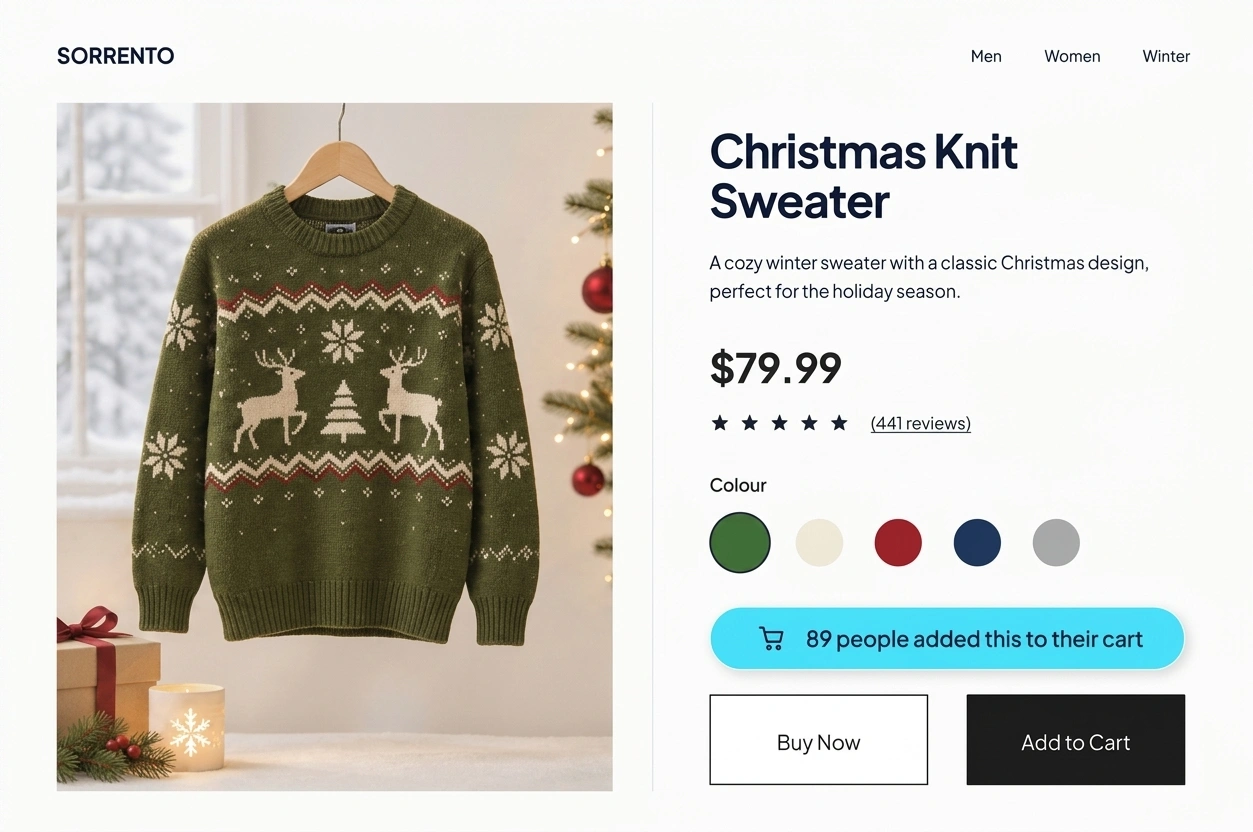
#4 Deliver Real-Time Festive Content and Promotions
Adapting to demand, purchase trajectories, and customer behavior in real-time is critical during holiday season. Festive content needs to update in real time, because holiday emails are built days before they land.
In between, prices change, stock runs out, and countdowns expire. Active Content enables email content personalization that renders at the moment of open.
With Active Content, retailers can ensure that each creative pulls live pricing, inventory, recommendations, and countdown timers, and can combine customer data, offers, and loyalty details from several sources, then assembles a one-to-one version for every recipient.
So, you just have to design it once, and the same block personalizes across email, WhatsApp, SMS, RCS, and app notifications.
How AI Is Transforming Festive Marketing Campaigns
AI moves festive marketing from scheduled to responsive. Instead of locking every send in advance, brands can utilize festive season marketing models to read live signals and act on them as the season unfolds.
Here’s how AI transforms the campaigns.
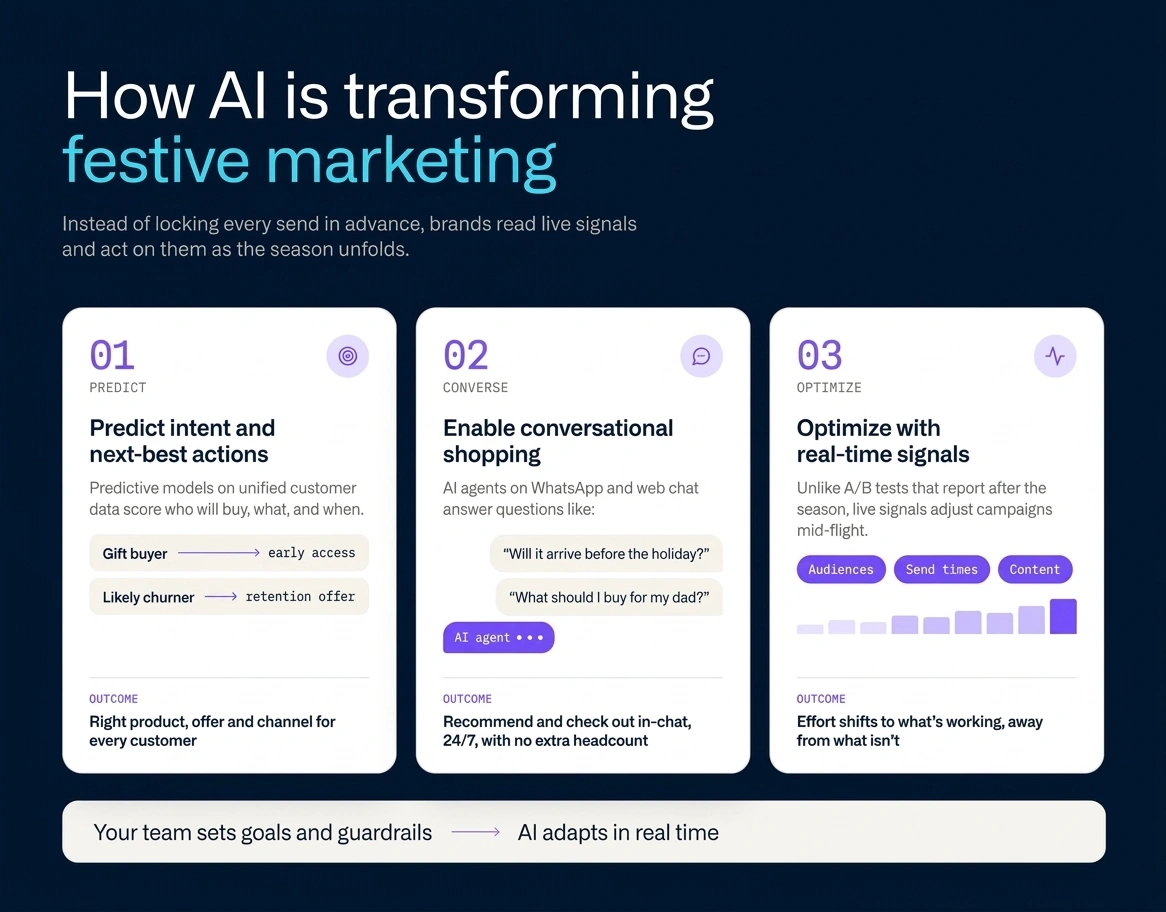
#1 Predict Customer Intent and Next-Best Actions
Predictive models built on unified customer data score who is likely to buy and who is likely to churn. Those scores drive next-best actions: the right product, offer, or channel for each customer at each moment.
Hence, a high-propensity gift buyer gets early access, and a likely churner gets a retention offer before they drift away to the competition.
#2 Enable Conversational Shopping with AI Agents
Increasingly, customers are doing their shopping in chat. They interact with chat bots and live agents, and ask questions, like – Will it arrive before the holiday? Does it come in another size? What should I buy for my dad?
ADA’s Conversational AI can answer these questions on the channels customers already use, such as WhatsApp and web chat. They recommend products and guide customers to checkout inside the conversation, at any hour, without adding seasonal headcount.
#3 Optimize Campaigns with Real-Time Customer Signals
Traditional A/B tests that report after the season ends are too late to matter. Live signals let you adjust while the campaign runs instead. Recommend™ automatically tests recommendation strategies and scales the best performer, and Social Proof Optimize continuously ranks its messages against the KPI you choose, such as revenue per visit or conversion.
Hence, your team sets goals and guardrails, while the system makes adjustments in real-time, without losing the customer to delayed attention or competition.
Festive Marketing Campaign Ideas Across Industries
While the holiday season stays the same, the festive season marketing playbook changes by industry.
- Retail and eCommerce: Send gift guides that update with the available stock at open, last-shipping-date countdowns, and personalized bundles built from each customer’s browsing history.
- Consumer Goods: Examples include marketplace campaigns timed to 11.11 and 12.12, personalized offers for loyal buyers, and festive packs that complement general-trade sell-out.
- Financial Services: Consider pre-approved festive spending offers, travel insurance ahead of year-end trips, and card rewards tied to seasonal categories, all inside compliant journeys.
- Telecommunications: Try roaming packs before holiday travel, family data bundles, and device upgrade offers timed to gift season.
- Healthcare: Try triggers like for prescription refill reminders before clinic closures, new-year wellness packages, and appointment scheduling around holiday hours.
How to Measure Festive Marketing Campaign Performance
Measuring the festive season marketing campaign performance is tricky because festive results look good by default. Demand naturally rises for everyone across all categories and measuring what your campaign added, and not what the season delivered, becomes difficult.
Here are some metrics that retailers can track to measure campaign performance.
- Track engagement (open, click-through, and click-to-open rates) by segment and channel.
- Judge success on conversion rate, revenue per visitor, average order value, and incremental revenue against a holdout group.
- Watch unsubscribe and complaint rates too: festive volume can erode list health that took all year to build. Then keep measuring after the season. The share of festive buyers who purchase again within 90 days tells you whether the campaign built a customer base or rented one.
Next, we discuss how to turn holiday email marketing into a long-term strategy instead of seasonal activity.
Turn Festive Campaign Engagement into Long-Term Customer Loyalty
The festive season brings in customers you didn’t have during the rest of the year,; right? So, keeping them is where real revenue lies.
Keep festive-acquired customers in the loop, so their post-season journey differs from your regulars. This can be done in many ways, such as sending a thank-you that isn’t a sales pitch, then following up with recommendations based on what they bought, and not what you need to clear.
You can also try inviting them into your loyalty program while the purchase is fresh. Use the preference data the season generated (channels, categories, price points) to personalize January instead of reverting to generic sends. A gift buyer may never return, but a self-purchaser who found you through a festive offer can become a regular.
How ADA Global Powers Intelligent Festive Marketing Campaigns
During peak season, most retailers run recommendations, on-site content, social proof, and email as separate tools. Each makes its own decision, so the offer in the inbox often doesn’t match what the shopper saw on the site.
ADA’s personalization suite reads each shopper’s intent once and uses it at every step. Audience Manager builds the festive segments. Recommend™ picks in-stock products for each shopper from what they searched for and browsed on your website, and Social Proof Optimize adds real popularity or low-stock cues where the data supports them. Active Content then carries those picks and cues into email and WhatsApp at the moment of open, so the inbox continues what the shopper started on site. ADA’s Conversational AI extends the same experience into chat.
Active Content also plugs into your existing data sources and email service provider, so there is no platform switch mid-season.
Read how Bergfreunde cut campaign prep time by 75% across 12 European markets with it.
Conclusion
Festive season marketing rewards the brands that stay accurate under pressure. Plan around clear goals and live segments, coordinate every channel, and let behavior trigger the next message. Above all, stop sending holiday email campaigns that are out of date by the time they’re opened.
Always remember, real-time content keeps every price, product, and countdown current at the moment that counts.
Take the next step toward optimizing your festive season marketing campaigns. Talk to our experts at ADA today!
Frequently Asked Questions About Holiday Email Marketing
What are the most effective festive marketing strategies?
The most effective festive strategies combine real-time segmentation, personalized offers and product recommendations, consistent messaging across email, WhatsApp, social, and web, and behavior-triggered follow up for abandoned carts and lapsed buyers. Open-time content keeps prices, stock, and countdowns accurate, so customers never see an offer that no longer exists.
How can AI improve festive marketing campaigns?
AI predicts which customers are likely to buy, what they want, and when to reach them. It selects products for each customer, powers conversational agents that answer questions and guide checkout, and adjusts audiences, timing, and content mid-campaign based on live engagement and conversion signals.
Which channels work best for festive marketing?
Email remains the backbone for offers and gift guides. WhatsApp and other messaging apps drive conversation and fast conversion, especially across Asia. Social builds awareness and discovery, and the website closes the sale. The strongest results come from coordinating all four around one customer profile.
How do brands measure festive campaign ROI?
Compare revenue from campaign recipients against a holdout group that received nothing, then subtract campaign costs, including discounts. Track revenue per recipient, average order value, and conversion by channel. Extend measurement past the season: repeat purchases within 90 days show whether festive spend built lasting value.
