
Is Your Personalization Engine Ignoring New Products Without Behavioral Data?

Digital Experience Personalization
Blogs

Is Your Personalization Engine Ignoring New Products Without Behavioral Data?

As an eCommerce brand, many of the items in your inventory might be the kind that fly off the virtual shelves in minutes and have to be constantly replenished. There might also be some products that remain undiscovered by users for several reasons, such as the product is new, niche, or seasonal. For such cases, users need a little help with their product discovery optimization.

New products most likely get ignored by your personalization engine. This is because personalization platforms typically start recommending a product only after it has gathered enough behavioral data around it, such as pageviews, click-throughs, add-to-carts, purchases, etc.

Without such behavioral data, these new or seasonal products remain buried on your site. This scenario also applies to long-tail products—items that are niche, have limited stock, or are not commonly searched for or bought by customers.

The traditional approach is to manually add merchandising rules to boost them to the top of search results pages, category pages, or homepage. However, this approach isn’t scalable.


Why Rule-based Inventory Visibility Isn’t Ideal

If you’re using merchandising rules to promote visibility for new products, some of the problems you’ll have to contend with are:

  1. If you have a site where new SKUs are constantly being added, manual updating is a tedious task.
  2. Time is of the essence for certain products that are seasonal or holiday based. This means your teams will not get enough time to manually create rules for every single new product on the site.
  3. You also have to remember to turn off the rules when the products start appearing in search results organically or when the season for those products is over.
  4. The boosted products could show up in irrelevant search queries. Worse, they could inundate a page and bury the relevant results. Both these scenarios will frustrate at least two out of your five customers and drive them away from your brand.

Altogether, the manual merchandising rules approach puts pressure on your resources and wastes time and money that can be used more productively elsewhere. So, replace this manual and tedious job with an AI-powered personalization engine.


How NLP Improves Visibility for New and Long-tail Products

Natural Language Processing (NLP) is a deep learning algorithm that processes text data to understand the meaning of the words as a human would, instead of employing the old-fashioned keyword-matching technique.

In the context of personalization, NLPs read through texts related to the product, such as descriptions and customer reviews, extracts associated attributes and text vectors, and forms associations between products based on feature complements and semantic similarity.

Here’s an example. Say a home décor store has added 300 new Christmas-related products to their inventory. They switch on the NLP strategies on their AI-powered personalization platform, and the platform analyzes text data about these products in a matter of minutes. See the adjacent image for an example of how text is analyzed and word associations are formed.

Though these products do not contain the obvious word “Christmas”, NLP associates words such as red, green, holiday, snowy, festive, merry, Xmas, Santa Claus, secret Santa, chocolate, gift, and desserts with the holiday.
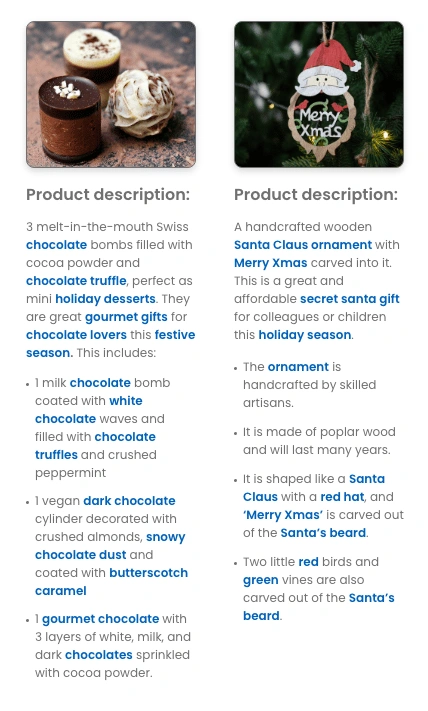
An example of how NLP processes text to develop word associations to find and recommend products.
So, the products shown above will also surface in results for a variety of search queries, such as Christmas gifts, Christmas décor, holiday gifts, holiday décor, and festive décor.

And once they become visible and users interact with the product, the platform has the behavioral data necessary to organically recommend them, which means that NLP also becomes a “trainer” for other personalization strategies.

In addition, NLP can also re-rank products in real time during the same user’s session, based on whether the person views such products or not.

All this ensures that new and long-tail products are personalized, users see relevant content personalization cross-sell offers from the start, and personalized product recommendations become more relevant as users move through the purchase funnel.


Time to Get an NLP-based Recommendation Platform

The ADA Global DeepRecs™ platform leverages NLP algorithms to make the right ecommerce search personalization product recommendations. Because of the retail expertise already “learned” by our Xen AI by working with dozens of customers, DeepRecs™ is already production-ready and scalable with several NLP word vectors and semantic knowledge that you can bank on.

The platform can use your data to create custom models for your products, factoring in actual co-purchase behavior. It ensures that new, seasonal, and long-tail products are recommended at the right time—for search queries as well as for recommendations of dynamic content personalization, similar products, cross-sell, and upsell.

Get a demo to see how your business can benefit from DeepRecs NLP.

5 Powerful Ways to Deploy 1:1 Personalization

Digital Experience Personalization
Blogs

5 Powerful Ways to Deploy 1:1 Personalization

From Segmentation to Individualization – Part 3

In the previous two articles of this series, we set the stage for you to understand why it’s important to move from rule-based segmentation to individualization.

Now, let’s dive right in and take a look at five proven strategies to deliver ML-powered 1:1 personalization to your customers.

1 Personalize for First-time Visitors Using Wisdom of Crowd

Wisdom of Crowd (WoC) is an ML-based personalization strategy that combines insights and trends from general visitor behaviors and draws correlations between products. Using these insights, the strategy can recommend products with similar styles, brands, models, or colors of the product a visitor views first.

This strategy is quite useful for first-time visitors to your site—when you don’t have any historical or behavioral data about them.

Another place where WoC works well for new users is search personalization. Say Jack enters the search query “laptop” on an electronics store website. The average search results for this query will include an array of products labeled “laptop” on the site’s product metadata.

However, by employing Wisdom of Crowd, you can prioritize showing the most purchased and most viewed laptops in the search results. These results are likely to be more relevant because they would be trending and latest products.

2 New Products Getting Ignored by Product Recommendation Engines? Let NLP Help

When new products are added to your inventory, they usually don’t get picked by recommendation engines because of lack of data (pageviews, click-throughs, purchase, purchase co-occurrence). This is a lose-lose: your customers miss out on discovering these new products and you miss out on getting enough sales for the product.

This is where Natural Language Processing (NLP) algorithms come in handy. Instead of relying on behavioral or transactional data related to the product, NLP “reads” the product descriptions and metadata, and extracts the key attributes.

It then forms associations among products based on feature compatibility, semantic similarity, and word vectors. Accordingly, it delivers personalized product recommendations for alternative products, cross-sell, or upsell.

NLP is useful for new products, niche products such as special needs cosmetics, or long-tailed products such as rapidly sinking food for bottom-feeders in fish tanks. It uncovers buried treasures in your inventory and helps customers discover them easily.

Case Study

Learn how Neowing and CDJapan leveraged NLP to improve product discovery optimization of new and long-tail products, which form over 96% of the catalog.

Download Now


3 Cross-sell the Right and Most Relevant Products

When a user views a product or adds one to the basket, show them not just items based on visual or category similarity, but products complementary to the one being viewed. This is especially applicable to products such as printers, mobile phones, or laptops that need specific accessories.

To hyper-personalize the right cross-sell products, ML-based personalization engines deep-dive into different kinds of data. These include purchase co-occurrence data, attributes extracted from product descriptions and metadata through NLP, and compatibility data extracted from advanced merchandising, among others.

This ensures that you are able to show to your users not only the right complementary products for the model or brand, but also a wider variety of them, increasing the chances of getting higher conversions and average order values.

4 Personalize Different Kinds of Email Campaigns

Email personalization is not uncommon, but have you considered the different ways emails can be individualized?

Adding customer’s first names to the subject line and copy or sending emails on customers’ birthdays are just basic strategies. Go many steps ahead and add product recommendations to automated hyper-personalized email campaigns to maximize their ROI.

Global conversion rates of cart abandonment emails stood at 34% in 2020. In addition, click rates of personalized promotional emails can be 41% higher than those for non-personalized emails. Do you need more convincing to add product recommendations to your emails?

Personalize product recommendations on email campaigns such as:

  • Browse abandonment (searches, viewed products, similar/alternative products)
  • Cart abandonment (searches, viewed products, similar/alternative products)
  • Out-of-stock alerts (similar/alternative products)
  • Back-in-stock alerts based on the customer’s geolocation
  • Post-purchase (cross-sell and upsell recommendations)
  • Replenishment mails for frequently purchased and repeated use products
  • New product releases in product categories the customer has purchased or viewed previously
  • Sale alerts with countdown timers for purchased or viewed product categories
  • Offers curated to the customer’s milestones (anniversaries, birthdays, and relationship with the brand), demographics, and purchase patterns

An important ai email personalization strategy that is not used well enough is open time personalization. This kind of content personalization allows you to deliver contextually relevant and individualized engagement in real time. Read more about open-time personalization here.

5 Hyper-personalize Offers and Product Recommendations at Physical Stores

Make customer profiles available to physical stores so that sales executives can see the customer’s preferred brands or styles, recent and frequent purchases, and other affinities.

This can help them individualize the in-store personalization experience of customers even if the person is visiting the store for the first time. They can recommend products from the customers’ favorite brands, show them the latest arrivals of their favorite products, offer them discounts on higher-value purchases or higher basket sizes, and much more.

Be Where Your Customer Is: Implement Omnichannel Personalization

When you have a centralized repository for dynamic 360-degree real-time customer profile, you can extend hyper-personalization across various digital and offline channels.

Here’s a quick list of the channels you can deliver individually personalized experiences on:

  1. Website
  2. Mobile and web apps
  3. SMS
  4. Email
  5. Social media
  6. In-store
  7. Customer support centers

Most users these days interact with a brand on different channels in a single buying journey. For example, you may search for products and add products to cart on the website via desktop, and then open the mobile app to complete the transaction because it’s more convenient.

Or you might look up products on the website or app, then visit the nearest physical store to try out the products, and then complete the purchase on the website or app because the discounts are better online.

So, omnichannel personalization is the way to go.

Use apps for triggered email marketing to alert customers about items in cart, offers on their favorite brands or product styles, or about new product releases.

Use one-to-one personalization emails and targeted adverts on social media and third-party channels to re-engage with them and reduce churn.

Arm your sales and customer support executives with customer profiles to help them deliver individualized experiences in-store and on call/chat/email.

All this and more is possible with ADA Global’s Personalization Suite. Contact us to learn more and get a demo.

This is the third and last part of a three-part series on the importance of individualized customer experiences in eCommerce and how to deliver hyper-personalization.

Table Of Contents
From Segmentation to Individualization – Part 3
Be Where Your Customer Is: Implement Omnichannel Personalization

Why You Should Hyper-Personalize Customer Experiences

Digital Experience Personalization
Blogs

Why You Should Hyper-Personalize Customer Experiences

From Segmentation to Individualization – Part 2

Part one of this series talks about the limitations of segment-based personalization.

Post-pandemic, customer loyalty toward brands has gone down in the US. Consumers are more likely to buy products from a brand or marketplace based on value, convenience, and availability, rather than wait for the product to be back in stock or on sale on their favorite brand site.

This is because the eCommerce world of today is crowded, and shoppers are spoiled for choice. Every company, be it a big brand with a global presence or a small-scale brand, is selling online. Consumers have the pick of products and brands reflecting their values, whether it is about being a global leader or cruelty-free or sustainable.

Moreover, most online brands and marketplaces have similar merchandising and marketing strategies these days—cart abandonment emails, first-time purchase offers, and recommendations for similar products, cross-sell, and products frequently bought together, among others.

So, what can a business do to stand out and catch a consumer’s attention? How can they ensure that their products are not lost in the world wide web, like Revlon recently experienced?


Hyper-personalization Is Key to Reducing Churn

Engaging customers with the right dynamic content personalization and building individualized and relevant shopping experiences are now the best way to increase conversions and revenue and reduce the loss of customers. Though “focus on the customer” is a much-abused cliché, it is now the do-or-die strategy for brands and marketplaces.

Delivering hyper-personalized experiences is a must, so that more and more users come back to you for the shopping experience and not just the products or prices. Wouldn’t you keep returning to the footwear shop where the salesperson remembers what you bought last and what your favorite brands are, tells you which footwear looks better on you, and alerts you about an upcoming sale on some brand or product types?

In fact, 32% of US consumers would stop favoring a brand after just one bad experience, according to a PwC study.

With the number of changes user behavior has undergone in the past two years, segmentation-based personalization as the go-to marketing solution is indeed outdated. Today’s consumer can surprise you with their variety of choices in purchases, and their behaviors and needs are evolving at a fast pace, thereby making it difficult to put them in restrictive cohorts.

What you need now is segments of one, i.e. individualization.


Machine Learning Has Revolutionized Personalization

It’s true that seamless omnichannel personalization can be delivered only after a user visits one of your business channels. Without any direct contact, you are dependent on third-party data-based segmentation to target the user.

Your starting strategy may be to deliver targeted adverts to the user segment on search engines, on websites that use Google Ads or Microsoft Advertising, or via ad-enabled apps.

So, segmentation is useful to acquire a customer or get them to interact with one of your channels. But to deploy one-to-one personalization, you need the capacity to understand your customer at an individual level and deliver hyper-personalized experiences to them in real time.

Thanks to machine learning algorithms, companies now have access to the technology necessary to do this at scale, to process and utilize the zettabytes of data sitting idle in your database.

ML algorithms help you understand every customer as an individual. They provide an up-to-the-minute view of the shopper’s preferences in products, brands, time, channels, purchase history, browsing history, search terms, etc. This ensures that you are able to deliver personalized retail experiences for the individual in real time.

AI-powered personalization can help you to not only direct consumers to products that are right for them, but also orchestrate their journeys by guiding them through your products with the right offers, personalized product recommendations, and campaigns at the right time.

So, machine learning allows you to help your customers enjoy their shopping experience by engaging with them in real time, at all their touchpoints with your brand, across devices and marketing channels. You can personalize ecommerce search personalization, content, emails, product discovery on homepage and category pages, offers and incentives, in-store experiences, marketing campaigns—you name it, and it can be done.

But only with the right personalization engine and definitely not just with segmentation.

ADA Global’s algorithms, for example, use configurable strategies from a library of over 150 to surface the most relevant products, content, navigation, and search experience. This helps you individualize every user’s journey.

Read more about ADA Global’s Omnichannel Personalization Suite and get in touch with us for a demo.

This is part two of a three-part series on the importance of individualized customer experiences in eCommerce. The third part will discuss use cases of how businesses can achieve hyper-personalization.

Table Of Contents

Understanding the Limitations of Segment-based Personalization

Digital Experience Personalization
Blogs

Understanding the Limitations of Segment-based Personalization

Why is individualization the need of the hour? Read about the limitations of segment-based personalization.

From Segmentation to Individualization – Part 1

When someone asks a marketer how to go about personalizing customer experiences, their first answer is likely to be targeting. For example, special promotions targeted at “new users”, or additional incentives on in-cart products for “cart abandoners”.

This kind of targeting works at a user segment level. Segmentation refers to the grouping of users into different cohorts with similar parameters. These parameters could be based on demographics (age, gender, location, income level, etc.), technographics (device, browser), behaviors (purchase history, search history), or psychographics (affinities, preferences, attitudes, values).

Standard personalization platforms work on rule-based targeting: you add rules to combine and create segments and target the right customer with the right products and services.

However, this does not allow for a deep understanding of the customer. Some percentage of individuals in each segment will be different from the rest in many ways, and to convert these users into customers, you need to go beyond rule-based segments.

How Traditional Marketing Approaches Personalization

Marketers can no longer ignore the power of personalization.

  • The purchase decision of 86% of US consumers have been influenced in some way by personalization. At the same time, almost three-fourths of retailers say personalization has increased their sales.
  • A whopping 91% of customers in North America and Europe are more likely to shop with brands that personalize experiences for them.
  • In fact, 83% of consumers in North America and Europe are willing to share their personal data for a personalized experience.

A look at early adopters like Amazon is enough to tell you why users prefer personalized digital experiences.

It’s close to impossible to survive in today’s market if you are not using any personalization strategies. However, traditional marketing strategies have a blinkered view of personalization.

A common misconception is that adding product recommendations at various stages of customer journey is enough. But in reality, product recommendations are just one of the many aspects of personalization.

So, in the hurry to get on the personalization bandwagon, companies end up using quick-deployment options such as product recommendation widgets and audience segmentation-based personalization tools.

An important factor affecting the executive decision of purchasing personalization engines and related platforms is the cost. An AI-powered personalization engine may be considered expensive against widget-based options that can be as cheap as $9 per widget per month. It becomes easier for business executives to justify poor ROI against low costs than to invest more and place higher trust in one software.

In addition, most large businesses also suffer from legacy systems and poor tech stack consolidation. Multiple tools are purchased at different points of time for different reasons, and the potential of each of these tools is not exploited fully.

A quick look at the tech stack of a leading US fashion brand (source: BuiltWith) shows that they use 4 marketing automation tools, 3 analytics tools, and 2 personalization tools. Instead of spending money on 9 platforms, if the business consolidates and optimizes its tech stack, they would be able to not only save on the software overhead but also achieve higher ROIs from the platforms they actually use.

How Do Segmentation-based Personalization Tools Work?

Segmentation tools work on the simple principle of analyzing user data and putting each user in a segment with other users who display similar traits. These segments are based on demographics, technographics, interests and affinities, onsite behavior, relationship level, etc.

A single user can be in multiple segments—for example, a 42-year-old male interested in golf can be in 3 different segments (gender: male; age group: 36-45; income group: $100,000-$200,000, interests: golf).

At a simplistic level, this kind of segmentation works—there’s no denying that. So, when this individual comes to a website selling golfing accessories, they get targeted ads or offers based on their age group or gender or income level (the interest being irrelevant here as they are on a site of their interest already). However, when they visit a website selling t-shirts, their interest segment is also given equal weightage, and they may be shown t-shirts with golfing references first.

The above strategy can, of course, yield positive results in conversion rates in general. But what if the individual has no affinity to golf-reference t-shirts? What if they like to keep their sport interests separate from their fashion interests? That personal information cannot be understood by tools that simply use segmentation based on third-party data.

Why Segmentation Is Not Enough

Take Monica, a 28-year-old looking for evening dresses. She searches for “evening dresses” on a brand website and clicks through to the product page of a classy purple dress. A possible segment she has been grouped into by the site’s personalization tool would be: “age: 25 to 34” + “search for evening dress”.

The recommendations Monica receives on the product page will probably be different types of evening dresses, based on the most popular ones on the site or from the same brand as the product she is looking at—and these recommendations wouldn’t be wrong. This strategy still has a good chance of converting the user into a customer.

But consider this: Monica’s favorite color is purple. In fact, she has shopped for purple attires and accessories from the same website a few times in the past. This changes the whole way the recommendations should have been personalized for her, doesn’t it?

Imagine a personalized recommendation panel of visually similar products reading: We know you love purple, so check out these evening dresses!. And then, to add more layers to the probability of conversion, a second set of “complete the look” recommendations containing complementary products and accessories, and a third recommendation panel with trending or popular products from the same category.

This deep personalization strategy with multi-pronged product recommendations and content will have a higher chance of helping Monica find the right dress (and even some accessories to go with the dress) than the previous segment-based mode.

Don’t Let the Limitations of Segmentation Hold Your Business Back

An average personalization engine fails to process and integrate all data points available about an individual user, is dependent on segment rules, and is not capable of delivering the individualized experiences shoppers of today expect.

Individual-level data unification and 360-degree view of customers can only be achieved through ML-based platforms such as the ADA Global Personalization Suite. You need an algorithmic foundation and real-time analytical horsepower to provide 1:1 personalization that will facilitate better customer experiences and customer expectation management.

Read more about ADA Global Personalization Engine and how it can help your business.

This is part one of a three-part series on the importance of individualized customer experiences in eCommerce. The second part discusses why hyper-personalized customer experiences are the key to survival in eCommerce today.

Table Of Contents
From Segmentation to Individualization – Part 1
How Traditional Marketing Approaches Personalization
How Do Segmentation-based Personalization Tools Work?
Why Segmentation Is Not Enough
Don’t Let the Limitations of Segmentation Hold Your Business Back

The Power of ‘Me-Too’ in eCommerce

Digital Experience Personalization
Blogs

The Power of ‘Me-Too’ in eCommerce

It is no wonder that marketers have capitalized on social proof messaging software to persuade consumers to buy a product—with promotional lines such as ’99 per cent of people prefer’ or ‘highly recommended by’ to considerably increase the chances of a product being bought. Things are no different in the digital world. In fact, in the world of online and social media, the desire to be liked, accepted and fit in is also very strong.

Ever since the beginning of civilization, human beings have acted and behaved in a manner to be ‘liked’ or ‘accepted’ by peers and also are guided by influencers in society.

This concept of ‘social proof’ was first presented by psychologist Robert Cialdini in 1984 in his book, ‘Influence: Science and Practice.’ Social proof works best when we are indecisive about expected behaviour in a certain situation and look to other people to guide us towards action. Social proof is also effective when people around us are perceived to be well-informed and more familiar about a situation than us.

‘Pull of the crowd’ is also an important factor that influences our behaviour. For example, when we see people queuing up at a particular food kiosk, we are inclined to join this line, believing the food to be good.

This is best demonstrated by Apple’s social proof strategy showing long queues of eager customers waiting to pick up their new phone on the first day of its launch. All leading publications throng to click and publish the exciting moments before the stores open. Apple has managed to create a build up before the launch and make heroes out of consumers who manage to buy the product on Day One. This works as a great social proof marketing for its next product launch.

It is no wonder that marketers have capitalized on social proof to persuade consumers to buy a product—with promotional lines such as ‘99 per cent of people prefer’ or ‘highly recommended by’ to considerably increase the chances of a product being bought.

Also read: The Social Proof Advantage: Elevate Your Ecommerce Game


Social proof in the digital world

Things are no different in the digital world. In fact, in the world of online and social media, the desire to be liked, accepted and fit in is also very strong. Thus, people imitate or follow the actions of others because they believe it is the ‘correct’ behavior in a particular situation.

For instance, social media messages by Indian celebrity couple Anushka Sharma and Virat Kohli endorsing an ‘animal and pet friendly’ life have gone down well with young people. The couple regularly posts messages to show sympathy and concern towards stray animals.

Digital marketers are also using the power of collective influence to win over uncertain customers because they find comfort in large numbers. For instance, when the concept of UPI was introduced in India, there were doubts about its safety. But, in just two years, people are saying, “When a large number of people are using it, it must be safe” and are downloading online payment apps.

Marketing companies are using social proof to reinforce marketing messages and substantiating product/service claims through testimonials, user reviews and feedback, customer referrals and social media shares.

Whether it is choosing a laptop for work, a beauty product, a vacation rental, or any other product or service category, social community recommendations, referrals and customer ratings go a long way in improving real time customer engagement trust, leading to a successful purchase or decision.

Research by Nielson says that globally, around 92% of respondents, trust recommendations by friends and families. According to research by BrightLocal, in 2019, about 91% of consumers stated that positive reviews make them more likely to use a business. As many as 63% of customers are more likely to make a purchase from a site with user reviews. For example, every restaurant listed on food delivery app Zomato gets a rating by users. The higher the rating, the more likely that a new set of users will order from the restaurant.

New-age marketers are also using trust icons, data/numbers, influencer marketing, user generated content, and ‘featured in’ badges to boost social proof.


Benefits of social proof
  • Authenticity: Authenticity is very important to consumers, especially millennials, when choosing brands they want to support. User generated content, like reviews, are seen as the most authentic form of content a brand can use to showcase their products.
  • Trust: Social proof builds trust with the audience. For instance, company reviews by employees enhance trust in a company for a new prospect; in fact, further boosted if companies add a name and a face to the testimonial.
  • Emotional connection: Social proof from other customers creates an instant emotional connect with potential shoppers. For example, if a person is looking to go on a pilgrimage, a carefully worded testimonial from a like-minded individual who has gone on a similar trip will strike the right chord.
  • Click-through rate: Social proof can boost click-through rate by catching the attention of potential customers. By harnessing the power of social proof, marketers can convince people to purchase their product or service simply because other people are doing the same.
  • Conversion rate: Social proof gives a huge boost to conversion rates. Research shows that great testimonials can increase conversion rates on sales pages by 34%. Online product reviews can result in an uplift of an impressive 270% (Spiegel Research Center). Using FOMO (fear of missing out) as a push method, marketers can improve conversions from anywhere between 40% and 200%.

If there is a lot of uncertainty and weak social proof, the impact could be negative. So, it is important for marketers and retailers to adopt high-quality social proof techniques to realize a huge conversion impact.

For ecommerce personalization brands, leveraging social proof messaging pushes people’s confidence in making purchase decisions and helps eliminate doubts before making the actual purchase. Marketers must first identify the uncertainties of their customers and buffer them accordingly with appropriate social proof measures.

Brands also need to bear in mind that social proof messaging solution is not always a quick fix for persuasion and conversion. And one method does not serve everyone. It’s important to assess and understand the audience well and choose a social proof type that works best for them. They must also use it subtly, cleverly and sparingly, so that they do not come across as being too pushy or too direct.

This article was first published on ETBrandEquity.com.

Is Your Commerce Search Traditional and Not Personalized?

Digital Experience Personalization
Blogs

Is Your Commerce Search Traditional and Not Personalized?

Use this checklist to find out.

Do you understand various search behaviors?

Like most retailers, you are seeing a greater influx of visitors – both new and old. Over the past 24 to 30 months, there has been an appreciable shift in shopper expectations, needs, and behaviors. So, is your commerce search keeping up?

To analyze this better, let’s take a step back to understand visitor behavior. Even as your visitors traverse through various stages of their customer journey, they exhibit different behaviors in how they use commerce search. For example, visitors who know what they want demonstrate a very different pattern of searching compared to those that are not sure what they are looking for and need assistance or even those that are looking for a solution to address a challenge but don’t know how.

  1. Exact Search Terms – e.g., Configuration and model number of a gadget or a search such as ‘Sneakers made of recyclable material’ of a certain size and color from a particular brand.
  2. Search with abbreviations – e.g., 15’ or 15 ft or 3 Ounces or oz
  3. Misspelled words – Broccolli or Vaccum
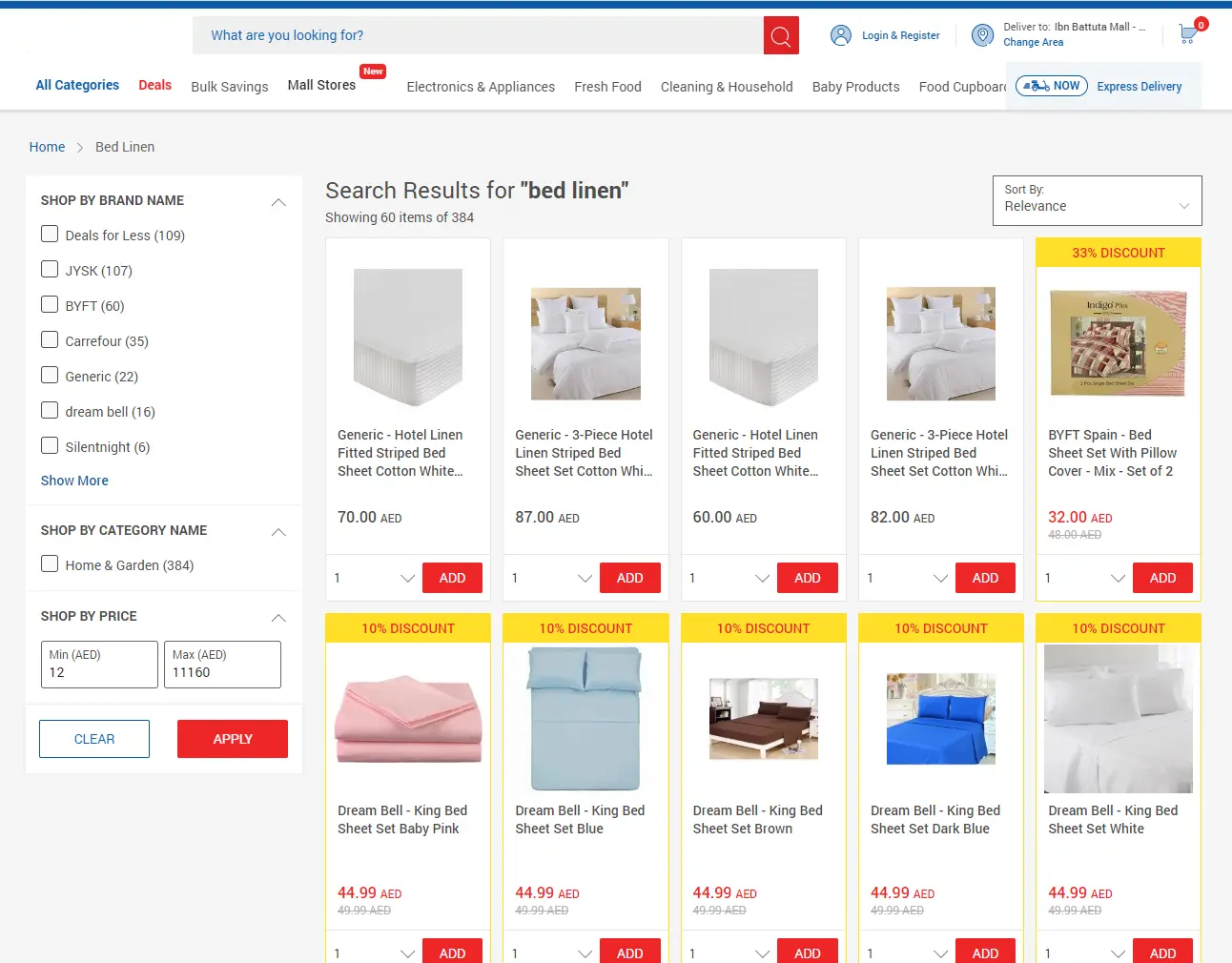
  4. Alternative words – Bed sheet or bed linen

  5. Plurals – Sunglasses or Shades
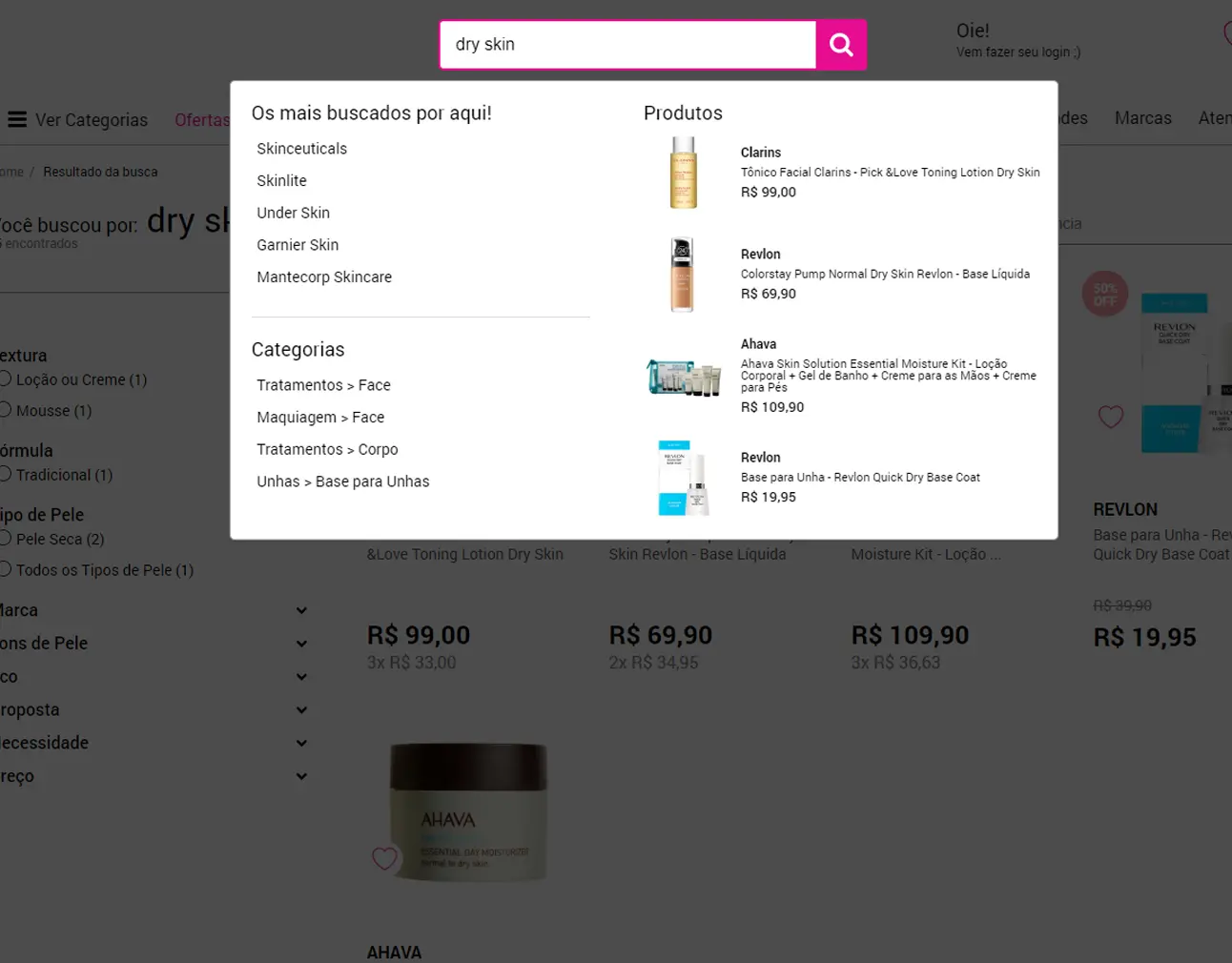
  6. Search terms based on a problem – ‘Dry skin’ instead of ‘body lotion’

    Are you able to home in on visitor intent?
  7. Shopper searches can reveal high intent signals. If you can pick them, you can dramatically improve the relevancy of your search results for the shopper and prevent ‘no results’ situations.

    Some terms are more important, e.g., 12″ sky blue sleeve (where 12″ is as important as the color of the product), ‘Organic’, ‘Gluten free’, etc.

  8. Your shoppers’ collective searches are revealing as well. They can help you determine associations between categories, products, and search terms. The best part is that algorithms that can self-learn can make these associations without you needing to write rules manually or change product data.

  9. A shopper’s affinity for custom attributes like style, pattern, size, color, or preference around brands and products can be understood not just from their current session but their history as well. Personalizing search based on this information can drive higher conversions.

    What are you doing to aid visitors to explore the most relevant products in your catalog?
  10. Sometimes, visitors are unsure as to what they want to purchase. This is your opportunity to guide, inspire, and even surprise them with meaningful yet interesting search results. This is what separates plain vanilla searches from personalized commerce searches.

    As shoppers begin typing into the search box, you could predict what they may be looking for and provide some inspiration.

    Increasing search result relevancy with each keystroke makes for better experiences.

  11. When products need multiple dimensions for selection, contextual filters can help quickly narrow down results.

  12. With 70% of traffic coming from mobiles and the limited real estate that these devices afford, you need to be able to personalize commerce searches. You want users to find what they are looking for faster. And that means your search needs to be contextual and display the most relevant items at the top of the results. We use a metric called Findability to measure if shoppers are finding what they need.

In other words, commerce search must be simple, intuitive yet sophisticated. It must reduce the need for users to scroll or use filters, and thereby help them complete their journey quicker.

The commerce search box is the perfect ally for marketers and merchandisers in helping deliver the best experience and boost conversions without relinquishing control over aspects like stock counts, trade promos, and private label growth metrics.

Commerce search can be really potent for retailers if it’s personalized. So, how would you rate your commerce search based on these 12 points?

Learn how you can move from legacy, one-size-fits-all search to self-learning personalized search.

Experience Browser – Adding Intelligence to Web Personalization

Digital Experience Personalization
Blogs

Experience Browser – Adding Intelligence to Web Personalization

It is not just enough to know if personalization is working on your commerce site. Apart from displaying the right content or products to shoppers, you should also know why and how they are being shown. But do you?

As marketers aim to drive higher visitor engagement, delivering personalized customer experiences has always been a top priority. The more individualized the experience, the higher the engagement and better the conversions. By investing in artificial intelligence and machine learning for e-merchandising teams, companies want every website visitor to have their own unique experience, rather than defining a generic, one-size-fits-all experience.

AI solutions these days, rather most of them, are made for automation. They are not designed to build on existing capabilities and the accumulated intelligence internal to the business. There is also a definite lack of visibility into how they arrived at an outcome. Such ‘black box’ solutions are quite simple, and thus do not provide business controls, visibility, and extensibility, thereby limiting the companies from uncovering the best outcomes using AI.

Xen AI, through the Experience Browser, opens this “black box” and gives you visibility into how the system works, giving you unprecedented control over areas to improve and explore, test new possibilities, and deliver the best outcomes.

The Experience Browser: AI Transparency the Way You Always Wanted

Understanding why and how an optimal experience was selected for an individual is key to aid decision-making for business users. That is exactly what XB, or Experience Browser provides – a keen insight into how Xen AI is driving performance.

The XB UI sits on top of the customers’ websites and gives you actionable insights into how dynamic personalization experiences are being created. Traditional tools do not even come close to having such functionality.

An intuititve visual overlay enables business users to edit and audit AI decisions using a single click on aspects like unified customer profile, summary of recommendations, dynamic segments, rules involved, and strategy evaluation.

Picking Individuals From the Unified Customer Profile

All the interactions that any specific individual has had with your brand can be viewed through the XB. Since all the data does not include personally identifiable information, whatever analysis you conduct and insights you derive don’t step upon the privacy of your customers.

All searches, the different dynamic segments they belong to, declared and derived preferences and affinities, clicks, prior purchases, and standard geo-location data if shared are available at a single click.

For companies that run omnichannel businesses, matched real-time customer profile with offline and store purchases can be depicted by the XB.

Understand the Strategies Used to Drive Decisions on Every Placement

Multiple areas in any website can be personalized. These areas include, but not limited to, product placements, content personalization platform, search overlays, and promotional offers. Through the XB, one can easily understand why and how the decisions were taken by the Experience Optimizer, the heart of the Xen AI engine.

In short, multiple strategies are measured against one another in a competitive match by the Experience Optimizer and the best one is chosen as per the context in real-time. After applying the merchandising rules, the one-to-one personalization experience is determined for every customer.

Along with the strategies picked by the Experience Optimizer and the rule selection, the Experience Browser also shows the reason behind that particular selection and a progressively filtered result set.

Real-time Trends on the Website

At any given point in time, you can use the Experience Browser to view the product trends as they happen, in real-time, including views, clicks, and purchases on the website. Holiday or seasonal sales preparedness can benefit greatly from this.

In terms of products viewed but not purchased, the insight gained can help merchandising teams determine boost versus bury rules.

Deep Links to Experience Insights

The presentation of real time customer data profiles reporting and multi-dimensional analytics provided by the XB nicely complements the ADA Global dashboard. Easily accessible reports for sales attribution, slice-and-dice by segments, cohorts and more across key metrics – attributable sales, revenue per visitor, session, etc. are just a sample of the insights that you can derive from the XB.

Content Performance Rankings And More

Visualizing dynamic content personalization performance at a glance is really handy. This is also made possible by XB. Drilling down to details like which pieces are being used where and how much is the performance affected by any kind of placement change. In a few clicks, you can determine engagement as well as conversion through the XB. Understanding how much revenue flowed in due to a creative asset is a unique capability offered by the XB.

Experience Browser Is Imperative for Your Holiday Readiness Plan

Having visibility across your strategies and their efficiency in driving personalized product recommendations is key to generating more conversions. That is exactly what the XB helps you achieve. Club that with your holiday readiness initiatives and you have a recipe for success.

More Reading:

Check out our Guide to Omnichannel Personalization to learn how to integrate your online and offline channels and deliver a unified experience to consumers.

How Algorithmic Testing Is Changing Marketers’ Experiments

Digital Experience Personalization
Blogs

How Algorithmic Testing Is Changing Marketers’ Experiments

The world of marketing has become way more defined and data-driven than it used to be. Multivariate tests and A/B tests, analytics, statistical significance, allocation of traffic, tweaking variables, refreshing, optimizing, and repeating – are now an integral part of every marketer’s life.

Clearly, testing has a huge bearing on the performance of campaigns and is the difference between running an optimized campaign versus a poor-performing one. Testing tools providers have built entire product lines around these, and you will find that they are constantly urging marketers to “test everything” and rightly so.

The world of retail is now too complex to tackle with manual testing. Manually tackling different flows of data for every individual is obviously not feasible. Adding more people to the testing team isn’t the answer. At the end of the day, the volume of data is too large and the value-add may be sub-optimal.

This begs the question: How can your business then provide tailored shopping experiences to customers without having to create discrete experiences manually for segments?

ADA Global steps in here with a range of native testing tools built specifically to address such concerns. These include traditional A/B and MVT tests, but in addition also have full-fledged continuous algorithmic testing and optimization.


What Is Algorithmic Testing?

Taking A/B testing and experimentation a notch or two higher, algorithmic testing uses data science with a continuous, always-on testing environment for improving conversions on the go.

It’s a critical need if your customer journey culminates with a purchase and you want to test conversions, especially on cart pages.


What Is Different About Algorithmic Testing?

As opposed to manual testing, algorithmic testing allows one to continuously test every variable, i.e., every digital transaction, while focusing on revenue conversion and at the same time, self-optimize to achieve the desired result via AI/machine learning, adapting at scale for every individual.

Algorithmic testing is one of the foundation stones of hyper-personalization.


How Algorithmic Testing Works

This works in two stages via an AI decisioning engine, known as the Experience Optimizer that is unique to ADA Global. While considering the context, the Experience Optimizer tests and picks the best experience for every individual automatically.

One can choose from over 150 strategies that have been tried, tested, and refined over time with outcomes specific to retail. ADA Global’s Xen AI consists of these strategies, and they are built using an ensemble of algorithms – including statistical, machine learning, and deep learning ones, like natural language processing or NLP.

In real-time, multiple strategies are tested against each other by the Experience Optimizer to determine the winner for any interaction. While doing that, it considers metrics like RPS, RPV, and CTR. It also tries out new content or other viable recommendation strategies that are relevant to each customer or visitor.

In its exploration mode, which is completely customizable by the business, the Experience Optimizer makes sure that results never hit any kind of ceiling, and continue to propagate over time.

New content or strategies can also be added into the mix by clients, and the Experience Optimizer can choose when they could be used given a situation.

ADA Global’s native A/B and MVT tools can be used by marketers to test out specific content, placements, strategies, rules, and even the merchandising of category and browse pages. These tests can then be targeted and accordingly, traffic can be allocated towards specific segments or all visitors. As opposed to traditional A/B testing tools, algorithmic tests treat each visitor uniquely.

Testing of strategies; optimization of metrics for different areas of the funnel; and testing of other configuration changes, campaigns, or promotions can also be done by clients.

The insights dashboard can be used to monitor results, or clients can even use the Experience Browser for the same. Results across multiple metrics are automatically shown, even if those metrics are not included by the user in their test. A variety of filters, including, but not limited to segments can be used to view the results. Outlier filtering can be used to measure the impact of outliers.

As the future of experimentation, algorithmic testing will operate alongside your regular A/B testing tools. It’s not like one can replace the other.

Learn about all the ways we can help your business drive hyper-personalized marketing at scale.

Content Personalization: ‘Experience Designer’ for eCommerce

Digital Experience Personalization
Blogs

Content Personalization: ‘Experience Designer’ for eCommerce

Creating content can be a daunting task, even for digital marketing organizations. The sheer number of variations you need to curate in order to target specific segments of customers in a data-driven manner makes the whole exercise quite cumbersome. Well, help is at hand – we are talking about Experience Designer to help you kickstart personalization of your content.

If you’re familiar with our personalization engine, you may be aware of the Experience Browser (XB), which is pioneering transparency in AI decisioning. Working with XB, the Experience Designer leverages Xen AI engine in order to identify the appropriate targets automatically and subsequently uses your existing content to create relevant campaigns.

Without the hassle of carrying out full tests, marketers can iterate and therefore distribute real data to the ones who are actually delivering the experience. This acts like a bridge between the marketing and commerce teams. Let’s dig a bit deeper into how this works.

Auto-discovery of Behavioral Segments

Segment creation is the most important aspect when it comes to targeting customers and creating personalized content. Since digital commerce is quite complex and volatile, extracting actionable and timely insights from data becomes a challenge. Let alone the time spent on it, even your entire analytics budget could be spent, and you would still not be able to fulfill your objectives. Auto-discovery of behavioral segments is a new feature that we have added to eliminate manual effort in the process of segment creation.

Through this feature of auto-discovery, Xen AI-driven machine learning algorithms replace costly and inefficient manual analytics to find new and more interesting behavioral segments, while also providing a web-based visual tool for reviewing and acting upon the insights generated.

Using this feature, you can easily discover segments based on any kind of filter, be it brand, category, or product. Furthermore, once identified, it becomes all the more easier to target said segments with highly personalized cross-sell campaigns and offers. For example, you can discover customers that convert but with low spends.

So, how does this auto-discovery work?

Using metrics like conversion rate, average order value, revenue per visitor, and the like, auto-discovery can cluster audiences together. After that, such clusters are filtered. Clusters are excluded if they have less than 10 percent of the overall paying audience. Also excluded are the clusters that have less than 5 percent (minor) positive or negative metrics variation when compared with the average audience metrics.

Assuming average conversion metrics, the remaining clusters are used to calculate the potential revenue as additional revenue.

Benefits of the Experience Designer

If you have used XB, you will find the Experience Designer to be quite familiar. It is a similar web-based tool that sits atop the web page on your browser, like an overlay, or a HUD, if you can relate to FPS games.

The Experience Designer can help marketers create, execute, and edit content-based placements and campaigns directly from the live web page, without needing to navigate to another tool or requiring the intervention of the IT team.

For marketers who wish to test, modify, or launch campaigns on the go, this tool can be a boon. Apart from giving the freedom to create campaigns fast, this tool also helps marketers realize the complete potency of the content in their libraries.

Once the segments are defined through auto-discovery, segment builder, or via the segment import tool for externally created ones, you would need to define the campaign/s for these audiences.

Now that you know what sort of fine-tuning you can achieve with audiences, you will be pleased to learn that the same kind of intuitiveness is also offered when designing a campaign. You can drill down to narrower targeting via metrics that were earlier just an unusable tag. Campaign design is rather effortless, with filters that allow for more specific control on the segment including subsets of monthly new or returning visitors, abandoned carts, infrequent loyalty members, etc.

After that, you would need to choose the content that is applicable from your existing library. This is then used by the Xen AI engine to continuously work towards optimizing for conversion or click-through goals.

Last but not the least, you choose where the placement would be on the website. All it takes are a few clicks – no coding required. There is an approval process that needs to be followed though, so your experiments are not pushed to production by an erring click.

And that’s all there is to it!

The Experience Designer helps bring in commerce data to understand conversions from content, and that is where digital marketers benefit the most. Why choose from among content and commerce when you can have the cake and eat it too?

Learn more on how ADA Global can help you strengthen your content personalization strategy.

Table Of Contents
Auto-discovery of Behavioral Segments
Benefits of the Experience Designer

Why Hyperpersonalization Is Key to Winning Grocery Retail

Digital Experience Personalization
Blogs

Why Hyperpersonalization Is Key to Winning Grocery Retail

One of the most remarkable shifts we have witnessed in retail recently has to be the unprecedented growth in the grocery segment. According to a recent report from IGD, grocery is set to grow by 24% and generate an incremental $2.2 trillion in sales by 2024.

The key drivers for growth across both mature and emerging markets in North America/Europe and Asia respectively will still be online and convenience. As grocers race to grab a share of the increase in consumer spending, they must be mindful of the changes in consumer behavior, the importance of catering to a whole new set of first-time customers, and adapting quickly to evolving needs. This means grocers need a fresh and nimble AI-driven approach to delivering exceptional customer experiences. This alone will separate the winners from the also-rans.

For starters, this means grocers must look beyond traditional marketing methods that involve segmentation which is essentially grouping individuals into buckets called ‘segments’ based on a certain set of common predetermined criteria including interests, geographies, and demographics.

In the past, marketers would typically define segments such as ‘shoppers over the age of 45 who spend 40 GBP monthly in-store’ or ‘households that buy more than 10 organic items monthly’. This helped marketers better organize large amounts of consumer data and personalize communications to some extent. Clearly, it has its drawbacks – since every consumer is unique, no two shoppers have the same buying habits, tastes, or preferences and naturally, you end up with sub-optimal results.

Bottom line, it isn’t true Individualization or what we now call hyper-personalization – where every customer is delivered unique, tailored experiences. Make no mistake, consumers today expect grocers to deeply understand their needs, preferences, brand affinities, and purchase behavior in real-time and to engage them via their preferred channel.

In other words, consumers are looking for contextual relevance, and hyper-personalization delivers on that promise by creating a real-time behavioral profile for every visitor that is extensible to their household. This is achieved by a deep learning framework, a real-time customer data platform (CDP), a full suite of experience personalization, and personalized marketing orchestration capabilities that afford retail grocers the benefits of precision marketing and scale.

Clearly, hyper-personalization is the way forward, but let’s look at what this means from a consumer’s standpoint. In a nutshell, it translates into three things – Recognize Me, Understand Me, and Inspire Me in real-time.

Recognize Me: Know your shoppers. What if you knew your customer shops for a family with two children during the first week of every month, and 30% of his spend is on frozen food. A small portion of purchases includes vegan products, indicating a family member is a vegan. Legumes, dairy products, and dark chocolate bars are regular buys. The customer also buys vitamin supplements, fabric softeners, and disposable plates every alternate month. With this knowledge, you will be able to surface personalized product recommendations that drive better conversions.

Understand Me: Another important ingredient of hyper-personalization is knowing the Why behind the purchase. It can provide surprising insights into the shopper’s context and enable you to tailor the shopping experience. If you know that a customer often purchases avocados and is into healthy foods, you could recommend products that complement it (Mexican salsa for example).

A change in buying patterns or habits may be indicative of moving to a certain variety of food (gluten-free) or an addition of a pet. You may also discover that this customer engages with gamification content and often redeems points to get discounts or you may encounter a customer that constantly compares prices for select staples online and buys in-store. This level of deeper understanding allows you to adapt instantly to changes in customer behavior and extend the best, most relevant offers.

Inspire Me: The more you know your customers, the better your ability to personalize and drive conversions. When you understand affinities, preferences, and behaviors deeply, you can surprise and delight them with the best in-the-moment recommendations that drive higher engagement and top-class digital experiences. These can range from recipes to one-click ingredient purchases or recommendations based on the weather, unique bundled offers, or surprise customers with new product alternatives. You can bring insights from your in-store purchases to influence the online shopping experience.

In summary, massive opportunity beckons grocers. So why not look beyond the mundane automated replenishment to deliver a rich user experience that keeps customers coming back? Hyper-personalization has all the answers to convert routine buying into delightful shopping experiences. Make grocery shopping joyous again.

Check out our Guide to Omnichannel Personalization to learn how you can integrate your online and offline channels to deliver a more holistic customer experience.