
Marketing Fireworks: Ignite Your 4th of July Campaigns

Digital Experience Personalization
Blogs

Marketing Fireworks: Ignite Your 4th of July Campaigns

Cue the fireworks and get ready to celebrate America’s birthday with a bang! The 4th of July is the ultimate summer extravaganza, where patriotism meets family fun, and barbecues light up backyards nationwide. It’s also a prime time for brands to tap into the festive spirit with sizzling sales, major clearance events, and the latest summer collections.

Independence Day isn’t just about fireworks and barbecues; it’s a prime shopping event. In 2023, consumers spent a whopping $9.5 billion on the 4th of July, up from $7.7 billion in 2022, and the trend shows no signs of slowing. From food and beverages to electronics, clothing, and home goods, spending spans various categories, making it a golden opportunity for marketers.

Before crafting your holiday marketing strategy, it’s essential to understand your shoppers—their buying habits, preferences, and behaviors. Personalize your approach to resonate with them on a personal level. To get you started, here are some key consumer trends for 2024 that you should consider when planning your Independence Day campaign.

It’s All About the Timing

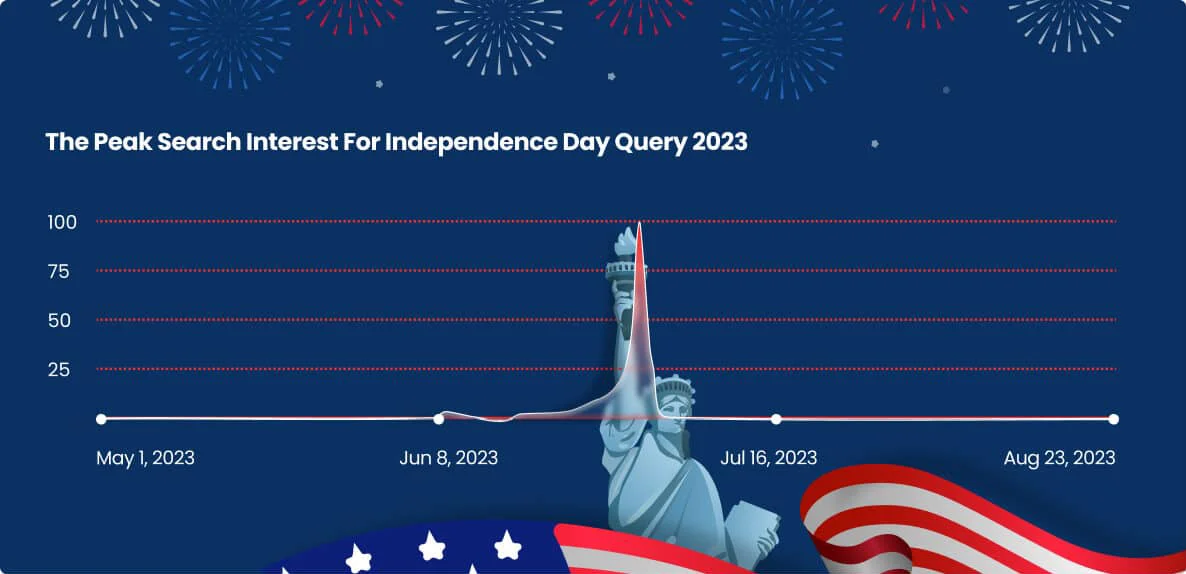
Timing is crucial for maximizing the impact of your 4th of July campaigns. Consumers begin their holiday research around mid-June, with interest peaking from July 1st to July 8th. To capture this audience, start building your campaign hype by mid-June.
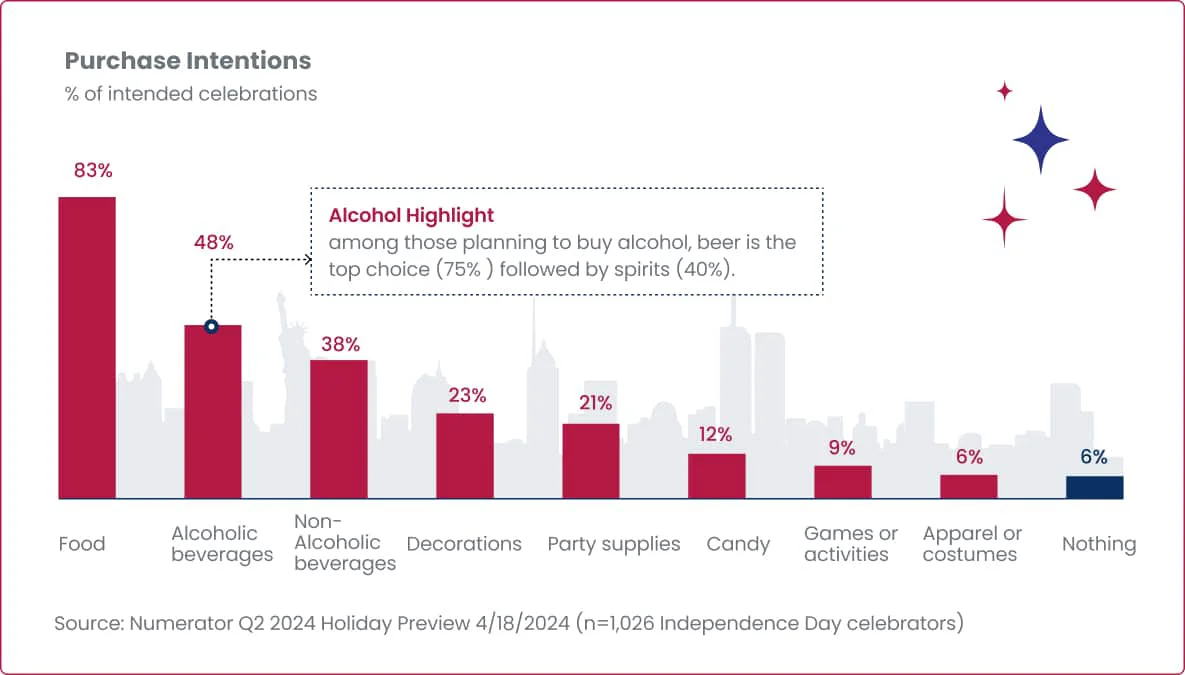
Top Spending Categories Include

  • Food: Essential for cookouts, barbecues, and picnics.
  • Alcoholic and Non-Alcoholic Drinks: Popular choices for celebrations.
  • Decorations and Party Supplies: Flags, Star-Spangled gear, and more.
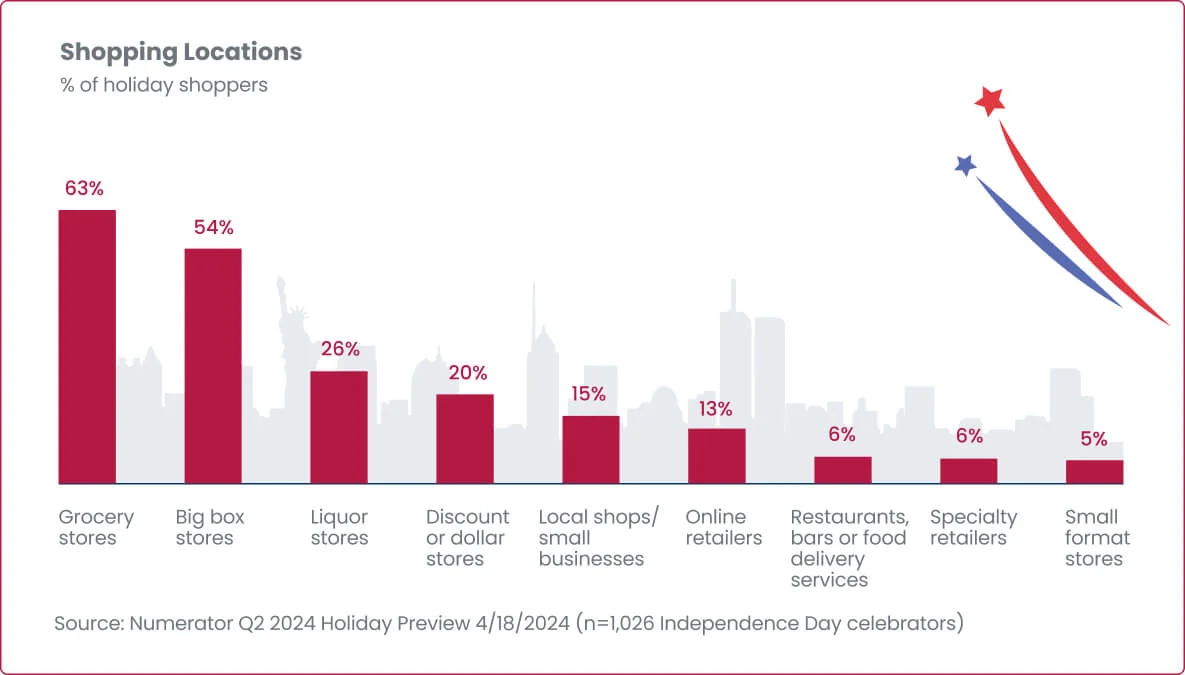
Additionally, grocery stores and big box retailers are poised to lead Independence Day sales. Over half of holiday shoppers expect to purchase their Independence Day supplies from one of these two channels.

Ada Global Tip:

A great customer engagement solution such as Audience Manager helps you segment audiences based on who purchased products from particular categories on the 4th of July last year so that you can retarget them for your 2024 Independence Day campaigns.
Now that you’re up to speed on the latest trends, it’s time to dive into effective strategies. Here are some winning tactics of successful brands to spark your 4th of July marketing efforts. This will help you harness the patriotic fervor to create impactful marketing campaigns that resonate with your customers and boost your sales.

1. Academy Sports + Outdoors

Celebrate Independence Day by honoring the brave heroes who fought for our freedom. Your 4th of July campaigns can shine a spotlight on the armed forces in meaningful ways. Show your gratitude with exclusive deals. If you’re running an Independence Day sale, add an extra discount for current soldiers and veterans. It’s a small way to say a big thank you. You can also consider donating a portion of your sales to veteran organizations. Highlight this in your emails to connect with a broader audience and add a noble touch to your campaign, making it more than another sale.
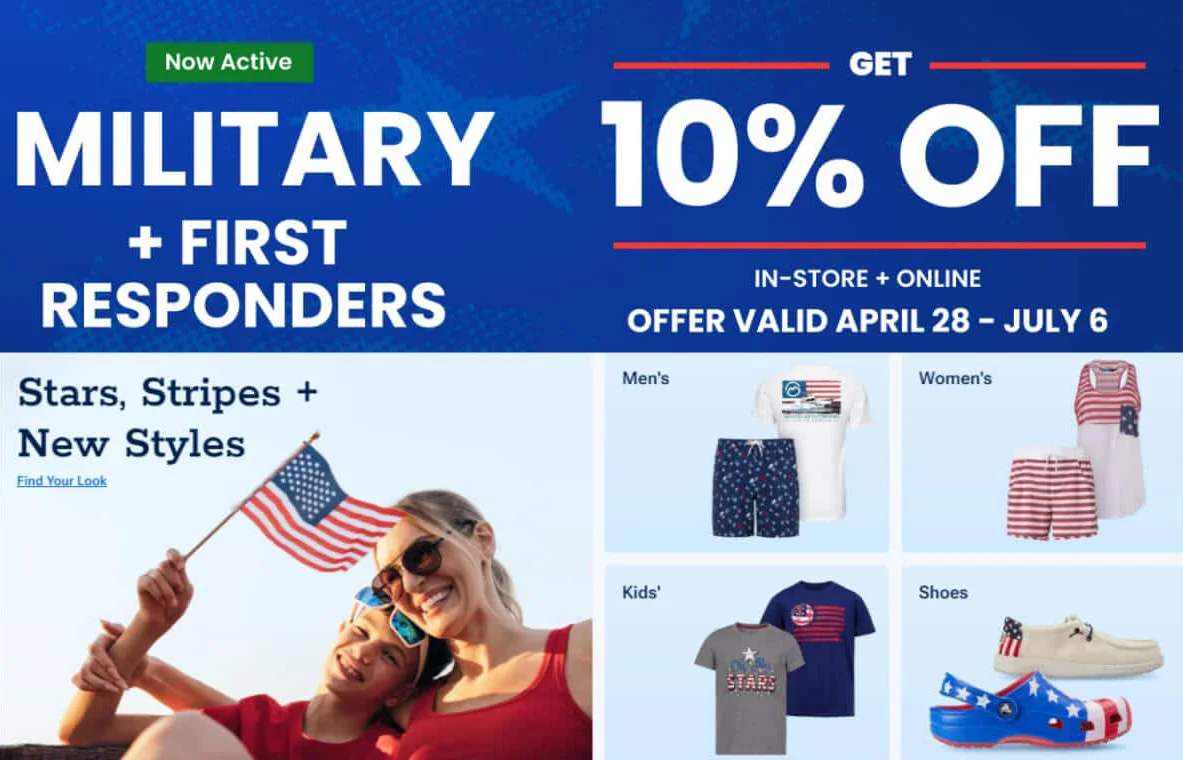
Academy Sports + Outdoors embraces this heartfelt approach with their “You Serve, You Save” campaign. This initiative offers seasonal military discounts as a token of gratitude to active service members, veterans, and first responders. From April 28, 2024, to July 6, 2024, Academy provides a 10% discount on online and in-store purchases. This gesture reflects their commitment to honoring those who protect our nation and serve our communities. Various savings opportunities can also be explored on their main discounts page.

The company proudly acknowledges all active duty members and veterans from the Air Force, Army, Coast Guard, Marine Corps, Navy, and the Reserves and National Guard. Through this, Academy Sports + Outdoors not only boosts sales but also strengthens its connection with a crucial segment of the community.

Ada Global Tip:

Instead of showing the banner to each visitor, Academy Sports + Outdoors can segment the veterans and respondents and show them relevant offers. For others (civilians), you can personalize banners based on their known behavior and preferences with Engage™.

2. Kroger
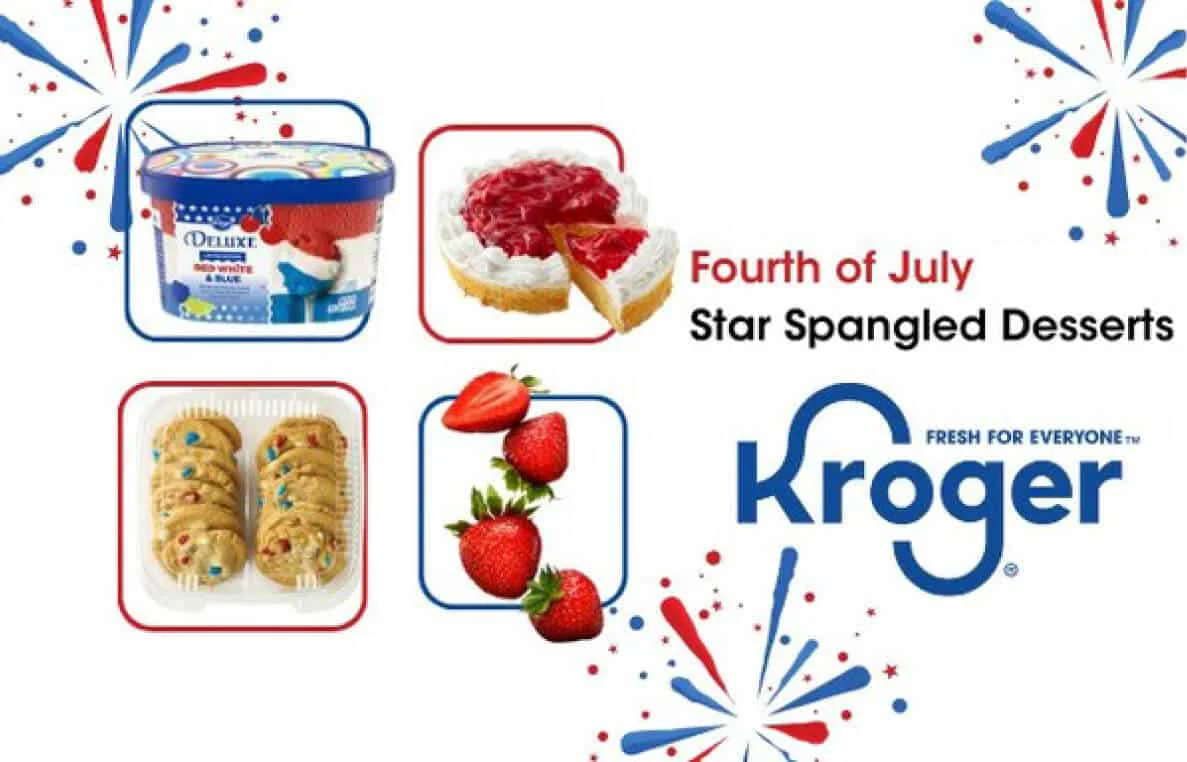
Kroger uses launching limited edition collections as a powerful strategy to create a sense of urgency and entice shoppers to buy, ultimately boosting sales. These exclusive products attract attention and encourage customers to make quick purchases to avoid missing out.

Kroger has effectively implemented this approach for Independence Day by launching limited edition collections that make holiday celebrations even more special. Kroger’s seasonal items, from star-spangled bakery treats to patriotic desserts, help customers celebrate in style. These limited-edition products create excitement and encourage festive gatherings.
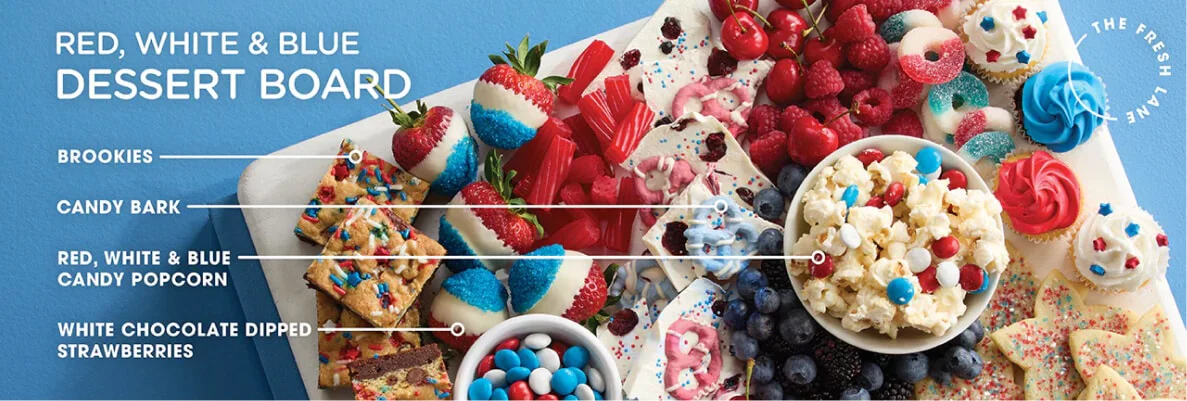
To complete the Fourth of July experience, Kroger offers cooling treats like ice cream and popsicles, adding a refreshing touch to summer festivities. Additionally, DIY dessert ideas with seasonal fruits turn treat-making into a fun family activity, creating memorable moments.
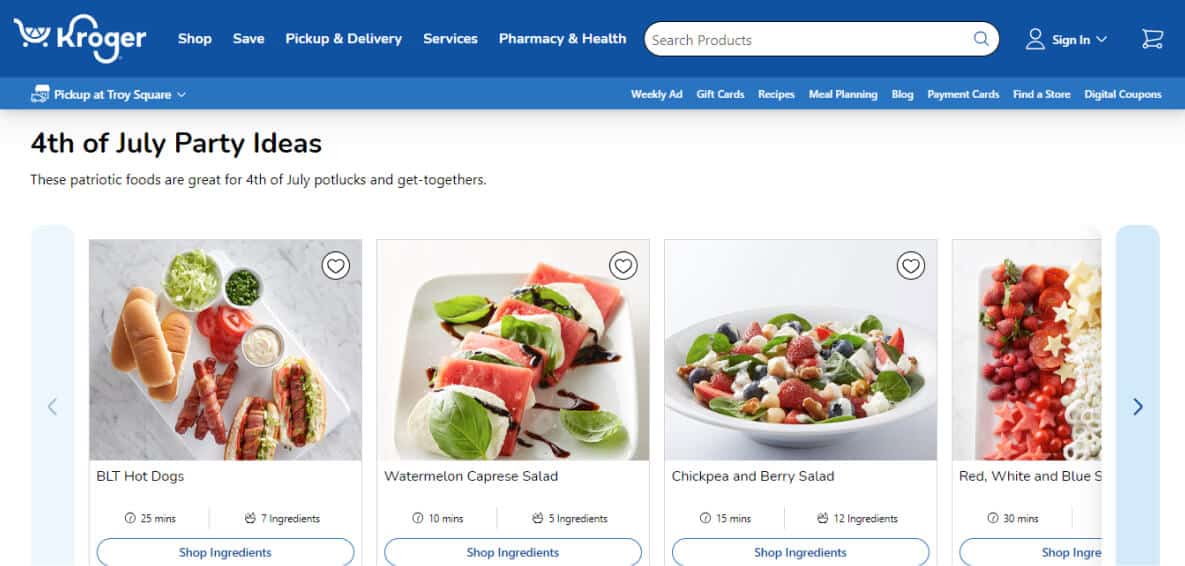
Customers can discover all their favorite sweet treats and summer essentials by shopping in-store, using Kroger Pickup, or opting for delivery with Boost by Kroger Plus.

Ada Global Tip:

Kroger can employ Social Proof Messaging to instill shopper confidence and trust with real-time visibility into trends, popularity, and purchase metrics, thus driving urgency and accelerating purchase decisions, thus improving conversion.

3. World Market
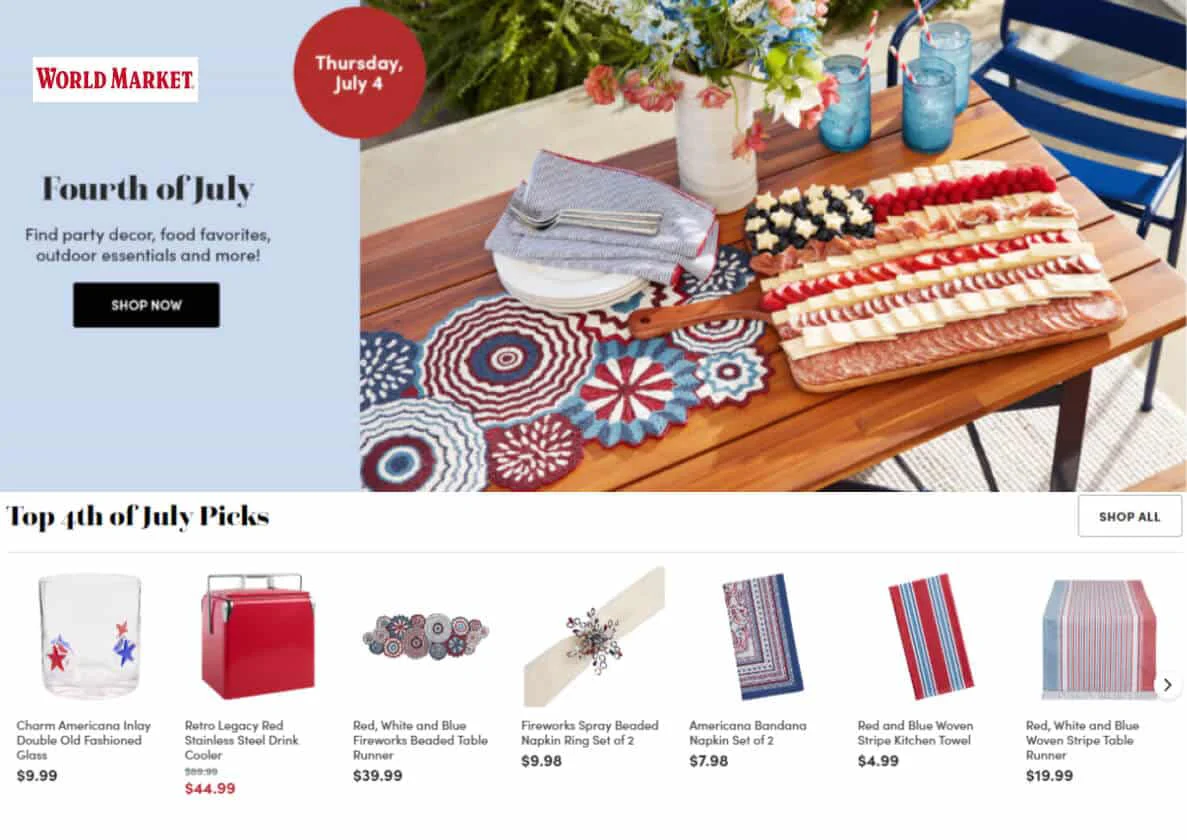
An impactful 4th of July marketing strategy is to launch a themed collection featuring the holiday’s iconic red, white, and blue colors. World Market has implemented this strategy by adding a prominent CTA banner on their homepage that reads, “Hurry, Your 4th of July Finds Are Here!” This eye-catching banner directs visitors to a dedicated section for Fourth of July and Top 4th of July Picks, instantly grabbing shoppers’ attention and driving sales.

World Market didn’t stop there. By creating a specific landing page featuring all holiday items, they’ve simplified the shopping experience, encouraging more purchases.
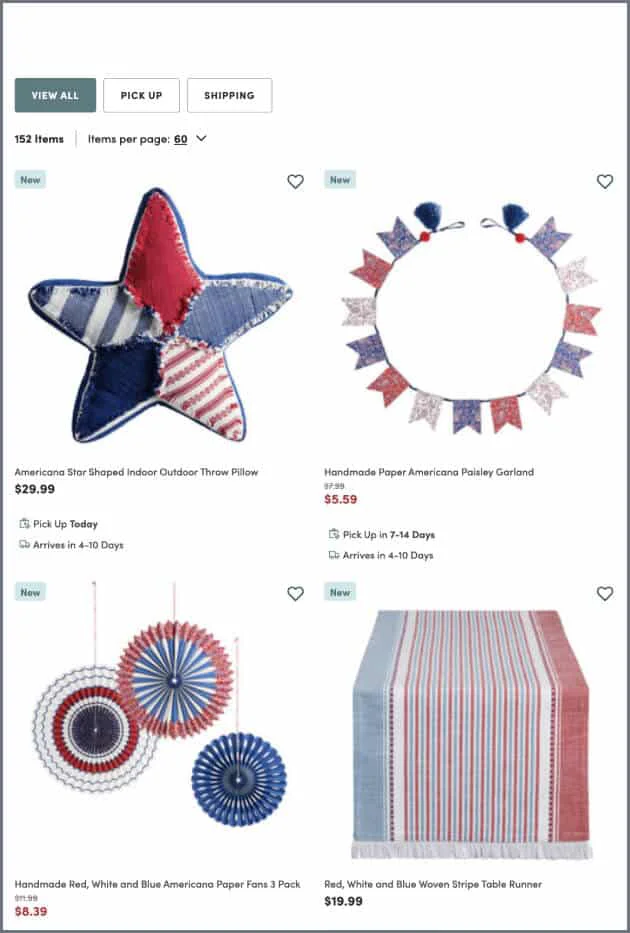
If you plan to launch a themed collection, follow World Market’s lead and create a dedicated landing page that curates all the products. This makes it easy for customers to find and buy everything they need for their Independence Day celebrations.

Ada Global Tip:

World Market can use Discover to personalize product listing pages based on behavior, past purchases, and occasions and even boost products that shoppers are likely to buy. The customer engagement solution will enable World Market to increase engagement and bypass decision fatigue by surfacing the most relevant products on its web or mobile store category pages.

With these proven strategies, you’re well on your way to a standout 4th of July campaign. By tapping into the patriotic spirit and offering exclusive, targeted promotions, you can create memorable experiences that resonate with your customers and boost your sales. However, before you launch, you must avoid common pitfalls that could derail your efforts. Let’s dive into the key mistakes to avoid in your 4th of July marketing campaigns.
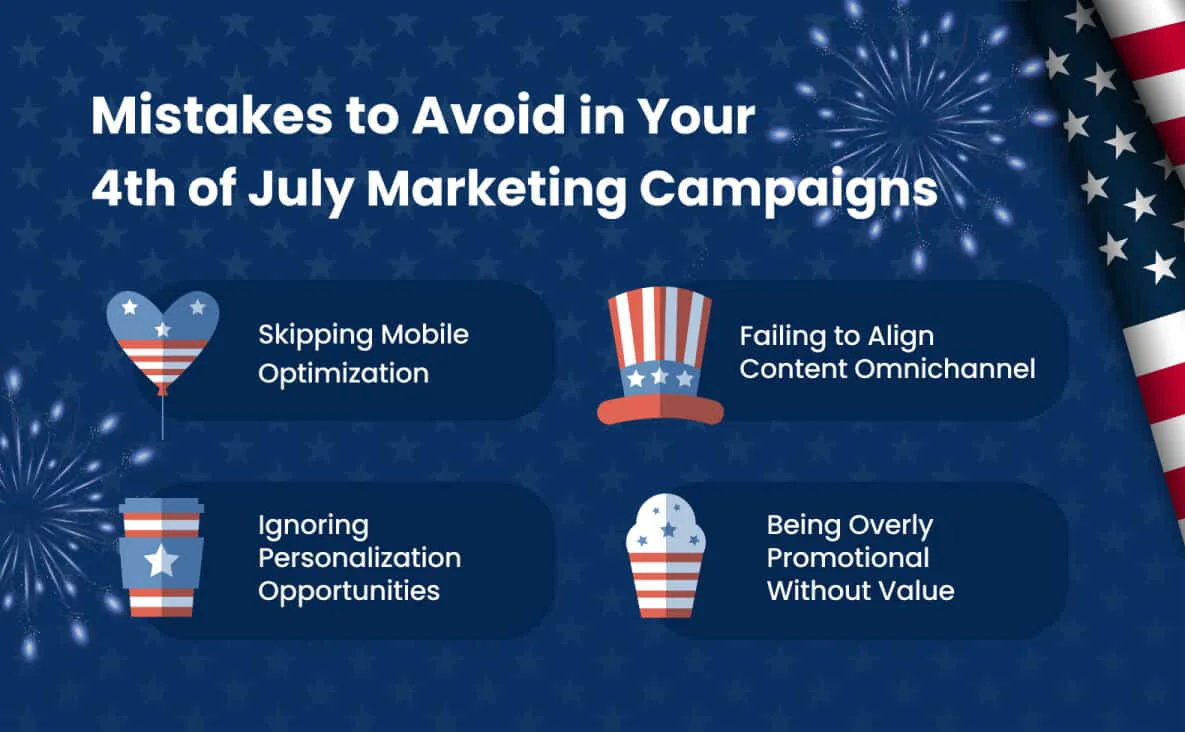
You’ve got some fantastic 4th of July campaign ideas ready to go? Great! But before launching, ensure you’re not tripping over these common pitfalls. Let’s dive in!

1. Skipping Mobile Optimization
Are your campaigns mobile-friendly? If not, you’re ignoring a massive audience. Whether email, SMS, or in-app notifications, make sure your content looks great on mobile. Imagine your meticulously crafted 4th of July message not displaying correctly on smartphones—yikes! Customers will stop engaging, or worse, mark you as spam. Test and optimize for mobile to keep those fireworks going.

2. Failing to Align Content Across Channels
Do you have a catchy headline or push notification? That’s awesome, but make sure the content delivers what it promises. If your 4th of July sale says “70% off everything,” your landing page should match that deal. Misleading subject lines or pop-ups might get clicks, but they’ll also get a lot of unsubscribes and lost trust. Be honest and clear to keep your audience loyal.

3. Ignoring Personalization Opportunities
Whether it’s email, SMS, or website pop-ups, tailor your messages to your audience. A personalized greeting or recommendation can make your 4th of July campaign feel like a private party just for them. Skip the generic messages—show your customers you know them, and they’ll keep returning.

4. Being Overly Promotional Without Value
Instead of blasting out generic deals, offer something that resonates with your customers’ needs. Whether through emails, app notifications, or website banners, ensure your 4th of July offers provide real value. A well-targeted offer will always outperform a generic one.

Conclusion

Remember to personalize, segment, and optimize across all channels. As you gear up for the 4th of July, remember that a well-executed marketing strategy can significantly boost your brand’s visibility and sales. By honoring the armed forces, creating themed collections, and launching limited edition products, you can tap into the patriotic spirit and create memorable customer experiences. Keep these strategies in mind to ensure your Independence Day campaign is a resounding success, and watch your sales soar like fireworks in the night sky.

How Ada Global Can Help in Your 4th of July Campaigns

Disclaimer: This blog does not indicate an ongoing business partnership with the brands, and all references are solely for illustrative purposes.


Table of Contents
It’s All About the Timing
Top Spending Categories Include
1. Academy Sports + Outdoors
2. Kroger
3. World Market
Conclusion
How Ada Global Can Help in Your 4th of July Campaigns

5 Signs You Need B2B Search and What to Do Next

Digital Experience Personalization
Blogs

5 Signs You Need B2B Search and What to Do Next

Research suggests that 80% of customers on B2B commerce platforms expect to receive a buying experience that’s on par with that offered to their B2C counterparts1 – placing a great deal of pressure on businesses to up their game.

However, 75% of B2B customers feel that their expectations for personalized shopping experiences are not being met.2 The reason? Conventional personalization platforms can’t adapt to the unique nature of B2B commerce.

B2B ecommerce personalization comes down to helping buyers get what they need faster. That starts in the search box, typically the primary point of interaction for online shoppers with a company’s website. This is especially true for B2B customers who are driven by intent and know just what they need. Unsurprisingly, 92% of B2B purchases begin with search.3

Here are five signs it may be high time for you to switch up the B2B search experience for your buyers and tips on how to proceed.

1. You risk disengagement by offering shoppers an access-unaware discovery experience

Within a business ecosystem, your client may have multiple shopper groups, each with a designated buyer who purchases for the group. These groups may have specific viewing permissions for categories and products, sometimes with overlaps.

Take, for instance, a purchasing manager knee-deep in orders and invoices – they’d naturally require full access permissions to get the job done. Conversely, an associate might only need a peek at the price list to do their thing.

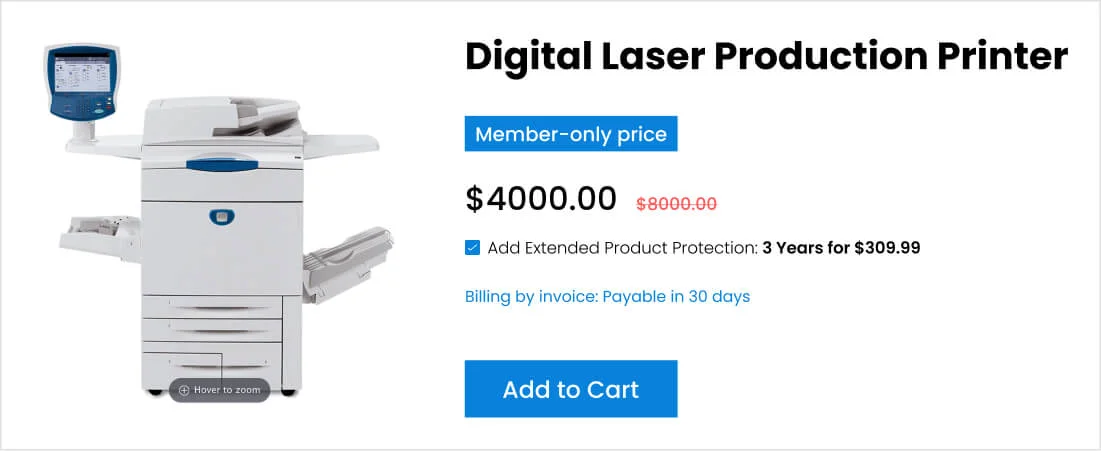
Pro Tip: Your site’s search and discovery solution will be the first to reflect fidelity. Implement a best ecommerce search engine that interprets and applies contract terms in real time, ensuring users see accurate pricing based on their specific agreements. Doing this will enhance trust and satisfaction among users and improve efficiency in contract management.

2. Contracted buyers cannot access negotiated prices for products on your marketplace

B2B sellers often have different prices they’ve negotiated with other buyers. For example, if a buyer purchases large quantities, you want to give them bulk-ordering discounts. This record is typically managed by product permissions and entitlements in ERP and CRM systems — that house data outside the B2B ecommerce platform.

That’s tough for search engines to handle — so buyers often only see pricing on a product detail page or, worse, that confounded “Call for Pricing”. When buyers see regular pricing or contract terms that do not apply to their organization, it’s a very jarring experience. You can expect escalation emails to fly!

Pro Tip: Your site’s search and discovery solution will be the first to reflect fidelity. Implement a search solution that interprets and applies contract terms in real time, ensuring users see accurate pricing based on their specific agreements. Doing this will enhance trust and satisfaction among users and improve efficiency in contract management.

3. Shoppers bounce off after using your site search, unable to find what they were looking for

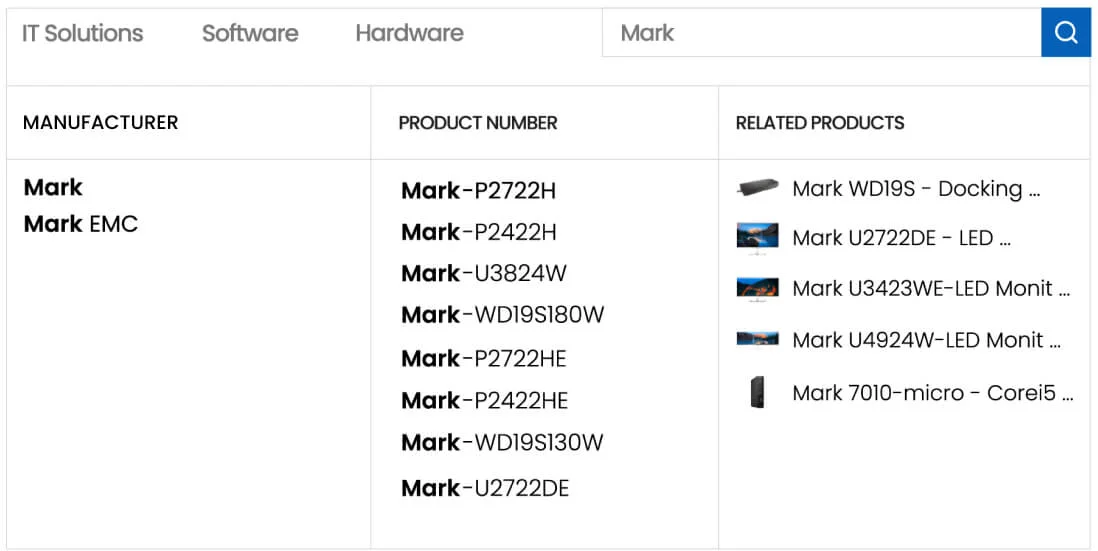
High exit rates from your search results page are an alarming sign, and you’d be shocked at how many B2B ecommerce platforms face this daily. Legacy search experiences are limited to keyword matching between user input and product catalog. It is based on the wildly incorrect assumption that users are typing precisely what you have named your products – right down to their model number!

Pro Tip: You require an advanced search technology that empowers business shoppers to explore items not solely by name but also by parameters such as SKU, category, partial name, etc. A robust search engine transcends mere keyword matching; it facilitates B2B shoppers in locating desired items with an intuitive and efficient browsing functionality, such as filtering, sorting, and faceted navigation.

4. Your merchandising rules are manual and do not balance user preferences with business objectives

B2B companies require control over catalog presentation to users, choosing quickly which offerings to promote and which products to highlight. However, with vast catalogs and multiple sub-divisions typical of B2B commerce, this can soon become a mammoth task blighted by a unidirectional approach that doesn’t optimize user behavior. Additionally, large B2B organizations with multiple sub-divisions must be able to roll out merchandising guidelines at the sub-level.

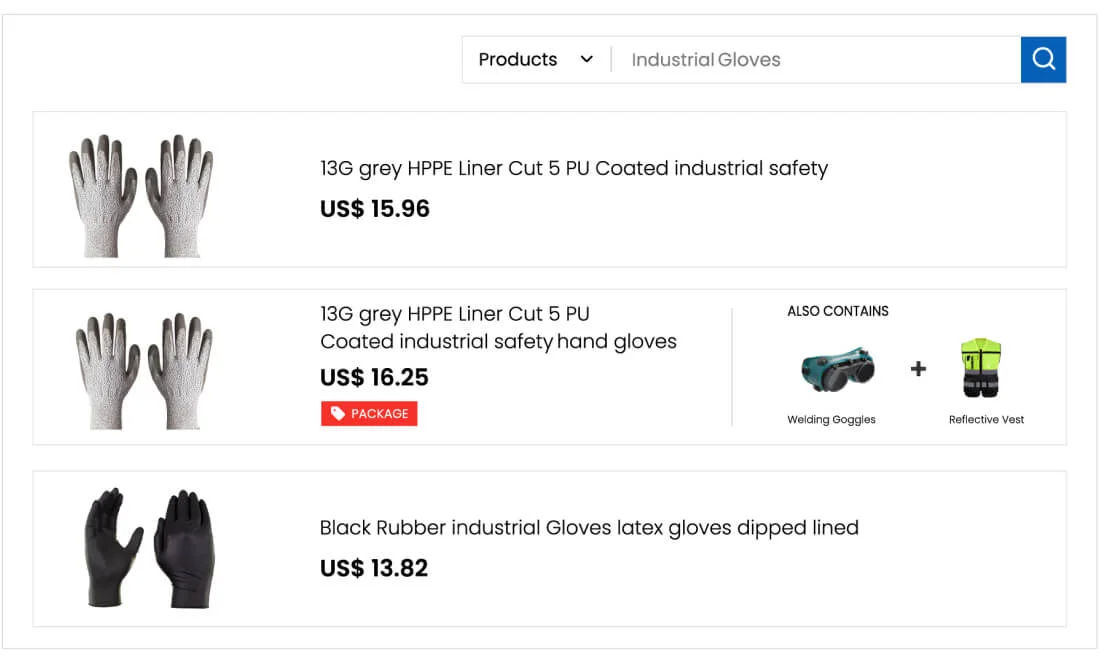
Pro Tip: Get a search solution that balances auto-optimization driven by machine learning and business/brand objectives by setting the desired weights and rules. While offering users ML-generated personalized product recommendations, dynamically re-ranking search results to ensure the most popular products appear at the top, or suggesting AI-generated synonyms based on user searches, an intelligent search solution will also contextualize recommendations to fit your brand and unique business goals. This includes features such as ‘best paired with’ or ‘frequently bought together‘ to drive cross-selling, increase order value, and ‘related products’ to maximize conversions and catalog exposure.

5. Your product pages don’t show the most recent stock information

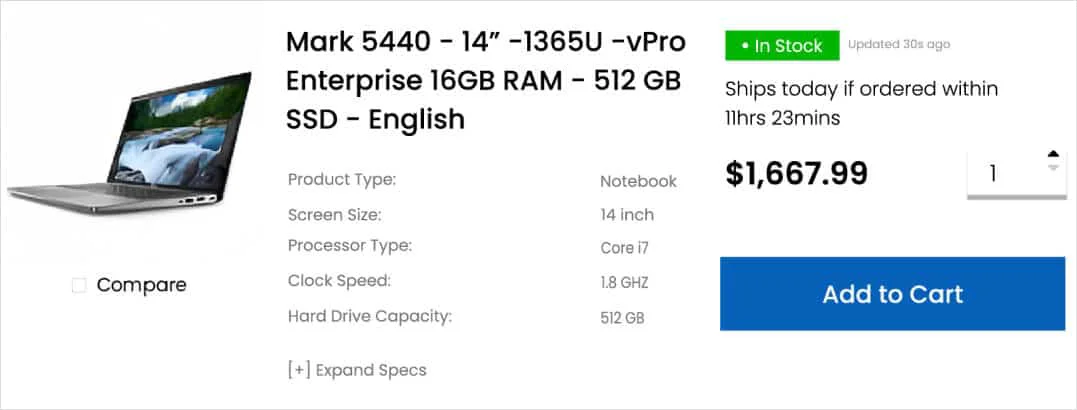
Picture this. A shopper wants to order a batch of 50 laptops for their office, and after searching, comparing, selecting, and ordering – they get to know the required numbers aren’t available. This happens when variable attributes such as stock levels, like custom pricing, live in an external location that does not communicate with your ecommerce front-end experience directly. It must be out of sight if it’s ‘out of stock’, right?! Inadequate real-time pricing and availability data integration into your catalog leads to discrepancies between displayed information and actual inventory optimization levels and frustrates customers.

Pro Tip: Get something that can store and fetch real time customer data profiles (& shopper tier pricing or any attribute that may not be indexed in the catalog) from an external system and surface that as part of the search request. That will ensure shopper satisfaction and reduce load on your support team.

Conclusion

The B2C market often dominates CX discussions, but today’s businesses demand an experience to match the elevated levels afforded to consumers. Expectations are evolving, and you’d be wise to meet them. Why not start with personalization search ecommerce – the most effective personalization method for B2B commerce worldwide?

If you recognize any of these issues (even a single one), you must consider upgrading from your current site search solution to a modern-day integrated, ecommerce personalization platform solution.

Check out B2B Find, ADA Global’s versatile search solution that combines sought-after B2C features with the chops to handle the complexity of B2B commerce platforms, and curates experiences based on the shopper’s contracted products, pricing, and individual preferences.

References:

Table Of Contents
1. You risk disengagement by offering shoppers an access-unaware discovery experience
2. Contracted buyers cannot access negotiated prices for products on your marketplace
3. Shoppers bounce off after using your site search, unable to find what they were looking for
4. Your merchandising rules are manual and do not balance user preferences with business objectives
5. Your product pages don’t show the most recent stock information
Conclusion

Beyond Browsing: How Guided Selling Is Reshaping Product Discovery in Online Shopping

Digital Experience Personalization
Blogs

Beyond Browsing: How Guided Selling Is Reshaping Product Discovery in Online Shopping

The recommendation engine market size, valued at just over $1 billion in 2018, is projected to hit an astounding $12 billion by 2025. Almost seven out of ten business leaders are boosting their investments in personalization, revealed a recent survey.

In a time where the majority of eCommerce players are focusing on ecommerce personalization, businesses must craft unique and memorable shopping experiences that not only cater to shoppers’ individual preferences but also set them apart from the competition.

Guided Selling, powered by ADA Global Recommend™, lets optimization managers curate a shopping journey like never before. The shopper is presented with an interactive questionnaire. Upon submission of the quiz, products are dynamically selected based on a combination of the shopper’s inputs and behavioral data that has already been gathered about them.

It’s the fusion of intention and past interactions that gives rise to a shopping experience that’s not just tailored but truly individualized.

Zero-Party Data: A New Input to Personalization

From a personalization perspective, a Guided Selling experience is especially compelling because it enables optimization managers to incorporate the shopper’s inputs into the results.

This is known as zero-party data. Forrester coined the term zero-party data, which is “data that a customer intentionally and proactively shares with a company.“

Shoppers willingly offer up information, and in return, they expect a more personalized ecommerce experience, relevant shopping experience.

Personalized Recommendations, Today and Tomorrow

With ADA Global’s Guided Selling, personalization isn’t limited to the current shopping session. It extends its reach into future interactions with the shopper.

How? By seamlessly integrating the shopper’s responses into their real-time customer profile or User Profile (UPS). This integration allows optimization managers to apply merchandising rules based on these answers at a later stage in the shopping journey, creating an ongoing cycle of personalization.

Imagine this scenario: In a Guided Selling experience centered around beauty products, the shopper is prompted with a question about their eye color. If the shopper shares that their eye color is blue, this valuable piece of information is stored within their UPS.

Now, when this same shopper receives an email with personalized product recommendations, ADA Global’s personalization engine can apply a merchandising rule that boosts products specifically compatible with blue eyes.

The result? Not only are the recommendations stemming from the Guided Selling quiz more tailored to the shopper, but the product suggestions in future interactions also hit the mark.

Gift Finder: An Excellent Application of Guided Selling

Guided Selling extends its utility even when shoppers make purchases on behalf of others, as is often the case when buying gifts.

By presenting a series of well-crafted questions on the recipient’s preferences, interests, and occasion, Guided Selling can intelligently suggest the most suitable gift options, ensuring that the chosen gift resonates with the recipient.

With ADA Global’s Guided Selling, you can swiftly construct a proof of concept that seamlessly integrates into your website without necessitating any additional development resources from your end.

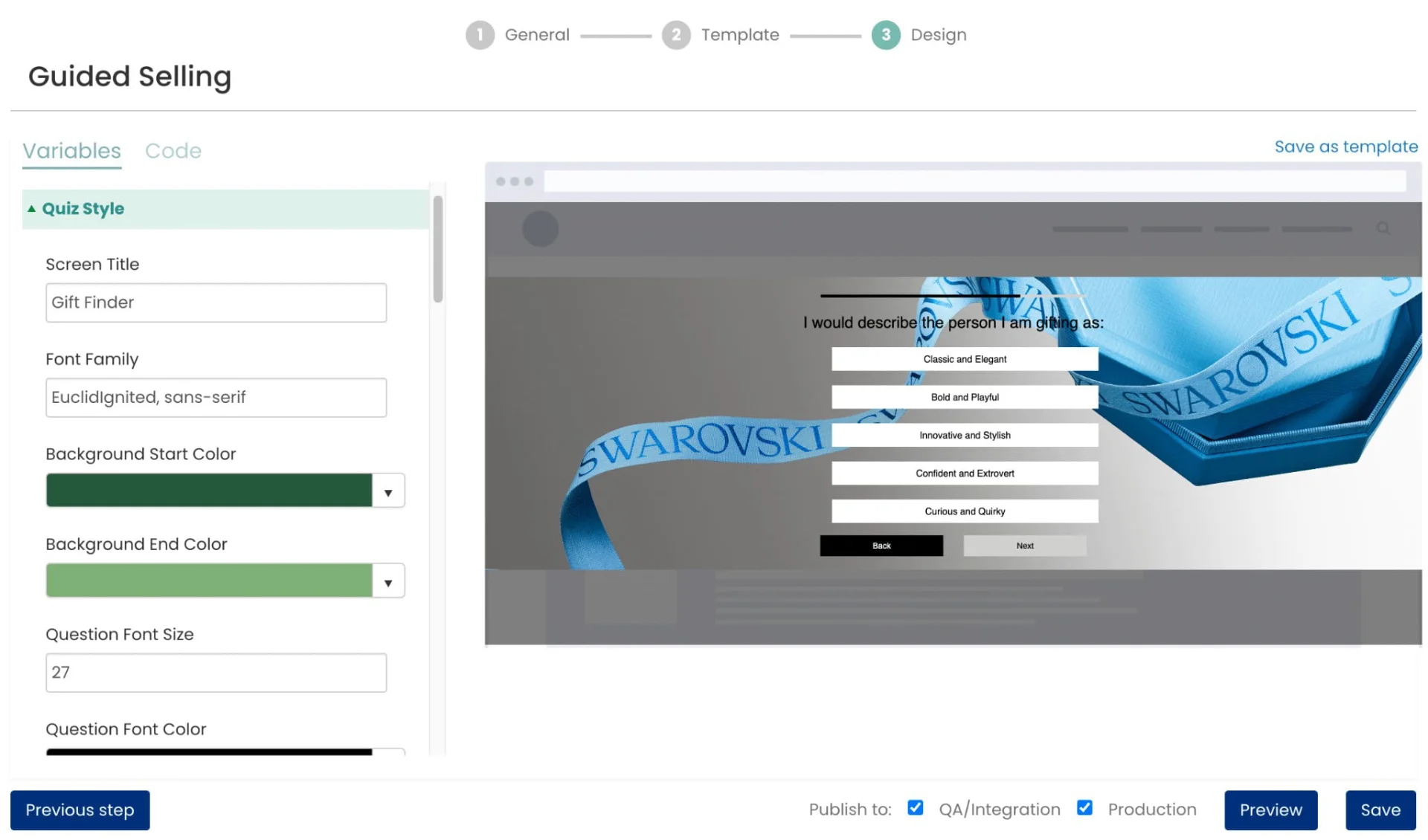
The user interface of ADA Global’s Guided Selling Platform

Here’s a step-by-step guide to get you started:

  1. Define the Questions: Begin by outlining the questions you intend to ask shoppers. These queries serve as the foundation for tailoring the gift recommendations. They might include:
    • Who is the gift for?
    • What is the occasion?
    • What are the recipient’s hobbies or interests? (e.g., Sports and fitness, Travel and adventure, Cooking and food, Fashion and beauty, Technology and gadgets, Books and reading, Arts and crafts)
    • Do you have a budget range in mind?
  2. Align Questions with Catalog Elements: Map your questions and the provided answers to elements within your product catalog. These elements can include categories, specific product attributes, or price ranges.
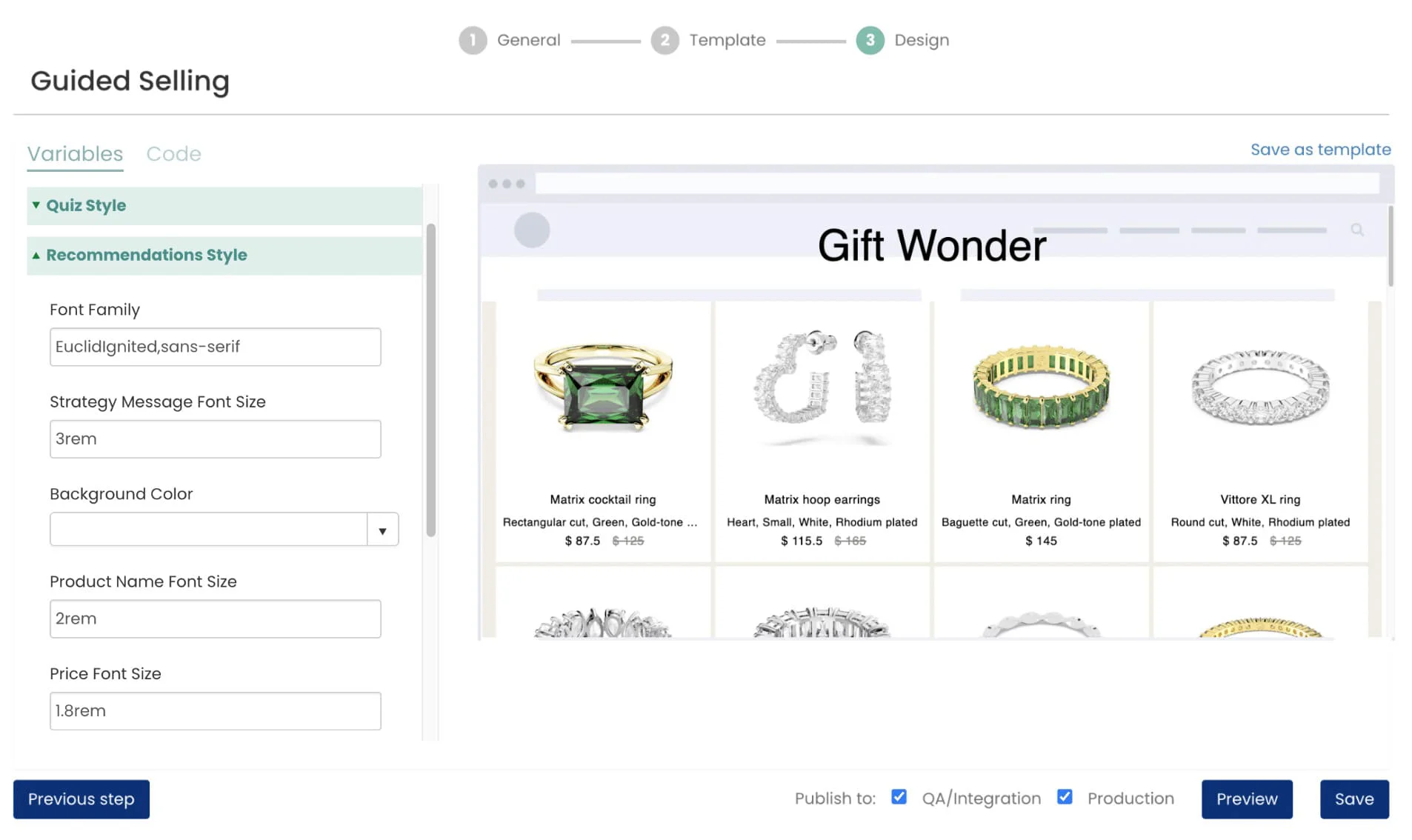
  3. Customize the User Experience: To make the process engaging and visually appealing, personalized retail the look and feel of the quiz and the resulting gift recommendations. You can incorporate images as answer options and tailor the interface with your preferred fonts and color schemes.

By following these steps, you can seamlessly integrate a Gift Finder into your website, delivering an enhanced shopping experience that is bound to delight your customers no matter the occasion.

A preview of recommendations from Guided Selling

Conclusion

ADA Global’s Guided Selling merges the art of shopper intention with the science of data-driven one-to-one personalization, creating an experience that’s not just curated but genuinely one-of-a-kind. With the integration of zero-party data and the ability to store shopper responses in the UPS, Guided Selling opens up a new frontier of personalization.

Learn more about our personalized product recommendation platform. Or request a demo to see it in action.

More Reading:

How Optimization Managers Can Harness ‘User Affinity Sorting’ to Fine-tune Their eCommerce Personalization Strategies

Table Of Contents
Zero-Party Data: A New Input to Personalization
Personalized Recommendations, Today and Tomorrow
Gift Finder: An Excellent Application of Guided Selling
Conclusion

Optimizing Your Retail Strategy for the Holiday Season

Digital Experience Personalization
Blogs

Optimizing Your Retail Strategy for the Holiday Season

The holiday season is a time of joy and celebration for many, but for online retailers, it’s also a period of intense preparation.

As a personalization consultant at Ada Global, I’ve had the privilege of assisting some of the world’s leading retail businesses in ensuring that their customer experiences are finely tuned and optimized for the festive rush.

In this blog post, I’ll take you through the essential strategies and optimizations that we recommend to our clients to ensure a successful holiday season.

Early Planning and Strategy

The holiday season isn’t just a busy time for shoppers; it’s equally hectic for retailers. Planning well in advance is key to success.

Two months before the holiday rush, we start by examining our clients’ existing configurations to ensure accuracy. Any technical issues are addressed promptly, setting the stage for smooth operations during the holidays. Furthermore, we understand that user behavior shifts during this time, and strategies must align with these changes.

Adding Visibility with Additional Placements

One of the most effective ways to boost sales is to provide better visibility for your top-selling items. If your website has a dedicated landing page for showcasing holiday deals, consider adding a personalized product recommendations carousel. This tool can highlight the hottest sellers and make it easy for shoppers to discover them.

Introducing Dynamism for User Engagement

To cater to the dynamic nature of user demand during the holidays, we recommend introducing dynamic strategies.

For example, using “top sellers in the last hour” or “top viewed items in the last hour” strategies can harness the power of social proof messages and recent confirmation data. Not only do these strategies highlight your bestsellers, but they also level the playing field for all shoppers looking for the hottest items.

Leveraging Social Proof

Shoppers find confidence in numbers. Incorporating social proof on item pages by showcasing the number of recent purchases—500 times in the last few hours, for instance—can significantly boost confidence and encourage more purchases.

Enhancing Navigable Areas of the Site

Retail websites must make the most of their navigable spaces. If you have a carousel below your hero section, utilize it to capture users’ attention by displaying personalized ecommerce experience items based on their browsing history or trending items of the season.

Optimizing the Search Experience

During the holiday season, users are in a hurry to find the perfect gift. Make sure your search experience yields optimized results. If space allows, show trending items when users click on the search box, helping them discover what’s currently popular.

Guided Selling

For retailers with a vast catalog and users seeking direction, Guided Selling through Q&A can be a game-changer. Ask users questions to understand their preferences, differentiating each product or category. Examples include a “Fragrance Finder” or a “Mattress Finder.”

Recommendation Carousels with Fixed Categories

Boosting the impact of your recommendation carousels involves displaying gifts with specific messaging.

For instance, use labels like “Shop Watches for Dad” or “Shop Bags for Mom” to inspire users to find the perfect gift while engaging with your products. Marketers can further enhance the experience by sorting products by brand or price.

Conclusion

In the world of online retail, the holiday season presents both challenges and opportunities. By taking proactive measures such as early planning, optimizing algorithms, leveraging dynamic content personalization, and enhancing user experiences, retailers can ensure they are fully prepared for the holiday rush. Success during this crucial period can set the tone for a prosperous year ahead.

As we’ve seen, one-to-one personalization and optimization are at the heart of holiday readiness for online retailers. By following these strategies, you can provide a seamless, engaging, and enjoyable shopping experience for your customers.

If you have any questions or need assistance in preparing your online retail strategy for the holidays, don’t hesitate to reach out to us at Ada Global. Our team is here to help you make the most of this festive season.

Table Of Contents
Early Planning and Strategy
Adding Visibility with Additional Placements
Introducing Dynamism for User Engagement
Leveraging Social Proof
Enhancing Navigable Areas of the Site
Optimizing the Search Experience
Guided Selling
Recommendation Carousels with Fixed Categories
Conclusion

How Optimization Managers Can Harness ‘User Affinity Sorting’ to Fine-tune Their eCommerce Personalization Strategies

Digital Experience Personalization
Blogs

How Optimization Managers Can Harness ‘User Affinity Sorting’ to Fine-tune Their eCommerce Personalization Strategies

Laura Wishingrad, Product Manager (Personalization) at ADA Global, talks about a new Recommend™ feature that allows for testing multiple attribute-based personalization strategies.

Recommend™, ADA Global’s personalized product recommendation platform, offers optimization managers a way to test how different affinity-based personalization strategies influence how shoppers interact with product recommendations.

The platform allows for the exploration of various sorting approaches, such as sorting products based on a shopper’s affinity toward brands or their affinity toward color.

This feature offers a dual advantage: firstly, optimization managers can A/B test the different sorting methods against each other, and secondly, they can employ unique sorting techniques in specific scenarios.

For example, they have the flexibility to sort by brand affinity on their website while simultaneously applying color affinity sorting in their email campaigns. This versatility enables them to glean valuable insights into how their shopper base reacts to various affinity-based sorting strategies.

User Affinity Configuration – How It Works

A User Affinity Configuration can be used to re-order product recommendations based on the shopper’s propensity toward specific attributes present in the product catalog. These attributes could be related to brands, categories, or any other characteristic associated with the products.

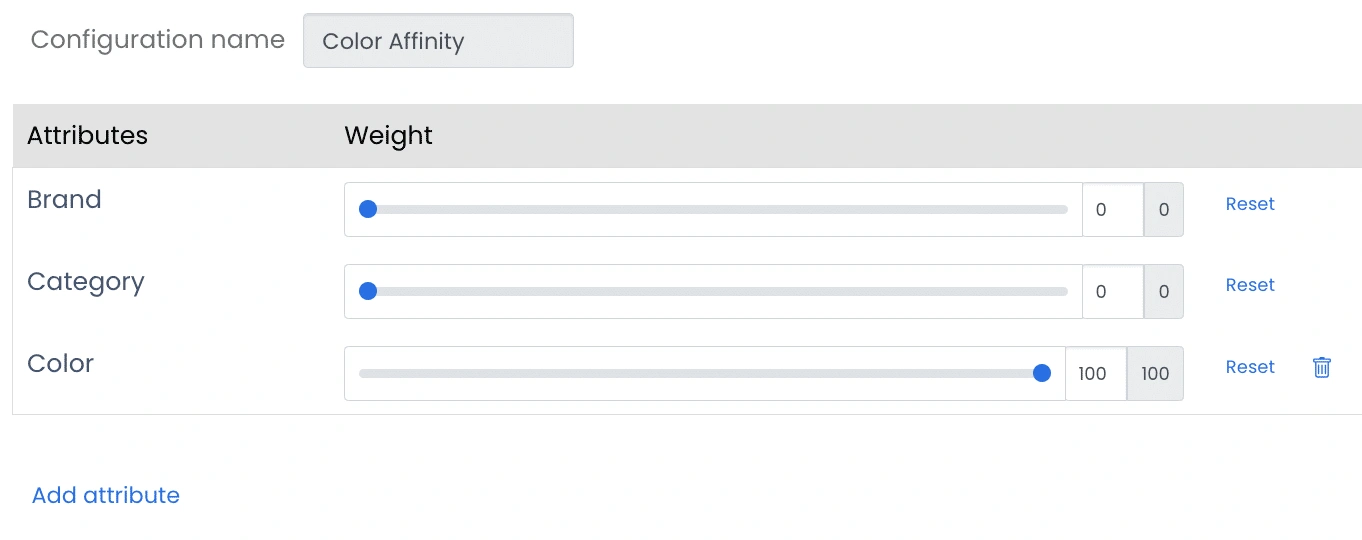
Each attribute within the configuration is assigned a distinct weighting, reflecting its relative importance. In the example below, we are using only the Color attribute to define the affinity.

When a shopper interacts with the platform, their real-time customer profile (UPS) is analyzed to generate affinity scores for each defined attribute within the User Affinity Configuration. These scores are determined based on the products that the shopper has engaged with or purchased in the past.

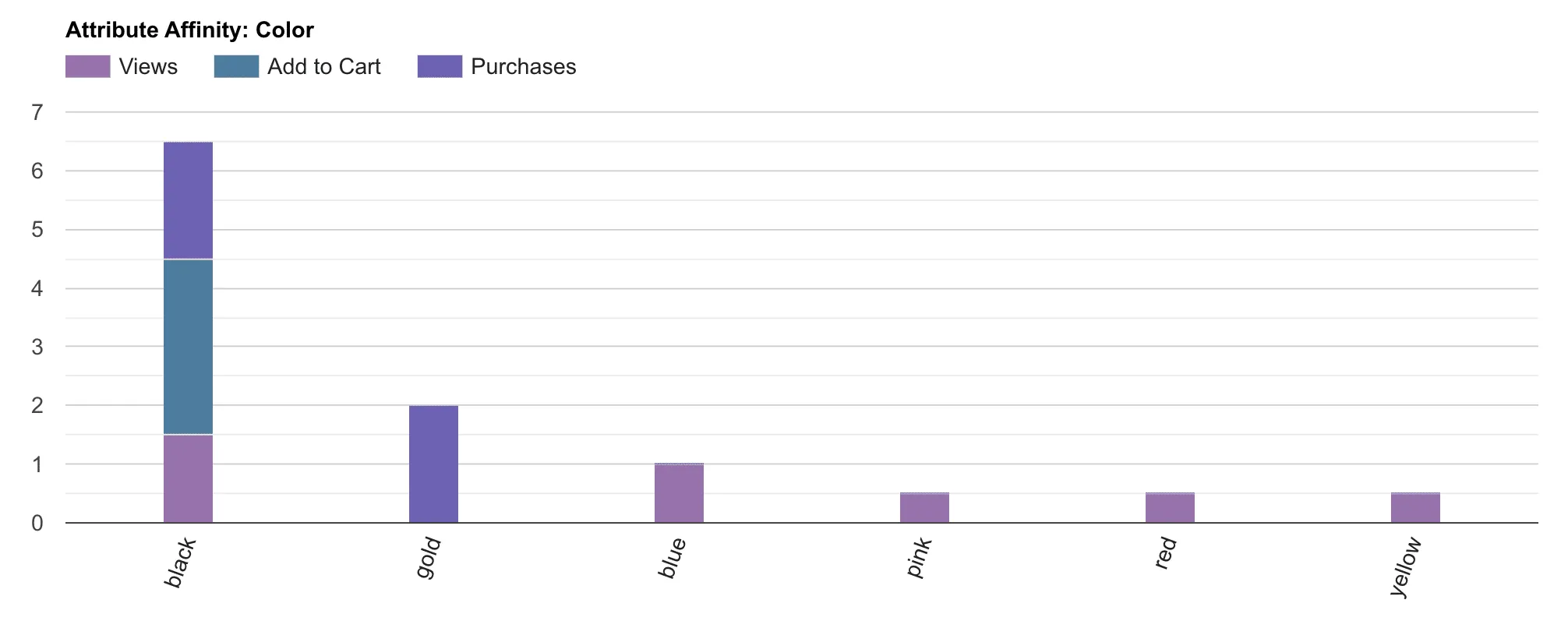
In the example below from an apparel website, the shopper has a strong affinity toward black products and a medium affinity toward gold products.

To leverage the power of User Affinity Sorting in their recommendations, optimization managers can create custom strategies using Configurable Strategies. By selecting the User Affinity Sort option, recommended products can be re-ranked based on how well they align with the affinity scores for each shopper. This re-ranking process ensures that the products most closely matching a shopper’s affinity are given priority, allowing for a highly personalized ecommerce experience recommendations.

Also read: Why Consumer Electronics E-tailers are Betting Big on Commerce Personalization

Creating Multiple User Affinity Configurations

The flexibility of Recommend™ extends further by enabling the creation of multiple User Affinity Configurations, enabling optimization managers to focus on different product attributes of interest. For example, they can create one User Affinity Configuration centered around brand affinity and another focused on color.

Then, using Configurable Strategies, the optimization manager can specify which User Affinity Configuration is used for each strategy, allowing them to create different recommendation strategies that sort the recommendations based on differing affinity configurations. This allows for in-depth analysis and comparison of the performance and shopper response associated with each attribute.

In summary, Recommend™ empowers optimization managers to experiment with and compare various personalization strategies using User Affinity Sorting.

By leveraging User Affinity Configurations and Configurable Strategies, optimization managers can gain insights into the shopper base’s preferences and tailor personalized product recommendations based on specific attributes like brand or color.

Learn more about Recommend™ or request a demo to see the platform in action.

Table Of Contents
User Affinity Configuration – How It Works
Creating Multiple User Affinity Configurations

Personalization Challenges: Solution for 1to1 Model Failures

Digital Experience Personalization
Blogs

Personalization Challenges: Solution for 1to1 Model Failures

Conventional wisdom has maintained that Personalization Utopia can be obtained by 1-1 Individualization. Sounds like a novel idea, but the reality for eCommerce executives is that it is not only difficult to achieve, it is simply not scalable. Thus, these initiatives eventually never take off and often find a home in the archives of failed plans.

Why is it so hard? What can retail leaders do to get close and what can technology do to assist?

Well for starters, cross-functional alignment is absolutely needed to determine the KPI impact. If there is a new program to reduce churn, eCommerce needs to lay out the strategy, corporate provides content, legal approves the media, merchants agree on categories that may be impacted, and lastly, the CFO approves the budget.

Many times, somewhere, one of these key links goes missing, and the programs never take off or never realize their full potential.

Most companies are quick to jump into initiatives like Improved Search when only 10% of the users use search. What about the 90% that don’t? And if browsing is key, then start with browse. Then, work your way to clearly understand the user’s journey.

You will be surprised with the results of the exercise. And don’t just rely on the eCommerce team – pull in your merchants (buyers) into the conversation. It shapes their demand planning too!

While popular initiatives take precedence, it is crucial to focus on YOUR business and see what makes sense to start from! So what gives? How does an eCommerce executive start? Here is a simple recipe for getting results fast!

  1. Identify the revenue or savings goals of the stated imperative – In fact, let the goal and the KPI drive the imperative, not the other way around! I have had dozens of executives and practitioners tell me they are locked in on a Customer Data Platform or a Client 360 or a Personalization/email initiative. But three questions in, I realize that the KPI goals were not clearly defined, participating teams were not identified, and the ability to measure, correct, and re-launch had no place in the slide show used!
  2. Find out the ability to attribute the exercise – aka build a Pro Forma for the ROI, NPV savings, or simply incremental Cash Flow. If the goal is to drive revenue, understand how you will measure specific impact so you don’t dilute other initiatives or worse, double-count benefits – that’s the worst case. Sounds basic, but I have been surprised before!
  3. Get to real-time audiences first – before you can personalize, you need to know who to go after. Then we can worry about how to get to them. Pulling in-store transactions can provide a world of insights because they are the best evidence of success. However, if they are not used to influence your online behavior then it’s not useful to anyone. Understand where your shoppers spend time and derive audience behavior to choreograph personalized customer experiences online.

In summary, as macroeconomic conditions create a lot of concerns on spend, it is imperative to go back to the basics of building a solid business case with a strong financial benefit tied to it.

The numbers are the easy part. Bringing cross-functional agreement along with user stories that are evidence-based (e.g. online conversions and store transactions) and justifiable in front of your CFO will drive success.

Companies that are willing to focus on the above will come out winning on the other side of the uncertainty because they invested in areas that matter the most – and not just because it ‘sounded right’.

Also read: The More You Personalize, the Better the Customer Experience – True or False?

Personalized Digital Experiences Across Touchpoints: The Key to Winning the Holiday Season in Today’s Digital World

Digital Experience Personalization
Blogs

Personalized Digital Experiences Across Touchpoints: The Key to Winning the Holiday Season in Today’s Digital World

Personalization has moved past the eCommerce world to include retail touchpoints across online and offline channels. Customers now demand to be met with personalized experiences on their turf and their terms. With traditional differentiation approaches such as strategic pricing and promotions no longer deemed ‘enough’, how can retailers stay relevant and champion the holiday season? The key is to provide contextual and personalized retail experiences at every point of interaction across the customer’s lifecycle.

Be Present Throughout the Shopping Process

The fundamental of getting omnichannel personalization right this holiday season begins with a clear understanding of the customer. When do they shop? Where do they shop? How do they shop? What influences their buying decisions? These are key questions that will help brands provide the right experience at the right stage.

To be relevant, brands must provide value to customers WHEN they require it the most.

Brands must be prepared to kickstart the holiday shopping experience early this year. According to Research 451, in a recent survey, 61% of customers stated that their holiday shopping expedition started in the months and weeks leading to the actual sales holidays, i.e., Black Friday/Cyber Monday.

With shopping already underway, brands need to recognize that customers will be in different stages of the buying process and mobilize triggered email marketing campaigns to meet them in their individual journeys.

Facilitate Real-time Omnichannel Interaction

Bolstered by advances in technology, customers now engage with brands over a plethora of channels. Brands must be present, listen, learn, and engage the customer with contextual interaction at each of these preferred touchpoints in real-time. Simply put, customers no longer want to search for product specifications, recommendations, or offers across platforms and devices, instead, they demand these interactions be personalized and tailored to meet them in each moment along their lifecycle.

Now, more than ever, to thrive in an already crowded and highly competitive landscape, such as retail, brands must provide value WHERE the customer requires it.

It is also important to acknowledge that customers engage and transact using a mix of devices. According to 451 Research, 66% of customers surveyed chose in-store as their preferred mode of shopping this holiday season, while 51%, 31%, and 27% of customers chose computer web browsers, mobile apps, and mobile web browsers respectively. Brands must provide a seamless and consistent ecommerce personalization solutions as customers transition across platforms and devices to guarantee positive outcomes.

Enable Seamless Buying Experiences

Customers want to shop based on convenience. In its paper, 451 Research found that while 56% of customers surveyed responded they plan to do their holiday shopping online, 44% stated they would prefer in-store shopping this year. This indicates a shift towards digital.

Customers want the option of online, offline, and even hybrid buying.

In fact, purchases made online that were then picked up either by the curbside or at the brick-and-mortar store increased by 52%.

With the path to purchase diverging, brands need to provide customers with options to complete their transactions and personalize each interaction thereof. For example, brands can provide information to facilitate a smooth and contactless pick-up experience and send real-time updates.

To gain a competitive advantage this holiday season, brands must provide value to customers HOW they require it. Below we discuss how they should go about this.

Build Trust to Scale Personalization

Data is key to personalizing the customer experience across touchpoints. To provide a contextual and personalized experience, brands must piece together first-party, second-party, and third-party data from multiple sources to create a real-time customer profile of the customer. It is this data that is leveraged and synthesized into actionable insights to provide the next best action and enhance the customer experience.

However, the challenge of data privacy and security can pose a hurdle to brands.

451 Research found that while 85% of customers preferred privacy over personalization, 43% strongly agree that context for how/why a business uses their data would make them more likely to share it.

To secure this crucial first-party data, brands must provide rewards such as social proof messages as incentives to improve the customer experience. Further, brands must be transparent about what data is being collected, why it is being collected, and how it is being used within the guidelines stipulated. Brands would also greatly benefit from giving customers the ability to manage their personal preferences.

Configure Personalized Customer Experiences

67% of customer experiences fail to meet customer expectations.

To win the holiday season, brands must bridge the gap between customer experience and expectation. With 9 out of 10 customers stating having a bad experience will make them less likely to shop with a brand in the future, it puts into perspective the pivotal importance for brands to understand what customers expect this holiday season.

According to 451 Research, customers’ expectations for the holiday season include product reviews, detailed product information and specs, convenient experience across online, offline, and in-store, better ecommerce search capabilities, convenient payment options, rich image and video content, personalized experience based on past purchases, and the ability to configure preferences.

To stay relevant and come out on top this holiday season, brands must personalize each expectation based on data (personal, behavioral, and transactional) to provide the right contextual experiences at the right time in each interaction along the customer journey.

Ensure Effective Digital Transformation Strategy

According to 451 Research, there is a correlation between customer experience emphasis and equity returns. With a $305B opportunity available to brands based on 451 Research’s customer experience measure, providing a one-to-one personalization across all touchpoints becomes pivotal. Yet, to bridge the gap between expectation and experience, brands must improve their digital strategy to be more contextualized and personalized. In its paper, 451 Research found that digitally driven businesses demonstrate a composite index that is 3X more effective than those that are lacking.

If personalized customer experience is to remain a priority, brands must adopt a digitally-driven approach. This would reflect customer experiences that according to 451 Research are:

  • Individualized and managed by algorithmic initiatives.
  • Leverage advanced ML and AI capabilities.
  • Harness real-time 360-degree customer data profiles.
  • Driven by cloud-based processes.
  • Managed end-to-end across the enterprise.

Also read: Why You Should Hyper-Personalize Customer Experiences

In summary, to capitalize on the season’s veritable goldmine, brands must ramp up their ecommerce personalization platform strategy to build on a solid and adept digital foundation. To truly stand out from the competition this holiday season, brands must invest in digital capabilities that enable real-time, omnichannel, intelligent personalization across touchpoints at scale.

Learn how Ada Global’s omnichannel personalization platform can help your business.

Table of Contents
Be Present Throughout the Shopping Process
Facilitate Real-time Omnichannel Interaction
Enable Seamless Buying Experiences
Build Trust to Scale Personalization
Configure Personalized Customer Experiences
Ensure Effective Digital Transformation Strategy

Consumer Electronics Etailers Embrace eCommerce Personalization

Digital Experience Personalization
Blogs

Consumer Electronics Etailers Embrace eCommerce Personalization

Consumer electronics is a rather crowded space with a swarm of brands trying to make their presence felt in every category — from wearables to televisions and headphones to laptops. Unless a shopper knows exactly what they’re looking to buy, consumers in this space often fall victim to ‘overchoice,’ a term coined by Alvin Toffler in his 1970 book Future Shock.

As the name suggests, the overchoice effect occurs when a buyer is overwhelmed by a large number of options available, often resulting in the person abandoning the decision-making altogether, or worse, taking their business elsewhere. For today’s consumers who seek instant gratification, experiencing this is a nightmare. And for a retailer, it’s bad for business.

In a bid to improve product discovery across shoppers’ digital commerce journeys, retailers have been investing heavily in personalization. According to a Forrester study, personalization ranked the highest among tech investments in 2021.

The same holds true for consumer electronics retailers. B.TECH is among Egypt’s top retailers in this category, with more than 100 stores and a growing online presence. The retailer saw a sharp increase in its ecommerce revenue in 2020, as consumers stayed home and relied on electronic devices for professional as well as social and entertainment needs.

That said, B.TECH realized that product discovery was a problem — it was important to surface relevant products with respect to each shopper and their current context. Doing so consistently is a surefire way of earning (and keeping) a shopper’s loyalty.

To individualize commerce experiences in real time and at scale, B.TECH deployed an AI-powered personalization engine. Let’s take a quick look at their personalization in action.

1 Category Page

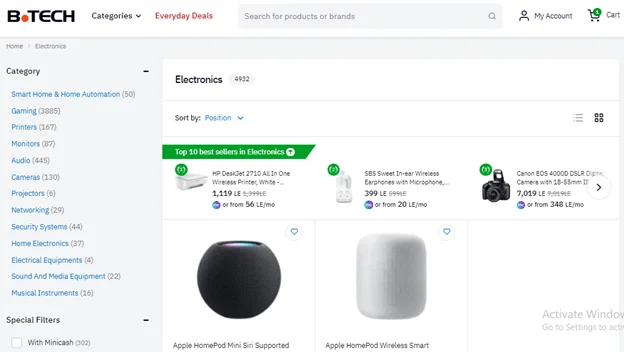
When a shopper visits a category page, it’s likely that they are in exploration mode and open to suggestions. The image below shows a merchandised placement for ‘Top 10 best sellers’ at the top of the electronics category page. This helps a shopper discover popular items they probably hadn’t considered exploring before. This approach also works well for new or unknown visitors for whom there is no data on behavior and preferences.

2 Product Detail Page

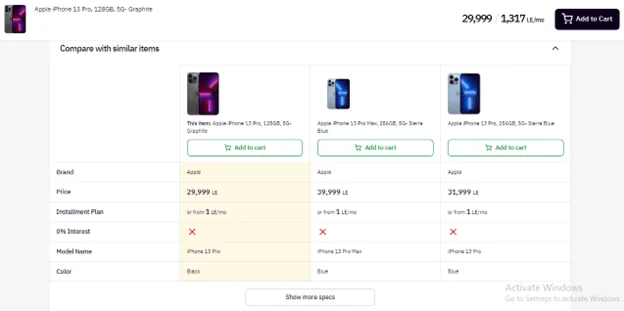
When a shopper visits an item page, they also see the option to ‘Compare with similar products.’ While this may be a common feature, what makes this more convenient is that the shopper can easily compare the specifications without having to visit each product page.

This placement uses advanced merchandising that enables relevant upsell and cross-sell recommendations based on the item being viewed, without the need for manual merchandising.

3 Add-to-Cart Page

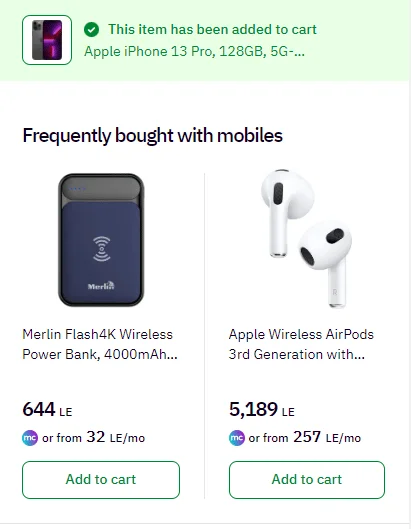
Upon adding an item to the cart, the shopper gets relevant cross-sell recommendations for accessories or products compatible with the main product, sparing the shopper the effort of searching for these items separately. For example, Wireless AirPods are recommended when an iPhone is added to the cart.

4 Cart Page

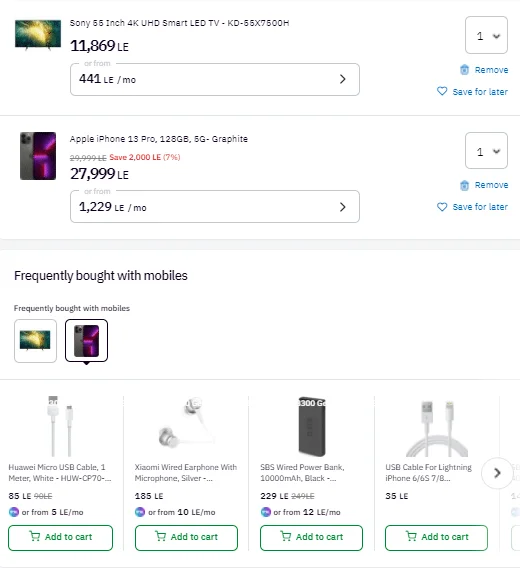
When the shopper proceeds to the cart page, the engine again reminds them of complementary items they might want to purchase along with the main product, without being pushy. But what’s unique about this recommendation block is that the shopper can switch between the items in the cart and view recommendations for each item separately.

And when a shopper empties their cart, instead of just an ‘Oops! Your cart is empty’ message, the engine suggests strong alternatives to the items the shopper deleted. These recommendations make sense as the shopper had a clear buying intent.

In addition to the aforesaid efforts, B.TECH delivers relevant recommendations on the home page as well based on a shopper’s search queries, previously viewed items, and items in their cart — making it easier for the shopper to pick up where they’d left off.

Product discovery is now a breeze for B.TECH’s customers. Since personalizing its web store, B.TECH has seen strong business results:

  • 18.6% of the sales from the website, mobile site and apps can be attributed to personalized recommendations driven by the engine (compared to 11% earlier)
  • 5% attributable revenue from cross-sell
  • 10X RPMV on the cart page

Another retailer that turned to personalization is Verkkokauppa.com. The company is among Finland’s largest online stores, with 65,000 SKUs in multiple categories, including consumer electronics.

Verkkokauppa moved from traditional commerce site search to self-learning, personalized search in order to solve pressing issues such as irrelevant search results and instances wherein a shopper sees a no-results page after making a search query.

To elaborate, when a shopper searches for ‘Apple’, the search could show all the available Apple products. But would this be relevant to the shopper? Probably not. Personalized search helped Verkkokauppa address this problem by using a strategy known as Wisdom of the Crowd (WOC).

WOC typically uses a machine learning algorithm that learns from the collective behavior of shoppers, their search queries and what product they view or purchase thereafter. It then uses this information to display search results that in all likelihood match the shopper’s intent. Shoppers who use search often have clear purchase intent, and personalized search helped the retailer convert these shoppers quicker.

In addition to search, Verkkokauppa also personalized other commerce touch points of product recommendations, browse or category pages and content. Here are the business outcomes they experienced as a result:

  • 31% higher conversions
  • More than a 24% increase in basket sizes
  • Over 25% attributable sales from product recommendations (up from 6% earlier)
  • Sessions involving search convert 5X more than the ones without search

In conclusion, it is paramount that retailers personalize every key touch point in the online shopping journey, including search, product recommendations, browse and content. Doing so will allow for a more holistic experience that customers expect today. Creating contextually relevant experiences consistently will also help retailers become top-of-mind brands at a time when customers are spoiled for choice and loyalty is hard to come by.

This article was first published on Retail TouchPoints.

Also read: Evolution of Ecommerce Personalization: A Look at Trends in 2024

7 Ways to Use Dynamic Experiences to Reduce Cart Abandonment

Digital Experience Personalization
Blogs

7 Ways to Use Dynamic Experiences to Reduce Cart Abandonment

Cart abandonment is a user behavior every eCommerce business hates but has to contend with every day. Among the top reasons for cart abandonment are high shipping costs or taxes, mandatory account creation on the site, slow delivery, and window shopping.

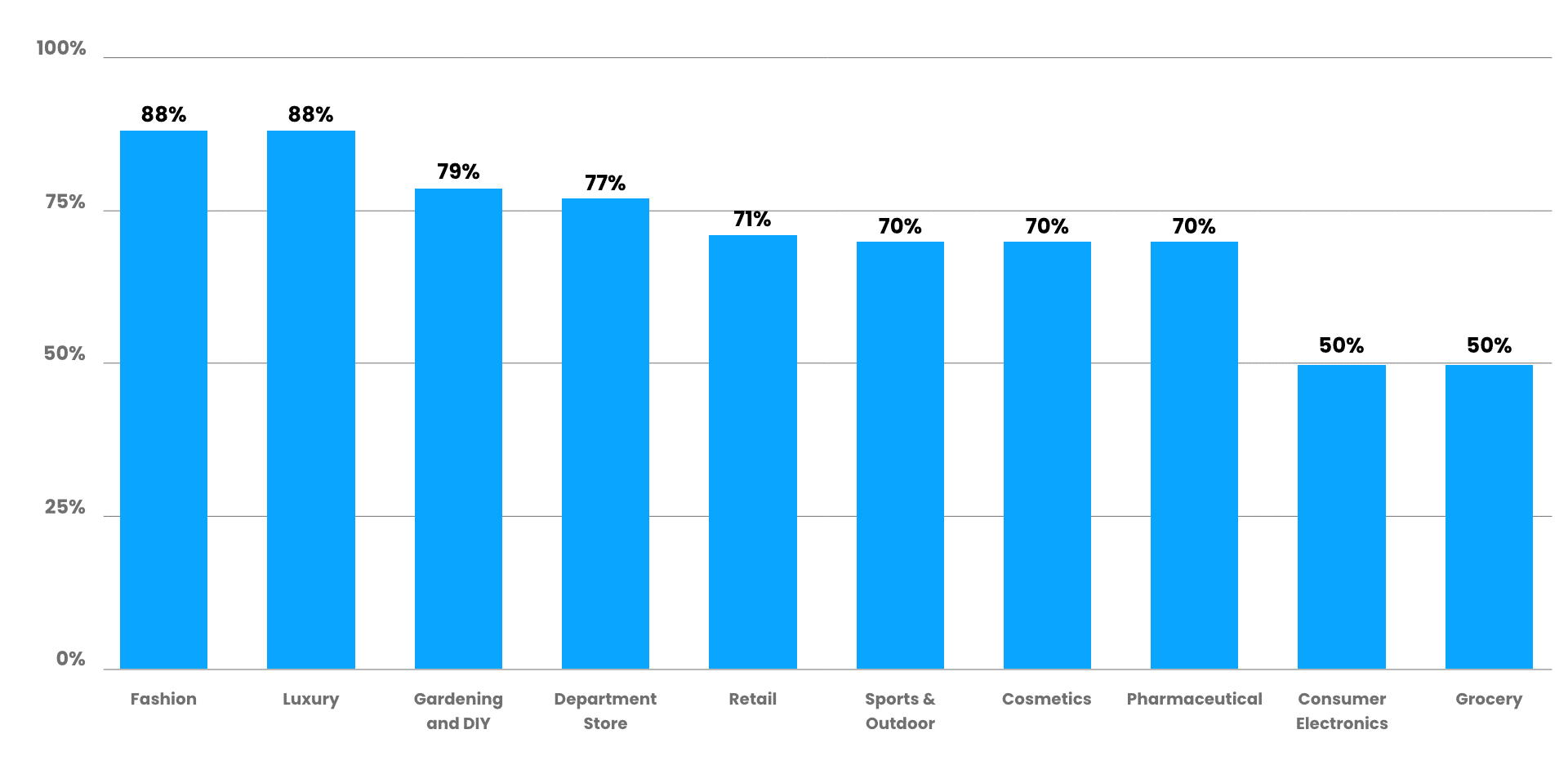
Take a look at the global cart abandonment rates by segment in 2022:

Source: Statista

Losing a customer at such a later stage in the purchase funnel is disastrous on your revenues. So, how do you prevent revenue loss due to cart abandonment?

The standard tactic used by marketers is to send cart recovery emails triggered by the event. And it does deliver results—one study says you can get up to 10% of shoppers to complete their transaction by running triggered email marketing campaigns.

However, this strategy can work only if you already have the user’s email address. So, the question stands: What can you do to ensure that customers who add items to cart complete the transaction sooner rather than later?

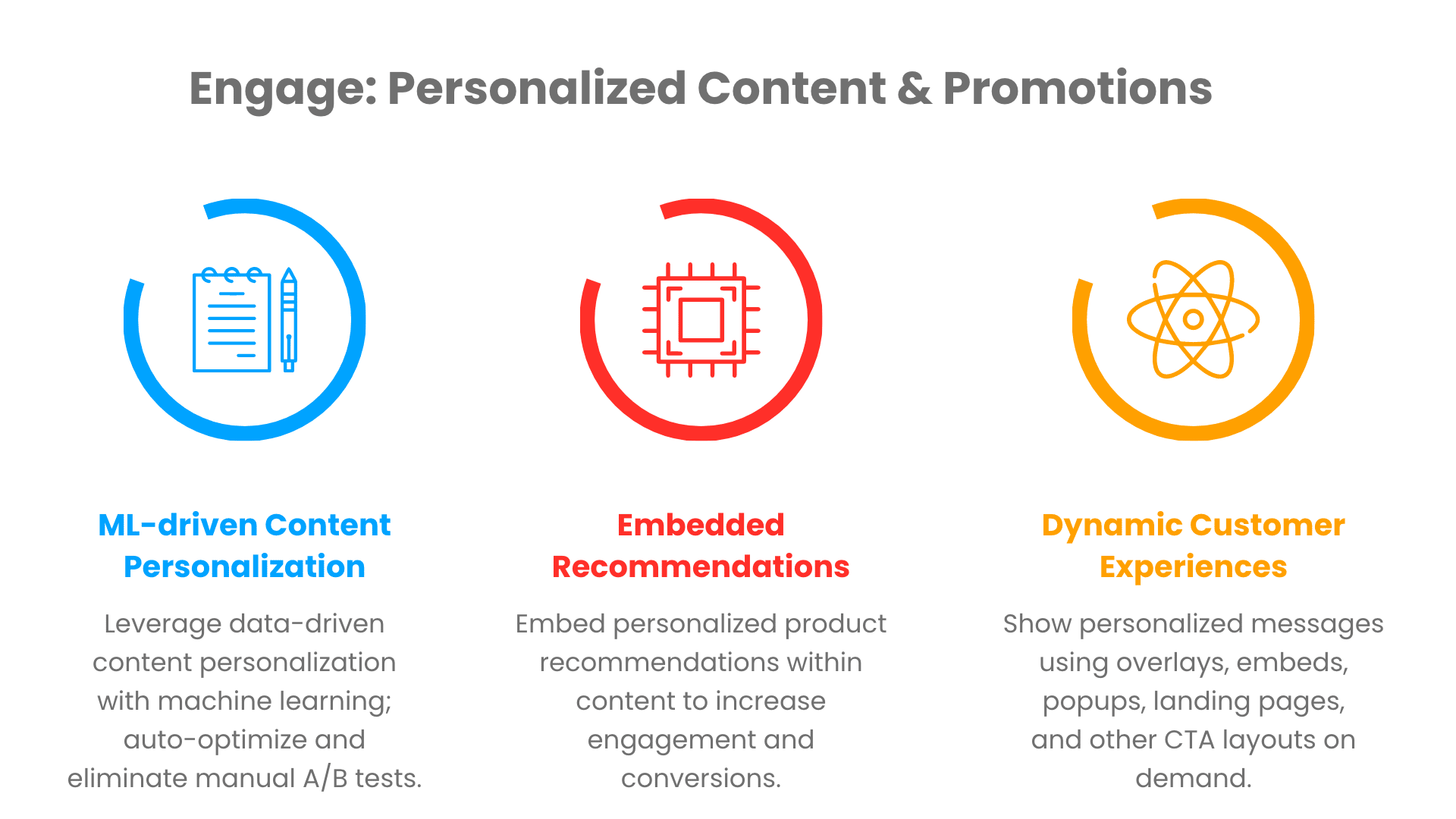
The answer is to add preventive measures to your curative measures. While most of the key reasons for cart abandonment are business-level reasons, you can do a lot with some smart content personalization strategies. Use a mix of persuasive conversion optimization techniques and dynamic, personalized, and engaging customer journeys created using content personalization engines like ADA Global’s Engage™ to encourage users to checkout.

Let’s dive right into the strategies to encourage users to checkout.

Reducing Cart Abandonment: 7 Proven Strategies

1 Use the Power of Social Proof

Social proof may sound like a common answer to many problems in eCommerce, but that is because it is a powerful device when used right. Don’t just add social proof widgets to your product page and forget about it—show the right kind of social proof on the right page through dynamic messaging.

For example, on the product page, show the average ratings—highlight the good ones. Show how popular the product is, how many people are looking at it, adding it to cart and purchasing it right now. On the cart page, show reaffirm the messages that show urgency, like “x number of people are buying this now”, “Flying off the shelves”, or “Low Stock”.

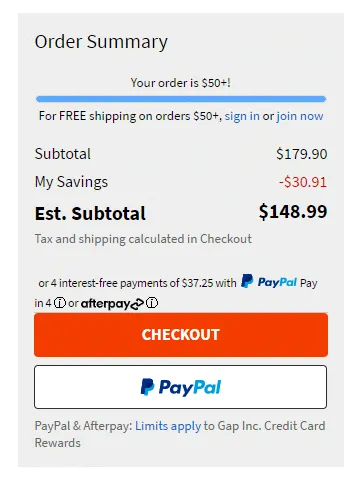
On the cart page, security badges can be used to assure users that the process will be secure (e.g. Norton Secured or Guaranteed Safe Checkout). Even showing multiple popular payment options on this page can act as trust-evoking social proof.

Gap.com’s cart page highlights PayPal and Afterpay,
which can instill trust among users.

All this can help alleviate different kinds of user anxieties and motivate them to complete the transaction.

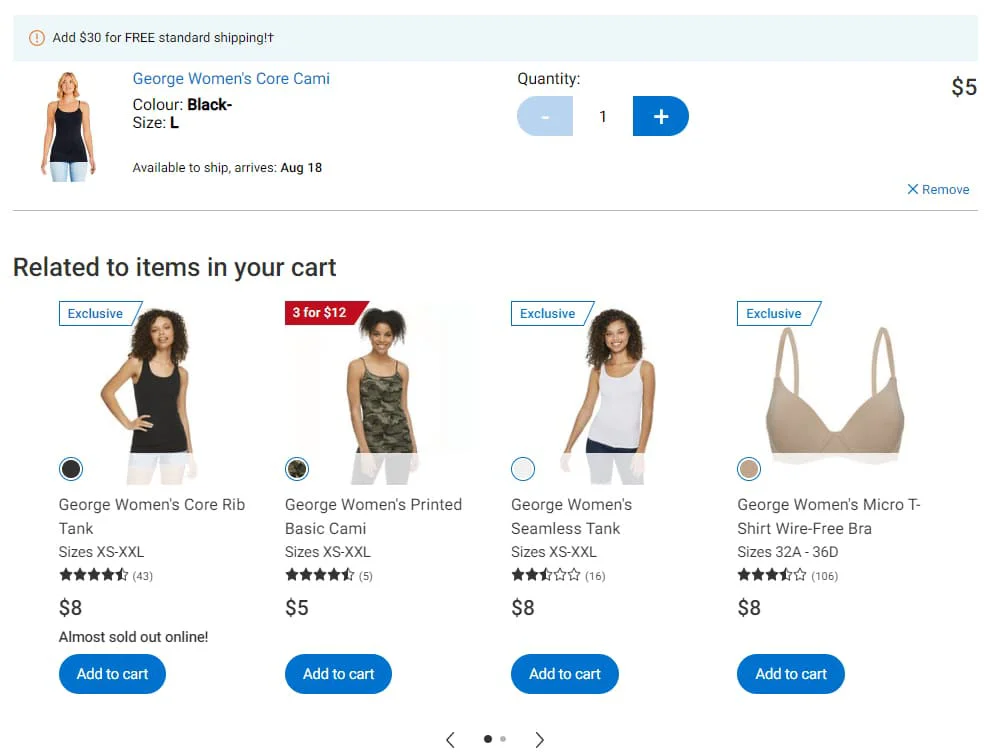
2 Recommend Products to Meet the Shipping Fee Threshold

In today’s age of free deliveries and next-day deliveries, delivery fees are a prime perpetrator of cart abandonment. In the US, 63% of users abandon carts because of shipping costs.

But you cannot realistically provide free delivery for small order values, right? It won’t work out logistically. Worry not, 68% consumers are willing to spend enough money to qualify for free shipping. Use this consumer psychology to your advantage, and show recommendations of complementary products, cross-sell recommendations, gifts, and offers on the cart page or sitewide.

With ADA Global Engage™, you can do this by specifying a cart order value after which customers will be shown incentives and recommendations. The incentives or products shown to each user will depend on the price difference between the existing cart value and the promotional thresholds alongside user affinities and preferences.

This will ensure that each user sees products and content that are hyper-personalized and relevant to them and get them quickly to that all-important free shipping.

3 Use Exit Intent Popups and Time-based Popups

Exit intent is the recognition of a user’s intent to exit the site. This is identified by tracking user behavior and capturing the moment when the user moves their mouse to the address bar or to close the browser.

By identifying this behavior in real time, Engage™ allows you to show the user popups with dynamic content personalization. This can include visual reminders of the items they’ve left in their basket (“Don’t forget to checkout”) or showing time-bound discounts for certain items in their basket (“Get extra 5% off T-shirts for the next one hour!).

Popups with cart reminders can also be shown based on the time spent by the user on the site. For example, if a user has been on the site without any activity for more than five minutes, you could show a visual cart reminder.

Showing images of the items in the cart is more impactful than simply showing a message, as consumers tend to react positively to visuals than simply text.

Engage™ has several ready-to-use templates for these popups, which means you can deploy such personalized popups easily and effortlessly.

4 Auto Discovery of Segments

Segment personalization is a powerful tool when it comes to cart abandonment. With ADA Global Engage™, the AI is constantly looking for segments where customers fall into two groups:

  • Cross-sell Candidates are customers who generally checkout but with low average order values (AOVs). These customers would be shown cross-sell items and initiatives to increase their basket size.
  • Incentive Candidates add a lot to their basket but do not checkout. They would be shown the promotions and initiatives that will help them get to checkout.

5 Personalized Cart Abandonment Emails

Yes, we did say that cart abandonment emails are basic. But here we’re talking about ai email personalization deployed through Engage™, not the standard “You left this in your cart” message.

Firstly, using unified data and real-time analytics, the ADA Global platform is able to identify whether the user completed the transaction on another channel or not.

Secondly, it can also add dynamic personalization to the emails. Cross-sell and Upsell strategies can entice the customer back to the site with additional items they may not have considered. The Similar Products strategy can suggest items which may resonate with the customer if they were having second thoughts about the item they abandoned..

This adds layers to the cart abandonment email that enriches the customer buying experience and increases engagement levels and loyalty.

ADA Global’s Engage™ is easily added to any HTML email, so it is platform-agnostic. This means that any email tool can be personalized and turned into a complete re-engagement solution.

With Engage™, you can personalize different email campaigns as well as the entire email lifecycle of customers with individualized content, personalized product recommendations, and journeys.

Using product recommendations on the Add to Cart and Cart pages can help you increase AOVs and basket sizes and also encourage customers to checkout. Some strategies you can use for that are:

6 Add Product Recommendations to Add to Cart Confirmation Popups

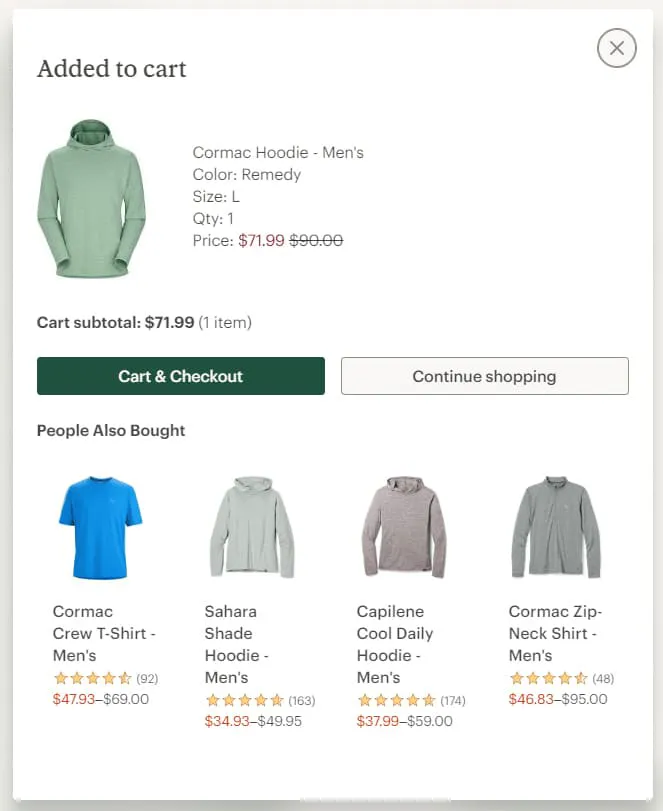
Generally, Add to Cart confirmations are a static “this product has been added to bag” message. But this is the perfect time to engage customers and try to get them to buy more, because they’ve already found something they liked on your website and are in the right frame of mind to buy more if they find another right product.

So, convert your Add to Cart confirmation page into a popup and add dynamic product recommendations to it.

Here’s an example:

Product recommendations on add-to-cart confirmation page

Engage™ uses machine learning to deliver hyper-personalized recommendations based on the user’s context, preferences, and behaviors. The platform allows you to embed recommendations anywhere on the site and customize the recommendation strategy as per your business goals.

The recommendations can be based on a mix of customer affinities, popular products, and cross-sell strategies.

7 Recommend Products on the Cart Page

A page that marketers often ignore is the cart page. Look at Amazon—they use every page on their site to continuously make ecommerce personalization tools of all sorts—similar products, complementary products, cross-sells, or upsells.

The cart page should be used to promote more products using dynamic recommendations, similar to the Add to Cart Confirmation page strategies mentioned above. This is an ideal space to show upsells and cross-sells and increase basket sizes and AOVs. The user is already in the mind-frame to purchase from you, so take advantage of it.

Product recommendations on the cart page

If people are exiting from the Cart page, it’s likely that there are issues in your shipping costs, delivery options, discount codes, or payment options.

Bonus Tip: Know What Drives Users Away and Fix It

The importance of user research in delivering engaging real time customer engagement cannot be emphasized enough. You must conduct on-site user research such as session recordings, usability reviews, and surveys to understand why your users are abandoning cart.

As mentioned earlier, shipping costs are a prime deterrent to completing a transaction, but almost 50% of US shoppers don’t complete their transactions because discount codes don’t work.

So, find out what is causing friction in your customers’ journey and see what you can do to reduce the friction. It could be delivery costs, lack of trust messages, lack of payment options, irrelevant form fields—whatever it is, fix it.

Read more about how ADA Global Engage™ can personalize content and promotions to increase customer engagement and drive conversions.

Table Of Contents
Reducing Cart Abandonment: 7 Proven Strategies
Bonus Tip: Know What Drives Users Away and Fix It

The What and the Why of B2B Personalization

Digital Experience Personalization
Blogs

The What and the Why of B2B Personalization

While B2C businesses are competing fiercely to make customer experiences on their digital channels more and more personalized, many B2Bs are still considering whether investing in personalization is worth it.

In 2020, a Folloze research showed that while 77% of B2B professionals believed that personalized experiences would improve customer relationships, 54% found B2B personalization more difficult to achieve than B2C personalization.

What you need to remember is that at the receiving end of B2B products and services is, nonetheless, a consumer; it’s just that the consumer has a different persona. And the B2B customer, like any other user in the past few years of accelerated digitalization, has evolved.

2 Key Reasons to Personalize B2B Customer Experiences

Here are two main reasons why hyper-personalization is essential in the B2B sector today.

1 Customers Expect It

Ever since Amazon started personalizing their website and app experiences, every customer wants that kind of experience from all brands they interact with, even B2B. Therefore, when 80% of US consumers say they would prefer to buy from a company that personalizes experiences for them, isn’t it safe to assume that B2B consumers would also have similar expectations?

When John Bruno, the then Senior Analyst at Forrester (and now VP of Strategy at PROS), spoke in an Ada Global (then RichRelevance) webinar in 2018, he said, “Regardless of the buying dynamic—B2C or B2B—it’s the next great experience that resets the bar for what a good customer digital experience should look like. And this has become the expectation for all buyers.”

So, if you thought only B2C consumers want personalized experiences, time to think again. Engage your B2B customers with hyper-personalization because they want it from you as much as from their favorite fashion brand.

2 You Can Sell More and Sell Efficiently

It’s true that most B2B companies do not sell to the multitudes like B2C generally does. And B2B products and services are often vastly different from those of B2C. However, around 80% B2B companies see sales growth once personalization is implemented.

Personalization also brings down the amount of effort sales teams have to put in for lead acquisition. With ecommerce personalization tools, you can identify prospects faster and more easily, which means less time spent sending cold emails that are ignored or deleted without opening.

Personalization helps you nurture and engage qualified leads, by focusing on individual needs and delivering dynamic content personalization and products or services relevant to each customer. This means shorter buying cycles and faster deal closures.

Case Study

Read how a leading UK-based office supplies company drives revenue through hyper-personalized cross-sells.

Read Now

B2B Has Evolved from Customization to Individualization

Many B2B brands add some personal touches to emails, the most common of which are including the recipient’s name in the subject line and salutation, or adding the recipient’s company name or designation to the body of the email.

This is basic and can be called customization, but not personalization.

If you were talking to a customer or potential customer face to face, wouldn’t you remember their preferences (they are a Lakers fan), address them as they choose to (a nickname), or know that they like to have working lunches at French restaurants?

Post-pandemic, when so many in-person meetings have become digital, to achieve true personalization, you need to individualize customer experiences at all touchpoints—email, website/app, phone, live chats, and personal meetings. This means you need to activate audience intelligence for all kinds of communications and interactions between you and your users, and “own more of the customer lifecycle”, as Forrester puts it.

What B2B Personalization Actually Means

Ex-Forrester John Bruno says the personalization bar is actually higher in B2B than in B2C because there are more personal interactions, and more explicit data in the business-to-business segment than in the business-to-consumer segment.

This is because customers or the sales team directly get in touch with each other in a B2B interaction and you get to know the buyer personally early in their purchase journey.

The personalization curve of a business may go from no personalization to basic segmentation to advanced segmentation, and finally, individualization. “The goal should be to take a generic experience, tailor it to a segment and then eventually make that a segment of one,” Bruno says.

To explain further, from providing the same generic experience to all users, you start creating distinct experiences for different segments based on data such as gender, seniority level, or last interaction with you.

Further, you enhance the experience by creating smaller and more focused segments based on data such as browsing patterns, what content personalization they consume on your website, click-throughs and pageviews, and past interactions with someone from your team.

Finally, when you’re ready for 1:1 personalization, you interact with each customer in real time, analyzing and addressing intent across all touchpoints.

So, the focus for a B2B marketer shifts from lead acquisition to optimizing customer experiences. You use everything you know about the B2B customer and create individual engagements and experiences that delight them.

Time for B2B Companies to Stop Pondering and Start Personalizing

Many companies are held back in their personalization efforts by budgetary constraints, inability to prove the ROI of investing in a strong ecommerce personalization platform, or lack of skilled resources to make the most of the platforms.

Ada Global has worked with several B2B commerce players and helped them deliver excellent customer experiences and increase revenue. We can help with your digital transformation and assist you in creating a personalization roadmap, enabling you to start showing ROI in months, if not weeks.

Learn more about Ada Global’s all-in-one personalization engine and how it can help grow your B2B business. Or request a demo here.

Table of Contents
2 Key Reasons to Personalize B2B Customer Experiences
B2B Has Evolved from Customization to Individualization
What B2B Personalization Actually Means
Time for B2B Companies to Stop Pondering and Start Personalizing