
7 Advertising Budgeting Methods That Businesses Should Use

Personalisation
Blogs

7 Advertising Budgeting Methods That Businesses Should Use

Why is Advertising Budget Important for Businesses?

Advertising is more than just spreading the word about your products or services; it’s about reaching the right audience at the right time with the right message. But without a clear budgeting strategy in place, your advertising efforts could fall short of achieving their full potential. This is where understanding different budgeting methods becomes paramount for businesses striving to make a meaningful impact in the market.

An advertising budget serves as a roadmap, guiding businesses on how much they can afford to spend on advertising and where those funds should be allocated. It helps in prioritising marketing efforts, ensuring that resources are utilised effectively to achieve specific business objectives. Without a defined budget, businesses risk overspending or underspending on advertising, both of which can lead to suboptimal outcomes.

7 Advertising Budgeting Methods That Businesses Should Use

There are seven advertising budgeting methods that you should use to maximise your advertising effectiveness, such as:

1. Percentage of Sales Method

This method allocates a fixed percentage of past or anticipated sales revenue towards advertising. While straightforward and commonly used, critics argue that it may be too conservative or not accurately reflect future growth potential.

2. Objective and Task Method

Businesses using this method set clear marketing objectives and determine the tasks needed to achieve them. Advertising expenditures are then aligned with these objectives, ensuring spending is focused on driving desired outcomes.

3. Competitive Parity Method

Businesses aim to stay competitive in the market by comparing advertising spending with competitors. While helpful for benchmarking, blindly matching competitors’ budgets may not guarantee desired results.

4. Market Share Method

This approach ties advertising expenditures to market share, with the assumption that higher spending leads to increased market share. However, critics argue that market share alone may not be a reliable indicator of advertising effectiveness.

5. Unit Sales Method

Here, businesses calculate advertising costs per unit sold and multiply it by the desired number of units to be sold. This method is effective when advertising costs can be accurately determined on a per-unit basis.

6. All Available Funds Method

This aggressive approach allocates all available profits to advertising, prioritising brand awareness and customer acquisition. However, it may limit investments in other areas crucial for business growth.

7. Affordable Method

Businesses determine their advertising budget based on what they can afford, considering various factors like overall objectives, competition, and market presence. While flexible, this method may overlook opportunities for strategic investment.

Each of these budgeting methods offers unique advantages and considerations. By carefully evaluating your business’s goals, resources, and market dynamics, you can select the most appropriate method or combination of methods to maximise the impact of your advertising efforts.

How to Choose The Right Advertising Budgeting Methods for Business?

Selecting the most suitable advertising budgeting methods for your business requires careful consideration of several key factors. Here’s a comprehensive guide to help you make informed decisions:

1. Understand Your Business Goals

Start by clearly defining your business objectives and marketing goals. Are you aiming to increase brand awareness, drive sales, expand market share, or launch a new product? Different budgeting methods may align better with specific objectives, so it’s essential to have a clear understanding of what you want to achieve.

2. Evaluate Market Dynamics

Assess your target market’s competitive landscape, industry trends, and consumer behaviour. Consider factors such as market saturation, customer preferences, and competitor strategies. This analysis will help you identify opportunities and challenges that may impact your advertising budgeting decisions.

3. Assess Resource Constraints

Determine the financial resources available for advertising and marketing initiatives. Consider your overall budget, cash flow projections, and any limitations or restrictions on spending. It’s crucial to allocate resources efficiently to maximise your advertising efforts’ return on investment (ROI).

4. Review Past Performance

Analyse the effectiveness of previous advertising campaigns and budgeting methods used by your business. Identify what worked well and what could be improved. Learning from past experiences allows you to make more informed decisions and refine your budgeting strategies for future campaigns.

5. Consider Risk Tolerance

Evaluate your business’s risk tolerance and appetite for experimentation. Some budgeting methods, such as the “All Available Funds” approach, may involve higher risks but offer the potential for significant rewards. Assess your comfort level with risk and choose budgeting methods that align with your business’s risk profile.

6. Seek Expert Advice

Consult with marketing professionals, financial advisors, or industry experts to gain insights and recommendations. They can provide valuable expertise and perspective on selecting the most appropriate budgeting methods based on your business’s unique circumstances and goals.

7. Stay Flexible and Adaptive

Recognise that market conditions and business priorities may change over time. Be prepared to adapt your advertising budgeting methods accordingly to reflect evolving needs and opportunities. A flexible approach allows you to respond effectively to emerging trends and optimise your advertising strategies for maximum impact.

Effective advertising budgeting is not just about allocating funds; it’s about making strategic decisions that drive tangible business outcomes. By understanding the various advertising budgeting methods and carefully selecting the right ones for your business, you can maximise the impact of your marketing efforts and achieve sustainable growth.

Consider your business goals, market dynamics, resource constraints, and risk tolerance when choosing budgeting methods. Review past performance, seek expert advice, and stay flexible in your approach to adapt to changing market conditions.

Remember, the goal is to spend money on advertising and invest it wisely to generate meaningful returns. With the right budgeting strategies in place, you can effectively reach your target audience, enhance brand visibility, and drive customer engagement.

Increase the Effectiveness of Your Advertising Budget for Business Growth with ADA

To maximise the effectiveness of your advertising budgeting methods and drive significant performance growth, your business needs support beyond just understanding each method. You also need to ensure that every advertising pound you invest delivers a sustainable positive impact on your business growth. This is where ADA comes in.

Through ADA’s Full Funnel Campaign Management, we offer comprehensive solutions to help businesses optimise their advertising budgets and achieve measurable results. From strategic planning to execution and analysis, we can support your marketing efforts at every customer journey stage.

Contact us today to learn more about how our services can help increase the effectiveness of your advertising budget for your business growth. Let us partner with you to drive success and unlock new opportunities in your marketing efforts!

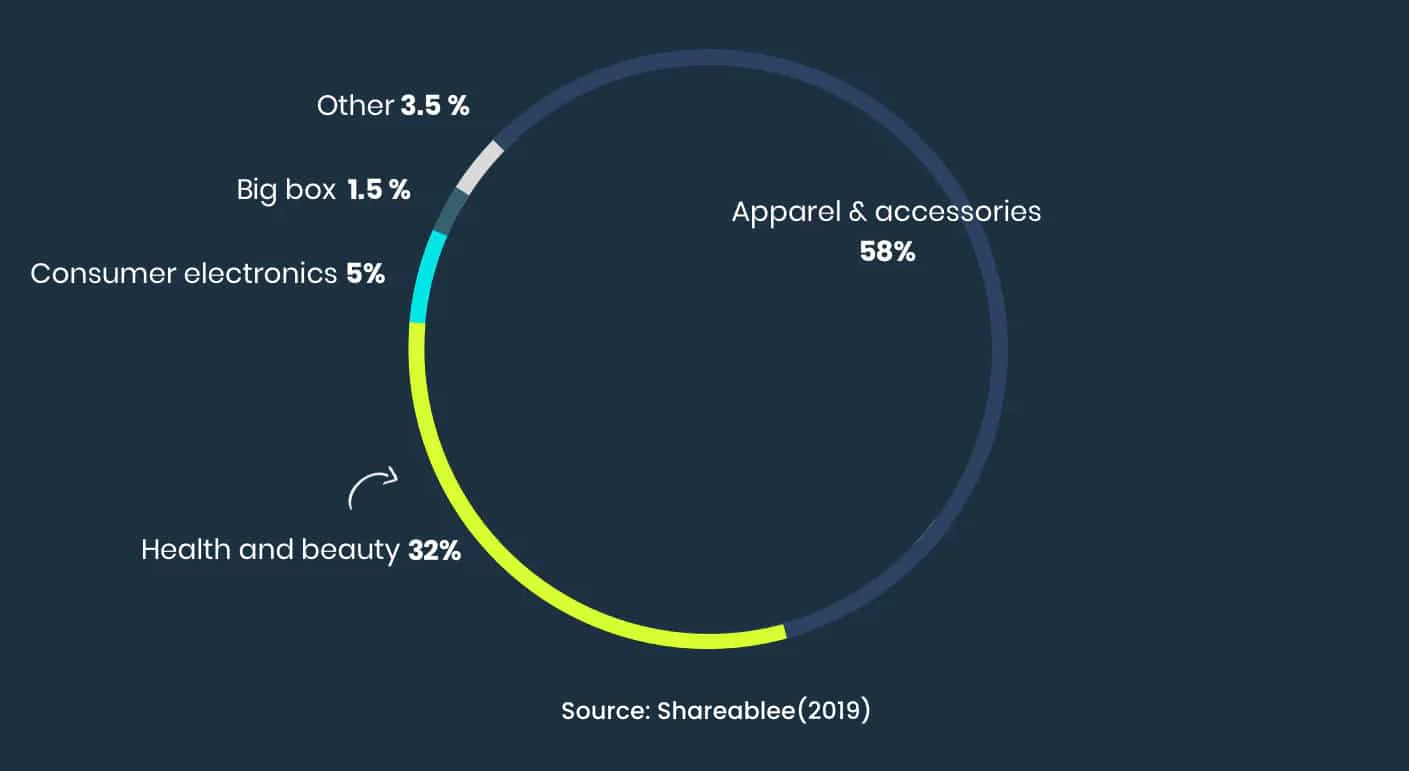
Table Of Contents
Why is Advertising Budget Important for Businesses?
7 Advertising Budgeting Methods That Businesses Should Use
How to Choose The Right Advertising Budgeting Methods for Business?
Increase the Effectiveness of Your Advertising Budget for Business Growth with ADA

Navigating the Beauty Maze: AI’s Role in Retail and Supply Chain Planning

Merchandising and Supply Chain
Blogs

Navigating the Beauty Maze: AI’s Role in Retail and Supply Chain Planning

In the bustling world of health, beauty, and wellness retail, staying ahead of the curve is not just a strategy – it’s a necessity. With customers demanding more personalized experiences and seamless transactions, retailers are faced with a myriad of challenges. From managing promotions to balancing complex product assortments, the road to success can seem daunting. And it doesn’t help that previously successful merchandising and supply chain planning strategies are now glaringly failing.

In this blog, we’ll delve into the obstacles faced by health, beauty, and wellness retailers when it comes to retail planning and explore the transformative role AI plays in overcoming them.

Riding The Waves Of Ever-Volatile Demand

One of the biggest challenges for beauty retailers is predicting and managing demand fluctuations. Demand for beauty products can vary depending on factors such as seasons, holidays, promotions, fashion trends, customer preferences, and even social media.

Especially during seasonal shifts and holidays, sales can fluctuate significantly, requiring retailers to adapt their orders to accommodate heightened demand. Given the prevalence of imported goods, anticipating spikes in demand poses a unique challenge. Failure to order popular products in advance from overseas suppliers could result in missed sales opportunities, while excessive caution may lead to surplus inventory. Hence, precision in forecasting becomes imperative.

Social media is another culprit. A single post by a popular influencer can instantly convert inventory of your beauty product to deadstock. Retailers therefore need to be agile to respond to such demand changes to achieve profitability.

According to a research conducted by Shareablee, Health and Beauty is the most watched video category on Youtube and draws the 2nd highest amount of social media action only after Fashion and Apparel.

With the complexity of demand patterns for beauty products, it becomes challenging to forecast demand accurately and avoid overstocking or understocking. Overstocking can lead to high inventory holding costs, markdowns, and waste, while understocking can result in lost sales, stockouts, and customer dissatisfaction.

To cope with demand fluctuations, beauty retailers need to use data-driven AI/ML based forecasting methods that predict accurate demand at channel category and store nuances.

So it is not a surprise that McKinsey notes that using ML and AI in inventory demand prediction and supply chain management can reduce errors by up to 50% and reduce lost sales and product unavailability situations by 65%. This can lower warehousing costs by up to 10% and administration costs by up to 40%.

Learn how machine learning improves retail demand forecasting

Managing inventory across channels and stores is becoming increasingly inhumane

Inventory optimization presents a significant challenge for health, beauty, and wellness retailers in today’s landscape. Not only is accurately predicting demand notoriously difficult, but aligning supply chain planning decisions without jeopardizing retail success adds further complexity. Numerous factors contribute to this challenge, each requiring careful consideration and strategic handling. Let’s address these factors individually to better understand their impact.

1 Dealing with product diversity

Beauty and personal care items vary widely in size, color, shape, and formulation, necessitating diverse storage, handling, and display requirements. For instance, certain products may necessitate storage in cool, dry environments, while others benefit from attractive or interactive displays.

Additionally, beauty products exhibit distinct life cycles, margins, and turnover rates, influencing decisions regarding retail replenishment solutions and allocation. Supply chains need to adjust to this new reality.

2 As Omni-channel as it could get

Furthermore, in today’s dynamic environment where health, beauty, and wellness retail is evolving towards customer-centricity and omnichannel experiences, consumer expectations have soared.

Customers demand superior quality, abundant availability, and a diverse array of beauty products, alongside seamless, personalized retail shopping experiences characterized by convenience and speed. They anticipate multiple channels and options for browsing, purchasing, and receiving products, including online platforms, physical stores, and click-and-collect services.

The prevalence of online sales in health and beauty sectors often surpasses that of other industries, underscoring the necessity for real-time monitoring of product availability. A shortfall in any item can result in the loss of an entire customer order.

While most customers show Omnichannel buying behavior, visiting store is central to decision making

To meet these heightened expectations, beauty retailers must integrate their inventory seamlessly across various channels and locations, optimize allocation and distribution, and offer tailored services to enhance real time customer engagement and loyalty.

3 The rise and rise of complex promotion mechanics

Health and beauty retailers operate in a cutthroat market where promotions dominate, comprising a whopping 80% of goods.

Innovative sales tactics like “buy one, get one free” and “buy one, get two” are commonplace, demanding a unique approach to inventory management.

Navigating this terrain requires retailers to juggle demand projections and orders with finesse, ensuring they don’t drown in excess stock while keeping shelves well-stocked for eager customers.

The current replenishment techniques that rely on excel based calculations and past-data modeling are proving inadequate in this fast-paced retail environment where supply chain is fragile. Retailers need to realize the complexity has greatly increased and leaving key ordering decisions to manual interventions can prove costly.

This is where ai replenishment planning can help. By not just factoring for demand fluctuations through more accurate predictors of sales, but also accounting for supply chain factors such as lead time, minimum order quantity, shelf life and expiry date – AI powered replenishment is scarily accurate everytime. This can mean your team being more accurate in ordering for over 85% of SKUs.

Check out top 5 reasons why your store replenishment might be ineffective

Suppliers galore, but not enough collaboration

As a beauty retailer, maintaining seamless communication with suppliers is paramount to avoid delays and frustration. The cosmetics and personal care industry moves at lightning speed, demanding swift responses for thriving businesses. With innovation at its core, there’s little margin for error.

Introducing new products presents its own set of challenges. From supplier collaboration onboarding to approvals, updating information, placing orders, processing payments, and sharing vital demand signals, every step requires meticulous attention.

Unfortunately, traditional collaboration methods often rely on manual processes, prone to errors and missed opportunities. It’s no surprise that nearly 80% of retail product launches end in failure without effective supplier processes in place.

Moreover, the costs associated with managing supplier information and the order-to-payment cycle are significant. Many retailers still rely on labor-intensive methods, with an estimated cost of nearly $1 million for health and beauty retailers just to maintain these records.

Furthermore, effective coordination with retail vendor collaboration is critical for successful trade promotions. Failure to do so can result in significant financial losses, with retailers risking over $1.5 million in missed opportunities and operational costs. To mitigate these risks and maximize profitability, streamlined supplier processes and enhanced communication channels are essential.

Check out your potential savings with true supplier collaboration

Empowering Your Teams With The Power Of AI

In the ever-evolving world of health, beauty, and wellness retail, embracing AI-powered solutions can revolutionize your team’s approach. The true power of AI lies in its capacity to learn and adapt to the intricacies of your business, offering granular insights to optimize decision-making. Here are the key areas where AI can truly elevate your operations:

1 Demand Forecasting

AI-driven demand forecasting frameworks utilize advanced algorithms to analyze historical sales data, market trends, and external factors such as weather, promotions, social media influence. By accurately predicting future demand, retailers can optimize inventory levels, minimize stockouts, and reduce excess inventory holding costs. This not only ensures product availability but also enhances customer satisfaction and maximizes profitability.

2 Inventory Replenishment

AI-powered replenishment optimization enables retailers to transform from static and “one-size-fits-all” to hyper-local replenishment planning. Its ML-based demand forecasting accurately predicts real demand across store, channel and categories while intelligent algorithms optimize order plans for constraints such as shelf-life, lead-time, expiration date, minimum order quantity, minimum display stock, and standard ordering frequency constraints. Automated reorder triggers ensure timely replenishment of stock, reducing the risk of stockouts and eliminating manual intervention. By optimizing inventory levels across channels and locations, retailers can improve operational efficiency and capitalize on sales opportunities.

3 Supplier Collaboration

Smart and automated supplier platforms  facilitate seamless communication and collaboration with suppliers, streamlining processes from product onboarding to order management. By automating supplier-related tasks such as order placement, invoice processing, and payment reconciliation, retailers can minimize errors, reduce lead times, and improve supply chain efficiency. Enhanced visibility into supplier performance and inventory availability enables proactive decision-making and fosters stronger partnerships.

Conclusion

In the fast-paced realm of health, beauty, and wellness retail, challenges like fluctuating demand and complex supply chains are ever-present. Yet, AI-powered solutions offer a transformative path forward. With AI driving demand forecasting, store replenishment, and supplier collaboration, retailers can not only meet but surpass customer expectations, all while boosting profitability. In this ever-changing landscape, AI stands as the cornerstone of success.

Table Of Contents
Riding The Waves Of Ever-Volatile Demand
Managing inventory across channels and stores is becoming increasingly inhumane
Suppliers galore, but not enough collaboration
Empowering Your Teams With The Power Of AI
Conclusion

14 Powerful Tips on How to Improve Customer Service

Data & AI
Blogs

14 Powerful Tips on How to Improve Customer Service

14 Powerful Tips on How to Improve Customer Service

In the competitive landscape of modern business, the quality of customer service can be a defining factor in a company’s success. Here, we present 11 powerful tips to elevate your customer service performance, ensuring satisfied customers and a positive brand image.

1. Train Employees in Customer Service

Invest in comprehensive training programs to equip your employees with the skills needed for exceptional customer service. Provide insights into effective communication, problem-solving, and the importance of customer satisfaction. A well-trained team lays the foundation for consistent and superior service.

2. Collect Customer Feedback

Actively seek customer feedback through surveys, reviews, and direct interactions. Analyse this valuable information to understand your strengths, weaknesses, and areas for improvement. A customer-centric approach involves listening, responding, and adapting based on customer feedback.

3. Use Customer Data to Personalise Interactions

Leverage customer data responsibly to personalise interactions. Utilise a Customer Relationship Management (CRM) system to track customer preferences, purchase history, and communication preferences. This enables businesses to tailor their services, providing a more personalised and memorable experience.

4. Offer Personalised Recommendations

Go beyond basic personalisation by offering tailored recommendations. Use customer data to suggest products or services based on past behaviours or preferences. This enhances the customer’s shopping experience and demonstrates a deep understanding of their needs.

5. Anticipate Customer Needs

Proactive customer service involves anticipating needs before customers articulate them. Use data analytics to predict trends and behaviours, allowing your business to offer solutions or recommendations before customers even realise they require assistance.

6. Offer Proactive Solutions

Don’t wait for issues to arise; be proactive in offering solutions. Identify potential challenges through data analysis and address them before they become problems. This approach prevents negative experiences and showcases a commitment to customer welfare.

7. Follow Up with Customers

After a purchase or interaction, follow up with customers to ensure satisfaction. This simple act shows that your business values its customers beyond the initial transaction. It also allows one to address lingering concerns and build a lasting relationship.

8. Apologise Sincerely and Offer Solutions

Mistakes happen, but how businesses handle them defines their reputation. When issues arise, apologise sincerely, take responsibility, and provide solutions. This proactive approach turns a negative experience into an opportunity to showcase excellent customer service.

9. Use Social Media for Customer Service

Social media platforms are powerful tools for customer service. Be present on channels where your customers are active. Respond promptly to inquiries, address concerns publicly, and use social media for proactive communication and engagement.

10. Conduct Regular Customer Service Audits

Regularly assess and audit your customer service processes. Analyse response times, customer feedback, and the effectiveness of implemented strategies. Continuous improvement ensures your customer service remains adaptable and responsive to evolving customer expectations.

11. Celebrate Your Customers

Show appreciation for your customers by celebrating milestones, anniversaries, or special occasions. This can be through personalised messages, exclusive offers, or loyalty programs. Celebrating customers not only fosters loyalty but also creates a positive brand image.

The importance of mastering the art of customer service cannot be overstated. In an era where digital interactions shape brand perceptions, exceptional customer service is a differentiator.

It builds trust, fosters positive relationships, and sets the stage for customer loyalty. Businesses that consistently provide outstanding customer experiences are better positioned to weather challenges, adapt to market shifts, and outshine competitors.

12. Create a Customer Service Standard

Creating a customer service standard acts as a roadmap to consistent and exceptional service. With clear guidelines, customer service representatives understand what’s expected of them, from response times and communication style to knowledge base and problem-solving techniques.

This consistency ensures a smooth experience for customers, regardless of who they interact with or which channel they use. Standards also allow for measurable benchmarks. By tracking performance against these metrics, businesses can identify areas for improvement and train their staff more effectively.

13. Gives Recognition to Exceptional Employees

Recognizing exceptional employees who deliver outstanding customer service creates a positive ripple effect throughout your organisation. When employees feel appreciated for their efforts, it boosts morale and motivates them to continue exceeding expectations. This translates into a more positive work environment where employees are genuinely invested in providing excellent service.

Recognized employees become role models for their colleagues. Their success stories inspire others to adopt similar practices, leading to a gradual improvement in the overall customer service approach. Additionally, recognition programs can attract and retain top talent. When employees know their hard work will be acknowledged, they’re more likely to stay engaged and contribute to a consistently high standard of customer service.

14. Use Automation Wisely

Used strategically, automation can be a game-changer for customer service. By taking over repetitive tasks like answering frequently asked questions, sending order confirmations, or resetting passwords, chatbots and automated systems free up human agents to tackle more complex issues.

This not only reduces wait times for customers but also allows agents to focus on providing personalised and empathetic support. Additionally, automation can be a lifesaver for offering 24/7 service. Chatbots can answer basic inquiries around the clock, ensuring customers get help whenever they need it, even outside of business hours.

Enhance Your Customer Service Efforts

Enhance Your Customer Service Efforts to the Next Level with Customer Engagement Solutions from ADA Asia

Improving customer service is not just a task; it’s an ongoing commitment essential for business growth and customer affection. However, achieving significant improvements can be challenging in today’s fast-paced era.

Building and maintaining customer trust in the digital space is crucial, and negative experiences like data breaches or poor online reviews can swiftly tarnish a business’s reputation.

Collaborating with ADA Asia allows you to not only prevent potential issues but also to elevate your engagement and sales to unprecedented heights. Customer Engagement Solutions from ADA Asia provides comprehensive features to ensure a seamless and impactful connection with your audience.

Contact us to find out how our service can help you expand the capabilities of your business.

Table Of Contents
14 Powerful Tips on How to Improve Customer Service
Enhance Your Customer Service Efforts

13 Teknik Jitu Cara Mencari Pelanggan Baru dan Mempertahankannya

Data & AI
Blogs

13 Teknik Jitu Cara Mencari Pelanggan Baru dan Mempertahankannya

13 Teknik Jitu Cara Mencari Pelanggan Baru untuk Bisnis Anda

Dalam dunia bisnis yang kompetitif saat ini, memahami strategi terbaik cara mencari pelanggan baru adalah salah satu aspek kunci untuk kesuksesan jangka panjang. Tantangan utama bagi banyak pemilik bisnis adalah bagaimana cara efektif menjangkau pasar baru dan pada saat yang sama menjaga hubungan yang kuat dengan pelanggan yang sudah ada.

Dengan perkembangan teknologi dan perubahan perilaku konsumen, strategi untuk mencari dan mempertahankan pelanggan terus berkembang. Dalam artikel ini, kita akan menjelajahi berbagai teknik dan strategi yang dapat Anda terapkan untuk menarik pelanggan baru serta mempertahankan pelanggan yang sudah ada dalam bisnis.

Dalam upaya untuk mengembangkan bisnis dan meningkatkan omzet, menemukan pelanggan baru menjadi langkah yang sangat penting. Berikut adalah 13 teknik yang terbukti efektif dalam mencari pelanggan baru untuk bisnis Anda:

1. Memanfaatkan Media Sosial

Platform media sosial seperti Instagram, Facebook, dan X dapat menjadi alat yang sangat efektif untuk menjangkau pelanggan baru. Manfaatkan berbagai fitur promosi dan iklan yang ditawarkan oleh platform-platform ini untuk meningkatkan visibilitas bisnis Anda.

2. Optimalkan SEO

Pastikan situs web bisnis Anda dioptimalkan dengan baik untuk mesin pencari agar mudah ditemukan oleh calon pelanggan. Gunakan kata kunci yang relevan dan buat konten yang berkualitas untuk meningkatkan peringkat hasil pencarian.

3. Berkolaborasi dengan Influencer

Kerja sama dengan influencer yang memiliki audiens yang sesuai dengan target pasar bisnis Anda dapat membantu meningkatkan visibilitas merek Anda dan menarik pelanggan baru.

4. Mengadakan Event atau Promosi Khusus

Mengadakan event atau promosi khusus secara berkala dapat menjadi cara yang efektif untuk menarik perhatian pelanggan baru. Berikan diskon atau hadiah kepada pelanggan yang melakukan pembelian selama event tersebut.

5. Bekerja Sama dengan Bisnis Terkait

Jalin kerja sama dengan bisnis lain yang memiliki target pasar yang serupa tetapi tidak bersaing langsung dengan bisnis Anda. Ini dapat membantu memperluas jangkauan bisnis Anda dan menjangkau pelanggan baru secara efektif.

6. Buat Konten Berkualitas

Konten yang berkualitas dan bermanfaat dapat menjadi alat yang sangat efektif untuk menarik perhatian calon pelanggan. Buat konten yang informatif, menarik, dan relevan dengan kebutuhan target pasar bisnis Anda.

7. Gunakan Email Marketing

Kampanye email marketing yang terarah dan relevan dapat membantu membangun hubungan yang kuat dengan pelanggan potensial dan mengonversi mereka menjadi pelanggan.

8. Buat Program Loyalitas

Program loyalitas yang menarik dan memberikan nilai tambah kepada pelanggan dapat menjadi cara yang efektif untuk mempertahankan pelanggan yang sudah ada dan menarik pelanggan baru.

9. Berkomunikasi dengan Pelanggan Secara Aktif

Selalu berkomunikasi dengan pelanggan secara aktif dan responsif. Dengarkan masukan mereka dan tanggapi pertanyaan atau keluhan dengan cepat dan efisien.

10. Beri Pelayanan yang Unggul

Memberikan pelayanan yang unggul dan pengalaman pelanggan yang positif merupakan salah satu faktor utama dalam menarik pelanggan baru dan mempertahankan mereka dalam jangka panjang. Pelayanan yang baik mencakup responsif terhadap kebutuhan dan keluhan pelanggan, memberikan solusi dengan cepat dan efisien, serta memastikan bahwa pelanggan merasa dihargai dan diperhatikan.

11. Buat Kemitraan Strategis

Jalin kemitraan strategis dengan perusahaan atau organisasi lain yang dapat membantu meningkatkan visibilitas dan reputasi bisnis. Kemitraan semacam ini dapat meliputi kerja sama dalam acara promosi, pertukaran promosi bersama, atau bahkan pengembangan produk atau layanan baru secara bersama-sama.

12. Gunakan Teknologi Terbaru

Manfaatkan teknologi terbaru seperti kecerdasan buatan (AI) dan analisis data untuk meningkatkan efisiensi dan efektivitas strategi pemasaran dan penjualan bisnis. Teknologi ini dapat membantu dalam memahami perilaku dan preferensi pelanggan, mengidentifikasi tren pasar, dan memberikan wawasan yang berharga untuk pengambilan keputusan yang lebih baik.

13. Selalu Evaluasi dan Tingkatkan

Selalu evaluasi dan tingkatkan strategi pemasaran dan penjualan bisnis Anda berdasarkan hasil dan umpan balik dari pelanggan. Teruslah belajar dan berkembang untuk tetap kompetitif di pasar yang terus berubah.

Bagaimana Cara Mempertahankan Pelanggan yang Sudah Ada?

Mempertahankan pelanggan yang sudah ada merupakan langkah penting dalam menjaga keberlangsungan bisnis dan meningkatkan loyalitas pelanggan. Berikut adalah 10 cara yang dapat Anda terapkan untuk mempertahankan pelanggan yang sudah ada:

1. Pelayanan yang Konsisten dan Berkualitas

Pastikan pelayanan yang Anda berikan kepada pelanggan tetap konsisten dan berkualitas. Hal ini mencakup responsif terhadap pertanyaan atau keluhan pelanggan, serta memberikan bantuan atau solusi dengan cepat dan efisien.

2. Buat Hubungan Personal

Usahakan untuk membangun hubungan personal dengan pelanggan. Kenali nama mereka, ingat preferensi mereka, dan berkomunikasi secara pribadi untuk membuat mereka merasa dihargai dan diperhatikan.

3. Berikan Nilai Tambahan

Berikan nilai tambahan kepada pelanggan dengan menawarkan diskon eksklusif, hadiah atau program loyalitas yang menarik. Hal ini dapat membuat pelanggan merasa diuntungkan dan lebih cenderung untuk tetap setia.

4. Kualitas Produk dan Layanan yang Unggul

Pastikan produk dan layanan yang Anda tawarkan tetap berkualitas dan sesuai dengan harapan pelanggan. Jangan mengorbankan kualitas demi mengejar keuntungan singkat, karena hal ini dapat merusak reputasi bisnis Anda dalam jangka panjang.

5. Dengarkan Masukan Pelanggan

Selalu dengarkan masukan dan umpan balik dari pelanggan mengenai produk, layanan, atau pengalaman berbelanja mereka. Gunakan informasi ini untuk terus meningkatkan dan menyempurnakan bisnis Anda.

6. Sajikan Pengalaman Pelanggan yang Memuaskan

Fokuslah pada memberikan pengalaman pelanggan yang memuaskan dan menyenangkan. Hal ini mencakup segala aspek dari interaksi pelanggan dengan bisnis Anda, mulai dari proses pembelian hingga layanan purnajual.

7. Buat Komunikasi Rutin

Lakukan komunikasi rutin dengan pelanggan melalui email, pesan teks, atau media sosial. Berikan informasi terbaru tentang produk atau promosi yang sedang berlangsung, serta berikan tips atau saran yang bermanfaat bagi mereka.

8. Adakan Program Khusus untuk Pelanggan Setia

Berikan apresiasi kepada pelanggan setia dengan mengadakan program khusus atau acara eksklusif untuk mereka. Hal ini dapat membuat mereka merasa dihargai dan lebih terikat dengan bisnis Anda.

9. Tingkatkan Kepercayaan

Bangun kepercayaan dengan pelanggan melalui transparansi, integritas, dan konsistensi dalam bertindak. Pastikan bahwa pelanggan merasa aman dan nyaman dalam bertransaksi dengan bisnis Anda.

10. Terus Evaluasi dan Sesuaikan Strategi

Selalu evaluasi efektivitas strategi mempertahankan pelanggan Anda dan terus sesuaikan dengan perkembangan pasar dan perubahan kebutuhan pelanggan. Jangan ragu untuk menguji strategi baru dan bereksperimen untuk meningkatkan hasilnya.

Mencari dan mempertahankan pelanggan baru adalah dua aspek penting dalam membangun bisnis yang sukses dan berkelanjutan. Dengan menerapkan berbagai teknik dan strategi yang telah dibahas dalam artikel ini, Anda dapat meningkatkan visibilitas bisnis Anda, menarik perhatian pelanggan baru, dan mempertahankan loyalitas pelanggan yang sudah ada.

Penting untuk diingat bahwa kesuksesan dalam mencari dan mempertahankan pelanggan tidak terjadi secara instan, tetapi memerlukan komitmen, konsistensi, dan kesabaran. Teruslah belajar dan berkembang, selalu mendengarkan umpan balik dari pelanggan, dan jangan ragu untuk mengadaptasi strategi Anda sesuai dengan perubahan dalam pasar dan perilaku konsumen.

Dengan melakukan ini, Anda akan dapat membangun hubungan yang kuat dengan pelanggan Anda, meningkatkan loyalitas mereka, dan menciptakan dasar yang kokoh untuk pertumbuhan bisnis Anda pada masa depan.

Personalisasi Hubungan Pelanggan dengan Bisnis Anda Bersama CRM Terbaik dari ADA Asia

Untuk mencapai kesuksesan dalam strategi mencari pelanggan baru dan mempertahankan yang sudah ada, Anda perlu lebih dari sekadar pemahaman. Pengelolaan yang efektif untuk mengelola dan mempertahankan pelanggan yang sudah ada juga menjadi kunci penting dalam menjaga keberlangsungan bisnis Anda.

Namun, tidak dapat dimungkiri bahwa pergolakan dan persaingan dalam bisnis digital seringkali membuat pemilik bisnis merasa kewalahan. Ini bisa menyebabkan usaha untuk mempertahankan pelanggan kurang maksimal.

Di sinilah peran krusial ADA hadir untuk membantu Anda. Melalui solusi Customer Relationship Management (CRM) dari ADA, kami dapat membantu meningkatkan keterlibatan dengan pelanggan Anda melalui strategi yang menggabungkan kekuatan messaging dan conversational AI untuk interaksi yang mulus dan berbasis data di seluruh dunia.

Keunggulan utama dari solusi CRM dari ADA adalah kemampuannya untuk menyediakan pengalaman pelanggan yang personal dan relevan secara skala global. Dengan memanfaatkan kecerdasan buatan dan analisis data yang canggih, kami dapat membantu Anda memahami preferensi dan kebutuhan pelanggan secara lebih baik, sehingga memungkinkan Anda untuk memberikan layanan yang lebih baik dan meningkatkan loyalitas pelanggan.

Kunjungi situs resmi kami hari ini untuk informasi lebih lanjut tentang solusi CRM kami dan bagaimana kami dapat membantu bisnis Anda dalam meningkatkan engagement dengan pelanggan.

Table Of Contents
13 Teknik Jitu Cara Mencari Pelanggan Baru untuk Bisnis Anda
Bagaimana Cara Mempertahankan Pelanggan yang Sudah Ada?
Personalisasi Hubungan Pelanggan dengan Bisnis Anda Bersama CRM Terbaik dari ADA Asia

10 Cara Meningkatkan Pelayanan Customer Service dalam Bisnis

Data & AI
Blogs

10 Cara Meningkatkan Pelayanan Customer Service dalam Bisnis

Seberapa Penting Customer Service bagi Sebuah Bisnis?

Pelayanan customer service yang berkualitas tinggi adalah salah satu elemen kunci untuk kesuksesan bisnis modern. Dengan persaingan yang makin ketat di pasar, memberikan pelayanan yang luar biasa kepada pelanggan bukan lagi pilihan, melainkan keharusan. Pelanggan yang puas tidak hanya cenderung kembali, tetapi juga bisa menjadi duta merek yang loyal, memberikan rekomendasi kepada orang lain.

Dalam artikel ini, ADA akan membahas beberapa cara meningkatkan pelayanan customer service yang dapat Anda terapkan. Namun sebelum itu, mari pelajari seberapa penting customer service bagi sebuah bisnis terlebih dahulu!

Customer service bukan hanya tentang menyelesaikan masalah pelanggan; ini tentang bagaimana Anda membangun hubungan yang langgeng dengan mereka. Mari lihat mengapa customer service adalah salah satu aspek paling penting dari strategi bisnis apa pun:

1. Membangun Hubungan yang Kuat

Customer service yang baik tidak hanya tentang menyelesaikan masalah pelanggan, tetapi juga tentang membangun hubungan yang kuat dengan mereka. Hal ini melibatkan pendekatan yang personal dan empati terhadap kebutuhan dan keinginan pelanggan. Dengan memahami pelanggan secara lebih baik, Anda dapat menyesuaikan pelayanan Anda untuk memenuhi harapan mereka, yang pada gilirannya dapat membantu membangun hubungan yang langgeng.

2. Meningkatkan Retensi Pelanggan

Retensi pelanggan adalah kunci untuk pertumbuhan bisnis yang berkelanjutan. Dengan memberikan pelayanan yang superior, Anda dapat meningkatkan peluang untuk mempertahankan pelanggan Anda. Pelanggan yang merasa puas dengan layanan Anda cenderung untuk kembali dan melakukan pembelian ulang, yang dapat memberikan kontribusi yang signifikan terhadap pendapatan bisnis Anda dalam jangka panjang.

3. Menciptakan Kesetiaan Pelanggan

Kesetiaan pelanggan adalah aset berharga bagi setiap bisnis. Dengan memberikan pelayanan yang baik, Anda dapat menciptakan kesetiaan pelanggan yang kuat. Pelanggan yang merasa terhubung dengan merek Anda tidak hanya akan tetap berbelanja dengan Anda, tetapi juga akan merekomendasikan bisnis Anda kepada orang lain. Hal ini dapat membantu meningkatkan basis pelanggan Anda secara organik.

4. Meningkatkan Citra Merek

Citra merek adalah salah satu aset paling berharga bagi bisnis. Dengan memberikan pelayanan yang superior, Anda dapat meningkatkan citra merek Anda di mata pelanggan. Ketika pelanggan menerima pelayanan yang baik, mereka cenderung memiliki pandangan yang lebih positif terhadap merek Anda. Hal ini dapat membantu memperkuat posisi merek Anda di pasar dan membuatnya lebih menarik bagi calon pelanggan.

5. Mengurangi Keluhan dan Pengembalian Barang

Customer service yang baik juga dapat membantu mengurangi jumlah keluhan dan pengembalian barang. Dengan memberikan pelayanan yang responsif dan efektif, Anda dapat membantu pelanggan menyelesaikan masalah mereka dengan cepat dan efisien. Hal ini dapat mengurangi frustrasi pelanggan dan membuat mereka lebih puas dengan pengalaman berbelanja mereka.

Bagaimana Cara Meningkatkan Pelayanan Customer Service?

Pelayanan customer service yang baik tidak hanya penting untuk mempertahankan pelanggan yang sudah ada, tetapi juga untuk menarik pelanggan baru. Berikut ini adalah beberapa cara meningkatkan pelayanan customer service yang dapat diterapkan dalam bisnis Anda.

1. Pelatihan Karyawan yang Teratur dan Berkelanjutan

Melakukan pelatihan karyawan yang teratur dan berkelanjutan adalah investasi yang sangat penting untuk meningkatkan pelayanan customer service. Pelatihannya dapat mencakup memperkenalkan produk atau layanan serta mengembangkan keterampilan interpersonal, empati, dan solusi masalah. Dengan melatih karyawan secara teratur, Anda dapat memastikan bahwa mereka selalu siap dan mampu memberikan pelayanan yang berkualitas tinggi kepada pelanggan.

2. Menggunakan Teknologi untuk Meningkatkan Efisiensi

Teknologi seperti chatbot, CRM, dan sistem tiket dapat sangat membantu dalam meningkatkan efisiensi pelayanan customer serviceChatbot dapat membantu merespons pertanyaan umum secara otomatis, sementara CRM dapat membantu mengorganisir informasi pelanggan dan mengidentifikasi tren yang dapat membantu meningkatkan pelayanan. Sistem tiket memungkinkan tim customer service untuk melacak dan menanggapi masalah dengan lebih efisien.

3. Menyediakan Pelatihan Bahasa untuk Karyawan

Dalam bisnis global saat ini, penting untuk memiliki karyawan yang dapat berkomunikasi dalam berbagai bahasa. Pelatihan bahasa dapat membantu karyawan customer service untuk lebih efektif berkomunikasi dengan pelanggan dari berbagai latar belakang budaya. Ini dapat menciptakan pengalaman yang lebih positif bagi pelanggan dan meningkatkan citra merek Anda.

4. Memahami Kebutuhan dan Keinginan Pelanggan

Memahami kebutuhan dan keinginan pelanggan adalah kunci untuk memberikan pelayanan yang baik. Dengan mendengarkan dengan baik dan memahami apa yang pelanggan inginkan, Anda dapat memberikan solusi atau jawaban yang tepat. Ini tidak hanya dapat meningkatkan kepuasan pelanggan, tetapi juga dapat membantu menciptakan hubungan yang lebih kuat dengan mereka.

5. Memberikan Respons yang Cepat

Respons yang cepat terhadap pertanyaan atau keluhan pelanggan adalah hal yang penting dalam pelayanan customer service. Pelanggan mengharapkan jawaban yang cepat dan jelas, dan ketidakmampuan untuk memberikan respons yang cepat dapat menyebabkan frustrasi. Dengan memberikan respons yang cepat, Anda dapat meningkatkan kepuasan pelanggan dan memperkuat hubungan dengan mereka.

6. Menggunakan Bahasa yang Ramah dan Sopan

Bahasa yang ramah dan sopan adalah kunci untuk menciptakan pengalaman positif bagi pelanggan. Hindari menggunakan bahasa yang kasar atau kurang sopan, dan usahakan untuk selalu bersikap profesional dalam setiap interaksi dengan pelanggan. Ini dapat membantu meningkatkan citra merek Anda dan menciptakan hubungan yang baik dengan pelanggan.

7. Meminta dan Menghargai Umpan Balik Pelanggan

Umpan balik pelanggan adalah sumber informasi berharga yang dapat membantu Anda meningkatkan pelayanan customer service. Selalu minta umpan balik dari pelanggan tentang pengalaman mereka dengan layanan Anda, dan gunakan informasi ini untuk melakukan perbaikan di masa mendatang. Jangan lupa untuk menghargai setiap umpan balik yang Anda terima, baik itu positif maupun negatif.

8. Menyediakan Pilihan Kontak yang Beragam

Menyediakan berbagai pilihan kontak, seperti telepon, email, atau live chat, dapat memudahkan pelanggan untuk berkomunikasi dengan Anda. Hal ini juga dapat meningkatkan tingkat kepuasan pelanggan, karena mereka dapat memilih cara yang paling nyaman bagi mereka untuk berkomunikasi dengan Anda.

9. Memantau Kinerja Customer Service secara Teratur

Melakukan monitoring terhadap kinerja customer service secara teratur dapat membantu Anda untuk mengidentifikasi area yang perlu ditingkatkan. Hal ini dapat membantu Anda untuk terus meningkatkan pelayanan customer service Anda dan memastikan bahwa pelanggan selalu mendapatkan pengalaman terbaik.

10. Mengukur Kepuasan Pelanggan Secara Berkala

Melakukan pengukuran terhadap tingkat kepuasan pelanggan secara berkala dapat membantu Anda untuk mengetahui sejauh mana efektivitas pelayanan customer service Anda. Hal ini dapat menjadi dasar untuk melakukan perbaikan di masa mendatang dan memastikan bahwa Anda selalu memberikan pelayanan yang terbaik kepada pelanggan Anda.

Dalam menjalankan bisnis, mengetahui cara meningkatkan pelayanan customer service yang baik merupakan salah satu kunci menuju kesuksesan. Dengan menerapkan berbagai strategi dan teknik yang telah dibahas di atas, Anda dapat meningkatkan kualitas pelayanan customer service dalam bisnis Anda. Namun, tidak semua bisnis memiliki sumber daya dan teknologi yang memadai untuk melakukan hal ini dengan efektif.

Itulah mengapa kami merekomendasikan untuk menggunakan layanan Customer Engagement Solution dari ADA. Layanan ini menggabungkan kekuatan pesan dan kecerdasan buatan (AI) untuk menciptakan interaksi yang mulus dan berbasis data di seluruh dunia. Dengan layanan ini, Anda dapat meningkatkan keterlibatan pelanggan melalui berbagai saluran seperti WhatsApp, mempunya pesan kampanye yang sesuai, dan interaksi pelanggan 24/7.

Apabila Anda tertarik untuk meningkatkan pelayanan customer service Anda dengan teknologi terkini, hubungi ADA sekarang juga untuk memulai! Dengan layanan Customer Engagement dari ADA, Anda dapat mengambil langkah lebih maju dalam meningkatkan kualitas pelayanan customer service dan memperkuat hubungan dengan pelanggan Anda.

Table Of Contents
Seberapa Penting Customer Service bagi Sebuah Bisnis?
Bagaimana Cara Meningkatkan Pelayanan Customer Service?

Beyond Browsing: How Guided Selling Is Reshaping Product Discovery in Online Shopping

Digital Experience Personalization
Blogs

Beyond Browsing: How Guided Selling Is Reshaping Product Discovery in Online Shopping

The recommendation engine market size, valued at just over $1 billion in 2018, is projected to hit an astounding $12 billion by 2025. Almost seven out of ten business leaders are boosting their investments in personalization, revealed a recent survey.

In a time where the majority of eCommerce players are focusing on ecommerce personalization, businesses must craft unique and memorable shopping experiences that not only cater to shoppers’ individual preferences but also set them apart from the competition.

Guided Selling, powered by ADA Global Recommend™, lets optimization managers curate a shopping journey like never before. The shopper is presented with an interactive questionnaire. Upon submission of the quiz, products are dynamically selected based on a combination of the shopper’s inputs and behavioral data that has already been gathered about them.

It’s the fusion of intention and past interactions that gives rise to a shopping experience that’s not just tailored but truly individualized.

Zero-Party Data: A New Input to Personalization

From a personalization perspective, a Guided Selling experience is especially compelling because it enables optimization managers to incorporate the shopper’s inputs into the results.

This is known as zero-party data. Forrester coined the term zero-party data, which is “data that a customer intentionally and proactively shares with a company.“

Shoppers willingly offer up information, and in return, they expect a more personalized ecommerce experience, relevant shopping experience.

Personalized Recommendations, Today and Tomorrow

With ADA Global’s Guided Selling, personalization isn’t limited to the current shopping session. It extends its reach into future interactions with the shopper.

How? By seamlessly integrating the shopper’s responses into their real-time customer profile or User Profile (UPS). This integration allows optimization managers to apply merchandising rules based on these answers at a later stage in the shopping journey, creating an ongoing cycle of personalization.

Imagine this scenario: In a Guided Selling experience centered around beauty products, the shopper is prompted with a question about their eye color. If the shopper shares that their eye color is blue, this valuable piece of information is stored within their UPS.

Now, when this same shopper receives an email with personalized product recommendations, ADA Global’s personalization engine can apply a merchandising rule that boosts products specifically compatible with blue eyes.

The result? Not only are the recommendations stemming from the Guided Selling quiz more tailored to the shopper, but the product suggestions in future interactions also hit the mark.

Gift Finder: An Excellent Application of Guided Selling

Guided Selling extends its utility even when shoppers make purchases on behalf of others, as is often the case when buying gifts.

By presenting a series of well-crafted questions on the recipient’s preferences, interests, and occasion, Guided Selling can intelligently suggest the most suitable gift options, ensuring that the chosen gift resonates with the recipient.

With ADA Global’s Guided Selling, you can swiftly construct a proof of concept that seamlessly integrates into your website without necessitating any additional development resources from your end.

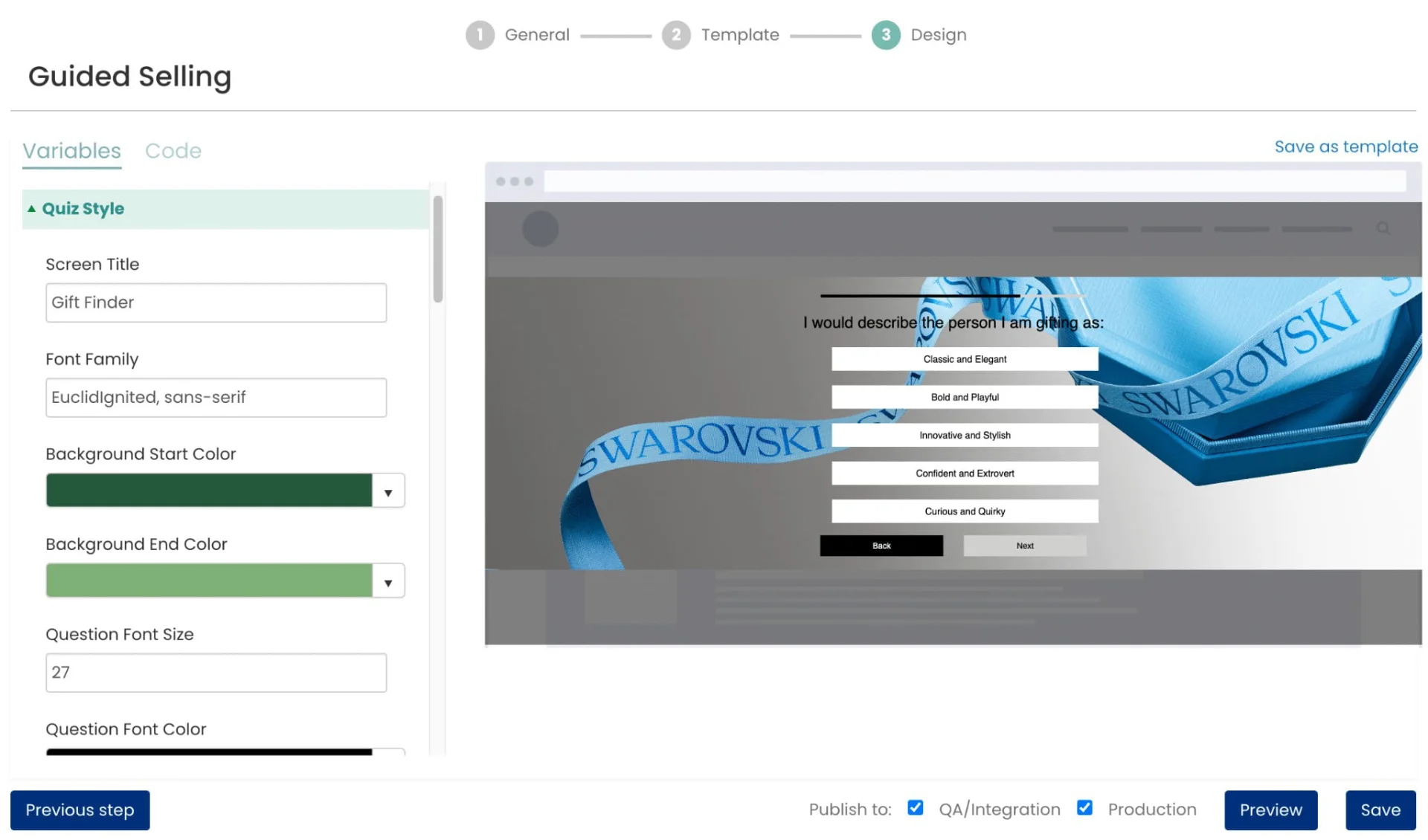
The user interface of ADA Global’s Guided Selling Platform

Here’s a step-by-step guide to get you started:

  1. Define the Questions: Begin by outlining the questions you intend to ask shoppers. These queries serve as the foundation for tailoring the gift recommendations. They might include:
    • Who is the gift for?
    • What is the occasion?
    • What are the recipient’s hobbies or interests? (e.g., Sports and fitness, Travel and adventure, Cooking and food, Fashion and beauty, Technology and gadgets, Books and reading, Arts and crafts)
    • Do you have a budget range in mind?
  2. Align Questions with Catalog Elements: Map your questions and the provided answers to elements within your product catalog. These elements can include categories, specific product attributes, or price ranges.
  3. Customize the User Experience: To make the process engaging and visually appealing, personalized retail the look and feel of the quiz and the resulting gift recommendations. You can incorporate images as answer options and tailor the interface with your preferred fonts and color schemes.

By following these steps, you can seamlessly integrate a Gift Finder into your website, delivering an enhanced shopping experience that is bound to delight your customers no matter the occasion.

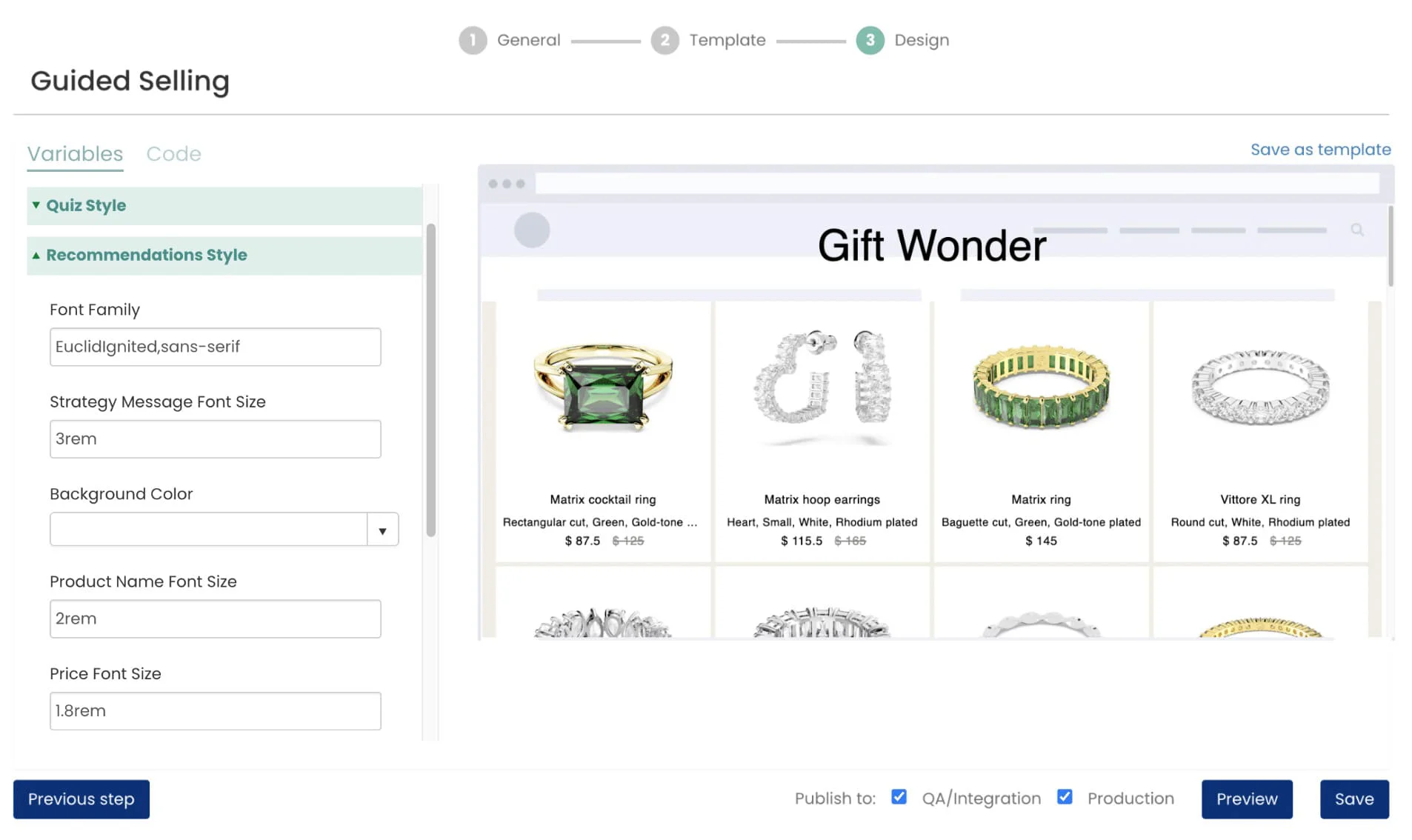
A preview of recommendations from Guided Selling

Conclusion

ADA Global’s Guided Selling merges the art of shopper intention with the science of data-driven one-to-one personalization, creating an experience that’s not just curated but genuinely one-of-a-kind. With the integration of zero-party data and the ability to store shopper responses in the UPS, Guided Selling opens up a new frontier of personalization.

Learn more about our personalized product recommendation platform. Or request a demo to see it in action.

More Reading:

How Optimization Managers Can Harness ‘User Affinity Sorting’ to Fine-tune Their eCommerce Personalization Strategies

Table Of Contents
Zero-Party Data: A New Input to Personalization
Personalized Recommendations, Today and Tomorrow
Gift Finder: An Excellent Application of Guided Selling
Conclusion

Optimizing Your Retail Strategy for the Holiday Season

Digital Experience Personalization
Blogs

Optimizing Your Retail Strategy for the Holiday Season

The holiday season is a time of joy and celebration for many, but for online retailers, it’s also a period of intense preparation.

As a personalization consultant at Ada Global, I’ve had the privilege of assisting some of the world’s leading retail businesses in ensuring that their customer experiences are finely tuned and optimized for the festive rush.

In this blog post, I’ll take you through the essential strategies and optimizations that we recommend to our clients to ensure a successful holiday season.

Early Planning and Strategy

The holiday season isn’t just a busy time for shoppers; it’s equally hectic for retailers. Planning well in advance is key to success.

Two months before the holiday rush, we start by examining our clients’ existing configurations to ensure accuracy. Any technical issues are addressed promptly, setting the stage for smooth operations during the holidays. Furthermore, we understand that user behavior shifts during this time, and strategies must align with these changes.

Adding Visibility with Additional Placements

One of the most effective ways to boost sales is to provide better visibility for your top-selling items. If your website has a dedicated landing page for showcasing holiday deals, consider adding a personalized product recommendations carousel. This tool can highlight the hottest sellers and make it easy for shoppers to discover them.

Introducing Dynamism for User Engagement

To cater to the dynamic nature of user demand during the holidays, we recommend introducing dynamic strategies.

For example, using “top sellers in the last hour” or “top viewed items in the last hour” strategies can harness the power of social proof messages and recent confirmation data. Not only do these strategies highlight your bestsellers, but they also level the playing field for all shoppers looking for the hottest items.

Leveraging Social Proof

Shoppers find confidence in numbers. Incorporating social proof on item pages by showcasing the number of recent purchases—500 times in the last few hours, for instance—can significantly boost confidence and encourage more purchases.

Enhancing Navigable Areas of the Site

Retail websites must make the most of their navigable spaces. If you have a carousel below your hero section, utilize it to capture users’ attention by displaying personalized ecommerce experience items based on their browsing history or trending items of the season.

Optimizing the Search Experience

During the holiday season, users are in a hurry to find the perfect gift. Make sure your search experience yields optimized results. If space allows, show trending items when users click on the search box, helping them discover what’s currently popular.

Guided Selling

For retailers with a vast catalog and users seeking direction, Guided Selling through Q&A can be a game-changer. Ask users questions to understand their preferences, differentiating each product or category. Examples include a “Fragrance Finder” or a “Mattress Finder.”

Recommendation Carousels with Fixed Categories

Boosting the impact of your recommendation carousels involves displaying gifts with specific messaging.

For instance, use labels like “Shop Watches for Dad” or “Shop Bags for Mom” to inspire users to find the perfect gift while engaging with your products. Marketers can further enhance the experience by sorting products by brand or price.

Conclusion

In the world of online retail, the holiday season presents both challenges and opportunities. By taking proactive measures such as early planning, optimizing algorithms, leveraging dynamic content personalization, and enhancing user experiences, retailers can ensure they are fully prepared for the holiday rush. Success during this crucial period can set the tone for a prosperous year ahead.

As we’ve seen, one-to-one personalization and optimization are at the heart of holiday readiness for online retailers. By following these strategies, you can provide a seamless, engaging, and enjoyable shopping experience for your customers.

If you have any questions or need assistance in preparing your online retail strategy for the holidays, don’t hesitate to reach out to us at Ada Global. Our team is here to help you make the most of this festive season.

Table Of Contents
Early Planning and Strategy
Adding Visibility with Additional Placements
Introducing Dynamism for User Engagement
Leveraging Social Proof
Enhancing Navigable Areas of the Site
Optimizing the Search Experience
Guided Selling
Recommendation Carousels with Fixed Categories
Conclusion

Mastering Success Amidst Product Cannibalization with AI-powered strategies

Merchandising and Supply Chain
Blogs

Mastering Success Amidst Product Cannibalization with AI-powered strategies

Ah, the joyous season is almost upon us, and retailers are donning their festive hats to prepare for the promotional whirlwind – scrambling to finalize the assortment and promotions for the season.

Yet, amidst the tinsel and cheer, there’s a not-so-merry disruptor lurking—In-store product cannibalization.

What exactly is this grinch-like phenomenon, how does it threaten the holiday merchandising feast, and how can AI save the day? Let’s unwrap the mystery.

Unmasking Product Cannibalization

Picture this: one product munching on the demand of another, akin to a festive feast gone awry. This, my friends, is the essence of in-store cannibalization. It’s like musical chairs, but instead of chairs, products are vying for the attention of eager shoppers.

But why does this happen? Blame it on the combination of rampant discounts and the waning loyalty towards brands, especially for everyday products.

The grocery aisle becomes a battleground, and every product hopes to be the shining star of the season. Steep discounts and promotions become the magic wand, but sometimes, the spell goes awry, leading to products devouring each other’s demand. It’s a retail jungle out there!

The Sales Tango – When Promotions Hit The Floor

In the delightful world of sales bumps, customers aren’t just making purchases; they’re doing the purchase acceleration mambo—maintaining their usual consumption but sneakily stockpiling for increased consumption later. Talk about a shopping spree with a twist!

Then there’s the increasing quantity cha-cha. Customers aren’t just sipping on a soft drink; they’re guzzling down bottles of joy because, hey, its holiday season! More sips, more smiles, and a whole lot of consumption celebration.

Now, let’s salsa into switching behavior. Picture this: a customer gracefully gliding from a cola to bottled water (that’s some fancy category switching), or doing the brand tango—swapping from Coke to Pepsi. Oh, and don’t forget the store shuffle—picking a different supermarket for a shopping spree. Lastly, there’s the SKU salsa—grabbing a different product of the same brand, right there, right then.

Repercussions Of Demand Shift

While we’re busy calculating the demand lift due to promotions, the silent shift in demand often goes unnoticed. Well, my fellow retailers, it’s not just a minor hiccup—it’s a disruptive force.

In the study by Van Heerde et al., it’s a tale of two stores: one offering a tantalizing price promotion, and the other, well, just doing its regular thing. Imagine the suspense!

For the peanut butter enthusiasts (yes, that’s a thing), the findings are like music notes in a symphony. There are cross-brand effects (43% shift in secondary demand), cross-period effects (24% shift due to primary demand borrowed from other time periods), and category expansion (33% shift due to market expansion and cross-store effects).

What does this mean for Retailers?

It means shelves groaning under the weight of aging stock, margins doing a disappearing act, and, in some cases, products reaching their expiration date in bulk. Talk about post-holiday blues lingering like an unwelcome guest into the next year.

It’s time to take off the rose-tinted glasses and acknowledge the ripple effect of in-store cannibalization.

AI’s Carol For Retail Success

Fear not, weary retailers, for there’s a solution to tame the cannibal Grinch! The key lies in a symphony of demand forecasting solutions and replenishment frameworks that not only capture the demand “LIFTS” but also dance to the tune of demand “SHIFTS” caused by promotions.

Picture this: a symphony of algorithms orchestrating a flawless forecasting and replenishment planning solutions framework that not only predicts the future but does so with a keen awareness of cannibalization effects.

AI, with its prowess in data analysis and pattern recognition, transforms the art of prediction into a science. By sifting through mountains of historical sales data, weather patterns, social trends, and even the subtle nuances of consumer behavior, AI paints a vivid picture of what lies ahead. But what sets it apart in the realm of cannibalization is its ability to dissect the intricate relationships between products.

Traditional forecasting models often struggle to capture these nuanced interactions. AI, however, navigates this labyrinth effortlessly. Through advanced machine learning techniques, it identifies not only the direct impact of one product on another but also the ripple effects that resonate through the entire inventory.

Moreover, its ability to optimize order schedule based on supply chain constraints such as lead time, minimum order quantity, order frequency etc. as well as category factors such as expiration dates, and shelf life at a granular level clearly sets it apart from the traditional approach.

Achieve lean retail inventory optimization solution, reduce out-of-stocks and food wastage by algorithmically optimizing your replenishment with automatic store replenishment.

Future-proofing Your Retail Game

What makes this framework future-proof is the adaptability of AI. It doesn’t just learn from historical data; it evolves with the changing landscape of consumer preferences and market dynamics.

Moreover, AI is rooted in its ability to handle complexity. Traditional methods might falter when faced with a myriad of variables, but AI thrives in complexity. The more data it has, the better it becomes at untangling the web of relationships within a product portfolio.

Imagine a world where your store replenishment processes are aligned not just for individual products but for the entire product class. It’s a harmonious dance where each product complements the other, ensuring that post-holiday blues are replaced with a festive glow of success.

So, as you gear up for the seasonal planning extravaganza, remember the AI carol that sings the tune of demand shifts and lifts. Let it be your guiding star through the retail holiday galaxy, ensuring that jingle bells are heard, not the knells of cannibalization.

Happy seasonal planning, and may your shelves be merry and bright!

Table of Contents
Unmasking Product Cannibalization
The Sales Tango – When Promotions Hit The Floor
Repercussions Of Demand Shift
AI’s Carol For Retail Success
Future-proofing Your Retail Game

Understanding Consumer Behaviour in the Digital Era

Personalisation
Blogs

Understanding Consumer Behaviour in the Digital Era

What is Consumer Behaviour?

Consumer behaviour in the digital era has undergone significant transformations. With the widespread adoption of technology and the internet, consumers have access to a wealth of information and choices. This shift has revolutionised how individuals interact with brands and make purchasing decisions. To thrive in this evolving landscape, businesses must understand and adapt.

Consumer behaviour studies how individuals, groups, or organisations decide and utilise resources to satisfy their needs and wants. It encompasses various psychological, social, and cultural factors that shape the decision-making process. Understanding consumer behaviour is crucial for businesses as it helps them identify and respond to customer needs effectively.

How did Consumer Behaviour change in the Digital Era?

Consumer behaviour has undergone significant changes in the digital era, driven by advancements in technology and the widespread adoption of the internet. Let’s explore some key ways in which consumer behaviour has evolved in response to the digital revolution:

1. Empowered Decision-Making

In the digital era, consumers can access abundant information at their fingertips. They can easily research products, compare prices, read reviews, and gather insights before purchasing. This easy access to information has empowered consumers to make more informed choices.

Consumers no longer have to rely solely on advertisements or sales pitches but can instead rely on authentic user reviews and recommendations. As a result, businesses need to focus on building a positive online reputation, providing transparent and accurate information, and ensuring the quality of their products or services.

2. Rise of Online Shopping

The digital era has witnessed a significant shift towards online shopping. eCommerce platforms have made it convenient for consumers to browse and purchase products from the comfort of their homes. Online retailers offer various choices, competitive prices, and personalised recommendations based on consumer preferences and past purchases. This shift has posed challenges for traditional brick-and-mortar stores, prompting them to establish their online presence or adopt omnichannel strategies to stay competitive.

3. Influence of Social Media

Social media has emerged as a powerful influence on consumer behaviour. Consumers often seek recommendations and opinions from their peers on social media before purchasing. Influencers with a significant following and expertise in specific niches can also sway consumer opinions and preferences. Businesses have recognised the impact of social media and are actively leveraging these platforms to engage with their target audience, build brand awareness, and drive sales.

4. Mobile Dominance

Smartphones have become integral to consumers’ lives, transforming how they interact with brands. Mobile devices offer convenience and accessibility, allowing consumers to browse, shop, and interact with businesses anytime, anywhere. As a result, businesses must optimise their websites and online experiences for mobile devices to ensure seamless navigation, fast loading times, and a user-friendly interface. Mobile apps have also gained popularity, providing personalised experiences and enhancing customer loyalty.

5. Personalisation and Customisation

The digital era has ushered in an era of personalised experiences. Businesses can leverage consumer data and advanced analytics to understand individual preferences and tailor their offerings accordingly. Personalisation goes beyond addressing customers by name; it involves curating product recommendations, delivering relevant content, and providing customised promotions based on previous interactions and purchase history. This focus on personalisation helps businesses enhance customer satisfaction, build stronger relationships, and foster loyalty in an increasingly competitive market.

Challenges for Businesses in Adapting to Digital Consumer Behaviour

Consumer behaviour in the digital era as described above brings some new problems for companies. Here are some challenges that businesses should look out for in navigating the changing consumer behaviour in the digital era:

1. Constantly Changing Platforms

New digital platforms and social media networks seem to emerge regularly. Businesses must adapt to these platforms and understand where their target audience is most active. Staying updated on platform changes, algorithms, and features can be overwhelming.

2. Information Overload

Consumers are inundated with information and content daily. Cutting through the noise and grabbing their attention is a challenge. Businesses must create compelling, relevant, and personalised content to stand out.

3. Privacy Concerns

Consumers are increasingly concerned about their privacy online. Stricter data protection regulations, like GDPR, have changed how businesses can collect and use customer data. Companies must navigate these regulations while still personalising their marketing efforts.

4. Customer Expectations

Consumers expect immediate responses to their inquiries and personalised experiences. Meeting these expectations requires real-time monitoring and responsive customer service.

5. Global Competition

The digital era has made it easier for businesses to reach a global audience, but it has also increased competition around the world. Standing out in a crowded market requires innovative and strategic marketing approaches.

6. Analytics and Data Complexity

In order to understand consumer behaviour in the digital age, data plays an important role. However, managing and making sense of vast amounts of data can be challenging. Businesses need the right tools and expertise to analyse data effectively and use it to inform decision-making.

7. Sustainability and Social Responsibility

Consumers increasingly expect businesses to be environmentally and socially responsible. Companies must align their marketing efforts with their sustainability initiatives to meet these expectations.

Navigating these challenges in the face of evolving consumer behaviour requires businesses to be agile, data-driven, and customer-centric. Adapting to changing technology and consumer preferences while maintaining ethical and responsible marketing practices is essential for success in the digital era.

How Your Business Can Adapt to Consumer Behaviour in the Digital Age?

To thrive in the digital age and effectively connect with consumers, businesses must adapt their strategies to align with evolving consumer behaviour. Let’s explore ten key strategies that businesses can employ to adapt and succeed in the digital era:

1. Develop a Strong Online Presence

Establishing a strong online presence is crucial for reaching and engaging digital consumers. This includes creating a user-friendly website, optimising it for search engines (SEO), and utilising social media platforms to connect with the target audience. Regularly updating online content and maintaining a consistent brand image across digital channels helps build consumer trust and credibility.

2. Embrace eCommerce

With the rise of online shopping, businesses should consider integrating eCommerce into their operations. Setting up an online store enables customers to browse and purchase products at any time conveniently. Offering secure payment options and a seamless checkout process enhances the customer experience and encourages repeat purchases.

3. Leverage Social Media Marketing

Social media platforms provide an excellent opportunity for businesses to connect directly with their target audience. Developing a comprehensive social media strategy involves identifying the platforms most relevant to the business and its target market, creating engaging content, and actively interacting with followers. Leveraging social media advertising and influencer collaborations can further amplify brand visibility and reach.

4. Optimise Mobile Devices

Given the dominance of mobile devices, businesses must optimise their online presence for mobile users. This involves adopting responsive web design, ensuring fast loading times, and providing a seamless mobile browsing experience. Mobile optimisation extends to emails, ads, and other digital marketing assets, ensuring they are designed to be mobile-friendly and visually appealing on smaller screens.

5. Utilise Data Analytics

Leveraging data analytics allows businesses to gain valuable insights into consumer behaviour and preferences. By analysing data from website analytics, social media metrics, and customer interactions, businesses can identify patterns, trends, and areas for improvement. This data-driven approach helps make informed decisions and tailor marketing strategies to meet consumer needs effectively.

6. Personalise the Customer Experience

Personalisation is key to enhancing the customer experience in the digital age. Utilise data and customer profiles to deliver personalised recommendations, targeted offers, and relevant content. Personalisation extends beyond product recommendations and can include personalised email marketing campaigns, customised landing pages, and tailored customer support experiences.

7. Foster Online Reviews and Testimonials

Online reviews and testimonials have a significant impact on consumer decision-making. Encourage satisfied customers to leave reviews and testimonials on review platforms, social media, and your website. Whether positive or negative, responding to reviews demonstrates your commitment to customer satisfaction and helps build trust with potential customers.

8. Engage with Influencers

Influencer marketing has become an effective way to reach and engage digital consumers. Identify influencers relevant to your industry and target audience, and collaborate with them to promote your products or services. Influencers can provide authentic recommendations, increase brand visibility, and drive traffic to your business.

9. Provide Exceptional Customer Service

Digital consumers expect prompt and personalised customer service. Utilise various communication channels, such as live chat, social media messaging, and email, to provide timely and helpful assistance to customers. Aim for quick response times, effectively address customer inquiries and concerns, and go the extra mile to provide a positive customer experience.

10. Stay Agile and Adapt

Consumer behaviour in the digital era is constantly evolving. Stay informed about the latest trends, emerging technologies, and changes in consumer preferences. Continually monitor and analyse the effectiveness of your digital marketing efforts, gather feedback from customers, and be ready to adapt and refine your strategies accordingly.

Understanding and adapting to consumer behaviour in the digital era is crucial for businesses aiming to thrive in today’s competitive landscape. By embracing digital strategies, optimising mobile devices, leveraging social media, and personalising the customer experience, businesses can effectively connect with their target audience and build lasting relationships. However, navigating the complexities of the digital age can be challenging. That’s why it’s essential to partner with the right solutions provider.

Get Your Business Up to Speed with ADA

When you choose ADA Global as your go-to Marketing Services solution, your company may maximise the marketing process’s potential, and boost your company’s performance. Using ADA Global can help you to build better marketing strategies for businesses, from data-driven approach to personalized marketing. Furthermore, ADA Global is a leading digital marketing agency that provides cutting-edge solutions and expertise to help businesses thrive in the digital landscape. Contact ADA Global today and take your business to new heights!

Table Of Contents
What is Consumer Behaviour?
How did Consumer Behaviour change in the Digital Era?
Challenges for Businesses in Adapting to Digital Consumer Behaviour
How Your Business Can Adapt to Consumer Behaviour in the Digital Age?
Get Your Business Up to Speed with ADA

16 Benefits of CRM to Improve Customer Relationship

Data & AI
Blogs

16 Benefits of CRM to Improve Customer Relationship

What is a Customer Relationship Management (CRM) System?

Before diving into the advantages of CRM, it’s crucial to understand what a CRM system entails. Customer Relationship Management (CRM) system is a software solution that consolidates and manages customer data, interactions, and communications across multiple touchpoints. It serves as a central hub where businesses can store and access information about their customers, track sales activities, and analyse data for strategic decision-making.

What are the Benefits of Using a Customer Relationship Management (CRM) System?

Bridging the gap between businesses and their customers, a Customer Relationship Management (CRM) system presents various advantages that can elevate customer interactions. Let’s explore the 15 key benefits of incorporating a CRM system into your business operations:

1. Enhanced Customer Information Management

One of the primary benefits of a CRM system is its ability to centralise and organise customer information effectively. By consolidating contact details, purchase history, preferences, and more, businesses can ensure that all customer-facing teams can access accurate and up-to-date data. This streamlined approach to customer information management lays the groundwork for better customer interactions.

2. Visualising Data

Reading and understanding data can be a difficult activity, especially when the amount of data your business has is huge. With CRM, you can turn that pile of data into a visual that your employees can easily understand.

CRM can show customer information such as purchase history when the customer last interacted with the company, and what questions the customer has asked. With a better understanding of the data, your company will certainly be able to make better decisions regarding customers.

3. Improved Customer Service

Comprehensive customer profiles provided by customer relationship management software can help your business to improve customer service. Business can deliver top-notch customer service. Armed with a 360-degree view of each customer’s preferences and past interactions, customer service representatives can offer personalised support, address queries promptly, and resolve issues more efficiently. This personalised approach goes a long way in boosting customer satisfaction and fostering long-term loyalty.

4. Streamlined Sales Processes

CRM solutions empower sales teams with automation and streamlining capabilities, revolutionising their sales processes. From lead generation to closing deals, CRM software can automate repetitive tasks, track sales activities, and manage pipelines effectively. This newfound efficiency allows sales representatives to focus on building relationships and closing deals, resulting in increased revenue and productivity.

5. Enhanced Marketing Strategies

Harnessing the power of customer data, CRM systems open the doors to more targeted and personalised marketing campaigns. By analysing customer behaviour and preferences, marketing teams can tailor their messages and offerings to suit specific segments, significantly improving engagement and conversion rates. This data-driven marketing approach optimises marketing efforts and maximises the return on investment.

6. Improved Cross-Selling and Upselling Opportunities

Understanding customer buying patterns is key to unlocking cross-selling and upselling opportunities. CRM systems enable businesses to identify complementary products or services that align with each customer’s preferences and history. By presenting relevant offers at the right time, businesses can increase the average order value and boost revenue without aggressive sales tactics.

7. Increased Customer Retention and Loyalty

Strong customer relationships are the bedrock of customer retention and loyalty. With a CRM system, businesses can nurture these relationships effectively through personalised interactions, timely follow-ups, and proactive customer service. By making customers feel valued and understood, businesses reduce customer churn and increase the lifetime value of each customer.

8. Better Sales Forecasting and Reporting

CRM does not only help marketing teams, but also sales teams to do their job better and more efficiently. Accurate sales forecasting is crucial for effective resource allocation and planning. CRM systems provide real-time insights into sales performance, helping businesses make data-driven decisions and set achievable sales targets. Sales representatives can better track their progress and identify areas for improvement, leading to more consistent and reliable revenue forecasts.

9. Improved Team Collaboration

CRM systems promote seamless collaboration among different teams by providing shared access to customer data and communication history. This collaborative approach ensures that marketing, sales, and customer service teams are on the same page to meet customers’ needs and expectations. By breaking down silos, businesses can provide a unified customer experience across all touchpoints.

10. Enhanced Customer Segmentation

Understanding the diverse needs of customers is vital for effective marketing. CRM systems enable businesses to segment their customer base based on various factors, such as demographics, behaviour, and purchase history. Businesses can craft highly targeted marketing campaigns that resonate with each segment by categorising customers into specific groups.

11. Automated Task Management

CRM systems streamline business processes through task automation. Repetitive and time-consuming tasks, such as sending follow-up emails or updating customer records, can be automated, freeing employees’ time to focus on more strategic and value-added activities. This automation strategy leads to improved efficiency and ensures essential tasks are not overlooked.

12. Mobile Access to Customer Data

In the age of mobile workforces, access to customer data on-the-go is crucial. Modern CRM systems offer mobile applications, empowering sales and customer service teams to access critical customer information anytime. This mobile accessibility ensures seamless customer interactions, even when employees are out of the office.

13. Data Security and Privacy

Customer data is sensitive information and must be protected from unauthorised access. CRM systems have robust security features that safeguard customer information, ensuring compliance with data protection regulations. Businesses build customer trust and credibility by prioritising data security and privacy.

14. Improved Customer Insights

CRM systems provide valuable insights into customer behaviour, preferences, and buying habits. By analysing this data, businesses gain a deeper understanding of their customers’ needs and expectations. These insights help tailor products, services, and marketing strategies to meet customer demands better.

15. Integration with Other Business Tools

CRM systems can integrate seamlessly with other essential business tools, such as email marketing platforms, social media, and accounting software. This integration streamlines processes, eliminates data silos, and enhances overall business efficiency. Businesses can operate more cohesively, leveraging the strengths of various tools to optimise their operations.

16. Scalability and Flexibility

As businesses grow, so do their CRM requirements. CRM systems offer scalability and flexibility to accommodate changing business needs. Whether handling an increasing customer base or integrating with new technologies, a robust CRM system can adapt to support a company’s growth journey.

In a nutshell, incorporating a Customer Relationship Management (CRM) system into your business brings numerous benefits that revolutionise customer interactions and pave the way for sustainable growth. From streamlined processes to personalised customer experiences, CRM systems empower businesses to foster stronger relationships and make data-driven decisions. Embrace the power of CRM, and watch your business thrive in the realm of exceptional customer relationship management.

Embracing ADA’s Customer Relationship Management can be a game-changer for your business, unlocking a world of possibilities for delivering personalised customer experiences. Our CRM platform helps you drive growth by streamlining your marketing processes, allowing you to focus on more important tasks. With a centralised system to manage your customer information, contact us now to start improving lead management and target your marketing efforts for maximum conversions today!

Frequently Asked Questions (FAQs) about Benefits of CRM

1. What is the impact of CRM in business?

The impact of CRM in business can be seen in the number of customer retention and higher customer lifetime value. CRM can help marketing and sales teams to identify high value customers and their behaviour and preferences. That information plays a vital role in helping companies gain new customers and retain customers to keep making purchases.

2. How does CRM impact marketing?

CRM can help marketing teams to create personalised content by providing relevant data about customers. Customer data from CRM can be used by the marketing team to identify customers’ wants, difficulties, and other relevant matters. The marketing team can then use this information to create content that addresses these issues and makes customers or potential customers feel understood and interested in trying or buying your business products or services.

3. How does CRM improve productivity?

CRM can increase productivity by eliminating the need for you to perform menial tasks, such as data entry. In addition, CRM can also provide you with all the data you need regarding your customers so that you can strategise and take action faster with accurate data.

Table Of Contents
What is a Customer Relationship Management (CRM) System?
What are the Benefits of Using a Customer Relationship Management (CRM) System?
Frequently Asked Questions (FAQs) about Benefits of CRM