
Instore Personalization: Relevant, Contextual & Rewarding

Digital Experience Personalization
Blogs

Instore Personalization: Relevant, Contextual & Rewarding

Spend some time on any media channel—be it a newspaper, radio, social media, or any other Internet-based channel—and it won’t be long before you’re bombarded with ads trying to sell you a myriad of products. Brands spend a ton in such marketing efforts in a bid to get your attention and influence you into engaging with them. But how much of an impact are they making on you, the individual consumer, with these spray-and-pray tactics? Perhaps none at all. In fact, you may find such brand messages rather annoying.

Now, imagine receiving a highly personalized message on your mobile. The message not only recognizes you as an individual but also addresses your current shopping need. The brand, through this message, gives you an attractive offer on a product or category you’re interested in, and that too while you’re in a store pondering what to buy.

Which of the above two scenarios are you more likely to respond to? Obviously the latter. An Accenture study revealed that 91% of consumers are more likely to shop with brands that provide relevant offers and recommendations.

Online stores tend to enjoy greater success when it comes to personalizing shoppers’ experiences. With customer data at their fingertips, they can access granular insights related to every customer’s behavior, needs, preferences, and purchase pattern. This intel enables e-tailers to predict what a customer wants and make relevant offers and recommendations accordingly. This results in higher customer engagement and sales. And customers get the instant gratification that they seek.

Most offline retailers, who still rely on traditional marketing methods, aren’t as successful in delivering the same level of experience to shoppers. However, real-time in-store personalization can help them compete on an equal footing and craft delightful experiences for customers.


Understanding In-store Personalization

When an offline retailer starts identifying every customer as an individual, understanding their current context, and combining these insights with their historical behavior and tastes to deliver tailored recommendations, they have essentially started delivering in-store personalization.

However, all of this needs to be done in real-time while the customers are still weighing their options in a store. That would make it possible for retailers to make timely cross-sell or upsell offers that influence buying decisions and boost revenue. Retailers usually identify a shopper after they’ve reached the POS, but by this time the window of opportunity has long been shut.

But Is It Possible to Deliver In-store Personalization in Real-time?

The answer is yes, and lies in leveraging the great enabler – technology. A customer’s mobile phone and its Bluetooth capabilities along with the store’s WiFi and RFID tools can help offline retailers to achieve personalization that is nothing short of magical. Let us understand how from a few examples.

Scenario 1

Suzanne can access the free WiFi of a store on her mobile phone. Since her mobile number is already present in the store’s registry and linked to her past purchases, a buyer profile can easily be generated in advance that indicates what she normally shops for, when, and how often. It will also include data on if she chose a particular brand due to a sale or went with another despite an offer going on. This allows the store to send messages that are relevant to her.

“Hi Suzanne, running low on coffee pods? Do not miss an offer on Brand A in aisle number 3! Get up to 30% off on select products by mentioning your mobile number when you approach the biller.” Here, the system knows which day of the week Suzanne normally drops in to buy coffee pods and sends her a notification about an offer. It could even be made specific to address a particular flavor.

Scenario 2

Upon entering a mall, Jonathan gets a push notification to accept offers via Bluetooth. The store he frequents can then easily send him a personalized message to cross-sell another product related to his usual purchases.

“Good afternoon, Jonathan. Head over to The Gent. Get a 25% off on our brand-new selection of neckties when you buy any of our formal shirts/trousers. Use the coupon code GENTREGULAR at the time of billing.”

Scenario 3

Judith receives a push notification to send an SMS to a specific number so she can get personalized offers from a store. The SMS she sends enables the system to identify her as a first-time customer. The next SMS she receives is something along these lines: “Welcome to our store. Get 30% discount on anything you purchase with the coupon code THEFIRST.”


How Technology Enables In-store Personalization

All the aforementioned situations had the customer identified and sent relevant messaging that were targeted towards them. Doing all this in real-time requires analytics and machine learning that can work with enormous volumes of data from various sources.

Often, a rules engine in the background helps in identifying business conditions on moving and stationary data. Contextual targeting becomes easier when the retailer divides their customers based on demographic and psychographic analysis. Technology not only allows the retailer to drive personalization but also helps measure its effectiveness and improve upon the messaging as more and more data is collected.

Retailers can give their personalization strategy an added boost with mobile apps. Through apps, they can stay connected with customers and send them contextual messaging whether they’re inside or outside the store.

Beacon-based positional targeting has been implemented by many large retailers, within the store. Visual Light Communication (VLC) technology-based LED lights acting as beacons can interact with mobile phones, and they have seen increased adoption around the world.

Using beacons, retailers can even personalize based on the aisle a customer is in within the store. For instance, if a customer is in the wine aisle, they could receive an offer on their favorite red wine – let’s say, Merlot. And when the customer is in the pantry section, the beacon uses context to send another message recommending what pairs well with red wine, with offers for roasted Chicken.


Embrace In-store Personalization to Build Loyalty

In a world where customers are spoiled for choice, retailers should leverage technology to deliver relevant, contextual customer engagement. This is the key to building long-term loyalty and staying relevant in the market. What retailers shouldn’t do is spam a customer who’s trusted them with their information. Hyper-personalizing experiences throughout the entire customer lifecycle, across channels and touchpoints, is the way forward.

Check out our comprehensive omnichannel personalization guide to learn how to hyper-personalize customer experiences across both online and offline channels.


3 Data Feeds Retailers Should Focus On for Personalization

Digital Experience Personalization
Blogs

3 Data Feeds Retailers Should Focus On for Personalization

Over time, the increase in the number of avenues through which consumers interact with your brand has contributed to the exponential increase in the amount of data at the retailer’s disposal. And it is showing no signs of abating. Although it adds several layers of complexity in how you deal with this constant stream of data, tapping into it to uncover ‘in-the-moment’ opportunities will make it all worthwhile.

However, that’s easier said than done. Clearly, the real challenge lies in how you can harness the right online and offline data efficiently to better understand and engage customers at precisely the right time. This capability alone will separate retailers that thrive from the rest in the years ahead.

That begs the question, which data is useful to deliver hyper-personalized experiences that consumers expect from retailers today? How can it be harnessed? Here are some examples:

1. Online Data is Just Half the Story

Granted online data is easier to gather and use – to deliver personalized experiences. But simply using in-store purchase data can significantly enhance the shopper experience. After all the lines have blurred, and consumers shift effortlessly between the website, mobile app, or the physical store.

Click and mortar stores can gain a significant advantage over pure-play commerce stores if they can better utilize this data for an omnichannel personalized experience. The key however is arriving at the right mix of offline and online data with a reasonable level of consistency. AI-driven omnichannel personalization solutions can help. Believe it or not, a simple tag like “products trending in-store” can reduce friction through the online shopping journey.

Some of our customers have reported an increase of over 2% in their average order values just by bringing offline data to refine the online experience. To add to that, more unified experiences are offered to customers by way of recommendations across product categories. For instance, the AI can automatically filter out poorly rated footwear products and eliminate them from recommending those to consumers in their email campaign with offers for matching clothes. Besides, the system does all this automatically, eliminating the need for manual merchandising or interventions.

2. Using Back Office Data to Increase Margins

Sure, you want to deliver individualized experiences, but at the same time, an area that is worth focusing on for retailers when it comes to increasing profits and margins is back-office data. Some avenues to explore:

  • Margin data: Using this data, customers can be guided to higher margin products through boosted search results, promotional offers, and recommendation blocks. These high-margin products when intelligently combined with loss leaders have shown they can boost profitability. These can easily be tested by the system.
  • Brand: Brand affinity is a great way to boost margins. Similar brands at similar price points can be linked up and budget brands can be suppressed within search results to drive more return visits, perceived relevance, and larger basket sizes. The critical part is that the AI delivers the best results for affinity-based products by determining the right price point ranges for related products.
  • Regional store/inventory: Using regional inventory data can help in adding a layer of personalization to the online buying experience, help drive demand and reduce out-of-stock disappointment, while driving up profitable store visits.

3. Fixing the Unstructured Data Problem to Solve Unsolved Problems

One of the common challenges with data has to do with poor product feed data, whether it is to do with quality or depth of it. Many approaches can be used to expand data to increase sales.

  • Starting simple helps. For example, you might have a range of kitchen accessories, let’s say for a brand called “Denver”. Using simple rules, you can boost the product name “Denver” by promoting other items from that brand. The rule would have an if-then clause like ‘if the product name contains the term “Denver”, then boost other products containing the term “Denver” from the same category.’
  • Deep Learning AI lets you understand how customers research your products before making a purchase decision. Descriptions, comments, social posts, tags, and other such data are crucial in helping customers find their choice of product, while also helping them realize their ‘intent’ of what they want – all through the power of AI.

When you link ‘similar’ products together based on common concepts (e.g., easy, simple, long-lasting, rugged, etc.) and start to understand the ‘why’ behind a purchase decision (e.g., long-lasting frying pan for someone who camps out a lot), you get access to a whole host of products that you might have never guessed would be a perfect fit for some of your customers.

Bottom line

It’s true that data can be invaluable, but you do not need to use everything that is available. Begin by using small sets of relevant data as mentioned above. When coupled with AI, it can give your business a real shot in the arm.

1. Online Data is Just Half the Story
2. Using Back Office Data to Increase Margins
3. Fixing the Unstructured Data Problem to Solve Unsolved Problems
Bottom line

Breaking the CDP Conundrum: Should You Build or Buy?

Omnichannel Marketing
Blogs

Breaking the CDP Conundrum: Should You Build or Buy?

A marketer who is looking to invest in a customer data platform (CDP) grapples with the build vs. buy conundrum. The points of view are more entrenched in this space than any other. This is primarily because the end deliverable is a data platform that caters to the unique needs of each retailer. Let’s compare the build and buy options.

Building a CDP Solution

If you know exactly what you need, you can specifically define your requirements, and you have a service partner or a large in-house IT team that can deliver on the requirements, build may be a path to consider. A large-scale IT project is often lost in translation – what the customer explains is different from what the project manager understands. Further translations happen to the engineer, and then to the programmer, and alas, the result ends up looking significantly different from what was envisioned.

The people investments required to deliver a custom CDP and maintain it are considerably higher than the buy option. Make sure to build it atop an established cloud that provides you with resources to operate and support the platform. Besides, you may have to wait for 6 to 12 months to be able to start using the platform.

If time to market is not a critical consideration, you could opt for the build route for a fully customized solution instead of compromising with a generic software. If done right, there could be competitive advantages with a custom solution. However, one should be cautious of budget overruns, time delays due to expanding scope, and post-implementation support.

Buying a CDP

A pre-packaged customer data platform for retail that is crafted for a specific industry offers the best of both worlds – quick time to value of a plug-and-play solution and close fit of a bespoke solution. While you would need some technical resources for the set-up and upkeep, the time and costs involved are much lower, and there are no harsh surprises.

This means you can run pilots and POCs quickly before you go all-in. You can examine and be sure that the solution really works for you. A much lower upfront cost and quick onboarding takes away risks, and still provides a solution that is tailored for your needs.

Most CDPs come with out-of-the-box connectors to integrate with existing MarTech systems, and you have the vendor’s professional services to take care of seamless integration with systems of record and orchestration.

A CDP solution that Supercharges Individualized Customer Engagement

A good CDP caters to all use cases in a way that is specific to your industry. A CDP is a means to an end – with the end being contextually relevant engagement. This means the CDP needs to necessarily have these features:

  • Streaming ingestion of demographic, transactional, behavioral, known & unknown customer profile data from online and offline systems.
  • Identity resolution by creating a single, 360-degree view of the customer and a golden record by deduplicating and enriching the data.
  • Granular real time customer segmentation and advanced customer insights powered by micro-segments, segment analysis, market basket, churn, lookalike, propensity, and lifetime value analyses to drive next-best actions, and measure ROI with campaign and journey analytics.
  • Real time customer engagement activation to drive hyper-personalized, journey-based marketing orchestration across online and offline channels and connect with customers in the moment.

CDP Case Study

A multinational conglomerate used a real-time CDP to create unified customer views and drive one-to-one personalization omnichannel marketing.

Learn More

All of these features with a marketer-friendly UX are increasingly becoming important, to reduce the dependence on IT teams. It should be flexible to serve marketers and campaign planners who want to promptly analyze metrics and decide targeting strategies or perform segment personalization. It should be scalable to serve data scientists who work with large data sets and require clean, well-organized data.

Critical Questions to Ask to Make a Buy or Build Decision

  • What are the use cases I want to address?
  • Are these use cases unique to my organization?
  • Is the scope likely to change with time?
  • What is the budget I’m willing to invest for a solution?
  • By when do I want to have this up and running?
  • Do I have in-house IT resources to allocate that are rightly skilled?
  • Do I have the resources for long-term support?

Customers today are truly omnichannel which increases the complexity of knowing what, how, and when they want to shop. It is no wonder that the worldwide CDP software market will grow at 19.5% CAGR from $1.3 billion in 2020 to $3.2 billion in 2025. It is a quintessential tool to understand customers as their tastes and behaviors evolve and connect with them at the right time, on the right channel with the right dynamic content personalization message.

Looking for a real-time CDP that promises fast time to value and low cost of ownership?

Request a demo here.

Table Of Contents
Building a CDP Solution
Buying a CDP
A CDP solution that Supercharges Individualized Customer Engagement
Critical Questions to Ask to Make a Buy or Build Decision

‘Algorithmic Decisioning’ Will Take the Center Stage at NRF 2022

Digital Experience Personalization
Blogs

‘Algorithmic Decisioning’ Will Take the Center Stage at NRF 2022

Channels are dead. Period.

Omnichannel experiences are now non-negotiable. Retail technology investments saw a 300% YoY increase in Q2 ‘21 to $31.5 billion, as more consumers turned into omnichannel shoppers (CB Insights).

Consumers are no longer following a linear path to purchase. Retailers are trying to solve the pressing issues of broken customer journeys and inconsistent engagement. And these issues often arise when a consumer switches between different online and offline channels – a behavior that has become commonplace in the post-pandemic world.

Today’s channel-agnostic consumers expect to be able to seamlessly switch between channels. They expect to progress in their journey without friction points such as repeatedly having to specify their current need, price point, brand or taste preference, and so on.

Retailers across key functions have to make countless decisions and course-correct as context changes. What products to recommend, what is the right assortment mix for the season, what items to re-stock, how much to sell them for, and when and how much to mark down are some of these crucial decisions that impact customer experience, profitability, and key business metrics.

Another key challenge that retailers are facing today is the inability to personalize an experience as per a consumer’s real-time intent and context. A Forrester report revealed that personalization ranked the highest in the list of tech investments in 2021.

In fact, 89% of digital businesses are investing in personalization. But there’s a problem. Only 40% of consumers feel that the information they get from brands is relevant to their tastes and interests. This massive gap exists because personalization has evolved from tactical segmentation to strategic individualization, and most retailers are playing catch-up.

To solve these challenges, retailers must adopt a more forward-looking approach to decision-making. Retailers are no strangers to big data analytics. This technology has been a focus area for the better part of the last decade. But the problem even today is, most companies are using data primarily to make tactical business decisions, making them reactive rather than proactive with their data strategy. They’re still data-driven instead of decisioning-led.

Point solutions don’t cut it, as they hinder retailers from future-proofing their digital strategy, creating new competitive advantages to remain relevant, and staying ahead of ever-evolving customer behaviors. What’s needed today is AI-powered decision-making at scale across marketing, eCommerce, merchandising, inventory management, pricing, and supplier management.

To meet this need, we’re going to unveil the industry’s ONLY Algorithmic Decisioning Platform at NRF 2022 – Retail’s Big Show, Booth #6403. Algorithms take away the pain of decision-making from individuals across key retail functions by not just making decisions but also executing them autonomously. Here’s how the platform cuts across different functions.

ADA Global’s Algorithmic Decisioning Platform

Commerce leaders can:

  • Create a unified, seamless experience across search, recommendations, category pages, content, email, and offline channels
  • Hyper-personalize search results and category pages based on behavioral data, such that no two shoppers see the same results
  • Help shoppers find visually similar products and provide complete-the-look recommendations based on product images, without manual merchandising
  • Fill recommendation gaps even for products with no behavioral data and fast-changing catalogs
  • Pre-load a customer’s basket with items they’re likely to re-buy and boost basket sizes

Aldi, one of our clients, is surfacing more of their catalog to shoppers without compromising on relevance, achieving 46% higher revenue per visitor and 10% higher average order value.

Marketers can:

  • Act on unified customer data across stores and digital for a single source of truth
  • Drive real-time, journey-based engagement across email, SMS, stores, mobile app, online store, contact center, kiosk, direct mail, and social media
  • Auto-discover micro-segments
  • Acquire new customers that resemble their star customers
  • Grow loyalty and frequency through individualized interactions
  • Spot and reverse churn behavior
  • Algorithmically test campaigns and auto-optimize without manual A/B tests

A supermarket chain and a Forbes 500 private brand with over 100 stores achieved 3% incremental sales and 2x digital adoption with Algorithmic Decisioning.

Merchandisers can:

  • Accurately forecast demand based on customer, economic, and social environment
  • Plan assortments and availability across stores and digital channels based on customers’ current and evolving needs
  • Optimize markdowns to reduce inventory and margin erosion
  • Steer insights-driven supplier collaboration by automating end-to-end processes, from onboarding and ordering to pricing and promotions
  • Curate and segment merchandise for a hyper-local and hyper-personal experience

A multinational conglomerate leveraged our Algorithmic Decisioning Platform for merchandising, resulting in a 95% improvement in sales forecast accuracy, 12% increase in sell throughs, and 30% reduction in excess stock. See how this retailer cut excess stock by 30%.

Data and technology leaders can:

  • Leverage a lakehouse of structured and unstructured data for a single source of truth
  • Use pre-built, retail-specific models to unearth deep insights for varying business needs and digital transformation strategies
  • Get easy access to persistent, unified data for advanced investigation and custom analyses, with minimum data preparation
  • Drive robust data governance with access control and encryption from a single point, eliminating the overheads of managing data governance on multiple tools

Seize Every Retail Moment with Algorithmic Decisioning

Retail decisions need to become self-driving – where algorithms consider the context, understand your goals, and orchestrate decisions that put the customer first. More than 400 retailers and brands across the world have achieved this target state with ADA Global. Want to learn more?

Table Of Content
Commerce leaders can
Marketers can
Merchandisers can
Data and technology leaders can
Seize Every Retail Moment with Algorithmic Decisioning

Data-driven to Decision-led: The Retail New Normal

Digital Experience Personalization
Blogs

Data-driven to Decision-led: The Retail New Normal

‘Data is the new oil’ – an industry cliché that everyone quoted at every remotely relevant discussion. One that you’re perhaps tired of hearing. But is it really the new oil? It seems fine at a level where it acts as the key economic driver but nothing beyond that really. And why am I saying that? Read on to find out.

To turn oil into money, one needs to drill, extract, refine, and then sell it. However, with data, though we have a ton of it, we either don’t know or we’re not able to extract the value from all that data to help generate revenue. For example, with this mass exodus to digital, grocers who have an online presence were able to capture a lot of customer data. However, they are unable to leverage that data to enhance customer experience which would result in improved revenue.

The reality is that over 85% of retailer decisions are gut-based, as only 43% of the data is deemed actionable. So, data is worthy only when it can be leveraged to make appropriate decisions in real time. And that’s where the need to move from data-driven to decision-led arises. And algorithms make this possible.

The constantly evolving business environment, customer needs and preferences, competitive landscape, and many such factors add to the complexity. There is a plethora of opportunities in this dynamic marketplace, but retailers need a tool that helps them convert data into actionable insights in real-time to make those contextually relevant decisions. They need AI to transform data into money.

Inaccurate and Delayed Decisions Are Costly

Customers today expect individualized experiences. With little product differentiation, the shopping experience is increasingly becoming the key differentiator for retailers to win the long-term loyalty of customers. In order to cater to customers with the right dynamic content personalization, at the right time and on the right channel, retailers need actionable insights that are contextually relevant and up to the moment accurate.

Relying on dated approaches of making decisions based on instincts or dated reports and basic aggregated data is no good. This has cost retailers dearly – they’ve quickly lost customers to more-savvy competitors, resulting in revenue loss and ultimately the shutters going down on the business.

Data is a Fundamental Challenge

While retailers have data coming in from various sources, the complexity is high. Data is stored in siloed systems that don’t talk to each other. Retailers, therefore, lack a single source of truth. They have CRM, Data Warehouse, and ERP systems, but these systems don’t provide actionable intelligence. They require manual intervention and are too complex to manage as well.

Here’s where a Customer Data Platform (CDP) brings about a change. The platform unifies data from across sources to provide a single view of the customer that is complete and current. CDPs create granular segments and analyze every customer transaction, behavior, and preference that retailers can leverage to make decisions for personalized engagement.

Decisioning Made Possible by Algorithms

In a day and age where customers expect contextually relevant experiences in the moment, retailers must equip themselves with tools and technologies that arm them with what is needed to meet customer expectations.

Customers today expect to be served as individuals whether it is while shopping online or in a store. They expect relevant product recommendations based on their taste, offers that align with their need, and communication in their preferred channel, at the right time. To cater to this, retailers need to make smart, intelligence-infused decisions while the customer is in their journey.

It is common for retailers to have separate systems in place for point-of-sale, eCommerce, and loyalty – all containing important insights on shopper engagement. How do we stitch all this data and leverage it to unearth insights for competitive differentiation? Even the largest retailers that have more resources and tools usually have too few data scientists and analysts working with overly complicated tools to support their decision-making.

Algorithms are your answer. AI has the power to bring all the data together and analyze it to cull out deep insights at an individual level, at scale.

Algorithms with real time customer engagement decisioning capabilities support continuous testing, ensuring that the right decisions are being made automatically. They continually test and evaluate strategies to determine the winner for each user interaction and business KPI. The models adjust for subtle changes in behavior, inventory, pricing, etc., and provide complete transparency into why a decision was made.

Retailers could expand their customer base by attracting a similar kind of audience as their loyal customers and reverse churn behavior by sending the right offer on the customers’ most preferred brand and product. They could delight existing customers and increase basket value by recommending the right handbag that would go with the dress the customer just bought and push the perfect burger combo offer to the customer at lunchtime based on their location.

How a Large American Grocer Enjoyed a 3% Increase in Revenue with Algorithmic Decisioning

The grocery chain struggled with how to implement and sustain a data-driven, targeted marketing strategy. In their earlier state, they at best sent weekly email flyers to their customers on all the offers without any customization based on past purchases and preferences.

Multiple channels were deployed, however, there was no integration among digital systems leading to a lack of a unified customer experience across channels. They were unable to run multi-channel campaigns, and email campaigns were run manually with no holistic understanding of performance. There was no real time customer segmentation capabilities on eCommerce and the mobile app, leading to low (~10%) digital penetration and engagement.

To start with, Ada Global’s CDP provided real-time customer profile. Its intelligence layer, supported by machine learning algorithms, helped create granular customer segments by applying RFM modeling. The CDP helped understand customer journeys, identify products of interest, and utilize propensity models to gauge the likelihood to respond, buy, and churn.

Armed with deep customer insights, the grocery chain adopted a personalized marketing approach that was curated to each customer’s preferences, transactional behavior, lifecycle stage, and promotional activity. They were able to achieve a 4X increase in mobile app usage and a 3% increase in revenue through an Algorithmic Decisioning approach to personalize customer engagement.

From Data-driven to Decision-led

It’s time for retailers to shun outdated BI tools and espouse AI to make critical decisions. Retailers are time-starved, and an overload of backward-looking reports is of no help to the decision-makers. Contradictory findings from disparate solutions that are poorly integrated need to be a thing of the past.

Instead, retail decision-makers need intelligent, actionable insights delivered in an easy-to-consume fashion. They need comprehensive, predictive (forward-looking) insights with prescriptive recommendations. In summary, retailers must move from being data-driven to being decision-led with AI at the center of it.

Table Of Contents
Inaccurate and Delayed Decisions Are Costly
Data is a Fundamental Challenge
Decisioning Made Possible by Algorithms
How a Large American Grocer Enjoyed a 3% Increase in Revenue with Algorithmic Decisioning
From Data-driven to Decision-led

Winter Release ’21 – Newly Launched Social Proof Messaging

Digital Experience Personalization
Blogs

Winter Release ’21 – Newly Launched Social Proof Messaging

Science has been playing an increasingly important role in marketing, not just in data science and analytics but also in psychology. People like to follow the majority and find comfort in numbers. We’re influenced by what others are doing, and view a behavior or action as appropriate if we see others doing it as well. This is why we consult our friends when booking a vacation or buy products endorsed by celebrities.

However, research shows that the opinion of strangers influences us just as much as that of an expert or a friend. Which is why we care to read product or movie reviews, adopt new habits such as yoga, or have an instant inclination for NYT bestsellers. As a new meditator, this tiny message on my meditation app, that tells me others are practicing now, subtly nudges me to continue without doubting the process.

To help marketers and retailers leverage this powerful social phenomenon and make their eCommerce experience more compelling, we’re introducing real-time social proof messaging. Online shopping is often cold and lacks experiential elements such as cues on what products others in the store are shopping for, or what mains and entrees other diners are ordering. Mid-funnel drops due to indecision are common, and social proof messaging is a small way to arrest these drops.

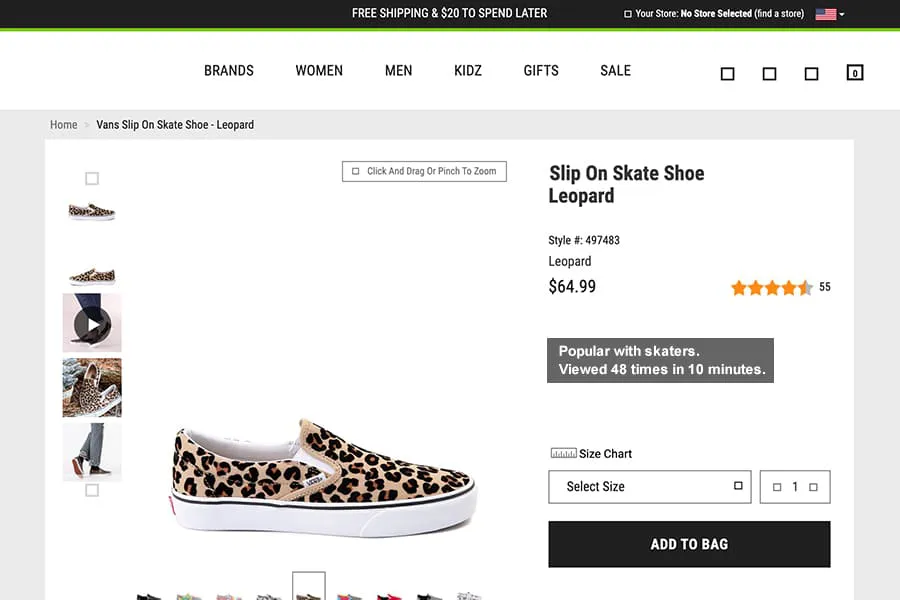
Timely social/urgency messaging helps shoppers decide, by signalling if the product they are viewing is in-demand. Retailers can easily customize the messaging and choose from real-time metrics such as number of views, purchases, add-to-carts, or even inventory levels of a given product. In addition, social proof messaging can be used on pages across the shopping funnel – home page, category pages, product pages, or even at the bottom of the funnel on add-to-cart pages.

Here are some sample messages you can show:

  • 15 people bought this today
  • Selling fast – in 34 carts right now
  • Low stock – only 3 left and in 21 carts right now
  • On fire – viewed 67 times in the last 30 minutes

What’s more, you can make the messages more personalized to a shopper. For example, ‘8 people added to cart since your last visit’ or ‘Popular with skaters – viewed 48 times in 10 minutes’.

Creating a new message is simple and marketer-friendly, and no developers are harmed in the process. 🙂

All it takes is a few clicks and your knowledge of the customers.

  1. Select a template from the library
  2. Choose the design, colors, look and feel
  3. Select the relevant segments, or even a geo-location or an attribute
  4. Pick the pages to display it on, set thresholds for different metrics, and that’s it!

Simple A/B testing allows marketers and merchandisers to test different messaging and metrics, locations and variations – and all of this without the need for any coding skills.

Watch how the set up works.

As they say, your customers are your best marketers – leverage the power of social proof to build conviction and grow sales.

Creating New Relevance In the World of ‘Digital Sameness’: What Retailers Need to Know

Digital Experience Personalization
Blogs

Creating New Relevance In the World of ‘Digital Sameness’: What Retailers Need to Know

What makes consumers choose the brands they do business with? Brendan Witcher, VP & Principal Analyst, Digital Business Strategy, Forrester, in his keynote session at ADA Global Customer Summit 2021, talked about how a lot of brands are unable to answer this question conclusively, or worse, believe the wrong answers. In this blog, we discuss some insights from the session and what retailers can learn from them.

Most brands know who their customers are, but they don’t know why they buy from them. They don’t understand a customer’s conditions for buying and, more importantly, what makes them a top-of-mind brand when a customer wants to make a purchase decision.

As part of a project, Brendan Witcher asked the executive team of a company as to why their customers buy from them. They said customers are loyal to their brand because they love their high-quality products and think the brand aligns with their shopping values.

Interestingly, when he interviewed some of their best customers, they said they would completely stop buying from the brand if they didn’t live near their store, even though the brand has an eCommerce website. In this case, the customer’s condition is the convenience of the store being nearby and has little to do with the products. This highlights how disconnected companies are from the idea of understanding customers and their conditions.

Segmentation Is Passé

Conditions for buying are different for different consumers. Some want to buy online and pick up in-store, while others want same-day delivery to their homes. Some won’t buy unless there’s a discount. And then there are some who only shop during weekends. Every consumer is unique. These behaviors have nothing to do with gender, age, location, and income. And yet these are the factors that businesses consider to create personalization.

So what can companies do? How can they create standout moments that make consumers think of their brand not only when they want to make a buying decision but also when they’re not in purchase mode? The solution lies in moving beyond segment personalization and delivering individualized experiences to consumers. However, most retailers have yet to make real progress in this regard.

According to Forrester, 89% of digital businesses are investing in personalization. But only 40% of consumers say that the information they get from brands is relevant to their tastes and interests.

These numbers indicate that companies need to understand customer journey orchestration and do more to offer personalized experiences.

The Trap of ‘Good Enough’ Customer Experiences

Businesses today fail to create new competitive advantages because of what Brendan called digital sameness. They settle for “good enough” consumer experiences instead of striving to take them to the next level through personalization that is real-time and individualized. Since most businesses think this way, the collective inaction has resulted in digital sameness.

As a result, the majority of consumers don’t think much of their digital experience.

Brendan revealed that 65% say their CX is ‘Ok’, only 17% think it’s good, and no one rates it as excellent.

‘Ok’ experiences don’t create competitive advantages. It’s important to note that each time a consumer is exposed to an improved digital experience, their expectations are reset to a new, higher level. This is how the digital-savvy consumer behaves today.

I once had a go-to eCommerce site for buying clothes. It had a great user experience. But what wasn’t great was product discovery optimization – I often found myself digging deep into the catalog to find products to my liking. The quality of personalized product recommendations often didn’t hit the mark. Later, I discovered another brand, and the more I shopped with them, the better their personalization became. I never shopped with the former brand again.

A brand’s products aren’t an advantage. A great website or a shiny new app isn’t an advantage. To keep customers loyal in the world of digital sameness, companies need to continually improve their one-to-one personalization and differentiate themselves from the infinite number of brands out there.

Customer Data at Multiple Touchpoints Are an Opportunity

With connected consumers leaving their digital footprints across different channels and touchpoints, retailers have the opportunity to leverage this data to understand their customers at a much deeper level. This is the reason why investments in data management solutions like Customer Data Platforms (CDPs) are rising.

According to MarketsandMarkets, the global CDP market size is expected to grow from $3.5 billion in 2021 to $15.3 billion by 2026, at a CAGR of 34.6% during the forecast period.

A CDP ingests customer profile data from various online and offline channels, serving as an always-available, integrated source of customer data. It gathers a customer’s transactional, behavioral, and identity data, and links identifiers to create a 360-degree view of the customer. This view helps retailers understand not only who the customer is but also their conditions for buying.

Getting Data Strategy Right

Data management and operations aside, most retailers are lacking in terms of an effective data strategy. Brendan revealed that only 26% of companies said they’re data-led – they avoid pre-conceived notions about the customers and their business, and executives use data to guide strategic decisions before they make them. While 51% of companies are data-driven – they use data for tactical decision-making and often to support strategic decisions that executives have already made.

Evolving to a data-led state is key to staying relevant in a world where customer journey orchestration continue to become more complex and non-linear. Retailers and brands need to ask three questions when defining their data strategy:

  1. Is the data relevant for supporting our overall business strategy?
  2. Can the data help predict customer behaviors and business outcomes?
  3. Is the data actionable enough to improve our engagement strategy?

Companies that are more proactive with consolidating their data, generating granular customer insights, and creating real time customer engagement experiences for the individual customer in real time are the ones who become top-of-mind brands. Focusing on these areas, including effective customer journey orchestration, is key to delivering consistent experiences everywhere and every time, which is what today’s channel-agnostic consumers expect.

Table Of Contents
Segmentation Is Passé
The Trap of ‘Good Enough’ Customer Experiences
Customer Data at Multiple Touchpoints Are an Opportunity
Getting Data Strategy Right

MarTech Strategy: Best of Breed vs. Best of Suite

Omnichannel Marketing
Blogs

MarTech Strategy: Best of Breed vs. Best of Suite

The Marketing Technology or MarTech industry is moving so fast that marketers are struggling to keep up. Hence it’s crucial for marketing leaders to have a well-defined approach to building their MarTech stack and an effective approach for managing the various technologies and systems.

This brings us to the topic of what’s the right approach. Marketers are divided between best of breed and best of suite when it comes to MarTech investments. Both approaches have their pros and cons. On one side sit advocates for best-of-breed technology solutions with market-leading functionality. On the other are those who prefer the simplicity of integrated technology suites with broad capabilities.

In the recent past, the popularity of best-of-breed marketing technology has grown as thousands of specialized MarTech startups have mushroomed, offering advanced AI technology to solve one problem well. However, with the sudden need to accelerate digitization driven by customer demand, marketers are looking for digital transformation partners – those that drive a customer-centric approach wherein they enable deep customer understanding and leverage those insights to engage with the customer in a relevant way, at the right time, in the channel of their choosing.

A marketing software is evaluated based on its ability to provide a differentiated customer experience for the brand. This is evident in the direction the MarTech industry is moving towards – Salesforce purchases Evergage, Manthan and RichRelevance merge to form Ada Global, Sitecore buys Boxever, and many more. The aim is to be able to solve the pertinent problem of personalized customer experience.

Now, is this adding to the confusion that you thought you had it all sorted? I’m not an advocate of the one-size-fits-all approach. So, I believe marketers must evaluate the technologies that are out there in the market with a clear agenda of what challenges they want to address while keeping in mind their existing position.

There are multiple factors at play in choosing one approach over the other. Let’s evaluate the approaches based on five key factors: time to value, functionality, scalability, flexibility, and seamless experience.

Time to value

In a world where digital adoption is rapidly increasing, quick ROI is an important criterion that marketers must evaluate marketing technology on, with a win or fail fast agenda. The ones that deliver the fastest time to value are those that come with out-of-the-box algorithms that cater to industry-specific use cases. In general, marketing clouds tend to be generic and horizontal where the gestation periods are long and immediate business impact is elusive.

A platform that is ready to use without the need for marketing teams to further tune the algorithms to fit your objective is the one that delivers the least time to value. For example, retail-specific strategies could include ‘Buy Together for Cross-sell’ or ‘Category Top Offers for Offer Based Strategies’.

Functionality

The biggest advantage of best-of-breed marketing vendors is that they offer highly specialized solutions with levels of functionality that suite vendors are unable to provide. For example, personalization product vendors offer end-to-end personalization — which is powered by advanced machine learning algorithms — covering search, content, recommendations, browsing, navigation, and more across all channels.

There aren’t too many full-suite vendors who provide great quality products for specialized functions with deep integration across products. Full-suite vendors that have a strong product development team for individual products or those that have brought together best-of-breed products and stitched them well could be worth considering too. They also offer good customer support ensuring that the best practices are available to you and will constantly help tune your business for the best results. Best of breed or best of suite, marketers must look for the availability of key functionalities based on their business requirements.

Scalability

If you’re looking for a MarTech stack that supports large-scale customer data management and large volume campaigns, then an integrated stack is a good place to start. The challenge with best of breed is that they break when the volumes are big. Your current volumes and pace of growth are important factors in making that decision. The other aspect is the ability to make system/product updates without impacting the performance of the existing system or without needing to train the staff on the new system.

Flexibility

I’ve noticed that flexibility is a factor of the business model the marketing technology company embraces, not so much whether it is a focused product or an integrated suite. While mostly smaller companies are more flexible to allow for customizations to suit your business requirement, there are many suite vendors who not only offer the flexibility but also bring the right teams with the right skills to custom-build some of the features or provide custom support.

Here, one must note that many full-suite vendors who specialize in providing industry-specific solutions offer best-of-breed solutions that focus on specific niches and may provide functionality that’s more tailored to your organization. At the end of the day, products that are interoperable and adaptable are essential for building out an effective MarTech stack.

Seamless experience

Seamlessness is a must-have, both for end-customers and users in the marketing team. A critical aspect of providing frictionless user or customer experiences is in a well-integrated MarTech stack which provides a single customer view and helps you drive personalized customer interactions. Marketing suites or platforms connect seamlessly out of the box, and this reduces the effort required for implementation. This also means it’s easier for users to get started with using the platform.

With the best-of-breed approach, building a seamless MarTech stack usually requires substantial effort. While most best-of-breed MarTech products have APIs that make it possible for seamless integrations, problems do often arise. Not every best-of-breed technology plays well with other technologies. It’s important that the technology you invest in has robust integration capabilities across ingress and egress of data for smooth orchestration.

When it comes to choosing between a best-of-breed or suite approach, it really does come down to your brand’s circumstances, resources, and existing software stack. However, maybe choosing between the two isn’t necessary. Perhaps the best option is a combination of the two approaches – best of both worlds, if you will.

Customer is a good place to start in identifying where the gaps are in providing a best-in-class experience for them. Evaluate your existing stack and look for platforms or products that provide fast time to value, with the required functionality and the flexibility to meet your specific requirements. Look for products that can scale without breaking and provide great user and customer experience.

This could mean choosing niche products for specific functionality that can easily integrate with larger solutions or an integrated, robust MarTech stack that provides a frictionless experience. Either way, look for a vendor whose skin is in the game and one who intends to be your strategic partner for the long run.

Are you looking to drive omnichannel marketing with maximum precision and minimal effort? Learn about Ada Global’s Customer Journey Orchestration that helps retailers automatically orchestrate, test, and optimize personalized campaigns across the entire customer journey.

Table of Contents
Time to value
Functionality
Scalability
Flexibility
Seamless experience

How Experiments Influence Customer Decisions: Opinion

Digital Experience Personalization
Blogs

How Experiments Influence Customer Decisions: Opinion

As businesses aim to adapt and sharpen their skills in the digital-first world, they need new abilities to create business success. As customers interact with businesses in a real-time, always evolving competitive environment, they have to implement decisions with adaptive precision and run algorithmic experimentation at granular scale.

Experimentation is the technique carried out under a controlled environment to discover an unexplored effect or principle; to put forward or to establish a hypothesis, or to demonstrate a known principle.

Hence it is very important to create a culture of experimentation within any organization. Experimentation does imply that ideas bloom but also run the risk of some failure, and companies should be prepared for it. Without failing at some ideas, one will never be able to achieve that single great idea that might take your organization to the next level of growth.

Experimentation is an age-old technique to test a hypothesis. A good example of this is retail catalogs, which adopted an experiment to see if prices ending with $0.99, i.e. $7.99 and $8.99, would generate higher sales. To explore the effectiveness of this experimentation, retailers sent out varying product catalogs and, in some cases, left the prices unchanged, and in others, they changed the pricing either at the beginning or at the end of the catalog with $0.99. To their surprise, they found that having such experimentations resulted in an overall increase in sales.

Lee Hibbett, an Associate Professor of Marketing at Freed-Hardeman University, says it might appear ridiculous to price products one cent short of a dollar, but this trick of pricing has a psychological influence on customers. Hence as per Hibbett, because we read from left to right, the first digit of the price resonates well with us most often; hence the reason customers are more likely to buy a product for $7.99 than the same one for $8. This is famously called psychological pricing or charm pricing.

Retailers also use bundle pricing strategies, wherein organizations sell a set of goods with lower prices than they would have charged if the customer bought all of them independently. Most common examples are BOGO (buy one get one free), or buy two products and get another product at 20% off. Pursuing a bundle pricing strategy allows retailers to increase their profit by giving customers a discount.

To get to the optimum products that can be experimented as part of the bundle pricing strategy, retailers rely upon affinity analysis, a.k.a. market basket analysis. The main idea behind affinity analysis is to achieve insights by identifying which products are frequently purchased together. It helps retailers find patterns between purchases in orders, which can be used as a cross-selling opportunity. It can also be used to ascertain what products can go on discount. It’s needless to emphasize that this can apply to many other use cases, which can help increase sales and customer satisfaction.

Another strategy is anchor pricing, which allows retailers to make a product appear cheaper when it is put alongside another product. It is a technique to keep a buoyant pricing strategy. This is the very reason retailers put their own private labels or their own brands next to the market leader, as most often their own brand is cheaper than major label brands.

Price experiments are a technique used by retailers to gauge the association between demand and price change. Price experiments enable retailers to not only present the best price to their customers but also make sure they are rewarded well from a strategic business standpoint.

Tech companies have embraced the experimentation techniques more often than others. Online experiments are vital for ecommerce companies in the development of their web facing products. Given that they have a large user base, even tiny improvements can have a large impact on their profits. For such organizations online controlled experiments are crucial for assessing the impact of product changes in their businesses. They represent the best scientific design for establishing causal association between changes and their influence on observable user behavior.

This example demonstrates how important it is to assess the potential of fresh ideas. A Bing team member of Microsoft in 2012 suggested changing the way Bing search was displaying advertisement headlines, but his product manager considered it a low priority item. It was not until six months later that another team member launched a simple online controlled experiment of an A/B test to assess the impact of it. To everyone’s surprise, within a few hours it was delivering abnormally high revenue.

Similarly, Google’s 41 shades of blue experimentation demonstrates that small design decisions can have considerable impacts on user engagement, resulting in substantial positive engagement.

Digital marketing plays a pivotal role in generating measurable transactions that can be measured to calculate a return on investment. Amazon found that every 100ms of latency cost them 1% in sales. Similarly, a brokerage firm found that if they are 5ms behind their competition then they could lose $4 million in revenues per millisecond.

Thus, businesses are starting to appreciate how critical it is not only to run as many experiments concurrently — but also as cheaply — as possible. Now digital marketing plays a pivotal role in generating measurable transactions that can be measured to calculate a return on investment.

The other decision is the timeframe an experiment has to run for. In general, it is recommended to run an experiment for one to two weeks. Hence the treatment effect measured for such a time frame is called short-term impact. But there are cases when long-term impact is a lot different than short-term impact. For example, increasing the price of products on an ecommerce platform might increase revenue in the short term, but eventually act against long-term revenue because users might shift to some other site for better price.

Experiments might fail due to various reasons, for example the tactics being inadequate. If the experiment fails, then there could be a problem with the underlying experiment design, infrastructure, data or analysis of the result.

Leading global companies competent in algorithmic customer engagement are now powering digital strategies through their products and have always nurtured experimentation as a de facto standard. These companies have embedded experimentation into their organizational DNA, for all their deployment strategies, be they DevOps or MLOps adapts Blue/Green, Canary, A/B testing technique, while rolling out new feature functionalities.

They leverage multivariate testing to evaluate the impact made by their recommendations, merchandising rules and location of one or more placements on certain page(s) on their customers’ ecommerce platform. Likewise, they are also leveraging Contextual Multi-Armed Bandit to intelligently learn from multiple contexts like browsers, user segments, products and handheld devices, for true real-time decision-making supporting personalized recommendations in a seamless and automated fashion.

(This article has only focused on experimentation and how experiments influence decision making processes in the digital-first world and a few techniques that are adhered to in industry. It is in no way a full-fledged representation of various approaches that are followed across the industry since this is an evolving space.)

The article first published in RetailTouchPoints

Customercentric Algorithmic Merchandising for Retail

Merchandising and Supply Chain
Blogs

Customercentric Algorithmic Merchandising for Retail

Driven by the disruptive events of the past year, retailers have had to fundamentally reassess how they do business, resulting in pushing digital transformation forward at previously unknown speeds. The importance of technology to the industry has also been accentuated, thereby accelerating digitization driving retailers to adopt technologies across the business – customer experience, operations, people, and finance with a two-fold focus on attracting and retaining customers and optimizing costs.

Algorithmic retailing gets a push as it encompasses the combined power of advanced analytics and artificial intelligence to transform retailing as we know it. Retailers have been using various advanced analytics technologies and are beginning to leverage machine learning algorithms, smart data discovery, context-aware computing, and deep learning technologies.

We’re witnessing the process of retail decision-making as well as the mindset of retailers experiencing a drastic change. On the back of this trend, algorithmic merchandising is experiencing a spike in adoption for retailers want to build business resilience while being customer-centric in their approach.

According to Gartner’s Hype Cycle for Retail Technologies, 2021, “Algorithmic retailing connects big data to results, navigating a journey from descriptive to prescriptive analytics. This journey includes the identification of data sources, use of automation and advanced analytics, and application of algorithms and artificial intelligence that will lead to highly repeatable and tenable business processes. It is the use of mathematical algorithms, data discovery, advanced analytic capabilities, and AI, combined with automation, to drive effective decision making.”

Merchandising forms a key part of Algorithmic Retailing and will enable retailers to attain higher sales and margins. The technology seamlessly supports complex analytics that customer-centricity requires, enabling smarter decisions at any level of the retail organization.

Let’s dwell on how algorithmic merchandising can have a huge impact during the different stages of seasonal or cyclical retail businesses.

The Pre-Season Stage

During this crucial planning stage, retailers perform a lot of demand forecasting which consequently drives the allocation, production, and sales plans. During this phase, analytics systems are used to forecast how products will fare in the market. Retailers have never completely relied on or trusted the data-driven demand forecasting model as they know that there are multiple other variables that affect demand. Even if analytical tools are used, a lot of gut and experience-based micro-decisions are made to generate demand forecasts. For instance, in fashion retail, new products are designed every season based on several factors like style, fabric, color, cuts, patterns, fit, finish, and texture that eventually influence shopping decisions.

In such a scenario, AI and machine-powered analytics systems offer greater control over the use of these variables in modeling demand and therefore promise higher accuracy on the demand forecast. AI-augmented analytics takes into consideration the business context, real-time data, external influencers like weather, promotions, social media reviews, the performance of similar products, and a lot more to forecast demand.

Accurate demand forecasting in turn determines how well the inventory gets managed, how the pricing decisions get made, what kind of customer-engagement strategies get implemented, and much more.

The In-Season Stage

During this phase, the retailer’s focus is to execute according to the sales plan and generate maximum profits from the inventory. Inability to closely monitor how products are selling across the stores and controlling their inventory movement to match the plan typically results in out-of-stock situations or excess stocks that must be heavily marked down and cleared off at the end of the season.

With thousands of products and styles moving across hundreds of stores, businesses today rely on algorithmic processes. These can detect patterns and bring to light the under-performing products that need a temporary price reduction tactic early in the season to maximize their revenue during the rest of the season.

These algorithmic anomalies also uncover other opportunities in the business, like changing store merchandising or running behaviorally targeted campaigns to lift sales. In this phase, retailers can leverage algorithmic retailing for inventory optimization, price recommendation, assortment tuning, new product sales optimization, customer-centric offer recommendations, personalized promotions, and a lot more. All these results in optimized sales and profits.

The End of Season Stage

After the season is over, products that have not sold well despite in-season optimization efforts have to be marked down in a specific promotional/clearance window. AI and machine learning techniques are useful in processing answers to questions like – “What percentage of markdown price is ideal for each product to clear off its inventory?” Or “Which products have the most chances of a sale in which store locations?”

Algorithmic markdown analytics continuously optimizes markdown price for the highest return on inventory in each store cluster and store location. It analyzes which products need to be discounted, what should be the amount of the discount, the price elasticity, competition from other retailers, ongoing promotions, other marketing techniques, shelf placements, and so on.

AI-augmented algorithms can build several decision trees at the same time on a variety of sub-groups and then combine them all to present a predictive solution. They can also interface with pricing systems to automatically (or through a workflow) implement recommended price changes across the store network, thereby making it easier to implement the pricing decisions.

ADA Global’s Algorithmic Merchandising Solutions

Realizing the disruptive power of these technologies, ADA Global has been focusing heavily on AI and machine learning techniques to automate data management, algorithm processing, and insight generation in order to improve analytics consumption across the retail organization. We apply these technologies in retail merchandising applications to automatically sense the merchandising user’s decision context, machine-generate insights, make AI-augmented recommendations, and execute the decisions.

Our AI-powered analytics platform also offers a conversational analytics interface that allows users to talk to the system in the natural language. Users can not only run descriptive analytics uses cases, but also complex predictive and prescriptive ones. For these reasons, ADA Global’s AI-powered retail and merchandising solutions have found special mention in categories including, “AI in Retail”, “Algorithmic Retailing” and “Retail assortment management applications”, in Gartner’s Hype Cycle for Retail Technologies, 2021.

Write to us to understand how our customer-centric Merchandising Analytics Solution leverages the power of AI to offer superior business outcomes.

Table Of Contents
The Pre-Season Stage
The In-Season Stage
The End of Season Stage
ADA Global’s Algorithmic Merchandising Solutions