
Financial Services Reimagined: How AI-Powered Messaging Transforms Financial Services

Identity
Blogs

Financial Services Reimagined: How AI-Powered Messaging Transforms Financial Services

Here’s a glimpse into Kristina’s morning. She’s scrolling through WhatsApp over coffee when a notification pops up from her bank. Not a generic “Check your balance!” blast, but a personalized carousel showing three loan options perfectly in sync with her financial profile: a personal loan at 0.8%, car financing for the sedan she’s been researching online, and a home renovation loan that aligns with her recent property searches. She taps the auto loan option, chats with an AI bot that already has her financial history logged on to its system, completes her application in a single thread, and gets pre-approved – all before finishing her coffee.

Meanwhile, across town, Mark is dealing with his credit card inquiry the old-fashioned way, calling the fax line, waiting on hold whilst elevator music plays, explaining his situation to three different people, and getting transferred again. By lunch time, he’s irritated and considers switching providers. Kristina and Mark represent two sides of the customer experience revolution happening right now. One company has the upper edge, while the other is still living in reminiscence of the past.

Numbers Tell: The Financial Services Industry’s Messaging Revolution

It is not uncommon for businesses to pivot their entire customer communication strategy, with WhatsApp emerging as the most popular channel of choice. Over the years, WhatsApp has grown to unprecedented levels, reaching over 3 billion¹ MAUs globally, making it the most widespread messaging platform. Additionally, messaging boasts a 98%open rate compared to email’s 20%, a significant advantage often overlooked². With the rise of digitalization, the Financial Services industry has also adapted, as 83% of users open WhatsApp daily³. However, the Financial Services journey is multidimensional. Banks need more than just seamless user experience. They require secure interactions capable of handling complex financial transactions while ensuring full regulatory compliance.

Specialized Solutions for the Financial Services Use Cases

Financial Services represents one of the most complex technological environments, driven by stringent regulatory frameworks and compliance requirements from national and international financial authorities. Oftentimes, generic messaging platforms fall short in serving financial institutions due to limitations such as an inability to meet regulatory compliance standards, inadequate handling of complex financial transactions such as loan applications and credit assessments, poor integration capabilities with core Financial Services systems, and lack of personalization for deploying financial services.

ADA addresses these industry-specific challenges by developing purpose-built solutions that directly target Financial Services’s operational requirements and regulatory landscape. Our platform is engineered to evolve alongside the dynamic nature of financial services, ensuring banks can deliver secure, compliant, and personalized customer experiences at scale.

The Four Pillars of Financial Services-Focused Messaging AI

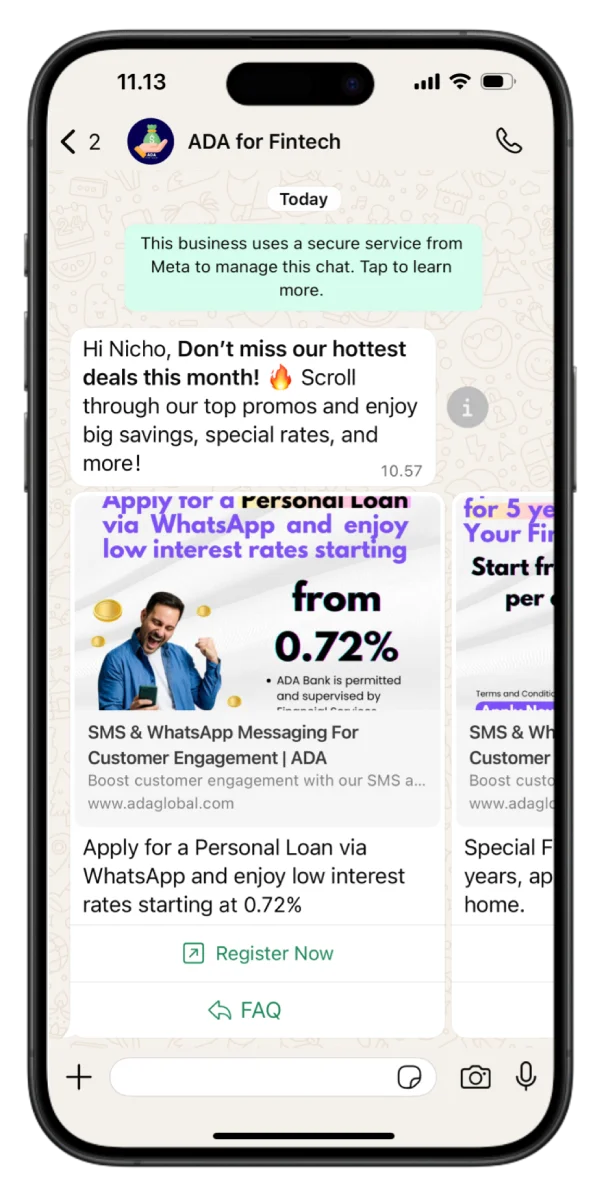
1 Carousel Templates: Financial Marketing Made to Convert

ADA’s carousel templates transform financial marketing into personalized guidance. Customers receive curated product showcases based on Financial Services history and behavioral indicators. Banks can display a variety of financial products, special deals, and customized loan options in a single, eye-catching carousel format thanks to this feature. Within the same messaging interface, customers can easily navigate through various interest rates, loan terms, and exclusive offers, resulting in an engaging and immersive experience that drives higher customer engagement and conversion rates.
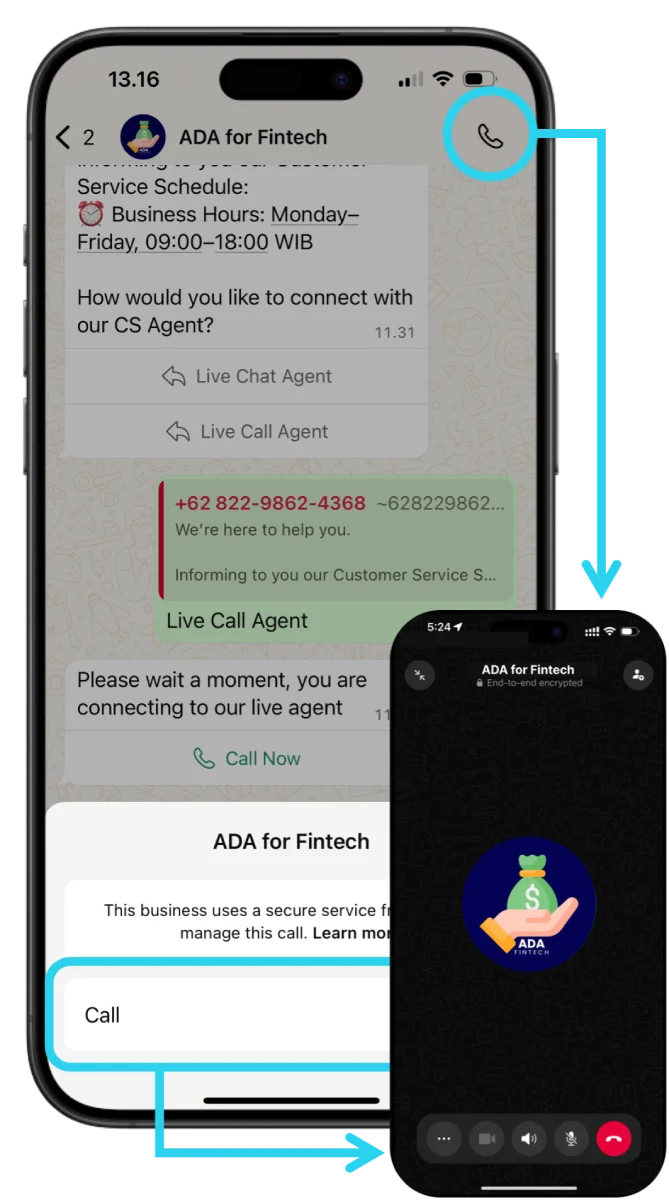
2 WhatsApp Voice Call: End-to-End Support Standby 24/7

ADA’s WhatsApp Voice Call Integration enables VoIP communication directly within the platform, offering a cost-effective alternative to pricey number services. The cloud-based solution supports both inbound customer-initiated calls for complex Financial Services inquiries and outbound agent calls with proper permission protocols, all featuring Meta’s verified caller ID for enhanced trust. This keeps entire conversations in one thread for faster resolution while combining voice capabilities with media features like carousels and call-to-action buttons, driving higher conversion rates in Financial Services.
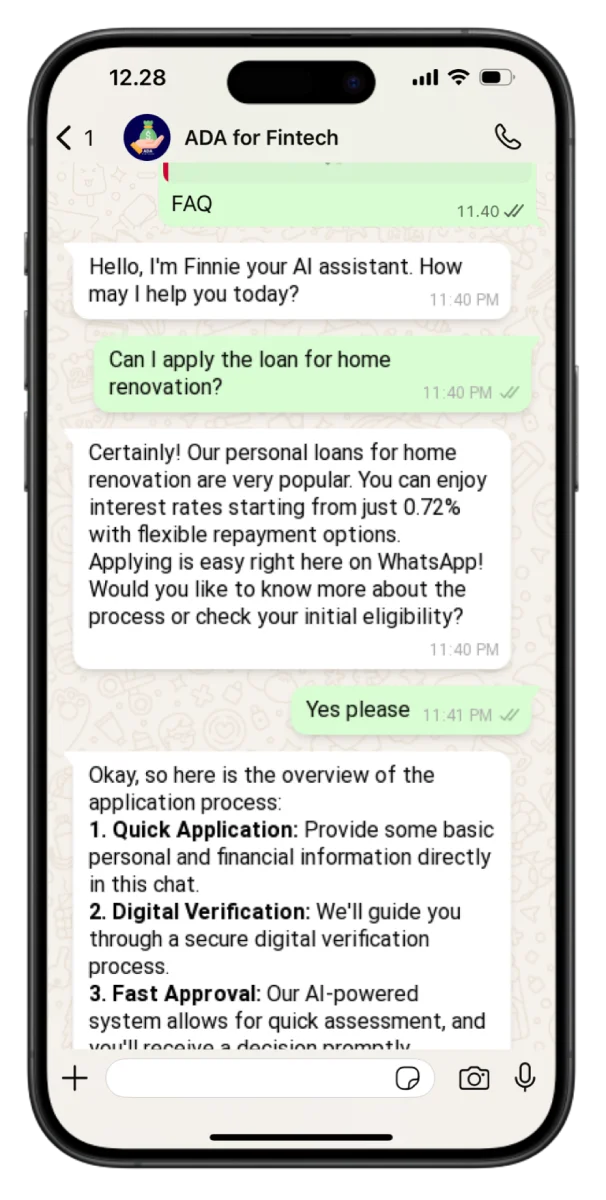
3 Generative AI: Financial Conversations that Read the Room

ADA’s AI-powered FAQ system doesn’t just provide mere template responses, but it understands conversation context, maintains dialogue flow, and delivers relevant answers based on customer inquiries. The system intelligently handles complex FinancialServices requests from loan applications, financial services, to account transactions, while maintaining regulatory compliance. This automation ensures customers receive immediate assistance around the clock, while redirecting complex queries to human agents if deemed necessary. This method of messaging has significantly boosted response times and improved overall customer satisfaction.
4 WhatsApp Flow: Streamlined Financial Services Processes

WhatsApp flow keeps the biodata collection process integrated in a single thread so customers can provide their personal financial information through an encrypted messaging channel. This integration eliminates the need for multiple platform switches, reduces application abandonment rates, and ensures all customer data is collected and processed in accordance with Financial Services regulations while maintaining the convenience of familiar messaging platforms. For example, a loan application that traditionally required branch visits, black on white forms, and extensive processing now happens entirely within WhatsApp. Customer scan start the application, upload documents using their personal devices, receive real-time status updates, and get approval notifications all without leaving the chat.
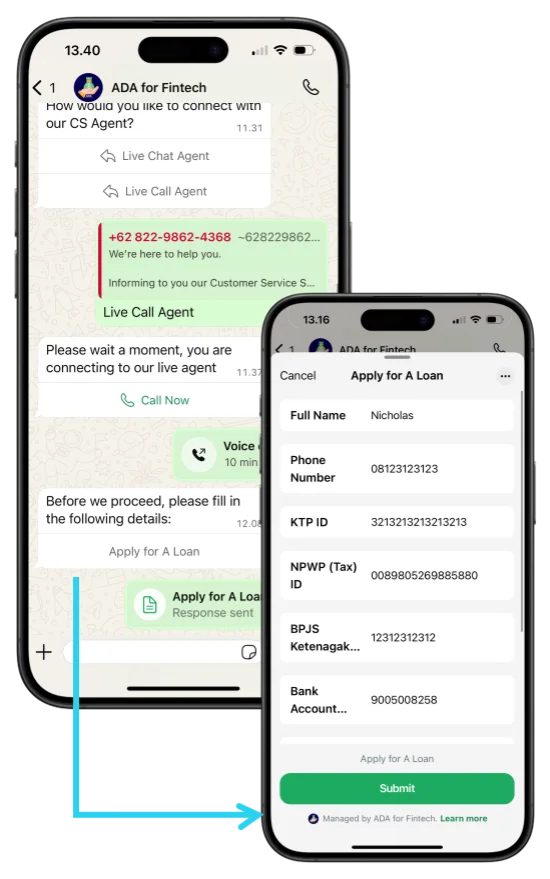
While carousel templates,AI-powered responses, WhatsApp Voice Call, and WhatsApp flow represent the visible aspects your business can implement, the real differentiator lies inADA’s comprehensive platform built to cater to Financial Service’s needs. Our strength in solutioning means we understand the exact touchpoints that drive growth for financial institutions and construct the perfect messaging journey to maximize every interaction. So, you might be asking yourself, what makes ADA different?

  1. Strength in Solutioning. We understand the touchpoints that drive growth for your business and design the perfect messaging journey.
  2. Enterprise-grade Platform. 99.9%uptime, 5million+ of secure messages daily at enterprise scale
  3. Local Excellence. Dedicated teams on the ground for faster support, deeper market understanding, and adherence to local regulations
  4. Meta Premier Partner. Priority support and early access to new rollouts and Beta programs.
  5. Seamless Integrations. Works with100+ tools such as Shopify, Salesforce, Zoho, Zendesk, and more.
  6. Completely Secure. ISO 27001:2022certified, flexible hosting, and enterprise-grade authentication controls.

Closing

Technology alone doesn’t solve the challenges in Financial Service. What matters is delivering experiences that customers trust and regulators approve. ADA blends deep financial services expertise with conversational AI that works within the realities of your business, from encrypted loan applications to compliant onboarding flows. That means less friction for your team and more confidence for your customers.

In this new era of Financial Services, the institutions that thrive will be those that make every customer interaction feel as effortless as Kristina’s morning coffee routine, efficient, impactful, and personalized to your needs.

Test it for yourself today, talk to our sales team

References

¹Statista. (2025). WhatsApp Monthly ActiveUsers Report.

²WhatsApp Business. (2022). Using WhatsApp toAchieve Your Business Goals. WhatsApp Business.https://business.whatsapp.com/blog/use-whatsapp-business-goals

³Gallabox. (2025). Latest WhatsApp BusinessStatistics and Trends in 2025. Gallabox.com. https://gallabox.com/blog/whatsapp-business-statistics

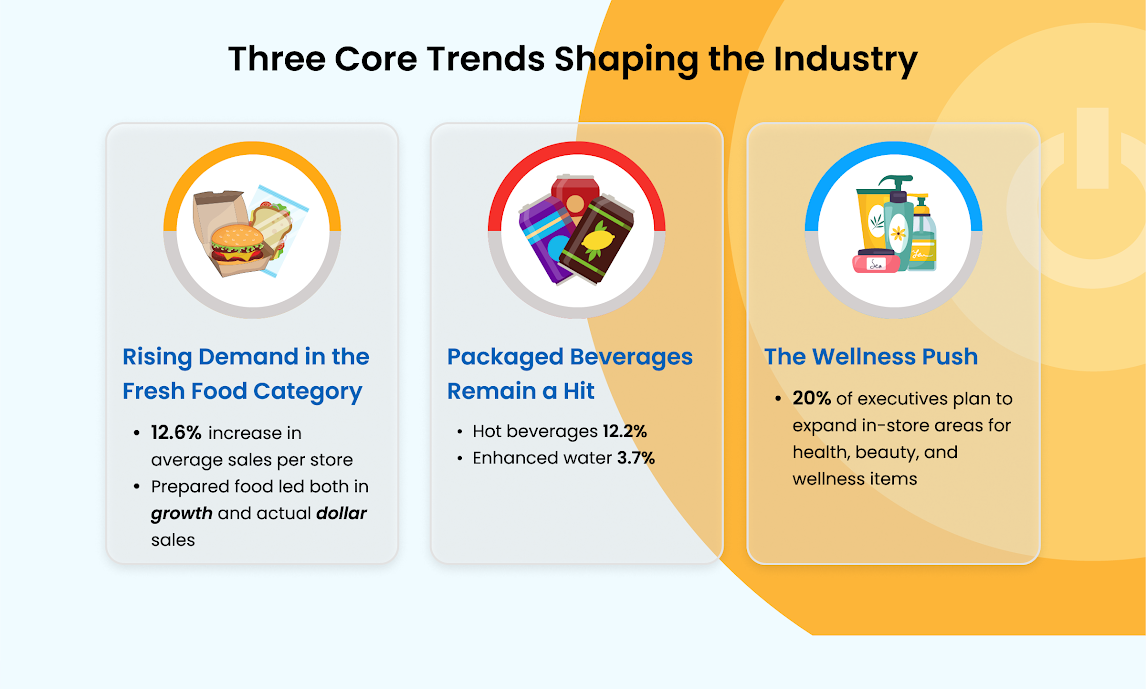
Table Of Content
Numbers Tell: The Financial Services Industry’s Messaging Revolution
Specialized Solutions for the Financial Services Use Cases
The Four Pillars of Financial Services-Focused Messaging AI
Closing

The Next Era of Convenience Retail: GenAI-Led Replenishment at Scale 

Merchandising and Supply Chain
Blogs

The Next Era of Convenience Retail: GenAI-Led Replenishment at Scale 

The global c-store retail industry is headed for growth, inching closer to the trillion-dollar mark and recording a whopping 165 million daily transactions in the US alone. Yet, as the demand explodes and the c-stores’ footprint increases, the pressure on profitability matches the pace.

Retailers are grappling with unpredictable demand fluctuations, rising demand for newer categories and items, and high spoilage in consumables. The existing replenishment methods and legacy tools fail to deliver across the replenishment and forecasting requirements, causing stock imbalances, high inventory costs, and affecting the operational efficiency.

From replenishment roadblocks to revenue boosts – here’s how AI-led replenishment can flip the script to drive growth.

Three Core Trends Shaping the C-Store Retail Industry

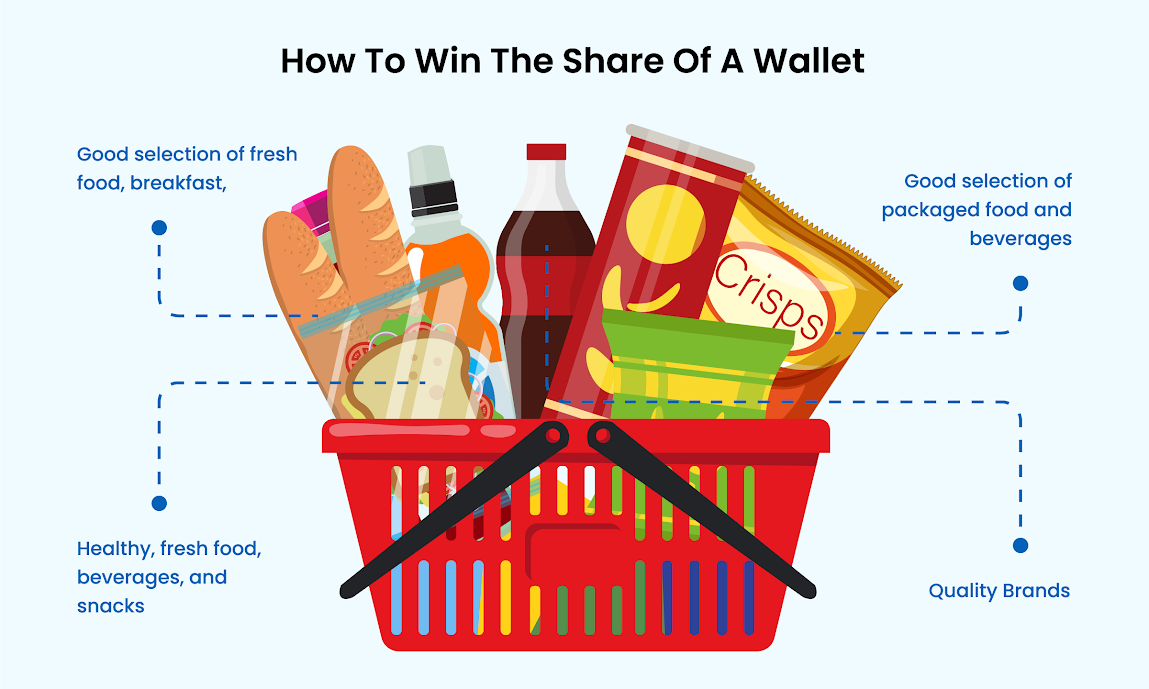
How to Win the Share of Wallet: Top Trends in Customer Purchases

The purchase patterns in c-store retail are becoming more and more nuanced, shifting away from ‘traditional convenience’ and aligning with the rapidly evolving purchase sentiments of modern consumers. The demand for international and imported snacks is rising, while the local brands remain a staple.

Further, the sales are being influenced by micro-trends – local events, holidays, seasonality, sudden changes in weather, and eating preferences. Among all the trends, the following four stand out:

  • Quality Brands
  • Good selection of packaged food and beverages
  • Good selection of fresh food, breakfast,
  • Healthy, fresh food, beverages, and snacks

Further, customers seek a rich variety and prefer the c-stores where the shelves are always stocked. Hence, the store replenishment strategies need a reset – moving away from a standard, one-size-fits-all approach to a more nuanced and sophisticated one.

How does AI-led Replenishment Help Retailers Rise Above Challenges and Unlock Optimal Replenishment?

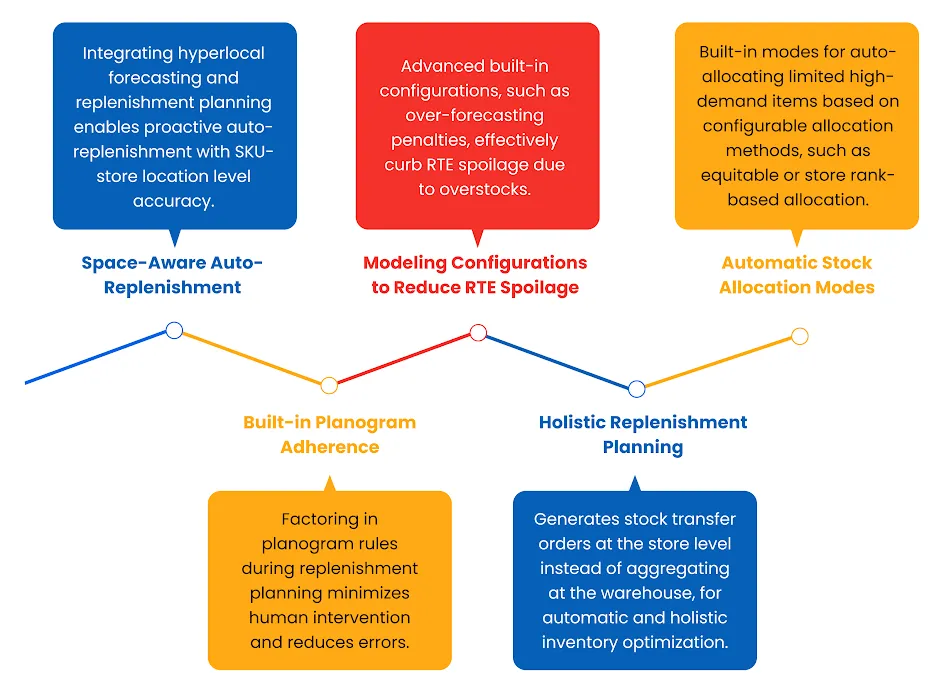
1 Space-Aware Auto-Replenishment

Tight shelf and storage space in convenience stores limit the type and amount of inventory. Further, this increases the reliance on the warehouse for inventory replenishment. Traditional tools lack the modeling sophistication for optimal replenishment with granular precision for each c-store. They forecast demand in the same manner for all store locations, leading to stock imbalances and bloated inventory costs.

AI/ML-led inventory demand prediction and auto-replenishment solutions integrate forecasting and replenishment planning, enabling proactive auto-replenishment with SKU-store location level accuracy. They offer a uniform forecasting rigor for all store locations, ensuring the forecast accuracy is high down to the SKU-location level. While the traditional forecasting happens at the category or sub-category level, the AI-based solutions forecast demand at the SKU level while factoring in location-specific and other influencing factors for unmatched accuracy.

2 Built-in Planogram Adherence

Planogram constraints are critical for c-store shelves, where the space is limited when compared to the inventory. As traditional replenishment tools offer no flexibility to add or consider the planogram constraints, the demand planners end up adjusting the order plans manually to align with the planogram rules. This not only makes replenishment more complex, but it also makes it error-prone and vulnerable to stock imbalances.

On the other hand, ai replenishment planning solutions can factor in planogram rules during replenishment planning, which minimizes human intervention and reduces errors. Another important benefit is the ability to tune replenishment for each c-store with respect to location-specific demand patterns and planograms from a single interface automatically.

3 Modeling Configurations to Reduce RTE Spoilage

Heavy spoilage in the ready-to-eat (RTE) category continues to be a major challenge for retailers, especially as the demand for consumables, fresh food, and snacks rises. Traditional tools lack the technological capabilities and modeling sophistication to prevent overforecasting in the RTE category, and forecast demand like any other category, such as packaged water. However, the demand and demand predictors and influencers for the RTE category vary hugely from the other packaged snacks category.

This is exactly where AI, ML, and deep learning based auto-replenishment and demand planning solutions emerge as the best choice. They allow the demand planners to add as many demand predictors as required and do feature-level configurations to choose or automatically opt for advanced features such as penalized overstocking functions. All these features prevent overstocking of RTE items and enable retailers to exercise granular control over retail inventory optimization solution, even in the most challenging categories.

4 Holistic Replenishment Planning

Traditionally, multiple c-stores are linked to a warehouse or distribution centre or dark store, depending on the location and footfall. As the c-stores are heavily reliant on these inventory locations for quick just-in-time replenishment, the inventory at all such facilities tends to be bloated at all times. Irrespective of the actual consumption, the retailers have to bear the high inventory costs and revenue loss from spoilage and expiry. The legacy systems don’t offer any functionality to optimize inventory as a whole across all locations, making it impossible for demand planners to optimize different kinds of orders from a single interface.

The AI/ML-led solutions can offer holistic inventory optimization views and optimize inventory at all locations from a single intuitive dashboard. Hence, retailers can generate stock transfer orders at the store level instead of aggregating at the warehouse, for automatic and holistic inventory optimization. This means the demand planners can optimize all kinds of orders – direct to store, warehouse, and distribution centre orders without having to switch interfaces, unlocking higher inventory efficiency and lower costs.

5 Automatic Stock Allocation Mode

Every c-store has some high-demand key value items. Poor allocation of such items causes frequent stockouts, eroding revenue, and customer loyalty. Traditional tools for replenishment planning solutions don’t offer feature-level configurations to optimize the allocation of such items. This leads to over-allocation at c-stores where the actual demand is low, while the c-stores with high demand are affected by stockouts.

The AI/ML-driven automatic store replenishment solutions generate auto-replenishment recommendations for such key value items and offer built-in modes for auto-allocating limited high-demand items. They also offer configurable allocation methods, such as equitable or store rank-based allocation based on store-level sales and demand metrics.

As the convenience retail industry grows and markets diversify, retailers need to move towards proactive, agile, and intelligent replenishment built on top of accurate forecasting with hyperlocal precision. Hence, strategic replenishment optimization becomes an imperative, and AI/ML-driven platforms pave the way.

Table Of Contents
Three Core Trends Shaping the C-Store Retail Industry
How to Win the Share of Wallet: Top Trends in Customer Purchases
How does AI-led Replenishment Help Retailers Rise Above Challenges and Unlock Optimal Replenishment?

Turning Customer Data into Actionable Insights with a Real-Time Customer Data Platform

Omnichannel Marketing
Blogs

Turning Customer Data into Actionable Insights with a Real-Time Customer Data Platform

Digital-first brands are not short of customer data. Product analytics, CRM entries, web and app behavior, campaigns, surveys, and billing systems all collect data, However, they are stored in different locations. When leadership asks simple questions, such as “Which customers are at risk right now?” or “Which journeys create the most expansion?”, the answers still require days of manual work.

The global customer data platform market was valued at approximately $5.4 billion in 2023 and is expected to surpass $51.95 billion by 2030, driven by the growing demand for first-party data, personalization, and AI-ready infrastructure.

Marketing teams continue to invest in tools, but decisions still rely on instinct and manual spreadsheet work. In a market where growth has slowed, and efficiency matters more than vanity metrics, that gap between raw data and actionable insights is becoming unsustainable.

One-third of companies in a recent HubSpot study reported direct revenue loss due to their customer data being scattered and disorganized, and only 9% stated they fully trust their data for reporting purposes. Salesforce research supports this, with 81% of leaders stating that data silos slow digital transformation.

This is the problem a real-time customer data management platform  (rCDP) is designed to solve. rCDP creates a single, unified view of each customer and turns that view into real-time intelligence that any team can utilize.

Why More Customer Data isn’t Translating into Better Decisions

Every team views a different aspect of the same customer.

  • Marketing monitors campaign performance and lead scoring.
  • Product teams watch features, cohorts, and events.
  • Sales and account teams look for CRM opportunities and renewal dates.
  • Customer success relies on ticketing systems and NPS tools.

In theory, each function is working with data. In practice, they work with different subsets, stored in separate systems, each with its own fields and definitions. Reporting takes days of manual reconciliation. By the time a combined view is ready, the customer might be about to drop off.

From the customer’s perspective, this fragmentation is obvious. A prospect that is highly engaged in the product might still receive generic nurture emails. Loyal customers are sometimes treated like strangers because one platform has not synced with another. The problem is not a lack of data. It is the lack of a single, trusted customer data platform.

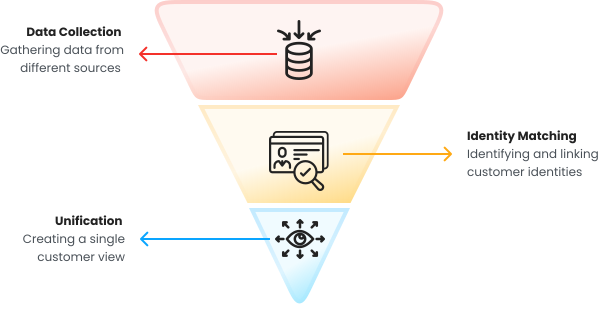
How Identity Resolution Turns Fragmented Data into One Customer Truth

The first job of any credible customer data platform is identity resolution. One person might appear as a free trial user with a personal email address, a contact in CRM management with a corporate domain, a billing owner in the finance system, and an attendee in webinar tools. Without a unifying layer, each system treats them as a different person.

Ada Global’s platform applies deterministic and probabilistic matching techniques to stitch these fragments together into a golden customer record. That record contains demographic details, firmographic attributes, purchase history, channel preferences, consent flags, and summary metrics built from event streams.

How to Achieve a Unified Customer Profile with CDP

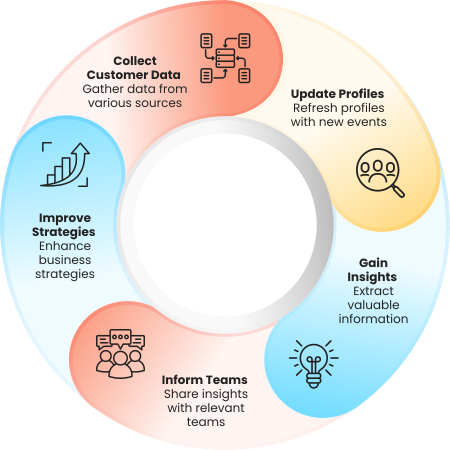
This unified customer profile does more than remove duplicate records. It becomes the shared language of the business. Product teams can identify which features are most important to high-value accounts. Marketing teams are aware of which channels each customer prefers. Finance and leadership can finally reconcile revenue numbers with actual engagement. Because the customer data management platform updates profiles as new events arrive, insights remain fresh, rather than being confined to static quarterly decks.

From Disconnected Events to Meaningful Segments and Insights

Raw data on its own rarely changes decisions. What teams need are segments, scores, and insights that prioritise where to act. A customer data management platform accelerates this step by enabling users to work directly with unified data, eliminating the need for engineering tickets.

With Ada Global’s platform, marketers and growth leaders can define audiences based on product behaviour, recency and frequency of usage, campaign interactions, lifecycle stage, predicted value, and more. The CDP’s artificial intelligence (AI) and machine learning (ML) capabilities help uncover micro segments that would be hard to spot manually, such as clusters of customers who respond strongly to a certain offer or who tend to expand into a specific module next.

When segments and insights live inside the customer data platform, they are not just reports. They are live objects that journeys and campaigns can use immediately.

To learn more, read 5 Must-have Spells for Mastering Audience Engagement with CDP

Activating Insights Across Every Customer Touchpoint

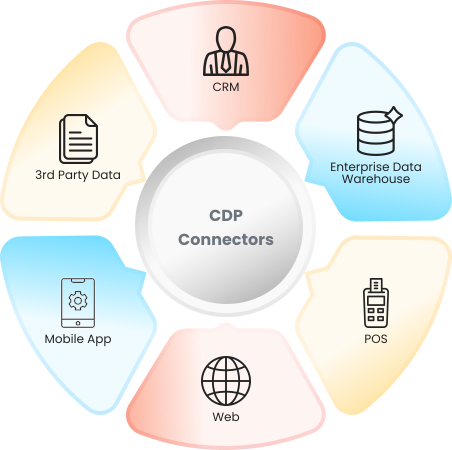
Insight only matters when it transforms customer experience. A stellar customer data platform connects unified profiles and segments to every important touchpoint. Ada Global’s customer data platform plugs into email service providers, mobile push and SMS tools, digital advertising platforms, contact centers, kiosks, websites, and apps through out-of-the-box connectors.

As the platform analyzes new events in real-time, it can trigger journeys the moment something meaningful occurs.

  • A trial user who reaches a key feature milestone can enter a tailored sequence.
  • When a customer shows a strong affinity for a set of products, relevant recommendations and offers appear consistently across email, app, and site, rather than as disconnected messages.
  • A paying customer whose usage drops can enter a save journey that blends in product nudges, targeted offers, or human outreach.

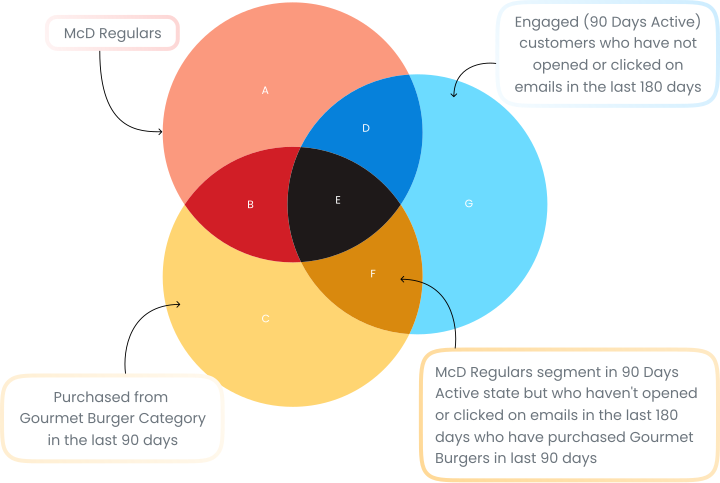
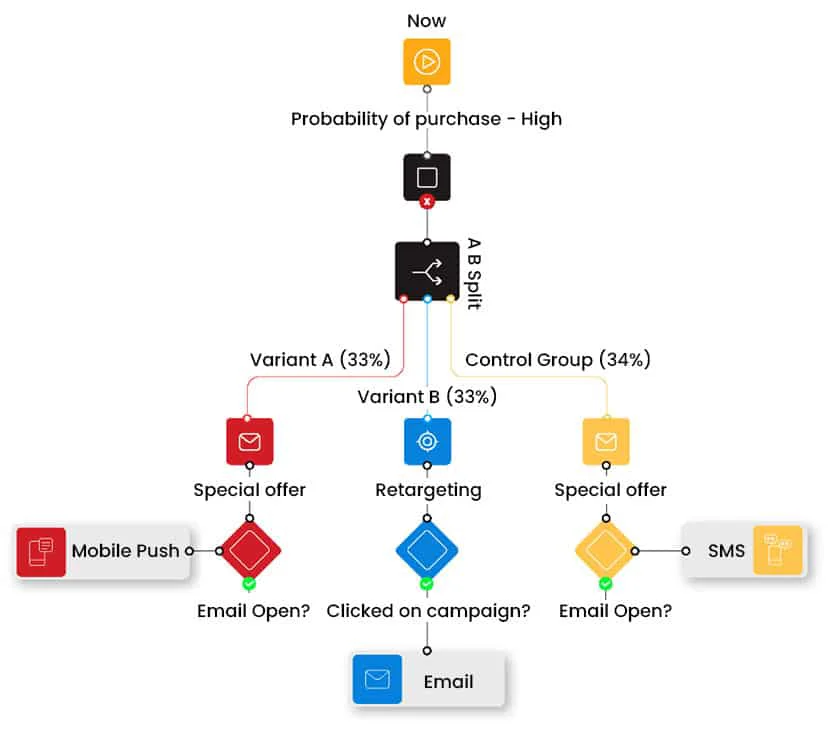
At McDonald’s India, Ada Global’s customer data management platform and customer journey orchestration solution allowed the brand to create automated journeys for weekly promotions, frequency building, McDelivery penetration, and win-back strategies. This automation ran across SMS, email, Facebook, and WhatsApp, with A/B tests and universal control groups to measure impact.

Ada Global’s platform helped McDonald’s in creating microsegments to design winback campaigns.

Why Successful Marketing Teams Leverage a Customer Data Platform

The value of a customer data platform becomes most clear when examining specific outcomes. A few high-impact scenarios stand out across Ada Global’s customer base.

  • Intelligent onboarding and activation
    By combining acquisition source and early product behavior, the rCDP platform identifies the actions that correlate with long-term retention. Marketing teams can then design onboarding flows that guide each customer through those actions, rather than a generic checklist.
  • Product and account qualified lead scoring
    Instead of static scores that live only in CRM, an rCDP recalculates scores whenever important events occur. Sales can focus on the highest intent accounts, while marketing uses similar signals for lookalike audiences and retargeting.
  • Retention, win back, and expansion
    Signals such as declining usage, negative feedback, or repeated support tickets feed into churn propensity models. The rCDP uses those models to trigger save plays, offer adjustments, or success outreach before it is too late.
  • Cross-sell and expansion journeys
    Unified profiles and basket analysis models highlight the next best product, module, or package for each customer. Journeys can then present these in a sequence rather than relying on a one-off campaign.
  • Scalable Omnichannel Engagement
    McDonald’s (West & South India) deployed Ada Global’s customer data platform, customer journey orchestration, and marketing services to centralise customer data management across delivery apps, aggregators, and physical stores. This unified view enabled granular segmentation and automated campaigns across six channels, creating more than:
0 %
Million Engagement Opportunities
0 %
Growth in Omnichannel Customers
0 %
YoY Increase in McDelivery Users

“The CDP and Customer Journey Orchestration projects were key to McDonald’s India’s digital and data transformation journey, whereby we were able to build capabilities to drive insights-driven marketing across channels. We deeply appreciate the invaluable assistance provided by Ada Global’s analytics and campaign specialists, who have worked closely with us to develop and optimize our campaigns.”

Arvind R P CMO, McDonald’s India

How to Evaluate a Customer Data Platform That Delivers Business Impact

Once the business case is established, the next step is selecting the right customer data platform. Drawing on industry research and Ada Global’s experience with over 400 brands, the following criteria can guide your decision.

Strong data management foundation
Look for flexible ingestion options, such as batch files, real-time APIs, and clickstream capture, along with robust cleansing, enrichment, and identity resolution. Ada Global’s platform supports deterministic and probabilistic matching, household creation where relevant, and enrichment from third-party sources.

Audience building and analytics for business teams
An effective CDP enables marketers, product managers, and CRM teams to easily build segments, apply AI-based models, and analyze performance over time without heavy engineering support. The interface should function as a workspace rather than a back-office tool. Ada Global’s platform combines Audience Manager, built-in analytics, and AI/ML models for affinity, churn propensity, and replenishment, making advanced segmentation accessible.

  • Clustering Model​
  • RFM based Audiences
  • Churn Propensity
  • CLTV Model
  • Propensity​
  • Replenishment
  • Affinity Model
  • Lookalike Model
  • Market Basket Analysis

Activation and journey orchestration

Ada Global’s platform should integrate easily with existing channels and orchestration tools. It should provide capabilities for audience export, triggered journeys, and rule-based flows that work across email, mobile, digital advertising, and on-site experiences. Ada Global’s platform integrates journey orchestration and personalization, enabling teams to transition from insight to experience without needing to build custom connectors for every idea.

Security, privacy, and governance
Finally, any platform that handles customer data management must prove its approach to privacy, consent, and security. This includes support for regional regulations, access controls, and clear auditability. Many marketing leaders say that management of first-party customer data in a way that balances privacy and value exchange is becoming increasingly challenging, so the CDP must help rather than add risk.

When evaluating options, it often helps to run a pilot that connects a few key sources, delivers one or two priority use cases, and measures impact. That reveals how well the platform works with your existing stack and teams in practice, not just in slideware.

Future-proofing Your Data Strategy With CDP

The next wave of growth in SaaS and retail will belong to companies that treat customer data management as a strategic asset rather than a byproduct of operations. AI, predictive models, and automated agents will amplify this difference. Models are only as good as the data they are trained on. If that data is scattered, stale, or poorly governed, the promise of AI-driven personalization and efficient growth will remain out of reach.

A customer data platform is not a magic wand, but it is a practical way to build solid foundations. By unifying customer data into trusted profiles, surfacing actionable segments and insights, orchestrating journeys across all channels, and closing the loop with measurement, a CDP turns the idea of customer centricity into an operational reality.

Table Of Contents
Why More Customer Data isn’t Translating into Better Decisions
How Identity Resolution Turns Fragmented Data into One Customer Truth
How to Achieve a Unified Customer Profile with CDP
From Disconnected Events to Meaningful Segments and Insights
Activating Insights Across Every Customer Touchpoint
Why Successful Marketing Teams Leverage a Customer Data Platform
How to Evaluate a Customer Data Platform That Delivers Business Impact
Future-proofing Your Data Strategy With CDP

Shopify Personalization: The Complete Guide for Stores in 2026

Digital Experience Personalization
Blogs

Shopify Personalization: The Complete Guide for Stores

You’ve polished your product pages, experimented with themes, and fine-tuned your ad campaigns to perfection.

Yet there’s one thing that Shopify store owners miss: every visitor, whether a curious shopper or a loyal customer, walks into the same one-size-fits-all experience.

That’s the personalization gap, and it’s costing you revenue.

Brands that use strategic personalization are seeing revenue growth of up to 40%. And with 90% of shoppers expecting personalized experiences, it’s no longer optional.

This guide shows you exactly how to implement Shopify personalization in your store in 2026.

You’ll learn what works, where to focus your efforts, and how to measure real results without needing a massive budget or technical team.

What is Shopify Personalization?

At its core, personalization on Shopify is about tailoring each customer’s shopping experience to their unique behavior, preferences, and purchase history.

Instead of showing everyone the same product, categories, offers, and even banners, you dynamically adjust what they see based on their preferences or your retail goals.

Think of it like this: If you walked into a physical store multiple times, a good salesperson would remember you, know what you’re interested in, and make relevant suggestions.

Personalization brings that same thoughtful customer experience to your Shopify stores.

Solution: Harnessing Behavioral Data for Smarter Email Campaigns

Before we delve any further, let’s address a common misconception. ‘Personalization’ and ‘customization’ are often used interchangeably, but they’re not the same thing.

  • Personalization happens when your store automatically adapts to each shopper using data and algorithms. The shoppers don’t configure their experiences.
  • Customization is when customers manually adjust their experience. They choose their preferences, build their own product, or tweak settings to suit their needs.

For example:
A shopper on Nike.com sees running shoes based on their past purchases. This is personalization. They then select the preferred color and add initials to the pair. This is customization.

Now, let’s explore why personalization is the game-changer that can set your Shopify store apart.

Why Invest in Personalization for Your Shopify Store?

We know the drill: running a Shopify store means there’s always another lever to pull—a theme to tweak, an app to try, an ad to adjust, a product page to polish.

So, why should you consider adopting a sophisticated personalization approach over the default, basic one?

Because most of your competitors are still serving generic experiences.

Despite all the buzz, most Shopify stores are still stuck on the basics when it comes to personalization.

That’s your opportunity.

Let’s break down the specific benefits.

1 Improve Shopify Conversion Rate

This is where personalization delivers instant wins.

Show shoppers recommendations that align with their interests and intent, and your Shopify conversion rate can rise significantly.

When you add personalization to Shopify and display relevant product bundles, smart cross-sells, and featured items that customers actually want, they’ll end up purchasing more, increasing Average Order Value (AOV).

Forget the generic “customers also bought” widget. Now you’re harnessing real shopper behavior to recommend items that actually complement each other for each individual.

And the results speak for themselves. Matas, a leading Danish retailer, increased its attributable sales by 36% by personalizing every user touchpoint on its website. Read their story here.

2 Improve Shopify Customer Experience

And here’s something analytics won’t always capture: personalization simply makes shopping more enjoyable.

When you add personalization to Shopify store effectively, shoppers no longer have to wade through hundreds of products that don’t interest them. Irrelevant pop-ups and banners don’t distract them.

They find what they want in a flash, and their journey feels seamless.

They’re more likely to come back, recommend you to friends, and leave positive reviews. You’re building brand affinity, not just processing transactions.

3 Improve Shopify Customer Lifetime Value

This is where personalization shows a long-term effect. When your Shopify store consistently provides a personalized ecommerce experience to your shoppers, they are more likely to return.

Your store stays relevant, not just for the first purchase, but for every visit after.

Let’s say a customer bought running shoes from you three months ago. With personalization, you can show them running accessories on their next visit, highlight new arrivals in running gear, and remind them it might be time for new insoles.

Without personalization, they see the same generic homepage as everyone else and are likely to leave.

This compounding impact drives up Customer Lifetime Value (CLV), a core metric that reflects both customer loyalty and the long-term profitability of your Shopify store.

Where to Implement Shopify Personalization?

Now that you know the powerful benefits of personalization, the real question is: where should you put it to work?

The short answer: everywhere possible. But let’s zero in on the spots that deliver the biggest impact.

Product Detail Page Personalization

Your product pages (PDPs) are where purchase decisions happen, making them prime real estate for personalization.

The strategies that work:

  • Related products: Show items that complement what they’re viewing based on purchase patterns, not just products from the same category.
  • Product bundles: Suggest complete solutions by bundling the current product with commonly purchased companion products.
  • Cross-selling: Highlight accessories or add-ons that enhance the main product.
  • Complete the look: Suggest ensembles that encourage shoppers to purchase complementary products.

Example:

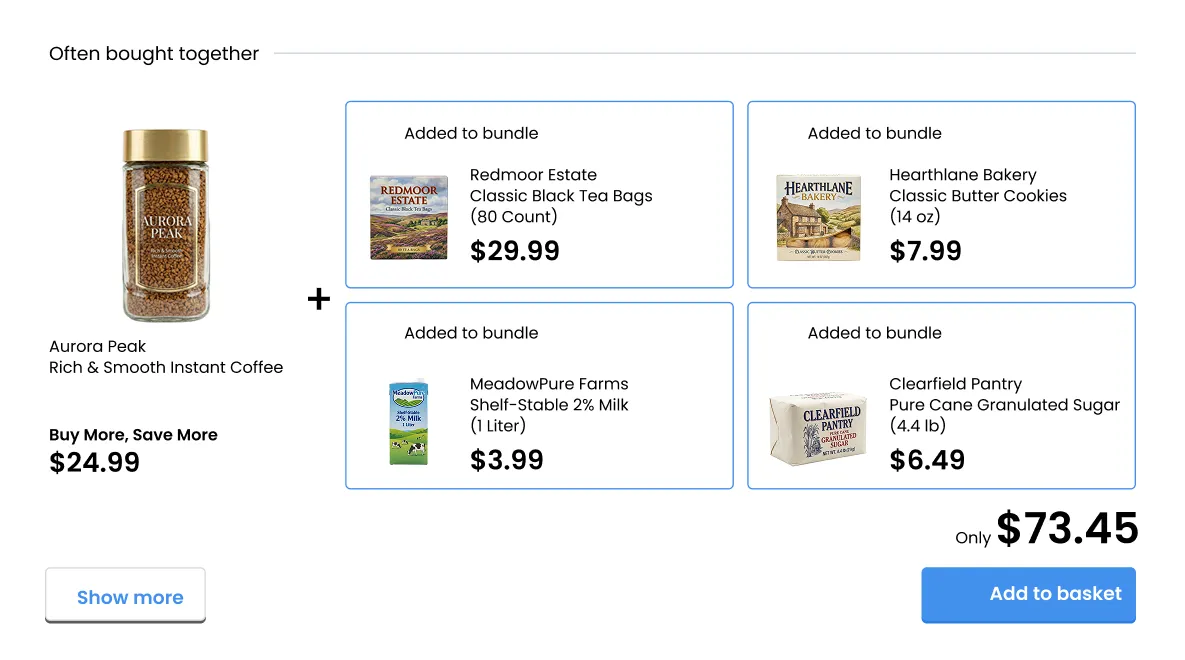
A customer is looking at a coffee product in your store, priced at $24.99.

In the suggestions, you also show tea, biscuits, milk, and sugar—items that customers who buy this coffee often purchase together. These products are grouped into a bundle costing  $73.45 that can be added with one click.

That’s the difference between a $24.99 single-item purchase and a $73.45 bundled order, driven by relevant, data-backed personalized product recommendations.

Ready to implement AI-powered product recommendations on your PDPs? Ada Global AI Recommendations automatically delivers related products, bundles, and cross-sells that drive conversions without any manual configuration.


Homepage Personalization

Your homepage is the first impression for many visitors. But showing the exact same homepage to a first-time visitor and a loyal customer is a missed opportunity.

Personalizing your homepage content can make all the difference.

For returning customers, you can highlight new arrivals in categories they’ve shown interest in. Feature products similar to their past purchases, or create personalized hero banners based on their preferences.

Example:

A first-time visitor to your jewelry store sees the standard homepage with best-sellers and current promotions.

However, when a shopper, who has been searching for rings, returns to the homepage, the main banner changes to feature your top ring styles tailored to their browsing history. This is content personalization in action.

Your shopper feels seen and is effortlessly guided back to the pieces that truly catch their eye.


Category Page Personalization

Category pages are where browsing typically occurs, and personalization enhances the browsing experience for shoppers.

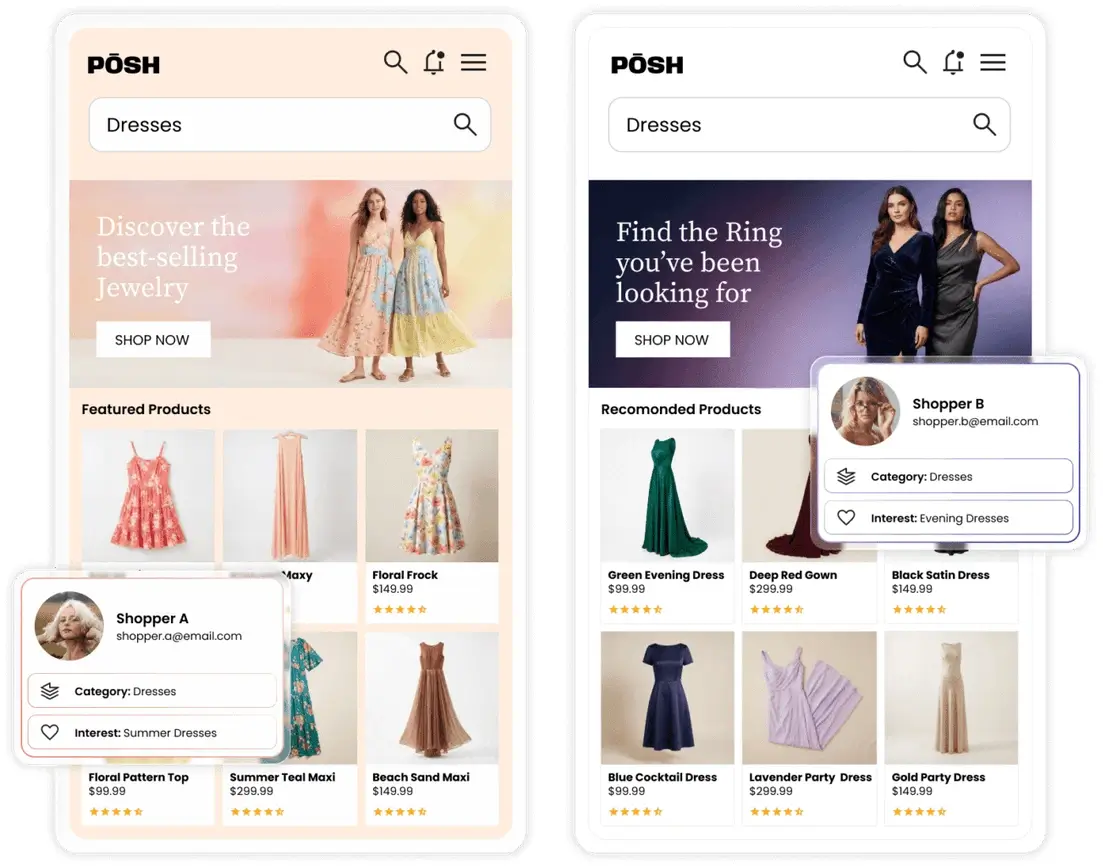
You can create real time customer segmentation based on browsing patterns and past purchases of your shoppers, then reorder products on category pages to showcase the most relevant items first.

Example:

Two shoppers open your “Dresses” category. One has been browsing casual summer styles, while the other has been looking at formal evening wear.

With personalization, the first shopper sees breezy day dresses featured at the top, while the second sees elegant evening gowns first.

Same category page, but two different relevant experiences.


Cart & Checkout

Cart and checkout are your final chance to boost order value, yet most stores treat them like afterthoughts. That’s a costly oversight.

There are hidden opportunities for upselling, bundling, and cross-selling that you can tap into with personalization.

Suggest complementary items based on what’s actually in the cart or offer bundles that make sense with the current selection.

Example:

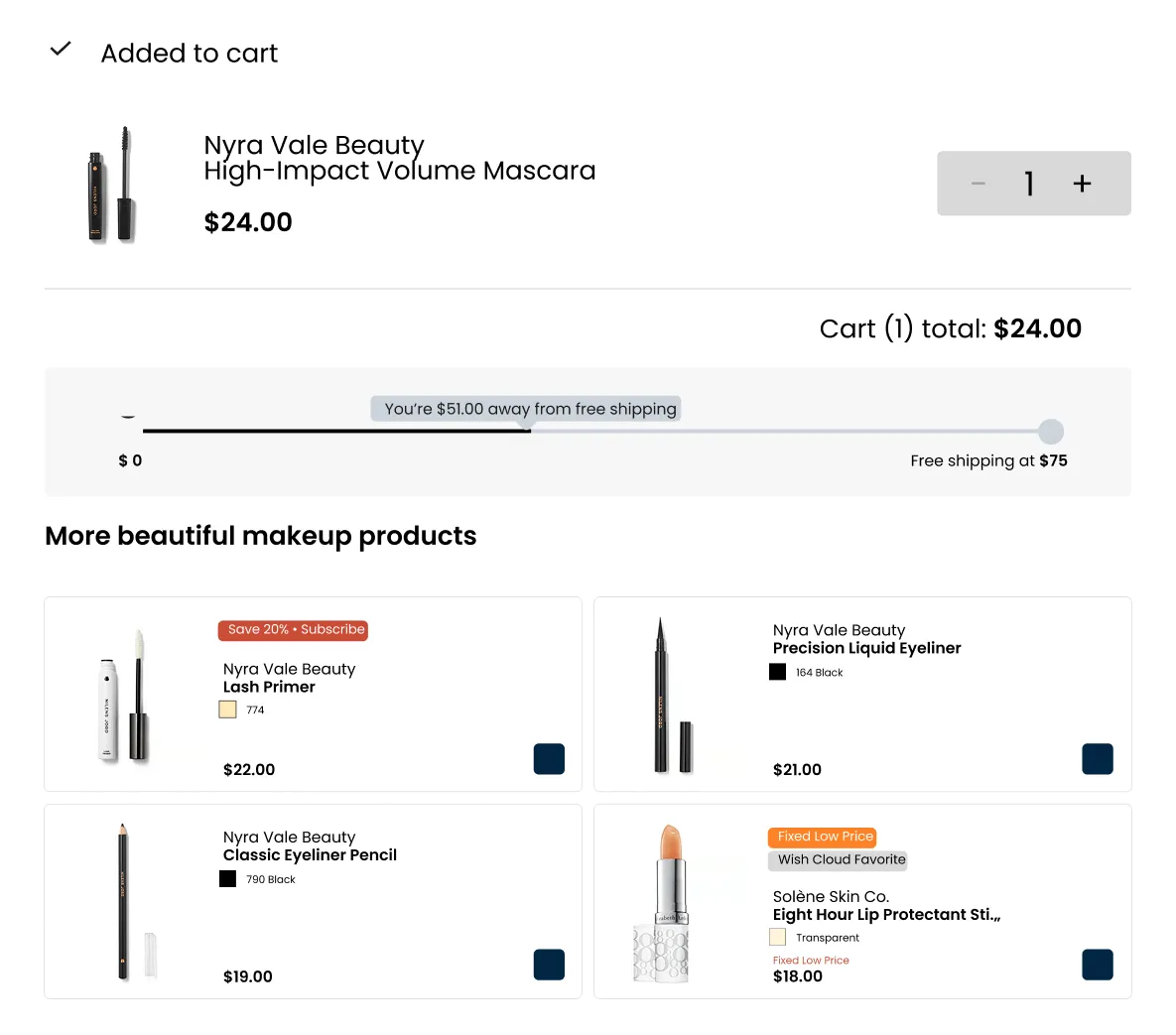
A customer has a High-Impact Volume Mascara in their cart, priced at $24.00. At checkout, personalization recognizes that shoppers who buy mascara often complete their look with eye and lip essentials.

The cart suggests:

  • Lash Primer ($22.00)
  • Precision Liquid Eyeliner ($21.00)
  • Classic Eyeliner Pencil ($19.00)
  • Eight-Hour Lip Repair Stick ($18.00)

How to Add Personalization on Shopify?

To add personalization to Shopify, start by personalizing product recommendations on product detail pages, then expand to your homepage, category pages, and cart using either Shopify’s Search & Discovery app or ecommerce personalization software that adapt experiences in real-time.

Let’s look at how these two approaches work.

Use Native Features

Let’s start with the free option: Shopify’s Search & Discovery app. It enables you to create product recommendations and customize search results without requiring third-party tools or coding.

You can manually configure related products, popular items, or specific collections on PDPs, homepage, and cart.

The major downside is that it’s manual and basic.

You’ll need to manually create and maintain recommendation rules for different products and pages. This may not seem like a significant challenge at first. For small catalogs, this might be fine. But for mid-market stores with hundreds or thousands of SKUs, it quickly becomes unmanageable.

The recommendations also aren’t dynamically personalized to individual shoppers. You’ll just be implementing the same rule-based suggestions for everyone.

It’s better than nothing, but it’s not real personalization.

Install AI personalization platforms that integrate with Shopify

This is where personalization gets powerful. The Shopify app store has dedicated personalization apps that bring sophisticated capabilities without requiring you to build everything from scratch.

These apps use algorithms and AI to automatically personalize product recommendations, content, and experiences based on real time customer data profiles.

Take ADA Global AI Recommendations as an example. It’s built specifically for Shopify merchants who want enterprise-level personalization without enterprise-level complexity. Here’s what you get:

  • AI-powered product recommendations
  • AI and rule-based merchandising capabilities
  • Margin-aware models
  • Real-time personalization
  • Easy implementation
  • White-glove onboarding

Battle-tested with 400+ enterprise retailers, the personalization engine is now built for Shopify. The same technology trusted by Tiffany & Co. and Abercrombie & Fitch can help Shopify stores unlock a 10–15% lift in attributable sales.

Shopify Personalization Trends to Follow in 2026

The landscape of personalization is evolving rapidly. Here’s what you need to watch as we move deeper into 2026 and beyond:

AI-Driven Personalization Becomes the Default
Real-time AI replaces manual rules across the store.

Content Personalization Differentiates Brands
Hero banners and messaging adapt to each shopper.

Sentiment-Aware Experiences
UX responds to shopper intent and behavioral patterns.

Privacy-First Personalization
First-party data and transparency become critical.

Agentic Commerce Goes Mainstream
AI agents guide discovery and purchasing.


AI-Driven Personalization Becomes Default

  • We’re moving past rule-based personalization into the era of true AI-driven experiences. AI-powered algorithms can now analyze thousands of data points in real-time to predict what each customer wants.
  • This isn’t a talk of the future; it’s happening now.
  • The sophistication that once required a team of data scientists is now being packaged into accessible apps that any Shopify merchant can utilize.
  • If you’re still relying on manual product recommendations or basic rules-based personalization, you’re falling behind. The good news? Catching up is easier than ever with apps like ADA Global AI Recommendations.

Content Personalization Will Be the Differentiator

Everyone offers product recommendations now. The real competitive edge is dynamic content personalization.

Consider creating tailored hero banners for new and returning visitors. Messaging that shifts based on traffic source. Sustainability callouts for eco-conscious shoppers and performance messaging for athletes.

It creates experiences that feel truly custom. It’s harder to pull off, which is exactly why it will separate the winners from everyone else.

Stricter Pushback on First-Party Data

Privacy regulations continue to tighten globally. GDPR was just the beginning.

More regions are implementing stricter privacy laws, and customers are becoming increasingly concerned about how their data is used.

The trend? You’ll need to be more transparent about data collection and more thoughtful about what you collect in the first place.

Stores that get ahead of this trend will build trust that translates into customer loyalty.

Agentic Commerce Becomes Mainstream

AI shopping assistants are in. These ‘agents’ can understand natural language, make recommendations, answer questions, and even complete purchases on behalf of customers.

Instead of browsing through filters and categories, customers might simply tell an AI agent, “I need a wedding gift for my outdoorsy friend, budget $100,” and receive curated suggestions.

For Shopify merchants, this means that your product descriptions must be AI-ready. It should be well-structured, richly described, and properly tagged.

How to Measure the Success of Personalization on Shopify?

Track the following metrics when implementing personalization:

  • Conversion Rate: Compare conversion rates for visitors who experience personalized elements versus control groups.
  • AOV: Personalized product recommendations and bundles should increase AOV. Measure AOV for customers who interact with personalized recommendations.
  • Engagement Time: Personalization makes browsing more enjoyable and relevant, typically increasing time on site.
  • Click-Through Rate: Track the percentage of customers who click on your personalized product suggestions. Low CTRs suggest that your recommendations may not be relevant.

Set up proper tracking before launching personalization, so you can measure its true impact.

Most personalization apps include built-in analytics, but you can also monitor changes in your core Shopify analytics and Google Analytics.

Ready to Start Personalizing Your Shopify Store?

Personalization is no longer an option, but a necessity for retailers today.

Customers expect stores to understand their preferences and show them relevant products.

The best part? The same personalization tech used by retail giants is now within reach for any Shopify store. No huge budget or data science team required.

So, today, the question isn’t whether to personalize, but how quickly you can roll out sophisticated Shopify personalization before your competitors do. To achieve this, you need personalization tools that are built to scale with your growth.

Want to implement powerful personalization without the complexity? Check out ADA Global AI Recommendations on the Shopify App Store and start your free trial today.

Ready to Personalize Your Shopify Store?

Get 10-15% sales lift with enterprise-level AI personalization on your Shopify store.

Start Your Free Trial

FAQs

1 ​​Do I need a large budget to implement personalization on Shopify?

No. You can start with Shopify’s free Search & Discovery app for basic personalization, or use affordable third-party apps like ADA Global AI Recommendations, which bring AI-powered personalization without the enterprise-level costs.

2 Where should I implement personalization first?

Start with your product detail pages (PDPs) since that’s where purchase decisions happen. Then expand to your homepage, category pages, and cart/checkout pages for maximum impact.

3 How long does it take to see results from personalization?

Conversion rate improvements from personalization often show up immediately, while benefits like increased customer lifetime value build over time as you gather more behavioral data.

4 Will personalization work for stores with small catalogs?

Yes, though the impact is typically greater for stores with larger product catalogs. Even smaller stores benefit from showing the right products to the right customers at the right time.

5 What metrics should I track to measure personalization success?

Focus on conversion rate, average order value (AOV), engagement time, and click-through rates on personalized recommendations compared to control groups.

6 Is Shopify’s native personalization enough?

For basic needs and small catalogs, it might work. However, it requires manual configuration and doesn’t offer true dynamic personalization based on individual shopper behavior like AI-powered apps do.

Table Of Contents
What is Shopify Personalization?
Why Invest in Personalization for Your Shopify Store?
Where to Implement Shopify Personalization?
How to Add Personalization on Shopify?
Shopify Personalization Trends to Follow in 2026
How to Measure the Success of Personalization on Shopify?
Ready to Start Personalizing Your Shopify Store?
FAQs

5 Benefits of One-Time Password for Business

Data & AI
Blogs

5 Benefits of One-Time Password for Business

What Are One-Time Passwords (OTP)?

One-time passwords (OTPs) have emerged as a crucial tool in the world of digital security and authentication. In an era where data breaches and cyber threats are rising, businesses are turning to OTPs as a reliable means of protecting sensitive information and ensuring secure transactions.

In this article, we will delve into the world of OTPs, exploring what they are, how they work, and, most importantly, the substantial benefits of OTPs to businesses. So, let’s dive in and uncover the five significant advantages of OTP implementation in business!

What Are One-Time Passwords (OTP)?

One-time passwords, commonly called OTPs, are fundamental to modern digital security. These passwords serve as a dynamic and highly secure means of authentication in an increasingly interconnected world.

Unlike traditional static passwords, which remain unchanged until the user decides to modify them, OTPs are temporary and unique for each authentication attempt. They provide an additional layer of security by requiring users to enter a new code each time they log in or perform a transaction.

The core principle behind OTPs is their one-time usability. When a user initiates an authentication process, the system generates a unique OTP and sends it to the user through their registered mobile number, email address, or other designated channels. This OTP is valid for a brief duration, often just a few minutes, after which it becomes obsolete. Once used, the OTP cannot be employed again, making it exceptionally resilient to hacking attempts.

The dynamic nature of OTPs adds a significant level of security to various online activities, including logging into accounts, confirming financial transactions, and accessing sensitive information. By utilising OTPs, businesses can fortify their security measures and safeguard their digital assets against unauthorised access and cyber threats.

How Does OTP Work?

Understanding the inner workings of one-time passwords (OTPs) is essential to appreciating their role in enhancing security. The mechanism behind OTPs is ingenious and effective, making them a vital tool in digital authentication.

1. Generation of a Unique OTP

The OTP process begins when a user attempts to log in to an account or perform a transaction that requires authentication. At this point, the system generates a single-use OTP. This code is randomly generated and consists of a sequence of numbers or characters, making it highly unpredictable and challenging to guess.

2. Delivery to the User

Once generated, the OTP is delivered to the user through a secure channel. Common delivery methods include SMS messages, email messages, dedicated mobile apps, or even hardware tokens. The chosen method depends on the business’s security policies and user preferences.

3. Limited Validity Period

OTPs have a limited lifespan, typically lasting just a few minutes. This time constraint adds an extra layer of security because it means that even if an attacker intercepts the OTP, they have only a short window to use it before it becomes invalid.

4. User Authentication

To complete the authentication process, the user must enter the OTP received into the designated login or transaction page field. The system compares the entered OTP with the generated one and sends it to the user. If they match, the user is granted access or allowed to proceed with the transaction. If not, the authentication fails.

5. Single-Use Security

The defining feature of OTPs is that they are single-use. Once employed for authentication, an OTP cannot be used again. This characteristic makes OTPs extremely secure, as even if an attacker obtains a previously used OTP, it will be useless.

6. Protection Against Unauthorised Access

OTPs are highly effective in safeguarding accounts and transactions. Even if someone can acquire a user’s password or other login credentials, they still require the current OTP to gain access. This added layer of protection is instrumental in preventing unauthorised access to sensitive data.

In summary, the operation of OTPs revolves around generating unique, time-sensitive codes that are delivered to users for authentication. Their one-time use, limited validity period, and secure delivery methods make OTPs a formidable tool in the fight against cyber threats and unauthorised access. Businesses can employ OTPs to bolster security and provide their users with a reliable means of safeguarding their digital identities and transactions.

Benefits of OTP Implementation in Business

Implementing one-time passwords (OTPs) in a business environment offers a range of significant advantages that contribute to enhanced security, user experience, and compliance with data protection regulations. Let’s explore these benefits in detail:

1. Enhanced Security

One of the foremost benefits of OTP implementation is its enhanced security. Businesses can thwart many common security threats by requiring users to enter a unique OTP for each authentication attempt. Even if an attacker obtains a user’s password or login credentials, they still need the current OTP to gain access. This dynamic layer of security significantly reduces the risk of unauthorised access and data breaches.

2. Protection Against Phishing

OTPs are a formidable defence against phishing attacks, a prevalent tactic cybercriminals employ. Phishing attempts typically involve tricking individuals into revealing their passwords or sensitive information. With OTPs, the attacker would still require the OTP for access even if a user unknowingly divulges their login credentials. This added layer of security helps safeguard businesses and their customers against phishing threats.

3. Compliance with Regulations

In an era of stringent data protection regulations, businesses must demonstrate their commitment to safeguarding customer data. OTP implementation can aid in compliance with these regulations. By using OTPs for user authentication and transaction verification, companies can enhance data security and build customer trust, which contributes to an improved overall customer experience driven by better data management.

4. User-Friendly Authentication

While OTPs offer robust security, they are also user-friendly. Unlike complex password requirements that frustrate users, OTPs are typically short and easy to enter. This simplifies the authentication process, reducing the likelihood of forgotten passwords and the need for frequent password resets. A seamless user experience can enhance customer satisfaction and retention.

5. Cost-Effective Security

Implementing strong security measures can be costly, especially for smaller businesses. However, OTPs offer a cost-effective solution. They don’t require extensive infrastructure or expensive hardware. OTPs can be delivered through widely accessible channels such as SMS, email, or dedicated mobile apps, making them affordable for businesses of all sizes. This cost-effectiveness allows businesses to bolster their security without straining their budgets.

In conclusion, implementing one-time passwords (OTPs) is crucial to fortifying your business’s security infrastructure. The benefits of enhanced security, protection against phishing, regulatory compliance, user-friendly authentication, and cost-effectiveness make OTPs a compelling choice.

Leverage WhatsApp Business Solution with ADA Asia

As you look to embrace this cutting-edge security solution, consider taking your customer experience to the next level with ADA’s WhatsApp Business Solutions. Connect more effectively with your customers on WhatsApp and elevate your customer experience by harnessing the power of WhatsApp chatbots.

With ADA, you can double agent productivity and boost sales conversions, all through the convenience of WhatsApp. Take advantage of this opportunity to enhance both security and customer engagement. Get started with ADA’s WhatsApp Business Solution today! Contact us to find out how our service can help you expand the capabilities of your business.

Frequently Asked Questions (FAQs) about Benefits of OTP

How Is OTP Used for Secure Payments?

In the realm of online and mobile payments, security is of paramount importance. One-time passwords (OTPs) have become a linchpin in ensuring secure financial transactions, offering a robust defence against fraud and unauthorised access. Let’s delve into how OTPs are effectively utilised to enhance the security of payments.

1. Initiating the Payment

When a customer initiates an online payment, whether for purchasing goods or services or conducting a financial transaction, the process begins as usual. They select the items they wish to purchase or specify the transaction details.

2. User Verification

When confirming the payment, the system prompts the user for an OTP. This OTP is sent to the user’s registered mobile number or email address, depending on their preference and the payment platform’s configuration.

3. Receiving the OTP

The user receives the OTP via the chosen delivery method, often as a text message (SMS) on their mobile phone. This OTP is unique and time-sensitive, adding a layer of security to the payment process.

4. Entering the OTP

To proceed with the payment, the user enters the OTP into the designated field on the payment page. This step ensures that the person making the payment is the account holder and has access to the registered contact information.

5. Authentication and Approval

The system verifies the entered OTP against the one it generated and sent to the user. If the OTPs match and are within the valid timeframe, the payment is authenticated, and the transaction is approved. The transaction is declined if a mismatch or the OTP has expired, safeguarding against unauthorised access.

6. Secure Completion

With a successfully authenticated OTP, the payment is securely processed. The user can confidently complete their purchase or financial transaction, knowing that the OTP has provided additional protection.

7. Single-Use Security

Importantly, the OTP used for the payment is single-use and cannot be used again. This means that even if a malicious actor obtains the OTP, it will be useless for future transactions, making OTP-based payments highly secure.

Using OTPs for secure payments significantly reduces the risk of fraudulent transactions. Even if an attacker can acquire the user’s payment details, they still require the OTP for each transaction sent directly to the user. This multi-factor authentication process adds a robust layer of security, giving businesses and customers peace of mind when conducting online and mobile payments.

Table Of Contents
What Are One-Time Passwords (OTP)?
How Does OTP Work?
Benefits of OTP Implementation in Business
Leverage WhatsApp Business Solution with ADA Asia
Frequently Asked Questions (FAQs) about Benefits of OTP

Inventory Optimisation for Indian CPG Supply Chains

Personalisation
Blogs

Inventory Optimisation for Indian CPG Supply Chains

The New Inventory Optimisation Standard Indian CPG Leaders Are Building for 2026

Inventory is no longer a back-office “numbers exercise” of replenishment cycles; it is the strategic lever for unit economics in the 2025-2026 Indian market. In practice, it shapes some of the most important outcomes in a CPG business, from revenue protection and cash flow to service reliability and customer trust.

Even small inefficiencies add up quickly. Out-of-stock days can reduce potential revenue by 5% to 10%. At the other end of the spectrum, carrying too much inventory brings its own cost, typically 20%to 30% of inventory value each year once storage, handling, financing, and obsolescence are considered. Wastage compounds the issue further, with a meaningful share of stock lost to expiry, overproduction, or misaligned distribution.

The Death of the “One-Size-Fits-All” Model

In 2025, a singular inventory strategy is a liability. Leading CPG players are now adopting a ndian market:

  • The Q-Comm Sprint: Using AI to manage hyper-local dark stores where stock-outs are measured in minutes, not days.
  • The Kirana Pulse: Leveraging AI to bridge the data gap in unorganized retail, predicting “Next-Gen” orders for millions of small shops.
  • The Rural Reach: Optimizing long-haul logistics for Tier 3+ cities where infrastructure remains the primary bottleneck.

Understanding Inventory Optimization as a Capability

At its core, inventory optimization is about making informed trade-offs. It is the discipline of holding the right inventory, in the right locations, at the right time, while keeping cost and risk under control.

Rather than relying on broad buffers or fixed safety stock, inventory optimization uses data-led forecasting, reorder logic, and buffer strategies that reflect real demand patterns and supply constraints.This allows organizations to respond to variability with precision instead of excess.

When applied consistently, this approach improves cash flow by reducing unnecessary stock, while also supporting higher service levels. It also strengthens resilience. By understanding where inventory is exposed to risk, whether from long lead times, demand variability, or limited shelf life, businesses gain more control over outcomes. This is particularly relevant for inventory management CPG India operations, where scale, channel diversity, and distributor-led networks add complexity.

Where Inventory Optimization Commonly Breaks Down

Despite its importance, many organisations struggle to optimize inventory in practice. A common issue is limited visibility into stock age and expiry. Without reliable batch, lot, and expiry tracking, FIFO and FEFO principles are difficult to enforce consistently. Inventory can age unnoticed across warehouses and distributors, leading to shortened shelf life, forced discounting, and write-offs.

Visibility challenges often extend beyond expiry. Disconnected systems across manufacturing, distribution, and retail make it difficult to see inventory holistically. Teams may know how much stock exists, but not where it is most needed or how quickly it is moving. This lack of clarity leads to stock outs and overstocking, a pattern that ties up working capital while still disappointing customers.

These inventory visibility challenges are rarely caused by a single failure. They are usually the result of fragmented data, manual processes, and decisions made without timely feedback from the ground.

Why Traditional Approaches Struggle to Keep Up

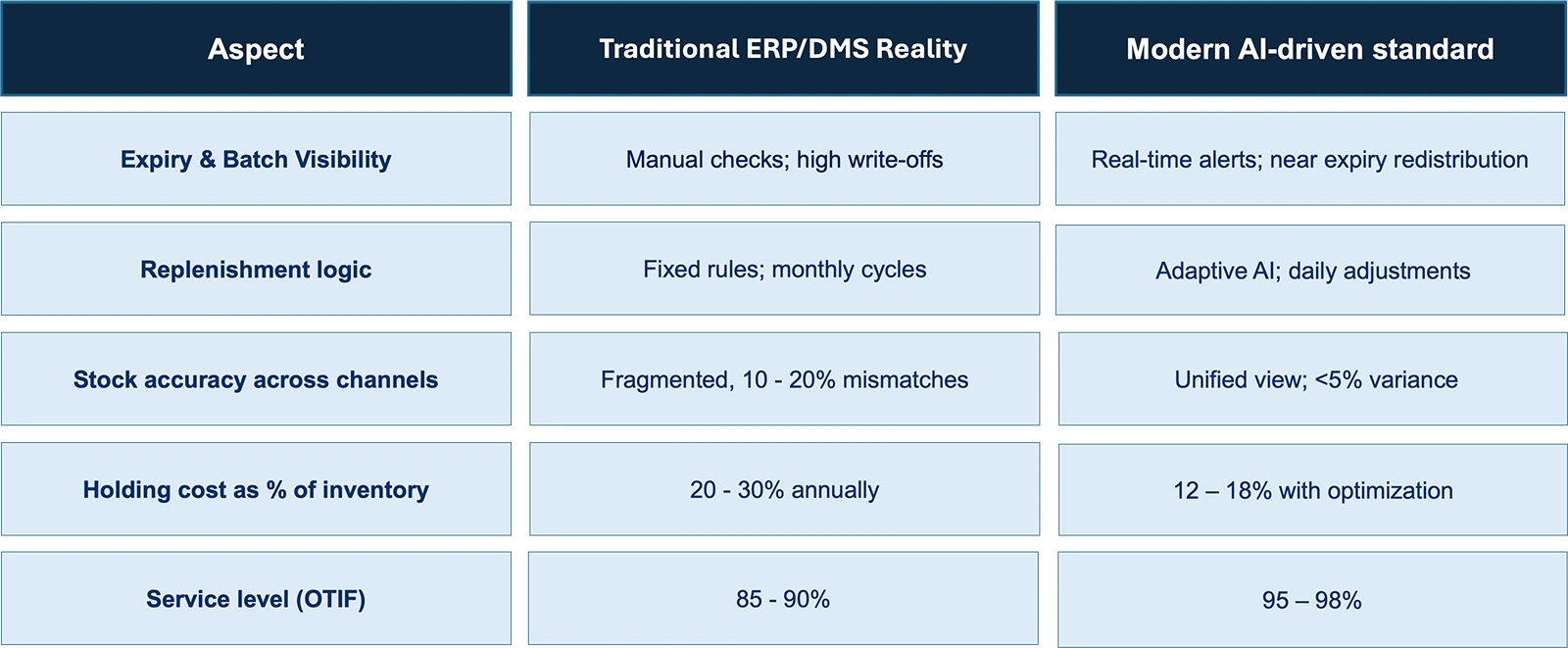
Most legacy DMS, SFA, and ERP environments were designed to record transactions, not to continuously optimize decisions.They provide structure and control, but often lack the responsiveness needed in fast-moving, multi-channel environments.

In general and modern trade, this can result in replenishment cycles that are slow to adapt, forecast assumptions that drift from reality, and inconsistent OTIF performance. In ecommerce and direct-to-consumer channels, the challenge is compounded by the need to synchronise inventory across multiple systems, increasing the risk of a mismatch between available and actual stock.

These approaches tend to address issues after they occur. Without predictive inventory analytics and SKU-level demand forecasting, organizations are left reacting to outcomes rather than shaping them. Over time, this makes it difficult to reduce inventory cost CPG India businesses continue to carry while still protecting service levels.

The gap between legacy systems and the new standard is clear:

What a More Effective Approach Looks Like

A more effective approach to inventory optimization starts with a strong data foundation and a data-first mindset. This does not require replacing existing systems, but rather connecting and enhancing them so decisions are based on a shared view of reality.

With integrated inventory optimization systems, organizations gain visibility into batch-wise stock age and expiry, allowing near-expiry inventory to be identified early. This enables timely actions, such as adjusting distribution or triggering liquidation, before value is lost. Brands adopting these data-first, AI-driven systems are seeing expiry write-offs reduced by up to 30%, overall inventory costs drop 20–30%, and holding costs fall 15–25% (McKinsey, ToolsGroup, and industry benchmarks 2024–25). Slow-moving SKUs can be managed more deliberately through smarter purchase order decisions, reducing holding costs while improving cash flow predictability.

Replenishment also becomes more adaptive. Instead of fixed rules, AI-driven workflows learn from demand signals, lead times, and movement patterns. Orders adjust as conditions change, reflecting actual consumption rather than static plans. Assortment and stock movement decisions are continuously refined to balance inventory across locations.

AI in inventory management supports this process by enabling timely notifications and actions to flow back into enterprise systems through ERP integration forFMCG environments. This helps ensure that insights lead to execution, not just analysis, and strengthens data-driven supply chain optimization efforts.

Conclusion

Inventory management in India CPG is gradually shifting from static, ERP-centred planning towards more dynamic, intelligence-led orchestration. Advances in demand sensing, multi-echelon optimization, warehouse automation, and generative AI for decision support are expanding what is possible.

In distributor-heavy markets such as India, these capabilities are particularly valuable. They help organizations manage complexity without relying solely on manual intervention or excess buffers.

By 2027, leaders will run near-autonomous networks; laggards will still chase expiry losses. The gap is widening now.

This evolution is not about removing human judgment. It is about supporting it with better information, clearer trade-offs, and faster feedback.

To strengthen your inventory optimization and supply-chain capabilities, contact ADA. Our team works alongside CPG brands and distributors to build connected, AI-driven inventory systems grounded in strong data foundations. If you’re ready to move beyond ERP-centric planning and accelerate your shift toward intelligent, autonomous inventory management, ADA is here to help.

Table Of Contents
The New Inventory Optimisation Standard Indian CPG Leaders Are Building for 2026
Understanding Inventory Optimization as a Capability
Where Inventory Optimization Commonly Breaks Down
Why Traditional Approaches Struggle to Keep Up
What a More Effective Approach Looks Like
Conclusion

From Peak to Repeat: How to Turn One‑Time Holiday Shoppers into Lifelong Customers

Omnichannel Marketing
Blogs

From Peak to Repeat: How to Turn One‑Time Holiday Shoppers into Lifelong Customers

Introduction

The holiday season delivers a tidal wave of new shoppers, a surge in traffic, and record conversion days. Retailers celebrate the spike, feature drops, inventory pushes, and high promotions, but too often the story ends once the credit card is charged. The real challenge begins after the holiday high: how do you convert these first‑time buyers from one‑off cheer into long‑term advocates?

69% of holiday shoppers fail to make a second purchase within six months of their first. Brands that don’t act quickly to re-engage risk losing the window of emotional resonance, product affinity, and post-purchase intent within just 30 days.

Many brands view holiday purchases as the culmination of the customer journey rather than its beginning. While new shoppers generate immediate revenue, momentum often fades. However, these buyers are receptive and open to engagement. With the right approach, you can turn holiday momentum into lasting relationships.

This blog examines the barriers to post-holiday retention and how marketers can convert one-time shoppers into repeat buyers through timely, relevant, and context-aware cross-channel journeys without having to rebuild every campaign from scratch.

The Holiday Surge, Where Opportunity Meets Risk

During the holiday rush, shopper behavior changes: budgets increase, intent rises, and new customers visit in greater numbers. In 2024, global online holiday sales reached $1.2 trillion,
 a 3% increase, with US sales exceeding $282 billion.

-Salesforce

However, these spikes present risks. Without a post-conversion plan, brands lose both revenue and long-term potential. Businesses typically lose 10–25% of their yearly customer base. Each holiday buyer represents a potential high-value repeat customer, provided the brand engages them beyond the initial transaction.

Where many go wrong

From One Purchase to Next Purchase – Why Many Brands Lose Momentum

Here’s what often happens right after the holiday bling:

You acquire a surge of new customers during your Black Friday / Cyber Monday / holiday promotion.

The majority never engage again, or only slowly trickle back.

Creative and offers revert to ‘business as usual’, no longer reflecting the heightened intent of that first holiday purchase.

No customer lifecycle is built for these one‑time buyers.

1 What Causes Customer Drop‑offs?

Lack of Timely Follow-up:
The holiday buyer was in a heightened state of gift mood. After the season, they feel ‘done,’ and the brand doesn’t meet them where they are.
Generic Re-engagement:
The post-holiday email resembles your standard welcome flow and fails to acknowledge their holiday behavior.
Missed Opportunity:
The ‘moment’ was during the holiday, but you waited until weeks later. Behaviour changed, memory faded.
Data is Underused or Too Slow:
The holiday purchase and intent aren’t stitched into dynamic content logic early enough

For marketers serious about retention, this is the pivot zone:

The sooner you move in that window, the more likely you are to capture the lifetime value.

2 Focus Areas for Building the Second Purchase Momentum

Identify the ‘buying inertia’ moment when that shopper is still warm.

Trigger a customer journey referencing their holiday action

Keep communication fresh and relevant

Build the Retention Engine with Real‑time Content & Omnichannel Reach

Here’s where the strategy becomes tangible and where Active Content offers real leverage.

A customer buys a gift during your Black Friday campaign. Two weeks later, you send them an email. The hero banner reads: “Thanks for being a first‑time holiday shopper! Here’s something we think you’ll love next…” That banner reflects their purchased category; the offer adapts based on what’s available, and the same creative logic appears not just in email but also as an RCS and a banner when they visit the website.

How to Retain Customers Using Active Content

Use Open-time Hero Banners: Content that renders not simply at send, but at open, reflecting current behavior, inventory, and context.

Define Modular Dynamic Content Blocks: One campaign that dynamically chooses which content block (based on purchase history, loyalty tier, or intent) to show.

Leverage Cross‑channel Touchpoints: Email → RCS → WhatsApp → Web banners and more. The story follows the customer, not just sits in the inbox.

Set No‑code Fallback Rules: If a product feed returns zero items, hide the block or swap to a loyalty‑offer hero. This removes broken experiences and keeps the journey smooth.
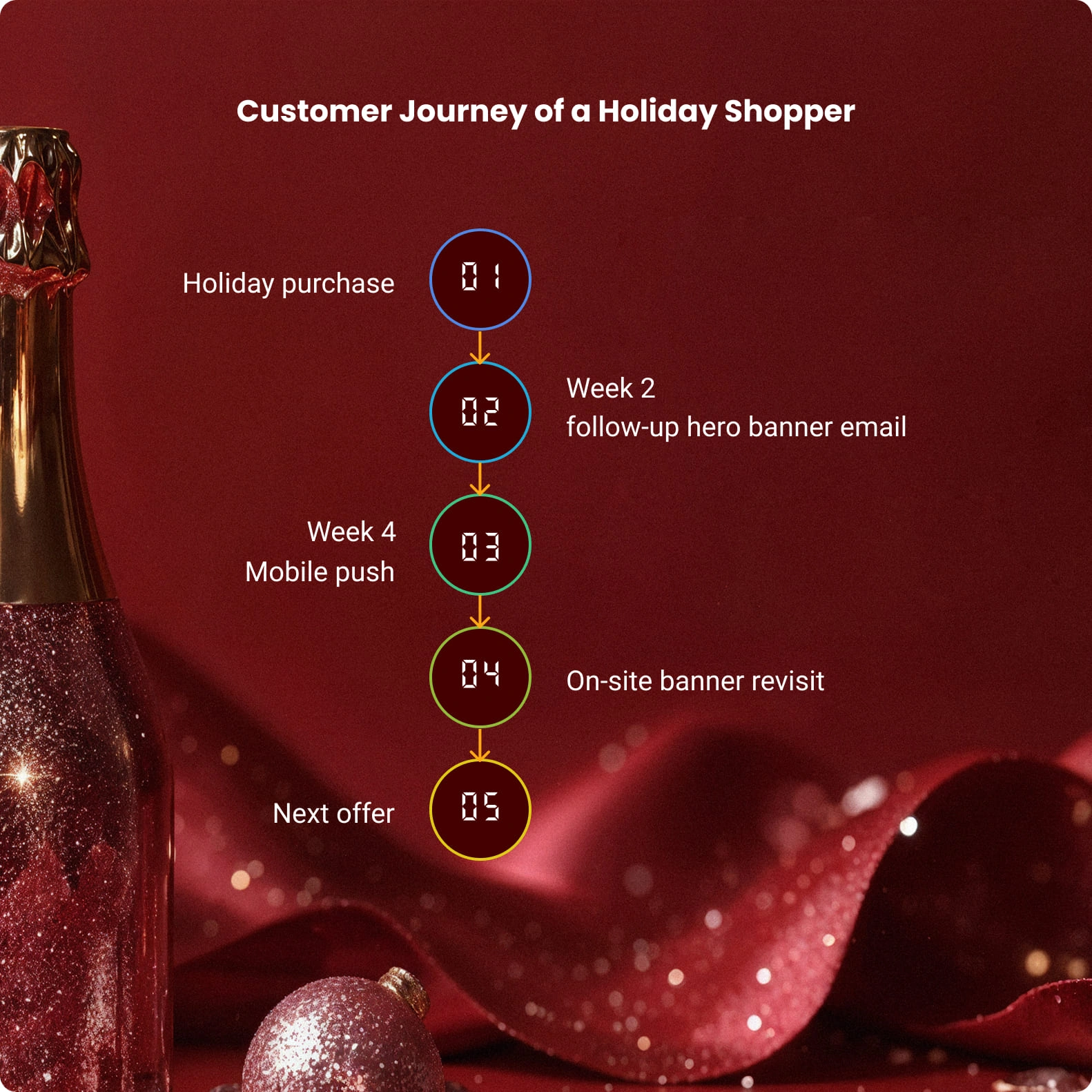


By executing this way, you convert that one‑time holiday purchase into the first chapter of an ongoing multi‑purchase story.

Measuring Success From Holiday Spike to Lifetime Value

The final piece of the retention story is measurement. Because if you cannot show that one‑time holiday buyers are being nurtured into repeat purchasers, your retention engine stays theoretical.

KPIs to Keep an Eye On

Repeat purchase rate among holiday‑acquired customers: How many bought again within 60, 90, 180 days? LTV growth: How does the value of a holiday‑acquired customer evolve compared with earlier cohorts?


Engagement across channels: Did the personalized hero banner email, mobile push, and web banner drive cross-channel visits? Retention campaign ROI:

 Using long‑window analytics, show how retention contributed revenue in Q1/Q2.

Creative resilience and fallback success: Analyze how many users experienced broken blocks or missing content compared to those who had smooth journeys.

38% of companies are focusing on reducing churn and increasing purchase frequency, recognizing that keeping the existing customer base engaged is more sustainable – and profitable – than chasing new ones.


Action Checklist
Convert Holiday Buyers into Lifelong Customers

Segment your holiday‑acquired customers immediately post‑campaign; tag them as ‘new holiday buyer’.

Define a follow-up journey within the first 30 days of purchase –
an open-time personalized email, RCS, WhatsApp, and web banner.

Prepare modular templates for omnichannel creative (email, RCS, web) that pull from the same dynamic content logic.

Identify high-value segments among holiday buyers (e.g., those with high purchase prices or high intent categories) and proactively nurture them with loyalty offers or VIP status.
Conclusion

The holiday rush is intoxicating – high traffic, big sales, momentum. But the true test comes after the frenzy. Retailers that look at those one‑time purchases not as isolated wins but as the first chapter of a retention story will differentiate themselves moving into the new year.

With real‑time creative, cross‑channel continuity, no‑code resilience, and measurement that spans beyond the holiday window, you can turn the holiday spike into a robust, enduring customer base.

This season, don’t stop at the sale, start the relationship. Because your next big holiday isn’t just about how many you convert, it’s about how many you keep.

Table Of Contents
Introduction
The Holiday Surge, Where Opportunity Meets Risk
From One Purchase to Next Purchase – Why Many Brands Lose Momentum
Build the Retention Engine with Real‑time Content & Omnichannel Reach
Measuring Success From Holiday Spike to Lifetime Value
Conclusion

Finding the Sweet Spot: How Coverage Analysis Powers Scalable Social Proof Messaging

Digital Experience Personalization
Blogs

Finding the Sweet Spot: How Coverage Analysis Powers Scalable Social Proof Messaging

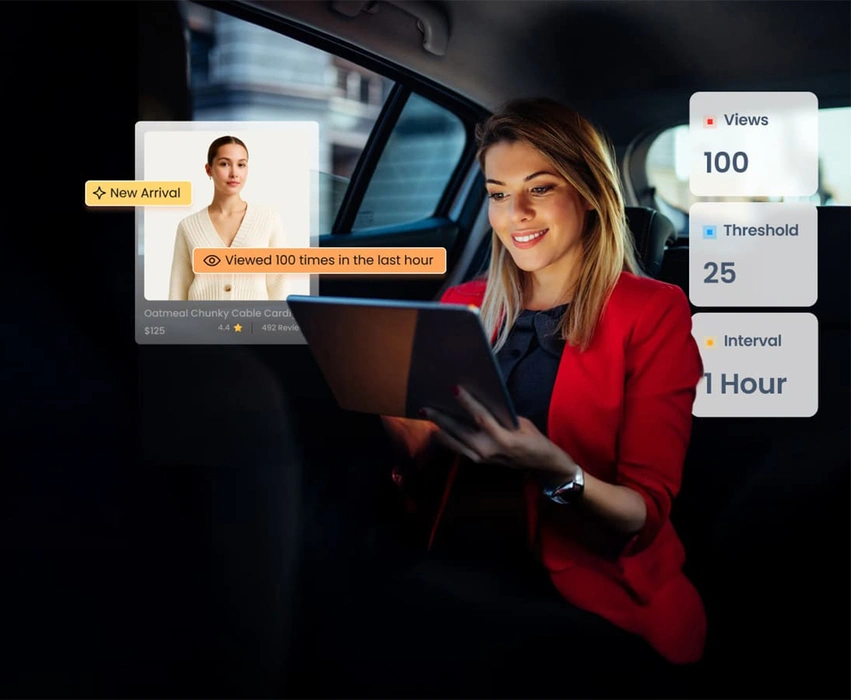
Personalization is all about showing the right message to the right shopper at the right time. When it comes to social proof messages — like “120 people viewed this product today” or “15 people added this to their cart in the last hour” — criteria and timing make all the difference between authentic persuasion and empty noise.

That’s where Coverage Analysis comes in — the behind-the-scenes science that ensures your social proof messages reach the widest audience possible.

What Is Coverage Analysis?

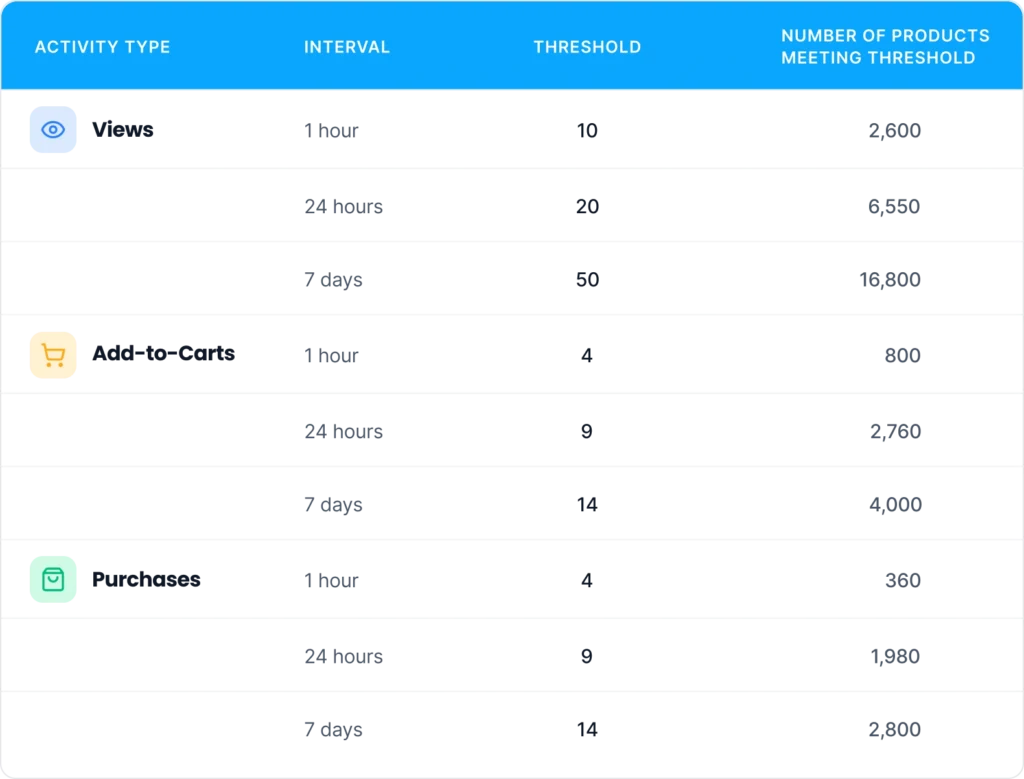
Coverage Analysis is the process of identifying what percentage of your product catalog qualifies for a social proof message at a given time. It’s based on three key inputs:

  • Metric
    Views, Add-to-Carts, or Purchases
  • Threshold
    Minimum number of actions that trigger a message
  • Interval
    The time window in which those actions occur (e.g.,
1 hour, 24 hours, or 7 days)

Think of it as a smart diagnostic tool that answers:

“If I show a message only when 10 people view a product in 24 hours,
 how many products will qualify?”

That percentage — your coverage rate — becomes your blueprint for scaling social proof messaging software without compromising authenticity.

Why Coverage Analysis Matters

Every marketer faces the same dilemma: reach vs. credibility.
Set your threshold too high, and only a handful of products show activity. Too low, and the message feels unconvincing.

Coverage Analysis helps you strike that perfect balance by quantifying reach, adapting to traffic patterns, and powering A/B testing — all of which reveal how social proof messaging drives higher engagement and conversions.

Coverage Analysis helps you strike that perfect balance by:

  • Quantifying reach: Identify the portion of your catalog that qualifies at each threshold.
  • Adapting to traffic patterns: A high-traffic brand might thrive on 1-hour intervals, while smaller catalogs need longer (7-day) windows.
  • Powering A/B testing: Experiment with different metrics, thresholds, and intervals to optimize your conversion rate.

As Robert Cialdini famously said in Influence: The Psychology of Persuasion, “People don’t always make decisions in a vacuum; they look to the behavior of others to guide their own.”

Coverage Analysis helps you quantify that behavior, and use it meaningfully.

How Coverage Analysis Works

1 Choose Your Intervals

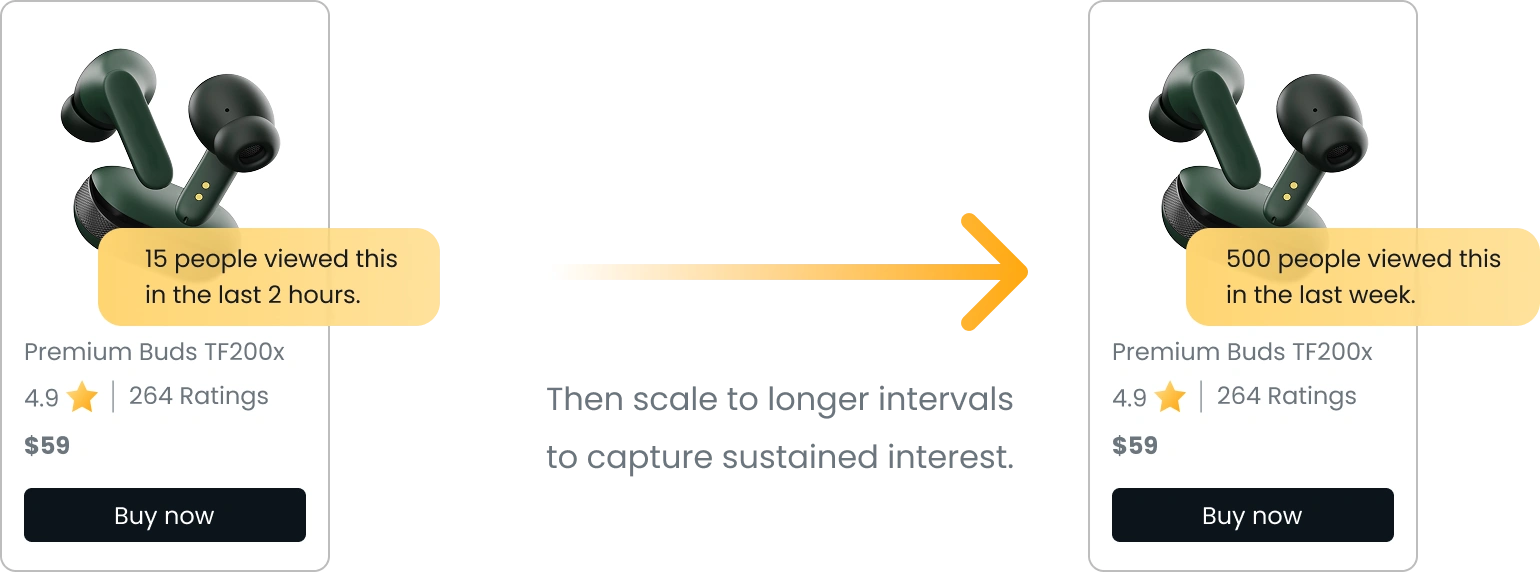
Start small (shorter intervals of 1 to 24 hours) to measure immediate engagement —
the “buzz” moments.

Example:

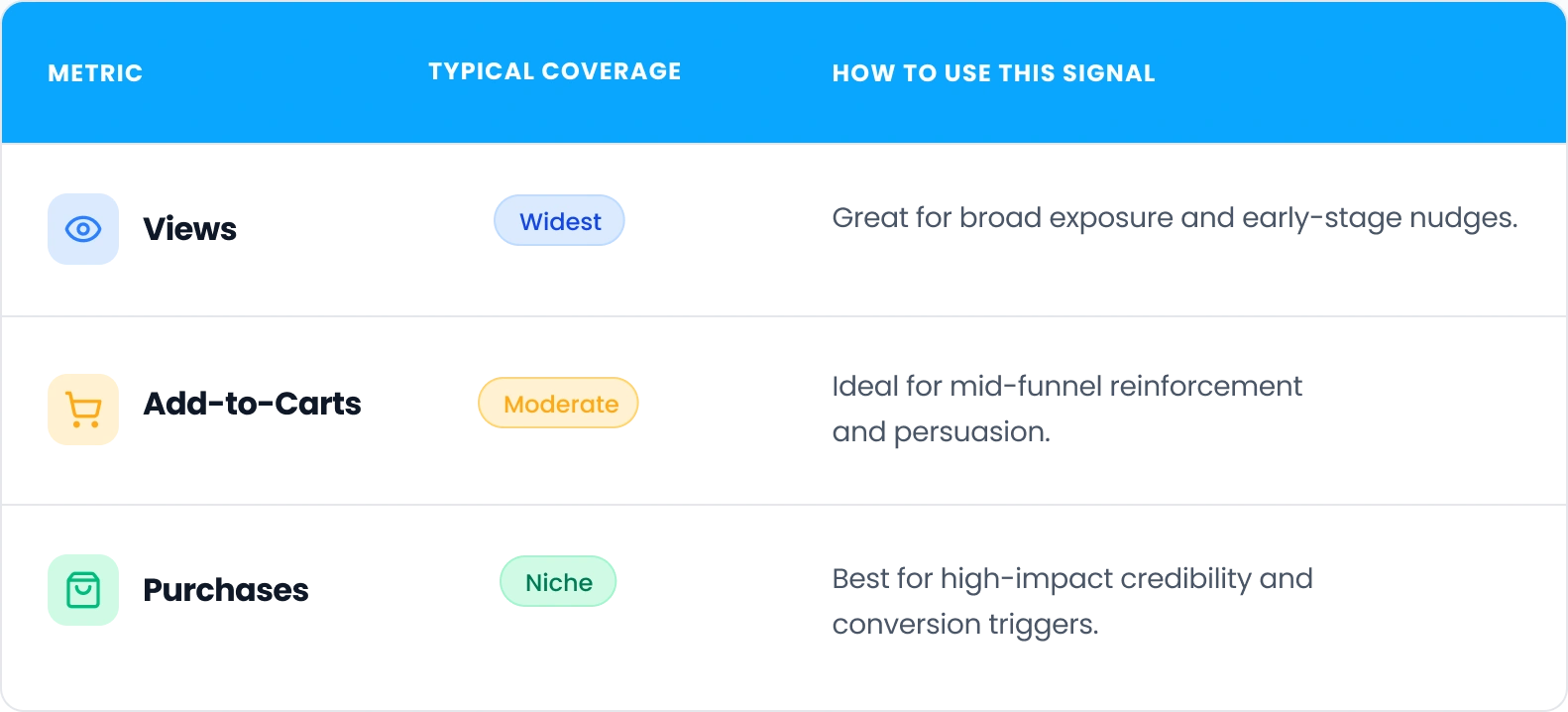
2 Compare Coverage Across Metrics

Each metric highlights a different level of shopper intent, and layering the right credibility cues on top makes your social proof strategy both persuasive and balanced.

3 Pick Data-Backed Thresholds

The system evaluates several thresholds (ranging from 1 to 500+), illustrating how coverage expands or narrows at each level.

Notice how coverage grows with longer intervals and lower thresholds. This flexibility helps tailor dynamic content personalization solutions to different business realities — from the urgency of flash sales to sustained interest in core categories.

Continuous Calibration for Continuous Trust

Coverage Analysis isn’t a one-and-done exercise. It’s a calibration tool that evolves with your traffic, seasons, and campaigns.

It answers three critical questions:

Which activity metric deserves focus right now — views, carts, or purchases?

Are your current thresholds too lenient or too strict?

How do you maintain scale without losing credibility?

Because trust isn’t built by showing every shopper the same message — it’s built by showing the right message, backed by credible activity data.

As your traffic patterns evolve, Coverage Analysis ensures your social proof thresholds adapt and keep performance steady without constant manual tuning.

In Conclusion

Coverage Analysis gives you the confidence that your social proof messaging is both authentic and optimized — not guesswork, but data-driven persuasion.

By understanding how many products qualify at different engagement thresholds, you can:

  • Scale your messaging without spamming users,
  • Highlight real behavioral trends, and
  • Turn collective activity into credible proof that nudges more shoppers toward conversion.

In short, it’s the analytics engine behind every truly intelligent social proof messaging software solution.

Ready to find your sweet spot between scale and credibility?

Run your own Coverage Analysis and see how the right metrics, thresholds, and intervals can transform your social proof messaging strategy.

Book a Free Trial
Table of Contents
What Is Coverage Analysis?
Why Coverage Analysis Matters
How Coverage Analysis Works
Continuous Calibration for Continuous Trust
In Conclusion

How to Deliver Personalized Holiday Campaigns That Scale and Convert

Omnichannel Marketing
Blogs

How to Deliver Personalized Holiday Campaigns That Scale and Convert

Introduction

The holiday season is the most chaotic and competitive period in a retailer’s calendar. Singles’ Day, Black Friday, Cyber Monday, Christmas, New Year’s, Valentine’, and so on. Every campaign matters, and every message is a shot at revenue. But the sheer volume of emails and promotions flooding customers’ inboxes creates a high bar for engagement.

And here’s the brutal truth: most brands still send the same generic campaign to thousands, hoping subject lines and discounts will do the heavy lifting. In a season that demands emotional connection, static creatives won’t work for you.

But what if your holiday campaign didn’t need to be built 15 different ways to feel personal? What if, instead of predicting the future at send-time, your content adapted in real time, to inventory, customer behavior, or region, the moment the email was opened?

That’s not hypothetical. It’s exactly what modern marketing solutions like Active Content make possible. Let’s walk you through why this matters and how to make it a reality.

The Holiday Email Challenge: Speed vs. Personalization

Retail marketers live in a paradox during peak season. On one hand, there’s the pressure to launch campaigns quickly, holiday calendars are tight, creative teams are stretched, and offers change overnight. On the other hand, there’s a growing demand for 1:1 personalization that resonates deeply with the customer’s preferences, behavior, and buying journey.

Typically, this results in trade-offs:

Either send one-size-fits-all campaigns fast, risking low engagement.

Or build dozens of segmented variants, which takes time, adds cost, and often leads to operational errors or burnout.
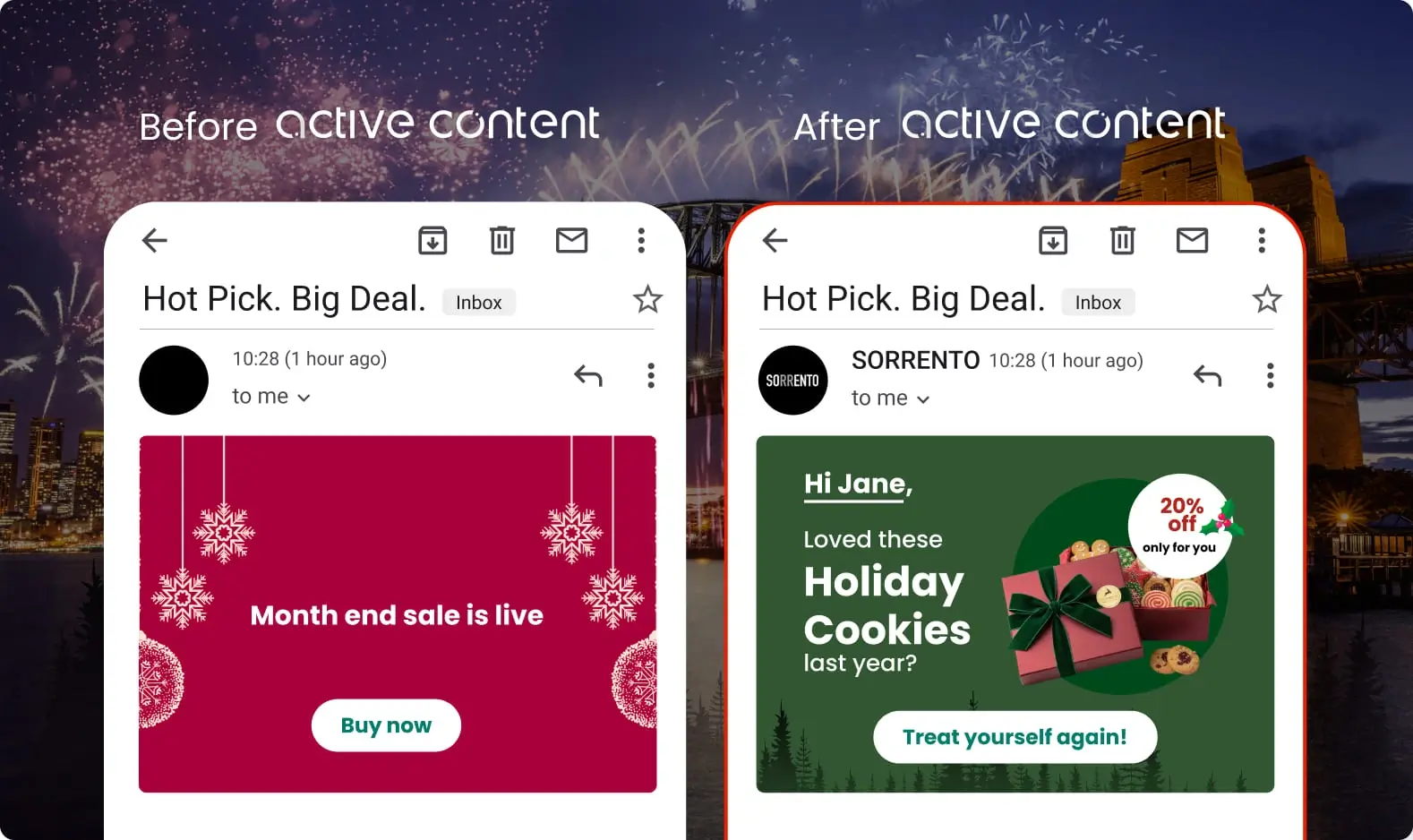


And let’s be honest, neither delivers the agility or scale today’s customer journey requires.

That’s where real-time content rendering becomes a game-changer. With open-time personalization, you no longer need to pre-select every creative asset, product, or offer before launch. Instead, you can define logic-based rules and let the system populate content at the moment of engagement.

This means
  1. faster launches
  2. less manual work
  3. and more relevance

especially during holiday chaos.


Here’s what gets easier:
  • Dynamic banners based on the customer’s last browsed category.
  • Display offers are available only if inventory is in stock.
  • Automatically adjust content based on loyalty tier, geolocation, or time of day.

Why Send-time Personalization is Failing Holiday Shoppers

Traditional personalization relies on preparing content at the moment of send, but this model is fragile. Consumers don’t open emails the minute you send them. Some check hours later, some days. Promotions expire, inventory depletes, and customer context changes.

This leads to broken experiences:


01 – Emails promoting out-of-stock products.
02 – Limited-time offers shown after expiry.
03 – Missed chances to reinforce a high-intent behavior

Open-time personalization addresses these broken experiences by making content decisions when the customer actually engages. Active Content connects to your CDP, inventory, and behavioral data, ensuring the experience reflects current, relevant, and real-world context.

You’re no longer guessing. You’re adapting in real-time.


Personalizing with Active Content Unlocks
  • Product showcases that reflect current availability.
  • Countdown timers that update dynamically.
  • Hero banners personalized to the recipient’s location, loyalty status, or browse history.

This is how you scale campaign performance while delivering tailored experiences at scale.
Read Marketer’s Guide to Hyper-personalized Engagement to learn more.

Creating One Campaign That Feels Handcrafted for Everyone

Marketers often assume personalization at scale means more workload, more variants, more data pulls, and more quality analysis. But that’s a myth. With the right infrastructure, one campaign can power thousands of personalized experiences.

Active Content utilizes modular dynamic content blocks, sourced from your CDP, CSV files, loyalty data, and more. You define what should happen based on conditions. Active Content decides which content to show in real-time.

How Active Content Works

Connect APIs to your Active Content Digital Canvas to build content Adjust visualization and edit layouts using the WYSIWYG editor


Check the output by simulating it Download/copy HTML snippet and embed it in your ESP or marketing automation tool

It’s how leading brands such as Consum are cutting campaign costs by 60% while scaling up holiday personalization.

Extending the Experience Beyond Email

Modern shoppers move fluidly between email, mobile, and web. Yet most brands still deliver disjointed experiences across these channels.

This holiday season, what if the personalized offer your customer sees in an email automatically appears on your website too, no new creative build, no dev dependency?

With Active Content’s webcrop feature, you can mirror the exact creative block from your email, including copy, visuals, and dynamic elements, right onto your homepage, category page, or product display.

This enables faster campaign launches and ensures a unified brand message across all customer touchpoints.

This strategy reduces creative duplication, eliminates rework, and ensures consistent messaging from inbox to site, increasing operational efficiency and customer trust.

Holiday Personalization Checklist

Before you launch your next campaign, align your workflow with modern personalization capabilities:

Build a modular email template with dynamic content blocks

Define open-time logic for hero images, offers, and product sets

Set fallback rules for missing data

Sync data feeds from CDP, catalog, and inventory sources

Use AI tools to generate multiple copy/image variants for testing
Extend creative logic to RCS, WhatsApp, web banners, and other platforms.

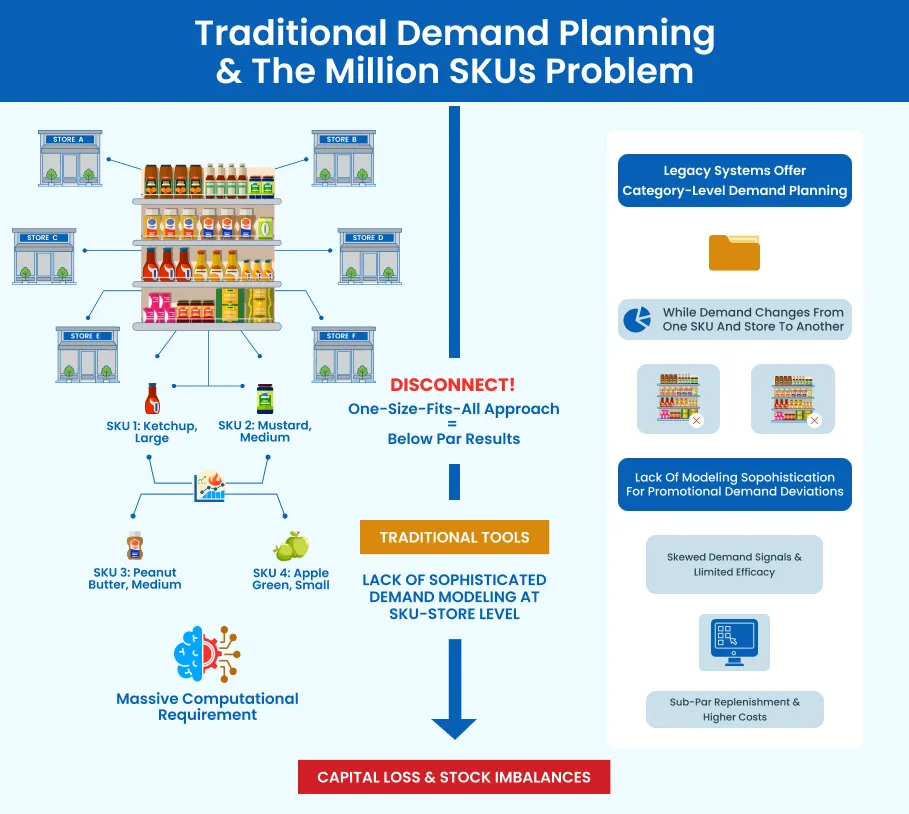
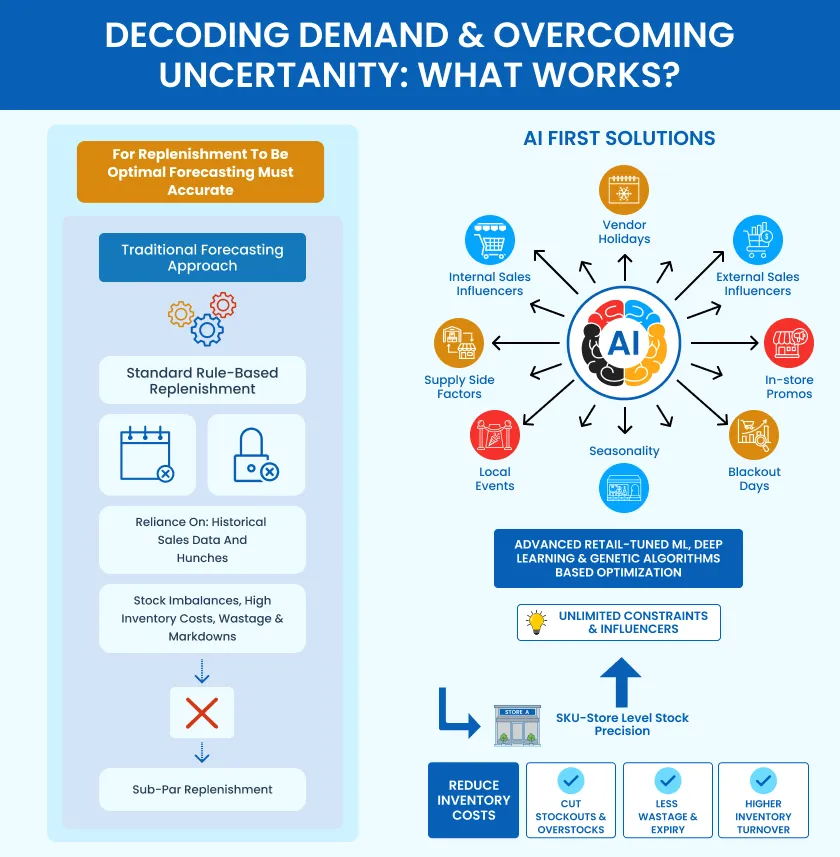
Conclusion

This holiday season, marketers have two paths: continue sending static, one-size-fits-all messages that get ignored, or embrace a smarter, more scalable way to connect with customers in real-time.

With Active Content, you don’t have to choose between speed and personalization. You get both. One campaign, multiple channels and hyper relevance.

Because in a season where inboxes are crowded and attention is short, relevance is your best conversion strategy.

Click here to learn about

Active Content
Table Of Contents
Introduction
The Holiday Email Challenge: Speed vs. Personalization
Why Send-time Personalization is Failing Holiday Shoppers
Creating One Campaign That Feels Handcrafted for Everyone
Extending the Experience Beyond Email
Conclusion

In-Store Replenishment Optimization: Food and Grocery Retail

Merchandising and Supply Chain
Blogs

In-Store Replenishment Optimization: Food and Grocery Retail

The global food & grocery retail industry is a $12 trillion market, but continues to bleed value – $1.77 trillion (in 2023) due to inventory distortions. Despite demonstrating an impressive rate of technology adoption, stockouts and overstocks continue to be a thorn in the side. Stats reveal that in 2023, retailers incurred losses amounting to $1.2 trillion from stockouts alone.

Apart from affecting the potential revenue from sales, stockouts also degrade customer experience, affecting customer loyalty directly. Likewise, overstocks not only contribute to capital lock-in, but they also lead to wastage, markdowns, and expiry, and affect sustainability.

What makes optimizing replenishment such a challenge in food and grocery retail, and why do inventory distortions keep being a thorn in the paw for retailers worldwide? 

Here, we explore the answers and outline the solutions that actually work!

Optimization at Scale: The Million-SKU Problem

Food and grocery retail operations span millions of SKUs across hundreds of locations. Now, in an ideal scenario, the retailers need a solution that helps them understand and decode the demand patterns at each store location for each SKU so that replenishment plans can be optimized to prevent stock imbalances and capital loss.

This requires forecasting and replenishment at a granular level, think SKU, and store locations; meaning, the computational requirement is massive.

On the other hand, the legacy systems and inventory planning tools work at the Category or sub-category level for each location. So, they are essentially treating all the SKU types the same for all locations. Hence, the demand for chocolate cookies, large pack, sold at one location, is modeled similarly to the demand for coconut cookies, small pack, being sold at another store.

This disconnect creates a huge problem by skewing the demand signals and limiting the optimization efficacy to a standard, one-size-fits-all approach.

It stems from the fact that traditional tools work with only a set of demand modeling methods and lack the sophistication and granularity to achieve robust, agile, and scalable replenishment planning at scale with hyperlocal precision.

So, if retailers are working with an infrastructure that is not tuned or built for the complexity and scale of food and grocery retail, then the results would definitely be below par.

Decoding Demand, and Overcoming Uncertainty in Food & Grocery Retail: What WORKS?

Before we take a deeper dive, here is a fact worth mulling over:

For replenishment to be optimal, forecasting must be accurate.

Traditionally, demand planning and replenishment are disparate processes, and lack the modeling sophistication to factor in the nuances that are unique to the food and grocery segment.

This is exactly where the strength of AI-first solutions lies.

AI-first solutions coupled with advanced retail-tuned ML, deep learning, and genetic optimization algorithms have this inherent capability to model not only the nuances of the food and grocery retail, but also to add an unlimited number of constraints or influencers.

Further, the AI/ML-led solutions have unmatched computational strength, enabling retailers to optimize the replenishment at the SKU-store level for hyperlocal precision. Hence, they can reduce inventory while cutting stockouts, wastage, and expiry.

This means retailers no longer have to stick to historical sales data, seasonal data, and manual adjustments based on hunches while planning for the upcoming holiday season or weekdays. They can factor in all kinds of external and internal sales and demand influencers, vendor holidays, and supply-side factors like minimum order quantities and more, and that too at scale.

Let’s take a look at how this happens.

Optimizing Food & Grocery Inventory With AI-led Auto-Replenishment Built for Hyperlocal Precision Delivered at Scale

1 Modeling Sophistication

AI-first solutions start at the SKU level and come with multiple optimization algorithms. They automatically select the most optimal algorithm for each product-store combination, using automatic or user-defined model selection criteria. Plus, they incorporate unlimited demand predictors, delivering highly accurate, hyperlocal forecasts.

Ultimately, retailers can get accurate forecasts for millions of SKU-store combinations without compromising speed, accuracy, or coverage.

2 Dynamic Demand Balancing

One critical drawback of traditional demand planning and replenishment tools is their inability to identify and manage the demand fluctuations or cannibalization during in-store promotions. This costs retailers as much as 17% of their promotional revenue, causing either stockouts or overstock.

AI/ML-led solutions enable retailers with dynamic demand balancing by anticipating the promo-effects well ahead of time and optimizing the replenishment recommendations automatically. Hence, the order plans ensure that more amount of quick-selling items are ordered and products with declining demand due to promotions are ordered less.

This keeps the inventory distortions at bay while preventing the margin loss from demand fluctuations during promotions.

3 Unlimited Demand Variables

Another powerful feature of AI-led demand forecasting and auto-replenishment solutions is their ability to allow users to add an unlimited number of demand variables. These solutions treat every influencer as a predictor variable, and factor in everything, ranging from weather, holidays, seasons, local events, to promotions, discounts, and many more such factors to offer unparalleled accuracy in demand forecasting.

Further, the users can choose the set of variables for each SKU and store combination, thereby unlocking never-before-seen accuracy for each store location. The ability to do so without feature-level coding or engineering requirements is another fantastic advantage of AI-first auto-replenishment solutions.

4 Configurable Automated Scheduling

Food and grocery retail order scheduling is particularly complex owing to its scale and diversity of SKUs. While traditional tools offer limited or negligible scheduling features for optimal ordering, AI-first solutions save time and help avoid errors by automating complex order scheduling.

They offer configurable automated scheduling capabilities that seamlessly incorporate all order placement, acceptance, and delivery restrictions, ensuring replenishment plans always comply with holidays and blackout periods, eliminating manual adjustments.

5 Predictive Alerts for Proactive Wastage & Expiration Management

Food and grocery retail inventory is vulnerable to markdowns stemming from high vulnerability to wastage, spoilage, and expiry. The problem becomes even more challenging while dealing with millions of SKU-store combinations to work with.

AI-first solutions inherently curb this with predictive alerting capabilities that can be configured at the product level with user-defined thresholds. The predictive alerts accurately notify potential wastages and expirations, helping retailers to take proactive actions, with time to spare.

Hence, retailers can act early to reduce spoilage, protect profits, and maintain shelf freshness.

With planning and optimizing capabilities delivering hyperlocal precision at scale, AI-first solutions definitely emerge as the most reliable and the best way forward for food and grocery retailers.

Table Of Contents
Optimization at Scale: The Million-SKU Problem
Decoding Demand, and Overcoming Uncertainty in Food & Grocery Retail: What WORKS?
Optimizing Food & Grocery Inventory With AI-led Auto-Replenishment Built for Hyperlocal Precision Delivered at Scale