
Role of Data Analytics in Social Media Marketing

Data & AI
Blogs

Role of Data Analytics in Social Media Marketing

What is Data Analytics and How Is It Used in Social Media Marketing?

Data analytics has become an essential aspect of social media marketing. By using data analytics tools, businesses can gain insights into their audience’s behaviour and preferences, measure the success of their campaigns, and adjust their strategies accordingly. In this blog post, we will discuss some of the recommended strategies and tools for data analytics in social media marketing.

Data analytics refers to the process of collecting, processing, analysing, and interpreting data to extract valuable insights, patterns, and trends. It involves various techniques and tools to transform raw data into actionable information, enabling informed decision-making and improved business outcomes.

In the context of social media marketing, data analytics is used to gather and analyse data from social media channels to enhance marketing strategies. It helps marketers understand their audience’s demographics, behaviours, and preferences, allowing for the creation of targeted content and personalised advertising campaigns.

By tracking key metrics such as engagement rates, click-through rates, and conversion rates, you can measure the effectiveness of your campaigns, optimise ad spend, and improve your channel strategies through a well-defined media strategy that aligns targeting, channel selection, and performance optimisation.

How to Use Social Media Analytics Effectively

Data analytics plays a pivotal role in social media marketing, helping businesses gather, interpret, and leverage data to enhance their social media strategies and achieve specific marketing goals. Here’s an in-depth look at the role of data analytics in social media marketing:

1 Audience Insights

Data analytics allows businesses to gain a deep understanding of their social media audience. By analysing demographic information, interests, behaviours, and engagement patterns, marketers can create detailed audience personas. These insights help in tailoring content, messaging, and ad targeting to resonate with specific segments of the audience.

2 Content Strategy

Data analytics aids in evaluating the performance of social media content. Marketers can track metrics like engagement rates, click-through rates, shares, and comments to identify what types of content are most effective. This information guides content creation and optimisation, ensuring that content aligns with audience preferences.

3 Posting Schedule Optimisation

Social media analytics provide insights into when your audience is most active. By analysing data on the best times to post, businesses can schedule content to maximise visibility and engagement. This strategy ensures that posts reach the right audience when they are most likely to be online.

4 Ad Performance

Social media advertising relies heavily on data analytics. Marketers can monitor ad campaigns in real time, tracking key metrics like click-through rates, conversion rates, and return on ad spend (ROAS). This data helps in optimising ad targeting, budget allocation, and creative elements to achieve the desired advertising goals.

5 Competitor Analysis

Data analytics enables businesses to assess their competitors’ social media performance. By comparing metrics like follower growth, engagement rates, and content strategies, marketers can identify opportunities and adjust their own strategies to stay competitive within their industry.

6 Customer Support and Engagement

Social media analytics tools help businesses monitor conversations about their brand and industry in real time. This allows for timely responses to customer inquiries, complaints, and feedback, enhancing customer support and engagement. Tracking sentiment analysis can also help gauge customer satisfaction.

7 Campaign ROI Measurement

Social media campaigns generate data that can be used to measure return on investment (ROI). By comparing campaign costs to the revenue generated or leads acquired, businesses can assess the effectiveness of their social media marketing efforts. This data-driven approach informs budget allocation for future campaigns.

8 Influencer Marketing

Data analytics assists in identifying and evaluating potential influencers for partnerships. Marketers can analyse an influencer’s audience demographics, engagement rates, and credibility to determine if they align with the brand’s target audience and values.

9 Trend Analysis

Social media analytics help businesses stay current with industry trends and consumer sentiment. By monitoring trending topics and hashtags, marketers can identify opportunities to participate in conversations, create relevant content, and engage with a wider audience.

10 A/B Testing

Data analytics allows for A/B testing of different social media strategies, from ad variations to post formats. Marketers can experiment with different elements and analyse the data to determine which strategies yield the best results.

In conclusion, data analytics is the backbone of effective social media marketing. It empowers businesses to make data-driven decisions, refine strategies, engage with audiences more effectively, and ultimately achieve their marketing objectives on social media platforms.

How to Use Social Media Analytics Effectively

To be able to maximise the power of data analytics, you have to prepare your implementation strategy carefully. Here is a guide to implementing data analytics in social media marketing:

Strategy 1: Set goals and KPIs

Before starting any social media marketing campaign, it is crucial to define your goals and key performance indicators (KPIs). This will help you determine which metrics to track and how to measure the success of your campaign. Some of the common KPIs for social media marketing include engagement rates, click-through rates (CTR), and conversion rates.

Strategy 2: Monitor and Analyse your Social Media Metrics

Once you have set your goals and KPIs, it’s time to start monitoring and analysing your social media analytics. Social media platforms like Facebook, Twitter, and Instagram offer built-in analytics tools that allow you to track your metrics in real time. These tools provide you with valuable insights into your audience’s behaviours, such as the time they are most active on social media, the type of content they engage with, and their demographic information.

Strategy 3: Use Third-Party Analytics Tools

In addition to the built-in analytics tools offered by social media platforms, there are also several third-party analytics tools that can help you gain even more insights into your audience’s behaviour. Some popular third-party analytics tools for social media marketing include Hootsuite, Buffer, and Sprout Social.

These tools provide you with a comprehensive view of your social media metrics across multiple platforms, allowing you to track your KPIs more effectively. They also offer features such as social listening, which allows you to monitor mentions of your brand on social media and respond to customer feedback real time.

Strategy 4: A/B Testing

A/B testing involves testing two variations of the same campaign to see which one performs better. For example, you could test an aspect in your social visual, email, or website to find out the preferred angle or tone. The aspect could be either the subject line, image used, call to action, or even the content to see which one generates more clicks or conversions.

A/B testing allows you to optimise your campaigns for better performance, and it can also help you identify which elements of your campaigns resonate most with your audience. Furthermore, it allows you to make the necessary improvements to boost engagement, cut down bounce rates, and enhance conversion rates. To perform A/B testing, there are various free and paid tools that you could use, such as HubSpot, Google Optimize, Optimizely, and more.

Strategy 5: Offline Tracking

Another metric you could track is the footfall of your outlets or competitors’ outlets. At ADA, we help clients to track footfall by means of geofencing desired points of interest (POI) or outlets and monitor footfall trend month-on-month via IFA (identifier for advertisers) in smartphones. For post campaigns, besides tracking engagement, CTR, and conversion online, it is an added advantage to be able to track offline footfalls, in comparison to footfall and cross-visitation of competitors’ outlets.

For instance, we worked with an oil & gas client to monitor footfall at petrol stations in Malaysia. To measure post campaigns performance, we mapped out campaign periods (including client’s and competitor’s campaigns) and found out who the visitors were, which petrol brands they supported, and when they visited them. Combining online and offline tracking enables our client to gain better insights and make impactful strategies to drive growth.

Social Media Analytics Metrics You Need to Pay Attention

The use of analytical data would be incomplete without a specific focus. In this case, you must determine what metrics you want to measure in your social media marketing campaign.

You don’t have to measure all the metrics described, but most of them are commonly used to measure social media marketing success.

Here are some of the metrics that you can look into:

1 Engagement Rate

Engagement rate is the level of interaction your content receives from your audience such as likes, comments, and shares. A high engagement rate indicates that your content is resonating with your audience, fostering community, and encouraging interaction.

2 Click-Through Rate (CTR)

CTR is the percentage of people who click on a link or CTA in your post. It is a crucial metric for evaluating the effectiveness of your content in driving traffic to your website or landing page. A higher CTR often indicates compelling content and effective call-to-action strategies.

3 Conversion Rate

Conversion rate tracks the percentage of users who complete a desired action, such as making a purchase, signing up for a newsletter, or downloading an ebook after clicking on a social media post or ad. It directly reflects the impact of your social media marketing on lead generation and sales.

4 Reach and Impressions

Reach represents the total number of unique users who have seen your content, while impressions measure the total number of times your content has been displayed. Monitoring these metrics helps you gauge the visibility and exposure of your posts and campaigns.

5 Follower Growth

Tracking the growth of your social media followers over time is essential for assessing your brand’s online presence. Steady growth can indicate that your content and engagement strategies are resonating with your target audience.

6 Social Share of Voice (SOV)

SOV measures your brand’s presence and influence compared to competitors within your industry or niche. Analysing your SOV helps you understand your market share on social media platforms and identify opportunities for growth.

7 Social Media Sentiment

Sentiment analysis evaluates the tone and sentiment of social media mentions related to your brand. It helps you gauge public perception and identify areas that may require reputation management or improvement in your social media strategies.

8 Share of Traffic and Leads

Monitoring the percentage of website traffic and leads generated from social media channels provides insights into the contribution of social media to your overall marketing efforts. It helps you allocate resources effectively and prioritise social media platforms.

By regularly monitoring and analysing these relevant metrics, social media marketers can refine their strategies, allocate resources effectively, and drive better results in their campaigns. These metrics provide valuable insights into the customer journey, brand perception, and the overall impact of social media marketing efforts on business objectives.

Make Informed Business Decisions with Data Analytics

Data analytics is an essential aspect of social media marketing that can help you gain insights into your audience’s behaviour and preferences, measure the success of your campaigns, and adjust your strategies accordingly. By using the strategies and tools discussed in this blog post, you can optimise your social media marketing campaigns for better performance and achieve your goals more effectively.

Leverage the power of data analytics and AI with ADA to gain deeper insights into your audience’s behavior and preferences. Measure the success of your social media campaigns and optimize your strategies for better performance and achieve your marketing goals. Contact us today to learn how we can help strengthen your social media marketing efforts.

Table Of Contents
What is Data Analytics and How Is It Used in Social Media Marketing?
How Data Analytics Can Help Social Media Marketing
How to Use Social Media Analytics Effectively
Social Media Analytics Metrics You Need to Pay Attention
Make Informed Business Decisions with Data Analytics

The hidden cost of building product recommendations in-house

Digital Experience Personalization
Blogs

The hidden cost of building product recommendations in-house

The part retailers only discover after two or three cycles of “We can build this ourselves.”

Every few months, we meet a retail team that proudly announces it is building its own personalization engine.

We never try to talk them out of it.

Because honestly? In 2025(or 2026, now that we’re inching closer to that), it feels like something you should be able to build.

  • You have embeddings.
  • You have vector databases.
  • You have open-source models that can map product similarities with ridiculous ease.
  • You have the talent.

So someone on the engineering team says the magic sentence: “Let’s build our own recommender.”

Everyone nods. Makes sense. Because on the surface, personalization looks straightforward: take products, find patterns, rank them, serve them up.

Then six months later (maybe after a Black Friday meltdown), it hits you.

You didn’t build a product recommendation feature. You accidentally took on responsibility for an entire real-time decisioning ecosystem.

And ecosystems don’t behave like features. They’re more like living things. They grow. They mutate. They break at 3am. And they demand constant attention.

This is the part no one sees coming.

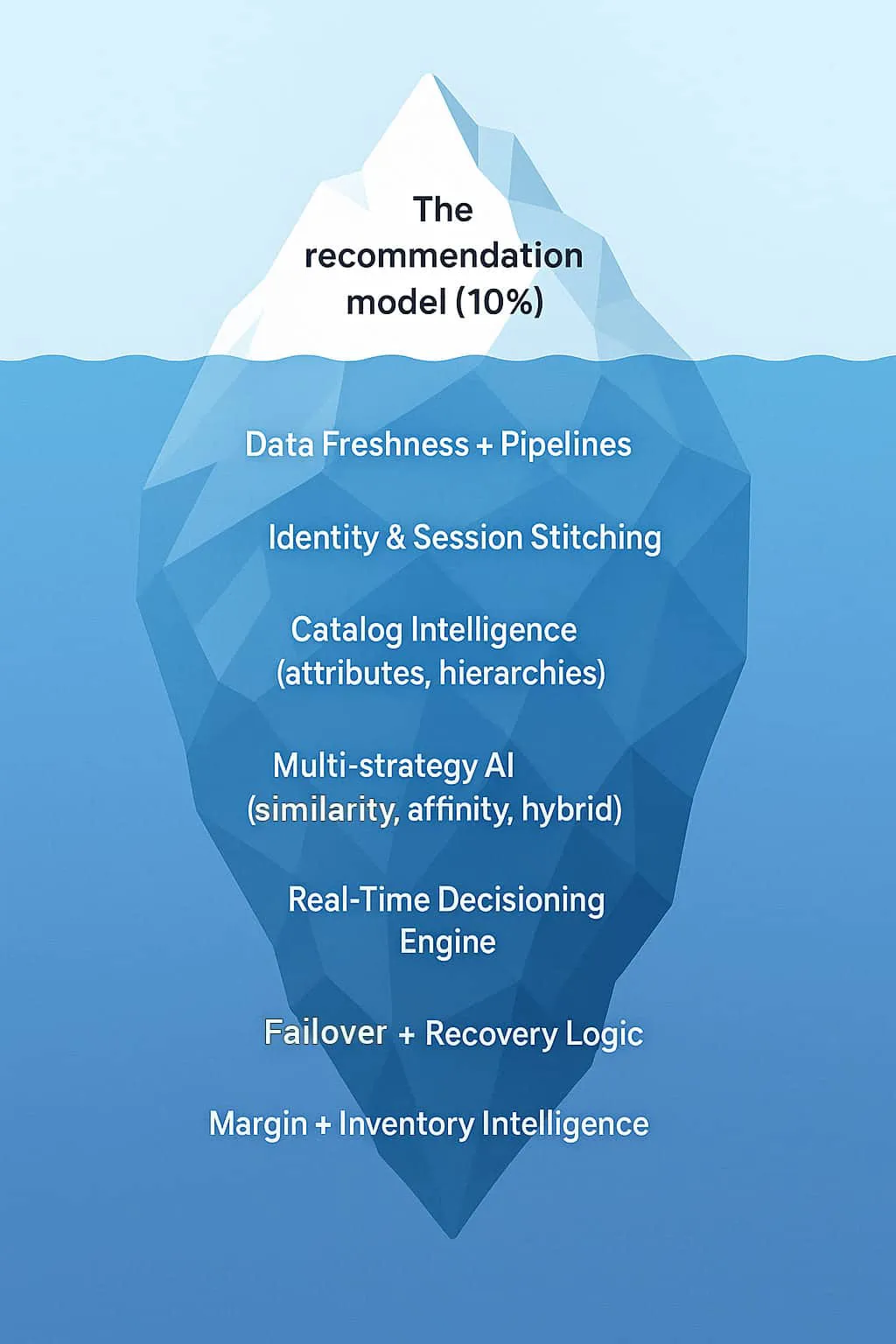
Personalization isn’t a model. It’s fifteen interconnected systems pretending to be one.

The biggest misunderstanding in retail tech? Thinking that personalization = “the model.”
But the real work is everything underneath it. And you don’t see that until it becomes your full-time job.

Let me paint the picture.

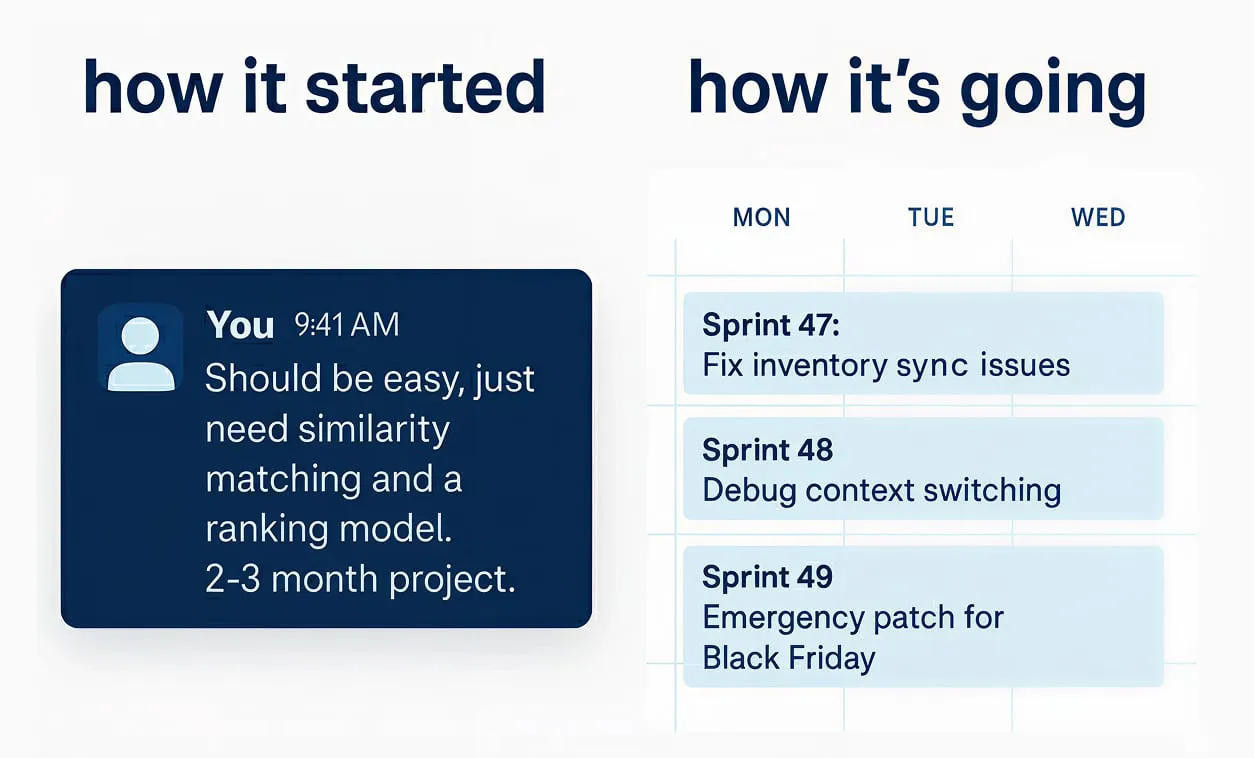
A European fashion retailer built their first internal model – simple “similar items” stuff. It worked beautifully on the product page. Sales went up. Click-through rates improved. The UX was clean. The data science team got high-fives.

Then merchandising asked: “Can we dial down discounted products when we’re launching new collections?”

Now you need business rules.

Marketing chimed in: “Can we show brand-focused looks to new visitors, but personalized picks to returning customers?”

Now you need context switching.

Operations joined the party: “We need to avoid recommending out-of-stock items during peak season…” Now you need real-time inventory feeds

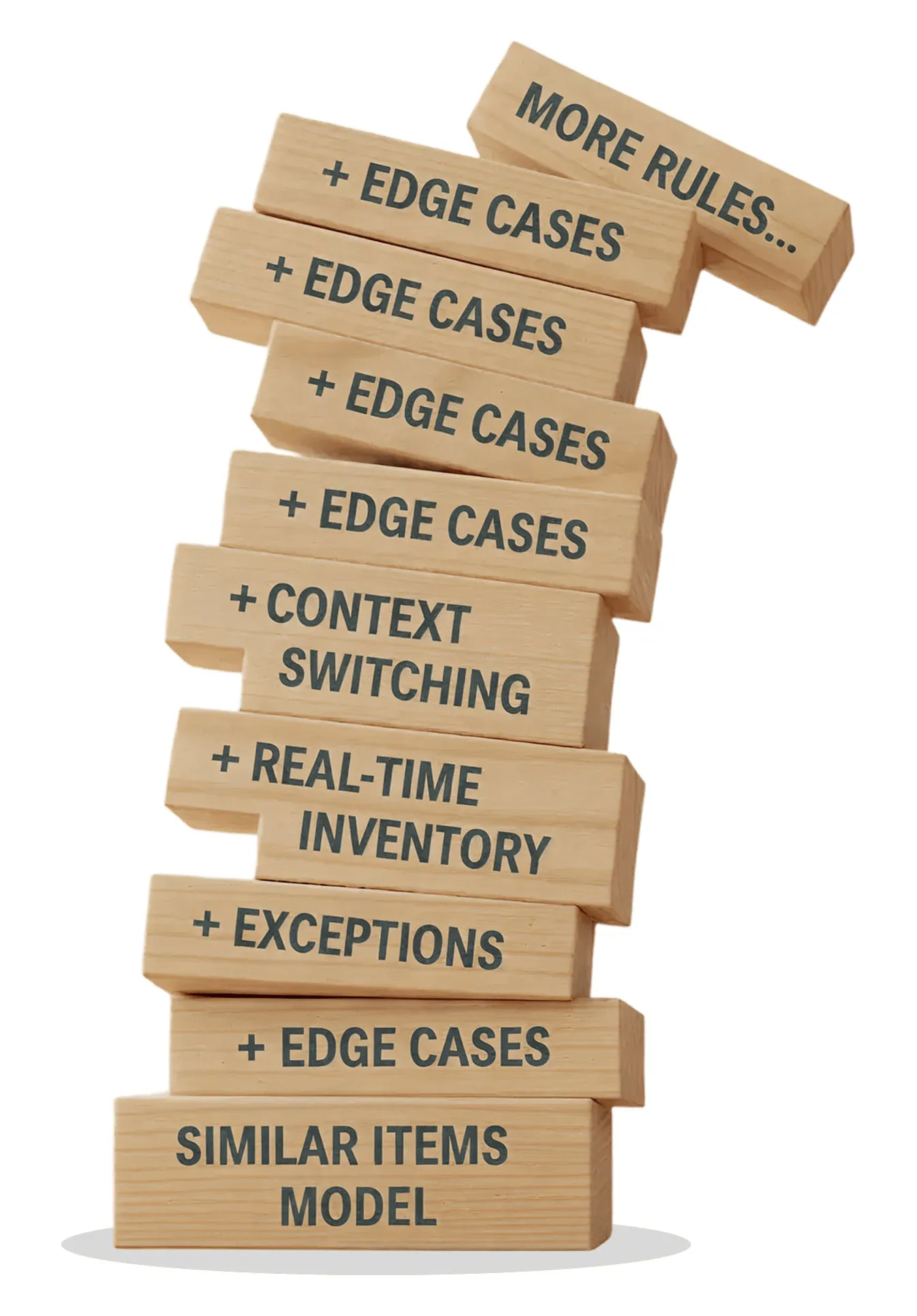
None of this sounds crazy. This is just retail. But each request chips away at your simple system–until that original “similar items” model is doing maybe 5% of the actual work.

That’s when it hits you: the hard part isn’t the model. It’s everything around it.

Where most internal systems break: decision debt

You know technical debt. We all do.

But personalization has a nastier cousin: decision debt.

Decision debt is what happens when you take shortcuts early on because you’re trying to ship fast.

  • You don’t add real-time inference at first – it’s too slow to implement.
  • You hardcode boosts instead of building a rules engine.
  • You reuse one strategy across all categories because it’s “good enough for now.”
  • You ignore long-tail items because the uplift seems marginal.
  • You skip building a proper evaluation framework because A/B testing can come later.

Each of these feels harmless in the moment.

But here’s the problem: decision debt compounds. Fast.

Every time the business changes– new categories, new collections, new seasonal patterns, new user behavior, and new merchandising tactics– that debt gets worse.

We worked with a North American electronics retailer who built a solid internal product recommender. First 90 days? Looked great. Simple. Fast. Effective.

Then they launched a new product line of “PC Gaming Accessories,” and everything fell apart.

Strategies that worked for TVs didn’t work for keyboards. Bundling logic for phones didn’t translate to gaming components. Their internal system had no concept of category-level strategy orchestration, and their team spent the next four months adding exceptions on top of existing exceptions.

Decision debt sneaks up on you.

Then one day, it buries your roadmap.

The Plateau no one predicts

Let’s say you avoid all the traps. You don’t take shortcuts. You build clean. Your team ships a solid ecommerce personalization platform with no decision debt.

You should be good, right?

Here’s the thing: even well-built internal systems hit a ceiling. Not because of messy code or technical debt, but because of algorithmic limitations.

The models that give you early wins? They max out. Fast.

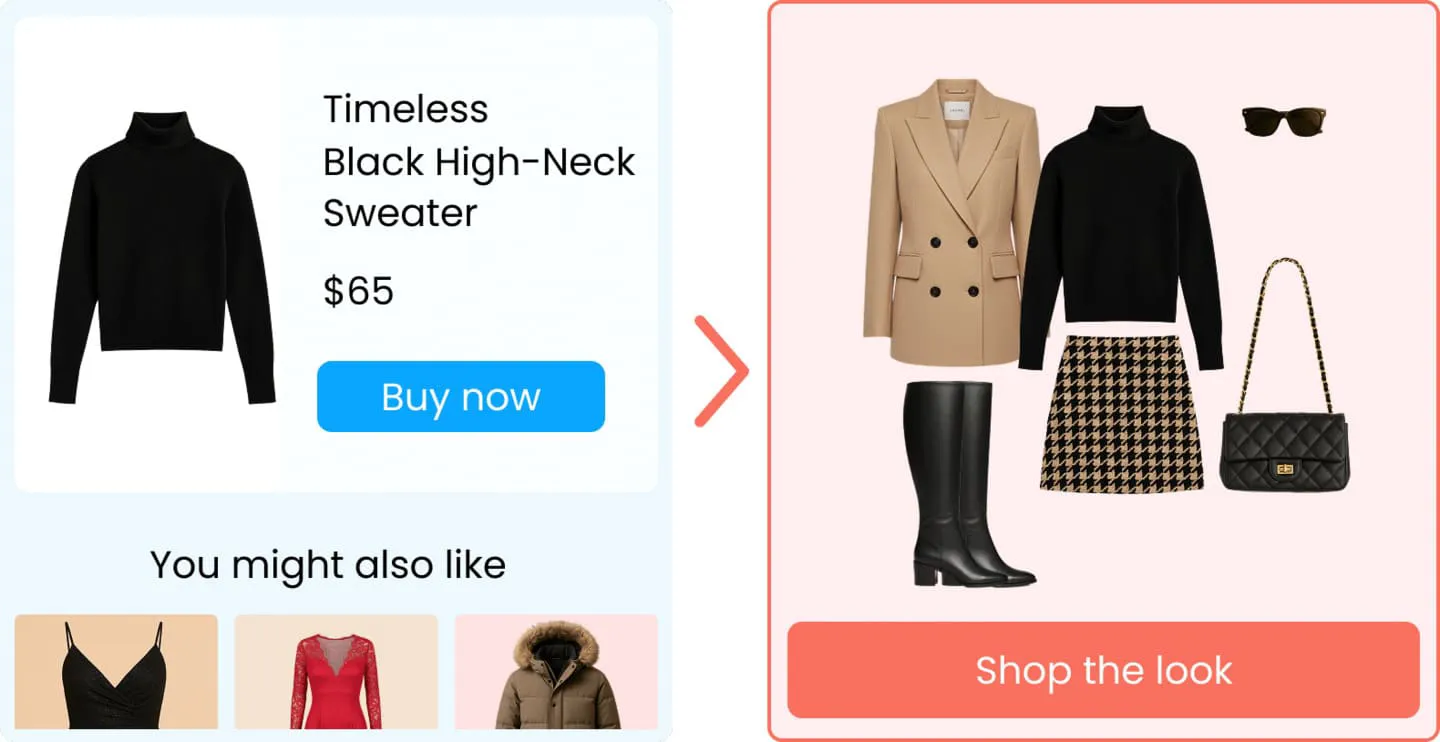
Similarity models work great at first. Someone’s looking at black dresses, you show more black dresses –boom, conversion. But similarity can’t tell you when someone’s ready to explore a new style, or when they’re gift shopping for someone else, or when they’ve already bought three black dresses and need something different.

Popularity models perform well initially. Top sellers are top sellers for a reason. But popularity can’t adapt to individual taste, can’t predict what someone might love before they know they love it, and definitely can’t help with discovery beyond what’s already trending.

Cross-sell works for obvious pairings. Chargers with phones. But it struggles with nuanced bundles, can’t optimize for margin, and misses opportunities for introducing customers to new categories.

These aren’t bad strategies. They’re just limited. And once you’ve captured all the obvious behavior, the gains start flattening out.

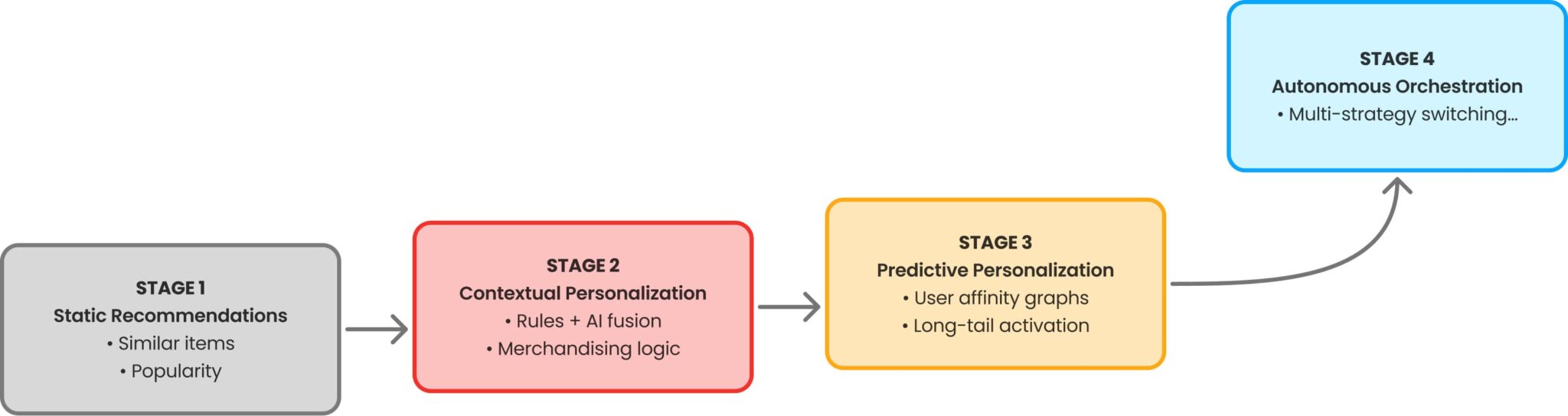
Here’s what the performance curve actually looks like:

Stage 1 strategies (similarity, popularity, basic cross-sell) can be incredibly effective early on. They capture high-intent, obvious behavior really well. But they tap out around 60-120 days because they’re reactive, not predictive. They show what people already want, not what they might want.

Moving to Stage 2 (contextual) or Stage 3 (predictive) personalization requires fundamentally different approaches. You need models that understand:

  • Session intent vs long-term affinity
  • Category exploration patterns
  • Seasonal timing and freshness
  • Margin optimization alongside relevance
  • Individual discovery thresholds

And that’s not just “adding more data to your existing model.” It’s building entirely new strategies.

The plateau shows up quietly. Your metrics don’t crash. They just stop improving. AOV stalls. Category penetration flatlines. New product discovery doesn’t move.

Not a sharp drop. A soft ceiling.

So what does it take to break through that ceiling?

The Personalization Ecosystem (what you accidentally signed up for)

Here’s what you’re really on the hook for when you build in-house:

You don’t see this stuff when you’re building that first model. You only see it when the business starts asking for things your system was never designed to handle.

And if any of these layers are missing? Personalization breaks. Not in obvious ways– subtly. Performance slowly erodes. AOV stalls. Long-tail products don’t move. Seasonal launches underperform. Customers stop discovering new stuff.

The teams that win don’t choose “Build” or “Buy.” They blend.

The retailers crushing it right now aren’t building everything themselves. And they’re not outsourcing everything either.

They’re doing something smarter:

They build what makes them unique. They buy what makes them fast.

They build: brand experience, UI, customer journeys, bundling logic, promotions, storytelling.

They buy: the machinery underneath–orchestration, data freshness, affinity modeling, margin awareness, strategy switching, failure recovery, all the messy infrastructure that never ends.

This approach gives them speed and differentiation.

More importantly? It keeps their engineering and data teams focused on work that actually moves revenue–not maintaining pipes.

The real question retailers should ask

It’s not: “Can we build a product recommendation system?”

You can. Every retailer can. That’s not the debate anymore.

The real question is:

“Can we build and sustain a full personalization ecosystem faster and better than a platform that has already solved this across hundreds of retailers?”

That’s the inflection point.

It’s why retailers like Matas, Blue Tomato, and even large global multi-category brands eventually turned to ADA Global Recommend™ .

Not because they couldn’t build it. They absolutely could.

But because they realized Recommend™ isn’t just “a model.”

It’s a retail-native decisioning system that already knows how to blend user affinity, business rules, inventory reality, margin constraints, and real-time context into every single product recommendation.

That’s what drives the lift. Not the algorithm. The ecosystem around it.

Look, the smartest retailers aren’t choosing between build or buy.

  • They’re choosing speed.
  • They’re choosing focus.
  • They’re choosing to build what makes them different– and plug into what makes them faster.

That’s the quiet truth behind personalization success.

And it’s exactly what ADA Global Recommend™ was built to deliver.

Table Of Contents
Personalization isn’t a model. It’s fifteen interconnected systems pretending to be one.
Where most internal systems break: decision debt
The Plateau no one predicts
The Personalization Ecosystem (what you accidentally signed up for)
The teams that win don’t choose “Build” or “Buy.” They blend.

The Impacts of TikTok Shop on Traditional Retail

Data & AI
Blogs

The Impacts of TikTok Shop on Traditional Retail

The Impact of Ecommerce on Traditional Retailers

You heard it right, we’re not here to talk about Kesha’s viral debut single, TiK ToK but the burgeoning social media app by ByteDance that has taken the commerce industry by storm – TikTok.

In recent years, TikTok has emerged as one of the most prominent social media platforms, especially among younger generations. Owing to its concise video format and the predisposition to spark viral trends, it has evolved into a nucleus for entertainment, education, and purchases. However, in addition to its social and cultural impact, TikTok is also transforming the eCommerce landscape, posing a challenge to traditional retail models. In this blog post, we will explore the impact of TikTok eCommerce on traditional retail, and how this trend is reshaping the way we shop.

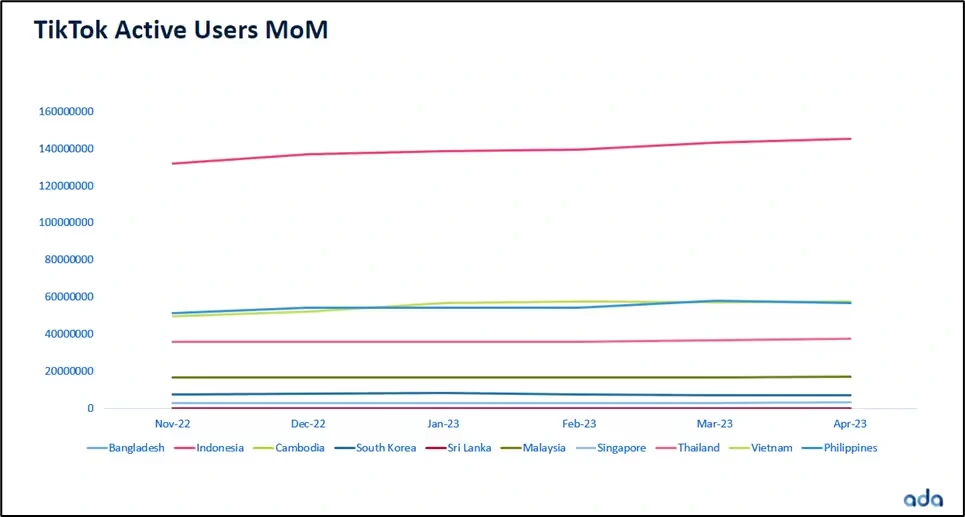
In August 2021, TikTok launched its own eCommerce feature. Also known as TikTok Shop, creators can add links to products in their videos. Users can now purchase products directly from TikTok without having to leave the app. This has opened a new world of opportunities for businesses and influencers, who can now monetise their TikTok content and generate sales in real-time. In fact, many businesses are now using TikTok as a marketing tool to reach new audiences, showcase their products, and drive traffic to their eCommerce sites. With more than 1 billion active users worldwide, TikTok has joined Meta in becoming a significant player in social commerce.

  • The impact of ecommerce on traditional retailers
  • Challenges of TikTok Shop

Over billions of active users on TikTok in the Southeast Asia region in the past six months
Source: data.ai

The Impact of Ecommerce on Traditional Retailers

There is no doubt that ecommerce platforms, such as TikTok shop, have a huge influence on traditional retailers.

Ecommerce has massively changed the way people go from finding products to transacting. Here are some of the impacts of ecommerce on traditional retail that business owners should understand:

1 Disruption of traditional retail models

In the past, retail was dominated by physical stores, which relied on having on-site locations and traditional advertising methods to attract customers. However, with the rise of eCommerce, more and more customers are turning to online shopping, andthis trend has only accelerated with the COVID-19 pandemic.

TikTok eCommerce takes this one step further, by allowing customers to purchase products directly from the app in the comfort of their homes. This has posed a significant challenge to traditional retailers, who now must compete with the convenience and accessibility of TikTok eCommerce.

For example, a customer may see a product they like on TikTok and decide to buy it on the spot, rather than waiting to visit a physical store or searching for the product online. If businesses do not have a strong online presence or use trending social media platforms like TikTok, they are at risk of losing out on potential high-value customers.

2 Establishment of new business models and revenue streams

TikTok is created based on the concept of social sharing, whereby users create and share content with their followers. This aspect has fostered the advent of a new type of influencer – TikTok influencer. Such influencers amass a vast following and thus, have the power to influence their followers’ buying decisions.

Many businesses are now partnering with influencers and creators on TikTok, who can promote their products to their followers and drive sales. This has led to the emergence of a new type of eCommerce, known as “influencer commerce”, which leverages the power of social media to drive sales. In fact, many influencers are now becoming entrepreneurs, by launching their own eCommerce businesses and using TikTok as a marketing tool.

3 Increased relevance of content recommendations

The algorithm of TikTok is designed to feed users with content that resonates with them. This spell out the advantage that businesses and influencers should make use of by creating engaging and relevant content so that they have a higher chance of reaching a wider audience. This spearheaded the materialisation of new trends, such as the unboxing of product videos, that have become popular among users.

Although the unboxing trend started in the early 2000s on YouTube, they’re mostly centred around gaming and electronic items. Nonetheless, this trend is resuming its popularity, especially for luxury goods because it is now being leveraged by a new generation of TikTok creators. In fact, this #unboxing hashtag has garnered 44.3 billion views on TikTok since 2018. Here’s a tip for luxury and fashion brands: ensure the legitimacy of your merchandise unboxing in your video so that you can attract the younger generation of consumers!

4 Options to compare product

If people used to do window shopping by walking from one store to another, then the advent of ecommerce such as TikTok Shop has changed that.

Besides being able to make transactions online, consumers now have the convenience of doing product comparisons online through modern eCommerce marketing strategies that optimise customer experience and decision-making journeys.

In addition to comparing product types or quality, consumers can now also compare product prices very easily.

All this convenience will certainly have an impact on physical visits to retail stores because all the information that consumers need is almost all available online.

5 Demand for faster shipping

The advent of online shopping has created a new need for speedy delivery. Companies must adapt by changing their supply chain strategies to accommodate these consumer needs.

This change in strategy also creates new logistics and fulfilment challenges for traditional retailers. For example, studies show that many online consumers want their goods to arrive in no more than 2 days. While the majority of consumers say they will not shop at a place where deliveries are delayed up to 3 times.

6 24/7 Availability

One of the biggest impacts of ecommerce on mortar and brick stores is probably 24/7 availability. Ecommerce platforms, such as TikTok Shop, allow stores to be open for a full day. The presence of technologies like Chatbot can also help stores to serve customers when human agents are not available.

Traditional retail stores may be able to stay open for a whole day, but it will definitely have an impact on operational costs as it requires more people to split the work shifts.

Challenges of TikTok Shop

Despite the positive influence on businesses and consumers, it is important to note that TikTok Shop is not insusceptible to challenges.

1 Trust and Authenticity

With so many businesses and influencers promoting products on TikTok, it can be difficult for customers to ascertain the authenticity of the products that are being promoted or sold. This has led to an upswing of fake products and scams on the platform, undermining customer trust and damaging the reputation of businesses and creators.

2 Limited Audience Targeting

While TikTok has a massive user base, it may not be the best platform for targeting specific audiences. For example, if you are selling products that are primarily targeted towards older adults like Baby Boomers and Gen X, TikTok may not be the best platform to reach them as the app primarily targets audiences that are much younger such as millennials and Gen Zs.

3 Competing with Influencers

TikTok is a platform that is dominated by influencers, and they often have a lot of influence over their followers’ purchasing decisions. As a result, it can be challenging for a retail business on TikTok to compete with them without having other influencers promote your brand on their platform.

4 Relatively High Content Creation Cost

TikTok is a platform that relies on video. The cost of creating a video itself is relatively higher than the cost of creating other types of content, such as articles on a website or images on social media like Instagram. The need to post regularly can also make TikTok’s content creation costs even higher.

Therefore, businesses that still have a relatively low marketing budget may find it difficult to sell on TikTok.

Leverage TikTok Shop to Elevate Your Business to the Next Level

The emergence of TikTok eCommerce has transformed the shopping experience of consumers and posed a challenge to traditional retail models. Its potential to disrupt conventional retail and create new business models is both invigorating and tricky for businesses and influencers alike. Nevertheless, a judicious approach towards TikTok eCommerce is essential, with an emphasis on maintaining authenticity and reliability amongst businesses and creators to foster lasting customer relationships. As TikTok continues to grow in popularity, it is likely that its impact on eCommerce and retail will only continue to grow.

Curious about how you can leverage this social platform for your brand or business? Contact our eCommerce growth experts today.

Table Of Contents
The Impact of Ecommerce on Traditional Retailers
Challenges of TikTok Shop
Leverage TikTok Shop to Elevate Your Business to the Next Level

11 CRM Implementation Challenges and How to Solve Them

Data & AI
Blogs

11 CRM Implementation Challenges and How to Solve Them

Customer Relationship Management (CRM) implementation can be a game-changer for your business. It’s the bridge that connects you to your customers, enabling you to build lasting relationships and boost your bottom line. However, the path to successful CRM implementation is laden with challenges.

In this article, we will delve into the 11 CRM implementation challenges businesses often face and provide practical solutions to overcome them. By the end of this article, you’ll be well-equipped to take your CRM implementation to the next level.

Why is CRM Implementation Important for Your Business?

Before we dive into the challenges and solutions, it’s crucial to understand the significance of CRM implementation for your business.

CRM implementation is essential for several reasons:

  • Customer insight: CRM systems provide valuable insights into customers’ behaviour, preferences, and needs. This data empowers you to tailor your products and services to meet customer demands effectively.
  • Efficient communication: CRM allows for efficient communication with customers, ensuring they receive the right messages at the right time. This personalisation leads to higher customer satisfaction and loyalty.
  • Sales and marketing alignment: A well-implemented CRM system bridges the gap between your sales and marketing teams. This alignment ensures that your sales efforts are more targeted and effective.
  • Data centralisation: CRM consolidates customer data in one place, making it accessible to all relevant team members. This centralisation improves decision-making and customer service.
  • Increased productivity: Automation and streamlining of processes through CRM increase productivity. Your team can focus on high-value tasks, leading to cost savings and improved efficiency.

Now that we’ve established the importance of CRM implementation, let’s explore why some businesses fail in this endeavour.

Why Does CRM Implementation Not Working?

CRM implementation can be a bumpy road, and there are several common reasons why it did not achieve the desired outcome:

  • Lack of clear objectives: Failing to define clear goals for your CRM implementation can lead to confusion and disarray. You must know what you want to achieve, whether it’s increasing sales, improving customer service, or enhancing marketing efforts.
  • Poor data quality: CRM relies heavily on data. Inaccurate or incomplete data can lead to incorrect decisions and poor customer experiences. It’s crucial to regularly clean and update your data to ensure its quality.
  • Resistance to change: People are often resistant to change. If your team is not on board with the new CRM system, its implementation will likely fail. Effective training and communication can help overcome this challenge.
  • Lack of user adoption: Even if your team is not resistant to change, they might not fully adopt the CRM system. This can happen if the system is too complex or lacks user-friendliness. It’s important to choose a CRM system that is easy to use and to train your team adequately.
  • Inadequate integration: Your CRM system should seamlessly integrate with your existing tools and systems. Inadequate integration can lead to inefficiencies and data silos.
  • Insufficient planning: Proper planning is essential for CRM implementation. Rushing into the process without adequate preparation can lead to costly mistakes and delays.

11 CRM Implementation Challenges and How to Overcome Them

Now that we’ve identified the common reasons for CRM implementation failure, let’s delve into the 11 implementation challenges and how to overcome them.

1 Choosing the Right CRM Software

Selecting the appropriate CRM software is the cornerstone of a successful implementation. The wrong choice can lead to inefficiencies, increased costs, and user dissatisfaction.

To overcome this challenge, it’s crucial to conduct in-depth research, considering factors such as scalability, user-friendliness, integration capabilities, and alignment with your business needs.

2 Data Migration and Clean-Up

Transferring existing data into the CRM system can be a daunting task. Inaccurate or incomplete data can lead to incorrect decisions and hinder effective customer relationship management.

To overcome this challenge, meticulous planning and data cleaning are necessary. Ensure data quality by updating and cleaning records before migration, and create a backup to prevent data loss.

3 Setting Clear Objectives

Unclear objectives can lead to confusion and disarray among team members. To overcome this challenge, it’s vital to define specific, measurable, and achievable objectives. Ensure that all team members understand these objectives and how they relate to their roles in the CRM system.

4 User Adoption

Getting your team on board with the new CRM system can be challenging, especially if there is resistance to change. To overcome this challenge, thorough training and ongoing support are essential.

Address any concerns or resistance from team members and ensure the CRM system is user-friendly, making it easier for your team to embrace the change.

5 Integration with Existing Systems

Inadequate integration with existing tools and systems can result in inefficiencies and data silos. To overcome this challenge, work closely with IT experts to ensure seamless integration. Test the integration thoroughly before full implementation to avoid potential issues.

6 Data Security

Data breaches can be disastrous, leading to a loss of customer trust and legal complications. To overcome this challenge, invest in robust data security measures. This should include encryption, access controls, and regular security audits to safeguard sensitive customer information.

7 Budget Constraints

Underestimating the cost of CRM implementation can hinder the process. To overcome this challenge, it’s crucial to identify all potential expenses, including software costs, training, and ongoing maintenance.

Create a realistic budget for these costs to prevent budget constraints from affecting your CRM project.

8 Analyse Customer Feedback

Ignoring customer feedback can result in poor customer experiences and hinder the success of your CRM implementation. To overcome this challenge, regularly gather and analyse customer feedback.

Use this input to make necessary improvements and adjustments to your CRM system, ensuring it remains customer-centric.

9 Provide Training and Support

Comprehensive training and ongoing support are essential for user satisfaction. To overcome this challenge, provide continuous training and support to ensure your team can effectively use the CRM system.

Address any issues promptly and maintain open lines of communication to enhance user confidence.

10 Proper Measurement and Analysis

Proper measurement and analysis are essential for tracking progress and making data-driven decisions. To overcome this challenge, establish key performance indicators (KPIs) and regularly assess the performance of your CRM system.

Make necessary adjustments based on the data collected, ensuring continuous improvement.

11 Resolving Technical Issues

Technical issues can arise during CRM implementation, leading to delays and disruptions. To overcome this challenge, have a dedicated IT support team or partner with a reliable IT service provider.

Their expertise can help swiftly address and resolve technical issues, minimising downtime and ensuring a smooth implementation.

Elevate Your CRM Implementation to the Next Level with ADA Asia

To take your CRM implementation to the next level and experience the benefits of world-class customer relationship management, consider partnering with ADA Asia. Our CRM solutions are customisable to your business requirements.

We understand that every business is unique, and we’ll work closely with you to ensure our CRM system aligns with your goals and objectives. This level of customisation ensures that your CRM system is a perfect fit for your organisation, helping you maximise its potential.

We prioritise the integration of our CRM system with your existing tools and systems. This ensures that your CRM operates smoothly within your existing infrastructure, minimising any disruptions and data silos. Our technical experts will work with you to guarantee a seamless integration process.

Contact us to find out how our service can help you expand the capabilities of your business.

Table Of Contents
Why is CRM Implementation Important for Your Business?
Why Does CRM Implementation Not Working?
11 CRM Implementation Challenges and How to Overcome Them
Elevate Your CRM Implementation to the Next Level with ADA Asia

Frequently Asked Questions (FAQs) about CRM Implementation Challenges

Common Challenges in Implementing a CRM System

Businesses often encounter several common challenges when implementing a CRM system. These include choosing the right CRM software that aligns with their needs and objectives, ensuring a smooth data migration process, setting clear and measurable goals for CRM implementation, and gaining user adoption, as employees may resist change.

Additionally, integrating the CRM system with existing tools and systems, safeguarding customer data through robust security measures, and managing the budget effectively is vital.

How to Ensure Data Security during CRM Implementation

Data security is a paramount concern during CRM implementation. To ensure the security of customer data, businesses must invest in robust measures.

This includes implementing encryption to protect data in transit and at rest, establishing strict access controls to limit data access to authorised personnel only, and conducting regular security audits to identify vulnerabilities.

Additionally, businesses should comply with relevant data protection regulations, such as GDPR in the UK, to safeguard customer information.

How to Effectively Measure the Success of CRM Implementation

Measuring the success of CRM implementation is essential for continuous improvement. To do so, businesses should establish key performance indicators (KPIs) that align with their objectives.

These KPIs may include metrics like customer acquisition cost, customer retention rates, sales growth, and customer satisfaction scores. Regularly tracking and analysing these KPIs provides valuable insights into the effectiveness of the CRM system.

Businesses should also encourage feedback from users and customers, making necessary adjustments based on their input.

CRM implementation is a critical step towards enhancing customer relationships and driving business growth. However, it comes with its share of challenges.

By choosing the right CRM software, focusing on data migration and clean-up, setting clear objectives, ensuring user adoption, integrating with existing systems, prioritising data security, and managing your budget effectively, you can overcome these challenges and make the most of your CRM system.

Don’t forget to stay customer-centric, regularly gather feedback, and invest in training and support. With the right approach, your CRM implementation can lead to improved customer relationships and increased profitability.

Top 4 CRM Models That Can Help You Boost Customer Loyalty

Data & AI
Blogs

Top 4 CRM Models That Can Help You Boost Customer Loyalty

Amidst fierce competition, businesses are seeking innovative approaches to bolster customer loyalty and drive profitability. Customer Relationship Management (CRM) has emerged as a crucial element in achieving these goals. In this article, we will explore the concept of CRM models and delve into the top four CRM models that can impact a company’s customer loyalty and profitability.

Understanding CRM Model

A CRM model is a structured framework that facilitates an organisation’s understanding of its customers and guides the implementation of strategies to manage and nurture customer relationships. It serves as a blueprint that outlines the processes, technologies, and methodologies necessary to acquire, retain, and grow a loyal customer base.

A well-designed CRM model enables companies to streamline customer interactions, provide personalised experiences, anticipate their needs, and resolve issues promptly. It empowers businesses to make data-driven decisions, leading to more efficient marketing campaigns, improved customer service, and increased customer satisfaction.

Companies should align their business objectives with customer-centric practices to implement a successful CRM model. This involves the integration of various departments, such as marketing, sales, and customer service to create a unified approach towards delivering exceptional customer experiences.

Top 4 CRM Models for Boosting Customer Loyalty and Profitability

Let’s explore four of the most impactful CRM models that have proven to be effective in enhancing customer loyalty and driving profitability:

1 IDIC Model

The IDIC CRM model, proposed by Francis Buttle, stands for Identity, Differentiate, Interact, and Customise. This model focuses on understanding customers at a granular level and tailoring interactions to meet their needs.

  • Identify: The first step involves identifying and segmenting customers based on various criteria, such as demographics, preferences, and buying behaviour. This segmentation allows companies to create targeted marketing campaigns and personalised offers.
  • Differentiate: Once customers are identified, the next step is to differentiate them based on their value and potential for the business. Not all customers have the same significance, and this step helps prioritise resources to focus on high-value customers.
  • Interact: Interacting with customers is a critical aspect of the IDIC model. Companies must engage with their customers through multiple channels, such as social media, email, or phone, to build meaningful relationships and gather valuable feedback.
  • Customise: Lastly, the IDIC model emphasises the importance of customisation. Companies should tailor their products, services, and interactions to cater to individual customer preferences, enhancing customer satisfaction and loyalty.

2 QCI Model

The QCI model, which stands for Quick, Complete, and Informed, is a customer-focused CRM model that centres on rapid issue resolution and efficient customer service.

  • Quick: Customers expect prompt responses to queries and issues in today’s fast-paced world. The QCI model emphasises the need for quick issue resolution to enhance customer satisfaction and loyalty.
  • Complete: Resolving customer issues effectively requires providing comprehensive solutions. The QCI model encourages customer service representatives to address all aspects of a problem to prevent recurring issues and ensure complete customer satisfaction.
  • Informed: Customer service representatives should be well-informed and equipped with the knowledge to address customer inquiries accurately. This approach fosters confidence in the company’s capabilities and expertise.

3 Payne’s Five Process Model

The Five Process Model, developed by Adrian Payne, focuses on five core processes that contribute to effective CRM implementation:

  • Strategy development: This process involves defining the CRM strategy, aligning it with the overall business strategy, and setting clear objectives.
  • Value creation: The second process revolves around creating value for customers by understanding their needs and preferences and delivering products or services that fulfil those requirements.
  • Multichannel integration: Customers interact with companies through various touchpoints in today’s omnichannel world. The multichannel integration process ensures seamless and consistent experiences across all channels.
  • Performance assessment: Measuring the effectiveness of the CRM strategy is crucial. This process involves evaluating key performance indicators (KPIs) to monitor customer satisfaction and the overall success of CRM initiatives.
  • Information management: The final process focuses on managing customer data effectively. Accurate and accessible customer information allows companies to make informed decisions and improve their CRM efforts continually.

4 CRM Value Chain

The CRM Value Chain model draws inspiration from Michael Porter’s Value Chain concept and applies it to CRM processes. It consists of five primary stages:

  • Customer Portfolio Analysis: Customer Portfolio Analysis helps your sales and marketing teams identify the star performers, your most significant customers. It starts by gathering data on everyone and then calculates their value based on purchases, profitability, and loyalty. Finally, you group them based on value and relationship potential, prioritising resources for your star customers.
  • Build Customer Intimacy: After identifying your most significant customers, start building relationships with them as if you want to be their best friend. You gather deep insights into their needs, wants, and even pain points. Then, you personalise everything: special offers, communication, and even early access to new products. Anticipate their needs with proactive service and remember their preferences. Most importantly, listen actively and use their feedback to improve.
  • Build Your Network: This stage is beyond the technicalities of your CRM strategy. To be able to satisfy the needs of your most valuable customers, you will certainly need a lot of help, from suppliers, investors, technology experts, and others. The bottom line; you have to network with people relevant to your most valuable customers to be able to fulfil their needs and expectations.
  • Value Proposition Development: Once you know who your most valuable customers are and have built a network to fulfil their needs, it’s time for you and your network to work together to build a value proposition to attract potential customers similar to and retain your most valuable customers.
  • Managing Customer Relationship: The last step of this CRM model is to maintain a good relationship with the customer. The previous steps, from identifying to building a value proposition, are steps to build and initiate relationships with customers. In maintaining relationships with customers, make sure you stick to the values you hold and offer because the customers you have come to you because of those values.

In conclusion, a robust CRM model is essential for any company aiming to enhance customer loyalty and drive profitability. By implementing the right CRM model, businesses can gain valuable insights into their customers, deliver personalised experiences, and optimise their operations for maximum customer satisfaction.

The IDIC model emphasises personalised interactions, the QCI model focuses on efficient issue resolution, Payne’s Five Process Model provides a comprehensive approach to CRM implementation, and the CRM Value Chain streamlines customer-focused processes. Each model has unique strengths and can be tailored to suit specific business requirements.

When choosing a CRM model, companies should consider their objectives, resources, and customer base carefully. Moreover, successful CRM implementation requires commitment and collaboration across all departments to create a customer-centric culture that permeates the entire organisation.

By adopting a well-suited CRM model and aligning it with their business goals, companies can establish long-lasting customer relationships, foster loyalty, and drive sustainable profitability in today’s dynamic business landscape.

Discover All-in-One Marketing Technology Solutions for Your Business with ADA

Customer Relationship Management (CRM) is crucial in understanding and managing customer interactions, enabling businesses to foster lasting relationships and drive growth. When combined with Full Funnel Marketing Management, companies can unlock powerful capabilities that propel their business to new heights of success.

Furthermore, companies can create a competitive advantage in today’s dynamic business landscape by comprehending customers better, delivering personalised experiences, and optimising marketing efforts through data-driven insights. ADA’s innovative CRM software and a customer-centric approach form a powerful duo that paves the way for sustainable business success. Contact us to learn more about how ADA’s all-inclusive marketing solutions can benefit the operations of your business.

Table Of Contents
Understanding CRM Model
Top 4 CRM Models for Boosting Customer Loyalty and Profitability
Discover All-in-One Marketing Technology Solutions for Your Business with ADA

7 Steps How to Choose Marketing Channels for Business

Data & AI
Blogs

7 Steps How to Choose Marketing Channels for Business

Why Is Marketing Channel Strategy Important?

Choosing the right marketing channels for your business can be a game-changer. It’s not just about throwing darts at a board and hoping for the best. Instead, it requires careful consideration, strategic planning, and a deep understanding of your target audience. In this guide, we’ll walk you through seven crucial steps on how to choose marketing channels to help you navigate and make informed decisions that drive real results for your business.

Marketing channel strategy is crucial for businesses because it determines how they reach and engage with their target audience. Here’s why it’s so important:

  • Audience Targeting: Different marketing channels attract different demographics and audiences. A well-defined channel strategy allows businesses to target their messaging to the right audience segments, increasing the chances of engagement and conversion.
  • Resource Allocation: Resources such as time, budget, and manpower are finite. A strategic approach to marketing channels helps businesses allocate these resources effectively, focusing on channels that offer the highest return on investment (ROI) and avoiding wasted efforts on channels that don’t resonate with their audience.
  • Brand Consistency: Consistency is key to building a strong brand identity. By carefully selecting and managing marketing channels, businesses can ensure that their messaging and brand storytelling remain consistent across all touchpoints, reinforcing brand recognition and trust among their audience.
  • Maximising Reach: Different channels have different reach potentials. A well-thought-out channel strategy allows businesses to maximise their reach by leveraging a mix of channels that collectively cover a broad spectrum of their target audience, ensuring that no potential customer goes unnoticed.
  • Adapting to Consumer Behaviour: Consumer behaviour is constantly evolving, especially in today’s digital age. A flexible channel strategy enables businesses to adapt to changing consumer preferences and trends, ensuring that they stay relevant and continue to meet their audience’s needs effectively.

Types of Marketing Channels for Business

Marketing channels are the pathways through which businesses connect with their target audience, promote their products, and drive sales. Here are some of the key types of marketing channels commonly used by businesses:

1. Social Media

Social media platforms such as Facebook, X, Instagram, and LinkedIn offer businesses the opportunity to engage directly with their audience. These platforms enable businesses to share content, run targeted ad campaigns, and leverage influencer partnerships to reach a broader audience.

Social media marketing is highly interactive, allowing real-time communication and fostering meaningful customer interactions.

2. Email Marketing

Despite the emergence of newer marketing channels, email marketing remains a reliable and cost-effective method to connect with customers. Businesses can use email marketing to nurture relationships, deliver promotions, and keep customers informed about new products and offers.

Email marketing allows for personalisation and segmentation, ensuring that messages are tailored to the recipient’s interests and preferences.

3. Content Marketing (Blogs, Articles)

Content marketing focuses on creating valuable and relevant content to attract and retain a target audience. Through blog posts, articles, videos, and infographics, businesses can showcase their expertise, educate their audience, and build brand credibility.

Content marketing also plays a crucial role in search engine optimisation (SEO), as high-quality content can improve website ranking and visibility.

4. Search Engine Optimisation (SEO)

SEO involves optimising a website’s content, structure, and meta-tags to improve its ranking on search engine result pages. By appearing higher in search results, businesses can increase their website’s visibility, attract organic traffic, and enhance brand exposure.

SEO is a cost-effective marketing channel that targets quality traffic and helps businesses compete effectively in the online marketplace.

5. Pay-Per-Click (PPC) Advertising

PPC advertising allows businesses to display ads on search engines or other websites and pay only when users click on the ad. Platforms such as Google Ads and Microsoft Advertising enable businesses to target specific audience segments and achieve immediate visibility.

PPC advertising provides quick results, precise targeting options, and easy measurement of campaign performance.

6. Direct Mail

Direct mail involves sending physical mail, such as letters, postcards, or catalogues, to targeted recipients. This marketing channel is highly personalised and tangible, making it effective for targeting specific geographic areas or demographics.

Direct mail campaigns can include personalised offers, loyalty programmes, or event invitations, helping businesses engage with customers offline.

7. TV

Television advertising remains a popular marketing channel for reaching a wide audience and building brand visibility. TV ads allow businesses to showcase their products or services to diverse demographics and leverage the power of visual storytelling.

While TV advertising can be expensive, it offers a wide reach and high impact, making it suitable for mass marketing campaigns.

These are just a few examples of the many marketing channels available to businesses. The key is to select the channels that best align with your business goals, target audience, and overall marketing strategy.

7 Crucial Steps on How To Choose Marketing Channels for Businesses

Choosing the right marketing channels for your business can significantly impact your overall success and growth. Here are seven crucial steps to help you navigate the process effectively:

1. Define Your Goals

Start by clearly defining your marketing goals. What do you aim to achieve with your marketing efforts? Whether it’s increasing brand awareness, driving website traffic, generating leads, or boosting sales, having specific and measurable goals will guide your channel selection process.

2. Know Your Audience

Understand your target audience inside out. Conduct thorough market research to identify their demographics, interests, preferences, and pain points. Knowing your audience intimately lets you choose marketing channels that resonate with them and effectively communicate your message.

3. Evaluate Channel Relevance

Not all marketing channels are created equal; what works for one business may not work for another. Evaluate the relevance of each channel to your target audience and business objectives. Consider factors such as reach, engagement potential, cost-effectiveness, and alignment with your brand values.

4. Conduct Competitive Analysis

Keep a close eye on your competitors and analyse their marketing strategies. Which channels are they using? Are they seeing success with certain platforms or tactics? While you don’t want to copy your competitors outright, their strategies can provide valuable insights into what works in your industry and where you should focus your efforts.

5. Test and Iterate

Don’t be afraid to experiment with different marketing channels and tactics. Set up small-scale tests to gauge the effectiveness of each channel and iterate based on the results. Monitor key metrics such as conversion rates, click-through rates, and return on investment (ROI) to identify which channels are delivering the best results for your business.

6. Create a Multi-Channel Strategy

Consider adopting a multi-channel marketing approach instead of putting all your eggs in one basket. Diversify your marketing efforts across multiple channels to reach a wider audience, mitigate risk, and maximise your chances of success. However, be mindful not to spread yourself too thin – focus on channels that align with your goals and resonate with your audience.

7. Monitor and Optimise Performance

Once you’ve selected your marketing channels and launched your campaigns, the work doesn’t stop there. Continuously monitor the performance of each channel and optimise your strategies based on real-time data and insights. Be prepared to pivot if certain channels underperform or if new opportunities arise.

By following these seven crucial steps, you can make informed decisions that drive tangible results for your business and ensure that your marketing efforts are strategic, effective, and aligned with your overall goals.

Choosing the right marketing channels for your business is not just about picking the most trendy options. It’s a strategic decision that requires careful consideration of your goals, target audience, and overall marketing strategy.

By following the seven crucial steps outlined in this guide – defining your goals, knowing your audience, evaluating channel relevance, conducting competitive analysis, testing and iterating, creating a multi-channel strategy, and monitoring and optimising performance, you can make informed decisions that drive tangible results for your business.

Remember that the marketing landscape is constantly evolving, and what works today may not work tomorrow. Stay agile, be willing to experiment, and adapt your strategies based on real-time data and insights. By continuously refining your approach and leveraging the right mix of marketing channels, you can maximise your reach, engagement, and ultimately, your success.

Elevate Your Marketing Performance on Various Marketing Channels with ADA

To maximise the performance of every marketing channel and achieve significant growth impact, your business needs more than just an understanding of how to choose them. You also need to ensure that each marketing channel continues to deliver the best results for your business. This is where ADA’s Performance Marketing Services come in.

We specialise in helping businesses elevate marketing performance across various channels. Whether it’s social media, email marketing, content marketing, SEO, PPC advertising, or any other channel, we have the expertise and technology to drive real results for your business.

Contact us today and learn more about ADA’s Performance Marketing Services and discover how we can help you maximise your marketing impact and achieve your business goals.

Table Of Contents
Why Is Marketing Channel Strategy Important?
Types of Marketing Channels for Business
7 Crucial Steps on How To Choose Marketing Channels for Businesses
Elevate Your Marketing Performance on Various Marketing Channels with ADA

9 Steps to Build and Maintain Customer Loyalty

Data & AI
Blogs

9 Steps to Build and Maintain Customer Loyalty

What is Customer Loyalty?

Acquiring new customers is undoubtedly important, especially in today’s competitive business landscape. However, equally, if not more crucial, is retaining the customers you already have. Customer loyalty is the lifeblood of any successful enterprise, as it ensures a steady revenue stream and amplifies your brand’s reputation through word-of-mouth marketing. So, the question arises: How can you maintain customer loyalty in an ever-evolving marketplace?

In this article, we’ll explore effective strategies to help you nurture and sustain customer loyalty, creating a solid foundation for long-term success. Whether you run a small business or a large corporation, this information can be applied to strengthen your customer relationships and boost your bottom line.

Customer loyalty refers to a customer’s willingness and inclination to consistently choose and support a particular brand, product, or service despite competing market alternatives. It represents customers’ deep-seated commitment and emotional attachment towards a business or brand.

Customer loyalty is not automatic and must be earned through consistently delivering high-quality products or services, exceptional customer experiences, and building trust. Loyalty programs, personalised marketing, excellent customer service, and a strong brand identity and storytelling strategy are approaches businesses use to cultivate and maintain customer loyalty.

Loyal customers are precious to businesses as they can significantly contribute to revenue, profitability, and sustainability. Furthermore, they can become brand advocates, actively promoting the brand and influencing others, which can lead to acquiring new customers.

What are The 5 Stages Of Customer Loyalty?

Customer loyalty is a journey that unfolds in five distinct stages, each representing a crucial step in building lasting relationships with your customers. Let’s delve into these stages to understand the process of cultivating customer loyalty:

1. Reach

In the first stage, “Reach,” businesses aim to expand their brand’s visibility and attract potential customers. This involves creating awareness about your products or services through marketing efforts, advertising, social media presence, and content marketing. The goal is to reach a broad audience and capture their attention, making them aware of your brand’s existence and what it offers.

2. Acquisition

Once you’ve grabbed the attention of potential customers, the next stage is “Acquisition.” Here, the focus shifts to turning these prospects into actual customers. This involves engaging them further, providing valuable information, and convincing them to make their first purchase. Strategies like targeted advertising, compelling offers, and an optimised website can help convert interested prospects into paying customers.

3. Conversion

“Conversion” is the stage where a customer makes their initial purchase. It’s essential to ensure a smooth and positive buying experience, as this sets the tone for their future interactions with your brand. Offering exceptional customer service and delivering on your promises helps build trust and satisfaction.

4. Retention

Once a customer has made their first purchase, the goal shifts to “Retention.” This stage is all about keeping customers engaged and encouraging repeat business. You can achieve this by providing ongoing value, personalised recommendations, loyalty programs, and consistent communication. Happy and satisfied customers are more likely to return and continue their relationship with your brand.

5. Loyalty

The final stage, “Loyalty,” represents the pinnacle of customer relationships. At this point, customers make repeat purchases and become advocates for your brand. They actively promote your products or services, refer others, and remain loyal despite competition. Building and maintaining this level of loyalty involves consistently delivering outstanding experiences, listening to customer feedback, and nurturing a sense of community around your brand.

How to Build and Maintain Customer Loyalty?

Building and maintaining customer loyalty is crucial for long-term business success. Here are seven key strategies to help you achieve this:

1. Build an Exceptional Customer Service Team

Building and maintaining customer loyalty is a long, difficult, but sometimes neglected part of business. To build and maintain customer loyalty, you need a team of specialists who understand what they need to do and are great at their job.

You can start by creating a playbook which contains a set of rules that your customer service team must follow to give exceptional customer service. It can include the things they should say when greeting customers, how they should handle a certain question, and who they need to reach to help them solve customers’ problems.

While accuracy is important, speed is also an integral part of exceptional customer service. Implement technologies, such as chatbot or utilise platforms such as WhatsApp to help your team manage customers’ questions and/or requests promptly.

2. Quality Products or Services

Consistently deliver high-quality products or services that meet or exceed customer expectations. Quality builds trust and encourages repeat business.

3. Personalisation

Tailor your marketing and interactions to existing customers preferences. Personalised experiences make customers feel valued and understood, fostering a stronger emotional connection.

4. Loyalty Programs

Implement loyalty programs that reward customers for their repeat business. Offer incentives like discounts, exclusive access, or points that can be redeemed for future purchases.

5. Regular Communication

Stay in touch with your customers through various channels, such as email newsletters, social media, and personalised offers. Keep them informed about new products, special promotions, and relevant content.

6. Feedback and Improvement

Encourage customer feedback and actively use it to improve. Show customers that their opinions matter and that you’re committed to enhancing their experience.

In collecting feedback, make sure you answer feedback from customers, even if it’s bad feedback.

By answering all the feedback that your customers give, you can show that your company really cares about customers and will continue to strive to make better products for them.

7. Consistent Branding

Maintain a strong and consistent brand identity that customers can recognise and trust. Consistency in branding helps build brand loyalty over time.

8. Partnering with Another Company

Partnering with another relevant company is a great way to cultivate customer loyalty. Partnering with other brands can help you deliver more value to customers and in the end increase customer satisfaction.

For example, if you own a laptop brand, partnering with keyboards, audio, or other relevant laptop accessories is a good way to deliver value to your business. You can bundle your product with another’s product to create a special offer for your customers.

You do not always have to partner with a for-profit company. You can, for example, do a partnership with a charity. Gen Z especially, has a strong preference for brands that do action for social good.

9. Utilise CRM Tools

Customer relationship management (CRM) tools can help your company to amplify the steps described above.

For example, you can identify your long-time customers and give them special gifts to celebrate their loyalty.

Then, data from CRM can help you personalise your communication. You can do things as simple as addressing customers by name, knowing when they open messages or emails from you, and determining the content you offer them according to where they are in the customer journey.

Why is Customer Loyalty Important?

Customer loyalty is vital for businesses for several compelling reasons:

1. Revenue Growth

Loyal customers spend more and frequently purchase, contributing significantly to a company’s revenue. Their consistent business helps stabilise cash flow and can lead to long-term financial success.

2. Cost Efficiency

Acquiring new customers can be up to five times more expensive than retaining existing ones. Loyal customers require fewer marketing resources and lower acquisition costs, boosting profitability.

3. Word-of-Mouth Marketing

Loyal customers become brand advocates who recommend your products or services to friends and family. Positive word-of-mouth marketing can effectively attract new customers without additional marketing spend.

4. Resilience to Competition

Customers loyal to a brand are less likely to be swayed by competitive offers or promotions. They are more resistant to switching, providing a protective barrier against market competition.

5. Feedback and Improvement

Loyal customers are often willing to provide valuable feedback, helping a business identify areas for improvement. This feedback loop can lead to product enhancements and better customer experiences.

In summary, customer loyalty drives both short-term and long-term business success by increasing revenue, reducing costs, and fostering a positive brand reputation that attracts new customers. It’s a cornerstone of sustainable growth and profitability for any company.

To take your customer loyalty efforts to the next level and enhance your Customer Relationship Management (CRM), consider leveraging the services offered by ADA Asia. We specialise in optimising customer relationships and can help you create a strategy that fosters lasting customer loyalty. Don’t miss the opportunity to strengthen your business – explore ADA Asia’s services today and unlock the full potential of customer loyalty.

Table Of Contents
What is Customer Loyalty?
What are The 5 Stages Of Customer Loyalty?
How to Build and Maintain Customer Loyalty?
Why is Customer Loyalty Important?

10 Technologies to Help Your Marketing Effort

Data & AI
Blogs

10 Technologies to Help Your Marketing Effort

What is Marketing Technology?

In today’s rapidly evolving business landscape, staying ahead in the marketing world is not just about creativity and strategy but also about harnessing technology’s power. Integrating technology into marketing efforts has become a necessity rather than an option. We will explore the various technologies that support the marketing function and how they can significantly enhance your marketing efforts.

Marketing technology, often called “MarTech,” encompasses various tools and platforms designed to streamline, automate, and improve marketing activities. These technologies aid businesses in understanding their target audience, optimising their marketing strategies, and ultimately driving better results.

What are the 8 Benefits of Using Marketing Technology?

Before we delve into the specific technologies, let’s first understand the significant advantages of incorporating marketing technology into your business:

1. Enhanced Customer Insights

Marketing technology allows businesses to collect, process, and analyse vast amounts of data related to customer behaviour, preferences, and demographics. This data allows companies to gain a deeper understanding of their target audience.

With enhanced customer insights, businesses can create more accurate buyer personas and tailor their marketing strategies accordingly. For example, knowing which products or content resonate most with specific customer segments enables businesses to deliver more relevant and personalised experiences.

2. Improved Customer Engagement

Marketing technology tools facilitate multi-channel customer communication, including email, social media, websites, and mobile apps. By leveraging these platforms, businesses can engage with their audience more effectively.

Personalisation and automation features allow for timely and relevant interactions, significantly enhancing customer engagement. When customers feel that a brand understands their needs and communicates accordingly, it fosters stronger relationships and increases customer loyalty.

3. Streamlined Marketing Operations

Marketing technology automates various marketing tasks and processes, reducing the manual workload for marketing teams. For example, email marketing automation can schedule and send emails, segment lists, and track responses without human intervention.

This streamlining of operations saves time and minimises the risk of errors. It allows marketing professionals to focus on strategic and creative aspects of their work, leading to more effective campaigns and better results.

4. Data-Driven Decision-Making

Marketing technology provides real-time data and analytics access, enabling businesses to make informed decisions swiftly. This data-driven approach helps optimise marketing strategies, as decisions can be based on concrete insights rather than guesswork.

For instance, analysing website traffic and conversion rates allows marketers to adjust their tactics, allocate resources effectively, and identify areas for improvement. Data-driven decision-making enhances agility and adaptability in a dynamic marketplace.

5. Cost Efficiency

By automating repetitive marketing tasks and optimising processes, marketing technology contributes to cost efficiency. Businesses can reduce operational costs related to manpower, resources, and time. For instance, automated email campaigns can reach a large audience without manual sending and tracking.

Cost savings can be reinvested into other marketing efforts or used to improve overall profitability. The result is a higher return on investment (ROI) from marketing initiatives.

6. Competitive Advantage

Staying up-to-date with the latest marketing technologies gives businesses a competitive edge. It allows them to adopt innovative strategies and tactics that outperform competitors relying on traditional marketing methods.

By leveraging the capabilities of marketing technology, companies can differentiate themselves in the market, attract a wider audience, and gain market share. This competitive advantage is essential in today’s fast-paced and digitally-driven business environment.

7. Scalability

Marketing technology solutions are designed to scale with the needs of startups or large enterprises. As a business grows, these tools can adapt to accommodate increased workloads, expanded customer bases, and evolving marketing strategies.

This scalability ensures that marketing efforts remain efficient and effective as the company expands, without a complete overhaul of marketing processes.

8. Measurable Results

Marketing technology provides robust analytics and reporting capabilities that enable businesses to track the performance of their marketing campaigns and initiatives. Key performance indicators (KPIs) can be monitored in real-time, allowing marketers to assess the success of their efforts.

Measurable results provide valuable insights into what works and doesn’t, facilitating continuous improvement. Businesses can adjust their strategies, allocate resources wisely, and make data-backed decisions to achieve better marketing outcomes.

10 Marketing Technologies That Every Company Must Know

Now that we understand the benefits, let’s explore ten essential marketing technologies that every business should be aware of:

1. Customer Relationship Management (CRM) Systems

CRM systems are software platforms designed to manage and streamline interactions with customers and potential customers. They enable businesses to store, track, and analyse customer data, including contact information, communication history, and purchase history.

CRM systems enhance customer relationships by providing a centralised view of customer interactions, helping businesses personalise communication and tailor their marketing strategies to individual needs.

2. Email Marketing Software

Email marketing software is a tool that facilitates the creation, delivery, and tracking of email campaigns. It allows businesses to send targeted emails to their subscribers, automate email sequences, and analyse the performance of email campaigns.

Email marketing is a powerful way to nurture leads, engage customers, and drive conversions by directly delivering relevant content and promotions to recipients’ inboxes.

3. Social Media Management Tools

Social media management tools assist businesses in scheduling, publishing, and monitoring content across various social media platforms. These tools simplify managing multiple social media accounts, enabling businesses to engage with their audience, respond to comments, and track social media performance metrics. Effective social media management enhances brand visibility and engagement.

4. Content Management Systems (CMS)

Content Management Systems (CMS) facilitate digital content creation, including the editing, and publishing of digital content, particularly on websites and blogs. Popular CMS platforms like WordPress and Drupal make it easy for businesses to manage their online content.

CMS systems allow for efficient content creation, editing, and organisation, enabling businesses to maintain fresh, engaging web content.

5. Search Engine Optimisation (SEO) Tools

SEO tools are essential for optimising online content to improve its visibility on search engines like Google. These tools help businesses analyse keywords, track rankings, and identify opportunities for improving website content and structure.

Effective SEO can increase organic traffic to a website, resulting in more qualified leads and potential customers.

6. Pay-Per-Click (PPC) Advertising Platforms

PPC advertising platforms like Google Ads and Bing Ads allow businesses to create targeted paid advertising campaigns. Advertisers pay a fee each time a user clicks on their ad.

PPC advertising allows for precise audience targeting, which is closely aligned with strategies such as location-based marketing that focus on reaching users based on geography.

7. Marketing Automation Software

Marketing automation software automates repetitive tasks and workflows, such as lead nurturing, email marketing, and customer segmentation. These tools enable businesses to deliver personalised content at the right time, score leads, and trigger automated responses based on customer behaviour.

Marketing automation increases efficiency and ensures that leads are effectively nurtured throughout the customer journey.

8. Analytics and Data Visualisation Tools

Analytics and data visualisation tools provide businesses with the means to collect, analyse, and present website and marketing performance data. Platforms like Google Analytics and Tableau offer insights into website traffic, user behaviour, and conversion rates.

Visualising data allows businesses to make informed decisions, optimise marketing strategies, and identify areas for improvement.

9. Chatbots and AI-Powered Customer Support

Chatbots and AI-powered customer support solutions use artificial intelligence to provide instant customer responses and support on websites and messaging platforms.

They can answer frequently asked questions, assist with product inquiries, and even complete transactions. These technologies enhance customer service by providing 24/7 support and freeing up human agents for more complex tasks.

10. Augmented Reality (AR) and Virtual Reality (VR)

Augmented Reality (AR) and Virtual Reality (VR) technologies are gaining traction in marketing. AR enhances the real-world environment with digital overlays, while VR creates immersive virtual experiences.

Businesses can use AR and VR for interactive product demonstrations, virtual store tours, and engaging marketing campaigns. These technologies provide unique and memorable experiences that captivate customers and drive brand engagement.

In conclusion, understanding and effectively utilising various technologies that support marketing is imperative for businesses in the digital age. The benefits are clear: enhanced customer insights, improved engagement, streamlined operations, data-driven decisions, cost efficiency, a competitive edge, scalability, and measurable results.

To remain competitive and relevant, businesses must embrace these technologies and stay open to ongoing advancements in the marketing technology landscape.

Build and Expand Your Brand Awareness with Full Funnel Marketing Management Services from ADA Global

To harness your marketing technology and data-driven strategies to their full potential, consider partnering with experts like ADA Global. ADA Global specialises in Full Funnel Marketing Managements ervices, helping businesses build and expand brand awareness and marketing strategies through data-driven optimisation. By optimising operations, enhancing customer experiences, and driving business growth, we can empower your business to thrive in today’s digital marketplace.

Contact us to find out how our service can help you expand the capabilities of your business.

Table Of Contents
What is Marketing Technology?
What are the 8 Benefits of Using Marketing Technology?
10 Marketing Technologies That Every Company Must Know
Build and Expand Your Brand Awareness with Full Funnel Marketing Management Services from ADA Global

AI Stylists vs. Traditional Fashion Recommendations

Digital Experience Personalization
Blogs

AI Stylists vs. Traditional Fashion Recommendations

As a CXO, CMO, or SVP of Digital in fashion retail, you face constant pressure: elevate the customer experience, reduce costly return rates, and boost conversions. Yet, despite heavy investment in personalization platforms, the numbers still tell a worrying story. In 2023, return rates across fashion hovered around 24.4%.

The truth is, product recommendations alone aren’t enough. Fashion shopping is rarely about “finding another similar item.” Shoppers are inspired by context and guided by style. They want to see how a look comes together before clicking ‘add to cart’.

This is where an AI stylist changes the equation. By adding a styling layer on top of traditional recommendations, AI-powered solutions transform static suggestions into curated, confidence-boosting outfits that actually convert.

How Standard Recommendation Engines Work

Most recommendation tools rely on one of three models:

Collaborative Filtering

Suggests items based on other shoppers’ behaviors.

Content-Based Filtering

Surfaces products with similar attributes (e.g., more red dresses if you viewed one).

Hybrid Approaches

Blend the two for broader coverage.

These approaches have their place. They work beautifully in categories where shoppers look for alternatives or replenishments. But in fashion, buying is less about “similarity” and more about style, context, and inspiration.

When “More Like This” Isn’t Enough

Fashion requires more than relevant alternatives. Shoppers are chasing:

  • A complete look, not a single product. A red dress recommendation helps, but without shoes, jewelry, and a jacket to match, the journey feels unfinished.
  • Visual harmony. Fashion is inherently visual. Suggesting sneakers with a cocktail dress may be “similarity-driven,” but it misses the mark on styling.
  • Freshness and trend awareness. Algorithms trained heavily on past behaviors often serve up stale recommendations in a fast-moving category.

Without styling context, even the most “relevant” suggestions fall flat. They present pieces but not ensembles—and in fashion, that’s the difference between browsing and buying.

Enter the AI Stylist: Turning Products Into Styled Experiences

An AI-powered stylist is not just another recommendation tool. It’s a digital styling partner that curates complete, on-brand outfits based on shopper intent, style rules, and occasion context.

Take Ensemble AI, our own solution. Instead of just showing another product tile, it builds shoppable looks that shoppers can instantly picture themselves wearing.

Here’s what makes an AI stylist like Ensemble AI different:

Complete-the-Look Curation

Outfits come styled with tops, bottoms, shoes, and accessories—designed to inspire and simplify decision-making.

Visual & Brand Coherence

Ensemble AI respects your brand’s styling guidelines—color harmony, proportions, and category rules—so every look feels intentional.

Styling Across Every Touchpoint

From homepage hero banners to PDP suggestions and cart reminders, styling moments appear consistently throughout the journey.

Automated Merchandising at Scale

Merchandisers set rules, themes, and seasonal priorities. The AI generates fresh, ranked ensembles—removing hours of manual work.

Why Fashion Retail Needs AI Stylists Now

Fashion thrives on inspiration, confidence, and context. Shoppers don’t just want more choices—they want guidance, ideas, and complete looks that match their lifestyle.

  • AOV
  • Returns
  • Engagement
  • Manual Merchandising

That’s why adding an AI stylist on top of your existing recommendation stack isn’t optional anymore. It’s how you:

  • Drive higher average order value (AOV) with styled multi-item baskets.
  • Reduce returns by giving shoppers confidence in how pieces fit together.
  • Scale personalized merchandising without increasing workload.

With an AI Stylist, you’re not replacing your current tech—you’re elevating it with styling intelligence that meets shoppers where they are.

Final Word: From Product Discovery to Outfit Inspiration

Today’s shoppers expect more than “you might also like.” They want looks they can imagine themselves in, confidence that styles will work together, and the joy of discovering new outfit possibilities.

That’s what an AI stylist delivers. And with an AI-powered stylist like Ensemble AI, you can turn browsing into buying—and product discovery into a styled journey your customers won’t forget.

Are you ready to bring styling intelligence to your ecommerce experience?

Know More
Table Of Contents
How Standard Recommendation Engines Work
When “More Like This” Isn’t Enough
Enter the AI Stylist: Turning Products Into Styled Experiences
Why Fashion Retail Needs AI Stylists Now
Final Word: From Product Discovery to Outfit Inspiration

Telling your brand’s story: strategies for effective marketing

Data & AI
Blogs

Telling your brand’s story: strategies for effective marketing

Identify your brand’s story

Storytelling has been a fundamental part of human communication since the beginning of time. While facts and figures may be informative, through stories, we have shared our experiences, passed down knowledge, and entertained each other. In recent years, storytelling has become increasingly important in marketing to connect with audiences on a deeper level.

At its core, marketing is about communication. Brands must communicate their value proposition, unique selling points, and brand identity to potential customers. However, in today’s world of constant advertising and information overload, it’s becoming harder and harder to cut through the noise and capture people’s attention. Here’s where storytelling comes in.

By telling a story, brands can create an emotional connection with their audience. Stories are more engaging and memorable than simple facts and figures. They can help to humanise a brand and make it more relatable. When a customer feels emotionally invested in a brand, they are more likely to trust it, recommend it, and become a loyal customer.

So, how can brands use storytelling to connect with their audience? Below are some tips:

Every brand has a story to tell. Your story should be authentic and unique, highlighting what makes your brand stand out from the competition. It could be the story of how the brand was founded, the story of a particular product or service, or the story of a customer who has been positively impacted by the brand. To tell this story, you should focus on creating interesting characters and a compelling plot to draw customers’ attention. Identify what makes your brand unique and compelling and use this as the basis for your storytelling. For example, the outdoor apparel brand Patagonia is known for its commitment to environmental sustainability. Their brand story focuses on their mission to protect the planet, and they frequently use storytelling to communicate this message. In their film “The Fisherman’s Son,” Patagonia tells the story of Ramón Navarro, a Chilean surfer who is fighting to protect the coastline from development. The film highlights Patagonia’s commitment to environmental conservation while also showcasing their products in action.

Use a narrative structure  

Every story has a beginning, middle, and end. Use this structure to create a narrative that takes your audience on a journey. Start with a problem or challenge that your audience can relate to, introduce your brand as the solution, and show how your product or service has made a positive impact on people’s lives. One example of a brand that does this well is Airbnb. In their “Belong Anywhere” campaign, Airbnb uses storytelling to show how their platform allows people to connect with each other and experience new cultures. In their video “Wall and Chain”, Airbnb tells the story of two musicians, one from Mexico and one from the United States, who meet through Airbnb and form a deep connection despite their different backgrounds. The video uses a narrative structure to draw the audience in and create an emotional connection with the brand.

Be authentic

Authenticity is critical when it comes to storytelling. People can tell when a brand is being disingenuous. Your story should be true to your brand and your values. Don’t try to create a false narrative that doesn’t align with your brand identity. One example of a brand that does this well is Dove. Dove’s “Real Beauty” campaign focuses on promoting body positivity and self-acceptance. Their videos and advertisements feature real women of all ages, shapes, and sizes, rather than professional models. This authenticity has helped Dove create a strong emotional connection with their audience and drive brand loyalty.

Use visuals and other multimedia  

Visuals, videos, and other multimedia can help to bring your story to life and create a more immersive experience for the audience. One great example of a brand that does this well is Coca-Cola. Coca-Cola’s “Share a Coke” campaign used storytelling to create a sense of connection and community around their product. The campaign featured personalised Coke bottles with people’s names on them, encouraging customers to share a Coke with someone they care about. Coca-Cola used a variety of multimedia, including videos and social media, to promote the campaign and create a sense of excitement around the personalised bottles.

Engage with your audience 

Finally, don’t forget to engage with your audience. Use social media and other channels to invite feedback, answer questions, and continue the conversation. This will help to build a community around your brand and create a sense of connection and loyalty. For example, Glossier’s Instagram account features user-generated content and encourages followers to share their own stories and experiences with the brand. This engagement has helped Glossier build a strong community of loyal customers and advocates.

Connecting with your audience effectively 

The art of storytelling is a powerful tool for brands looking to connect with their audience. By identifying your brand’s story, using a narrative structure, being authentic, using visuals and other multimedia, and engaging with your audience, you can create a powerful emotional connection that will help drive loyalty and advocacy.

Not sure what’s the best way to tell your brand’s story? Contact us for effective marketing and engagement strategies!

Table Of Contents
Identify your brand’s story
Use a narrative structure
Be authentic
Use visuals and other multimedia
Engage with your audience
Connecting with your audience effectively