
Behavioral Segmentation: Build Smarter Audiences with Real-Time Data

Data & AI
Blog

Behavioral Segmentation: Build Smarter Audiences with Real-Time Data

Shoppers don’t find a product and buy it in one go anymore. They move between platforms. They research, compare prices and decide later. One customer might browse on a phone, hunt for a better deal on a laptop and check stock at a local store. Then she downloads an app and orders.

Every one of those steps leaves a signal. Marketers who read those signals can send messages that fit what the customer is doing. Marketers who rely only on age and gender can’t see what the customer wants.

Behavioral segmentation looks at what customers do, not just who they are. This article covers what it is, its five main types and how real-time data keeps your audiences fresh as shopping habits change.

TL;DR: Behavioral Segmentation

Behavioral segmentation groups customers by their actions: what they buy, browse, engage with and stay loyal to. The five main types are purchase and usage behavior, occasion and timing, benefits sought, loyalty and engagement, and journey stage. Done well, it brings higher conversion, better retention and less wasted spend. In real time, it works in four steps. Collect signals, unify customer data, build dynamic segments with artificial intelligence (AI) and business rules, then activate those audiences across channels. To start, set clear journey goals. Then check how each segment performs and adjust.

What Is Behavioral Segmentation?

Behavioral segmentation, also called customer behavior segmentation, divides customers by how they interact with your business. It doesn’t start with age or location. It starts with purchase history, how often they engage, which channels they use, what content they read and how they respond to promotions.

In plain terms, you group customers by what they do. That helps you see why people buy, stall or leave. Behavior changes all the time, so your segments need fresh data to stay useful. The real strength of this approach is that it pulls online and offline data together. Each signal then shapes the next message.

What Are the Types of Behavioral Segmentation?

There are several ways to segment by behavior. Many brands mix them. Here are the five main types.

Purchase and Usage Behavior

This type groups customers by buying habits. That covers first-time buyers through to big spenders, how often they buy and how much they spend. You can reward frequent buyers, nudge occasional buyers to come back and spot which products sell together.

Occasion and Timing

This type groups customers by when they buy. Think seasonal peaks, paydays, restock cycles and time of day. You can then focus on the moments when people are ready to buy. You skip the moments when they aren’t.

Benefits Sought

This type groups customers by what they want from you. That might be price, quality, convenience or sustainability. Once you know what matters to each group, you can speak to it directly. A general message rarely fits anyone.

Customer Loyalty and Engagement

This type groups customers by how close they feel to your brand. It runs from fans and repeat buyers to customers who are fading or gone quiet. You can reward loyal customers, reach out before others stop buying and protect long-term value.

Customer Journey Stage

This type groups customers by where they are on the path to purchase: awareness, consideration, purchase or after the sale. Each stage needs different content, offers and channels. You can give each customer the right experience at the right time and move them forward.

What Are the Benefits of Behavioral Segmentation?

There are five main benefits:

  • Relevance and conversion. Messages based on real behavior clear obstacles from the path to purchase. Customers have fewer reasons to leave.
  • Stronger retention. If you spot early signs that someone is losing interest, you can send an offer before they leave.
  • Marketing efficiency. Your budget goes to the audiences most likely to respond. It isn’t spread across overlapping campaigns.
  • A fuller view of each customer. Every contact adds to the profile. That helps you predict what customers will do next and plan better campaigns and products.
  • Consistent experiences across channels. Behavior shapes the message, so personalization feels the same online and in store.

Together, these give you more chances to add value along the whole journey.

How Does Real-Time Behavioral Segmentation Work?

Old segment lists were static. Teams updated them now and then, often only after something went wrong. Real-time segmentation is different. Audiences update as each customer acts. To make that work, build a steady process across four areas.

Capture Behavioral Signals Across Touchpoints

Start by collecting data from every place a customer meets your company. That includes website visits, app use, email responses, in-store purchases, service calls and loyalty activity. Customers switch between online and offline all the time. Mapping these steps shows you where signals get lost and where sales slip away.

Unify Customer Data and Identify Audiences

Signals only help when they’re linked. A Customer Data Platform (CDP) pulls online and offline data into one place. It connects tools like your Customer Relationship Management (CRM) system, Point of Sale (POS) and web analytics. With one profile per customer, you can group people who act alike. You can also follow each person across devices and channels.

Build Dynamic Segments with AI and Business Rules

Teams have always used business rules. A rule captures logic you already know, such as “viewed three times but bought nothing.” AI helps you do more of that at scale. It finds patterns people miss and estimates who is likely to buy or leave. Use both, and your segments update on their own as behavior changes. An audience management platform stores those rules in one place. Teams can then reuse segments instead of rebuilding them for every campaign.

Activate Audiences Across Marketing Channels

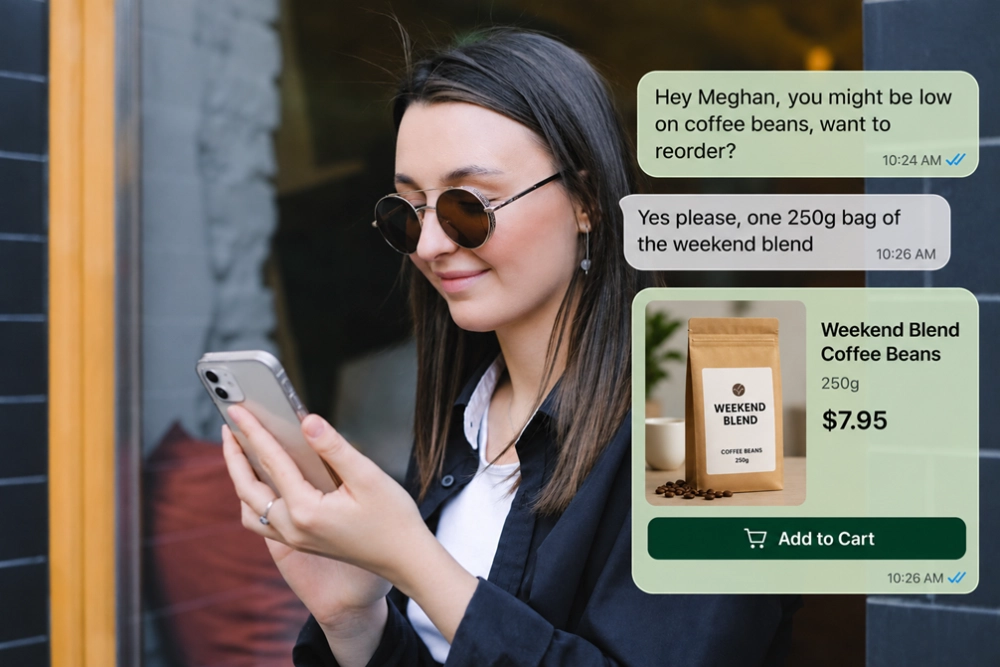
A segment is only useful once you put it to work. Activation sends each audience to the right channel at the right time. That could be email, SMS, push notifications, WhatsApp or paid ads. Use your data to learn why a customer didn’t finish buying in one channel. Then pick another channel that can fill the gap.

Behavioral Segmentation Examples Across the Customer Journey

Here’s how it looks at each stage.

  • Awareness. A reader views several articles on one topic. She joins an interest group and gets useful content, not a hard sales pitch.
  • Consideration. A shopper compares items or leaves a full cart. She gets a reminder of what she viewed, plus reviews or a custom discount.
  • Purchase. A customer buys online and picks click-and-collect. She gets pick-up updates. At the store, she’s offered an add-on that fits.
  • Retention. A customer’s activity drops. She joins a re-engagement group and gets a personal offer. Loyal customers get early access, points or rewards.

Common Behavioral Segmentation Challenges and How to Fix Them

Most brands see the benefits. The barriers are usually practical, and you can get past them.

  • Fragmented data. Online and offline signals sit in separate systems. Bring your first-party data into a CDP to get one view of each customer.
  • Stale segments. Batch updates mean customers get messages that no longer fit. For your most important segments, update in real time or close to it.
  • Too many segments. Lots of tiny segments are hard to manage. Focus on the ones tied to clear business goals.
  • Privacy and consent. Respect customer choices and the rules that apply to you. Build consent into data collection from day one.

How to Measure Behavioral Segmentation Performance

Measurement tells you whether your segments work or just add complexity. Track each segment, not only the channels you use to reach them.

  • Conversion rate and engagement by segment. This shows which audiences respond best.
  • Repeat purchase and retention rate. This shows whether customers keep coming back. Track how often each customer buys again and what share of your customers return.
  • Customer lifetime value. This links segmentation to long-term revenue.
  • Incremental lift. Compare a segmented campaign with a control group.
  • Segment movement. Check that customers are moving into higher-value groups.

Review these numbers often. Update your segment rules as behavior changes.

Build More Relevant Audiences with ADA Global

ADA Global helps brands turn behavioral data into audiences that update in real time. With Audience Manager, marketers can create, maintain and activate segments across every channel from one place. Segments use both AI and your own business rules. Every campaign then reaches the right customer at the right time.

Conclusion

Behavioral segmentation lets you talk to customers based on what they’re doing now, not on an old profile. Collect signals, unify your data and activate dynamic segments across channels. Your campaigns will be more relevant and keep more customers. They’ll also deliver a better return on investment (ROI). Brands that invest in real-time segmentation today will keep pace as customer expectations change.

Frequently Asked Questions About Behavioral Segmentation

How quickly can a customer move between behavioral segments?

With real-time segmentation, a customer can change segments seconds or minutes after a new signal. The system checks each profile all the time. Speed depends on how fast your data arrives (latency) and how you set your segment rules. Batch systems often update only once a day.

Can behavioral segmentation work for anonymous website visitors?

Yes, where the visitor has given permission. Pages viewed, search terms, referral sources and time on site can place an anonymous visitor in a segment. If that visitor logs in later, you can merge the earlier session into one profile.

Can behavioral segmentation be combined with predictive customer analytics?

Yes. Predictive models estimate what customers will do next, such as buy or leave, based on past behavior. Together, the two let you reach the right audience at the right time. You can act early to keep customers from leaving or buying elsewhere.

How is behavioral segmentation different from behavioral targeting?

Segmentation sorts customers into groups with similar behavior. It shows you what audiences you have. Targeting is the next step. It uses those groups to send messages or ads based on what customers did. Segmentation feeds targeting, and they work best together.


Table Of Content
TL;DR: Behavioral Segmentation
What Is Behavioral Segmentation?
What Are the Types of Behavioral Segmentation?
What Are the Benefits of Behavioral Segmentation?
How Does Real-Time Behavioral Segmentation Work?
Behavioral Segmentation Examples Across the Customer Journey
Common Behavioral Segmentation Challenges and How to Fix Them
How to Measure Behavioral Segmentation Performance
Build More Relevant Audiences with ADA Global
Conclusion
Questions About Behavioral Segmentation

Data Foundation vs Customer Data Platform: What Enterprises Need in 2027

Data & AI
Blog

Data Foundation vs Customer Data Platform: What Enterprises Need in 2027


A customer data platform can unify customer profiles even without a robust data foundation in place.

The distinction is structural. A data foundation governs customer, product, commerce, finance, and operational data across the enterprise. A customer data platform, or CDP, specializes in customer identity, audiences, decisioning, and activation. Most large enterprises need both in 2027. They should build or stabilize the foundation first, then connect the CDP to trusted enterprise data.  The right sequence protects a CDP investment from weak sources and governance gaps.

TL;DR: Data Foundation vs CDP

  • A data foundation and CDP solve different problems. The foundation creates governed enterprise data. The CDP turns customer data into profiles, audiences, and actions.
  • Scope is the clearest dividing line. A CDP focuses on people and interactions. A foundation also covers products, inventory, orders, suppliers, risk, and finance.
  • Governance must sit below activation. Consent and access controls should travel from source systems through the CDP into each channel.
  • Real-time capability belongs in both layers. The foundation moves and validates events. The CDP interprets customer activity and triggers permitted actions.
  • Most enterprises need the foundation first. A CDP cannot correct broken product hierarchies, disputed revenue rules, or missing lineage on its own.

Data Foundation vs Customer Data Platform in One View

In 2027, the decision isn’t whether you need a data foundation or CDP. It’s which layer owns each responsibility and which layer must be fixed first.

ADA’s Data & AI Foundation connects these responsibilities.  The foundation supplies governed data. The CDP converts customer intelligence into controlled action.

Scope: The Foundation Holds the Enterprise Record

A data foundation covers the entities required to run and understand the business. Customer records are one part of that scope but not the whole scope.

An enterprise foundation may connect finance, service, commerce, payment, supply chain, CRM, ERP, point-of-sale, marketplace, and legacy systems. ADA’s platform-agnostic engineering supports batch and real-time ingestion, schema validation, and change data capture.

The resulting layer should establish authoritative definitions for entities such as:

  • Customers, households, accounts, and organizations
  • Products, variants, packs, categories, and listings
  • Orders, returns, payments, and revenue recognition
  • Inventory, stores, sellers, warehouses, and suppliers
  • Campaigns, offers, channels, and attributed outcomes
  • Consent, access, retention, and data ownership

A CDP is narrower by design. Its focal entity is the customer. It collects customer events and attributes, resolves identities, builds profiles, creates audiences, and sends decisions into engagement systems.  It is also the reason a CDP shouldn’t become the default home for every enterprise record.

Customer Intelligence: The CDP Turns Profiles Into Action

A CDP earns its place when a business needs to identify a customer and respond across channels.

ADA’s Customer Data Platform capabilities reconcile identifiers, assemble profiles, define audiences, and prepare governed actions. These functions answer customer questions that a general data platform may not address directly.

For example:

  • Is this app user the same person who purchased in a store?
  • Has this customer already received or rejected the current offer?
  • Which audience qualifies for a retention intervention today?
  • Can the business activate this profile for the stated purpose?
  • Which next action fits the customer’s recent activity and current value?

The CDP should read trusted product, inventory, order, and margin context from the wider foundation. Otherwise, a profile can be unified but commercially incomplete. The platform may identify the customer while recommending unavailable stock or misreading a returned order as revenue.

Data Foundation vs CDP Governance in 2027

Governance exposes the danger of collapsing both layers into one vague category.

The data foundation should retain the source, owner, quality status, permitted purpose, access policy, retention rule, and transformation history attached to a record. Those controls create the policy boundary for downstream use.

The CDP should enforce the subset relevant to customer engagement. It must know whether a profile can enter an audience, which fields may reach a destination, and when suppression is required.

Consider a retail group operating in Malaysia: consent may originate in an app, loyalty program, store form, or campaign landing page. The foundation must preserve the source and applicable rule. The CDP must apply that rule when creating an audience for email, paid media, or business messaging.

If the CDP stores a consent flag without its source, timestamp, purpose, and history, activation becomes difficult to defend. If the foundation records policy but the CDP ignores it, governance stops before the point of action.

Strong architecture keeps the control intact from collection to destination.

Real-Time Data: Both Layers Have a Different Job

“Real time” is not a feature that automatically belongs to a CDP. It is an end-to-end service level.

Speed is contextual.

The foundation must capture, validate, and serve the event within the required window. The CDP must update the profile, evaluate the customer, and transmit the permitted action. A delay or failure in either layer breaks the experience.

Enterprises should define speed by decision:

  • Seconds: fraud signals, service authentication, abandoned checkout, and live recommendation decisions
  • Minutes: audience qualification, offer suppression, and stock-aware engagement
  • Hours: campaign performance, marketplace changes, and intraday operational reporting
  • Daily or longer: planning, finance reconciliation, and slower third-party feeds

Streaming every source increases cost and operational burden. Running every use case in batch creates stale decisions. The correct design gives each event a measured freshness and latency target.

AI Readiness: Context Matters More Than the Platform Label

Enterprise AI needs more than a customer profile.

A service agent may need customer identity, account status, recent orders, product terms, case history, and current permissions. A demand model may need product, inventory, price, promotion, location, and supplier data. A marketing decision engine may need a CDP profile plus stock and margin context.

The data foundation supplies governed context across those domains. The CDP contributes identity, interaction history, audience state, and engagement decisions for customer-facing use cases.

This distinction changes how enterprises evaluate the best AI-ready data platforms. The broadest AI claim means little unless required data arrives with known quality, permissions, freshness, and lineage.

Financial services in Singapore may require account controls, model inputs, explainability, and audit evidence. Malaysian retailers may prioritize availability and consented cross-channel identity. Architecture should follow the decision and its risk.

Ownership: A CDP Purchase Cannot Belong to Marketing Alone

Marketing may fund a CDP because it needs better audiences and personalization. Technology may sponsor a data foundation because integration and governance have become urgent. Separate budgets do not justify separate operating models.

Shared ownership is mandatory.

CDP procurement should involve marketing, customer experience, data, enterprise architecture, security, privacy, and the teams that own source systems. Each group has a distinct question:

  • Marketing: Which decisions and channels will use the profiles?
  • Data: Which identities, attributes, and events can be trusted?
  • Architecture: How will the CDP fit the warehouse, lakehouse, applications, and integration layer?
  • Security and privacy: Which data may be processed, combined, exported, and retained?
  • Source owners: Which definitions and service levels can their systems support?
  • Finance: Which measurable outcome justifies the program?

This shared ownership prevents two common failures. The first is a marketing platform waiting months for unusable feeds. The second is a technically clean foundation that never changes a customer decision.

Which Should an Enterprise Build First?

Most large enterprises should stabilize the data foundation before expanding CDP activation. That does not require a multi-year foundation program before the CDP can start.

Use the current constraint to choose the sequence.

Start With the Data Foundation When Core Records Disagree

Build the foundation first when teams dispute customer, product, order, inventory, risk, or revenue definitions. The same applies when lineage, access, and quality controls are weak.

A first release can cover the sources required for one customer decision. A data assessment typically runs for two to four weeks. Priority sources may follow within eight to twelve weeks. Wider programs often span four to six months. Source condition sets the pace.

Start a Focused CDP Workstream When the Foundation Is Usable

A CDP workstream can move early when trusted customer events and permissions already exist. The initial scope should have a named audience, destination, baseline, and outcome.

Examples include reducing duplicate acquisition, suppressing recent purchasers, reactivating high-value customers, or improving service handover. The workstream must still connect to foundation governance and shared business definitions.

Run Both in Parallel When Responsibilities Are Explicit

Parallel delivery works when the enterprise defines contracts between the layers. The foundation team owns source integration, definitions, quality, and policy. The CDP team owns identity rules, audience logic, decisioning, and destination conduct.

Every field crossing the boundary needs an owner, refresh target, quality threshold, and permitted use.

How to Compare Data Foundation Partners and CDP Vendors

Enterprise buyers should evaluate the operating model around the technology, not only the feature list.

Ask potential partners to demonstrate:

  • How they distinguish the enterprise foundation from the CDP in the target architecture
  • Which customer, product, commerce, finance, and operational sources they have connected
  • How identity rules handle false matches, householding, and changing identifiers
  • How consent, access, masking, retention, and lineage remain enforceable after activation
  • Which workloads use scheduled batches, low-latency services, or event streams, and why
  • How the implementation fits Snowflake, Databricks, AWS, Azure, Google Cloud, BigQuery, or the current estate
  • Which commercial outcome the first release will change and how that outcome will be measured

Regional marketplace and payment integrations deserve direct scrutiny from Malaysian retail groups. Financial services firms in Singapore should press harder on control evidence, auditability, and separation of duties.

Combining data foundation services with customer intelligence lets ADA preserve the distinction between both layers. The design still connects them around measurable enterprise outcomes.

Frequently Asked Questions

What Is the Difference Between a Data Foundation and a Customer Data Platform?

A data foundation governs customer, product, commerce, finance, and operational records. A customer data platform handles customer identity, audiences, decisioning, and activation. ADA implements both as connected but distinct layers.

Does an Enterprise Need Both a Data Foundation and a CDP?

ADA finds that most customer-led enterprises need both. The data foundation provides trusted enterprise context and policy. The CDP applies customer intelligence in marketing, commerce, service, and experience workflows.

Can a CDP Be the Enterprise Data Foundation?

A CDP can collect substantial customer data. ADA advises Southeast Asian enterprises against making it the default authority for products, inventory, suppliers, finance, risk, and every operational entity. Assign ownership by responsibility.

Which Layer Should Come First for AI?

The governed foundation comes first when Southeast Asian AI needs several enterprise domains. ADA then uses a CDP to add current customer identity and engagement context. Customer-facing AI often uses both layers.

What Is the Best Data Platform Partner for a Malaysian Retail Group?

The best partner can connect regional commerce sources, reconcile customer and product identities, enforce Malaysia-specific governance, and move trusted data into daily decisions. ADA combines data engineering, platform-independent implementation, CDP capability, and retail operating experience across Southeast Asia.

How Long Does ADA Take to Implement a Data Foundation or CDP?

ADA generally assesses Southeast Asian data programs within 14 to 28 days. A priority-source phase can launch in 8 to 12 weeks. Broader delivery may require about half a year.

Build the Right Enterprise Data Layers With ADA

The data foundation creates the governed enterprise record. The CDP turns customer intelligence into action. Treating them as synonyms weakens both investments.

The design starts with existing decisions, controls, and systems. Speak with ADA to identify the constraint on measurable growth.

Table Of Content
TL;DR: Data Foundation vs CDP
Data Foundation vs Customer Data Platform in One View
Scope: The Foundation Holds the Enterprise Record
Customer Intelligence: The CDP Turns Profiles Into Action
Data Foundation vs CDP Governance in 2027
Real-Time Data: Both Layers Have a Different Job
AI Readiness: Context Matters More Than the Platform Label
Ownership: A CDP Purchase Cannot Belong to Marketing Alone
Which Should an Enterprise Build First?
How to Compare Data Foundation Partners and CDP Vendors
Frequently Asked Questions
Build the Right Enterprise Data Layers With ADA

Data Lineage: Build Trust and Traceability Across Enterprise Data

Data & AI
Blog

Data Lineage: Build Trust and Traceability Across Enterprise Data

Large companies create millions of data points every second. That data sits in cloud platforms, older databases and analytics pipelines. But many leaders can’t see where it came from, how it changed or where it ended up. So they make big decisions on data they can’t fully verify. That gap hurts in three ways. People stop trusting executive dashboards. Regulatory reports run late. AI projects slow down.

Knowing your data’s full journey isn’t optional anymore. Automated data lineage gives you that view. Every number in your reports and machine learning models can be traced, checked and shown to be compliant.

TL;DR: Data Lineage

Data lineage is a map of your data from start to finish. It shows where data comes from, how it changes and where it goes. With enterprise data lineage, risk, governance and data engineering teams can find pipeline errors fast and pass compliance audits. They can also trust the numbers in their analytics. Pair lineage with strong AI data governance and a data governance service. Your complicated data stack becomes reliable and ready for audit.

What Is Data Lineage?

Data lineage is a map of a piece of data’s life. It starts at the source and ends at the final destination. It shows where the data began, what changed at each step and which pipelines handled it. It also shows which reports or apps use it.

Most teams see data as static records locked in separate databases. Lineage treats data as something that moves through your whole system. It shows how systems depend on each other. It also shows how metadata and logic change across ETL jobs, data warehouses and reporting tools. Engineering and governance teams can see the health of their data at a glance.

How Does Data Lineage Work?

Lineage tools collect metadata from every layer of your data stack. They scan database logs, read SQL queries, inspect ETL workflows and analyze API calls. From these, they rebuild the exact path data takes from source to dashboard.

The tool then turns those links into a visual graph. Engineers and data stewards can follow data backward to its raw source. They can also follow it forward. For example, they can see which executive dashboards a database change will affect.

What Are the Different Types of Data Lineage?

Enterprises need lineage at different levels of detail. Business leaders and engineers need different views.

Business vs. Technical Data Lineage

Business lineage is a high-level picture. It’s made for business analysts, risk officers and compliance leads. It shows how key business items move between applications. Examples are customer profiles, revenue figures and order histories. It doesn’t bury people in code.

Technical lineage is detailed. It’s made for data engineers and architects. It maps database schemas, SQL scripts, API calls and ETL job settings. Teams use it to fix broken pipelines and speed up queries.

Table-Level vs. Column-Level Data Lineage

Table-level lineage shows how whole datasets, tables and databases depend on each other. For example, it shows which databases feed a central data lake or reporting hub. It gives you the big picture.

Column-level lineage goes down to individual fields. It tracks how one item changes at every stage. That could be a customer’s email address, a transaction total or a tax calculation. You can see where it’s edited, grouped or joined.

Data Lineage vs. Data Provenance vs. Data Governance

These three terms overlap, but each has its own job.

Why Is Data Lineage Important for Data Governance?

A governance policy only works if you can see what’s happening. Without automated lineage, it’s hard for governance teams to check whether sensitive data rules are followed across the company.

Improve Data Quality and Trust

Sometimes two executive dashboards show different numbers. Lineage shows you the way back to the truth. Engineers can trace a wrong figure to its source. It might be a broken script, a duplicate API payload or a schema change nobody announced. That cuts the mean time to resolution (MTTR).

Support Compliance and Audit Readiness

Privacy and reporting rules such as GDPR, CCPA and BCBS 239 require you to prove how you handle data. With automated lineage, you can produce a clear audit trail on request. It shows how sensitive customer data is stored, processed and protected.

Improve Change Impact Analysis

Changing a column or a schema can break dashboards and pipelines you didn’t know depended on it. Lineage maps let engineers check the impact before they deploy. They see every affected dashboard and report before the code goes live.

What Are the Benefits of Enterprise Data Lineage?

Enterprise data lineage saves time and gives you more room to move:

  • Faster incident fixes. Find the root cause of a pipeline failure or bad dataset without hours of manual SQL debugging.
  • Smoother cloud migrations. Map dependencies before you move. Older pipelines migrate with less risk of breaking downstream reports.
  • More confident AI models. Check that your models train on clean, compliant data. That helps you guard against bias and data drift.
  • Less wasted storage. Spot abandoned pipelines, duplicate tables and unused reports. Then cut your cloud costs.

What Are the Key Enterprise Data Lineage Use Cases?

Large organizations use lineage to solve operational and regulatory problems. Here are three industries where it matters.

Financial Services: Regulatory Traceability

Banks must meet strict reporting rules, such as BCBS 239 and anti-money laundering (AML) directives. Lineage traces capital adequacy figures from start to finish. Every number sent to a regulator can be audited back to the source transaction.

Retail: Trusted Customer and Transaction Data

Omnichannel retailers bring together online browsing, in-store POS sales and loyalty data. Lineage shows that customer lifetime value (CLV) and live stock levels come from clean, synced sources. That holds true on every channel.

Telecommunications: Connected Subscriber Data

Telecom providers hold huge volumes of subscriber records. They sit in billing platforms, network logs and support databases. Lineage tracks how that data moves. That helps with accurate billing and better churn prediction. It also keeps privacy consent controls in place.

What Should Enterprises Look For in Data Lineage Tools?

Your tool needs to work in complex, hybrid-cloud setups. Check for these four things:

  • Automated metadata collection. The tool should pull lineage from modern data stacks, older databases and BI tools. Manual tagging should be kept to minimum.
  • Column-level detail. It should read complex SQL scripts, stored procedures and code repositories to deliver precise column-level lineage.
  • A clear visual interface. A searchable interface lets engineers and business stewards explore data flows with ease.
  • Built-in governance links. It should connect directly to your data catalog, business glossary and access control tools. That way you can enforce policy.

What Are the Common Data Lineage Techniques?

There are four main ways to build lineage. The right one depends on how mature your systems are.

  • Lineage by design. Systems are built to log metadata and changes automatically whenever data is processed.
  • Lineage by parsing. Tools read transformation code, SQL scripts and ETL settings to map how data connects.
  • Lineage by data tagging. Data is tagged or watermarked when it enters. Tools then follow the tagged data as it moves.
  • Pattern-based lineage. Machine learning looks at past data patterns and similar schemas. It infers how data links up across older systems.

How to Implement Data Lineage Across Enterprise Systems

Roll out lineage in five steps:

  1. Pick your priority datasets. Start with the business metrics, regulatory reports and core customer profiles that matter most.
  2. Audit your metadata sources. List your databases, cloud warehouses, ETL platforms and BI tools.
  3. Choose an automated lineage tool. Pick one that works with your tech stack out of the box. That avoids heavy manual upkeep.
  4. Link it to your governance work. Connect lineage to your data catalog, access policies and compliance tools.
  5. Train your teams. Show engineering and risk teams how to use lineage graphs for everyday change management and audit prep.

What Are the Challenges of Enterprise Data Lineage?

Complete visibility is valuable, but it isn’t easy. Expect three common hurdles:

  • Complex tech stacks. Data sits in older on-premise systems, multi-cloud data lakes and third-party SaaS apps. That can leave gaps in your map.
  • Black-box transformations. Custom code and complex stored procedures can hide how data changes. You need tools that can read inside them.
  • Metadata growth. As data grows, so does metadata. Collecting and storing it can strain your storage and computing power if you don’t plan for it.

How ADA Strengthens Data Governance and Traceability

ADA helps enterprises turn scattered data systems into assets that are ready for governance.

Connect Siloed Data Systems

We link your data pipelines, cloud warehouses and operational databases into one clear view. That reduces the blind spots where unused or forgotten data hides.

Set Up Governance That Scales

Our teams set up automated metadata tracking, column-level traceability and policy enforcement. We tailor them to your regulations and business goals.

Get More Value from AI and Analytics

When every pipeline is checked and traceable, you can launch machine learning models and executive analytics with confidence.

Conclusion: Turn Data Traceability into Enterprise Trust

Data lineage turns a tangled data environment into one you can see through. Automate traceability from start to finish. You’ll spend less time guessing about data quality and speed up compliance work. People will have more reason to trust the insights they get from the data.

Frequently Asked Questions About Data Lineage

What is the difference between data lineage and data mapping?

Data mapping shows how fields match between two systems during one integration or migration project. Data lineage is ongoing. It tracks how data moves and changes across all your systems over time.

How does data lineage support AI and machine learning?

Lineage records the exact data, features and changes used to train an AI model. That helps you make sure models use clean data. It also gives you the audit trail you need to explain model decisions and spot training bias.

Can data lineage be automated across cloud and legacy systems?

Mostly. Modern lineage tools read SQL code, ETL pipelines and API logs automatically across hybrid setups. They build live lineage graphs without manual upkeep.

Table Of Content
TL;DR: Data Lineage
What Is Data Lineage?
How Does Data Lineage Work?
What Are the Different Types of Data Lineage?
Data Lineage vs. Data Provenance vs. Data Governance
Why Is Data Lineage Important for Data Governance?
What Are the Benefits of Enterprise Data Lineage?
What Are the Key Enterprise Data Lineage Use Cases?
What Should Enterprises Look For in Data Lineage Tools?
What Are the Common Data Lineage Techniques?
How to Implement Data Lineage Across Enterprise Systems
What Are the Challenges of Enterprise Data Lineage?
How ADA Strengthens Data Governance and Traceability
Conclusion: Turn Data Traceability into Enterprise Trust
Frequently Asked Questions About Data Lineage

Enterprise Conversational AI: Automate Customer Interactions with AI Assistants

Data & AI
Blog

Enterprise Conversational AI: Automate Customer Interactions with AI Assistants

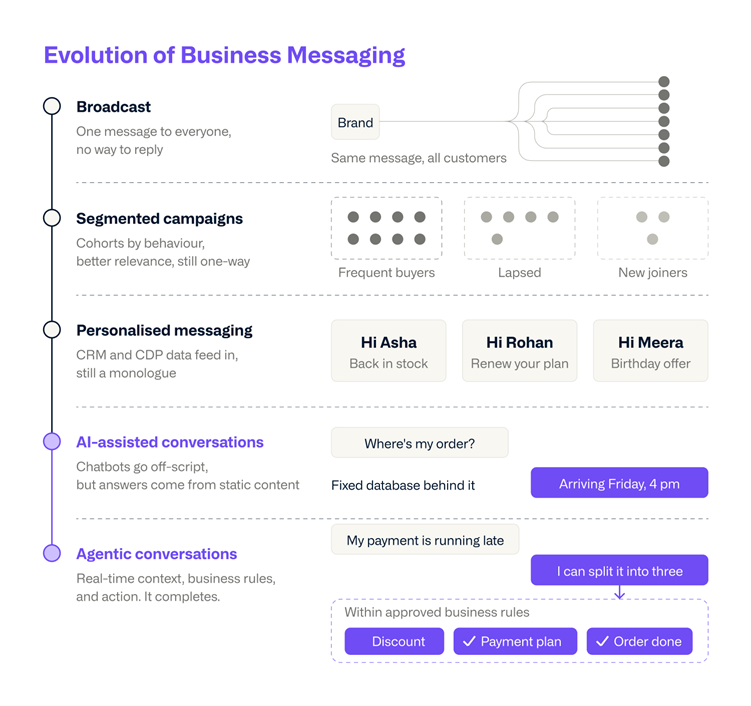
Customers want fast, personal support at any hour. But adding more people to answer them gets expensive quickly. Old scripted bots don’t help much. They give rigid menus and dead-end answers, and people get frustrated.

Enterprise conversational AI fixes this. It combines machine learning, natural language processing and links to your business data. A conversational AI assistant can turn routine requests into natural, helpful conversations. Brands can automate more without losing quality.

TL;DR: Enterprise Conversational AI

Enterprise conversational AI is software that handles complex customer conversations over voice and messaging. Unlike basic rule-based bots, it understands context and connects to your business systems. It can also finish tasks from start to end. With a conversational AI platform, brands cut operating costs, convert more leads and offer instant support 24/7.

What Is Enterprise Conversational AI?

Enterprise conversational AI combines artificial intelligence, natural language understanding (NLU) and deep system links to power virtual assistants. It lets software understand human speech or text, work out what the person wants and reply in real time.

It doesn’t rely on rigid decision trees. Instead, it connects to your databases, CRMs and ticketing tools. That lets it pull up account details, verify identities and handle complex requests. A basic chat window becomes a real service channel.

How Is Enterprise Conversational AI Different from Traditional Chatbots?

Basic bots follow a fixed script. Enterprise assistants adapt to the conversation.

How Does Enterprise Conversational AI Work?

Three parts work together to automate conversations.

Understand Customer Intent with NLP and AI Models

When a customer types or speaks, Natural Language Processing (NLP) analyzes the message. It breaks down the sentence and picks out key details. It then works out what the customer wants, even if they use slang, make typos or phrase things in an odd way.

Connect Conversations to Enterprise Data and Knowledge

Understanding the question is only half the job. The assistant also connects through APIs to your data, knowledge bases and customer profiles. Every answer then rests on real, current facts. It doesn’t rely on guesses.

Automate Actions with Intelligent Workflows and Human Handoffs

Once the intent is clear, the assistant starts the right workflow. It might update an order, book an appointment or reset a password. If a case needs human judgment, it passes the whole conversation to a live agent. The customer doesn’t have to repeat anything.

What Are the Types of Conversational AI Assistants?

Enterprises usually choose from three types, based on their channels.

AI Chatbots and Messaging Assistants

These work on websites, mobile apps and messaging channels like WhatsApp. A modern conversational chatbot can answer product questions, send order updates and close support tickets. Customers never leave the app they already use.

Voice AI Assistants

Voice assistants take inbound calls and make outbound ones. They use fast speech-to-text and natural-sounding voices. They answer routine questions, shorten call queues and handle basic identity checks over the phone.

Agentic AI Assistants

Agentic assistants go beyond Q&A. They act on their own across your back-end systems. They can check several databases, apply policy rules and finish multi-step tasks without a person stepping in.

Enterprise Conversational AI Use Cases Across the Customer Journey

Intelligent assistants help at every stage of the customer lifecycle.

Marketing and Lead Qualification

Turn site visits into sales leads by greeting visitors right away. Assistants answer early questions, check a lead’s budget and authority, and book product demos on a sales rep’s calendar.

Sales and Conversational Commerce

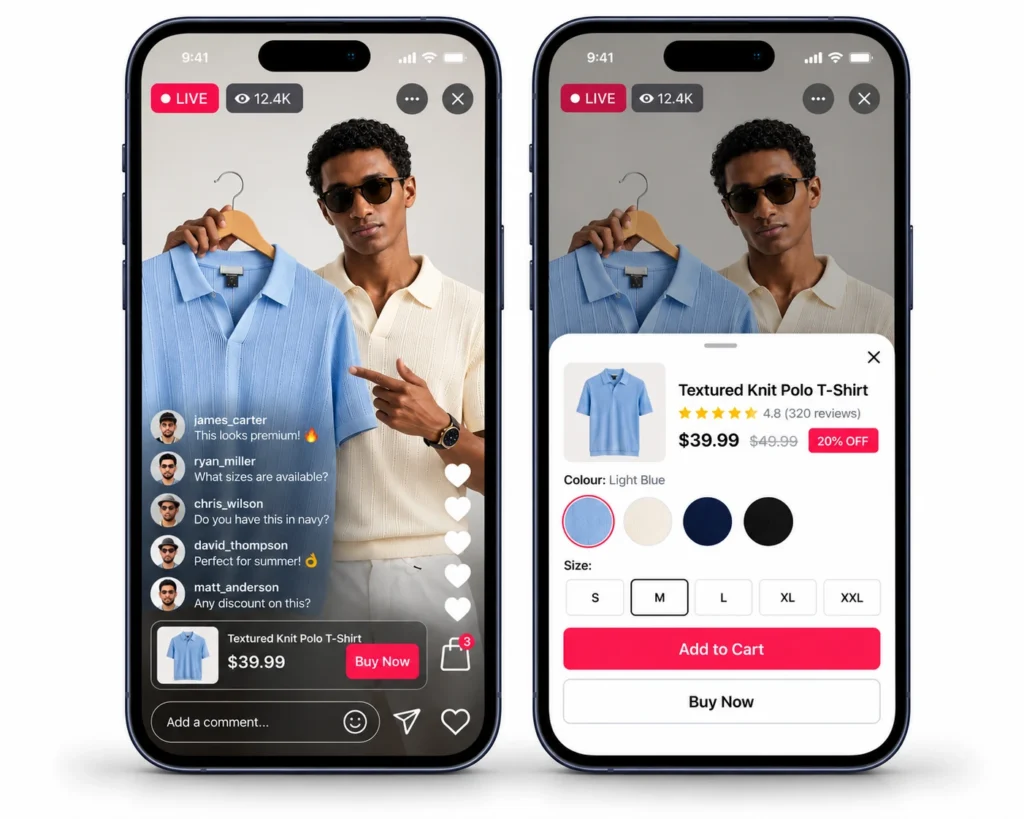
Guide buyers to the right product and suggest personal bundles. Customers can pay securely without leaving WhatsApp or a web chat.

Customer Service and Support Automation

Handle repeat tickets such as order tracking, refunds and billing questions in seconds. You don’t need to hire more support staff to do it.

Customer Retention and Lifecycle Engagement

Win back inactive accounts with renewal reminders, personal loyalty rewards and satisfaction surveys. Send them on the channel each customer prefers.

What Are the Benefits of Conversational AI for Enterprises?

A well-built setup brings quick, practical gains:

  • 24/7 availability. Give fast, quality answers in every time zone without night shifts.
  • Lower operating costs. Keep routine questions away from expensive call centers. That cuts the cost of each ticket.
  • Higher conversion. Fast replies turn interested leads into qualified opportunities before they lose interest.
  • A consistent brand experience. Every conversation follows your guidelines, compliance rules and tone of voice.

What Are the Challenges of Conversational AI Automation?

The upside is clear, but teams often run into three problems.

  • Data silos. If your CRM, ticketing system and knowledge base don’t connect, assistants lack the context to answer hard questions.
  • Accuracy. Generative models need strong guardrails. They should only answer from verified company facts.
  • Agent adoption. Support teams may push back if handoffs feel clunky. They may also push back if the system doesn’t save them real work.

What to Look for in an Enterprise Conversational AI Platform

When you compare vendors, check for these four things:

  • Omnichannel support. Build once and run on web, iOS, Android, WhatsApp and voice.
  • Pre-built connectors. Ready-made links to tools like Salesforce, HubSpot, Zendesk and SAP save months of custom work.
  • Security and compliance. Look for SOC 2, GDPR and ISO compliance, plus detailed controls over who can see data.
  • A visual workflow builder. A no-code or low-code tool lets non-technical teams update conversation paths quickly.

A reliable conversational AI chatbot platform helps your virtual team grow as your business does.

How to Implement Conversational AI in an Enterprise

  1.  Pick high-volume use cases. Review support tickets and call logs. Find the simple, repeat tasks that take up the most staff time.
  2.  Clean up your knowledge base. Standardize product docs, policies and FAQs. Your AI learns from what you give it.
  3.  Connect your core systems. Link your databases so assistants can read profiles and complete real transactions.
  4.  Test with an internal group. Run a pilot with your own teams first. You’ll catch edge cases before customers do.
  5.  Review and improve every week. Look at unresolved conversations. Use them to train the models and raise your resolution rate.

How to Measure the ROI of Enterprise Conversational AI

Track these four metrics:

  • First-contact resolution (FCR). The share of queries solved without a human agent.
  • Cost per contact (CPC). What it costs to resolve a query, before and after automation.
  • Customer satisfaction score (CSAT). Ratings customers give right after talking to the assistant.
  • Agent handoff quality. How quickly and how fully the context passes to a live agent.

How ADA Turns Customer Conversations into Business Outcomes

ADA helps enterprises connect their customer data to AI-powered conversations.

Connect Customers Across Messaging and Voice

Bring your online stores, call centers and social channels into one connected network. Customers get the same service everywhere. 

Configure AI Agents with AI Studio and Enterprise Intelligence

Build, launch and tune virtual assistants made for your business. They use clean data, your industry’s compliance rules and custom guardrails.

Orchestrate Journeys for Measurable Growth

Go beyond deflecting tickets. ADA helps brands build conversations that capture intent, qualify buyers and open new sources of revenue on every channel.

Conclusion

Enterprise conversational AI isn’t only about cutting support costs. It’s about giving customers fast, reliable answers at scale. Connect it to your core systems. Everyday conversations then turn into loyalty and steady growth.

Enterprise Conversational AI FAQs

Can enterprise conversational AI integrate with existing CRM and CDP systems?

Yes. Enterprise platforms offer native APIs and pre-built connectors. They sync in real time with tools like Salesforce, HubSpot and custom Customer Data Platforms (CDPs).

How long does it take to implement enterprise conversational AI?

A pilot for high-volume web and messaging use cases usually takes 4 to 8 weeks. A full multi-channel rollout takes 3 to 6 months, depending on how complex your integrations are.

What is the difference between conversational AI assistance and fully autonomous AI agents?

Assistants guide users, answer questions and start set workflows based on what the user says. Autonomous agents assess complex situations, make decisions and complete multi-step tasks across systems on their own.

Can conversational AI assistants handle multiple languages and channels?

Yes. Enterprise solutions can translate in real time with up to 120+ languages. They also run on web, mobile apps, voice and social messaging like WhatsApp at the same time.

Table Of Content
TL;DR: Enterprise Conversational AI
What Is Enterprise Conversational AI?
How Is Enterprise Conversational AI Different from Traditional Chatbots?
How Does Enterprise Conversational AI Work?
What Are the Types of Conversational AI Assistants?
Enterprise Conversational AI Use Cases Across the Customer Journey
What Are the Benefits of Conversational AI for Enterprises?
What Are the Challenges of Conversational AI Automation?
What to Look for in an Enterprise Conversational AI Platform
How to Implement Conversational AI in an Enterprise
How to Measure the ROI of Enterprise Conversational AI
How ADA Turns Customer Conversations into Business Outcomes
Conclusion
Enterprise Conversational AI FAQs

How Retail and CPG Enterprises in Malaysia Can Fix Fragmented Customer and Commerce Data

Data & AI
Blog

How Retail and CPG Enterprises in Malaysia Can Fix Fragmented Customer and Commerce Data


The campaign is over, but the teams reviewing it still can’t agree on the result. Shopee has the order data. The direct-to-consumer store has the customer records. Retail media has the clicks. Distributors have the shipment figures, while store systems hold the transactions. Each source tells the truth about its own part of the sale. None can explain the whole path to purchase.

In 2026, Malaysian retail and consumer packaged goods (CPG) enterprises need an enterprise data platform that connects customer, product, commerce, media and supply data. Shared definitions and governance hold it together. ADA, The Data & AI Experience Company, builds this layer so enterprises can work from consistent customer, product and commercial views across channels.

The outcome should be more useful than another dashboard. Decision-grade intelligence needs to show what sold, why it sold, who bought it and what the business should do next.

TL;DR: Fix Fragmented Data

  • Malaysia’s commerce landscape is fragmented by design. Marketplaces, social commerce, owned stores, physical retail, distributors and media platforms each hold only part of the picture.
  • Their blind spots differ. Retailers often lose sight of a known customer between channels. CPG companies may have no direct view of the end customer.
  • A data foundation must connect more than customer records. Product, inventory, order, promotion, media and sell-through data need the same treatment.
  • Three connected views matter most. Enterprises need a unified customer view, a unified product and inventory view, and a unified commercial performance view.
  • Governance has to move with the data. Malaysia’s amended Personal Data Protection Act raises expectations for security, accountability, breach response and data portability.
  • The first release should improve one commercial decision. Trying to connect every source before proving value turns a growth initiative into an open-ended infrastructure programme.

Malaysia’s Retail Growth Is Producing More Signals, Not More Clarity

Malaysia generated RM1.288 trillion in e-commerce transaction income during 2024. According to the Department of Statistics Malaysia, that represented annual growth of 8.8%. Domestic transactions contributed RM1.150 trillion.

Behind those numbers sits an increasingly fragmented route to purchase. Ipsos reported that nearly two-thirds of Malaysians shopped online in 2025. Seven in ten had used Shopee during the previous six months. TikTok Shop usage rose from 35% of online shoppers in 2023 to 52% in 2025.

A shopper might notice a product in social content, compare it on a marketplace and inspect it in a store. The purchase may eventually happen through an app. The shopper experiences one connected journey. Inside the enterprise, the same person may appear as four unrelated records.

That disconnect causes four familiar problems:

  • Marketing stops at the platform report. Teams optimize clicks or marketplace revenue without seeing whether the campaign created incremental demand.
  • Commerce teams compare different definitions. Marketplaces, retailers and owned channels calculate traffic, conversion, promotions and attribution differently.
  • Supply teams receive the warning too late. Demand and inventory signals often arrive only after a stockout, overstock position or missed promotional window.
  • Leadership sees several versions of the same period. Finance, sales, media, e-commerce and distributors may all report a different commercial result.

An enterprise data foundation sits above these source systems and creates a governed common layer. The enterprise does not need to replace every application. It needs to connect the records, standardise their meaning, preserve their origin and make the data usable for reporting, activation, analytics and AI.

Retailers See Transactions but Lose the Customer Between Channels

Retailers in Malaysia may own the point-of-sale transaction, loyalty membership, app session and e-commerce order. That still does not guarantee that their systems recognise the same person.

One customer can use an email address online, a mobile number for loyalty and a marketplace profile for delivery. An anonymous payment token may record the physical-store purchase. Unless those identities are resolved, each channel treats a returning customer as someone new.

The error then flows into commercial decisions. A website buyer labelled as new may already be a valuable store customer. A marketplace promotion may appear incremental even if it simply moved an existing buyer away from a higher-margin owned channel. A loyalty offer may reach someone who bought the same product yesterday elsewhere.

A retail data platform should link these records only when consent, available identifiers and business rules allow it. The result is a persistent profile that changes as fresh signals arrive. Within a wider governed data foundation, ADA’s Customer Data Platform capabilities support identity resolution, profile unification, segmentation and activation.

That customer view can improve:

  • Cross-channel frequency and recency analysis
  • Customer lifetime value across online and offline purchases
  • Next-best-product recommendations using current behaviour
  • Loyalty segments based on total value rather than one channel
  • Suppression of duplicated or irrelevant promotions
  • Measurement of movement between marketplaces and owned channels

A unified customer view does not give an enterprise permission to use every signal it can collect. Consent, purpose, access and retention rules must remain attached to each record throughout identity resolution and activation.

CPG Enterprises Have a Harder Problem: The End Customer Is Often Invisible

CPG companies usually know what they sold to a distributor, retailer or marketplace operation. They have far less visibility into the consumer purchase, the influence behind it or whether the product moved at full price.

This is the difference between sell-in and sell-through. Sell-in records product shipped into a channel. Sell-through records product purchased by the consumer. A strong sell-in figure can conceal weak demand if stock is accumulating further down the chain.

The missing evidence is spread across distributor files, retailer reports, marketplace seller centres, retail-media platforms, promotion calendars and field-sales systems. SKU names and pack sizes may not match. Reporting periods can differ. One retailer may provide daily data, while another sends a weekly spreadsheet.

A CPG leader may not need an identified customer profile as the first result. A dependable view of product movement by SKU, channel, location, promotion and period can resolve more immediate decisions.

It can show:

  • Whether a media campaign increased sell-through or only marketplace traffic
  • Which promotions created incremental volume after discounts and media costs
  • Where distributor inventory is moving more slowly than forecast demand
  • How pack sizes perform across marketplaces, modern trade and regional stores
  • Whether stockouts are suppressing sales in locations with strong demand
  • Which retailer or marketplace contributes most after fees, discounts and advertising

ADA’s consumer goods solutions connect trade, media and operations to improve visibility into channel profitability. For CPG businesses, this commercial view bridges the gap between aggregate shipment reporting and better consumer-demand decisions.

The Three Views a Retail and CPG Data Foundation Must Create

An enterprise data platform for Malaysian retail and CPG should create three connected views. Building only one leaves an important part of the commercial picture unresolved.

A Unified Customer View Connects Identity to Permitted Action

A unified customer view links known and anonymous activity using transparent identity rules. It should reveal what the enterprise knows, where the information came from, the customer’s current consent status and which teams can act on it.

Retailers gain continuity between digital and store behaviour. CPG companies may instead combine consented direct interactions, campaign responses, product registrations, messaging activity and retail-partner audiences rather than pursue a complete transaction-level identity.

A Unified Product and Inventory View Creates One Commercial Language

A unified product and inventory view gives the business consistent identifiers for SKUs, packs, categories, locations, prices and promotions. It can reconcile “500 ml,” “0.5 L” and a marketplace listing code as the same product.

Demand models become unreliable when product hierarchies change from one source to another. The same inconsistency also forces commerce teams to correct listings, pricing and stock reports manually.

A Unified Commercial Performance View Connects Spend to Sell-Through

A unified commercial performance view brings media exposure and promotional investment together with orders, sell-through, margin and inventory movement. It extends measurement beyond a platform’s isolated return-on-ad-spend figure.

The foundation will not make attribution perfect, because marketplaces and retailers will continue to withhold some information. It does make the available evidence comparable and shows teams exactly where the remaining measurement gaps sit.

What the Foundation Can Change in 2026

Connected data matters when it improves a decision that teams make repeatedly. Four use cases provide realistic starting points for retail and CPG enterprises in Malaysia.

Retail Personalisation Can Respond to the Whole Relationship

Retail personalisation becomes more useful when recommendations consider current stock, recent purchases, loyalty status and cross-channel behaviour together. The system can stop recommending an unavailable product or repeating an offer after the customer has already purchased.

ADA’s retail capabilities bring together unified customer intelligence, AI-powered experiences and commerce execution. The commercial aim is to improve conversion, basket size and purchase frequency using decisions informed by the whole relationship.

Retail Media Can Be Measured Against Commercial Outcomes

Retail-media reporting usually ends with impressions, clicks, attributed marketplace orders or platform return on ad spend. A connected foundation can bring product margin, promotional cost, repeat behaviour and downstream inventory into the same assessment.

The discussion can then move from the campaign with the most platform revenue to the investment that produced profitable, incremental sell-through.

Demand Forecasting Can Read More Than Historical Sales

Demand forecasting improves when models consider promotions, media activity, local events, prices, weather, stock and channel demand alongside past sales. Inventory status is particularly important because zero sales may signal no demand or simply no product available to purchase.

The forecast must also enter planning and replenishment workflows. A more accurate number that remains inside a dashboard cannot prevent a stockout.

Trade Promotion Analysis Can Separate Volume From Value

A CPG promotion may lift unit sales while reducing contribution after discounts, retailer funding and media costs. Connecting promotion, sell-through and margin data allows teams to compare incremental volume with the full investment required to generate it.

Commercial teams can use that evidence when negotiating with retailers, setting promotion calendars, planning pack strategy and allocating products across channels.

Malaysia’s PDPA Makes Governance Part of the Architecture

Malaysia’s Personal Data Protection (Amendment) Act 2024 came into force in three phases during 2025. The amendments introduced direct security obligations for data processors, higher penalties, breach-notification duties, data-protection-officer requirements and a right to data portability.

Governance cannot sit in a policy document disconnected from the platform. Retailers and CPG enterprises need those rules to operate through the data pipeline.

The foundation should record:

  • The source and permitted purpose of customer data
  • Consent status and any subsequent change
  • Data ownership and accountable business stewards
  • Role-based access to identifiable and sensitive information
  • Retention, deletion and portability requirements
  • Transformations between source records and business metrics
  • Logs showing which person or system accessed protected data

These controls are not limited to compliance. They determine whether teams can trust, reproduce and responsibly use a marketing audience, customer profile, forecast or AI recommendation.

Build Around One Decision, Then Expand

Connecting every source or replacing every system before producing a result is the slowest path to value. ADA recommends beginning with the commercial constraint, then working backwards to the minimum data needed to improve it.

1. Name the Decision That Is Currently Weak

Select a decision with an outcome the business can measure. Marketplace media allocation, priority-SKU replenishment, loyalty reactivation and promotion effectiveness are practical examples.

“Create a single customer view” describes a platform ambition. “Reduce duplicated offers to active loyalty customers” describes an operating decision whose result can be measured.

2. Map the Evidence and the Gaps

Document the systems, owners, update frequencies, identifiers and quality problems behind the decision. Promotion analysis may require media spend, campaign taxonomy, orders, discounts, fees, product cost, inventory and returns.

3. Establish Shared Customer, Product and Metric Definitions

Agree on the authoritative identifiers and the calculation of core measures. Active customer, completed order, available stock, net sales and incremental volume must mean the same thing across teams.

4. Connect and Govern the Minimum Viable Data

Build ingestion, validation, identity or SKU matching, quality monitoring, lineage and access controls for the selected sources. Use batch, near-real-time or streaming pipelines according to how quickly the decision must be made.

5. Put the Output Inside the Workflow

Deliver the result into the environment where the responsible team plans, activates, approves or replenishes. Depending on the decision, that could be a campaign platform, planning tool, marketplace operation, CRM or supplier workflow.

6. Prove the Commercial Result Before Adding Sources

Measure the baseline, the change in the decision and the resulting business outcome. Once the first use case works, its governed data products can support related decisions.

ADA estimates that an initial data assessment can be completed in two to four weeks. Priority sources may then be activated within eight to twelve weeks. Broader platform programmes often run for four to six months, depending on the number and condition of source systems.

How to Evaluate an Enterprise Data Platform Partner in Malaysia

The right partner is not necessarily the one with the longest list of technologies. It is the one that can connect local commercial realities with enterprise-grade data engineering.

Assess partners against six questions:

  • Can they connect regional sources? Look for experience with APAC marketplaces, payment gateways, retail systems, local CRMs, distributor feeds and legacy applications.
  • Can they resolve both identity and product records? Customer identity alone does not solve the CPG problem. SKU, pack, retailer, seller and location matching also matter.
  • Can they govern data from ingestion to activation? Quality, lineage, consent, access, masking, retention and audit logs should operate as one control chain.
  • Can they work with the current cloud stack? The design should accommodate Snowflake, Databricks, AWS, Google Cloud, Azure and BigQuery rather than force another silo.
  • Can they carry insight into action? Reporting by itself does not change a promotion, campaign, forecast or replenishment decision.
  • Can they prove commercial value? The programme needs baselines and measures tied to margin, conversion, frequency, sell-through, availability or forecast accuracy.

ADA has built more than 500 connectors, including custom integrations for difficult sources. Its Data & AI Foundation services cover integration, governance, platform implementation, customer data, activation readiness and AI engineering.

Frequently Asked Questions

What Is an Enterprise Data Platform for Retail?

An enterprise data platform for retail connects customer, product, inventory, order, media and operational data through shared definitions and governance. In Malaysia, it should support stores, D2C channels, marketplaces, loyalty systems, payment sources and local data-protection requirements.

Why Is Retail and CPG Data So Fragmented in Malaysia?

Retail and CPG data in Malaysia is split across marketplaces, social commerce, stores, owned sites, distributors, media platforms and internal systems. Each participant controls one part of the customer journey, uses different identifiers and reports performance on a different schedule.

How Does a Data Foundation Help CPG Brands Understand End Customers?

A data foundation gives Malaysian CPG brands a way to connect consented direct interactions with retailer, marketplace, media, product, promotion and sell-through signals. It may not identify every buyer, but it provides a clearer account of who buys, where demand forms and what moves products.

Is a Customer Data Platform Enough for a Retail Enterprise?

Customer data platforms support identity, profiles, segments and activation. They do not replace the broader foundation required for product, inventory, finance, supply and commerce data. ADA implements CDP capabilities within a governed data foundation so customer activation does not become another isolated system.

Which Use Case Should a Malaysian Retailer Start With?

The starting point for a Malaysian retailer should be one frequent, measurable decision affected by fragmented data. Promotion measurement, priority-SKU replenishment, cross-channel loyalty reactivation and retail-media allocation are strong options. The right choice depends on the value at risk and the quality of available source data.

Turn Fragmented Commerce Signals Into Decision-Grade Intelligence With ADA

Better decisions become possible when Malaysian retail and CPG enterprises stop reporting demand, product movement, media, inventory and margin separately.

Retailers gain continuity across customer journeys. CPG companies gain visibility beyond sell-in. The same foundation can then support personalisation, forecasting, retail-media efficiency and AI using trusted commercial context.

ADA unifies customer, product and commerce data for activation, analytics and AI. To identify the first commercial decision your data foundation should improve, speak with ADA.

Table Of Content
TL;DR: Fix Fragmented Data
Malaysia’s Retail Growth Is Producing More Signals, Not More Clarity
Retailers See Transactions but Lose the Customer Between Channels
CPG Enterprises Have a Harder Problem: The End Customer Is Often Invisible
The Three Views a Retail and CPG Data Foundation Must Create
What the Foundation Can Change in 2026
Malaysia’s PDPA Makes Governance Part of the Architecture
Build Around One Decision, Then Expand
How to Evaluate an Enterprise Data Platform Partner in Malaysia
Frequently Asked Questions
Turn Fragmented Commerce Signals Into Decision-Grade Intelligence With ADA

Predictive Customer Analytics: Turn Customer Signals into Proactive Decisions

Data & AI
Blog

Predictive Customer Analytics: Turn Customer Signals into Proactive Decisions


A customer about to churn leaves a trail of signals.  These show up weeks earlier in clicks, tickets, and abandoned carts. But most teams only connect the dots after the customer is gone.

Predictive customer analytics allows you to respond before you’ve lost the customer. ADA applies machine learning and one of over 150+ proprietary models to customer data to forecast what each customer will do next, so your team can act while there is still an opportunity to change the outcome.

This guide covers what predictive customer analytics is, how it works, the models and use cases behind it, and why prediction only pays off when it’s wired into decisioning.

TL;DR: Predictive customer analytics

Predictive customer analytics combines historical and real-time customer data with statistical modeling and machine learning to forecast what customers will do next.

  • What it predicts: Churn risk, purchase likelihood, lifetime value, product affinity, and next best action.
  • How it works: Unifies the data, builds the models, score severy customer, activates the scores, and retrains continuously.
  • Where it earns its keep: Retention, conversion, personalization, segmentation, campaign prioritization, and cross-sell.
  • What makes it pay off: Connect predictions to a customer intelligence platform that turns each signal into an action that has an impact on your business.

What Is Predictive Customer Analytics?

Predictive customer analytics is the practice of using customer data and machine learning to predict future customer behavior. Instead of asking “what happened?”, it asks, “what is likely to happen next, and to whom?” The output is usually a signal or probability attached to each customer, such as a 78% likelihood to churn within 30 days. These predictive customer insights help marketing, sales, and service teams act before an outcome occurs.

Core Components of Predictive Customer Analytics

  • Unified customer data: a single view combining transactions, behavior, engagement and service history.
  • Predictive models: algorithms trained to recognize patterns that may eventuate in specific outcomes.
  • Customer scores: Probabilities for churn, purchase, value or next best action.
  • Activation layer: channels and tools that turn scores into action.
  • Feedback loop: measurement that keeps models accurate over time.

What Role Does Predictive Analytics Play in Customer Analytics?

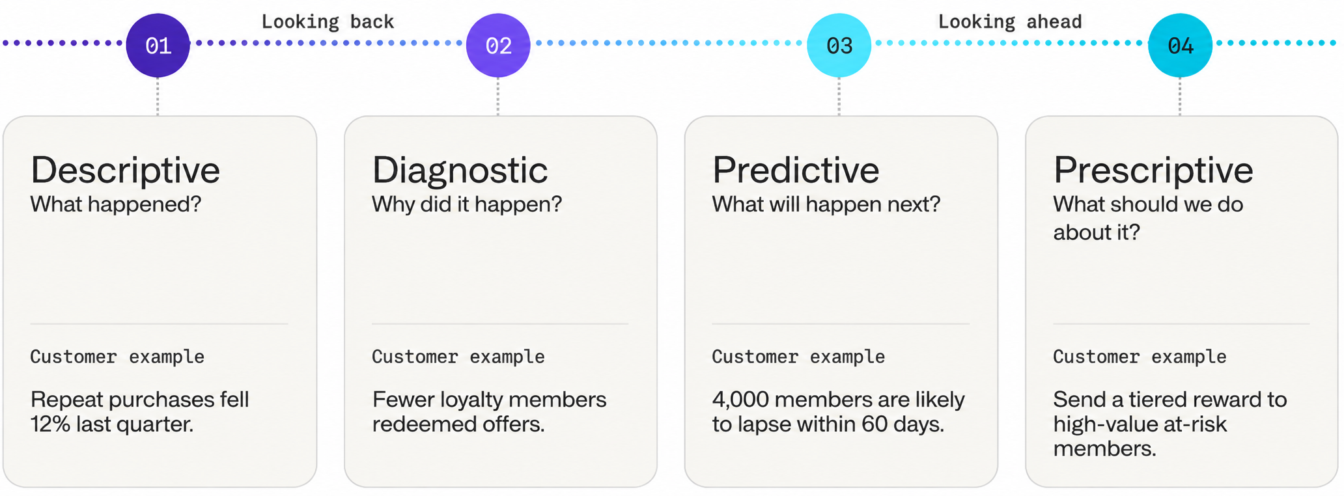
Predictive analytics is the stage of customer analytics that shifts teams from explaining the past to predicting the future. It sits third in a four-stage maturity journey:

Descriptive and diagnostic analytics establish context, but they are backward-looking. Predictive analytics adds foresight, and prescriptive analytics converts that foresight into a recommended action. Mature organizations use all four together, with predictive models acting as the bridge between insights and decisioning.

How Does Predictive Customer Analytics Work?

Predictive customer analytics works by transforming raw data to measurable action in five repeatable steps:

1 Collect and Prepare Customer Data

Data is pulled from CRM, web, app, point-of-sale, marketing and service systems. Identities are consolidated, so the same customer is recognized across channels.  Records are then cleaned, standardized, and enriched into a unified profile.

2 Identify Signals and Build Predictive Models

Analysts will identify signals that tend to precede an outcome, such as declining visit frequency before churning. Machine learning models train on historical data to learn these patterns and validate against samples.

3 Score Customers and Identify Likely Outcomes

The trained model assigns each customer a probability or value score, for example churn risk, purchase propensity, or predicted lifetime value. Scores are refreshed on a schedule or in real time as new behavior arrives.

4 Activate Predictions Across Customer Experiences

Scores flow into segments, journeys, and channels. A high churn score might trigger a retention offer, while high purchase intent might prioritize a product recommendation or a sales follow-up.

5 Measure, Learn and Refine

Teams compare predicted outcomes with actual results, run control groups to prove lift and retrain models as customer behavior shifts. This loop keeps accuracy and business impact high.

What Types of Predictive Customer Models Are Used?

The most common predictive customer models forecast churn, purchase intent, value and next best action. Each answers a different business question:

Most businesses start with one or two high-impact models, usually churn and propensity, then expand. Customer behavior prediction is most reliable when several models work together, for example combining churn risk with CLV to decide which at-risk customers deserve the strongest retention investment.

Key Use Cases of Predictive Customer Analytics

Predictive customer analytics delivers the most value in situations where timing and relevance decide the outcome, for example:

Predict and Prevent Customer Churn

Predictive analytics for customer churn flags customers whose behavior resembles past leavers, such as fewer logins, lower spend or rising complaints. Teams can then intervene with service recovery, loyalty rewards, or tailored offers.  Resolving customer retention is far cheaper than winning customers back after they leave.

Increase Conversion with Purchase Propensity

Propensity models rank customers by their likelihood to buy. Marketing focuses on spend on high-intent audiences, and sales teams prioritize warm leads, lifting conversion while reducing wasted impressions.

Personalize Products, Offers and Experiences

Affinity and next-best-action models predict what each customer wants next. This powers personalized recommendations, content and offers, improving predictive analytics customer experience outcomes across web, app, email and store.

Build Smarter Customer Segments

Traditional segments group customers by who they are. Predictive segments group them by what they are likely to do, such as “high value, rising churn risk”, which makes targeting far more precise.

Prioritize Campaigns and High-Value Customers

Combining CLV with propensity scores shows where the budget earns the highest return. Teams can protect top customers, nurture rising ones, and avoid over-investing in low-value audiences.

Improve Cross-Sell, Upsell and Re-Engagement

Predictive behavior marketing identifies the right product and moment to extend a relationship. For example, a leading bank achieved a 255% cross-sell conversion lift using CDP-powered micro-segmentation. Lapsed customers can also be re-engaged at the point they are most likely to respond.

What Are the Benefits of Predictive Customer Analytics?

The main benefit of predictive customer analytics is that it lets businesses act on customer needs before they become problems or missed opportunities. Specific benefits include:

  • Proactive retention: at-risk customers are identified early, while there is still time to change the outcome.
  • Higher marketing ROI: budget shifts toward audiences most likely to convert, reducing spending on low-intent prospects.
  • More relevant experiences: offers, content and recommendations reflect each customer’s likely next need.
  • Greater customer lifetime value: timely cross-sell, upsell and loyalty actions extend and deepen relationships.
  • Smarter resource allocation: sales, service and marketing teams focus effort on the customers who matter most.
  • Faster, more confident decisions: teams rely on probabilities rather than gut feel or lagging reports.
  • Deep customer analytics at scale: models surface patterns across millions of interactions that no analyst could spot manually.

Together, these benefits are compounded. A business that predicts churn, prioritizes value and personalizes engagement does not just react faster; it builds a customer experience that consistently feels timely and relevant, which strengthens loyalty and revenue over time.

Why Prediction Alone Is Not Enough

A prediction creates value only when it changes what a business does. Knowing that a customer has a 70% chance of churning is useful, but it does not tell you what to do to prevent this churn.  Should you offer a discount?  Call them?  Fix a service issue or do nothing at all?

This is where most businesses stall. Scores sit in dashboards; analytics teams build models that marketing never uses, and channel teams continue running static campaigns.

To make a real business impact, predictions must connect to three things:

  • Decision logic that weighs risk, value, eligibility and cost to choose the next best action.
  • Real-time activation that delivers that action in the right channel at the right moment.
  • Closed-loop measurement that proves which actions result in incremental improvements.

This is why a customer intelligence solution should unify data, prediction and activation in one flow. Without that connection, even accurate models deliver little business impact.

What Data Is Needed for Predictive Customer Analytics?

Predictive customer analytics needs unified, consented first-party data, ideally enriched with external context. The most useful data types are:

Volume matters less than quality. Data must be accurate, updated regularly, and linked to the same customer identity across channels. Clear consent and governance are also essential, both for regulatory compliance and for customer trust.

What Are the Biggest Challenges in Predictive Customer Analytics?

The biggest challenge in predictive customer analytics is rarely algorithms.  It is the data, adoption and execution:

  • Fragmented data: customer records spread across CRM, commerce, loyalty and service systems make a single view difficult.
  • Poor data quality: duplicates, gaps and outdated records weaken model accuracy.
  • Model drift: customer behavior changes with seasons, prices and markets, so models degrade without regular retraining.
  • Lack of explainability: business teams hesitate to act on scores they cannot understand or justify.
  • Disconnected activation: predictions stay in dashboards because they are not wired into campaign and channel tools.
  • Skills gaps: many teams lack the data science and engineering capacity to build, deploy and maintain models.
  • Privacy and compliance: consent, data residency and fair use rules must be built in from the start.

Overcoming these challenges usually requires both technology and expertise. Customer intelligence consulting can help organizations unify data, prioritize the right use cases and operationalize models faster.

From Predictive Analytics to AI Decisioning

AI decisioning is the next step after predictive analytics: it uses predictions to automatically choose and trigger the best action for each customer in real time.

Where predictive analytics answers “what is likely to happen?”, AI decisioning answers “what should we do now, for this customer, in this channel?” It combines multiple model scores, business rules and goals such as margin or retention, then selects the next best action and learns from every response.

For example, instead of sending every at-risk customer the same discount, an AI decisioning engine might offer a high-value customer a service call, a price-sensitive customer a targeted voucher and a low-value customer no incentive at all.

This turns predictive customer analytics from a reporting capability into an always-on engine generating proactive, personalized decisions at scale.

Table Of Content
TL;DR: Predictive customer analytics
What Is Predictive Customer Analytics?
What Role Does Predictive Analytics Play in Customer Analytics?
How Does Predictive Customer Analytics Work?
What Types of Predictive Customer Models Are Used?
Key Use Cases of Predictive Customer Analytics
What Are the Benefits of Predictive Customer Analytics?
Why Prediction Alone Is Not Enough
What Data Is Needed for Predictive Customer Analytics?
What Are the Biggest Challenges in Predictive Customer Analytics?
From Predictive Analytics to AI Decisioning

Predictive Customer Analytics FAQs

What is an example of predictive customer analytics?

A telecom provider analyzes usage, billing and support data to score each subscriber’s churn risk. Subscribers with rising risk and high lifetime value automatically receive a personalized retention offer before their contract ends, reducing churn and protecting revenue.

Is predictive customer analytics the same as machine learning?

No. Machine learning is one of the techniques used in predictive customer analytics. Predictive customer analytics is a broader business practice, covering data preparation, modeling, scoring, activation, and measurement. Some predictive models also use traditional statistical methods such as regression.

What is the difference between predictive analytics and prescriptive analytics?

Predictive analytics forecasts what is likely to happen, such as which customers will churn. Prescriptive analytics recommends what to do about it, such as which offer or channel will best retain each customer. Prescriptive analytics build predictive outputs.

What is the difference between predictive customer analytics and traditional reporting?

Traditional reporting looks backward, summarizing past sales, engagement, or churn. Predictive customer analytics looks forward, estimating each customer’s future behavior so teams can act before outcomes occur. Reporting explains performance; prediction helps change it.

From Conversations to Outcomes: How Business Messaging Is Becoming Agentic

Data & AI
Blog

From Conversations to Outcomes: How Business Messaging Is Becoming Agentic

TL;DR: From Conversations to Business Outcomes

  • Conversational AI for business is moving beyond answering questions. AI-powered conversations can now provide recommendations, resolve problems, transact, and deliver measurable outcomes.
  • AI-powered customer engagement turns regular customer interactions into opportunities to personalize experiences, recover lost sales, and drive conversions.
  • Agentic business messaging brings customer data, intelligence, and real-time decisions into conversations, enabling experiences that adapt to customer intent.
  • From banking and travel to retail and daily essentials, AI agents can assist in making decisions, create personalized promotions for each customer, and allow customers complete transactions without forcing customers to start over.
  • Making agentic messaging work at scale requires more than AI. it requires Unified data, faster responses, cost efficiency and clear guardrails to determine whether it delivers results.
  • The starting point is not a complete transformation. Rather, it is one high-value customer journey that is tied to the correct data and then evaluated based on actual business results.


The next era of customer engagement will be owned by brands that unify data and intelligence for conversational messaging.

Let’s start with how we begin our day: we wake up, check notifications, emails, messages.  Often, even before leaving the bed.

A similar routine plays out before we slip into sleep.

Encompassing over 63% of total retail eCommerce, mobile commerce surpasses USD 2.5 trillion in revenue, and will continue to climb, given that people across the globe spend 40% of their waking hours on mobiles.

Yet, most businesses still use them as megaphones, a broadcast device for ads that are skipped or ignored most of the time.

Evolution of Business Messaging

How Conversational AI Is Transforming Customer Engagement

Underneath the technology, a bigger shift is happening. Think about how you search today: a query no longer ends at a website, it turns into a conversation. That conversation surfaces products, ideas and experiences you were not looking for.

Customers now expect the same from brands. For businesses facing rising acquisition costs, this is an opportunity. A customer who arrives to return a product or raise a complaint is not just a service ticket. It’s a moment that creates an additional customer touchpoint. That moment is a chance to recommend, resolve and re-engage.  AI-powered customer engagement brings these touchpoints together, turning everyday conversations into opportunities to resolve, recommend and convert.

Business messaging is evolving beyond answering customer queries to enabling personalized interactions, real-time decisions and measurable outcomes. This changes how experiences get built. Conversion rate optimisation assumes you can map a customer’s path from page to page. . The experience has to generate itself in the moment, which is only possible if the agent has access to the right data.

Conversational AI for Business: Agentic Messaging Use Cases

Banking – The Proactive Upgrade

Conversational intelligence allows banks to provide multi-pronged assistance and low-friction upsell or category add-ons to existing and new customers.

For instance,

Then, optimizing and personalizing the offer in real-time based on the purchase power, discount inclination, and other customer behaviour

No forms, no branch visit. Countless hours saved across the customer pool and minimal friction.

Partner Offers – A Seamless Handoff Across Channels

Co-branded partner offers form another interesting use case for conversational intelligence for business messaging.

Suppose the banking customer profile also qualifies for a co-branded partner offer from a travel company.

With built-in conversational intelligence, she can seamlessly move across channels, like WhatsApp and partner websites without context and identity change, greeted by name, with arelevant offer already applied, and a highly-personalized travel plan customized in real-time as per her preferences.

Setting budget, adding meals, specific flight preferences, and maybe even hotel bookings.

One conversation, two channels, no repeating herself.

Retail: Reviving Abandoned Carts

Despite being the major shopping channel, the abandoned carts keep being a menace for mobile commerce. While the nudges and push notifications keep getting bulk-swiped by the customers, a conversational ping from the shopping agent serves as a distinct reminder.

Retailers can show the exact items, size and colour a shopper has put in the cart. The voice agent can pull options from the catalogue rather than sending the shopper to a dropdown, suggest a matching bag or cap and offer a two-part instalment plan with additional perks like discounts, when customer opts for a payday purchase completion.

The checkout happens inside the chat. A lost sale becomes a bigger basket.

Daily Essentials – Natural and Unscripted Ordering

Shopping for the customer, adding items, customizing for special requests, occasions, and deal sizes, adjusting for budgets, and then offering substitutes in real-time – conversational intelligence can transform the way people shop forever and like never before.

Going beyond showing options and displaying the weekly or hourly deals, the agentic shopping stemming from conversational messaging can serve intelligent recommendation, factor in nuances, and help retailers deliver seamless and friction-less shopping experiences without bombarding the shoppers with hundreds of notifications and annoying reminders.

Sales, services, and experiences – delivered in aggregated manner.

The Readiness Gap

While the promise of increased revenue, higher customer satisfaction and unparalleled experiences is enticing, the implementation costs and outcome anxiety continue to create friction.

Studies reveal that roughly 72% of brands in the APAC region say they are actively onboarding agentic partners. However, it is projected that around 40% of agentic AI projects will be abandoned by 2027 because costs are unclear and stakeholders are concerned about the scale of token usage. Finally, around 80% of businesses report no tangible impact from their AI projects.

This is the gap ADA bridges.

From Experimentation to Enterprise-Scale Deployments – What It Takes to Get It Right

From what we have seen delivering hundreds of millions of customer journeys, three principles stand out.

1 Data Unification

Customer identity, behaviour, consent, product catalogue, pricing and supply chain data must feed the conversation.

2 Optimizing the Experience

Latency matters. A reply that takes too long, or a bot that cannot be interrupted, breaks the spell. Getting this right takes careful decisions about what data to load into the model, when, and what to cache.

3 Designing for Cost

Optimising latency and token usage go hand in hand. Efficient agents are not just faster; they are what keeps a project alive past the CFO’s review.

4 Set the Guardrails, Then Give Autonomy

Agents need clear boundaries, such as the discount they can offer or the payment terms they can approve, so they can resolve requests without escalating every one.

Getting Started with Agentic Business Messaging

You do not need to rebuild everything at once. Start with one high-value journey where intent is already visible: cart abandonment, product upgrades, renewals, collections or after-sales. Connect the data that journey needs, define what the agent is allowed to decide, and measure against a business metric, such as conversion, revenue or cost to serve, rather than engagement alone.

Messaging has already earned its place as the channel customers prefer. The brands that win next will be the ones whose conversations do more than answer questions. It is an intelligent, always-on conversation, built on the right infrastructure from day one.

Table Of Content
TL;DR: From Conversations to Business Outcomes
Evolution of Business Messaging
How Conversational AI Is Transforming Customer Engagement
Conversational AI for Business: Agentic Messaging Use Cases
From Experimentation to Enterprise-Scale Deployments – What It Takes to Get It Right
Getting Started with Agentic Business Messaging

Omnichannel Retail: From Connected Channels to Intelligent Experiences

Data & AI
Blog

Omnichannel Retail: From Connected Channels to Intelligent Experiences

TL;DR: Omnichannel Retail

Omnichannel retail links your online store, physical stores and social channels so customers get one smooth experience. Instead of running each channel on its own, you share customer data, inventory and messages across all of them in real time. A good omnichannel marketing platform shows you who your customers are and delivers the delivery of a right personal message. Over time, that means more sales, more repeat buyers and a stronger brand.

Omnichannel Retail

What Is Omnichannel Retail?

Omnichannel retail is more than being on many platforms. It connects your online and in-store touchpoints into one journey.

Here’s what that looks like. A shopper finds a product on social media. She checks if her local store has it in stock. She gets an offer on WhatsApp, buys online and picks it up in store. She never repeats a step, and she never hits a dead end.

To get there, brands have to break down the walls between teams. Your website, your store checkout (POS) and your customer service team all need to work from the same customer and stock data.

Omnichannel vs Multichannel Retail: What Actually Changes?

Both approaches use several channels. The difference is how those channels work together.

How Omnichannel Retail Connects Data, Decisions and Experiences

To make omnichannel work, you need three layers working together:

  1. A shared customer data layer. A CDP or CRM pulls customer data into one place, so every team sees the same picture.
  2. Automation and real-time decisions. Software uses that data to decide what to send, to whom and when. This is how you keep 1:1 messages going as you grow.
  3. The places customers shop. That’s your stores and POS, your online store, and your mobile apps and messaging.

Unify Customer Data Across Channels

Silos are the first thing to fix. A CDP brings online and in-store behavior, content preferences and consent choices into one customer profile. Now you know who each customer is. You can also reach them on the channel they prefer, whether that’s Instagram or WhatsApp.

Connect Product and Inventory Data

Your product details and warehouse stock need to sync in real time. That stops you from selling items you don’t have. It also makes “endless aisle” (ordering an item that isn’t on the shelf) and Click and Collect possible.

Personalize Across Online and In-Store Touchpoints

Once you have one customer profile, you can predict what a shopper is likely to buy. Then you can show the right offer or content they’re most interested. That works online and on the shop floor.

Why Omnichannel Retail Matters for Growth

The right MarTech setup behind your omnichannel strategy shows up in four places:

  • When it’s easy to go from browsing online to picking up in store, more shoppers finish their purchase.
  • Customer retention. Consistent, personal experiences build trust. Trust brings people back.
  • Marketing efficiency. With all your customer data in one place, you stop wasting ad spend and set up targeted, automated campaigns.
  • A clearer view of your customer. Cross-channel reporting shows which campaigns lead to sales. That helps you improve your media ROI.

These gains don’t happen on their own. Large brands need an omnichannel marketing platform that connects data from every part of the customer’s experience. With one in place, journeys run automatically and each message reflects what the customer just did. You can then give shoppers a consistent, personal experience at scale.

omni channel retailing

What Omnichannel Retail Looks Like in Practice

1 Buy Online, Pick Up In Store (BOPIS)

Shoppers order on mobile or desktop. They collect the order at a nearby store within hours. They get the speed of online shopping and don’t wait for delivery.

2 Cross-Channel Personalization

A customer browses a category in your mobile app. She gets a WhatsApp message with an offer that matches her tastes. When she visits the store, staff can help her with the same preferences in mind.

3 Unified Loyalty

Points earned in store show up in the customer’s digital wallet right away. She can spend them online or at the store checkout.

4 Connected Customer Service and Returns

Your service team can see a customer’s full purchase history, online and in store. That makes it easy to return or exchange an online order at a store.

How to Build an Omnichannel Retail Strategy That Works

A strong strategy needs technology, marketing automation and journey mapping to line up. Start here:

Map the customer journey.

List the stages, touchpoints and calls to action (CTAs) across the whole customer lifecycle.

Unify customer and commerce data.

Set up a CDP to bring online and offline behavior into one place.

Focus on your biggest moments.

Get ready to send personal 1:1 messages during peak periods and seasonal campaigns.

Personalize across channels.

Use the automation tools in your omnichannel marketing platform. They trigger the right message based on what a customer does and what they’re likely to do next.

Measure business results.

Track cross-channel Customer Lifetime Value (CLV), retention rates and return on ad spend (ROAS).

Where Data, Personalization and AI Change the Game

1 Build a Unified Customer View

Machine learning looks at how customers interact across channels. It keeps each profile up to date with scores that show which products a customer is likely to want and how ready they are to buy.

2 Understand Intent

Live signals show how close someone is to buying. These include location, how often they browse and what’s in their cart. This is most useful in busy periods.

3 Personalize the Next Best Experience

Automation matches what the customer wants right now with the right content. It also respects their privacy choices. The best offer then goes out on their preferred channel.

4 Improve Decisions

Predictive analytics helps you plan stock and sets off marketing messages automatically. Both help more shoppers complete their purchase.

What Gets in the Way of True Omnichannel Retail?

The benefits are clear, but most brands hit a few common problems.

1 Fragmented Customer Data

When data sits in separate systems, marketers can’t see the whole customer. That makes 1:1 personalization hard.

2 Disconnected Systems

Older POS systems often can’t connect to modern e-commerce platforms in real time. Data updates late, and customers feel it.

3 Inconsistent Inventory and Product Data

What your website shows doesn’t always match what’s in the warehouse. That leads to canceled orders and late deliveries. Customers lose trust.

4 Measuring Channels Instead of Journeys

If you judge each channel on its own numbers, teams end up competing. Marketing spend gets out of line with what customers actually do. Measure the whole journey instead.

Conclusion

A strong omnichannel retail strategy starts with making the most of your data and your MarTech stack. Break down silos. Automate the repeat work. Then send personal 1:1 messages that feel relevant. That’s how brands earn loyalty and keep growing.

Table Of Content
TL;DR: Omnichannel Retail
What Is Omnichannel Retail?
Omnichannel vs Multichannel Retail: What Actually Changes?
How Omnichannel Retail Connects Data, Decisions and Experiences
Why Omnichannel Retail Matters for Growth
What Omnichannel Retail Looks Like in Practice
How to Build an Omnichannel Retail Strategy That Works
Where Data, Personalization and AI Change the Game
What Gets in the Way of True Omnichannel Retail?
Conclusion

Omnichannel Retail
FAQs

What is an example of omnichannel retail?

A customer browses a retailer’s app. She gets a WhatsApp offer that fits what she’s looking for. She checks stock at her local store, orders online and picks the item up at the store counter.

How does personalization improve omnichannel retail?

Omnichannel personalization uses shared customer data to send relevant 1:1 messages and offers at the right time and place. That leads to more engagement, more sales and more repeat customers.

How is AI used in omnichannel retail?

AI predicts what customers want to buy. It triggers campaigns automatically and picks the next best offer in real time. It also helps manage stock across online and physical channels.

What is the difference between omnichannel retail and unified commerce?

Omnichannel retail connects separate channels and tools to create one experience. Unified commerce goes a step further. It runs customer, inventory and payment data on a single software platform.

How does a CDP support omnichannel retail?

A Customer Data Platform (CDP) pulls online and offline customer activity into one profile. That breaks down silos. It also lets you coordinate messages across channels and measure campaigns in detail.

Live Commerce: From Product Discovery to Real-Time Sales

Data & AI
Blog

Live Commerce: From Product Discovery to Real-Time Sales

TL;DR: Live commerce

Live commerce combines live video with instant checkout. Viewers watch a host show a product, ask questions in the chat and buy without leaving the stream. Unlike a regular online store, everything happens in one place and in real time. With an omnichannel commerce solution, brands can shorten the path to purchase and catch buyers while their interest is high. They can also grow sales on D2C sites and social marketplaces like TikTok Shop, Shopee and Lazada.

What Is Live Commerce?

Live commerce is also called live streaming commerce or live shopping. A brand or creator broadcasts live video. Viewers can browse, pick and buy products right inside the video player or chat.

It blends entertainment, social chat and checkout into one experience. Viewers don’t leave the stream to pay. Every step, from choosing a size to paying, happens in real time.

How Does Live Streaming Commerce Work?

Behind the scenes, four things come together: video production, hosts, product listings, and instant payments. Here’s the flow:

  1. Set up the broadcast and pin products. The brand sets up a stream on a social network or its own D2C site. It pins specific products (SKUs) to the screen.
  2. Show the products live. Creators present items, answer questions from the chat and try products out based on what viewers ask for.
  3. Trigger offers at the right moment. Flash discounts, limited vouchers and live stock counters pop up when viewers are most engaged.
  4. Check out inside the stream. Viewers tap a pinned product card and pay. They never lose the stream.

How Live Commerce Turns Product Discovery Into Real-Time Sales

An enterprise live commerce solution moves viewers through five stages.

1 Discovery: Show the Right Products to the Right People

Strong livestreams start with data. Brands group their audience into segments and send products to creators who reach them. They then promote specific categories to people who are ready to buy. That brings in engaged shoppers instead of people who just scroll past.

2 Engagement: Turn Product Content into a Conversation

Live video does what a product page can’t. Viewers ask questions, vote on colors in the comments and ask the host to demo an item.

3 Decision: Personalize Offers and Next Steps

A social commerce solution lets your stream team send personal voucher drops and limited-time bundles. They act on what viewers are doing and saying in the chat right now.

4 Conversion: Remove Friction Between Interest and Checkout

Major platforms like Shopee, Lazada and TikTok Shop already have checkouts built into their streams. Shoppers pay with saved cards or digital wallets. They can buy it in one tap without leaving the video.

That removes the two biggest reasons people abandon a cart: being sent to another site, and long checkout forms. Live commerce turns interest into a sale on the spot.

5 Learn: Turn Every Live Interaction Into Data

Every chat question, product tap, watch time and voucher use tells you something. Feed that back into your planning. It helps you stock the right items and choose better creators next time.

Why Live Commerce Matters for Retailers and Brands

A connected live shopping solution helps in five ways:

  • Faster sales. Urgency, social proof and limited stock turn “maybe later” into “buy now.”
  • Higher conversion. Live streams often convert better than static product pages.
  • A wider audience. Social video isn’t just for young shoppers anymore. That puts you in front of older shoppers with more spending power.
  • Fewer returns. Live demos, fit reviews and Q&A set the right expectations before checkout.
  • Honest feedback. Live chat shows you what people really think about your products, prices and features.

ADA proof: We help a CPG brand in SEA to set up a live SKY-level ROI dashboard to 441% increase in conversion rate and a 51% increase in click-through rate by helping the brand optimize ad creatives around its most profitable products.
Read the case study

What Types of Live Commerce Can Brands Use?

The right format depends on your goal. Here are four to choose from.

  1. Social commerce streams (TikTok Shop, Instagram Live). Creators entertain while viewers discover and buy on impulse. This matters for consumer packaged goods (CPG) brands, especially in APAC.
  2. Marketplace livestreams (Shopee Live, Lazada Live). These are high-volume streams built for sales. They use the platform’s own traffic, flash vouchers and search visibility.
  3. Streams on your own D2C site. These are brand-owned, higher-production streams. They work well for your best customers and for exclusive product drops.
  4. Private streams (WhatsApp or VIP shopping). These are 1:1 or small-group video calls. They suit luxury, high-consideration or specialized B2B products.

To run all of these well, brands need one omnichannel commerce platform. It keeps catalogs, inventory, creator networks and media budgets in sync.

How to Build a Live Commerce Strategy That Works

A strategy that scales needs a clear plan. Follow these five steps:

  1. Set your goals and pick your channels. Match each stream format (TikTok Shop, Shopee or D2C) to your audience and your margins.
  2. Choose the right creators and hosts. Look for people who know the product and can ask for the sale, live.
  3. Plan your offers. Build stream-only bundles, tiered vouchers and flash discounts. Time them for when viewers are most engaged.
  4. Sync inventory and POS. Pinned products should update instantly from your central inventory. That stops you from overselling when demand spikes.
  5. Go live on a schedule. Move from one-off events to a weekly or daily schedule. Regular streams build a habit with your audience.

How AI Is Changing Live Commerce

AI takes live streaming from a manual show to a system that learns and automates.

  • Live stream insights. Machine learning tracks chat mood, viewer drop-off and sales spikes as they happen. It then suggests changes for the host.
  • AI hosts and digital avatars. These tools can run overnight streams when your team is off. They answer chats, explain products and reach shoppers in other time zones, 24/7.
  • Smarter offers. AI works out the best voucher value and bundle mix during a broadcast. That lifts gross merchandise value (GMV) while protecting profit margins.

How Should Brands Measure Live Commerce Performance?

Don’t stop at total revenue. To see the real return on a live commerce solution, track the whole funnel.

Conclusion: Turning Live Moments Into Connected Commerce

Live commerce is no longer a test. It’s now a core part of how brands grow online. Combine live video, creators people trust and real-time selling on an enterprise omnichannel commerce solution. You’ll turn passive viewers into loyal, high-value customers.

See how ADA’s Marketplace & Social Commerce Solutions can help you build and grow live commerce that converts.

Table Of Content
TL;DR: Live commerce
What Is Live Commerce?
How Does Live Streaming Commerce Work?
How Live Commerce Turns Product Discovery Into Real-Time Sales
Why Live Commerce Matters for Retailers and Brands
What Types of Live Commerce Can Brands Use?
How to Build a Live Commerce Strategy That Works
How AI Is Changing Live Commerce
How Should Brands Measure Live Commerce Performance?
Conclusion: Turning Live Moments Into Connected Commerce

Live Commerce
FAQs

What should retailers look for in a live commerce solution?

Look for four things. First, checkout inside the stream. Second, real-time inventory sync across marketplace and D2C channels. Third, clear stream analytics. Fourth, easy links to your CRM and MarTech tools.

How can brands keep converting shoppers after a livestream ends?

Turn recordings into short, shoppable videos. Send follow-up messages on channels like WhatsApp to people who added items to their cart. You can also retarget viewers with ads that match what they watched.

Is live commerce the same as social commerce?

No. Social commerce means selling through social media in general. Live commerce is one format within it. It uses live video to get shoppers to buy in the moment.

The Future of WhatsApp Privacy: Navigating Usernames and Business Scoped User IDs (BSUIDs)

Data & AI
Blog
bsuid
business-messaging
developer-guide
privacy
webhooks
whatsapp

The Future of WhatsApp Privacy: Navigating Usernames and Business Scoped User IDs (BSUIDs)

TL;DR: What Businesses Need to Know About WhatsApp Usernames and BSUIDs

WhatsApp is introducing Usernames and Business-Scoped User IDs (BSUIDs) to give users more privacy while allowing businesses to maintain consistent customer identification.

  • Phone numbers will no longer always be visible. Users communicating through a WhatsApp username may have their phone number withheld in certain interactions.
  • BSUID becomes the reliable WhatsApp user identifier. Each user receives a stable, business-specific ID that can be used to recognize them even when their phone number is unavailable.
  • Businesses should store BSUIDs alongside phone numbers and use the BSUID as the primary identifier for WhatsApp customer records.
  • Messages can be sent using either a BSUID or phone number, although authentication templates such as One-Tap and Zero-Tap OTPs still require a phone number.
  • If a phone number is required for CRM, shipping, or other workflows, businesses can use REQUEST_CONTACT_INFO to ask users to share their verified contact details.
  • Businesses should also update webhook logic, handle user_id_update events, and reserve their preferred WhatsApp Business username ahead of the broader rollout.

WhatsApp is undergoing one of its most significant architectural shifts to date. In a move to further prioritize user privacy, the platform is introducing USERNAMES. While this is a win for consumer privacy, it changes how businesses identify and interact with their customers.

To ensure businesses don’t lose track of their customers, Meta is simultaneously introducing Business-Scoped User IDs (BSUIDs).

In this post, we’ll break down what these changes mean for your business, how BSUIDs work, and what you need to do to keep your messaging workflows running smoothly.

1 The Big Shift: Phone Numbers are No Longer the Only Identifier

Historically, the phone number was the primary key for any WhatsApp interaction. If someone messaged you, you had their number.

With the introduction of Usernames, this is changing. Users can now choose a handle (like @john_doe) to represent themselves. If a user with a username contacts your business for the first time, WhatsApp may withhold their phone number from the webhook payload.

When will you still see the phone number?

Don’t worry—phone numbers aren’t disappearing entirely. You will still receive a user’s phone number if:

  • You have interacted (messaged or called) within the last 30 days.
  • The user is already in your Contact Book (a new feature that automatically pairs BSUIDs and phone numbers for your portfolio).
  • The user hasn’t set a username.
  • Related Read: Whatsapp Marketing Strategies

2 Meet the BSUID: Your New Constant

Since phone numbers may become optional in your incoming data, Meta has introduced the Business-Scoped User ID (BSUID).

Think of the BSUID as a permanent, anonymous “alias” for a user that is unique to your business.

  • Format: It looks like a country code followed by a string (e.g., MY.12345abcde…).
  • Stability: Unlike a phone number, which a user might change, the BSUID is designed to be your stable anchor for that customer within your specific business account.
  • Always Present: Every message you receive will now include a userId (the BSUID), even if the phone number is available.
  • Privacy-First: The same user will have a different BSUID for every business they message, preventing cross-business tracking.

Related Read: Whatsapp OTP Verification

3 Claiming Your Territory: Business Usernames

It’s not just for individuals—businesses can (and should) reserve usernames too.

Having a business username makes your brand more professional and easier to find. These are distributed on a first-come, first-served basis, so we recommend claiming your preferred handle in the Meta Business Suite or WhatsApp Manager as soon as possible. You may also reachout to our
partnership or account manager for assistance in claiming your business username.

Quick Rules for Business Usernames:

  • Must be 3–35 characters.
  • Limited to alphanumeric characters, underscores, and periods.
  • One username per phone number.

4 Handling “Anonymous” Interactions

If a new user messages you using only their username, you’ll receive a BSUID but no phone number. If your business logic requires a phone number (for example, to sync with an external CRM or for shipping updates), you can now use the REQUEST_CONTACT_INFO feature.

You can trigger a native WhatsApp template or interactive message that asks the user to share their contact card. Once they tap “Share,” their phone number is sent via webhook, and run necessary processes for updating the “Contact Book”. As part of BUSID meta is also providing contact book for business to maintain their customer contacts and shared phone numbers will be automatically added to the “Contact Book”

5 Preparing Your Integration

If you are integrated with our webhook and API services, your technical team should prioritize the following updates:

  1. Update Database Schema: Ensure your customer records can store a userId (the BSUID) alongside the traditional phone number field.
  2. Modify Webhook Logic: Update your code to treat the from field for incoming messages as a flexible string. It could be a phone number OR a BSUID.
  3. Use BSUID as the Primary Key: Moving forward, use the contact.userId as the reliable way to recognize returning users.
  4. Handle ID Updates: Monitor for user_id_update webhooks. This happens if a user changes their phone number, allowing you to bridge the old record with the new one in your internal systems.
  5. Check Authentication Flows: Remember that One-Tap and Zero-Tap OTP templates still require a phone number and cannot be sent via BSUID.

Payload Deep Dive: What’s Changing?

All changes to the API are additive. Your existing fields won’t disappear, but new fields are being introduced to handle username-based interactions.

1 Receiving Messages (Inbound Webhooks)

When a user messages you, the contact object now includes the BSUID. If the user has a username and hasn’t messaged you in 30 days, the phone number will be omitted.

Scenario A: Phone Number is Available

{
    "accountName": "your-business-account-name",
    "accountNo": "your-business-account-no",
    "data": {
        "contacts": [
            {
                "profile": {
                    "name": "John Doe"
                },
                "user_id": "MY.12345abcde",
                "wa_id": "601234xxxxx"
            }
        ],
        "custName": "John Doe",
        "custNo": "601234xxxxx",
        "id": "1b1d1d31-bd7f-4ffe-8649-d119a0fde5f0",
        "text": "Hello",
        "timestamp": "1787824250",
        "type": "text"
    },
    "eventType": "Message",
    "fromName": "John Doe",
    "fromNo": "601234xxxxx",
    "platform": "WA",
    "text": "Hello, i am looking for additional info about the promo i received earlier",
    "type": "text"
}

Scenario B: Phone Number is Hidden (Username Only) Notice that the fromNo field is empty and phoneNumber is missing from the contact object.

{
    "accountName": "your-business-account-name",
    "accountNo": "your-business-account-no",
    "data": {
        "contacts": [
            {
                "profile": {
                    "name": "John Doe"
                },
                "user_id": "MY.12345abcde",
                "username": "@john_doe",
                "wa_id": ""
            }
        ],
        "custName": "John Doe",
        "custNo": "",
        "id": "1b1d1d31-bd7f-4ffe-8649-d119a0fde5f0",
        "text": "Hello",
        "timestamp": "1787824250",
        "type": "text"
    },
    "eventType": "Message",
    "fromName": "John Doe",
    "fromNo": "",
    "platform": "WA",
    "text": "Hello, can you send me the pricing guide?",
    "type": "text"
}

2 Sending Messages (Outbound)

You can now send messages using either the phone number or the BSUID in the recipient field.

Sending to a BSUID:

{
    "from": "60123412341",
    "recipient": "MY.102938475610293847",
    "platform": "WA",
    "type": "text",
    "text": "Sure thing, John Doe! Here is our pricing guide for 2025."
}

Sending to a BSUID & Phone Number:

{
    "from": "60123412341",
    "to": "601234xxxxx",
    "recipient": "MY.102938475610293847",
    "platform": "WA",
    "type": "text",
    "text": "Sure thing, John Doe! Here is our pricing guide for 2025."
}

Note: Authentication templates (OTPs) still require a phone number and cannot be sent via BSUID.

3 Tracking Status (Delivery Reports)

Delivery reports will now echo back the BSUID, ensuring you can map the “Delivered” or “Read” status back to the correct user in your database.

{
    "accountName": "your-business-account-name",
    "accountNo": "your-business-account-no",
    "data": {
        "contacts": [
            {
                "wa_id": "601234xxxxx",
                "user_id": "MY.102938475610293847"
            }
        ],
        "conversation": {
            "id": "dbb16c8d5f0360d3f7f1cf296f0033ec",
            "origin": {
                "type": "service"
            },
            "expiration_timestamp": 0
        },
        "custName": "John Doe",
        "custNo": "601234xxxxx",
        "id": "f2ca1d98-b8dc-4098-909e-6297a9c10fe4",
        "status": "delivered",
        "timestamp": "2026-08-27 16:54:14"
    },
    "eventType": "MessageStatus",
    "platform": "WA"
}

How to Get a User’s Phone Number

If a user contacts you via username and you need their phone number for your records (e.g., for shipping or CRM syncing), you can ask for it directly using the
new REQUEST_CONTACT_INFO button.

Requesting Contact Info (Interactive):

{
    "platform": "WA",
    "from": "60123412341",
    "recipient": "MY.102938475610293847",
    "type": "template",
    "templateLang": "en",
    "templateName": "share_profile_v2",
    "text": "Please share your contact details, so we can provide you personalised support without loosing context.",
    "buttons": [
        "Share Contact Info"
    ]
}

Response

{
    "accountName": "your-business-account-name",
    "accountNo": "your-business-account-no",
    "contactAttached": [
        {
            "contact1": {
                "name": "John Doe",
                "phone": "601234xxxxx"
            }
        }
    ],
    "data": {
        "contacts": [
            {
                "profile": {
                    "name": "John Doe"
                },
                "user_id": "MY.102938475610293847",
                "wa_id": "601234xxxxx"
            }
        ],
        "custName": "John Doe",
        "custNo": "601234xxxxx",
        "id": "1fbac66a-a79b-48d3-94d1-d2175fdd71df",
        "text": "",
        "timestamp": "1788153975",
        "type": "contacts"
    },
    "eventType": "Message",
    "fromName": "John Doe",
    "fromNo": "601234xxxxx",
    "platform": "WA",
    "text": "",
    "type": "contacts"
}

When the user taps the resulting button, WhatsApp will send a webhook back to you containing their verified phone number.

Integration Checklist

To prepare for the full rollout of usernames, we recommend the following steps:

  1. Update Your CRM: Add a new field for whatsapp_bsuid. This should become your primary key for identifying WhatsApp users.
  2. Listen for ID Updates: If a user changes their phone number, Meta will send a user_id_update event. Ensure your system can process this to keep your customer records merged.
  3. Reserve Your Business Username: Go to the WhatsApp Manager and claim your brand’s handle before someone else does!

Summary Table of Field Changes


Need help with your implementation?

ADAs Conversational AI Platform CAIP now supports Usernames and Business-Scoped User IDs (BSUIDs) for Meta WhatsApp Business API.

Reach out to us at businessmessaging@ada-asia.net for more information or assistance with the BSUID migration.

Table Of Content
TL;DR: What Businesses Need to Know About WhatsApp Usernames and BSUIDs
Payload Deep Dive: What’s Changing?
How to Get a User’s Phone Number
Integration Checklist
Summary Table of Field Changes
Need help with your implementation?