
Active Content: The New Frontier for Personalized Marketing

Omnichannel Marketing
Blogs

Active Content: The New Frontier for Personalized Marketing

Imagine sending a campaign that instantly reshapes itself based on each customer’s profile, location, past purchases, and even the weather when they engage with it. With Algonomy’s Active Content, this isn’t just possible—it’s simple.

According to a recent Forbes report, 71% of consumers feel frustrated when a shopping experience is impersonal. Meanwhile, a Gartner study indicates that brands deploying personalization see up to a 20% uplift in engagement rates. Active Content meets this demand head-on, empowering brands to create real-time, dynamic marketing experiences that resonate.

Why Active Content is Essential for Modern Marketing

Marketing has evolved rapidly over the past few years, and today’s consumers expect messages tailored specifically to them.

89% of digital businesses invest in personalization, and 77% of marketers agree that real-time personalization drives higher customer satisfaction and loyalty.

– Forrester, 2023

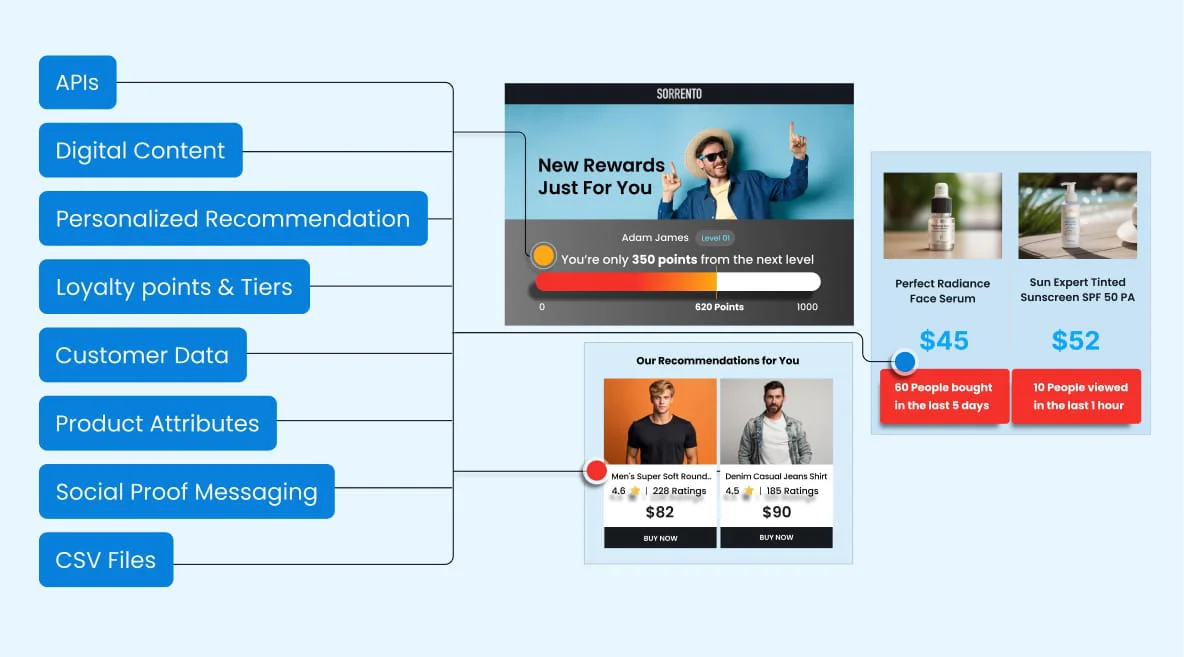
Active Content integrates data from multiple sources, stitching together valuable insights to create visually appealing, personalized content blocks that auto-update in real time across all platforms.

1 Instant Data Accessibility, Wherever You Are

Active Content seamlessly consolidates data across your organization into a single, interactive platform, including real-time customer profile, behavioral insights, and product information. It empowers you to leverage first-, second-, and third-party data for customer-centric experiences. Additionally, Active Content enables a unified view of data from diverse sources, accessible from one UI where users can experiment with different combinations to create tailored content blocks. This streamlined integration offers marketers a toolkit to craft and deliver dynamic, personalized experiences.
2 Streamlined and Simple: Built for Marketers, No Code Needed

One of Active Content’s standout features is its no-code, drag-and-drop interface, designed with marketers (not IT teams) in mind. This user-friendly interface allows us to create and manage dynamic content platform blocks effortlessly, with zero dependency on developers.

Gartner’s 2023 Martech Survey highlights that by 2024, 80% of marketing executives plan to implement AI-based solutions to reduce dependencies on IT (Gartner, 2023). Active Content’s intuitive interface lets marketers build one master template, define segments, and let it automatically handle the dynamic elements.
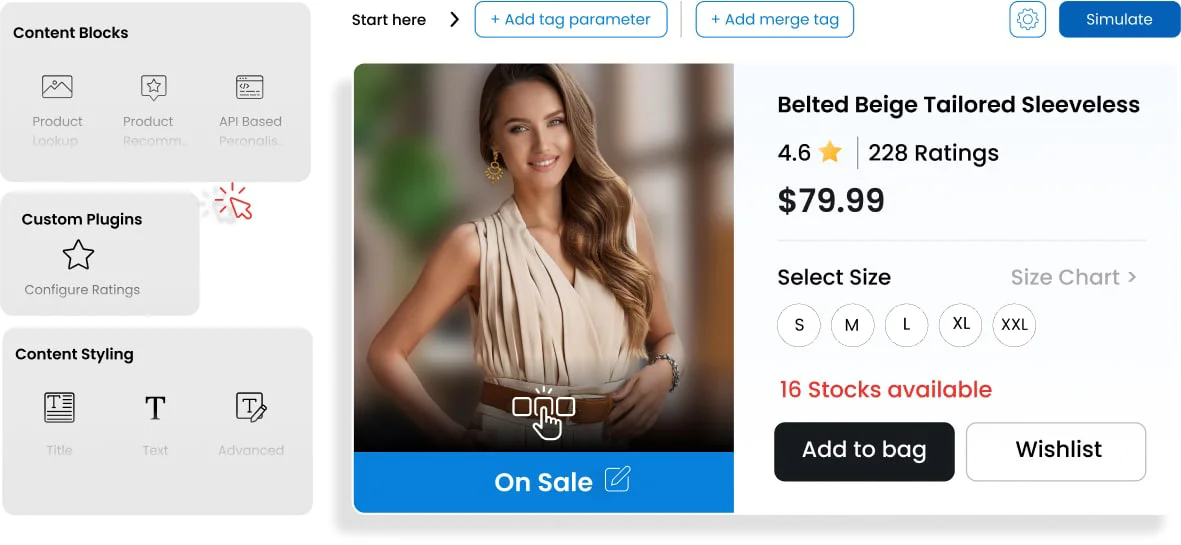
3 Real-Time Content Personalization: Content That Adapts on the Fly

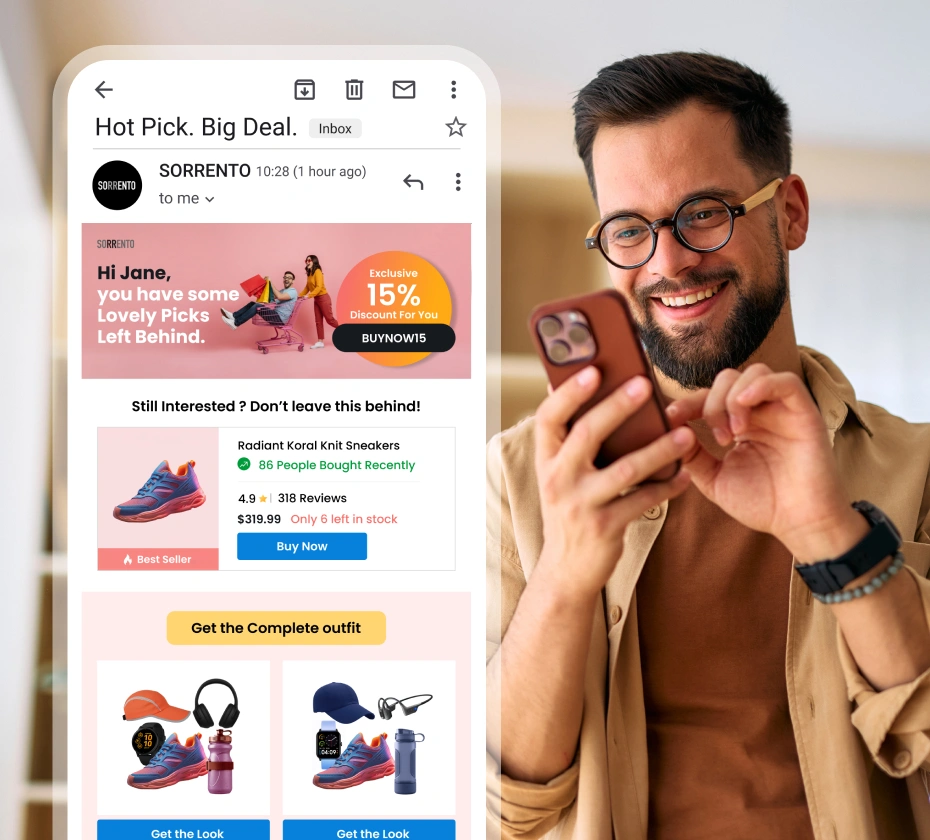
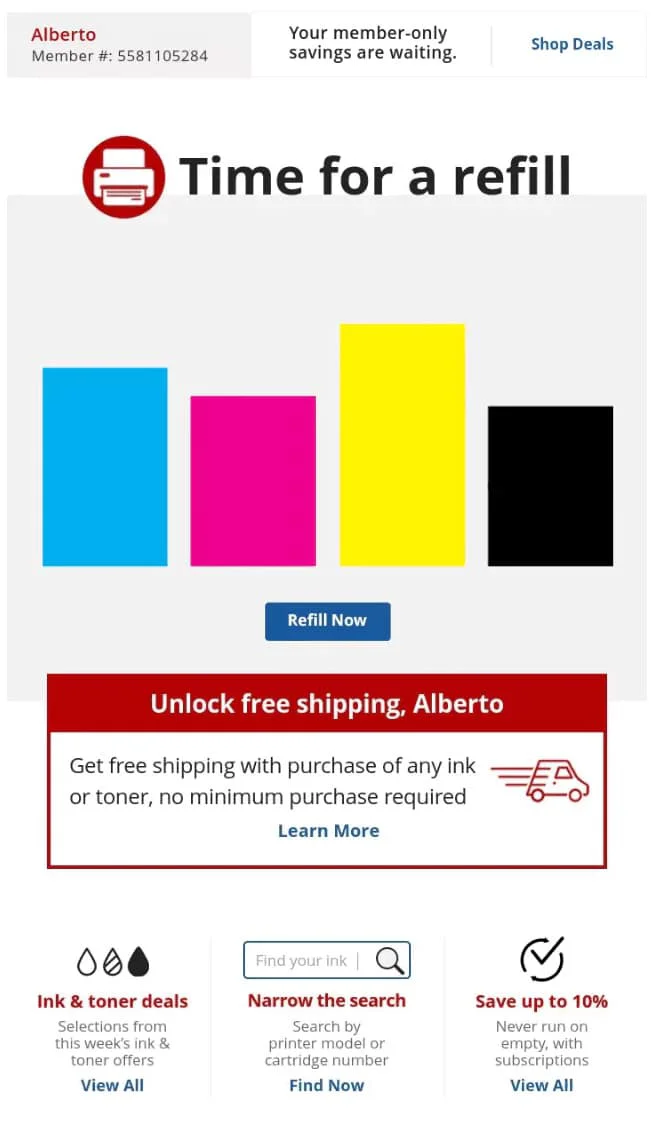
One of the biggest challenges marketers face is keeping content fresh and relevant as campaigns progress. With Active Content’s open time personalization, content updates when a customer opens it. This ensures they see the latest prices, stock availability, and and personalized content recommendations.

Real-time personalization can increase conversions significantly. By delivering the right message at the right moment, Active Content keeps our audience engaged and fosters stronger connections.

4 Seamless Integration into Any Martech Stack

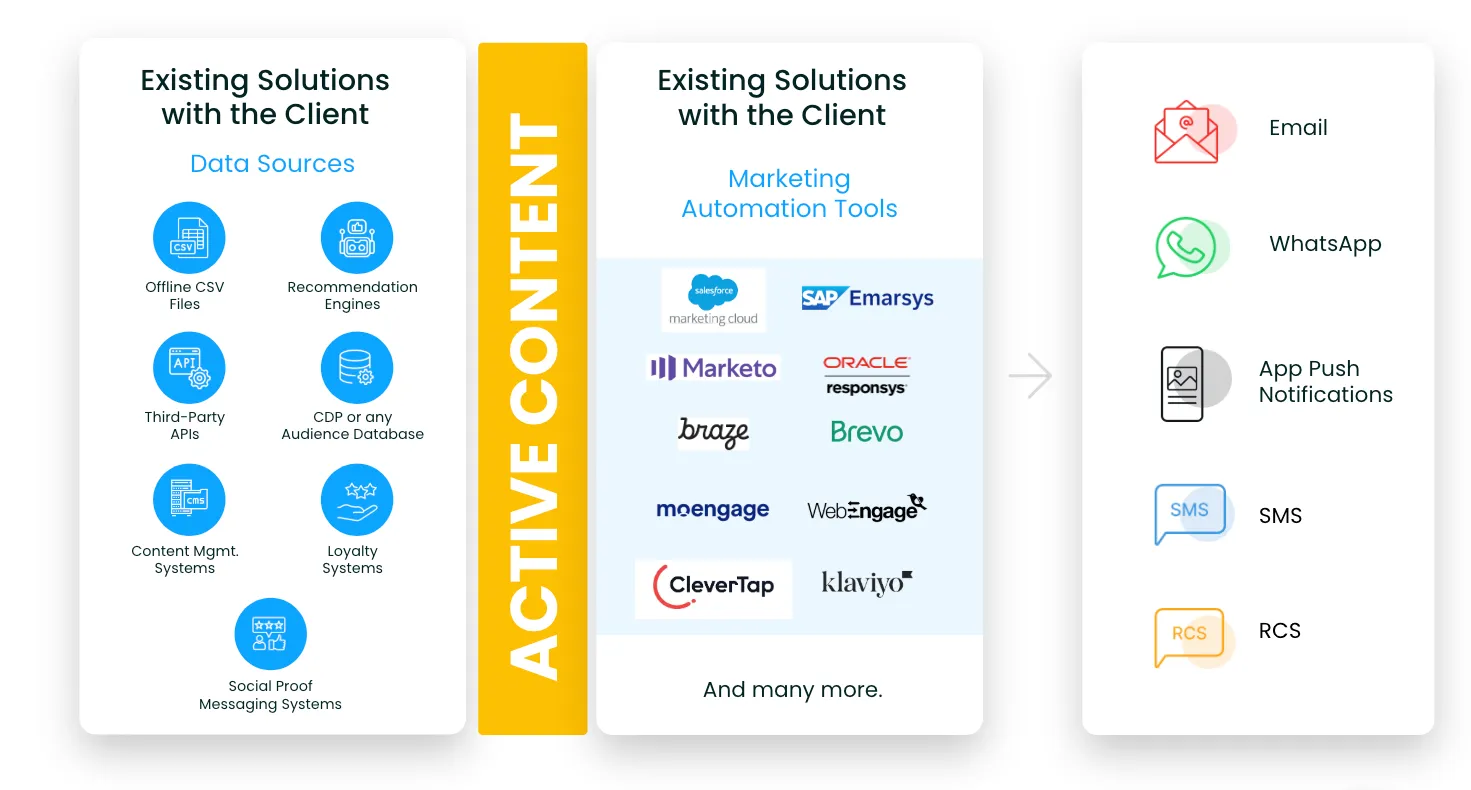
Active Content is versatile, integrating smoothly with existing Martech stacks like CRM, CDP, and ecommerce personalization platform. This flexibility means we can implement Active Content without the usual lengthy setup times and development costs.

Integrated Martech stacks see an increase in marketing efficiency. Active Content bridges the gap between data silos, ensuring campaigns use the most relevant, context-aware insights drawn directly from customer data.
Practical Use Cases That Drive Results

Active Content enables marketers to craft campaigns that aren’t just personalized—they’re timely and meaningful. Here’s how Active Content can be put into action:

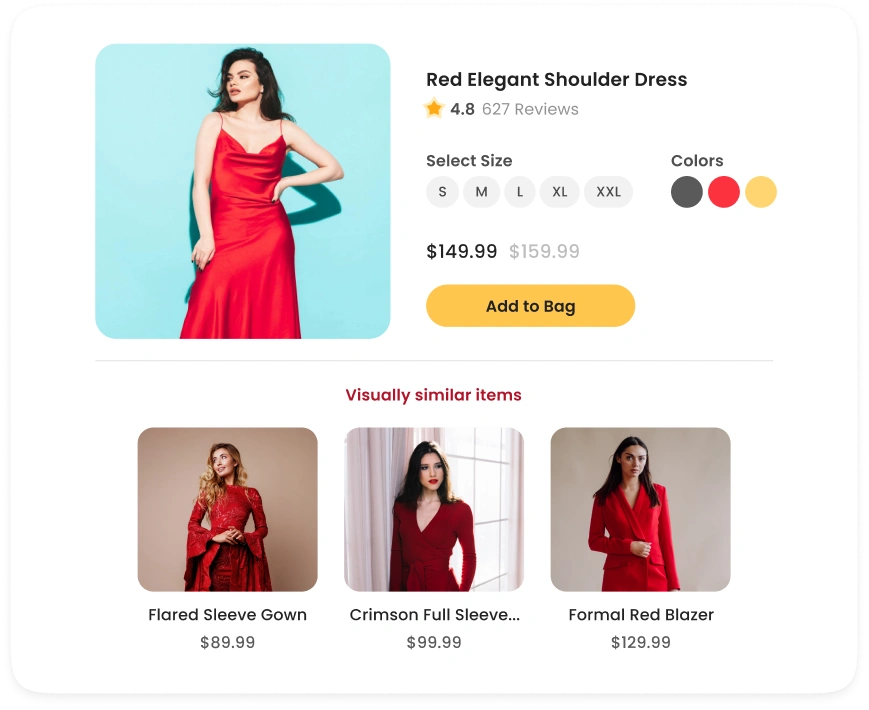
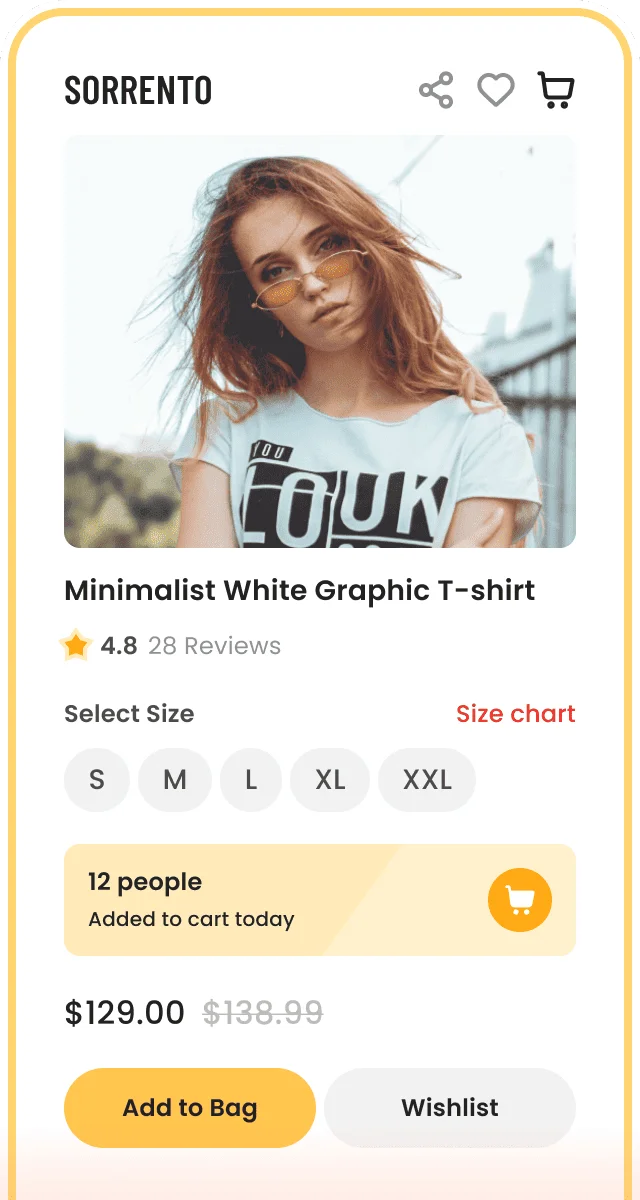
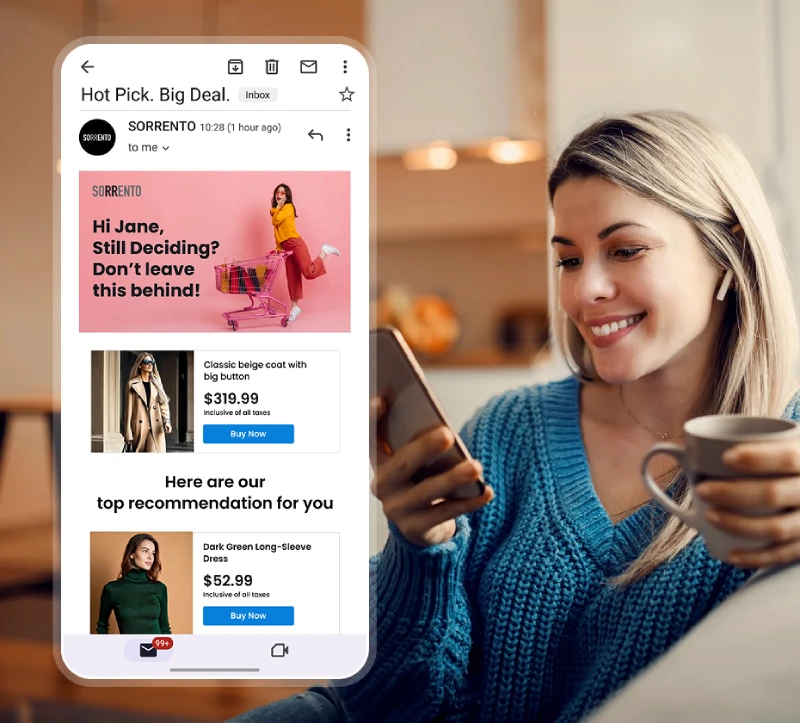
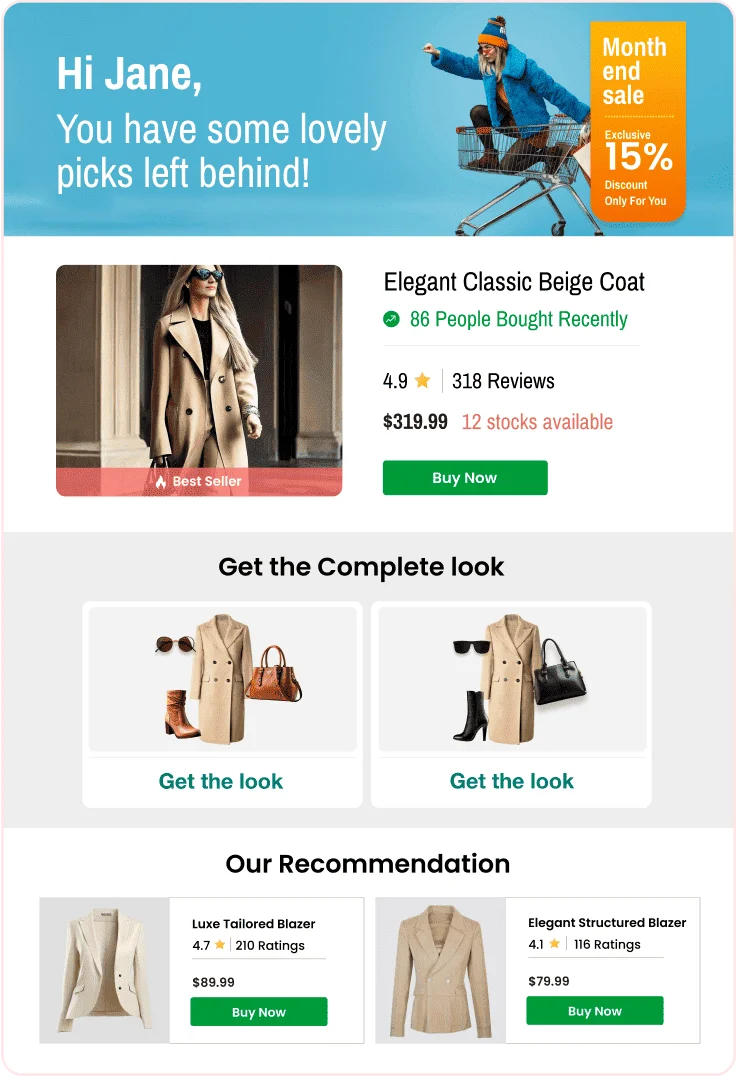
  • Smarter Abandoned Cart Campaigns: Active Content transforms triggered email marketing by incorporating live updates, such as price changes or limited stock notifications. By dynamically adapting to current data, these reminders become more persuasive, helping to recover lost sales and lower cart abandonment rates.
  • AI-Driven Style Suggestions: With the power of AI, Active Content offers personalized product recommendations, enhancing each customer’s experience with selections inspired by their browsing preferences, leading to greater order values and a more engaging shopping journey..
  • Localized and Relevant Hero Banners: Active Content enables the presentation of banners suited to a customer’s language, region, or demographics, which creates a more relatable experience and fosters higher engagement, as content feels specifically crafted for each location.
  • Dynamic Offer Displays: Active Content customizes offers for specific real time customer segmentation, dynamically adjusting promotions to align with individual needs better. This heightened personalization builds stronger customer connections and boosts conversions by presenting relevant offers in real-time.

Real-Time Optimization for Better Results

The real magic of Active Content is its ability to adjust campaigns on the fly. Imagine this scenario: you’ve sent out a campaign, but engagement rates aren’t meeting expectations. With most tools, you’d have to return to the drawing board, rework the content, and wait for IT to redeploy. With Active Content, you can make immediate updates that go live instantly, ensuring better campaign performance without the usual delays.

What Does the Future Hold for Active Content?

As personalization technology advances, Active Content is already paving the way for deeper,
AI-driven engagement strategies:

  • Expanded AI Capabilities: Active Content is poised to integrate even more advanced AI tools, enabling marketers to make real-time, data-driven decisions that enhance customer interactions. With dynamic marketing personalization platform insights, marketers can create increasingly precise, context-aware campaigns that meet customer expectations and drive engagement.
  • Increased Channel Expansion: Active Content’s roadmap includes support for emerging messaging platforms and voice-activated devices, enabling marketers to reach audiences wherever they are.
  • Deeper Predictive Analytics: By incorporating predictive analytics, Active Content will soon enable marketers to anticipate customer needs, offering one-to-one personalization rather than reactive personalization.

In Summary: A Marketer’s Best Ally

Active Content is more than just a dynamic personalization tool; it’s a platform designed to elevate every aspect of your marketing strategy. Active Content transforms how we engage with customers, from simplifying workflows to enabling always-on, hyper-personalized campaigns. In a world where consumer attention is more fleeting than ever, this tool is a game-changer that helps marketers like us make a lasting impact.

Are you ready to explore what Active Content can do for your brand? It’s time to turn every interaction into an opportunity for engagement and every campaign into a conversion powerhouse.
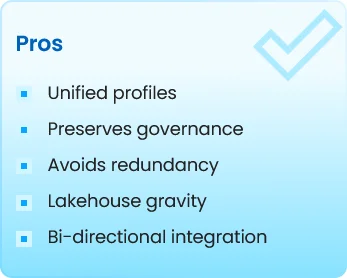
Table Of Contents
Why Active Content is Essential for Modern Marketing
Practical Use Cases That Drive Results
Real-Time Optimization for Better Results
What Does the Future Hold for Active Content?
In Summary: A Marketer’s Best Ally

Composable CDP for Retail: Necessary, but Not Sufficient for Personalisation

Omnichannel Marketing
Blogs

Composable CDP for Retail: Necessary, but Not Sufficient for Personalisation

Why isn’t a composable CDP enough for retail personalisation?

A composable CDP unifies customer profiles in the enterprise lakehouse. That is the right architectural move. But in retail, personalisation decisions also depend on product availability, store context, promotion mechanics, margin constraints, and consent status. Without a Retail Semantic Data Model that connects these entities in a shared business language, even the best composable CDP cannot power profitable, locally relevant, governed personalisation at scale.
Key Takeaways

  • Composable CDP is necessary but not sufficient. It solves data unification, not decision quality.
  • The missing layer is a Retail Semantic Data Model that gives business meaning to customer, product, store, inventory, promotion, margin, and consent data together.
  • India/APAC’s omnichannel complexity (quick commerce, WhatsApp commerce, assisted selling, and DPDP compliance) makes this semantic gap especially costly.
  • The semantic layer is also the governance layer: consent and permitted use must travel with every activation decision, not sit in a separate system.

This summary was created with AI and reviewed by an editor.

A Saturday Morning in Bengaluru

Priya is a Gold-tier loyalty member. Saturday morning, she walks into her neighbourhood store (a compact urban format, not a hypermarket) and picks up organic oats, Greek yogurt, and a promotion-discounted muesli.

Simple transaction. Except it isn’t.

Her basket is shaped by a health-conscious replenishment pattern the retailer can see across six months of purchase history. The muesli carries a category-level promotion inherited from a brand-funded trade deal, not a store-level markdown. Greek yogurt is in stock at this location but out of stock at the larger format store three kilometres away. And Priya has opted into app notifications but explicitly declined WhatsApp marketing under the retailer’s DPDP consent framework.

Now consider what the retailer’s systems need to know to make a single good decision about what to recommend, offer, or message Priya next:

Who she is (loyalty tier, household, lifecycle stage). What she bought (SKU, brand, category, basket composition). Where she bought it (store format, catchment, local assortment). What was available (inventory position, substitution options). What promotions were active (offer type, funding source, redemption rules). What her consent permits (channel eligibility, data-use boundaries). What the commercial objective is (margin target, category growth, basket expansion).

No single customer profile holds all of that. This is not a data-quality problem or a pipeline problem. It is a meaning problem. The data exists, often in the same lakehouse. But the connections between those entities, the semantic links, are missing.
Personalisation without availability is hallucination.
Personalisation without margin is a subsidy.
Personalisation without consent is a liability.

Explore Retail Semantic Data Model in Practice

The interactive widget below maps Priya’s shopping trip onto the semantic model, layer by layer. Start with the raw entities, then explore the product taxonomy and cross-entity inference that tells a retailer what to do next.

If you explored the widget, you likely noticed something: no single entity tells the full story. The insight only emerges when shopper context, basket composition, product taxonomy, store format, inventory position, and consent state are read together. That convergence is the semantic layer at work. A Retail Semantic Data Model is the business-language layer that sits on top of the composable lakehouse and gives consistent, queryable meaning to the full set of entities that drive retail decisions.

A Retail Semantic Data Model is not a schema exercise. It is the operating contract between every team and every algorithm that touches the customer.

What This Proves

Context Changes Meaning

Take organic oats as an example. The exact same SKU carries a different next-best-action depending on whether Priya is shopping in a compact urban store or a hypermarket. Store format determines assortment depth, substitution options, cross-sell candidates, and even whether a recommendation can be fulfilled. Remove store context, and the recommendation engine is guessing.

Meaning Can Be Inherited 

The muesli discount Priya received did not originate at the store. It was a category-level promotion, funded by the brand, with rules that cascade from category to subcategory to qualifying SKUs. If a personalisation system stores rules only at the SKU level, it cannot see the promotion’s structure, cannot calculate cannibalisation, and cannot measure whether the trade investment achieved its objective. Category-level inheritance is where commercial logic lives in retail.

Insight Is Cross-Entity, Not Trapped in One Table 

The inference that Priya is a high-value, health-conscious replenisher who could be nudged toward premium dairy (with a funded offer, fulfilled from current stock, sent via an app notification she has consented to) only emerges when you read across five entity types at once: shopper, basket, product, store, and consent. A customer profile, no matter how rich, is one table. The insight lives in the join.

What a Composable CDP Solves, and What It Does Not

A composable CDP builds unified customer profiles directly in the enterprise data warehouse, using modular, best-of-breed tools instead of copying data into a proprietary store. It preserves governance, avoids redundant data copies, and makes the lakehouse the system of data gravity. As architectural choices go, it is a sound one.

The composable foundation is no longer a debate. Most large enterprises have already integrated a data warehouse or lake with their martech stack, and the majority of those integrations are now bi-directional. It is becoming the default.

But composable architecture, by design, models the customer. It does not natively model what can actually be sold, fulfilled, substituted, promoted, or profitably recommended to that customer. The CDP Institute’s own definition (a system that creates a persistent, unified customer database) tells you where the boundary is.

Composable CDP

Pros

  • Unified profiles
  • Preserves governance
  • Avoids redundancy
  • Lakehouse gravity
  • Bi-directional integration

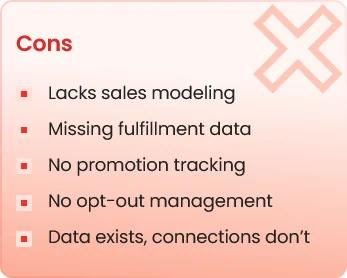
Cons

  • Lacks sales modeling
  • Missing fulfillment data
  • No promotion tracking
  • No opt-out management
  • Data exists, connections don’t

In retail, the customer profile is necessary. But it is not the whole decision. A grocery chain that knows Priya is a Gold-tier health-conscious shopper but does not know that organic oats are out of stock at her nearest store, that a funded muesli promotion expires tomorrow, or that she has opted out of WhatsApp. That chain cannot make a good next-best-action call. The data exists. The connections do not.

The composable CDP gives you the plumbing. The Retail Semantic Data Model gives you the meaning.

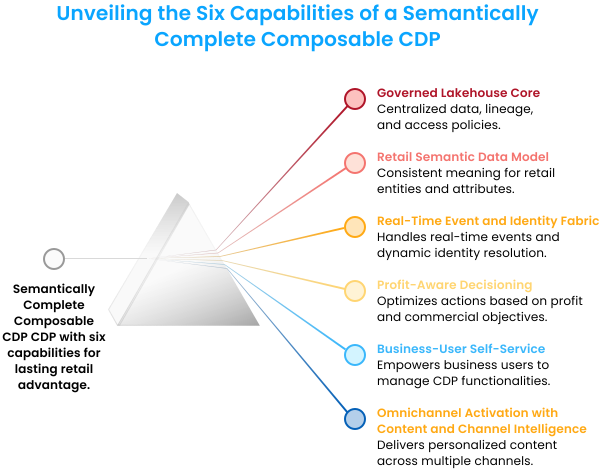
The Six Capabilities of a Semantically Complete Composable CDP

For retail enterprises, the composable CDP that delivers lasting advantage is not just architecturally open. It is semantically complete. That means six capabilities working together:

1 Governed Lakehouse Core

Data, lineage, access policy, and business definitions co-located in a single system of gravity. The composable architecture ensures nothing pulls the centre of gravity back out. Modern lakehouse platforms now support curated, trusted data-as-products with semantic consistency, operational synced tables for low-latency serving, and open sharing protocols for secure cross-platform data exchange.

2 Retail Semantic Data Model

Layered on top of the lakehouse, giving consistent meaning to the full range of retail entities. Not just customer attributes, but product hierarchies, store structures, inventory positions, promotion mechanics, loyalty logic, margin constraints, and consent states. This is the layer that makes the composable CDP retail-ready.

3 Real-Time Event and Identity Fabric

This goes beyond static profile resolution. It has to handle event fluency: replenishment signals, daypart shifts, search behaviour, geolocation triggers, and rapid intent decay in mobile and messaging channels. In grocery, replenishment windows are narrow. In QSR, daypart intent is fleeting. In WhatsApp commerce, wasted relevance is expensive.

4 Profit-Aware Decisioning

Actions ranked not just on customer propensity, but on stock, margin, offer cost, local conditions, and commercial objectives. The next-best action in retail must be customer-aware, stock-aware, store-aware, and margin-aware simultaneously. Research shows that even well-run grocers can expect 10 to 15 percent of promotions to dilute margins when these signals are disconnected.

5 Business-User Self-Service

Marketing, merchandising, and digital teams able to build audiences, define triggers, and launch journeys without engineering tickets. If composability only serves data engineers, the activation bottleneck simply moves downstream.

6 Omnichannel Activation with Content and Channel Intelligence

This is not just segment export. It is the ability to determine what to render, when to render it, and which channel to use, whether that is the app, web, email, store POS, or WhatsApp. The semantic layer makes this possible because it carries the context that channel selection depends on: consent state, store proximity, inventory position, and real-time intent.


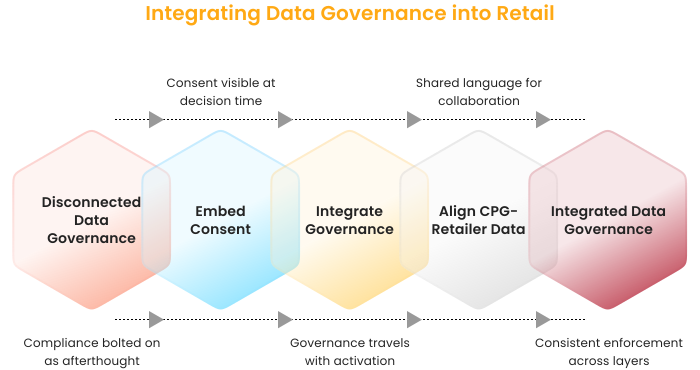
DPDP and the Governance Equation

India’s Digital Personal Data Protection Rules, notified in November 2025, do not sit outside this argument. They are part of it.
The rules require itemised consent notices, purpose-based data retention, mechanisms for access, correction, and erasure, and breach notification within 72 hours. Penalties can reach ₹250 crore for failure to maintain reasonable security safeguards.

For retail enterprises, this means consent, access rights, and data-handling obligations must be embedded in the activation layer itself, not bolted on as a separate compliance system the marketing engine queries as an afterthought. When Priya opts out of WhatsApp marketing, that consent state must be visible to the decisioning engine at the moment it evaluates channel selection, not discovered after the message has already been queued.

The semantic layer is also the governance layer. Consent, eligibility, permitted use, and auditability must travel with every activation decision.

A retail semantic model that understands “active customer,” “eligible offer,” and “high-value segment” must also understand whether that customer has consented, what attributes are permitted to travel where, and what audit trail exists for any decision. In the composable architecture, this is not a limitation. That is a structural advantage: governance and intelligence in the same layer, enforced consistently.

For CPG brands, the same logic applies upstream. CPG-retailer collaboration increasingly depends on shared data, shared product language, and measurable demand-shaping across retailer, banner, region, store cluster, and promotion. The retail semantic layer becomes the language of collaboration: aligning offer history, funding logic, store-level activation, and outcome measurement across partners.

What This Means for the C-Suite

For the CIO

You have built the composable foundation. The next investment is not more infrastructure. It is the semantic layer that makes the infrastructure commercially intelligent. The question to ask your data platform and CDP partners: does the model natively understand retail entities beyond the customer profile? If not, every downstream activation is working with incomplete context.

For the CDO

Data quality and governance are your mandate. The semantic layer extends that mandate from data accuracy to data meaning. It is the layer where business definitions, consent states, and commercial logic converge, and where DPDP compliance becomes enforceable at the point of activation rather than in a separate audit trail.

For the CMO

Personalisation performance is your accountability. If campaigns cannot factor in store context, inventory, promotion economics, and consent, if every targeted offer still requires a two-week data-engineering ticket, then the composable architecture has not yet delivered its promise. The semantic layer is what closes that gap and turns the martech investment into measurable, margin-positive outcomes.

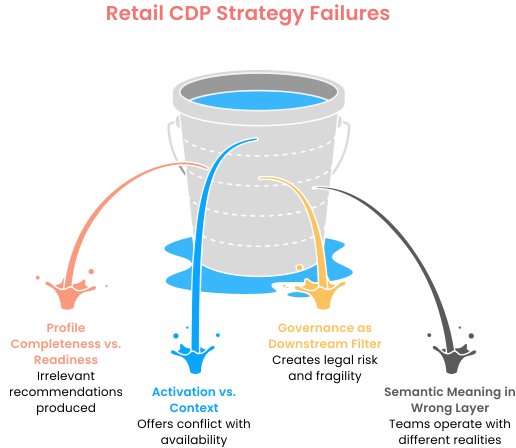
Where Retail CDP Strategies Usually Fail

The most common failure is not a technology failure. It is an assumption failure: believing that customer unification equals decision readiness.

Trap 1: Confusing Profile Completeness with Decision Readiness 

A rich, unified customer profile is valuable. But if the activation engine cannot access inventory, margin, or promotion context at decision time, the profile alone produces recommendations that are irrelevant, unprofitable, or impossible to fulfil.

Trap 2: Separating Activation from Merchandising and Store Context

When marketing activation operates in a silo, disconnected from merchandising calendars, store-level assortment, and inventory positions, the result is offers that conflict with what is actually available and promotions that erode margin rather than build it..

Trap 3: Bolting Governance On Later

Treating consent and data-protection compliance as a downstream filter, rather than embedding it in the decisioning layer, creates both legal risk and operational fragility. Under DPDP, this is no longer optional.

Trap 4: Storing Semantic Meaning in the Wrong Layer

When business logic lives in individual activation tools, BI dashboards, or campaign platforms rather than in a shared semantic model, every team operates with a slightly different version of reality. Category definitions drift. Promotion rules conflict. Store segmentation diverges. The semantic layer’s purpose is to be the single source of business truth.

The Bottom Line

Composable CDP architecture is the right structural foundation for retail. That question is settled. But architecture alone does not win in retail. What wins is the ability to turn a governed, composable data foundation into profitable, locally relevant, channel-aware, consent-compliant decisions at speed.

That requires a Retail Semantic Data Model: a shared business language, embedded in the composable architecture, that gives consistent meaning to customer, product, inventory, promotion, store, margin, and consent across every team and every AI system in the enterprise.

Composable was step one. Retail semantics is step two.

The question worth asking in your next data-platform review, your next architecture board, your next CDP partner evaluation:

If the answer is not yet, the architecture is ready. The semantic layer is the next move.

Table Of Contents
Why isn’t a composable CDP enough for retail personalisation?
A Saturday Morning in Bengaluru
Explore Retail Semantic Data Model in Practice
What This Proves
What a Composable CDP Solves, and What It Does Not
The Six Capabilities of a Semantically Complete Composable CDP
DPDP and the Governance Equation
What This Means for the C-Suite
Where Retail CDP Strategies Usually Fail
The Bottom Line

FAQs

What is a composable CDP in retail?

A composable CDP builds unified customer profiles directly in the enterprise data warehouse or lakehouse, using modular, best-of-breed tools. Unlike a traditional packaged CDP, it avoids copying data into a proprietary store, preserving governance and making the lakehouse the single system of data gravity. In retail, it is the preferred architectural foundation for customer data management.

Why is a composable CDP not enough for personalisation?

A composable CDP unifies customer data but does not natively model the other entities that retail decisions depend on: product availability, store context, promotion mechanics, margin constraints, and consent status. Without these connections, personalisation recommendations may be irrelevant (out of stock), unprofitable (margin-negative), or non-compliant (violating consent preferences).

What is a Retail Semantic Data Model?

A Retail Semantic Data Model is a business-language layer that sits on top of the composable lakehouse and gives consistent, queryable meaning to customer, product, store, inventory, promotion, loyalty, margin, and consent entities. It is the shared operating contract between analytics, marketing, merchandising, e-commerce, and AI systems.

How does store context change personalisation?

A Retail Semantic Data Model is a business-language layer that sits on top of the composable lakehouse and gives consistent, queryable meaning to customer, product, store, inventory, promotion, loyalty, margin, and consent entities. It is the shared operating contract between analytics, marketing, merchandising, e-commerce, and AI systems.

Why should promotion rules live at category level instead of SKU level?

Many retail promotions, especially brand-funded trade promotions, are structured at the category or subcategory level and cascade to qualifying SKUs. Storing rules only at the SKU level loses the promotion’s commercial structure, making it impossible to calculate cannibalisation, halo effects, or whether the trade investment achieved its objective.

How does a semantic layer improve next-best-action?

Next-best-action in retail requires reading across multiple entity types simultaneously: shopper context, basket composition, product taxonomy, store format, inventory, promotion eligibility, and consent. The semantic layer is what enables this cross-entity inference, turning fragmented data into a coherent, actionable signal.

What does DPDP change for Indian retailers?

India’s Digital Personal Data Protection Rules (notified November 2025) require itemised consent notices, purpose-based retention, access and erasure mechanisms, and 72-hour breach notification, with penalties up to ₹250 crore. For retailers, this means consent and governance must be embedded in the activation and decisioning layer, not managed in a separate compliance system.

Is this relevant outside India?

Yes. While India’s omnichannel complexity, WhatsApp commerce, and DPDP regulations make the semantic gap especially visible, the underlying argument applies globally. Any retail market with omnichannel activation, format diversity, promotion complexity, and data-protection requirements faces the same structural need for a semantic layer on top of the composable CDP.

How to Use AI for Email Personalization Without Sounding Robotic

Omnichannel Marketing
Blogs

How to Use AI for Email Personalization Without Sounding Robotic

In retail, effective personalization often determines whether a customer engages or ignores your message. The problem is that true personalization can be difficult to scale. Teams are juggling fragmented data, tight creative timelines, and constant merchandising shifts. Even when you have the right intent, it is easy to fall back on shallow tactics like “Hi {First Name}” and call it a day.

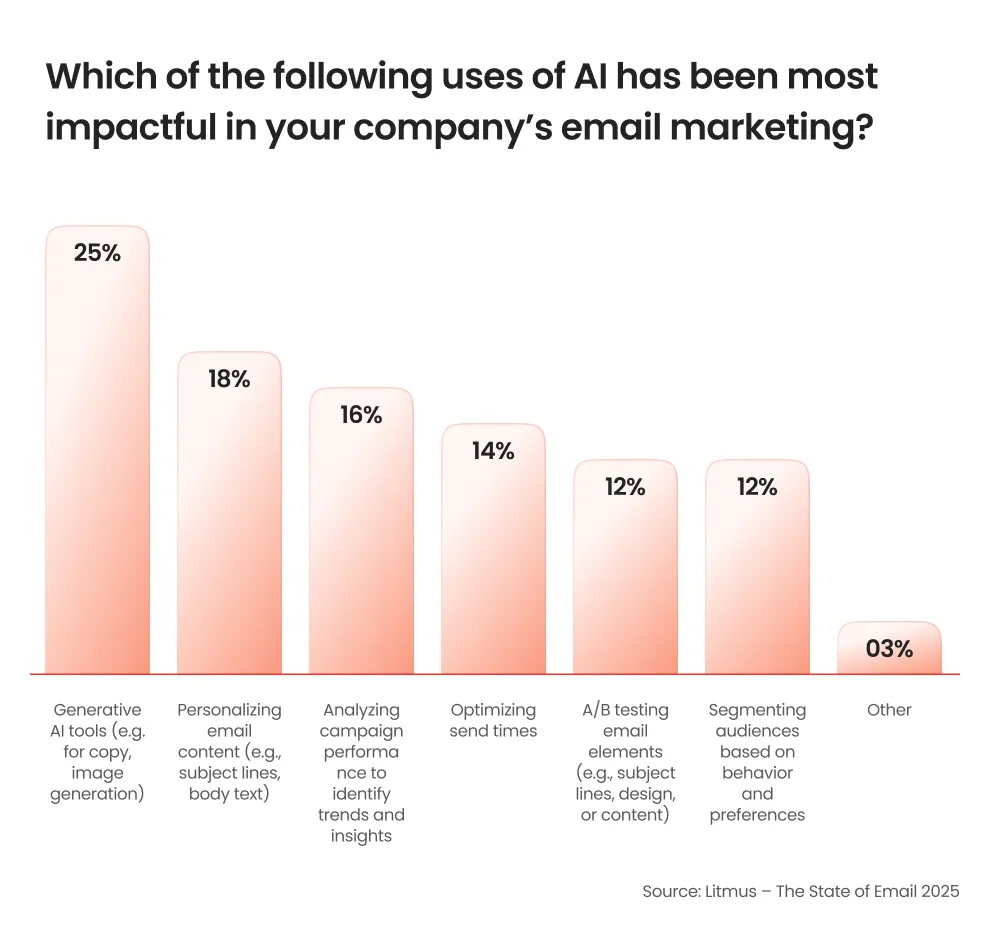
This challenge is driving rapid adoption of artificial intelligence (AI) in email campaigns. The State of Email 2025 reports that the most significant impact of AI in email marketing is generative AI for copy and image creation (25%), followed by personalizing content (18%), analyzing campaign performance (16%), and optimizing send times (14%). Brands are using AI primarily to streamline production, then extending it to personalization and optimization.

AI can transform email marketing when applied effectively. It enables faster understanding of customer intent, smarter segmentation, relevant content variations, and ongoing learning. Poor implementation, however, can result in emails that feel automated, generic, or intrusive.

This blog explains how to use AI for email personalization that sounds natural, builds trust, and drives better outcomes. You’ll see real campaign examples, best practices, and common mistakes. We’ll also close with how to scale creative personalization, without turning your team into a content factory.

What AI for Email Personalization Implies

AI for email personalization is the outcome of core AI layers working together to tailor email content, timing, and offers to each shopper’s behavior and context.

In most retail setups, personalization backed by AI is enabled by:

  • Recommendation engine that selects the most relevant products, categories, or content blocks for each customer (based on affinity, intent, and real-time signals).
  • AI/ML audience models that predict likelihood to buy, churn risk, next-best action, discount sensitivity, or category propensity, enabling more precise targeting and messaging than static rules.
  • A customer data layer (Audience Manager) that unifies identity and events across channels (web, app, POS, email), making personalization consistent and measurable.

With these enablers in place, AI for email personalization shows up in two ways:

Predictive decisioning (machine learning)

AI models analyze behavioral and transactional patterns to predict what a customer is most likely to do next, such as purchase, lapse, respond to an offer, or browse a specific category. These predictions guide who gets the email, what they see, and what the message should emphasize (newness vs savings vs convenience). This is commonly driven through Algonomy’s Audience Manager, combined with decisioning logic.

Content generation and variation (generative AI)

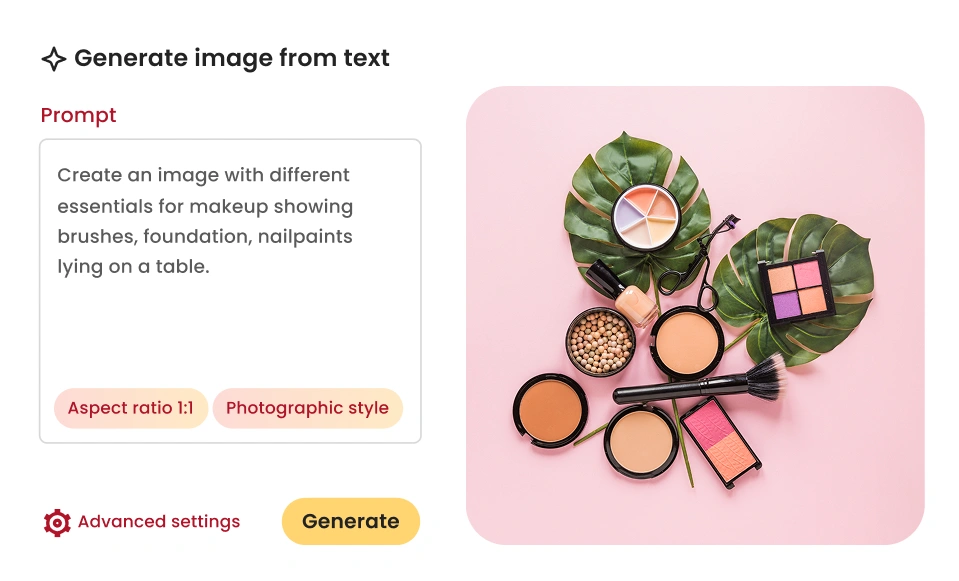
Generative AI supports the content side by creating and adapting email elements such as subject lines, headlines, product copy, and hero creatives. The goal is to increase relevance and speed without losing brand consistency. With Active Content, teams can use simple prompts to generate on-brand hero images and multiple headline/title variations for each email, enabling faster testing and personalization at scale.

Practical Examples of Using AI for Email Personalization

1 Personalized product picks that reflect intent,
not just history

Below are practical ways retailers use AI to personalize emails without sounding robotic. Each example focuses on relevance, not gimmicks.

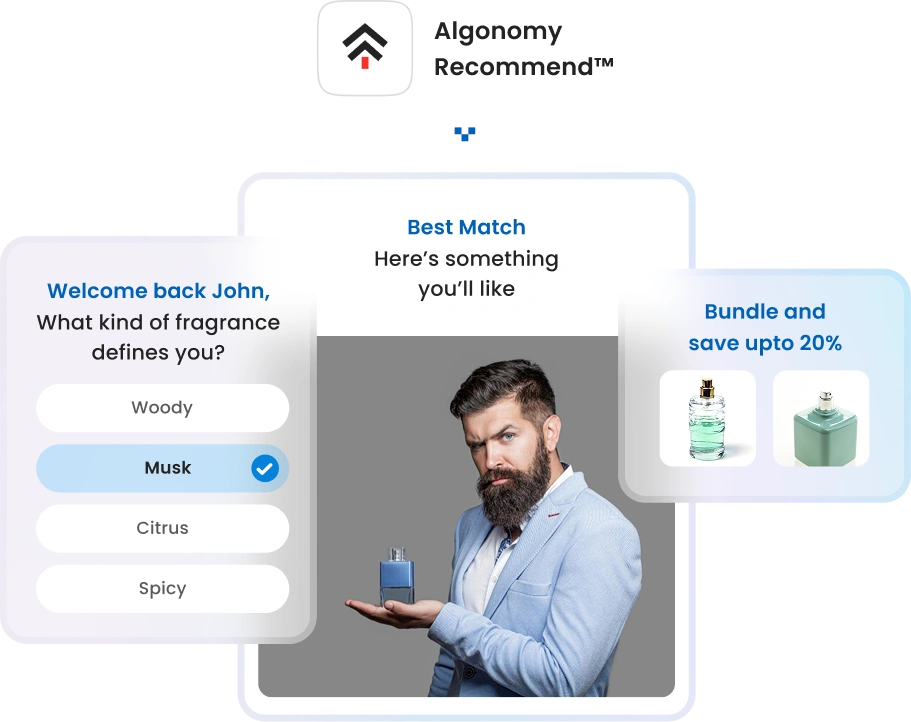
Instead of a generic “recommended for you” block that defaults to broad bestsellers, Recommend helps retailers tailor product picks and content to what each shopper signals in the moment, across browsing, affinity, and engagement patterns. The goal is simple: make the email feel like it was built for their intent, not for your average customer.

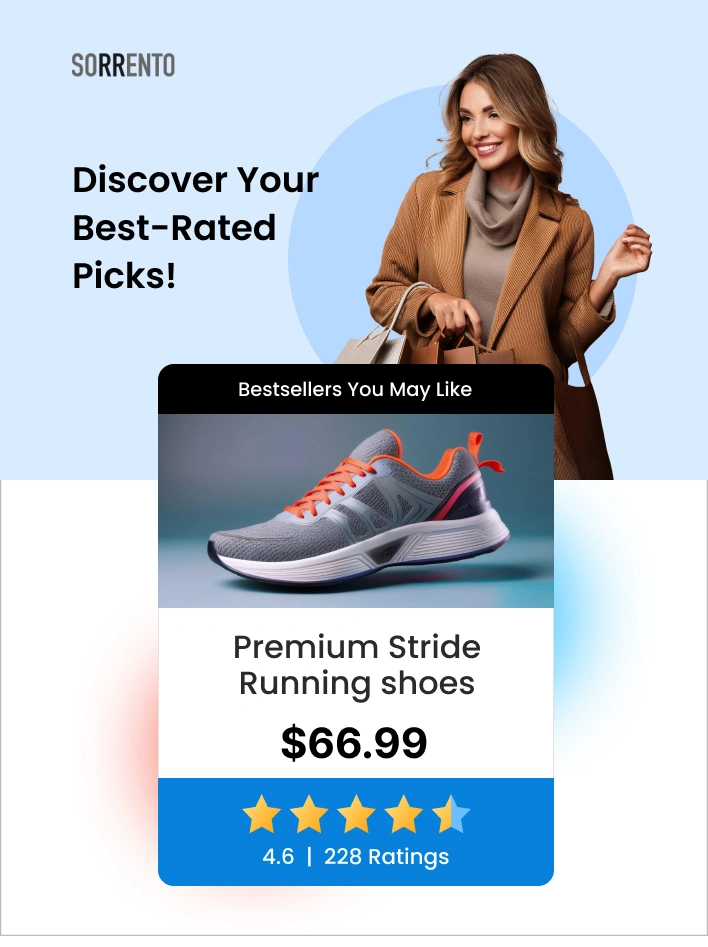
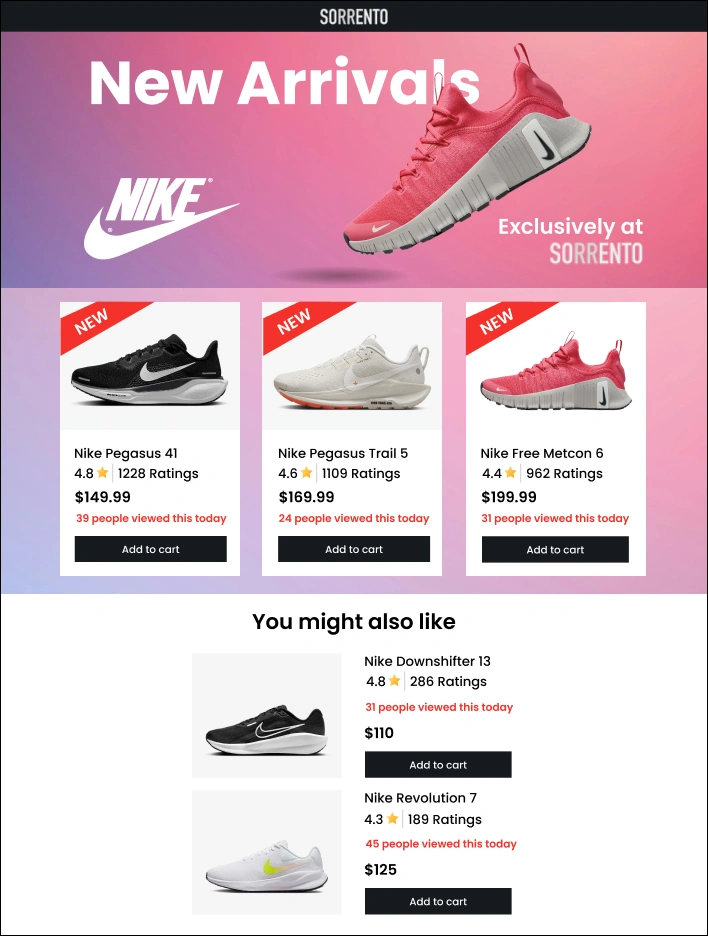
For example, if a shopper has explored running shoes multiple times, compared styles, and spent time on reviews, Recommend can prioritize high-intent, best-fit options within their price range, rather than pushing whatever is trending sitewide. If someone is browsing gift sets in December, the email can shift to giftable bundles and pair that with supporting content that reduces friction, like delivery urgency, easy returns, or “best gifts under…” messaging.

Why it Feels Human:
It mirrors what they’re currently trying to do.

2 Category-level personalization when the SKU-level is
too noisy

Not every shopper is ready for a specific product recommendation. Early in the journey, people browse broadly, compare styles, and explore price ranges. In these moments, category or theme-based personalization often feels more natural and less over-targeted.

With Algonomy’s Recommend, this is powered by affinity signals. As shoppers browse and engage, Recommend can help you identify affinity-based audiences (for example, athleisure enthusiasts, home organization, budget kitchen upgrades, skincare routine builders) and then tailor email content around the category they are most likely to care about right now. Instead of guessing, you’re aligning the email’s theme with the shopper’s demonstrated interest.

Examples of category-level themes that work well in retail:

  • New arrivals in contemporary sportswear
  • Trending kitchen upgrades under $50

Why it Feels Human:
It avoids overfitting and reduces the “I feel watched” effect.

3 Lifecycle emails that adapt based on predicted next best action

AI can choose which lifecycle path to send based on what a customer is most likely to need next.

  • New customer: onboarding with “how to style” or “how to use” content
  • Second purchase predicted: cross-sell accessories
  • Churn risk rising: reactivation with a softer incentive or a value-based message (newness, convenience, offers)

Why it Feels Human:
It fits where they are, not where your calendar says they are.

4 Personalized incentives that protect margin

Discounting everyone is easy. Discounting intelligently is better. Using affinity-based intent, such as purchase frequency, basket size, visit cadence, and offer sensitivity, retailers can tailor incentives so they drive action without turning every email into a coupon blast. For example:

  • No discount vs light nudge: Identify customers likely to convert with relevance alone, versus those who need a small incentive to move.
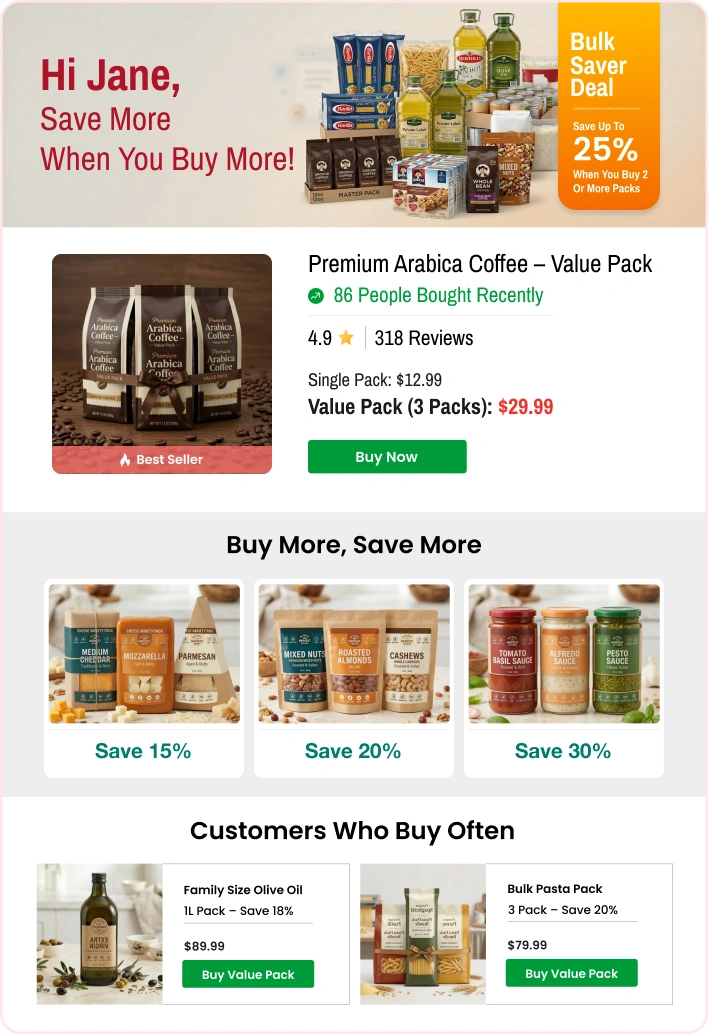
  • Bulk and premium offers: Encourage customers who buy smaller packs frequently to trade up with bulk discounts or ‘buy more, save more’ mechanics.
  • BOGO and reactivation offers: Use BOGO or bundle-style offers for shoppers with lower visit frequency or lapse risk to increase units and bring them back sooner.

Why it Feels Human:
The offers are appropriate rather than desperate.

5 Content module personalization, not whole email reinvention

Instead of rebuilding entire emails for every segment, retailers can personalize specific modules based on customer affinity and engagement signals.

Deciding what each shopper should see (audience/propensity/affinity-based decisioning)
Selecting the right content for that module (for example, product and category recommendations, loyalty messaging, or store/service content).

This keeps the email consistent in design, while making the most valuable blocks feel tailored.

  • Top module (interest-led): Use Recommend to populate category picks or product sets based on current affinity (for example, sportswear, kitchen upgrades), not generic bestsellers.
  • Middle module (value-led): Use Engage to tailor messaging based on loyalty tier or engagement stage, like points reminders, tier progress, or perks that match the customer’s status.
  • Bottom module (context-led): Personalize store/service content using customer context (nearest store, pickup options, delivery/returns messaging) so the email removes friction for how they’re likely to shop.

Why it Feels Human:
The email is customized where it matters without making the email
look over-engineered.

Benefits of Using AI for Email Personalization

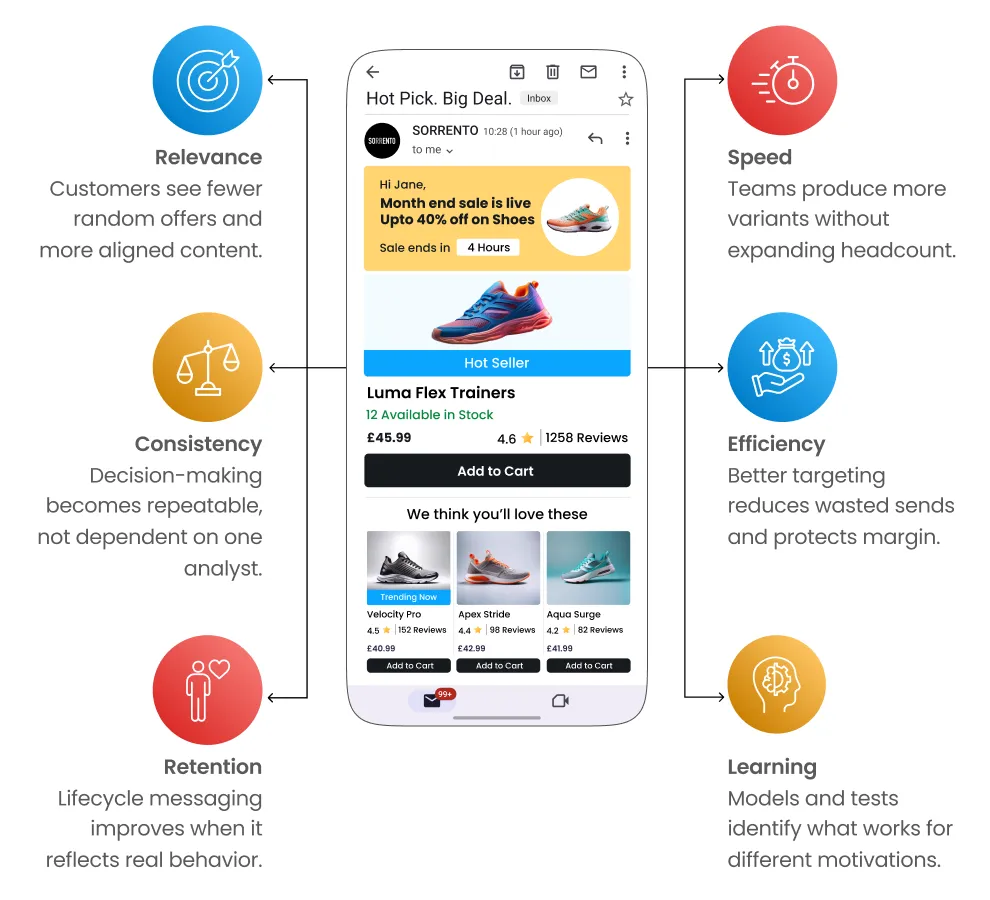
When done well, AI-led personalization improves:

  • Relevance: Customers see fewer random offers and more aligned content
  • Speed: Teams produce more variants without expanding headcount
  • Consistency: Decision-making becomes repeatable, not dependent on one analyst
  • Efficiency: Better targeting reduces wasted sends and protects margin
  • Retention: Lifecycle messaging improves when it reflects real behavior
  • Learning: Models and tests identify what works for different motivations

The goal is not to make every email different. The goal is to make emails consistently useful, so customers feel understood rather than processed.

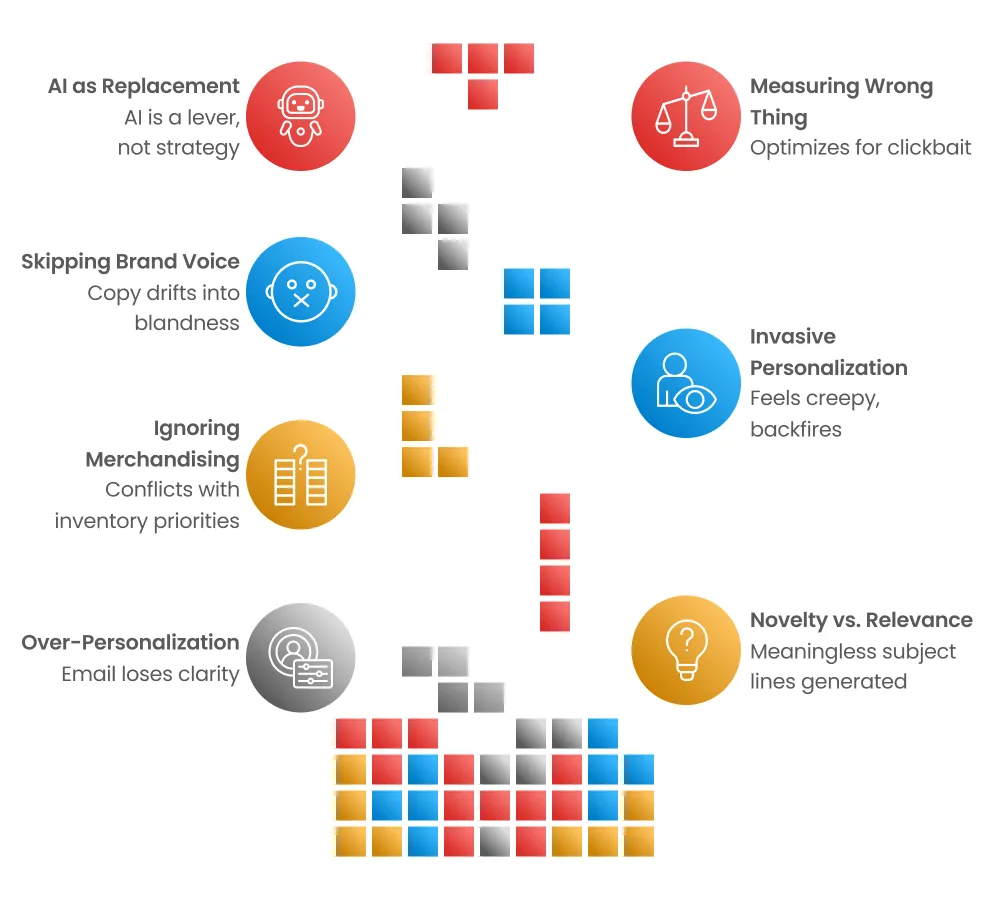
Common Mistakes and How to Avoid Them

Personalizing everything and improving nothing

If every module is personalized, the email may lose clarity. Begin by personalizing one high-impact section, then expand as measurement stabilizes.

Confusing novelty with relevance

AI can generate numerous subject lines, but not all will be meaningful. Ensure copy variations align with genuine motivations such as savings, newness, convenience, or exclusivity.

Letting the model ignore merchandising realities

If recommendations conflict with inventory, margin, or category priorities, internal resistance may arise. Implement guardrails and business rules to prevent this.

Using personalization that feels invasive

Overly specific references, such as “We saw you looked at this exact item at 10:30 PM,” can be off-putting. Strive for helpful personalization without crossing privacy boundaries.

Skipping the brand voice layer

Without clear voice guidelines, generative copy may become bland or excessively enthusiastic. Offer examples of approved tone, preferred language, and terms to avoid.

Measuring the wrong thing

Focusing solely on clicks can lead to clickbait. Balance engagement metrics with conversion rates, revenue per send, retention, and unsubscribe rates.

Treating AI as a replacement for strategy

AI is a tool, not a strategy. Your strategy should remain focused on delivering customer value by making it easier for people to discover, decide, and purchase.

What’s Next: Scaling AI Email Personalization with Active Content

Once your personalization strategy is clear, the hard part is executing it consistently, week after week, without creating messy emails, off-brand content, or recommendations that clash with merchandising reality. Algonomy brings that together by connecting decisioning and activation through three purpose-built capabilities that teams can run with.

Recommend helps you avoid personalizing everything and improving nothing by focusing personalization where it matters most: selecting the most relevant products or categories for each shopper based on affinity and engagement signals, while still respecting retail guardrails. This directly addresses the pitfall of letting personalization ignore merchandising realities, because recommendations can be governed by practical constraints like availability, category priorities, and commercial rules, so the email looks smart in theory but wrong in practice.

Active Content solves the second big pitfall: confusing novelty with relevance, and skipping the brand voice layer. Instead of churning out endless copy that sounds generic, Active Content helps teams generate on-brand hero banners and multiple headline/title variations quickly, so creative stays fresh without drifting off tone. It also reduces the operational friction that causes teams to fall back on the same templates, enabling you to produce variation at speed while still keeping control over what goes live.

Social Proof Messaging helps prevent personalization from feeling invasive or too engineered. Rather than calling out overly specific user actions, it supports credible, conversion-friendly reassurance using social validation cues (for example, what’s trending, what others are buying, or confidence-building proof points) in a way that feels natural in retail messaging. This is especially useful when a customer is undecided, because the email can add trust and urgency without leaning on creepy specificity.

Together, these three products help you execute AI for email personalization- relevant recommendations, on-brand creative variation, and confidence-building proof, measured against outcomes that matter (conversion, revenue per send, retention), not just clicks.

kflows create bottlenecks in launching personalized campaigns, requiring extensive

Table Of Contents
What AI for Email Personalization Implies
Practical Examples of Using AI for Email Personalization
Benefits of Using AI for Email Personalization
Common Mistakes and How to Avoid Them
What’s Next: Scaling AI Email Personalization with Active Content

FAQs

What is the best use case for AI email personalization?

Begin with a high-volume program with clear relevance, such as browse abandonment, cart abandonment, or category-based recommendations. This approach enables faster learning and clearer measurement.

How do I keep AI email personalization from sounding robotic?

Anchor personalization to customer intent, adjust messaging by segment, use clear language, and follow a brand voice guide. Avoid excessive personalization and always include fallback options.

Do I need first-party data to do AI email personalization well?

Yes, first-party signals such as browsing, purchase, engagement, and preferences provide the most reliable foundation. Catalog and contextual data can enhance personalization, but consented first-party data ensures accuracy and trust.

The Role of Browsing Behavior in Email Personalization

Omnichannel Marketing
Blogs

The Role of Browsing Behavior in Email Personalization

A decade ago, email personalization felt like progress if you could do two things well: address the customer by name and swap in a few product recommendations based on purchase history.

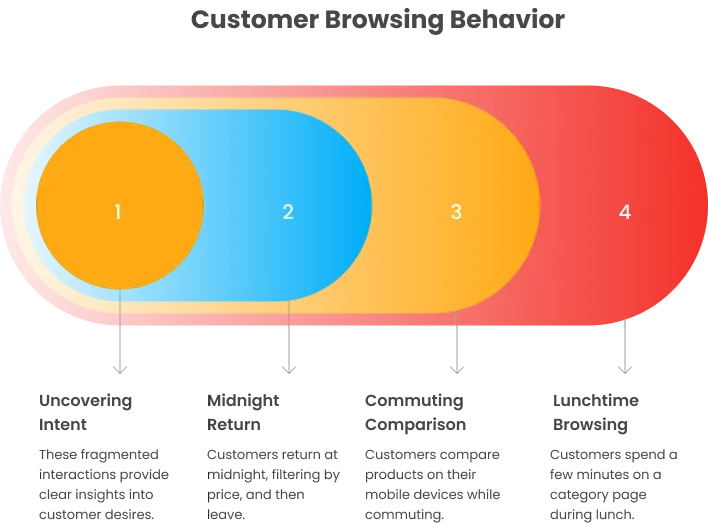
Customers browse in short, fragmented sessions, such as a few minutes on a category page during lunch, comparing products on mobile while commuting, or filtering by price late at night. These actions are not captured in purchase history, yet they often provide the clearest insight into future intent. As a result, leveraging browsing behavior has become essential for growth teams. Browsing behavior reflects intent, which can quickly expire.

If your email arrives after that intent has cooled, or if it reflects what the shopper cared about yesterday rather than what they care about at open time, you get what most retailers are seeing right now: decent deliverability, acceptable open rates, and a slow leak in click and conversion rates.

This is also the moment when marketers start searching for email personalization tools that can go beyond segmentation and send-time rules, and actually keep content relevant in motion.

A common misconception is that the challenge is creative. In reality, most email programs still function like print: content is finalized and static at send. However, browsing behavior changes frequently.

So the question arises
How do you build an email that behaves like a live digital touchpoint?

Why Browsing Behavior is the Highest Leverage Personalization Signal in Retail Email

Most retailers already personalize with name, location, or past purchases. Those are useful, but they have two limitations:

  • They change slowly
  • They do not always reflect the shopper’s current intent

Browsing behavior is different. It is fresh, contextual, and predictive.
A shopper who has viewed formal wear multiple times and compared brands within a week is often closer to purchasing than someone who bought formal wear months ago. Browsing behavior captures micro-intent, such as category interest, emerging brand preferences, price sensitivity, and decision friction.

Browse abandonment emails are effective because browsing activity signals intent, even at earlier stages than cart abandonment.

Framework for Turning Browsing Behavior into Email Personalization that Converts

1 Define the browsing signals that matter

Not every click deserves an email. Start with signals that show intent or friction:

  • Product views: repeat views, high dwell time, comparison behavior
  • Category views: repeated exploration of a category without purchase
  • Search behavior: high-intent queries (brand + product type), ‘size’ searches, ‘near me.’
  • Browse abandonment: product or category viewed, then the session ends with no cart
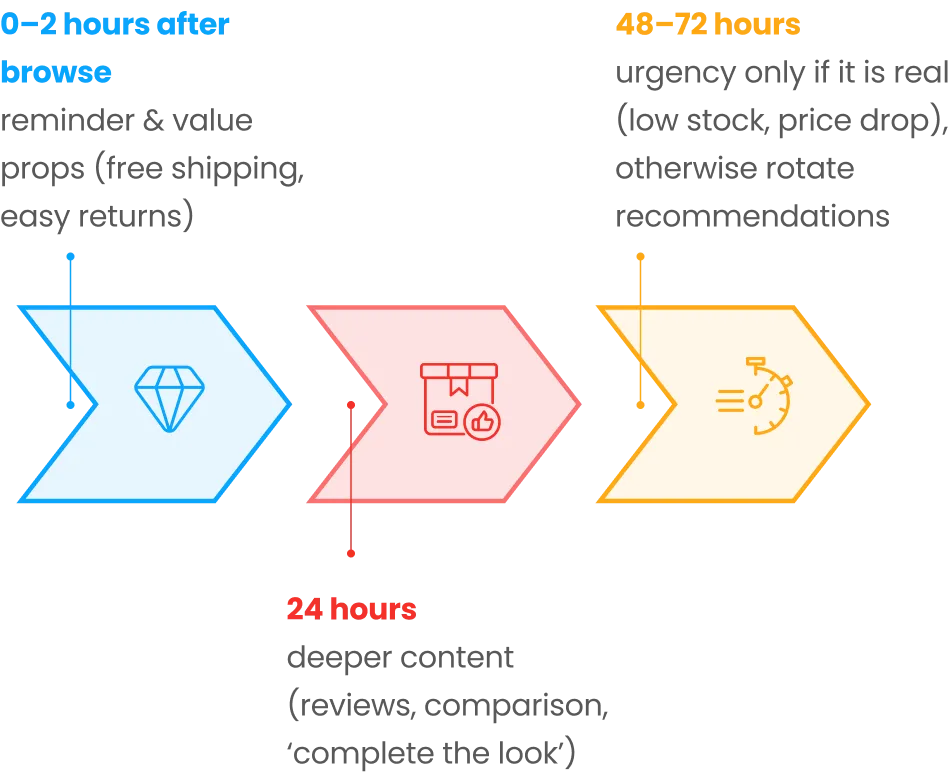
  • Engagement recency: last browse within 24–72 hours (or category dependent)

Product views > Category views > Search behavior > Browse abandonment > Engagement recency

2 Map signals to the right email moments

A common mistake is treating browse and cart abandonment as the same. They are not. Browse abandonment needs lighter friction and more inspiration.

A simple mapping that works well:

Industry best practices for browse abandonment follow this cadence: begin with a gentle reminder, then provide stronger proof or incentives in subsequent messages.

3 Decide what content should be dynamic

Many programs plateau at this stage, personalizing only subject lines while keeping the email body static.

Instead, identify modules that should update at open time:

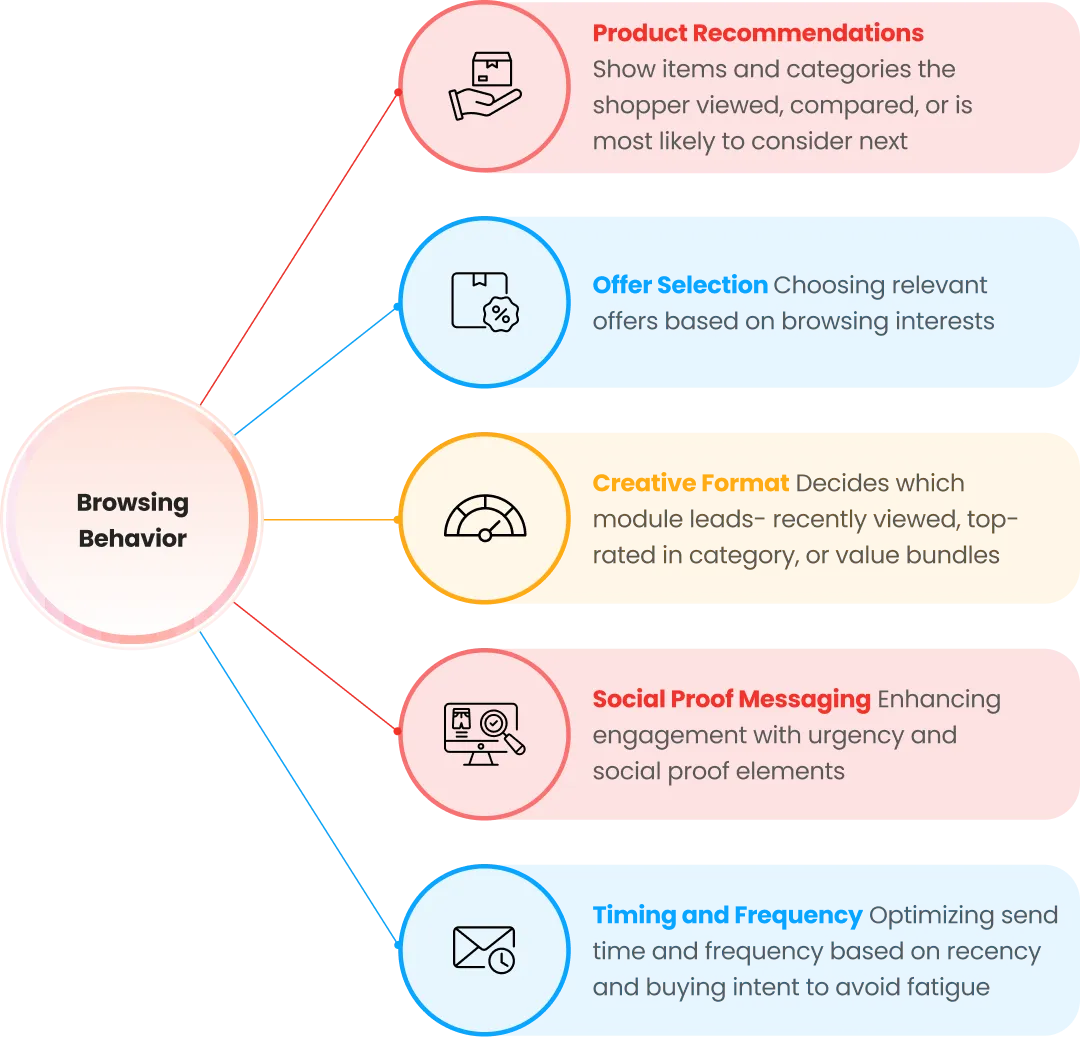
  • Recently browsed products (or category)
  • Price and discount status
  • Inventory level or availability
  • Ratings and reviews
  • Store proximity or fulfillment options
  • Personalized recommendations as per browsing behavior

4 Enrich browsing behavior with context

Browsing behavior indicates what action is needed, while context reveals the underlying objective.

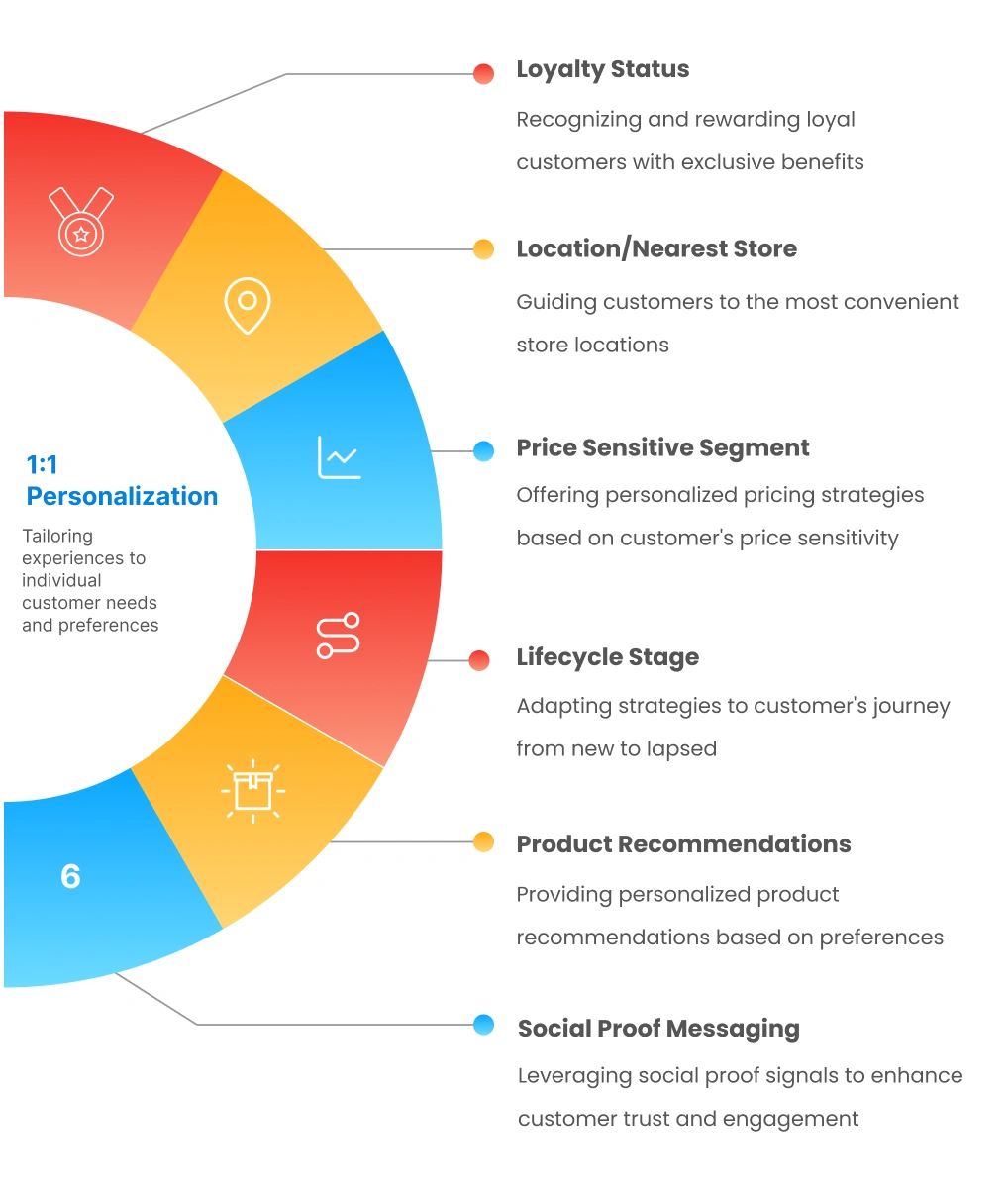
Effective personalization combines browsing behavior with loyalty status, location or nearest store, price sensitivity, lifecycle stage, product attributes, and social proof.

Many email personalization tools struggle at this stage because relevant data is distributed across multiple systems, including CDP, product catalog, reviews, inventory, loyalty, promotions, and recommendations.

Where Most Email Personalization Tools Fall Short

Searching for “email personalization tools” yields many lists, but these often conflate two categories:

  • Tools that help write personalized copy (often for sales outreach)
  • Tools that personalize the customer experience in retail (data-driven content, recommendations, dynamic modules)

For retail growth, focus on the second category.

While many marketing automation platforms can segment and trigger emails, advanced dynamic content often requires additional development, complex integrations, or custom templates. This gap highlights the value of open-time and dynamic module approaches. When evaluating email personalization tools, prioritize operational capabilities over feature checklists.

How Algonomy’s Active Content Operationalizes Browsing Behavior at Scale

Algonomy’s Algonomy Active Content delivers hyper-personalized marketing content across email, WhatsApp, and SMS by dynamically assembling content from multiple data sources and rendering the most relevant version when the customer interacts. This bridges the gap between browsing behavior and actionable creative.

Open-time personalization: Content updates when the email is opened, preventing stale pricing, sold-out items, or outdated recommendations.

Generative AI: Powered by Generative AI and Algonomy’s decisioning engine, Active Content precisely tailors each message for the individual and integrates seamlessly with existing MarTech stacks.

Multi-source data stitching: Combine browse events from your CDP, product data from your catalog, offers from your promotions engine, reviews from third-party APIs, and inventory from your OMS into a single, consistent, and current email module.

Reusable creative logic: Build a browse personalization module once and reuse it across segments, regions, and campaigns without recreating templates.

In Conclusion

Browsing is now the most time-sensitive signal in retail marketing, as customers explore in short bursts, switch devices, and change preferences quickly. Browsing behavior functions more as a live intent feed than traditional engagement data.

Successful brands treat browsing intent with discipline, interpret it thoughtfully, avoid over-personalization, and ensure content remains accurate when the customer opens the message. Relevance now depends on real-time accuracy, not just information available at send time.

This marks the shift from personalizing emails to personalizing the entire experience. When evaluating email personalization tools, prioritize platforms that convert behavioral signals into open-time, multi-source, no-code dynamic content that aligns with customer intent and powers hyper-personalized email campaigns.

Table Of Contents
Why Browsing Behavior is the Highest Leverage Personalization Signal in Retail Email
Framework for Turning Browsing Behavior into Email Personalization that Converts
Where Most Email Personalization Tools Fall Short
How Algonomy’s Active Content Operationalizes Browsing Behavior at Scale
Conclusion

FAQs

What is the role of browsing behavior in email personalization beyond browse abandonment?

Browsing behavior can power category-affinity campaigns, product-comparison messaging, price-drop alerts, back-in-stock journeys, and loyalty nudges. It is a real-time intent signal, not just a trigger.

How do email personalization tools use browsing behavior safely without feeling creepy?

Use restraint and relevance: limit frequency, avoid overly specific language (“we saw you do X”), and focus on practical utility like reviews, availability, and curated alternative guides. Recommend balancing personalization with customer comfort and privacy expectations.

What should I look for in email personalization tools if I want to use browsing behavior well?

Prioritize open-time personalization, the ability to stitch data from multiple systems (CDP, catalog, inventory, reviews, loyalty), and marketer-friendly workflows that reduce IT dependency.”

The Email Personalization Upgrade Retail Marketers Need

Omnichannel Marketing
Blogs

The Email Personalization Upgrade Retail Marketers Need

If you’ve ever looked at a campaign report and thought, “The offer was good, the creative was solid, why didn’t this land?” you’re not alone.

The challenge in retail is usually not the message itself, but the timing. Customers open emails when it suits them, not when you send them. By then, key details such as availability, price, urgency, and pickup options may have changed.

Email personalization is about staying relevant when the customer opens the email. This is where Recommendation Engine-powered personalization with Active Content stands out. Recommendation Engine helps pick the best products or messages for each shopper, and Active Content updates the email at open, keeping it accurate and up to date.

In other words, you’re not trying to make emails smarter for the sake of it. You’re trying to make them dependable. When what the customer sees in the inbox matches what they see on the site, right now clicks turn into confident clicks, and confident clicks turn into revenue.

Why Generic Personalization Stops Working in Retail

Most retail teams already personalize emails by using customer names, broad segments, and automated journeys like welcome, browse abandonment, and cart abandonment. These methods still help, but they are just the starting point.

The real issue isn’t personalization itself. It’s about getting the timing and accuracy right.

Retail moves quickly. Products sell out, prices change, and promotions update. A shopper’s intent can shift after just one browsing session. If your email content is set when you send it, it can quickly become outdated. When that happens, even a personalized email can feel generic.

Today’s shoppers compare your emails to their experience on your website. Online, you show what’s in stock, current prices, and recommendations based on recent activity. Your emails need to meet that same standard.

Active Content is built for that reality. Instead of treating email as a fixed design, Active Content lets you use dynamic content blocks that can update at open. This is especially useful in retail, where ‘what is true right now’ drives conversion.

Rethinking Email Personalization in 2026

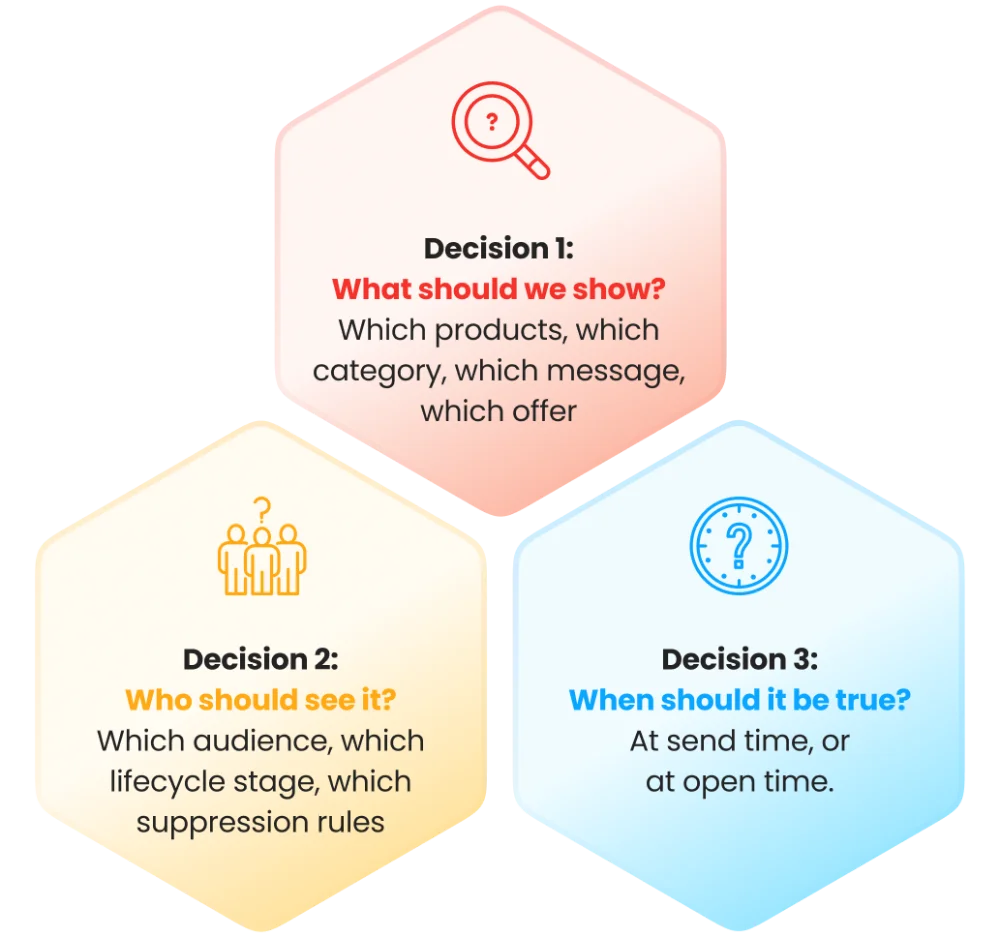
Every retail email has three decisions hiding inside it:

Most brands focus on the first two decisions and assume the third will work out on its own. But it doesn’t.

This is where Recommendation Engine-powered email personalization comes in. A Recommendation Engine can help with the first decision for each individual. Instead of picking one set of products for an entire segment, it can choose the right mix or message for each shopper, using signals such as browsing history, past purchases, price sensitivity, and channel engagement.

Active Content supports the third decision. It ensures the email matches what’s true when the shopper opens it. It can handle:

  • Open-time rendering of product content
  • Inventory and price-aware messaging
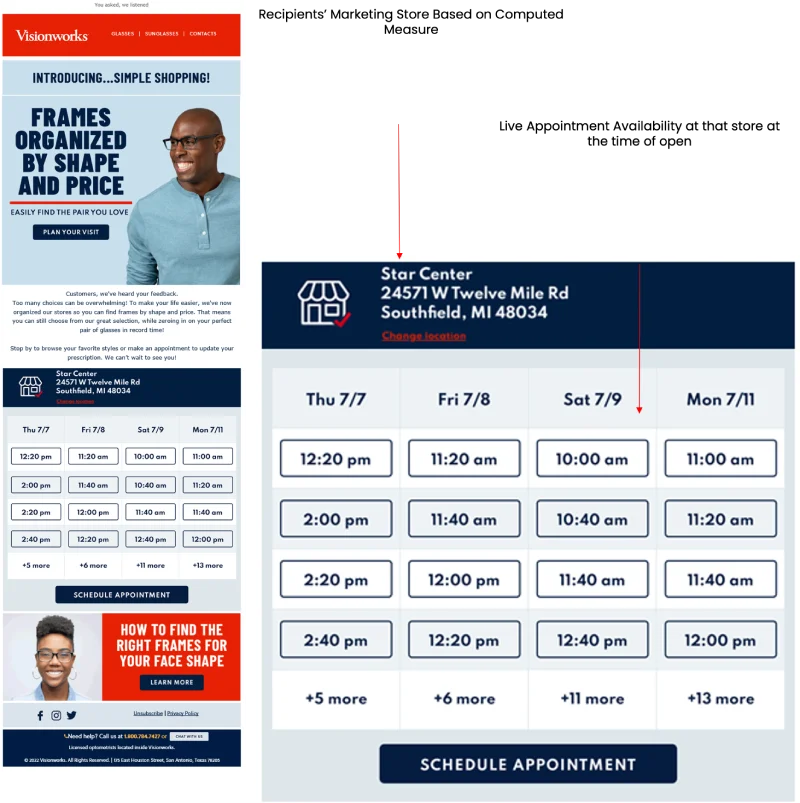
  • Store pickup and nearest store inventory
  • Deadline and countdown modules that remain accurate
  • Personalized content blocks driven by customer profile and behavior

Strategies that Make Email Personalization Feel Human

1 Make cart and browse emails accurate, not just automated

Cart and browse abandonment campaigns work well because they match real customer intent. But they can fail if the product sells out, the price changes, or the customer already bought the item.

With Active Content, recovery messages are more robust. The product block checks availability when opened, and if an item is out of stock, it can show a similar item or the store’s availability. With Active Content, abandoned cart emails are improved with inventory data, social proof, reviews, and recommendations.

2 Leverage urgency in a clean, honest way

Retailers use urgency to drive action, but customers dislike fake urgency.

A countdown timer works well when it’s tied to a real deadline, such as a sale ending, a shipping cutoff, a store event, or limited-time access. But it only helps if it’s accurate when the email is opened.

Active Content solves this by using a countdown block that updates when opened. This way, you avoid emails that say “3 hours left” when the customer opens them the next day.

A Recommendation Engine-powered email personalization can help here, too. Different customers respond to different motivators, some to early access, some to free shipping, and others to value. The Recommendation Engine can choose the best message to pair with urgency.

3 Make the Email do One Convenience Job

Most promotional emails try to cover everything. A simple way to improve results is to add a single convenience feature that makes things easier for customers.

In retail, the best convenience modules are often:

  • Store pickup availability
  • Nearest store address and hours
  • Delivery ETA messaging
  • Back in stock notifications
  • Loyalty points or member benefit reminder

Active Content lets you show these features based on customer profile and location. The email is easier to use because it answers the “Can I get it now?” question without making the customer click.

Why Open-time Email Personalization is a Game Changer

If you change how your content is shown, you need a clear way to measure the results. Keep your metrics simple.

  • Click rate and click-to-open rate
  • Conversion rate from email sessions
  • Revenue per email
  • Revenue per click
  • Downstream metrics in key journeys like cart recovery

Then add one operational metric that leadership will care about:

Time to launch: how quickly marketing can ship a campaign with
 personalization changes

If Active Content is doing its job, you should see two wins:

  • Better relevance results (more clicks and conversions)
  • Better operating results
 (fewer template versions, less rework, faster updates)

Our Customers Have Seen Significant Results

0 %
Higher CTR
0 %
Higher Conversions
-90 %
Campaign Build Time

Personalizing Without Breaching Privacy

Retail marketers are right to be cautious about going too far with personalization. The aim isn’t to surprise customers with what you know, but to be helpful.

Checks to ensure email personalization stays customer-friendly:

  • Keep personalization focused on shopping intent and convenience.
  • Use clear fallbacks when data is missing.
  • Avoid overly specific statements about browsing that feel invasive.
  • Make sure offers, prices, and deadlines are accurate.
  • Keep frequency
in check so relevance does not turn into noise.

Active Content helps by allowing blocks to use fallback logic. If a customer has no history, show best sellers. If you don’t know their location, skip the store module.

Conclusion

The best retail emails don’t feel like mass messages. They feel like your brand is paying attention.

That’s the real promise of email personalization in 2026: not just adding data, but making sure emails stay relevant and accurate when customers open them.

Active Content lets you use dynamic blocks in your emails, so the experience stays up to date even if the email is opened hours or days later. When you do this well, your inbox feels more like your storefront, always updated, relevant, and ready to convert.

Table Of Contents
Why Generic Personalization Stops Working in Retail
Rethinking Email Personalization in 2026
Strategies that Make Email Personalization Feel Human
Why Open-time Email Personalization is a Game Changer
Our Customers Have Seen Significant Results
Personalizing Without Breaching Privacy
Conclusion

FAQs

What is email personalization in retail, beyond using a first name?

Email personalization is using customer context to change what the email shows, not just who receives it. In retail, that usually means tailoring product tiles, offers, category focus, store messaging, and timing based on signals like browsing, purchase history, loyalty status, and location. The goal is simple: make the email feel relevant when he customer opens it, not just when it was sent.

How does Active Content improve email personalization?

Active Content enhances email personalization by enabling dynamic content blocks within the email. Instead of locking everything at send time, key sections such as product modules, offer messaging, store pickup modules, and urgency timers can be updated at open time. That helps reduce “dead clicks” caused by out-of-stock products, price changes, or expired offers, and keeps the email aligned with what the customer will see after they click.

How do you know email personalization is working beyond clicks?

Look for fewer dead clicks and more revenue-quality engagement: higher conversion rate from email sessions, higher revenue per email, and stronger performance in key journeys like browse and cart recovery. Active Content also helps operations, as teams can reuse dynamic blocks instead of building multiple versions, improving campaign speed without sacrificing relevance.

Turning Customer Data into Actionable Insights with a Real-Time Customer Data Platform

Post
Blogs

Turning Customer Data into Actionable Insights with a Real-Time Customer Data Platform

Digital-first brands are not short of customer data. Product analytics, CRM entries, web and app behavior, campaigns, surveys, and billing systems all collect data, However, they are stored in different locations. When leadership asks simple questions, such as “Which customers are at risk right now?” or “Which journeys create the most expansion?”, the answers still require days of manual work.

The global customer data platform market was valued at approximately $5.4 billion in 2023 and is expected to surpass $51.95 billion by 2030, driven by the growing demand for first-party data, personalization, and AI-ready infrastructure.

Marketing teams continue to invest in tools, but decisions still rely on instinct and manual spreadsheet work. In a market where growth has slowed, and efficiency matters more than vanity metrics, that gap between raw data and actionable insights is becoming unsustainable.

One-third of companies in a recent HubSpot study reported direct revenue loss due to their customer data being scattered and disorganized, and only 9% stated they fully trust their data for reporting purposes. Salesforce research supports this, with 81% of leaders stating that data silos slow digital transformation.

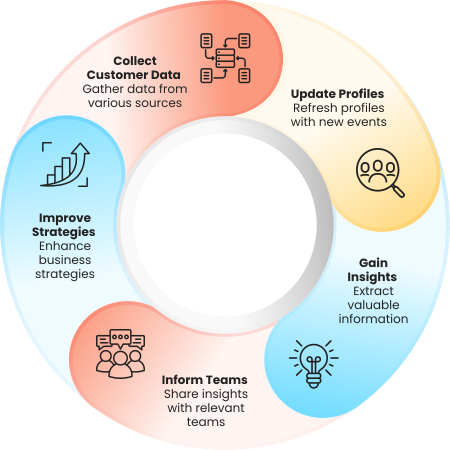
This is the problem a real-time customer data management platform (rCDP) is designed to solve. rCDP creates a single, unified view of each customer and turns that view into real-time intelligence that any team can utilize.

Why More Customer Data isn’t Translating into Better Decisions

Every team views a different aspect of the same customer.

  • Marketing monitors campaign performance and lead scoring.
  • Product teams watch features, cohorts, and events.
  • Sales and account teams look for CRM opportunities and renewal dates.
  • Customer success relies on ticketing systems and NPS tools.

In theory, each function is working with data. In practice, they work with different subsets, stored in separate systems, each with its own fields and definitions. Reporting takes days of manual reconciliation. By the time a combined view is ready, the customer might be about to drop off.

From the customer’s perspective, this fragmentation is obvious. A prospect that is highly engaged in the product might still receive generic nurture emails. Loyal customers are sometimes treated like strangers because one platform has not synced with another. The problem is not a lack of data. It is the lack of a single, trusted customer data platform.

How Identity Resolution Turns Fragmented Data into One Customer Truth

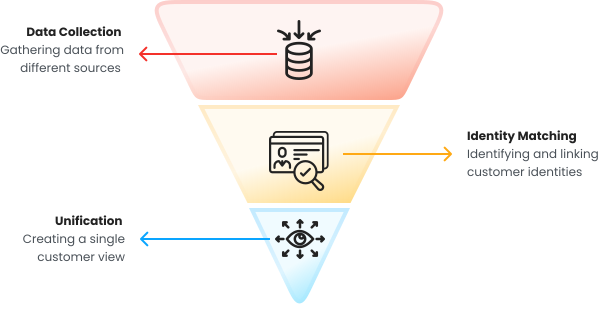
The first job of any credible customer data platform is identity resolution. One person might appear as a free trial user with a personal email address, a contact in CRM management with a corporate domain, a billing owner in the finance system, and an attendee in webinar tools. Without a unifying layer, each system treats them as a different person.

Algonomy’s platform applies deterministic and probabilistic matching techniques to stitch these fragments together into a golden customer record. That record contains demographic details, firmographic attributes, purchase history, channel preferences, consent flags, and summary metrics built from event streams.

How to Achieve a Unified Customer Profile with CDP

This unified customer profile does more than remove duplicate records. It becomes the shared language of the business. Product teams can identify which features are most important to high-value accounts. Marketing teams are aware of which channels each customer prefers. Finance and leadership can finally reconcile revenue numbers with actual engagement. Because the customer data management platform updates profiles as new events arrive, insights remain fresh, rather than being confined to static quarterly decks.

From Disconnected Events to Meaningful Segments and Insights

Raw data on its own rarely changes decisions. What teams need are segments, scores, and insights that prioritise where to act. A customer data management platform accelerates this step by enabling users to work directly with unified data, eliminating the need for engineering tickets.

With Algonomy’s platform, marketers and growth leaders can define audiences based on product behaviour, recency and frequency of usage, campaign interactions, lifecycle stage, predicted value, and more. The CDP’s artificial intelligence (AI) and machine learning (ML) capabilities help uncover micro segments that would be hard to spot manually, such as clusters of customers who respond strongly to a certain offer or who tend to expand into a specific module next.

When segments and insights live inside the customer data platform, they are not just reports. They are live objects that journeys and campaigns can use immediately.

To learn more, read 5 Must-have Spells for Mastering Audience Engagement with CDP

Activating Insights Across Every Customer Touchpoint

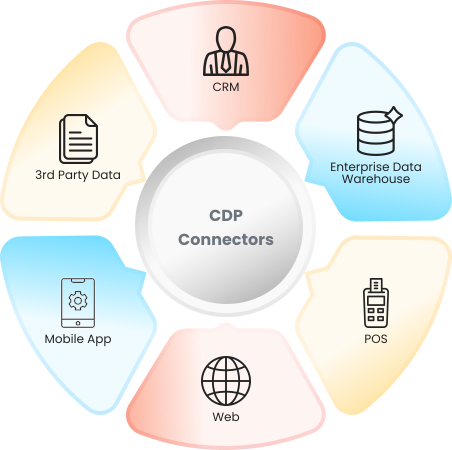
Insight only matters when it transforms customer experience. A stellar customer data platform connects unified profiles and segments to every important touchpoint. Algonomy’s customer data platform plugs into email service providers, mobile push and SMS tools, digital advertising platforms, contact centers, kiosks, websites, and apps through out-of-the-box connectors.

As the platform analyzes new events in real-time, it can trigger journeys the moment something meaningful occurs.

  • A trial user who reaches a key feature milestone can enter a tailored sequence.
  • A paying customer whose usage drops can enter a save journey that blends in product nudges, targeted offers, or human outreach.
  • When a customer shows a strong affinity for a set of products, relevant recommendations and offers appear consistently across email, app, and site, rather than as disconnected messages.

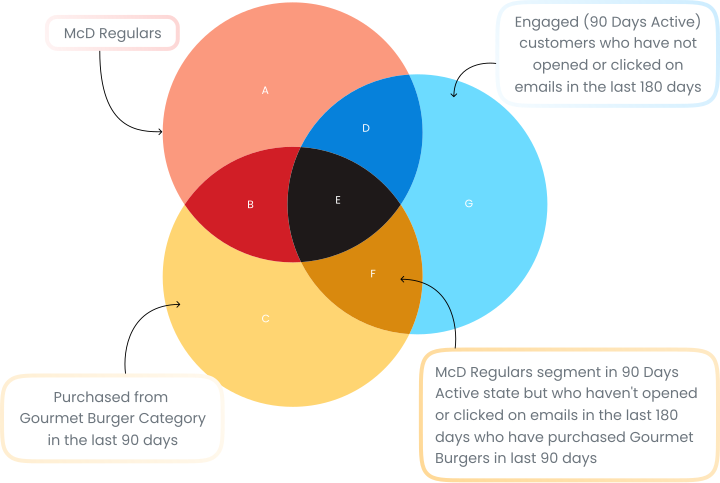
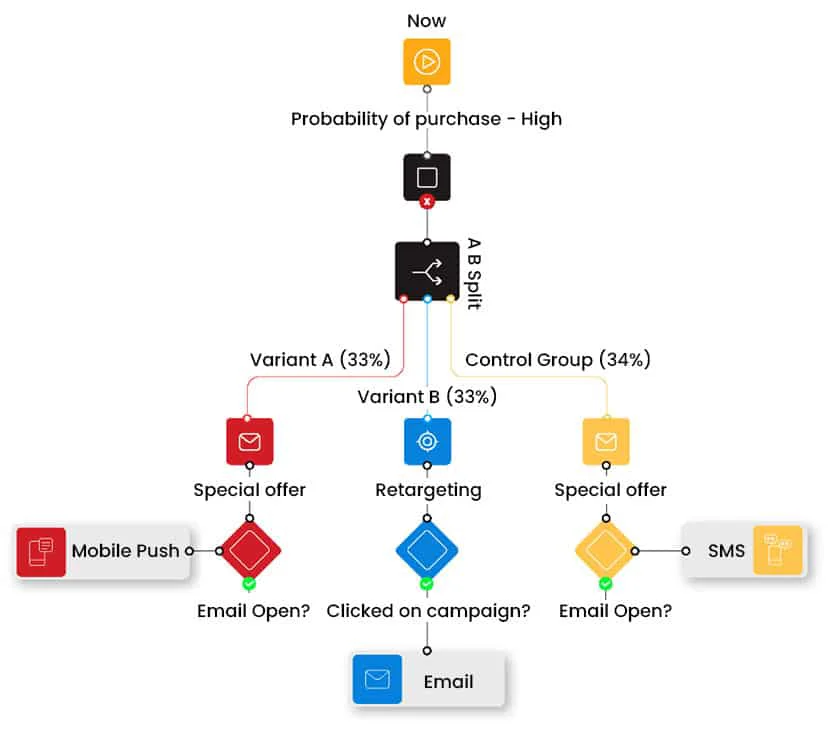
At McDonald’s India, Algonomy’s customer data management platform and customer journey orchestration solution allowed the brand to create automated journeys for weekly promotions, frequency building, McDelivery penetration, and win-back strategies. This automation ran across SMS, email, Facebook, and WhatsApp, with A/B tests and universal control groups to measure impact.

Algonomy’s platform helped McDonald’s in creating microsegments to design winback campaigns.

Why Successful Marketing Teams Leverage a Customer Data Platform

The value of a customer data platform becomes most clear when examining specific outcomes. A few high-impact scenarios stand out across Algonomy’s customer base.

  • Intelligent onboarding and activation
    By combining acquisition source and early product behavior, the rCDP platform identifies the actions that correlate with long-term retention. Marketing teams can then design onboarding flows that guide each customer through those actions, rather than a generic checklist.
  • Product and account qualified lead scoring
    Instead of static scores that live only in CRM, an rCDP recalculates scores whenever important events occur. Sales can focus on the highest intent accounts, while marketing uses similar signals for lookalike audiences and retargeting.
  • Retention, win back, and expansion
    Signals such as declining usage, negative feedback, or repeated support tickets feed into churn propensity models. The rCDP uses those models to trigger save plays, offer adjustments, or success outreach before it is too late.
  • Cross-sell and expansion journeys
    Unified profiles and basket analysis models highlight the next best product, module, or package for each customer. Journeys can then present these in a sequence rather than relying on a one-off campaign.
  • Scalable Omnichannel Engagement
    McDonald’s (West & South India) deployed Algonomy’s customer data platform, customer journey orchestration, and marketing services to centralise customer data management across delivery apps, aggregators, and physical stores. This unified view enabled granular segmentation and automated campaigns across six channels, creating more than:
0 %
Million Engagement Opportunities
0 %
Growth in Omnichannel Customers
0 %
YoY Increase in McDelivery Users

How to Evaluate a Customer Data Platform That Delivers Business Impact

Once the business case is established, the next step is selecting the right customer data platform. Drawing on industry research and Algonomy’s experience with over 400 brands, the following criteria can guide your decision.

Strong data management foundation
Look for flexible ingestion options, such as batch files, real-time APIs, and clickstream capture, along with robust cleansing, enrichment, and identity resolution. Algonomy’s platform supports deterministic and probabilistic matching, household creation where relevant, and enrichment from third-party sources.

Audience building and analytics for business teams
An effective CDP enables marketers, product managers, and CRM teams to easily build segments, apply AI-based models, and analyze performance over time without heavy engineering support. The interface should function as a workspace rather than a back-office tool. Algonomy’s platform combines Audience Manager, built-in analytics, and AI/ML models for affinity, churn propensity, and replenishment, making advanced segmentation accessible.

  • Clustering Model​
  • RFM based Audiences
  • Churn Propensity
  • CLTV Model
  • Propensity​
  • Replenishment
  • Affinity Model
  • Lookalike Model
  • Market Basket Analysis

Algonomy’s platform should integrate easily with existing channels and orchestration tools. It should provide capabilities for audience export, triggered journeys, and rule-based flows that work across email, mobile, digital advertising, and on-site experiences. Algonomy’s platform integrates journey orchestration and personalization, enabling teams to transition from insight to experience without needing to build custom connectors for every idea.

Security, privacy, and governance
Finally, any platform that handles customer data management must prove its approach to privacy, consent, and security. This includes support for regional regulations, access controls, and clear auditability. Many marketing leaders say that management of first-party customer data in a way that balances privacy and value exchange is becoming increasingly challenging, so the CDP must help rather than add risk.

When evaluating options, it often helps to run a pilot that connects a few key sources, delivers one or two priority use cases, and measures impact. That reveals how well the platform works with your existing stack and teams in practice, not just in slideware.

Future-proofing Your Data Strategy With CDP

The next wave of growth in SaaS and retail will belong to companies that treat customer data management as a strategic asset rather than a byproduct of operations. AI, predictive models, and automated agents will amplify this difference. Models are only as good as the data they are trained on. If that data is scattered, stale, or poorly governed, the promise of AI-driven personalization and efficient growth will remain out of reach.

A customer data platform is not a magic wand, but it is a practical way to build solid foundations. By unifying customer data into trusted profiles, surfacing actionable segments and insights, orchestrating journeys across all channels, and closing the loop with measurement, a CDP turns the idea of customer centricity into an operational reality.

Table Of Contents
Why More Customer Data isn’t Translating into Better Decisions
How Identity Resolution Turns Fragmented Data into One Customer Truth
How to Achieve a Unified Customer Profile with CDP
From Disconnected Events to Meaningful Segments and Insights
Activating Insights Across Every Customer Touchpoint
Why Successful Marketing Teams Leverage a Customer Data Platform
How to Evaluate a Customer Data Platform That Delivers Business Impact
Future-proofing Your Data Strategy With CDP

From Peak to Repeat: How to Turn One‑Time Holiday Shoppers into Lifelong Customers

Omnichannel Marketing
Blogs

From Peak to Repeat: How to Turn One‑Time Holiday Shoppers into Lifelong Customers

Introduction

The holiday season delivers a tidal wave of new shoppers, a surge in traffic, and record conversion days. Retailers celebrate the spike, feature drops, inventory pushes, and high promotions, but too often the story ends once the credit card is charged. The real challenge begins after the holiday high: how do you convert these first‑time buyers from one‑off cheer into long‑term advocates?

69% of holiday shoppers fail to make a second purchase within six months of their first. Brands that don’t act quickly to re-engage risk losing the window of emotional resonance, product affinity, and post-purchase intent within just 30 days.

Many brands view holiday purchases as the culmination of the customer journey rather than its beginning. While new shoppers generate immediate revenue, momentum often fades. However, these buyers are receptive and open to engagement. With the right approach, you can turn holiday momentum into lasting relationships.

This blog examines the barriers to post-holiday retention and how marketers can convert one-time shoppers into repeat buyers through timely, relevant, and context-aware cross-channel journeys without having to rebuild every campaign from scratch.

The Holiday Surge, Where Opportunity Meets Risk

During the holiday rush, shopper behavior changes: budgets increase, intent rises, and new customers visit in greater numbers. In 2024, global online holiday sales reached $1.2 trillion,
 a 3% increase, with US sales exceeding $282 billion.

-Salesforce

However, these spikes present risks. Without a post-conversion plan, brands lose both revenue and long-term potential. Businesses typically lose 10–25% of their yearly customer base. Each holiday buyer represents a potential high-value repeat customer, provided the brand engages them beyond the initial transaction.

Where many go wrong

From One Purchase to Next Purchase – Why Many Brands Lose Momentum

Here’s what often happens right after the holiday bling:

You acquire a surge of new customers during your Black Friday / Cyber Monday / holiday promotion.

The majority never engage again, or only slowly trickle back.

Creative and offers revert to ‘business as usual’, no longer reflecting the heightened intent of that first holiday purchase.

No customer lifecycle is built for these one‑time buyers.

1 What Causes Customer Drop‑offs?

Lack of Timely Follow-up:
The holiday buyer was in a heightened state of gift mood. After the season, they feel ‘done,’ and the brand doesn’t meet them where they are.
Generic Re-engagement:
The post-holiday email resembles your standard welcome flow and fails to acknowledge their holiday behavior.
Missed Opportunity:
The ‘moment’ was during the holiday, but you waited until weeks later. Behaviour changed, memory faded.
Data is Underused or Too Slow:
The holiday purchase and intent aren’t stitched into dynamic content logic early enough

For marketers serious about retention, this is the pivot zone:

The sooner you move in that window, the more likely you are to capture the lifetime value.

2 Focus Areas for Building the Second Purchase Momentum

Identify the ‘buying inertia’ moment when that shopper is still warm.

Trigger a customer journey referencing their holiday action

Keep communication fresh and relevant

Build the Retention Engine with Real‑time Content & Omnichannel Reach

Here’s where the strategy becomes tangible and where Active Content offers real leverage.

A customer buys a gift during your Black Friday campaign. Two weeks later, you send them an email. The hero banner reads: “Thanks for being a first‑time holiday shopper! Here’s something we think you’ll love next…” That banner reflects their purchased category; the offer adapts based on what’s available, and the same creative logic appears not just in email but also as an RCS and a banner when they visit the website.

How to Retain Customers Using Active Content

Use Open-time Hero Banners: Content that renders not simply at send, but at open, reflecting current behavior, inventory, and context.

Define Modular Dynamic Content Blocks: One campaign that dynamically chooses which content block (based on purchase history, loyalty tier, or intent) to show.

Leverage Cross‑channel Touchpoints: Email → RCS → WhatsApp → Web banners and more. The story follows the customer, not just sits in the inbox.

Set No‑code Fallback Rules: If a product feed returns zero items, hide the block or swap to a loyalty‑offer hero. This removes broken experiences and keeps the journey smooth.
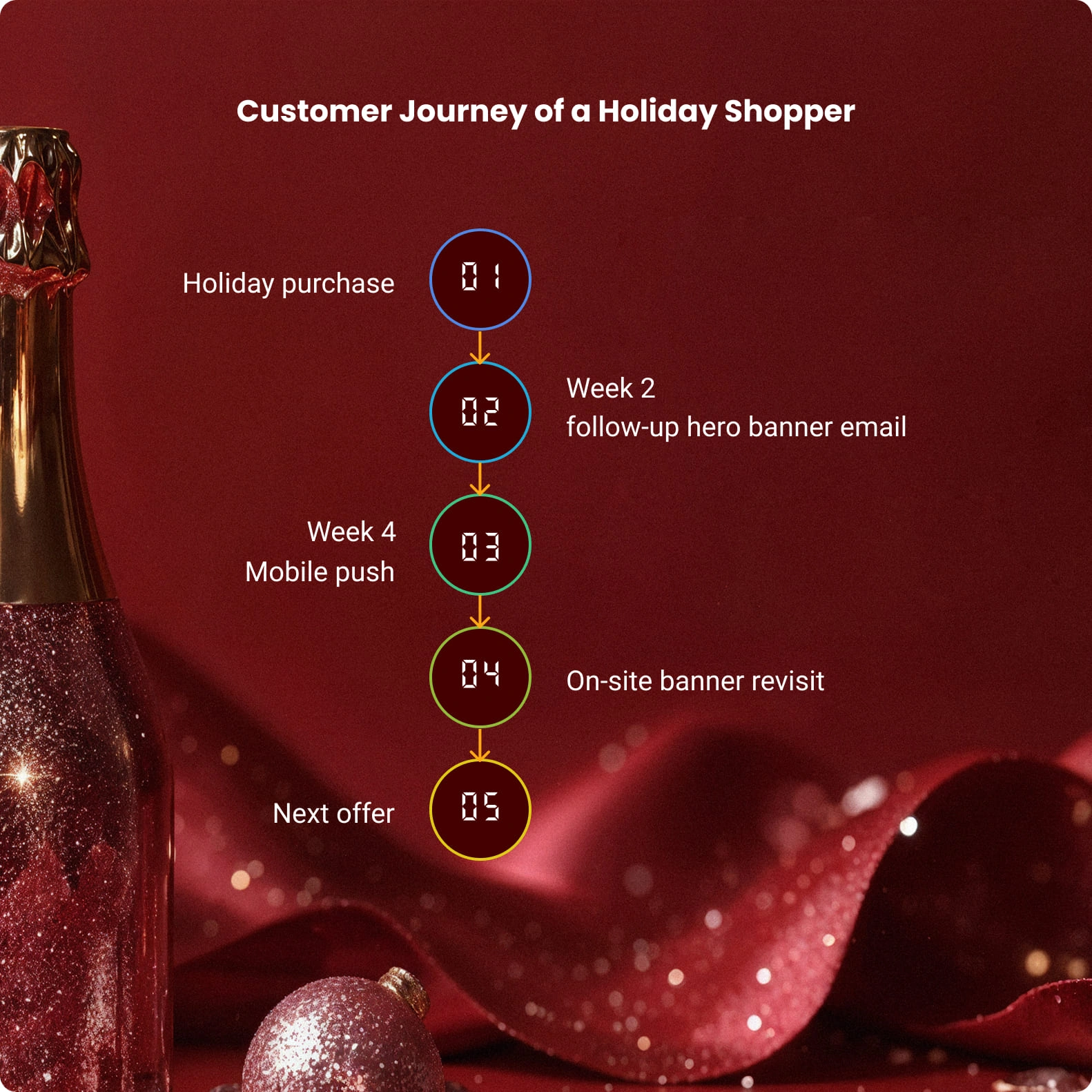


By executing this way, you convert that one‑time holiday purchase into the first chapter of an ongoing multi‑purchase story.

Measuring Success From Holiday Spike to Lifetime Value

The final piece of the retention story is measurement. Because if you cannot show that one‑time holiday buyers are being nurtured into repeat purchasers, your retention engine stays theoretical.

KPIs to Keep an Eye On

Repeat purchase rate among holiday‑acquired customers: How many bought again within 60, 90, 180 days? LTV growth: How does the value of a holiday‑acquired customer evolve compared with earlier cohorts?


Engagement across channels: Did the personalized hero banner email, mobile push, and web banner drive cross-channel visits? Retention campaign ROI:

 Using long‑window analytics, show how retention contributed revenue in Q1/Q2.

Creative resilience and fallback success: Analyze how many users experienced broken blocks or missing content compared to those who had smooth journeys.

38% of companies are focusing on reducing churn and increasing purchase frequency, recognizing that keeping the existing customer base engaged is more sustainable – and profitable – than chasing new ones.


Action Checklist
Convert Holiday Buyers into Lifelong Customers

Segment your holiday‑acquired customers immediately post‑campaign; tag them as ‘new holiday buyer’.

Define a follow-up journey within the first 30 days of purchase –
an open-time personalized email, RCS, WhatsApp, and web banner.

Prepare modular templates for omnichannel creative (email, RCS, web) that pull from the same dynamic content logic.

Identify high-value segments among holiday buyers (e.g., those with high purchase prices or high intent categories) and proactively nurture them with loyalty offers or VIP status.

Conclusion

The holiday rush is intoxicating – high traffic, big sales, momentum. But the true test comes after the frenzy. Retailers that look at those one‑time purchases not as isolated wins but as the first chapter of a retention story will differentiate themselves moving into the new year.

With real‑time creative, cross‑channel continuity, no‑code resilience, and measurement that spans beyond the holiday window, you can turn the holiday spike into a robust, enduring customer base.

This season, don’t stop at the sale, start the relationship. Because your next big holiday isn’t just about how many you convert, it’s about how many you keep.

Table Of Contents
Introduction
The Holiday Surge, Where Opportunity Meets Risk
From One Purchase to Next Purchase – Why Many Brands Lose Momentum
Build the Retention Engine with Real‑time Content & Omnichannel Reach
Measuring Success From Holiday Spike to Lifetime Value
Conclusion

How to Deliver Personalized Holiday Campaigns That Scale and Convert

Omnichannel Marketing
Blogs

How to Deliver Personalized Holiday Campaigns That Scale and Convert

Introduction

The holiday season is the most chaotic and competitive period in a retailer’s calendar. Singles’ Day, Black Friday, Cyber Monday, Christmas, New Year’s, Valentine’, and so on. Every campaign matters, and every message is a shot at revenue. But the sheer volume of emails and promotions flooding customers’ inboxes creates a high bar for engagement.

And here’s the brutal truth: most brands still send the same generic campaign to thousands, hoping subject lines and discounts will do the heavy lifting. In a season that demands emotional connection, static creatives won’t work for you.

But what if your holiday campaign didn’t need to be built 15 different ways to feel personal? What if, instead of predicting the future at send-time, your content adapted in real time, to inventory, customer behavior, or region, the moment the email was opened?

That’s not hypothetical. It’s exactly what modern marketing solutions like Active Content make possible. Let’s walk you through why this matters and how to make it a reality.

The Holiday Email Challenge: Speed vs. Personalization

Retail marketers live in a paradox during peak season. On one hand, there’s the pressure to launch campaigns quickly, holiday calendars are tight, creative teams are stretched, and offers change overnight. On the other hand, there’s a growing demand for 1:1 personalization that resonates deeply with the customer’s preferences, behavior, and buying journey.

Typically, this results in trade-offs:

Either send one-size-fits-all campaigns fast, risking low engagement.

Or build dozens of segmented variants, which takes time, adds cost, and often leads to operational errors or burnout.
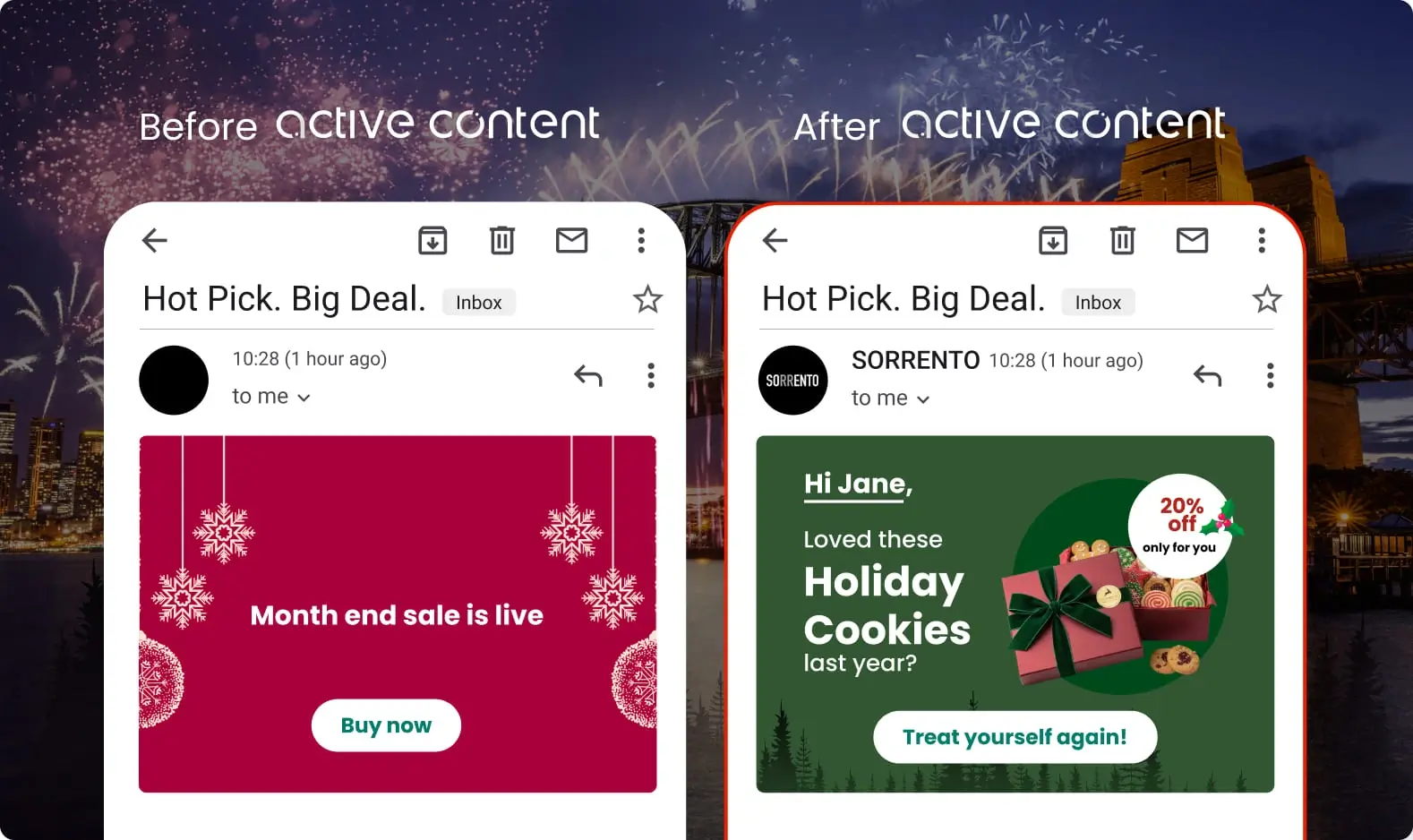


And let’s be honest, neither delivers the agility or scale today’s customer journey requires.

That’s where real-time content rendering becomes a game-changer. With open-time personalization, you no longer need to pre-select every creative asset, product, or offer before launch. Instead, you can define logic-based rules and let the system populate content at the moment of engagement.

This means

  1. faster launches
  2. less manual work
  3. and more relevance

especially during holiday chaos.


Here’s what gets easier:

  • Here’s what gets easier:
  • Display offers are available only if inventory is in stock.
  • Automatically adjust content based on loyalty tier, geolocation, or time of day.

Why Send-time Personalization is Failing Holiday Shoppers

Traditional personalization relies on preparing content at the moment of send, but this model is fragile. Consumers don’t open emails the minute you send them. Some check hours later, some days. Promotions expire, inventory depletes, and customer context changes.

This leads to broken experiences:

  • 01 Emails promoting out-of-stock products.
  • 02 Limited-time offers shown after expiry.
  • 03 Missed chances to reinforce a high-intent behavior

Open-time personalization addresses these broken experiences by making content decisions when the customer actually engages. Active Content connects to your CDP, inventory, and behavioral data, ensuring the experience reflects current, relevant, and real-world context.


You’re no longer guessing. You’re adapting in real-time.


Personalizing with Active Content Unlocks
  • Product showcases that reflect current availability.
  • Countdown timers that update dynamically.
  • Hero banners personalized to the recipient’s location, loyalty status, or browse history.

This is how you scale campaign performance while delivering tailored experiences at scale.

Read Marketer’s Guide to Hyper-personalized Engagement to learn more.

Creating One Campaign That Feels Handcrafted for Everyone

Marketers often assume personalization at scale means more workload, more variants, more data pulls, and more quality analysis. But that’s a myth. With the right infrastructure, one campaign can power thousands of personalized experiences.

Active Content utilizes modular dynamic content blocks, sourced from your CDP, CSV files, loyalty data, and more. You define what should happen based on conditions. Active Content decides which content to show in real-time.

How Active Content Works

Connect APIs to your Active Content Digital Canvas to build content Adjust visualization and edit layouts using the WYSIWYG editor


Check the output by simulating it Download/copy HTML snippet and embed it in your ESP or marketing automation tool

It’s how leading brands such as Consum are cutting campaign costs by 60% while scaling up holiday personalization.

Extending the Experience Beyond Email

Modern shoppers move fluidly between email, mobile, and web. Yet most brands still deliver disjointed experiences across these channels.

This holiday season, what if the personalized offer your customer sees in an email automatically appears on your website too, no new creative build, no dev dependency?

With Active Content’s webcrop feature, you can mirror the exact creative block from your email, including copy, visuals, and dynamic elements, right onto your homepage, category page, or product display.

This enables faster campaign launches and ensures a unified brand message across all customer touchpoints.

This strategy reduces creative duplication, eliminates rework, and ensures consistent messaging from inbox to site, increasing operational efficiency and customer trust.

Holiday Personalization Checklist

Build a modular email template with dynamic content blocks

Define open-time logic for hero images, offers, and product sets

Set fallback rules for missing data

Sync data feeds from CDP, catalog, and inventory sources

Use AI tools to generate multiple copy/image variants for testing
Extend creative logic to RCS, WhatsApp, web banners, and other platforms.

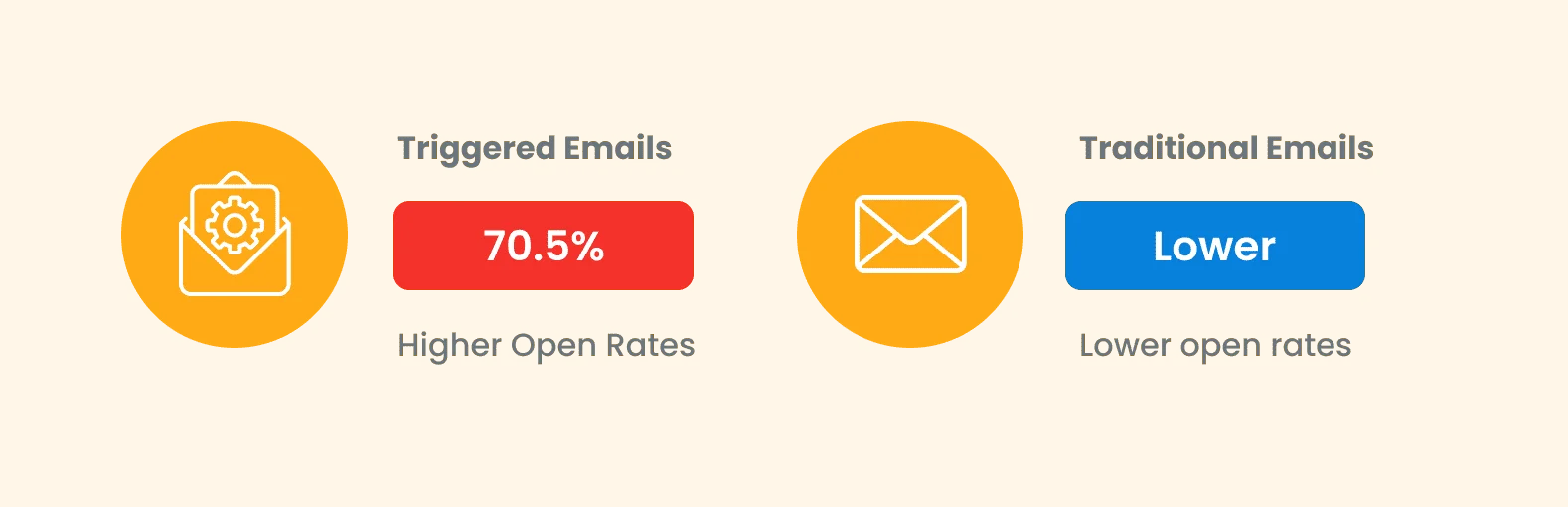

Conclusion

This holiday season, marketers have two paths: continue sending static, one-size-fits-all messages that get ignored, or embrace a smarter, more scalable way to connect with customers in real-time.

With Active Content, you don’t have to choose between speed and personalization. You get both. One campaign, multiple channels and hyper relevance.

Because in a season where inboxes are crowded and attention is short, relevance is your best conversion strategy.

Click here to learn about

Active Content
Table Of Contents
Introduction
The Holiday Email Challenge: Speed vs. Personalization
Why Send-time Personalization is Failing Holiday Shoppers
Creating One Campaign That Feels Handcrafted for Everyone
Extending the Experience Beyond Email
Conclusion

6 Triggered Campaigns That Outperform – And How to Elevate Them with Personalization

Omnichannel Marketing
Blogs

6 Triggered Campaigns That Outperform – And How to Elevate Them with Personalization

Why Triggered Campaigns Matter

In today’s highly competitive marketing landscape, where attention spans are shrinking and customer expectations are skyrocketing, mass promotional emails are no longer effective. Instead, triggered email campaigns automatically sent based on a customer’s behavior or life cycle event have emerged as a high-impact tool for engagement.

According to a 2023 report, triggered emails drive 70.5% higher open rates and 152% higher click-through rates than traditional marketing emails (Campaign Monitor, 2023). 82%[1] of marketers use automation to create triggered emails, which result in 8 times more opens and greater earnings than typical bulk emails.

Yet, many brands continue treating triggered emails as set-and-forget templates. To truly unlock the potential of personalized email marketing, we must rethink these campaigns with dynamic content, real-time personalization, and AI-driven segmentation.

Let’s explore six types of triggered email campaign examples and how you can elevate them using modern personalization techniques.

Types of Triggered Emails

1. Welcome Series: Setting the Stage for Customer Loyalty

Many brands treat welcome emails as a formality, a basic acknowledgment without a real strategy. However, this first impression shapes brand perception by setting the tone for the customer relationship. Research shows that welcome emails generate 320% more revenue per email than other promotional emails.

Welcome Emails vs. Bulk Marketing Emails
Welcome emails have 320% more revenue per email than other promotional emails, as well as:

0 %
lift in unique open rate
0 %
lift in unique click rate
0 %
lift in transaction rate

Entrepreneur[2]

Elevate Your Strategy:

  • Personalize hero banners based on geolocation or browsing data.
  • Deliver dynamic content showcasing bestsellers in the customer’s preferred category.
  • Embed personalized CTAs leading to curated onboarding journeys.

2. Cart Abandonment Campaigns: Turning Hesitation into Conversion

Cart abandonment costs e-commerce brands an estimated $18 billion[3] in lost revenue annually. While some instances are inevitable, such as distractions or casual browsing, many are opportunities waiting to be reclaimed. Well-crafted cart abandonment emails, boasting an average open rate of 41.18%, are crucial in recapturing these otherwise lost sales.

Left unaddressed, even minor lapses in the post-cart experience can compound over time, impacting revenue and customer loyalty. In an increasingly competitive landscape, brands can no longer afford to treat abandonment as an acceptable cost of doing business.

Elevate Your Strategy:

  • Display the abandoned product image dynamically.
  • Offer related product recommendations in emails to entice purchases.
  • Add social proof (“1200 people bought this last month!”) using real-time personalization.

Algonomy’s Recommend, combined with Ensemble AI, dynamically presents complementary or alternative products based on a shopper’s real-time behavior and preferences.

Rather than simply reminding customers of what they left behind, the system intelligently suggests relevant add-ons or an ensemble to complete their purchase, increasing the likelihood of re-engagement. This personalized product tie-in strategy revives abandoned purchases and boosts average order value, creating a win-win for both the brand and the customer.

Advanced cart abandonment personalization involves not just reminding but inspiring, making alternative offers irresistible, enhancing urgency with live inventory updates, and showing complementary products that fit their taste.

3. Post-Purchase Follow-Ups: Building Relationships Beyond Transactions

Neglecting this critical touchpoint risks losing engaged buyers, while thoughtful post-purchase communication can transform first-time purchasers into long-term brand advocates.Post-purchase is a golden moment to solidify loyalty and boost repeat purchases. Following a robust post-purchase email strategy helps improve customer lifetime value.

Elevate Your Strategy:

  • Recommend complementary products based on past purchases and affinity modeling.
  • Use replenishment signals from Audience Manager via dynamic content blocks to
set up reminders (e.g., for beauty or grocery categories).

Personalized post-purchase journeys tap into emotional satisfaction. A simple “We thought you might also like” section fueled by AI-powered marketing personalization increases retention.

4. Re-Engagement Campaigns: Winning Back Dormant Customers

Relying solely on generic “We miss you” emails is no longer enough to revive customer relationships. Today’s consumers expect relevant, meaningful engagement that speaks directly to their interests and behaviors. Failing to re-engage dormant customers doesn’t just cost potential sales, it damages long-term brand loyalty.

Recent industry research[4] shows that top-performing marketing teams are over twice as likely to invest in personalized marketing campaigns aimed at bringing back dormant users. Furthermore, the likelihood of selling to an existing customer can be as high as 70%[5], making re-engagement far more cost-effective than acquisition.

Elevate Your Strategy:

  • Use churn propensity scores to create high-risk segments.
  • Offer exclusive deals on previously browsed products.
  • Personalize messaging with emotional cues (“Still dreaming about that jacket)

For instance:
A customer who bought hiking gear but hasn’t engaged for 60 days gets an email:
“Your Adventure Awaits — Explore New Trails with 20% Off Hiking Boots.”
Using email campaign best practices, retail ensures the tone feels genuine, not robotic.

5. Back-in-Stock Alerts: Fueling FOMO with Timing

Nearly two out of every three shoppers will abandon an e-commerce site entirely if a product they intended to buy is unavailable.

2024 AlixPartners Consumer Sentiment Index


When inventory constraints ease, this creates a narrow but powerful window to recapture high-intent interest, a window that’s often missed due to manual workflows or delayed communication.


Well-timed back-in-stock alerts, powered by email personalization, ensure brands convert intent the moment it resurfaces. They signal attentiveness, build emotional connection, and foster a sense of exclusivity; hence, back-in-stock campaigns become not just a tactic but a critical part of the overall customer experience strategy.

Elevate Your Strategy:

  • Trigger real-time alerts as soon as products are replenished (using Active Content and Audience Manager integration)
  • Segment notifications based on likelihood to convert, prioritizing high-intent customers. (via Audience Manager’s predictive modeling).
  • Offer intelligent alternatives when original products are still low in stock.
  • Inject urgency indicators like low stock warnings, rising demand tags, or expiring deals.
  • Use dynamic countdown timers to create a subtle but effective pressure to act.

For e.g., A customer who wanted a blue denim jacket gets a real-time email:
“It’s Back — Your Favorite Jacket is Here! Sizes Are Selling Fast.”
This personalization approach often achieves 3–5x higher CTRs compared to generic alerts.


Leveraging real-time triggers through email personalization ensures you capitalize on intent the moment it reignites.

6. Price Drop Notifications: Make Savings Personal

Price drop emails are a high-conversion opportunity that taps into existing customer intent, especially for products they’ve previously browsed, wishlisted, or abandoned. These alerts don’t just highlight savings; they create urgency, often prompting immediate action on long-considered purchases. By showcasing recent markdowns, whether as targeted one-offs or in curated batch discount alerts, brands can drive quick wins while reinforcing value. Beyond the sale, these emails make customers feel seen: they show you’re listening, that you understand what matters to them. They’re also highly effective at clearing inventory, surfacing slower-moving products, and reducing dead stock without slashing margins blindly. In today’s price-sensitive market, a well-timed price drop email can turn interest into conversion and consideration into trust.

Elevate Your Strategy:

  • Target customers based on browsing, abandonment, and wishlist history.
  • Segment audiences dynamically using Audience Manager’s product and behavior data.
  • Sync real-time inventory to avoid promoting unavailable items.
  • Recommend similar products with higher conversion likelihood if stock is limited.

Through dynamic content personalization, price sensitivity is addressed individually, increasing open rates and driving conversions.

Key Takeaways: Scaling Impact with Personalized Email Campaigns

To master modern email marketing and beat inbox fatigue:

  1. Prioritize dynamic content personalization in every triggered email.
  2. Use behavioral, demographic, and intent signals to segment audiences.
  3. Leverage AI-powered marketing personalization to predict next best actions.
  4. Follow email campaign best practices, retail, and hyper-personalized messaging wins.

The goal isn’t more email. It’s creating meaningful email that drives connection and revenue.

How Algonomy’s Active Content Helps

Marketers no longer need to choose between creativity and technology. With Active Content, dynamic storytelling can be enhanced by real-time, data-driven personalization. See it in action:

1 Define Segments Using Audience Manager

Marketers build high-resolution segments using behavioral insights from your recommendation engine, predictive traits (e.g., churn risk), and other attributes like category interest or loyalty status.

2 Sync Segments to Active Content & Marketing Automation Solutions

These audience segments are simultaneously pushed into marketing automation tools for orchestration and Active Content for personalization logic at open time.

3 Build Templates on Active Content’s Digital Canvas

Marketers create templates using Active Content’s Digital Canvas, placing dynamic blocks for product recommendations, offers, loyalty, and other personalized content.

4 Configure Real-time Data Layering

Each dynamic block is wired to multiple live data sources via APIs (e.g., product info, reviews, stock, or offers), enabling rich, layered personalization that marketing platforms can’t support.

5 Trigger Campaigns Via Audience Manager or MA

Journeys initiate when a user qualifies, e.g., cart abandonment, back-in-stock event, or loyalty point threshold, sending the right message to the right person.

6 Personalize Content at the Moment of Email Open

Unlike traditional send-time personalization, Active Content renders the latest data when the email is opened. The same email can look different based on stock, price, or behavior at that moment.

7 Leverage Generative AI for Creative Efficiency

Marketers can auto-generate dynamic headlines, CTAs, or image variations using AI prompts, reducing creative bottlenecks and increasing campaign agility.

8 Control the Final Rendering Experience

Marketers retain full design flexibility over how dynamic content looks, removing the design constraints typically imposed by marketing automation platforms.

Best Practices for Successful Triggered Email Campaigns

  1. Start with Segmentation
    Build dynamic segments based on behaviors, demographics, purchase history, and churn risk.
  2. Invest in Real-Time Personalization
    Update content at open time, not send time, using dynamic content personalization engines.
  3. Use AI for Predictive Personalization
    Predict next-best actions (buy, browse, churn) and trigger accordingly.
  4. Optimize Send Times
    
Test and deploy emails at personalized send times using AI recommendations.
  5. Monitor Customer Fatigue
    
Avoid over-messaging by setting smart frequency caps based on engagement levels.
  6. Test, Learn, Iterate
    
Run A/B tests on subject lines, dynamic elements, and CTA placements regularly.

Future of Triggered Emails — Where We Are Headed

As personalization technology evolves, triggered hyper-personalized email campaigns will no longer be static workflows but adaptive journeys, powered by real-time signals, predictive analytics, and AI-curated content. With the right triggered campaigns and the right personalization, you don’t just communicate—you convert.

By 2026, Gartner predicts that 70% of brands adopting AI-powered marketing personalization will report a 25% higher marketing ROI (Gartner, 2024[6]).

For marketers willing to invest in email campaign personalization and dynamic content strategies today, the payoff is immense: deeper customer relationships, sustained engagement, and significantly increased revenue.

Ready to transform your triggered campaigns with best-in-class personalization?

today and explore how Algonomy empowers leading brands to deliver unforgettable customer experiences!

Book a Demo

Resources

Table Of Contents
Why Triggered Campaigns Matter
1. Welcome Series: Setting the Stage for Customer Loyalty
2. Cart Abandonment Campaigns: Turning Hesitation into Conversion
3. Post-Purchase Follow-Ups: Building Relationships Beyond Transactions
4. Re-Engagement Campaigns: Winning Back Dormant Customers
5. Back-in-Stock Alerts: Fueling FOMO with Timing
6. Price Drop Notifications: Make Savings Personal
Key Takeaways: Scaling Impact with Personalized Email Campaigns
How Algonomy’s Active Content Helps
Best Practices for Successful Triggered Email Campaigns
Future of Triggered Emails — Where We Are Headed
Resources

FutureProofing Content Delivery for RealTime Engagement

Omnichannel Marketing
Blogs

FutureProofing Content Delivery for RealTime Engagement

When Campaign Volume Spikes, Will Your APIs Keep Up?

Customers today expect seamless, personalized content experiences as they navigate across email, mobile, web, and more. Marketing campaigns are no longer isolated events; they’re part of a consistent, context-aware experience. To meet this expectation, your tech stack — CRM, loyalty, CMS, personalization engines, etc. must communicate in real time. While these systems have traditionally been used to extract data like segments or content for campaign execution, they’re often underutilized—or not used at all—for accessing the real-time state of a customer and to serve real-time content. Marketing content within email is usually stale and does not keep up with changing customer intents and changing merchandise

There are several reasons marketing teams struggle to fully leverage their tech stack for personalized campaigns:

Marketing tools lack seamless API integration.

Most marketing platforms don’t offer intuitive ways to integrate APIs, forcing marketing teams to rely heavily on IT to build and maintain complex integrations. Even when APIs are available, tapping into them often requires custom scripting, making even small changes, like updating content, a technical task. As a result, campaign execution slows down dramatically, often taking weeks. New ideas are frequently abandoned to avoid delays and scope creep.

APIs often fail to scale with marketing bursts.
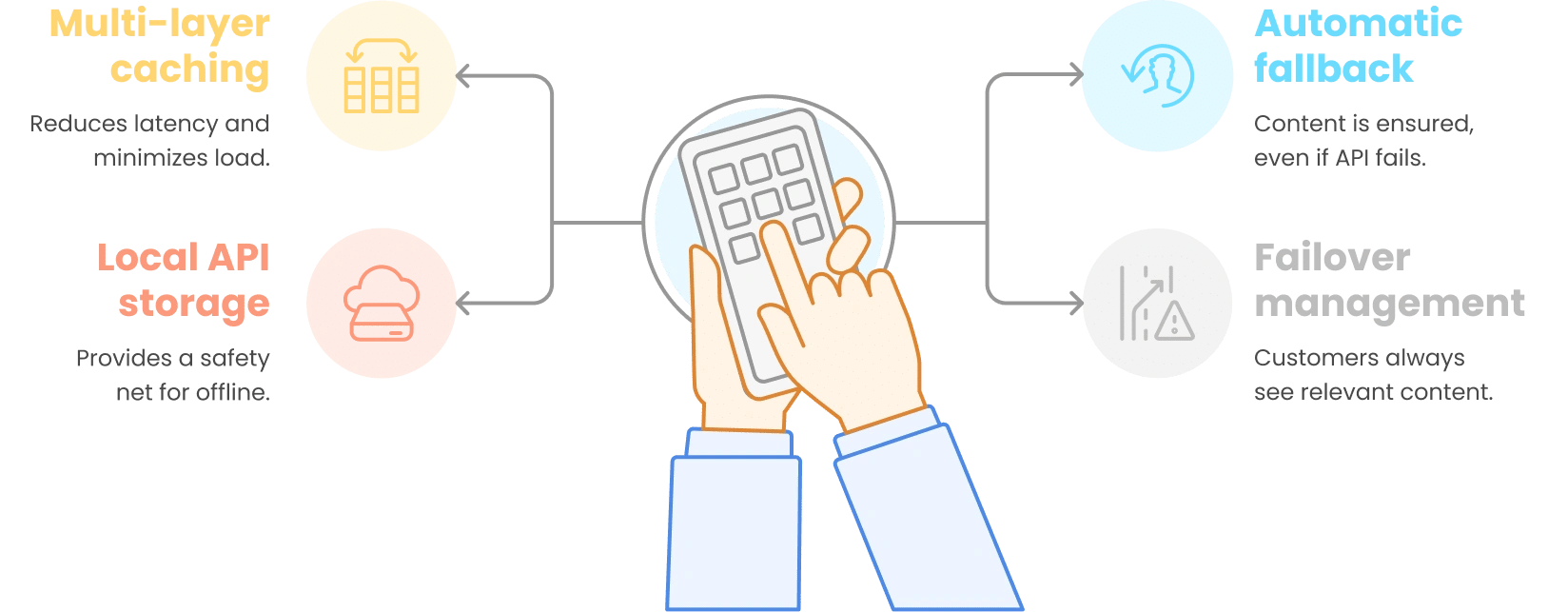
Even when APIs are integrated, they may not be built to handle the surge in traffic generated by large-scale campaigns. During peak send times, such as weekly newsletters or flash sales, overloaded APIs can fail, leading to broken content in emails or other touchpoints, impacting both customer experience and brand reputation. Most marketing platforms aren’t equipped to deal with such incidents and lack mechanisms to provide fallback content.

How Active Content Solves These Challenges

Algonomy’s Active Content is designed to solve these challenges, empowering marketing teams to harness real-time data from existing APIs and tech platforms to personalize content at the moment of engagement, like when an email is opened.

With an easy-to-use, no-code interface, Active Content enables marketers to integrate APIs or file feeds without waiting on IT. Active Content connects with all major marketing tools to deploy the content within existing emails. On email open, real-time calls are made to Active Content, which delivers the content within emails. This approach ensures real-time, context-aware content that reflects the customer’s current state and intent.

What Sets Active Content Apart

Why Marketing Teams Choose Active Content

Active Content’s architecture includes several key capabilities that make it the go-to solution for delivering real-time personalized content:

Multi-layered caching for both content and API responses significantly reduces latency and minimizes strain on backend systems.

Fallback orchestration is built in. Alternate APIs can be invoked automatically, or cached API responses can be used as backup content when real-time APIs are unavailable.

Local storage of API data allows the persistence of API responses locally within Active Content, which can be leveraged in scenarios when real-time APIs are unavailable.

Seamless failover management ensures that customers never see broken or missing content—only high-quality, personalized content experiences that drive engagement.

Conclusion

As marketing continues to evolve toward real-time, data-driven engagement, the ability to deliver consistently reliable, personalized content at scale will become a defining advantage. Brands can no longer afford to rely on static campaigns or infrastructure that falters under pressure. The path ahead demands solutions that are not only agile and resilient but also marketer-friendly, empowering teams to move quickly, innovate confidently, and stay ahead of customer expectations. Investing in capabilities that bridge these gaps isn’t just a technical upgrade—it’s a strategic imperative for sustained growth and meaningful customer relationships.

Table Of Contents
When Campaign Volume Spikes, Will Your APIs Keep Up?
How Active Content Solves These Challenges
Why Marketing Teams Choose Active Content
Conclusion