
What Is a Real-time Customer Profile? Why Is It Important?

Omnichannel Marketing
Blogs

What Is a Real-time Customer Profile? Why Is It Important?

As a business, one of the most effective ways to increase your customer engagement and conversions is to make your marketing efforts more targeted and precise. A study by Epsilon revealed that 80% of customers are more likely to buy from a brand that delivers personalized experiences.

But to target your customers with contextually relevant messages and offers at the right time, you must first know their needs, preferences, and behaviors in the moment.

To achieve this, you may be gathering customer data from various sources—your website, mobile app, POS systems, CRM, DMP, and others. However, combining and making sense of all this data—with the goal of better understanding your customers—may not be as simple as it sounds.

According to Shopify’s Future of Commerce report, 47% of brands say that unifying online and offline operations or data will “prove to be difficult” this year.

A siloed approach to data and analysis results in incomplete customer insights – like a jigsaw puzzle with missing pieces. And this in turn results in problems like inconsistent engagement and broken journeys when a customer switches from one channel to another.

For example, when you receive an offer on a product you wishlisted, except you purchased it a day ago. Or when you have to explain the situation—let’s say a product quality issue you raised—all over again to a customer support agent.

Today’s channel-agnostic customer expects individualized engagement no matter when and where they choose to engage with a brand. In fact, the average customer uses 6 touchpoints across their shopping journey, and 90% of customers expect consistent interactions across all channels.

To address this need, brands are turning to real-time customer profile.

What is a Real-Time Customer Profile?

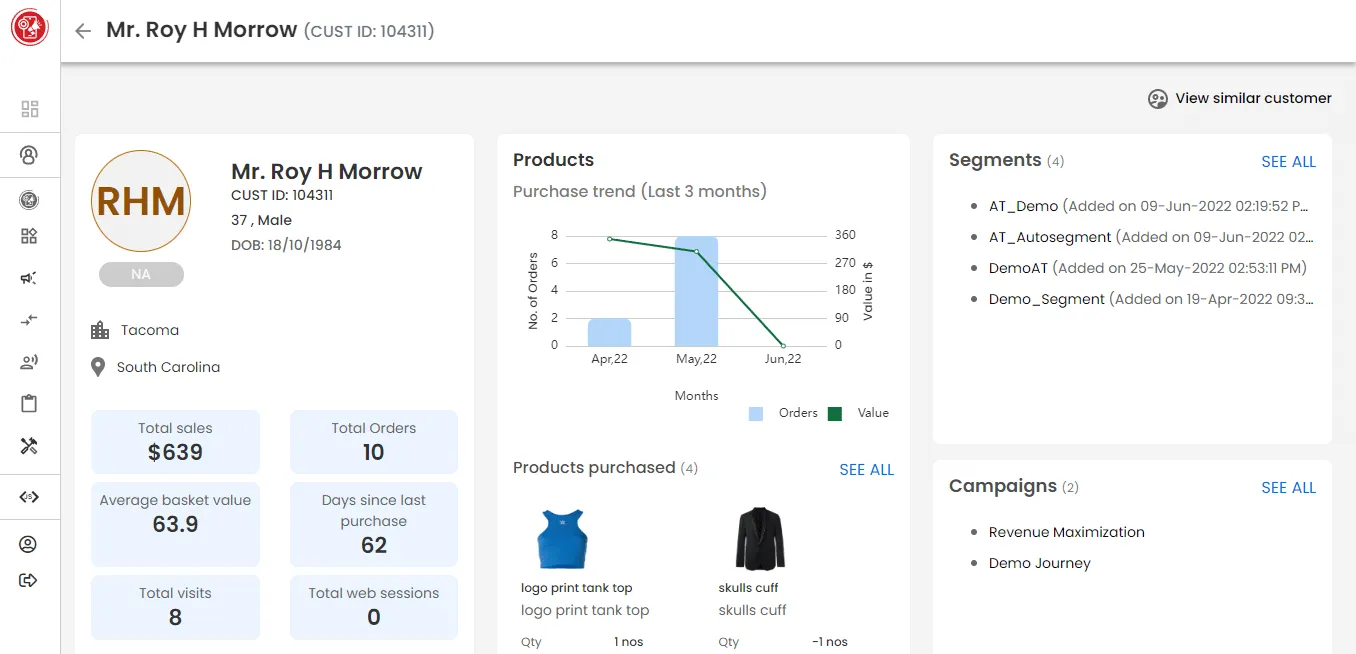
A real time customer data profiles provides a comprehensive view of a customer—complete with demographic information, transaction history, affinities, purchasing habits, activity timeline, and more.

As the name suggests, a real-time customer profile dynamically evolves with each customer interaction with your brand. This means your marketing team will always have updated and relevant information about the customer at any given time. Further, it helps you build more accurate segments to orchestrate tailored marketing messages and campaigns.
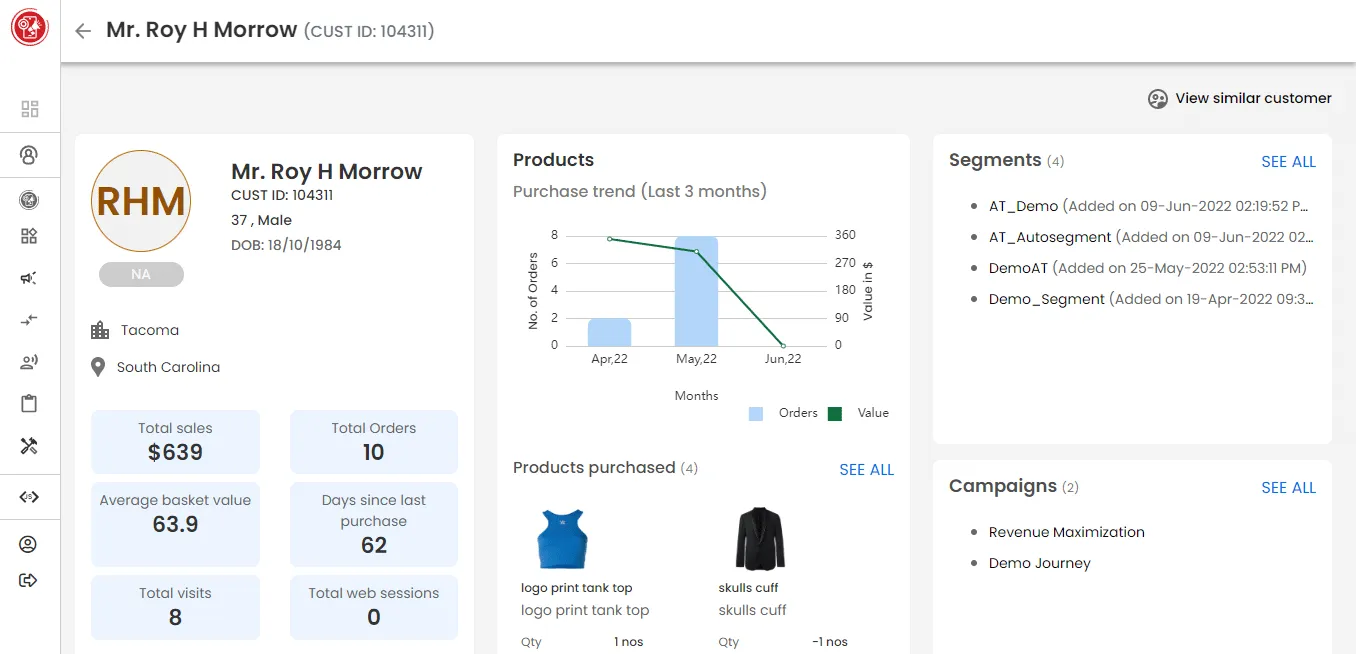
Real-time customer profiles go beyond traditional retail customer analytics and provide granular insights for a deeper understanding of customers. They not only tell you who your customers are but also shed light on the why behind their behaviors.

To elaborate, buying behavior varies from one customer to another. Some buy online and pick up in-store, while others want same-day delivery to their homes. Some only shop during weekends. And then there are some who never buy unless there is a discount. Every customer is unique. These behaviors have little to do with gender, age, location, and income.

Real-time profiles, therefore, help brands replace segment personalization and guesswork with insight-driven decision-making. They enable marketers to treat each customer as an individual and make every engagement feel personal.

3 Benefits of Real-Time Customer Profiles

Real-time customer profiles can offer you many short-term as well as long-term advantages. They help you to:

Access a Single Source of Truth for Each Customer

  • A real-time profile connects all online and offline, first, second, and third-party data to create a unified view of each customer.
  • It helps your marketing, sales, and support teams access relevant and accurate information about the customer in an instant.

Case Study

A multinational conglomerate, operating across 40 countries and driving over 30 businesses and 300 brands, wanted to address data silos. Their data was stored in disparate systems across various business units, which hindered them from deriving actionable customer insights.

The company deployed an AI-powered customer data management platform (CDP) that helped them centralize all of their customer data and prepare it for analysis. With probabilistic matching algorithms, they deduplicated customer records to create a unified view of each customer.

Further enrichment helped create Golden Customer Records, which gave an end-to-end view of the customer journey of over 5 million customers, cutting across the company’s brands and business units.

The company was able to remove 300,000 duplicate customer records and build 450 micro-segments to drive omnichannel, journey-based customer engagement.

Read the full case study

Drive Hyper-personalized Omnichannel Marketing

  • Real-time profiles help you move from tactical segmentation to strategic individualization.
  • They help you recognize your customers as individuals, engage in real-time, and personalize every interaction across their journey.
  • They enable contextually relevant customer engagement in the moment.
  • They help integrate your channels such that customers can seamlessly switch between them and continue along their journey without friction.

Case Study

A major US supermarket chain was struggling with implementing a data-driven, targeted marketing strategy. The company used a real-time customer data platform to build a unified view of customers across online and offline channels.

The CDP’s machine learning algorithms helped create granular real time customer segmentation by applying RFM modeling. This helped understand customer journeys, identify products of interest, and utilize propensity models to gauge the likelihood to respond, buy, and churn.

Armed with deep customer insights, the grocery chain adopted a personalized ecommerce experience marketing approach that was curated to each customer’s preferences, transactional behavior, lifecycle stage, and promotional activity.

Better targeting—across the touchpoints of app push notifications, email, eCommerce, SMS, and more—resulted in improved response rates and revenue. The company experienced an impressive 100% increase in digital account growth.

Read the full case study

Strengthen Your Marketing Campaigns and Improve ROI

  • Switch from spray-and-pray marketing tactics—such as mass campaigns and generic retargeting—to personalized marketing to increase customer engagement, lifetime value, and revenue.
  • Build one-to-one personalization relationships with your customers by sending thoughtful, relevant offers and promotions that meet their needs.

Case Study

A large pizza franchise, operating over 500 stores across 200+ cities was relying on manual, Excel-based analytics reports to make decisions on campaigns and customer engagement.

This meant that their marketing team wasn’t equipped with the right insights at the right time to be able to drive effective communication that would resonate with the end customer. This resulted in poor marketing ROI.

The company started by unifying their customer data that was spread across siloed systems—POS, loyalty, delivery, digital, etc.—with the help of a CDP. The CDP came with a layer of advanced AI algorithms for micro-segmentation, RFME & lifecycle status segments, segment migration, market basket, retention analysis, propensity, campaign effectiveness, and more.

Armed with this decisioning intelligence, they were able to drive relevant and open time personalization engagement based on customers’ tastes and preferences. This led to an 8% increase in overall sales and a 16.5% increase in average recency.

Read the full case study

Also read: Unpacking the First Real-time Customer Data Platform (CDP) Made for Retail

Solve for Real-time Profiles and More With a Retail-specific CDP

The prevalence of omnichannel customer engagements necessitates a real-time customer data platform that can centralize all your online and offline customer data, build a holistic view of each customer, and enable instant activation of your audience with retail-specific data structures and models.

ADA Global’s Real-time Customer Data Platform delivers on this very need. It is a ‘Campaign CDP’ that comes with a marketer-friendly UX. With simple drag-and-drop data onboarding to audience activation for campaigns, the CDP promises to help you drive real-time, contextually relevant customer engagement.

Learn more about Real-time CDP solutions. Or request a demo here.

More Reading

Check out our in-depth CDP guide to learn everything you need to know about the platform and explore potential use cases for your business.
Read Now
Table Of Contents
What is a Real-Time Customer Profile?
3 Benefits of Real-Time Customer Profiles
Solve for Real-time Profiles and More With a Retail-specific CDP

Is Your Personalization Engine Ignoring New Products Without Behavioral Data?

Digital Experience Personalization
Blogs

Is Your Personalization Engine Ignoring New Products Without Behavioral Data?

As an eCommerce brand, many of the items in your inventory might be the kind that fly off the virtual shelves in minutes and have to be constantly replenished. There might also be some products that remain undiscovered by users for several reasons, such as the product is new, niche, or seasonal. For such cases, users need a little help with their product discovery optimization.

New products most likely get ignored by your personalization engine. This is because personalization platforms typically start recommending a product only after it has gathered enough behavioral data around it, such as pageviews, click-throughs, add-to-carts, purchases, etc.

Without such behavioral data, these new or seasonal products remain buried on your site. This scenario also applies to long-tail products—items that are niche, have limited stock, or are not commonly searched for or bought by customers.

The traditional approach is to manually add merchandising rules to boost them to the top of search results pages, category pages, or homepage. However, this approach isn’t scalable.


Why Rule-based Inventory Visibility Isn’t Ideal

If you’re using merchandising rules to promote visibility for new products, some of the problems you’ll have to contend with are:

  1. If you have a site where new SKUs are constantly being added, manual updating is a tedious task.
  2. Time is of the essence for certain products that are seasonal or holiday based. This means your teams will not get enough time to manually create rules for every single new product on the site.
  3. You also have to remember to turn off the rules when the products start appearing in search results organically or when the season for those products is over.
  4. The boosted products could show up in irrelevant search queries. Worse, they could inundate a page and bury the relevant results. Both these scenarios will frustrate at least two out of your five customers and drive them away from your brand.

Altogether, the manual merchandising rules approach puts pressure on your resources and wastes time and money that can be used more productively elsewhere. So, replace this manual and tedious job with an AI-powered personalization engine.


How NLP Improves Visibility for New and Long-tail Products

Natural Language Processing (NLP) is a deep learning algorithm that processes text data to understand the meaning of the words as a human would, instead of employing the old-fashioned keyword-matching technique.

In the context of personalization, NLPs read through texts related to the product, such as descriptions and customer reviews, extracts associated attributes and text vectors, and forms associations between products based on feature complements and semantic similarity.

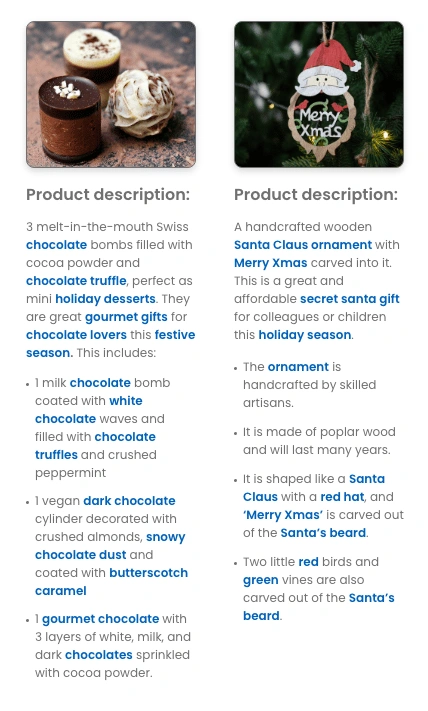
Here’s an example. Say a home décor store has added 300 new Christmas-related products to their inventory. They switch on the NLP strategies on their AI-powered personalization platform, and the platform analyzes text data about these products in a matter of minutes. See the adjacent image for an example of how text is analyzed and word associations are formed.

Though these products do not contain the obvious word “Christmas”, NLP associates words such as red, green, holiday, snowy, festive, merry, Xmas, Santa Claus, secret Santa, chocolate, gift, and desserts with the holiday.

An example of how NLP processes text to develop word associations to find and recommend products.

So, the products shown above will also surface in results for a variety of search queries, such as Christmas gifts, Christmas décor, holiday gifts, holiday décor, and festive décor.

And once they become visible and users interact with the product, the platform has the behavioral data necessary to organically recommend them, which means that NLP also becomes a “trainer” for other personalization strategies.

In addition, NLP can also re-rank products in real time during the same user’s session, based on whether the person views such products or not.

All this ensures that new and long-tail products are personalized, users see relevant content personalization cross-sell offers from the start, and personalized product recommendations become more relevant as users move through the purchase funnel.


Time to Get an NLP-based Recommendation Platform

The ADA Global DeepRecs™ platform leverages NLP algorithms to make the right ecommerce search personalization product recommendations. Because of the retail expertise already “learned” by our Xen AI by working with dozens of customers, DeepRecs™ is already production-ready and scalable with several NLP word vectors and semantic knowledge that you can bank on.

The platform can use your data to create custom models for your products, factoring in actual co-purchase behavior. It ensures that new, seasonal, and long-tail products are recommended at the right time—for search queries as well as for recommendations of dynamic content personalization, similar products, cross-sell, and upsell.

Get a demo to see how your business can benefit from DeepRecs NLP.

5 Powerful Ways to Deploy 1:1 Personalization

Digital Experience Personalization
Blogs

5 Powerful Ways to Deploy 1:1 Personalization

From Segmentation to Individualization – Part 3

In the previous two articles of this series, we set the stage for you to understand why it’s important to move from rule-based segmentation to individualization.

Now, let’s dive right in and take a look at five proven strategies to deliver ML-powered 1:1 personalization to your customers.

1 Personalize for First-time Visitors Using Wisdom of Crowd

Wisdom of Crowd (WoC) is an ML-based personalization strategy that combines insights and trends from general visitor behaviors and draws correlations between products. Using these insights, the strategy can recommend products with similar styles, brands, models, or colors of the product a visitor views first.

This strategy is quite useful for first-time visitors to your site—when you don’t have any historical or behavioral data about them.

Another place where WoC works well for new users is search personalization. Say Jack enters the search query “laptop” on an electronics store website. The average search results for this query will include an array of products labeled “laptop” on the site’s product metadata.

However, by employing Wisdom of Crowd, you can prioritize showing the most purchased and most viewed laptops in the search results. These results are likely to be more relevant because they would be trending and latest products.

2 New Products Getting Ignored by Product Recommendation Engines? Let NLP Help

When new products are added to your inventory, they usually don’t get picked by recommendation engines because of lack of data (pageviews, click-throughs, purchase, purchase co-occurrence). This is a lose-lose: your customers miss out on discovering these new products and you miss out on getting enough sales for the product.

This is where Natural Language Processing (NLP) algorithms come in handy. Instead of relying on behavioral or transactional data related to the product, NLP “reads” the product descriptions and metadata, and extracts the key attributes.

It then forms associations among products based on feature compatibility, semantic similarity, and word vectors. Accordingly, it delivers personalized product recommendations for alternative products, cross-sell, or upsell.

NLP is useful for new products, niche products such as special needs cosmetics, or long-tailed products such as rapidly sinking food for bottom-feeders in fish tanks. It uncovers buried treasures in your inventory and helps customers discover them easily.

Case Study

Learn how Neowing and CDJapan leveraged NLP to improve product discovery optimization of new and long-tail products, which form over 96% of the catalog.

Download Now


3 Cross-sell the Right and Most Relevant Products

When a user views a product or adds one to the basket, show them not just items based on visual or category similarity, but products complementary to the one being viewed. This is especially applicable to products such as printers, mobile phones, or laptops that need specific accessories.

To hyper-personalize the right cross-sell products, ML-based personalization engines deep-dive into different kinds of data. These include purchase co-occurrence data, attributes extracted from product descriptions and metadata through NLP, and compatibility data extracted from advanced merchandising, among others.

This ensures that you are able to show to your users not only the right complementary products for the model or brand, but also a wider variety of them, increasing the chances of getting higher conversions and average order values.

4 Personalize Different Kinds of Email Campaigns

Email personalization is not uncommon, but have you considered the different ways emails can be individualized?

Adding customer’s first names to the subject line and copy or sending emails on customers’ birthdays are just basic strategies. Go many steps ahead and add product recommendations to automated hyper-personalized email campaigns to maximize their ROI.

Global conversion rates of cart abandonment emails stood at 34% in 2020. In addition, click rates of personalized promotional emails can be 41% higher than those for non-personalized emails. Do you need more convincing to add product recommendations to your emails?

Personalize product recommendations on email campaigns such as:

  • Browse abandonment (searches, viewed products, similar/alternative products)
  • Cart abandonment (searches, viewed products, similar/alternative products)
  • Out-of-stock alerts (similar/alternative products)
  • Back-in-stock alerts based on the customer’s geolocation
  • Post-purchase (cross-sell and upsell recommendations)
  • Replenishment mails for frequently purchased and repeated use products
  • New product releases in product categories the customer has purchased or viewed previously
  • Sale alerts with countdown timers for purchased or viewed product categories
  • Offers curated to the customer’s milestones (anniversaries, birthdays, and relationship with the brand), demographics, and purchase patterns

An important ai email personalization strategy that is not used well enough is open time personalization. This kind of content personalization allows you to deliver contextually relevant and individualized engagement in real time. Read more about open-time personalization here.

5 Hyper-personalize Offers and Product Recommendations at Physical Stores

Make customer profiles available to physical stores so that sales executives can see the customer’s preferred brands or styles, recent and frequent purchases, and other affinities.

This can help them individualize the in-store personalization experience of customers even if the person is visiting the store for the first time. They can recommend products from the customers’ favorite brands, show them the latest arrivals of their favorite products, offer them discounts on higher-value purchases or higher basket sizes, and much more.

Be Where Your Customer Is: Implement Omnichannel Personalization

When you have a centralized repository for dynamic 360-degree real-time customer profile, you can extend hyper-personalization across various digital and offline channels.

Here’s a quick list of the channels you can deliver individually personalized experiences on:

  1. Website
  2. Mobile and web apps
  3. SMS
  4. Email
  5. Social media
  6. In-store
  7. Customer support centers

Most users these days interact with a brand on different channels in a single buying journey. For example, you may search for products and add products to cart on the website via desktop, and then open the mobile app to complete the transaction because it’s more convenient.

Or you might look up products on the website or app, then visit the nearest physical store to try out the products, and then complete the purchase on the website or app because the discounts are better online.

So, omnichannel personalization is the way to go.

Use apps for triggered email marketing to alert customers about items in cart, offers on their favorite brands or product styles, or about new product releases.

Use one-to-one personalization emails and targeted adverts on social media and third-party channels to re-engage with them and reduce churn.

Arm your sales and customer support executives with customer profiles to help them deliver individualized experiences in-store and on call/chat/email.

All this and more is possible with ADA Global’s Personalization Suite. Contact us to learn more and get a demo.

This is the third and last part of a three-part series on the importance of individualized customer experiences in eCommerce and how to deliver hyper-personalization.

Table Of Contents
From Segmentation to Individualization – Part 3
Be Where Your Customer Is: Implement Omnichannel Personalization

Why You Should Hyper-Personalize Customer Experiences

Digital Experience Personalization
Blogs

Why You Should Hyper-Personalize Customer Experiences

From Segmentation to Individualization – Part 2

Part one of this series talks about the limitations of segment-based personalization.

Post-pandemic, customer loyalty toward brands has gone down in the US. Consumers are more likely to buy products from a brand or marketplace based on value, convenience, and availability, rather than wait for the product to be back in stock or on sale on their favorite brand site.

This is because the eCommerce world of today is crowded, and shoppers are spoiled for choice. Every company, be it a big brand with a global presence or a small-scale brand, is selling online. Consumers have the pick of products and brands reflecting their values, whether it is about being a global leader or cruelty-free or sustainable.

Moreover, most online brands and marketplaces have similar merchandising and marketing strategies these days—cart abandonment emails, first-time purchase offers, and recommendations for similar products, cross-sell, and products frequently bought together, among others.

So, what can a business do to stand out and catch a consumer’s attention? How can they ensure that their products are not lost in the world wide web, like Revlon recently experienced?


Hyper-personalization Is Key to Reducing Churn

Engaging customers with the right dynamic content personalization and building individualized and relevant shopping experiences are now the best way to increase conversions and revenue and reduce the loss of customers. Though “focus on the customer” is a much-abused cliché, it is now the do-or-die strategy for brands and marketplaces.

Delivering hyper-personalized experiences is a must, so that more and more users come back to you for the shopping experience and not just the products or prices. Wouldn’t you keep returning to the footwear shop where the salesperson remembers what you bought last and what your favorite brands are, tells you which footwear looks better on you, and alerts you about an upcoming sale on some brand or product types?

In fact, 32% of US consumers would stop favoring a brand after just one bad experience, according to a PwC study.

With the number of changes user behavior has undergone in the past two years, segmentation-based personalization as the go-to marketing solution is indeed outdated. Today’s consumer can surprise you with their variety of choices in purchases, and their behaviors and needs are evolving at a fast pace, thereby making it difficult to put them in restrictive cohorts.

What you need now is segments of one, i.e. individualization.


Machine Learning Has Revolutionized Personalization

It’s true that seamless omnichannel personalization can be delivered only after a user visits one of your business channels. Without any direct contact, you are dependent on third-party data-based segmentation to target the user.

Your starting strategy may be to deliver targeted adverts to the user segment on search engines, on websites that use Google Ads or Microsoft Advertising, or via ad-enabled apps.

So, segmentation is useful to acquire a customer or get them to interact with one of your channels. But to deploy one-to-one personalization, you need the capacity to understand your customer at an individual level and deliver hyper-personalized experiences to them in real time.

Thanks to machine learning algorithms, companies now have access to the technology necessary to do this at scale, to process and utilize the zettabytes of data sitting idle in your database.

ML algorithms help you understand every customer as an individual. They provide an up-to-the-minute view of the shopper’s preferences in products, brands, time, channels, purchase history, browsing history, search terms, etc. This ensures that you are able to deliver personalized retail experiences for the individual in real time.

AI-powered personalization can help you to not only direct consumers to products that are right for them, but also orchestrate their journeys by guiding them through your products with the right offers, personalized product recommendations, and campaigns at the right time.

So, machine learning allows you to help your customers enjoy their shopping experience by engaging with them in real time, at all their touchpoints with your brand, across devices and marketing channels. You can personalize ecommerce search personalization, content, emails, product discovery on homepage and category pages, offers and incentives, in-store experiences, marketing campaigns—you name it, and it can be done.

But only with the right personalization engine and definitely not just with segmentation.

ADA Global’s algorithms, for example, use configurable strategies from a library of over 150 to surface the most relevant products, content, navigation, and search experience. This helps you individualize every user’s journey.

Read more about ADA Global’s Omnichannel Personalization Suite and get in touch with us for a demo.

This is part two of a three-part series on the importance of individualized customer experiences in eCommerce. The third part will discuss use cases of how businesses can achieve hyper-personalization.

Table Of Contents

Understanding the Limitations of Segment-based Personalization

Digital Experience Personalization
Blogs

Understanding the Limitations of Segment-based Personalization

Why is individualization the need of the hour? Read about the limitations of segment-based personalization.

From Segmentation to Individualization – Part 1

When someone asks a marketer how to go about personalizing customer experiences, their first answer is likely to be targeting. For example, special promotions targeted at “new users”, or additional incentives on in-cart products for “cart abandoners”.

This kind of targeting works at a user segment level. Segmentation refers to the grouping of users into different cohorts with similar parameters. These parameters could be based on demographics (age, gender, location, income level, etc.), technographics (device, browser), behaviors (purchase history, search history), or psychographics (affinities, preferences, attitudes, values).

Standard personalization platforms work on rule-based targeting: you add rules to combine and create segments and target the right customer with the right products and services.

However, this does not allow for a deep understanding of the customer. Some percentage of individuals in each segment will be different from the rest in many ways, and to convert these users into customers, you need to go beyond rule-based segments.

How Traditional Marketing Approaches Personalization

Marketers can no longer ignore the power of personalization.

  • The purchase decision of 86% of US consumers have been influenced in some way by personalization. At the same time, almost three-fourths of retailers say personalization has increased their sales.
  • A whopping 91% of customers in North America and Europe are more likely to shop with brands that personalize experiences for them.
  • In fact, 83% of consumers in North America and Europe are willing to share their personal data for a personalized experience.

A look at early adopters like Amazon is enough to tell you why users prefer personalized digital experiences.

It’s close to impossible to survive in today’s market if you are not using any personalization strategies. However, traditional marketing strategies have a blinkered view of personalization.

A common misconception is that adding product recommendations at various stages of customer journey is enough. But in reality, product recommendations are just one of the many aspects of personalization.

So, in the hurry to get on the personalization bandwagon, companies end up using quick-deployment options such as product recommendation widgets and audience segmentation-based personalization tools.

An important factor affecting the executive decision of purchasing personalization engines and related platforms is the cost. An AI-powered personalization engine may be considered expensive against widget-based options that can be as cheap as $9 per widget per month. It becomes easier for business executives to justify poor ROI against low costs than to invest more and place higher trust in one software.

In addition, most large businesses also suffer from legacy systems and poor tech stack consolidation. Multiple tools are purchased at different points of time for different reasons, and the potential of each of these tools is not exploited fully.

A quick look at the tech stack of a leading US fashion brand (source: BuiltWith) shows that they use 4 marketing automation tools, 3 analytics tools, and 2 personalization tools. Instead of spending money on 9 platforms, if the business consolidates and optimizes its tech stack, they would be able to not only save on the software overhead but also achieve higher ROIs from the platforms they actually use.

How Do Segmentation-based Personalization Tools Work?

Segmentation tools work on the simple principle of analyzing user data and putting each user in a segment with other users who display similar traits. These segments are based on demographics, technographics, interests and affinities, onsite behavior, relationship level, etc.

A single user can be in multiple segments—for example, a 42-year-old male interested in golf can be in 3 different segments (gender: male; age group: 36-45; income group: $100,000-$200,000, interests: golf).

At a simplistic level, this kind of segmentation works—there’s no denying that. So, when this individual comes to a website selling golfing accessories, they get targeted ads or offers based on their age group or gender or income level (the interest being irrelevant here as they are on a site of their interest already). However, when they visit a website selling t-shirts, their interest segment is also given equal weightage, and they may be shown t-shirts with golfing references first.

The above strategy can, of course, yield positive results in conversion rates in general. But what if the individual has no affinity to golf-reference t-shirts? What if they like to keep their sport interests separate from their fashion interests? That personal information cannot be understood by tools that simply use segmentation based on third-party data.

Why Segmentation Is Not Enough

Take Monica, a 28-year-old looking for evening dresses. She searches for “evening dresses” on a brand website and clicks through to the product page of a classy purple dress. A possible segment she has been grouped into by the site’s personalization tool would be: “age: 25 to 34” + “search for evening dress”.

The recommendations Monica receives on the product page will probably be different types of evening dresses, based on the most popular ones on the site or from the same brand as the product she is looking at—and these recommendations wouldn’t be wrong. This strategy still has a good chance of converting the user into a customer.

But consider this: Monica’s favorite color is purple. In fact, she has shopped for purple attires and accessories from the same website a few times in the past. This changes the whole way the recommendations should have been personalized for her, doesn’t it?

Imagine a personalized recommendation panel of visually similar products reading: We know you love purple, so check out these evening dresses!. And then, to add more layers to the probability of conversion, a second set of “complete the look” recommendations containing complementary products and accessories, and a third recommendation panel with trending or popular products from the same category.

This deep personalization strategy with multi-pronged product recommendations and content will have a higher chance of helping Monica find the right dress (and even some accessories to go with the dress) than the previous segment-based mode.

Don’t Let the Limitations of Segmentation Hold Your Business Back

An average personalization engine fails to process and integrate all data points available about an individual user, is dependent on segment rules, and is not capable of delivering the individualized experiences shoppers of today expect.

Individual-level data unification and 360-degree view of customers can only be achieved through ML-based platforms such as the ADA Global Personalization Suite. You need an algorithmic foundation and real-time analytical horsepower to provide 1:1 personalization that will facilitate better customer experiences and customer expectation management.

Read more about ADA Global Personalization Engine and how it can help your business.

This is part one of a three-part series on the importance of individualized customer experiences in eCommerce. The second part discusses why hyper-personalized customer experiences are the key to survival in eCommerce today.

Table Of Contents
From Segmentation to Individualization – Part 1
How Traditional Marketing Approaches Personalization
How Do Segmentation-based Personalization Tools Work?
Why Segmentation Is Not Enough
Don’t Let the Limitations of Segmentation Hold Your Business Back

3 Reasons Why Retailers Should Invest in a CDP to Improve Enterprise-wide ROI

Omnichannel Marketing
Blogs

3 Reasons Why Retailers Should Invest in a CDP to Improve Enterprise-wide ROI

Globally, customer-centricity has become one of the cornerstones of the retail industry transformation. One would think, it’s the Walmarts of the world that are setting high customer expectations in retail experiences. Not at all. It’s actually the tech giants that have shifted the paradigm and redefined buying experiences.

Leading the way are Google (Omniscient, Omnipresent!), Netflix (Disruptive Content Viewing recommendations!), and Amazon. And what about the introduction of the familiarly deep voice of Amitabh Bachchan on Alexa? Innovative to say the least and an absolute bestseller marketing strategy!

With such stratospheric expectations, it is only natural that retailers worldwide are investing in AI-powered solutions. These are built on robust customer data that promises a stellar end customer experience.

Of course, challenges in this spectrum aren’t new. Cloud computing becoming de rigueur and ubiquitous. Digital transformations was accelerated by the Covid-19 pandemic, resulting in changed consumer behaviour. Harnessing the best of customer data to take ‘intelligent’ decisions is the need of the hour. But the real issue is about the competing claims and varying tech offerings that promise the moon, but fail to achieve (flatter to deceive) when it comes to results.

Customer Data Platform (CDP), are the new kids on the block and in the rather over-crowded MarTech space they have definitely caught the fancy of all. Despite a purported market size of USD 1.6 Billion, there is still confusion and hesitation on part of the buyers, when it comes to the actual advantages of investing in such a platform/solution.

Based on multiple successful case-studies and applications from across global retailers, let’s look at three ways in which the CDP has generated massive positive payoffs not just for the marketers but for the entire enterprise.

Find, Grow and Retain the “High-value” Customers

A CDP can help identify your ‘best’ customers to engage with. Here are three fundamental aspects of how it enables this for a marketer.

  1. Create a Single View of the Customer
    retail customer data platform unifies data from every single customer touchpoint across the enterprise to create what is known as the ‘Golden Customer Record’. This enables building up an in-depth profile of every individual customer to start identifying the right behaviours/opportunities for growth, retention, loyalty, and lifetime value.
  2. Act on Real-time Customer Behavioural Trends
    CDP helps the marketers capitalize on those ‘Moments of Truth’ during a customer journey and ensures improved engagement, leading to faster conversion.Use cases can range from the more common cart-abandonment interventions and, on a shopping app using personalized in-app banners or push notifications leading to more complex journeys that could string together his search experiences, search terms and personalized recommendations. Based on this, marketers are orchestrating a triggered email marketing that is also dynamic and depending on the time he/she opens their email.
  3. Ensure Campaign Success Based on Optimal Audience Lists
    CDP drives analytics-based decisioning for multiple use cases. Say, for example, a retailer plans to introduce a new product and launch a promotional campaign for the same. CDP helps identify the most appropriate campaign audience for the same, with the help of lookalike profiling and finally give an appropriate audience that has a higher propensity to buy the new product/category or brand that one is promoting.

Increase Marketing Efficiency and Effectiveness

CDP literally becomes the ‘brains’ behind all marketing operations leading to precise targeting through better knowledge of customer needs. This has an impact both on the top-line revenue through improved metrics like frequency and on the average order value that can be influenced by such optimal marketing influences. What a CDP also focuses on, is improvement in the bottom-line margins through multiple cost-saving efficiencies. Here are a few examples:

  1. Better Managed Data – By unifying relevant data from multiple silos into a single purpose-built ‘lake-house’ for the marketing team’s end-usage.
  2. Cost Savings Through Improved Marketing Performance
    • Decreased cost of managing creatives by using template libraries for creatives.
    • Optimizing your paid media campaigns by the use of Custom Audiences with the right set of real time customer segmentation for all re-targeting campaigns on GA/FB/etc. This leads to decreased CPA on all your performance marketing initiatives.
    • Marketing Automation leads to faster Turn-Around Time for your campaign go-live – and this can be achieved across multiple types of customer journeys (E.g. On-demand CRM, trigger base, lifecycle based, drip journeys, etc.)
    • Improved App performance through native dynamic content personalization on the mobile app and lesser development efforts for any campaign requirements from external development resources/project management, etc. for the technology teams.

Amplify and Experiment with the Existing Marketing Technology Stack

With a CDP at the center of your MarTech, retailers can focus on building out a best-of-breed stack to understand what combinations can bring in the best results; all this without any disruption to customer experience. They can use the CDP as a central point of defining all customer experiences, including say, a new personalization engine that powers experiences on their app or change the underlying platform that powers their ecommerce personalization platform, etc.

Conclusion

Gartner defines a ‘Smart-Hub CDP’ as one of the most progressive types of CDPs.

The potential benefits of such a customer-centric master mind solution is not just for the marketers but also for the entire organization focused on deriving values by improving top-line growth (incremental sales) and staving off costs (bottom-line optimization) to bring in the best bang-for-the-buck from investments.

As we move into a world with fewer cookies and other identifiers, maintaining accurate measurement will depend heavily on the intelligent use of first-party data, privacy-safe techniques like data aggregation, and machine learning models.

A CDP gives marketers all of these, in an easy-to-use interface. The marketers who thrive and succeed, will be those who act on it and adopt it today. Are you one of them?

This article was first published on Times Internet.

Find, Grow and Retain the “High-value” Customers
Increase Marketing Efficiency and Effectiveness
Amplify and Experiment with the Existing Marketing Technology Stack
Conclusion

Autonomous Supply Chain Intelligence in Retail Logistics

Merchandising and Supply Chain
Blogs

Autonomous Supply Chain Intelligence in Retail Logistics

Current business scenarios are proving that companies that plan for both best- and worst-case circumstances are the real winners.

In recent times, we’ve seen that well-prepared companies were the ones able to ride out the troughs and crests caused by the pandemic, an unprecedented geopolitical climate, and booms and busts of the stock market.

These companies were able to do so because they had a strong and efficient supply chain intelligence in place, one that could adapt to any kind of scenario and handle seemingly insurmountable challenges. They couldn’t have done it without careful planning and disaster preparedness in the supply chain and retail logistics.

What happened to those companies that weren’t well-prepared? Take the biggest disruption that happened in 2020 — that of the COVID-19 pandemic. The fallout was the huge impact on supply chain planning and scheduling, which up to then were well-oiled functions for companies.

In the aftermath of the pandemic, companies found themselves grappling with disruptions in the movement of goods and availability of raw materials, making it difficult to meet production demands. Most were compelled to move from the brick-and-mortar model to online platforms.

Suddenly, all companies, especially retailers, had to stop relying on historical data to engage in supply chain forecasting. Instead, they had to align themselves with changing customer demand. That’s when they realized that flexible supply chain planning was key to responding to business demands brought on by uncertain times.

This lesson has led businesses to focus on reviewing and revamping their supply chain planning capabilities to do contextual commerce. An example is autonomous supply chain planning enabled by artificial intelligence, which helps companies to correct situations on their own by managing fluctuating demand and realizing maximum value from the data provided by digital analytics tools.

Autonomous supply chain planning draws on advanced technologies such as machine learning and AI, wiring together huge amounts of data points to generate useful insights. It ties in historical data with current supply and demand to arrive at a better understanding of market needs. And it allows companies to fulfill dynamic customer requests resulting from fluctuating market conditions.

Apart from inventory forecasting, the system also enables companies to benefit from time and cost savings. Data-based reports and planning can help track supply chain performance over time, and find ways to enhance supply chain operations and keep associated costs as low as possible.

AI has several use cases and applications in the retail supply chain:

  • Recognize and understand all opportunities and threats across the supply chain. This can be done by having an end-to-end supply chain perspective that’s not just objective-oriented, but also gives an appropriate response to the situation.
  • Gather and interpret data in real time so that stock replenishments become timely.
  • Employ the data to mitigate service-level failures and tackle challenges before they snowball into big issues.
  • Efficiently use the autonomous supply chain, which offers a single and updated forecast. This eliminates inconsistencies between supply and demand, as well as the standard “out-of-stock” answer that eats into sales.
  • Apply AI and ML to the company’s most critical supply chain functions, such as forecasting and inventory management, to realize higher and faster return on investment.

Supply chain autonomy is a catalyst for the retail sector to achieve cost controls and realize higher profit margins. This involves a gradual adoption process and isn’t always an overnight transformation. What’s crucial here is partnering with a company that can provide the full range of supply chain automation services, and support retail companies in accessing the power of autonomy in today’s digital-first world, to achieve last-mile efficiencies and delight customers.

This article was first published on SupplyChainBrain.

The Power of ‘Me-Too’ in eCommerce

Digital Experience Personalization
Blogs

The Power of ‘Me-Too’ in eCommerce

It is no wonder that marketers have capitalized on social proof messaging software to persuade consumers to buy a product—with promotional lines such as ’99 per cent of people prefer’ or ‘highly recommended by’ to considerably increase the chances of a product being bought. Things are no different in the digital world. In fact, in the world of online and social media, the desire to be liked, accepted and fit in is also very strong.

Ever since the beginning of civilization, human beings have acted and behaved in a manner to be ‘liked’ or ‘accepted’ by peers and also are guided by influencers in society.

This concept of ‘social proof’ was first presented by psychologist Robert Cialdini in 1984 in his book, ‘Influence: Science and Practice.’ Social proof works best when we are indecisive about expected behaviour in a certain situation and look to other people to guide us towards action. Social proof is also effective when people around us are perceived to be well-informed and more familiar about a situation than us.

‘Pull of the crowd’ is also an important factor that influences our behaviour. For example, when we see people queuing up at a particular food kiosk, we are inclined to join this line, believing the food to be good.

This is best demonstrated by Apple’s social proof strategy showing long queues of eager customers waiting to pick up their new phone on the first day of its launch. All leading publications throng to click and publish the exciting moments before the stores open. Apple has managed to create a build up before the launch and make heroes out of consumers who manage to buy the product on Day One. This works as a great social proof marketing for its next product launch.

It is no wonder that marketers have capitalized on social proof to persuade consumers to buy a product—with promotional lines such as ‘99 per cent of people prefer’ or ‘highly recommended by’ to considerably increase the chances of a product being bought.

Also read: The Social Proof Advantage: Elevate Your Ecommerce Game


Social proof in the digital world

Things are no different in the digital world. In fact, in the world of online and social media, the desire to be liked, accepted and fit in is also very strong. Thus, people imitate or follow the actions of others because they believe it is the ‘correct’ behavior in a particular situation.

For instance, social media messages by Indian celebrity couple Anushka Sharma and Virat Kohli endorsing an ‘animal and pet friendly’ life have gone down well with young people. The couple regularly posts messages to show sympathy and concern towards stray animals.

Digital marketers are also using the power of collective influence to win over uncertain customers because they find comfort in large numbers. For instance, when the concept of UPI was introduced in India, there were doubts about its safety. But, in just two years, people are saying, “When a large number of people are using it, it must be safe” and are downloading online payment apps.

Marketing companies are using social proof to reinforce marketing messages and substantiating product/service claims through testimonials, user reviews and feedback, customer referrals and social media shares.

Whether it is choosing a laptop for work, a beauty product, a vacation rental, or any other product or service category, social community recommendations, referrals and customer ratings go a long way in improving real time customer engagement trust, leading to a successful purchase or decision.

Research by Nielson says that globally, around 92% of respondents, trust recommendations by friends and families. According to research by BrightLocal, in 2019, about 91% of consumers stated that positive reviews make them more likely to use a business. As many as 63% of customers are more likely to make a purchase from a site with user reviews. For example, every restaurant listed on food delivery app Zomato gets a rating by users. The higher the rating, the more likely that a new set of users will order from the restaurant.

New-age marketers are also using trust icons, data/numbers, influencer marketing, user generated content, and ‘featured in’ badges to boost social proof.


Benefits of social proof
  • Authenticity: Authenticity is very important to consumers, especially millennials, when choosing brands they want to support. User generated content, like reviews, are seen as the most authentic form of content a brand can use to showcase their products.
  • Trust: Social proof builds trust with the audience. For instance, company reviews by employees enhance trust in a company for a new prospect; in fact, further boosted if companies add a name and a face to the testimonial.
  • Emotional connection: Social proof from other customers creates an instant emotional connect with potential shoppers. For example, if a person is looking to go on a pilgrimage, a carefully worded testimonial from a like-minded individual who has gone on a similar trip will strike the right chord.
  • Click-through rate: Social proof can boost click-through rate by catching the attention of potential customers. By harnessing the power of social proof, marketers can convince people to purchase their product or service simply because other people are doing the same.
  • Conversion rate: Social proof gives a huge boost to conversion rates. Research shows that great testimonials can increase conversion rates on sales pages by 34%. Online product reviews can result in an uplift of an impressive 270% (Spiegel Research Center). Using FOMO (fear of missing out) as a push method, marketers can improve conversions from anywhere between 40% and 200%.

If there is a lot of uncertainty and weak social proof, the impact could be negative. So, it is important for marketers and retailers to adopt high-quality social proof techniques to realize a huge conversion impact.

For ecommerce personalization brands, leveraging social proof messaging pushes people’s confidence in making purchase decisions and helps eliminate doubts before making the actual purchase. Marketers must first identify the uncertainties of their customers and buffer them accordingly with appropriate social proof measures.

Brands also need to bear in mind that social proof messaging solution is not always a quick fix for persuasion and conversion. And one method does not serve everyone. It’s important to assess and understand the audience well and choose a social proof type that works best for them. They must also use it subtly, cleverly and sparingly, so that they do not come across as being too pushy or too direct.

This article was first published on ETBrandEquity.com.

Retail Customer Data Platform for Personalized Engagement

Omnichannel Marketing
Blogs

Retail Customer Data Platform for Personalized Engagement

A Customer Data Platform (CDP) is used to collate consumer data from diverse first, second, and third-party sources into a single central location. It records and distills your consumer interactions into unified identities, and provides insights that help you drive marketing content and offers that resonate with the individual customer.

Let’s dive deeper to understand how this works.

What CDP-based Identity Resolution Means

Recognizing who your customers are and understanding their affinities, needs, and motivations is critical in marketing. The faster you do so, the more relevant and individualized your services and communications become. Identity resolution is key to achieving this objective.

Identity Resolution, or ID Resolution, involves the combining of user information to create a unified profile based on the data obtained from diverse online and offline sources, stitching together known logins with anonymized user sessions.

This means that irrespective of whether a user is logged in to their account on an eCommerce website or not, through recognizable data such as IP address or device, a CDP solution can identify the user or the household and update and enrich the existing customer profile.

Further data enrichment (using third-party data) turns every unified customer profile into a comprehensive Golden Customer Record, which then serves as the single source of truth. This ensures that, at any given juncture, organizations have an always-evolving 360-degree customer view for better engagement and targeting at an individual and household level.

Golden Customer Record

How CDP Solution Creates Individual Customer Profiles

The process of profile-building initially involves the standardization of data from different touchpoints. These touchpoints include online and offline sources, such as web search, mobile app browses, communication between customers and CRM executives at physical stores, POS data, and social media engagement.

Data taken from such disparate sources are generally in different formats and sizes. A CDP converts them all into a common format – a process known as data standardization.

Before getting into the various ways in which a CDP can build individual profiles, one must know the unique types of data that a CDP collects. The most vital of these is first-party data, which is the information your customers give you voluntarily. For example, the phone number, email address, and location a user provides while using a newly-installed mobile app. Other examples include data from loyalty programs and purchase history.

Another important first-party user data is identity-based, which is how a user wants to be identified by people and companies. This includes their name and gender.

Behavioral data comes from tracking users’ online behavior, such as social media engagements and customer journeys on eCommerce websites (think search, page views, click-throughs). All this data is collected dynamically from different user sessions on your site or app, after which the CDP starts the identity resolution process.

Using a common identifier such as IP address, clusters of duplicate records are created and one surviving record overrides the rest. This process is called deduplication.

Some of the characteristics of ID resolution are:

  • Persistency of ID — the assigning of an identifier to a given individual and maintaining it even when some of their details, like their phone number and postal address, change.
  • Deterministic matching, which involves associating multiple identifiers belonging to a given person to a given shared ID during profile building.
  • Probabilistic matching, which involves associating different identifiers across different devices or accounts that appear to relate to a given person even when no deterministic match is there between them. Probability-based data collection and identification may involve machine learning and AI algorithms.

Profile building is an essential aspect of customer data management through CDP. Building evolving profiles enables businesses to adopt a dynamic and omnichannel customer engagement model in marketing.

How a CDP Solution Fosters Omnichannel Customer Engagement

Omnichannel customer engagement is one of the several benefits of employing a CDP for marketing in an age wherein the boundaries between multiple channels of communication are getting increasingly blurred.

Omnichannel engagement requires businesses to blend multiple channels for seamless transitions, a task that is made possible by CDPs. By arming you with 360-degree customer views and deep customer insights, a CDP helps you deploy the right offers and product recommendations to the right user at the right time—whether the user is on your app or website, or at the physical store.

Say a customer is looking for Mother’s Day gifts on a beauty website via desktop. A few hours later, they download the app on their phone and continue searching for a gift.

Instead of a fragmented experience where the user has to start all over again on the app, with a CDP-resolved unified customer profile, the app experience can be personalized to directly show the user products similar to what they were searching on the website or the most popular Mother’s Day gifts of the season, and even offer them an incentive to complete the purchase.

Such a personalized experience will ensure conversion and seamless customer engagement across channels.

How CDP Solution Enables Personalized Customer Experiences

Fragmented data is among the major challenges marketers face, making it difficult to paint a clear and complete picture of customers. As discussed earlier, a CDP resolves this issue by centralizing all customer data and creating Golden Customer Records that are updated in real time.

This eliminates instances in which marketers have to second-guess themselves when it comes to their audience’s personal likes, dislikes, needs, and desires at any given moment.

A CDP, therefore, provides insights to make hyper-personalization possible. Below are some examples.

1 Personalizing Contact Center Experiences

A CDP can collect customer information from online contact forms, emails, social media posts, offline letters, etc., and display it all in one place for a customer care executive.

This would enable the executive to recognize their doubts, queries, or grievances immediately without the customer having to explain the whole situation, be it a product quality issue or a concern related to delivery.

This saves time and results in quicker and more efficient query and grievance resolution, higher overall productivity among contact centers executives, and less duplication of information.

Customers appreciate it when a support executive recognizes them as a person and not just another customer. Further, such high-quality service significantly improves brand perception and loyalty.

2 Making Purchase Recommendations Based on Online Searches

Often, a customer may visit an eCommerce website, search for and view a product, but not complete the purchase.

A retail customer data platform can help you track this behavior. You may then send a personalized offer to the customer via email, recommending the product they had viewed.

And the next time the customer visits the store, the store associate can show them the same product and encourage them to complete their purchase. Such tailored engagements delight customers and take their buying experience to the next level.

3 Using Data’s Potential on Social Media

A CDP’s customer insights can be used to create value for a customer on their social media. For instance, shopping and browsing data can be leveraged on Instagram in the form of targeted ads and promotions to boost customer engagement and loyalty to the brand.

4 Driving Meaningful Engagement ‘In the Moment’

The customer intelligence that a CDP affords can be used to drive contextually relevant, real-time engagement on the right channel.

For example, a multi-brand conglomerate with a franchise of a leading coffee chain as well as a global baby care brand unifies data across both brands to get a single view of the customer.

Their CDP’s AI algorithms detect a pattern that a customer prefers a certain coffee and is a regular customer of the baby care brand as well. The algorithm also knows that the customer regularly purchases baby care products from Location A.

Using these insights, the franchise sends an SMS offer on coffee at an outlet in Location A, when the customer makes a purchase at the baby care outlet, for that desirable in-the-moment connect. This entices the customer to make a purchase, resulting in increased conversion rate and revenue.

Conclusion

In conclusion, the ability to resolve customer identities and create ever-evolving Golden Customer Records is key to enabling hyper-personalized omnichannel experiences. ADA Global’s Real-time CDP addresses this need. The platform is built for retail with online and offline data management capabilities. Further, it uses AI-ML algorithms to create micro-segments and uncover marketing opportunities throughout the customer lifecycle.

Request a demo here.

More Reading

Check out our in-depth guide on Real-time CDP to identify potential use cases for your business, success stories, and more.

Read Now
Table Of Contents
What CDP-based Identity Resolution Means
How CDP Solution Creates Individual Customer Profiles
How a CDP Solution Fosters Omnichannel Customer Engagement
How CDP Solution Enables Personalized Customer Experiences
Conclusion

CDP vs DMP vs CRM: What’s the Difference?

Omnichannel Marketing
Blogs

CDP vs DMP vs CRM: What’s the Difference?

Today’s consumers want highly personalized services and digital experiences. In fact, about 3 out of 4 users get frustrated when they do not get that convenience. Ecommerce personalization is, therefore, crucial in today’s eCommerce-dominated marketing landscape.

The key requirement for personalization is coherent customer data. There are many data management solutions that process and analyze customer data to help you create personalized marketing strategies, targeted ad campaigns, and optimal experiences for your customers.

The most popular of these data management solutions are:

CDP, CRM, and DMP all have a common modus operandi—analyzing and compiling data collected from multiple sources to create detailed customer profiles. These profiles are used to optimize and personalize products, services, adverts, customer relationships, and other marketing-based functions.

At the same time, these platforms also have some fundamental differences. You need to know these differences to be able to choose the solution that is best for your business. Choosing the ‘wrong’ solution can affect your business operations and ROI, as all three options can be expensive to implement.

Let’s delve deeper into each tool to understand the differences.

Retail Customer Data Platform: The All-round Marketing Solution

A CDP is used to aggregate customer data from a wide array of sources to create a coherent, comprehensive, and evolving profile for each customer. These sources include your website, mobile app, social media pages, Point of Sale (POS) systems, live chats, and email marketing systems, among others.

A CDP gathers first-party data from the channels it is connected to and the systems it is integrated with. The data can be of different types: behavioral, demographic, technographic, transactional, and more.

The platform uses this data to create real-time customer profiles and build a comprehensive customer database. It gives you a 360-degree, unified view of a customer.

More importantly, a CDP centralizes this database, making it accessible to other enterprise systems that handle different functions like demand forecasting, CRM, data analytics, marketing automation, personalization, marketing campaign creation, A/B testing, and dynamic content personalization.

All the while, the system keeps collecting new data to update millions of customer profiles seamlessly and simultaneously.

Data Management Platform: The Prospective Customer Magnet

DMPs are used to collect and organize data from first-, second-, and third-party sources to build individual customer profiles. The aggregated data can then be shared with other business or marketing technology systems.

The data is specifically used to drive targeted advertising and personalization on different digital channels. That doesn’t mean that a DMP independently manages customer data and creates advertising campaigns. It acts as an intermediate entity between data sources and the places where the content will be used.

Now, the key differences between a DMP customer profile and a CDP customer profile are:

  1. Both the data and profiles in DMPs are anonymized. These profiles are accessible to marketers not as identifiable individuals but only as customer segments.
  2. The data and profiles can be stored for a limited time only.

For instance, say a marketer is looking to create a targeted marketing campaign for a certain demographic of people. They can use the DMP to find data for the segment they want to target, such as the number of women below the age of 30 currently using a Samsung Galaxy phone.

Once the DMP system gathers and runs this data through various analytical tools, marketers can target the customers in that segment. All the individuals in a segment will receive the same marketing messages, emails, and adverts on social media pages or other online touchpoints.

As a result, where a CDP is geared more towards profiling and serving existing customers, the primary use of a DMP is winning prospective customers with data-driven online advertisements.

Customer Relationship Management (CRM) — The Relationship Optimizer

A CRM uses a series of data collection, management, and analytical tools to manage relationships with customers. This system uses AI and machine learning-based tools for pattern recognition and in-depth data analytics. Chatbots—which are essentially AI-powered customer service executives—are prime examples of CRM tech.

Where a DMP is primarily used for targeted advertising, CRM is associated with sales teams. One of the main uses of CRM is analyzing data in user reviews and feedback to develop better products over time.

Like CDP and DMP, this solution too dynamically gathers customer data, but the purpose is to evolve and improve the quality of services. You can employ CRM systems to simplify customer interactions, resolve post-purchase grievances, and optimize the functionality, reliability, and durability of products and services.

A CRM platform enables you to align your sales and marketing operations through integration with CDP, DMP, and other similar tools. You can achieve this by tracking individual customer journeys by sourcing first- and second-party customer data from feedback forms, surveys, responses to emails, activity on your website, call center communications, cookies, and others.

Due to today’s cutting-edge competition, many products and services have similar quality, capabilities, and functionalities. So, customer opinions and purchase decisions are formed based on their marketing interactions and overall experience with your business. CRM tools help optimize these interactions.

Key Differences Between CRM, CDP & DMP

As is clear, there are several overlapping aspects among the three solutions. However, there are five areas where the three are different:

1 Data sources

All three platforms can process first-, second-, and third-party data. First-party data refers to information received directly from customers, second-party data refers to others’ (such as a partner or reseller) first-party data, and third-party data comes from various sources such as browsers, devices, website cookies, and mobile apps. CRMs and CDPs mainly process first-party data, while DMPs focus on third-party data.

2 Data storage and retention

DMPs only store the data for specific periods, while CDPs and CRMs store the data indefinitely unless the customer or the business decides to wipe it off. The duration and amount of data that can be stored also depends on the platform’s pricing. However, all three systems must comply with data protection guidelines in the region they are in (such as GDPR in Europe).

3 Customer profiles

CRMs and CDPs process personally identifiable information (PII) to create identifiable customer profiles, while DMPs create anonymized customer profiles. CDPs can bring together and analyze PII in conjunction with anonymous third-party data to identify the individual and give you a 360-degree real time customer data profiles snapshot.
CRMs cannot track unidentified users, so customers’ unidentified digital journeys (where they do not sign in to the browser or website account, for example) cannot be unified with their known profile.

4 Who the tools are for

A CRM is primarily used by sales teams, a DMP by performance marketing teams, and a CDP is for any marketer or digital merchandiser.

5 Purpose of data collection

CRMs are used for customer relationship management, customer profile building, and helping the sales and marketing tools deal with feedback and product and service development. DMPs are specific to advertising and segment personalization.

Retail customer data platforms can be used to manage customer relationships and engagement levels, in targeted marketing and ad campaigns, for 1-to-1 personalization, whatever your need is. All this is possible because of its ability to build unified customer profiles that evolve with each interaction.

As you can see, CDP has the widest array of capabilities of the three. Therefore, a CDP can carry out the functions that form the basis of the core functionalities of DMP and CRM, apart from its own capabilities.

Also read: 5 marketing challenges a customer data platform cdp can solve

Why Businesses Must Have a CDP Solution

A CDP is a well-rounded customer data management solution for many reasons.

  • First, only a CDP helps you unify data collected from diverse sources, including your legacy databases and other digitized records, to relentlessly update real time customer engagement profiles in real time. You can also integrate CRMs and DMPs into a CDP to help augment its first-party customer data.
  • Second, the centralization of data lets you break down any existing data silos between different sub-departments within your marketing department. This lets employees and managers across the board participate in marketing-related strategizing, thereby making decision-making more balanced and data-driven.
  • Third, the 360-degree customer profile lets your business optimize marketing campaigns and other engagement efforts by enabling hyper-personalization for individual customers. After all, dynamic personalization not only improves customer retention over time, but also revenue by 5-15% and cost efficiency by 10-20%, according to McKinsey.
  • More than anything, a CDP helps you make the most of every interaction between you and your customers across every channel and touchpoint. A CDP is more than just a data collection and unification tool–it enables audience activation and campaign orchestration across different communication channels.

The above-mentioned capabilities make ADA Global’s Real-time CDP a trusted and reliable solution among major retailers and brands worldwide. It is built for retail with online and offline data management capabilities, and tracks customer behavior using over 1,200 out-of-the-box measures and dimensions.

Further, it uses AI-ML algorithms to create real time customer segmentation and uncovers marketing opportunities throughout the customer lifecycle.

Request a demo here.

Table Of Contents
Retail Customer Data Platform: The All-round Marketing Solution
Data Management Platform: The Prospective Customer Magnet
Customer Relationship Management (CRM) — The Relationship Optimizer
Key Differences Between CRM, CDP & DMP
Why Businesses Must Have a CDP Solution