
How Experiments Influence Customer Decisions: Opinion

Digital Experience Personalization
Blogs

How Experiments Influence Customer Decisions: Opinion

As businesses aim to adapt and sharpen their skills in the digital-first world, they need new abilities to create business success. As customers interact with businesses in a real-time, always evolving competitive environment, they have to implement decisions with adaptive precision and run algorithmic experimentation at granular scale.

Experimentation is the technique carried out under a controlled environment to discover an unexplored effect or principle; to put forward or to establish a hypothesis, or to demonstrate a known principle.

Hence it is very important to create a culture of experimentation within any organization. Experimentation does imply that ideas bloom but also run the risk of some failure, and companies should be prepared for it. Without failing at some ideas, one will never be able to achieve that single great idea that might take your organization to the next level of growth.

Experimentation is an age-old technique to test a hypothesis. A good example of this is retail catalogs, which adopted an experiment to see if prices ending with $0.99, i.e. $7.99 and $8.99, would generate higher sales. To explore the effectiveness of this experimentation, retailers sent out varying product catalogs and, in some cases, left the prices unchanged, and in others, they changed the pricing either at the beginning or at the end of the catalog with $0.99. To their surprise, they found that having such experimentations resulted in an overall increase in sales.

Lee Hibbett, an Associate Professor of Marketing at Freed-Hardeman University, says it might appear ridiculous to price products one cent short of a dollar, but this trick of pricing has a psychological influence on customers. Hence as per Hibbett, because we read from left to right, the first digit of the price resonates well with us most often; hence the reason customers are more likely to buy a product for $7.99 than the same one for $8. This is famously called psychological pricing or charm pricing.

Retailers also use bundle pricing strategies, wherein organizations sell a set of goods with lower prices than they would have charged if the customer bought all of them independently. Most common examples are BOGO (buy one get one free), or buy two products and get another product at 20% off. Pursuing a bundle pricing strategy allows retailers to increase their profit by giving customers a discount.

To get to the optimum products that can be experimented as part of the bundle pricing strategy, retailers rely upon affinity analysis, a.k.a. market basket analysis. The main idea behind affinity analysis is to achieve insights by identifying which products are frequently purchased together. It helps retailers find patterns between purchases in orders, which can be used as a cross-selling opportunity. It can also be used to ascertain what products can go on discount. It’s needless to emphasize that this can apply to many other use cases, which can help increase sales and customer satisfaction.

Another strategy is anchor pricing, which allows retailers to make a product appear cheaper when it is put alongside another product. It is a technique to keep a buoyant pricing strategy. This is the very reason retailers put their own private labels or their own brands next to the market leader, as most often their own brand is cheaper than major label brands.

Price experiments are a technique used by retailers to gauge the association between demand and price change. Price experiments enable retailers to not only present the best price to their customers but also make sure they are rewarded well from a strategic business standpoint.

Tech companies have embraced the experimentation techniques more often than others. Online experiments are vital for ecommerce companies in the development of their web facing products. Given that they have a large user base, even tiny improvements can have a large impact on their profits. For such organizations online controlled experiments are crucial for assessing the impact of product changes in their businesses. They represent the best scientific design for establishing causal association between changes and their influence on observable user behavior.

This example demonstrates how important it is to assess the potential of fresh ideas. A Bing team member of Microsoft in 2012 suggested changing the way Bing search was displaying advertisement headlines, but his product manager considered it a low priority item. It was not until six months later that another team member launched a simple online controlled experiment of an A/B test to assess the impact of it. To everyone’s surprise, within a few hours it was delivering abnormally high revenue.

Similarly, Google’s 41 shades of blue experimentation demonstrates that small design decisions can have considerable impacts on user engagement, resulting in substantial positive engagement.

Digital marketing plays a pivotal role in generating measurable transactions that can be measured to calculate a return on investment. Amazon found that every 100ms of latency cost them 1% in sales. Similarly, a brokerage firm found that if they are 5ms behind their competition then they could lose $4 million in revenues per millisecond.

Thus, businesses are starting to appreciate how critical it is not only to run as many experiments concurrently — but also as cheaply — as possible. Now digital marketing plays a pivotal role in generating measurable transactions that can be measured to calculate a return on investment.

The other decision is the timeframe an experiment has to run for. In general, it is recommended to run an experiment for one to two weeks. Hence the treatment effect measured for such a time frame is called short-term impact. But there are cases when long-term impact is a lot different than short-term impact. For example, increasing the price of products on an ecommerce platform might increase revenue in the short term, but eventually act against long-term revenue because users might shift to some other site for better price.

Experiments might fail due to various reasons, for example the tactics being inadequate. If the experiment fails, then there could be a problem with the underlying experiment design, infrastructure, data or analysis of the result.

Leading global companies competent in algorithmic customer engagement are now powering digital strategies through their products and have always nurtured experimentation as a de facto standard. These companies have embedded experimentation into their organizational DNA, for all their deployment strategies, be they DevOps or MLOps adapts Blue/Green, Canary, A/B testing technique, while rolling out new feature functionalities.

They leverage multivariate testing to evaluate the impact made by their recommendations, merchandising rules and location of one or more placements on certain page(s) on their customers’ ecommerce platform. Likewise, they are also leveraging Contextual Multi-Armed Bandit to intelligently learn from multiple contexts like browsers, user segments, products and handheld devices, for true real-time decision-making supporting personalized recommendations in a seamless and automated fashion.

(This article has only focused on experimentation and how experiments influence decision making processes in the digital-first world and a few techniques that are adhered to in industry. It is in no way a full-fledged representation of various approaches that are followed across the industry since this is an evolving space.)

The article first published in RetailTouchPoints
Customercentric Algorithmic Merchandising for Retail

Merchandising and Supply Chain
Blogs

Customercentric Algorithmic Merchandising for Retail

Driven by the disruptive events of the past year, retailers have had to fundamentally reassess how they do business, resulting in pushing digital transformation forward at previously unknown speeds. The importance of technology to the industry has also been accentuated, thereby accelerating digitization driving retailers to adopt technologies across the business – customer experience, operations, people, and finance with a two-fold focus on attracting and retaining customers and optimizing costs.

Algorithmic retailing gets a push as it encompasses the combined power of advanced analytics and artificial intelligence to transform retailing as we know it. Retailers have been using various advanced analytics technologies and are beginning to leverage machine learning algorithms, smart data discovery, context-aware computing, and deep learning technologies.

We’re witnessing the process of retail decision-making as well as the mindset of retailers experiencing a drastic change. On the back of this trend, algorithmic merchandising is experiencing a spike in adoption for retailers want to build business resilience while being customer-centric in their approach.

According to Gartner’s Hype Cycle for Retail Technologies, 2021, “Algorithmic retailing connects big data to results, navigating a journey from descriptive to prescriptive analytics. This journey includes the identification of data sources, use of automation and advanced analytics, and application of algorithms and artificial intelligence that will lead to highly repeatable and tenable business processes. It is the use of mathematical algorithms, data discovery, advanced analytic capabilities, and AI, combined with automation, to drive effective decision making.”

Merchandising forms a key part of Algorithmic Retailing and will enable retailers to attain higher sales and margins. The technology seamlessly supports complex analytics that customer-centricity requires, enabling smarter decisions at any level of the retail organization.

Let’s dwell on how algorithmic merchandising can have a huge impact during the different stages of seasonal or cyclical retail businesses.

The Pre-Season Stage

During this crucial planning stage, retailers perform a lot of demand forecasting which consequently drives the allocation, production, and sales plans. During this phase, analytics systems are used to forecast how products will fare in the market. Retailers have never completely relied on or trusted the data-driven demand forecasting model as they know that there are multiple other variables that affect demand. Even if analytical tools are used, a lot of gut and experience-based micro-decisions are made to generate demand forecasts. For instance, in fashion retail, new products are designed every season based on several factors like style, fabric, color, cuts, patterns, fit, finish, and texture that eventually influence shopping decisions.

In such a scenario, AI and machine-powered analytics systems offer greater control over the use of these variables in modeling demand and therefore promise higher accuracy on the demand forecast. AI-augmented analytics takes into consideration the business context, real-time data, external influencers like weather, promotions, social media reviews, the performance of similar products, and a lot more to forecast demand.

Accurate demand forecasting in turn determines how well the inventory gets managed, how the pricing decisions get made, what kind of customer-engagement strategies get implemented, and much more.

The In-Season Stage

During this phase, the retailer’s focus is to execute according to the sales plan and generate maximum profits from the inventory. Inability to closely monitor how products are selling across the stores and controlling their inventory movement to match the plan typically results in out-of-stock situations or excess stocks that must be heavily marked down and cleared off at the end of the season.

With thousands of products and styles moving across hundreds of stores, businesses today rely on algorithmic processes. These can detect patterns and bring to light the under-performing products that need a temporary price reduction tactic early in the season to maximize their revenue during the rest of the season.

These algorithmic anomalies also uncover other opportunities in the business, like changing store merchandising or running behaviorally targeted campaigns to lift sales. In this phase, retailers can leverage algorithmic retailing for inventory optimization, price recommendation, assortment tuning, new product sales optimization, customer-centric offer recommendations, personalized promotions, and a lot more. All these results in optimized sales and profits.

The End of Season Stage

After the season is over, products that have not sold well despite in-season optimization efforts have to be marked down in a specific promotional/clearance window. AI and machine learning techniques are useful in processing answers to questions like – “What percentage of markdown price is ideal for each product to clear off its inventory?” Or “Which products have the most chances of a sale in which store locations?”

Algorithmic markdown analytics continuously optimizes markdown price for the highest return on inventory in each store cluster and store location. It analyzes which products need to be discounted, what should be the amount of the discount, the price elasticity, competition from other retailers, ongoing promotions, other marketing techniques, shelf placements, and so on.

AI-augmented algorithms can build several decision trees at the same time on a variety of sub-groups and then combine them all to present a predictive solution. They can also interface with pricing systems to automatically (or through a workflow) implement recommended price changes across the store network, thereby making it easier to implement the pricing decisions.

ADA Global’s Algorithmic Merchandising Solutions

Realizing the disruptive power of these technologies, ADA Global has been focusing heavily on AI and machine learning techniques to automate data management, algorithm processing, and insight generation in order to improve analytics consumption across the retail organization. We apply these technologies in retail merchandising applications to automatically sense the merchandising user’s decision context, machine-generate insights, make AI-augmented recommendations, and execute the decisions.

Our AI-powered analytics platform also offers a conversational analytics interface that allows users to talk to the system in the natural language. Users can not only run descriptive analytics uses cases, but also complex predictive and prescriptive ones. For these reasons, ADA Global’s AI-powered retail and merchandising solutions have found special mention in categories including, “AI in Retail”, “Algorithmic Retailing” and “Retail assortment management applications”, in Gartner’s Hype Cycle for Retail Technologies, 2021.

Write to us to understand how our customer-centric Merchandising Analytics Solution leverages the power of AI to offer superior business outcomes.

Table Of Contents
The Pre-Season Stage
The In-Season Stage
The End of Season Stage
ADA Global’s Algorithmic Merchandising Solutions

Boosting QSR orders via AI-based personalization

Digital Experience Personalization
Blogs

Boosting QSR orders via AI-based personalization

It might be called “artificial” intelligence, but the connections AI enables with QSR customers are not just real, but real revenue-drivers.

Personalization is key to the online ordering experience for QSRs. The promise of short delivery times, hygienic service and great food are crucial elements, but customers also seek that “human element” even in the virtual world. So, how then, can QSRs use AI to keep customers engaged and coming back for more?

It all starts with the algorithms. AI algorithms help power QSR marketing strategy with intelligence and this drives customer loyalty. Knowledge of customers’ behaviors, tastes, preferences, geographic location and other factors, allows for focused personalized retail and eventual growth in sales.

Cashing in on the transition to digital

The current crisis has accelerated the adoption of digital interfaces across quick service, and that’s a behavioral change that’s likely to stick around. It’s now or never then, for QSRs to make the shift to providing customers with a seamless ordering experience across digital channels. And, when customers do order online, the QSRs that are most adept at personalizing that experience will be the ones most capable of going the competitive distance.

Step No. 1: Know your customer

Customer data platforms — powered by algorithms — sift through the treasure trove of customer data collected through various digital touchpoints to assemble a unified view of customers, along with their wants and needs.

In a quick data study, for example, QSR “regulars,” who tended to experiment within a narrow range of options, were found to comprise the single largest category of customers. QSRs that know those customers’ food choice and customization preferences, as well as any food allergies or diet restrictions, birthdays and other special occasions, and even work patterns will build the best sense of bonhomie and customer connection.

Domino’s did this well with their emoji-based ordering mechanism. The campaign required customers to tweet or text Domino’s a pizza emoji to let them know they’re hungry for some pie.

Regular patrons could also select the brand’s “easy pizza” option, that made it that much easier to order their favorites, based on their past preferences. And though, that option required customers to create an account exclusively with Domino’s, the campaign was deemed successful and serves as an example of how a QSR connected emotionally with customers, in a socially relevant manner.

Emerging concepts for personalization

In a world full of merging identities, people are still defining their own personal style. And, what better way for QSR’s to promote individual sense of style than with a build-your-own concept?

With the help of AI, businesses can now canvas their customers, understand their meal preferences and even make room for a little experimentation with DIY menu options. Subway, Wendy’s, Starbucks and Burger King are already excelling at this task, but even smaller fledgling businesses are starting to get familiar with this approach as a way to build bridges with customers.

Standardization, personalization … now hyper-personalization

Hyper-personalization allows brands to extend offers, products, recipes and combinations that resonate with customers. It starts by gaining deep customer insights through the use of advanced algorithms for very specific customer segmentation, segment analysis and movement. This intelligence is then applied to driving personalized engagement with customers in their journeys.

Artificial intelligence technology can capture real-time dynamics through multiple digital channels so QSRs can tailor their content personalization quickly and effectively via their apps, social media, websites and other communication channels.

Key to the above is getting customers to sign up and allow for syncing accounts and identities. Most accounts then come with an order history or favorites list that can be used to curate ecommerce personalization efforts. And whether the data indicates the customer typically orders as a family or individual, social proof messages can be curated to best prompt them to order from the convenience of home with just one click.

Mobile apps drive personalization

With data indicating that the pandemic has triggered a 24% spike in time spent on digital media (mobile/web), QSRs are naturally heading to mobile to reel customers in.

Convenience has always made the QSR’s world go ’round and open time personalization mobile app and ordering experiences are key to that. Through built-in technology, QSRs can easily put customers on a path from initial purchasers, to loyal patrons with repeat orders. QSRs that use geo-fencing and location-based technology in their apps, like Burger King, Starbucks and Taco Bell, have been able to garner prepaid purchase orders in this way.

For instance, Taco Bell full-feature mobile-ordering app uses GPS location information to identify nearby customers and prompt them to place their orders ahead of time. Additionally, the brand can provide those customers with ai email personalization based on their past ordering behavior, which also expedites the customer’s journey.

Power-up with the right technology

Artificial intelligence and predictive analysis is embedded into digital touchpoints that can study, learn, understand and even recognize our voices. AI algorithms can help QSRs create a differentiated experience for their customers across the highly competitive quick-service landscape.

Mining big data from digital channels like websites, mobile applications and more provides endless possibilities for personalized product recommendations. More still, this information can help QSRs connect with even the most infrequent of patrons to help them understand how to order easily, quickly and conveniently from brands they know and those they’ve yet to discover.

The article first published in QSR Web

Table Of Contents
Cashing in on the transition to digital
Step No. 1: Know your customer
Emerging concepts for personalization
Standardization, personalization … now hyper-personalization
Mobile apps drive personalization
Power-up with the right technology

Realizing AI Effectively for Digital Commerce: The Composite AI Approach

Digital Experience Personalization
Blogs

Realizing AI Effectively for Digital Commerce: The Composite AI Approach

The pandemic has changed the dynamics of the retail world which has taken on a new avatar with growing smartphone penetration and disruptive technologies, one of which is Composite Artificial Intelligence (leveraging a multiplicity of AI methods in organic harmony with each other).

Deployment of AI in retail is expected to grow at a CAGR of 34.4% from 2020 to reach $19.9 billion by 2027, according to Meticulous Research. Gartner too had identified Composite AI as No. 1 Hype Cycle trend for 2020 and we think the feature rules in 2021 and beyond.

Why is the retail sector investing heavily in AI? The reason is not difficult to fathom. AI has opened up new opportunities and capabilities, speeded up processes and has made organizations agile and adaptable to changes in the future. To stay ahead of the competition, the retail sector is banking heavily on AI.

However, there are two key requirements to doing AI well: Firstly, a deep understanding of the sector being served and what we need to address. The key problem of AI is not coming up with the right answer; it is knowing what question to ask.

Secondly, a data-driven approach that carefully identifies the outcomes to optimize for, the inputs to use, the evaluation criteria, and the appropriate technologies to use. Depending on the problem, this may involve a variety of approaches such as rules-based systems, unsupervised and supervised machine learning, natural language processing (NLP), optimization techniques, graph techniques, deep learning etc.

A rigorous and data-driven approach ensures that the models and data flows we design are the ones that lead to truly successful outcomes.

In e-commerce there is no one-size-fits-all for AI deployment. Specific needs of retail and e-commerce have specific technologies. Composite AI harnesses powerful technologies such as deep learning for images and natural text and contextual bandits for nimble and sophisticated optimization. It facilitates rich customization that is controllable or automated as the client desires.

Intelligent Customer Interactions

The benefits of Composite AI are many. It allows retail enterprises to have intelligent customer interactions, leading to personalized ecommerce experience of customer experience, cross-selling and up-selling; merchandising; catalog handling; and end-user satisfaction.

Customer journeys make important data and retail thrives on seamless and frictionless customer journeys across channels and Composite AI acts as an enhancer and a facilitator for quick launches. Streaming live product recommendations driven by location, device, contextual understanding from clickstream/NLP chat conversations become a selling point.

Deep Learning for Right Recommendations

The Deep Learning approach delivers right recommendations in e-commerce where collaborative filtering does not succeed in making the right predictions, particularly where products do not have any user interaction at all. There needs to be a deep language model to understand cross-sell associations between products, based on product descriptions, trained by actual purchase events.

This new approach removes constraints linked with traditional recommendations that may not work for retailers with sparse data. It also helps product discovery optimization by capturing user’s preferences through a product’s visual features and textual description.

It can train a deep image network for “Complete the Look” recommendations for fashion/apparel items, working on a combination of clothing items and accessories that go well together (based on actual outfits) and then uses this trained model to propose complementary items, with phenomenal results.

Contextual Bandits Picks Optimal Strategy

The Contextual Bandits approach utilizes available context information to pick the optimal strategy for the page/placement at hand, in real time. It targets different optimization metrics for different stages of the shopping funnel: optimizing click-through-rate (CTR) while browsing items and optimizing revenue during/after purchase.

This is the answer for the recommendation space where there are many layers such as target engagement; inputs from point of sale etc.

Transformative Results from Composite AI

Retailers have benefited by deploying DeepRecs NLP and DeepRecs Visual AI. A Japanese entertainment online retailer with over 2 million products reported that 96 % of the products did not get sufficient view or have purchase history but with DeepRecs NLP (recommendations use text data i.e., product descriptions and products with similar affinities) the products propped up for shoppers. The CTR for the retailer increased +4.99%, while the average order value (AOV) was up by over 6.22% and the revenue per visitor (RPV) grew by over 7.29 %.

A French fashion retailer reported over 19% RPMI and 40% CTR with store-like recommendations coming up on e-commerce, leveraging visual characteristics of a product. This resulted in generating content personalization similar product recommendations based on visual similarity.

For transformative results from Composite AI, enterprises and vendors need to be immersed in the business space and have thorough knowledge of the key applications and pain points. A Composite AI approach needs a “composite architecture,” factoring in packaged business capabilities that run atop a flexible data fabric.  Retail needs to have a deep understanding of Deep Learning to harvest rich dividends.

The article first published in RIS News

Table of Contents
Intelligent Customer Interactions
Deep Learning for Right Recommendations
Contextual Bandits Picks Optimal Strategy
Transformative Results from Composite AI

5 Marketing Challenges a Customer Data Platform (CDP) Can Solve

Omnichannel Marketing
Blogs

5 Marketing Challenges a Customer Data Platform (CDP) Can Solve

Customer Data Platforms (CDPs) are among the most disruptive technologies we’ve seen in the last decade. As consumer behavior and preferences continue to evolve rapidly, marketing leaders are always looking for new solutions that will help them better understand their customers and engage with them on a more personal level.

CDPs have shown tremendous promise in addressing this need, as they serve as a reliable customer data management solution and an enabler of real-time, one-to-one personalization across channels. What’s more, they afford advanced analytics and reporting capabilities that help retailers make informed decisions across their marketing and customer engagement efforts. Investments in CDPs are therefore growing rapidly.

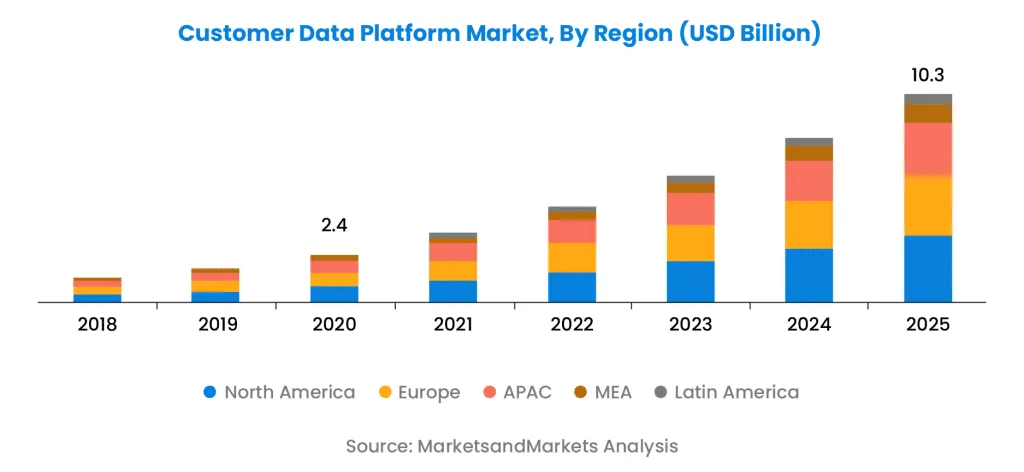
The global CDP market size is expected to grow from $2.4 billion in 2020 to $10.3 billion by 2025, at a CAGR of 34% during the forecast period.

CDPs have proven to be a key component of the MarTech stack, helping companies power digital-first strategies. Let’s dive deeper and look at five key marketing challenges that a CDP can solve.

1. Siloed Data and the Lack of a Unified Customer View

Connected consumers expect a unified, omnichannel brand experience across all touchpoints. However, siloed data hinders retailers from meeting this expectation. To ensure a unified customer experience, you need unified data.

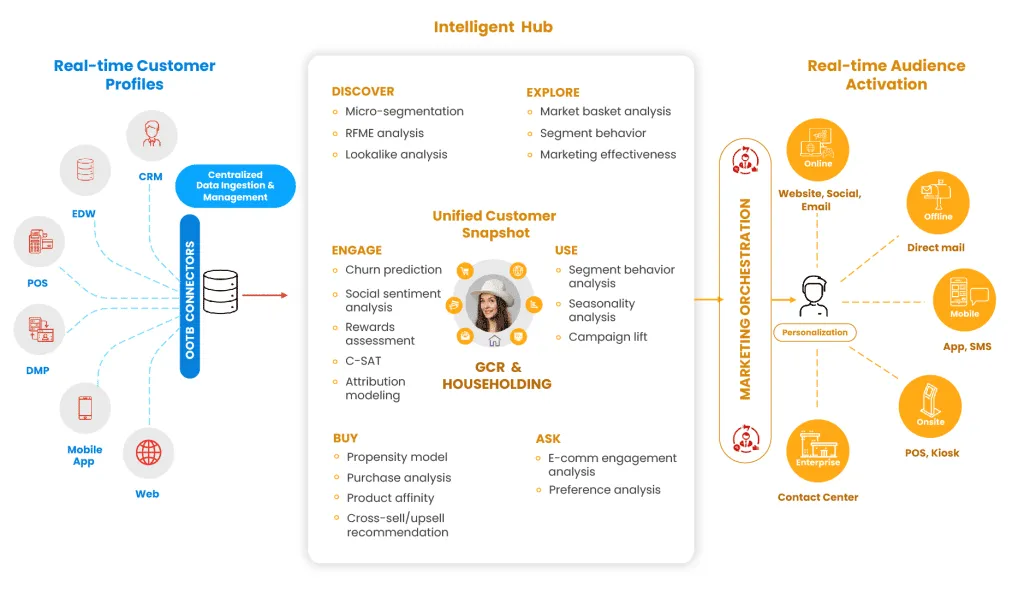
A CDP solution ingests customer data from disparate online and offline sources — website, mobile, eCommerce, POS, CRM, ERP, etc. — and serves as an always-available, integrated source of customer data, thereby eliminating silos. It democratizes data and helps other marketing systems access it for analysis and activation.

A CDP also helps marketers address the lack of a unified view of the customer. It gathers customer’s transactional, behavioral, and identity data, and links customer identifiers to create a 360-degree view of the customer. It merges multiple profiles a customer might have, a process known as deduplication, to build a golden customer record. This record serves as the single source of truth — helping retailers gain the intelligence and insights to run effective marketing campaigns that are personalized down to an individual.

54% of businesses say the lack of data quality and completeness is their biggest challenge to data-driven marketing success.

2. Generic Campaigns that Don’t Create Real Value

Sending generic campaigns to a broader audience is an approach that has become dated and ineffective. It’s important for businesses to get more granular with segmentation and send tailored offers and promotions at a preferred time and channel, to stay relevant in the intensely competitive retail space.

real-time customer data platform solution leverages machine learning algorithms to create complex micro-segments using a combination of customers’ cross-channel data. This allows for persona-driven targeted marketing, which is essential to drive loyalty, improve customer lifetime value (CLTV), and reduce churn. Further, a CDP solution helps identify high-value segments as well as underserved segments — enabling retailers to identify revenue opportunities across their customer base.

91% of people say they’re more likely to shop with brands sending offers and recommendations that are relevant to them.

3. Inability to Reverse Churn

Businesses often overlook the fact that a shopper’s behavior, tastes, and preferences can change significantly over time. The offers and promotions that are relevant to a customer today may not be so after some time passes.

A CDP helps refresh a customer’s data over different time periods and gain insight into their past segment, current segment status, and reasons as to why this segment switch happened. It helps identify if a customer who is a frequent buyer is slipping into dormancy. Churn models can analyze this behavior and determine the likelihood to attrite. These insights enable retailers to take corrective action with attractive offers on products/brands of their choice, to minimize churn.

32% of new and current customers would stop doing business with a brand after just one negative experience even if they’d previously loved the brand’s customer service.

4. Inability to Expand the Customer Base

While marketers focus significant time, money, and effort on customer acquisition, it still remains a challenge. A CDP solution facilitates lookalike marketing, which is among the most efficient ways to expand the customer base. It helps retailers use insights pertaining to their existing high-value customer profiles to identify similar potential customers and target them with acquisition campaigns.

Lookalike is a more holistic approach to customer acquisition than broad segments based on age or gender. For instance, not all women in the age group of 30-35 years have the same interests. Whereas, two groups of people that have similar preferences around products, brands, channels, etc. are likely to be more responsive to the same campaigns and offers.

A CDP, with its built-in analytics models, helps surface deep customer insights and granular segments for effective customer acquisition. It helps marketers save acquisition costs by eliminating ‘spray and pray’ methods, aside from improving conversion rates and driving sales.

Personalization can reduce acquisition costs by up to 50%, lift revenues by 5-15%, and increase the efficiency of marketing spend by 10-30%.

5. Missed Upsell and Cross-sell Opportunities

A CDP helps with market basket analysis, which uses association mining to predict what products are likely to be purchased together. It provides a detailed view of each customer segment, covering data such as average revenue, brand affinity, basket size, and average days since the last purchase. This helps retailers better understand basket composition and identify customer affinities. A CDP solution, therefore, powers decision intelligence to make relevant cross-sell and upsell recommendations, which translate to improved campaign response rates, CTLV, and revenue.

Upsell and cross-sell strategies are solely responsible for 10-30% of eCommerce revenues.

With the proliferation of marketing channels and the ever-growing volumes of data they generate, it is paramount for retailers to invest in a CDP to make sense of the deluge of customer data and drive customer-centric digital strategies. ADA Global’s real-time CDP is designed to meet this need and help marketers eliminate the aforesaid challenges.

What differentiates ADA Global CDP solution?

  • Real-Time Activation: Real-time activation of audience for contextually relevant connect in the moment
  • Deep Customer Insights: Deep and granular customer insights using ML algorithms for a segment of one connect. Leverage Lookalike models for expanding the customer base, market basket analysis, affinity and association mining to grow customers with relevant cross- and upsell and churn analysis, and CLTV to build loyalty.
  • Retail Focus: Comes with 150+ omnichannel strategies, 1,000+ KPIs out-of-the-box, 200+ pre-built reports to ensure rapid time to value

ADA’s Real-time CDP for Personalized Activation

To learn more about ADA Global CDP and determine if it is the right solution for your business, you can request a consultation here.

Table Of Contents
1. Siloed Data and the Lack of a Unified Customer View
2. Generic Campaigns that Don’t Create Real Value
3. Inability to Reverse Churn
4. Inability to Expand the Customer Base
5. Missed Upsell and Cross-sell Opportunities

4 Open Time Personalization Strategies for Restaurant Engagement

Digital Experience Personalization
Blogs

4 Open Time Personalization Strategies for Restaurant Engagement

Is email marketing dead for restaurants? Hardly.

With open time personalization of email content, quick-service operators can delight their customers with contextually relevant, hyper-personalized engagement in real-time.

With social media on everyone’s radar, has email as a marketing channel become obsolete? The answer is an emphatic “no.” With hyper personalization, email is still one of the most effective marketing tools that quick-service restaurants can use to acquire and retain customers. Thanks to open time personalization, the quick-service sector has upped its game and the customers are loving it.

However, the mantra to hyper personalization is how you get your act of algorithms right—that is having the right content at the right time and in the right place. For that “right” everything, quick-serves need to know who their customers are, what they are looking for, when they want it, where they want it, and how they want it. Open time personalization is all about 4Ws and 1H.

Individual customer behavior data is critical to open time personalization. The base is a customer data platform (CDP) which has demographic, transactional behavior information of the customer, all sourced from different platforms (point of sale, third party data, CRM systems, website, mobile app, etc). Algorithms take over and curate information about customers to create one comprehensive profile of customers for further downstream analysis from where one can drive ai email personalization.

Open-time hyper-personalized email campaigns are highly dynamic, where the dynamic content personalization in the email is contextually personalized, not at the time it’s pushed to the receiver, but at the time he/she opens the email. Essentially, it means that if there has been any change between the time the email was sent and opened, that impacts what is published in the email, then the change is incorporated to make it relevant to the minute of email opening.

While it is personalized when it is sent to the customer, it gets updated with the latest information based on any transaction that has happened post sending email or there has been a change in the offers or availability of the product. When a recipient opens the email, the email client sends a request in real-time and the personalization platform, using its algorithmic intelligence, pushes the most recent and relevant content directly into the email template.

Real-time recommendation

To illustrate, a quick-service restaurant sends an email offer with a discount on Peri Peri Chicken at 7 a.m. to one of its regular customers, Lily, who during the day has browsed for Crispy Fried Chicken. She opens the email by 2 p.m. and sees an offer on Crispy Fried Chicken. Voila! That is what Lily was looking for and to boot there is a discount offer, exclusively for her. This real-time product recommendation may probably get the quick-serve a happy customer who, again, may look out for such deals going ahead.

Real-time inventory

Not just that, the real-time inventory updates feature makes changes or updates to the menu at the time the customer opens the email. For instance, the quick-service brand sends Robert an email at 9 a.m. on a combo offer (Veg Extravaganza and Wedges), but Robert only opens the email at 3 p.m. and the offer has changed from Veg Extravaganza to Veg Delight (also Robert’s favourite) and Wedges as the quick-serve ran out of the item. This real-time inventory update is win-win for the restaurant as well as the customer.

Real-time price and offer update

Not just that, the real-time inventory updates feature makes changes or updates to the menu at the time the customer opens the email. For instance, the quick-service brand sends Robert an email at 9 a.m. on a combo offer (Veg Extravaganza and Wedges), but Robert only opens the email at 3 p.m. and the offer has changed from Veg Extravaganza to Veg Delight (also Robert’s favourite) and Wedges as the quick-serve ran out of the item. This automatic store replenishment update is win-win for the restaurant as well as the customer.

Weather-based recommendations

At 7 a.m. the weather at San Jose was bright and sunny. Grill & Chill sent an email promotion for their coolers and salads to their regular customers. By 9 a.m. it began drizzling and the weather got a bit chill. With open time personalization technology, Grill & Chill could instantly change the offers to Soup & Bread to those who opened the mail at 10 AM.

With open time personalization of email content, quick-service operators can delight their customers with contextually relevant, hyper-personalized engagement in real-time. This enhances customer experience, offer take up, conversion and lifetime value. According to eConsultancy, 64 percent of consumers expect companies to respond and interact with them in real-time and it is happening. AI algorithms make this happen with real time customer data profiles that activates audience and segments and then pushes that to personalization engine for 1-to-1 personalization via omni channel orchestration tools.

The article first published in QSR Magazine

Real-time recommendation
Real-time inventory
Real-time price and offer update
Weather-based recommendations

Five Personalization #EpicFails That Kill Conversions

Digital Experience Personalization
Blogs

Five Personalization #EpicFails That Kill Conversions

Based on real eCommerce and marketing examples that tell us what not to do

I thought ‘Hi First_name’ was the worst nightmare for a marketer who’s trying to seem like they have really crafted a message exclusively for the recipient. I was wrong. I hadn’t come across these epic fails that not only cost a conversion or sale, but can negatively impact brand perception.

Superficial personalization is common, but most customers can see through it and find it annoying at best and offensive at worst. Real relevance, on the other hand, is constantly learning and truly individualized. It requires a nuanced understanding of customer preferences, and results in a frictionless, enchanting shopping experience that drives repeat purchases and customer lifetime value.

Get the commerce personalization idea library with 20+ unique examples to help you grow digital revenues and engagement.

Here’s a look at some personalization fiascos. Are you guilty of any of these?

1. Obviously irrelevant search results

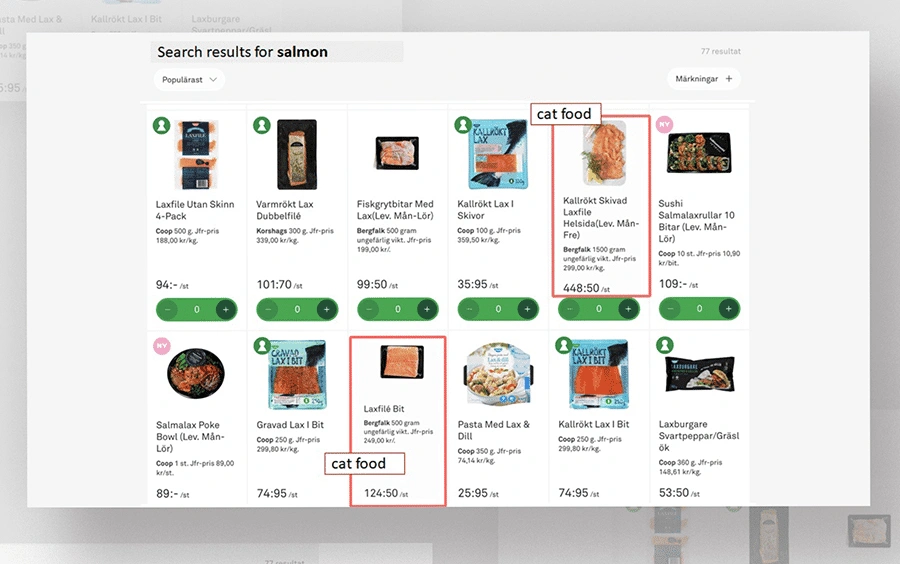
Cat food shows up in search results when I search for salmon.

The likely cause for this is product metadata that contains the word ‘salmon’, therefore being picked up by the search engine as a relevant item. It’s a mammoth task to ensure high quality product data, but there is a smarter way to solve this problem.

By using machine learning algorithms, search queries can be aggregated and associated with actual views and purchases, and those with higher confidence scores are indexed and shown to future shoppers using that search term. In this example, since visitors view and buy salmon (and not cat food), those products are boosted for future searches of salmon. We call this wisdom of crowd based learning, that does not require manual rules and synonym adding.

2. Bad product recommendations, unrelated to the seed product

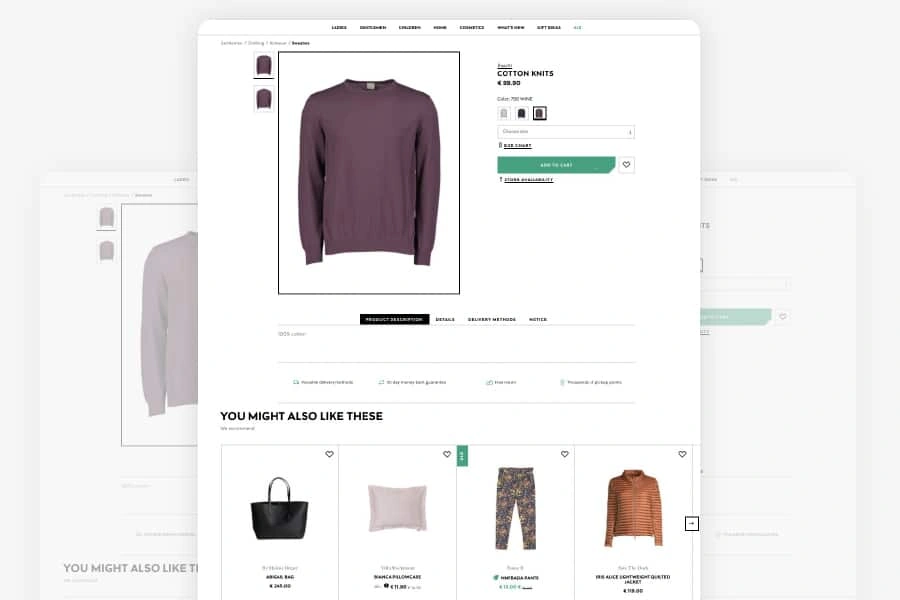
For a men’s sweatshirt, the recommendations on product page (PDP) include women’s handbag, women’s jacket, and kids pants.

The likely cause for this is using a traditional, common ‘people who bought this also bought’ strategy that clearly isn’t working, as purchases made over time are unlikely to be complementary. Instead ‘bought together in the same order’ is a strategy more suited for compatible cross-sell.

3. No results for a product available in the catalog

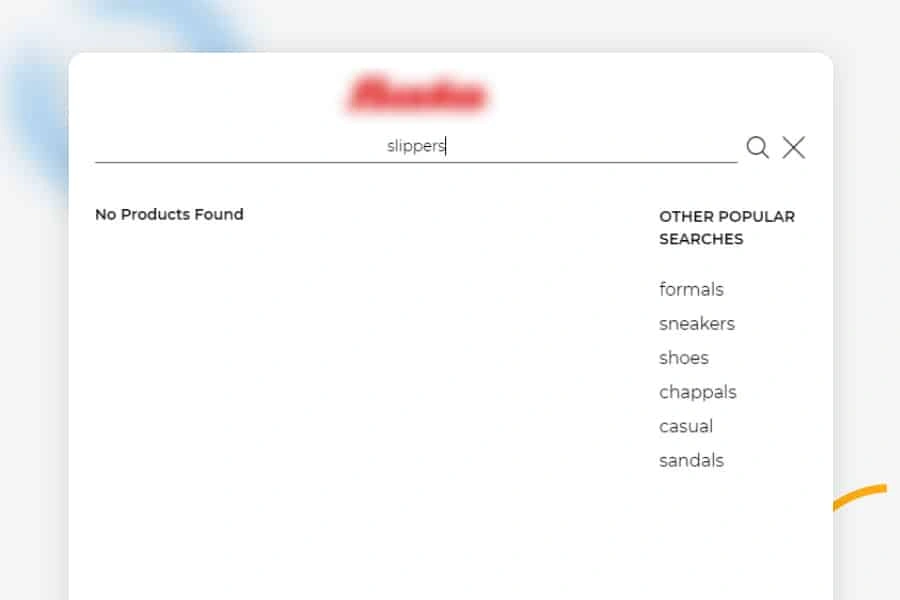
When I look for ‘cutlery’, the webstore returns a no-results page, even though they have cutlery in stock.

The problem is that dictionaries and synonyms aren’t set-up, and the search engine isn’t learning from actual shopper searches. The catalog uses the terms ‘silverware’, ‘forks and knives’ to refer to the same product.

This is a common problem across retail verticals.
In another instance, a search for ‘flip flops’ gets me relevant results, but it does not work when I search for ‘slippers’ or an Australian searches for ‘thongs’ (Yes, I spent some time in Australia, and that’s their term for flip flops!).

4. Spray and pray marketing, no personalization

I’m inundated with emails, messages, notifications that I never end up opening.

Many marketers are stuck in the 90s – they either lack the ability to target customers, or are constrained because their channels work in silos. Most have progressed to digital channels, but are blasting every communication to every customer on every channel – email, app push notifications, direct mail, SMS. Their inability to cap the total number of touches is of course overwhelming for the customer, and the result is them hitting unsubscribe, turning off notifications, and blocking.

5. Over-personalization – the belief that the more you personalize, the better the customer experience

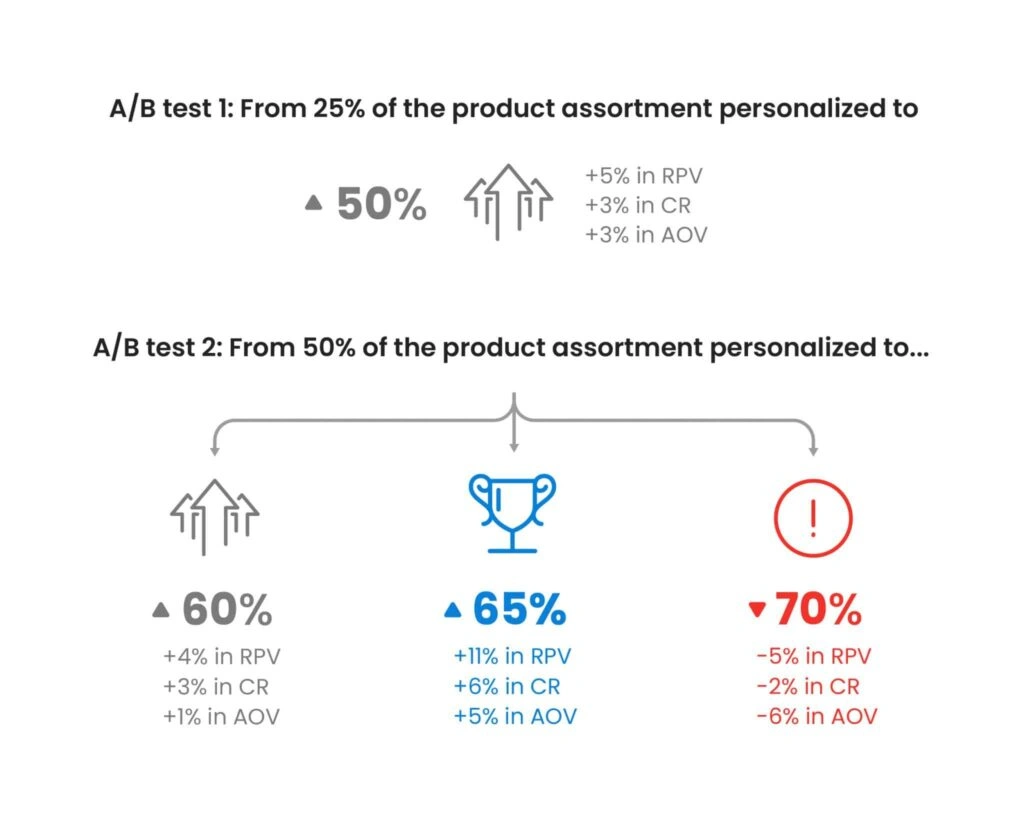
We’re all for relevance and tailoring experiences for an individual’s specific needs. However, know that there is an optimum level beyond which personalization can become restrictive and prevent exploration, giving the impression that there isn’t anything new to consider.

One of our clients found their sweet spot at 65%, and discovered that increasing personalization to 70% on their commerce store resulted in a 5% drop in revenue per visitor and 6% lower average order value.

Read more about over-personalization and findings from testing by a fashion marketplace

What to do next

Wondering if it’s possible to get customer experience right even as you deal with expanding catalogs, complex shopper journeys, demand and supply shocks, and shorter attention spans? We’re here to help.

Get this made-for-retail personalization idea library to learn about new use cases that are helping retailers and brands improve digital conversions, grow basket sizes, and boost engagement.

Table Of Contents
1. Obviously irrelevant search results
2. Bad product recommendations, unrelated to the seed product
3. No results for a product available in the catalog
4. Spray and pray marketing, no personalization
5. Over-personalization – the belief that the more you personalize, the better the customer experience
What to do next

Algorithmic Retail: A Formula for Marketers to Connect with Customers

Digital Experience Personalization
Blogs

Algorithmic Retail: A Formula for Marketers to Connect with Customers

The last year has witnessed transformative changes in the way retail works. The industry experienced a sudden exodus to digital—an increase in e-commerce, mobile apps, BOPIS (buy online, pick up in-store), social commerce. Loyalty went out of the window, with customers switching to brands and products based on availability and need. Customer preferences are evolving—brand loyalty is driven by shopping experience mainly online, high-value customers suddenly became value-conscious and offer-driven shoppers, healthy products are outdoing the traditionally popular brands and items, customers are reading beyond regular product description to understand how responsible the business is, and many such factors are influencing customer purchase decisions and behaviors.

Add to this intense competition not just from within the industry but also from outside forcing them to rethink their business models—from physical stores to e-commerce, DTC, BOPIS.

Lines of cars parked in front of stores, filled with customers waiting in their vehicles for items they have purchased online. Consumers taking their business from one store to another in search of a better, more personalized shopping experience, faster delivery, or the satisfaction of finding the items they want without driving from location to location. Retailers scratching their heads ever harder about how to stock their shelves, grappling with product shortages, and fighting competition from their market as well as from other market segments.

Insider Intelligence estimates that U.S. shoppers spent $72.5 billion via click-and-collect in 2020, accounting for 9.1 percent of all e-commerce sales. This year, those figures will increase to $83.5 billion and 9.9 percent.

Traditional retail sales have declined but e-commerce has seen a 129 percent year-over-year growth in the U.S.

Customers are becoming increasingly demanding. They are no more satisfied with fast service; they expect instant. Retailers sending personalized ecommerce experience offers via email the next day of purchase was considered fast. That’s not good enough—they want brands to provide contextually relevant experiences and to connect with them in the moment.

Customers are becoming increasingly demanding. They are no more satisfied with fast service; they expect instant. Retailers sending personalized offers via email the next day of purchase was considered fast. That’s not good enough—they want brands to provide contextually relevant experiences and to connect with them in the moment.

How then do marketers in the retail industry cope with this pace of change? It is no secret that the retail industry must extend its frontiers from analytics to artificial intelligence and algorithms. It is the cornerstone for marketers to create a differentiated brand experience and win the long-term race for customer loyalty. And it is the cornerstone to grabbing both customer mindshare and wallet share.

Algorithmic Intelligence Can Boost Personalization

Algorithms helps retailers better understand customers, individualize customer experiences, and effectively engage customers in an omnichannel manner. As mentioned earlier, customer tastes, preferences, and behaviors are evolving fast. AI can help marketers understand these changes as they happen and connect with customers in a relevant manner. For example, owing to the pandemic, the time-of-day preference to order a meal changed from lunch to dinner for a pizza chain. There was an increase in orders for evening snacks, and weekend lunch became more popular. Pizza chains that caught this change early on were able to make a quick change to personalize based on the menu, channel, and open time personalization preferences. Some of them enjoyed more than 30 percent increases in conversion rates and about 10 percent increases in average order value and purchase frequency with personalized interaction powered by algorithmic intelligence.

Another example is of a grocer who was able to identify certain high-value customers slipping to low-value owing to the impact of the pandemic, with basket value going down by more than 25 percent. Algorithms helped identify these granular segments, and by using an AI-powered recommendation engine, the grocery was able to push the right offers to the customers in this segment based on their purchase history (market basket and affinity analysis), reversing the trend and improving the lifetime value of the customers.

Real-Time Customer Engagement Driven by AI

With customer data platforms (CDPs) that have built-in algorithmic intelligence, retailers can engage with customers in a relevant manner in real time. CDPs enable streaming data ingestion and real time customer segmentation creation, which is then activated in real time for personalized interaction with the customer instantly.

Personalizing products in the catalog based on what the customer is searching for on the ecommerce search site to responding to a customer’s Instagram stories on the shoes she bought from a certain brand, AI enables real-time personalization for retailers.

Unifying customer’s behavioral and transactional data across touchpoints and tailoring journeys for every customer based on deep insights are must-have capabilities. Real-time decisioning intelligence helps predict customer needs and modify the journey to meet taste or behavioral changes. Algorithms and AI empower retailers with tools to drive real time customer engagement through the customer’s shopping journey in the channel of their choosing—mobile, web, email, or text—delivering up-to-the-minute personalized product recommendations based on customer behavior, location, etc.

Consistent Engagement Across Channels

Today, customers are spoiled with choices in the plethora of channels they have for shopping and learning about a brand. To be customer-centric is to connect with them where and when they would like to engage with you. AI-powered platforms for omnichannel orchestration do just that—help retailers know as soon as a customer arrives on one of their channels and engage with them right there.

If regular grocery store customers decide to download the grocer’s app and make a purchase, messages, offers, and social proof messages are customized based on their past purchases at the store, delighting customers and enticing them to come back.

If a customer forgets to complete a transaction, an SMS is sent to the customer reminding her to do so. A near sure-shot way to increase conversion rates.

By helping retailers understand their customers’ behavior, tastes, and preferences, algorithms deliver improved customer satisfaction, loyalty, and lifetime value—the right formula for sustainable business growth. AI algorithms enable accurate, triggered email marketing campaigns, thereby opening doors for new revenue-generating opportunities and minimizing spending on ineffective promotional vehicles while helping retailers scale as they grow.

The future looks even brighter with the infinite possibilities and seismic shifts that AI brings for retailers—virtual stores, live streaming, magic mirrors, and more. Challenges and roadblocks such as data fragmentation, changing customer expectations, heightened competition, and newer channels mushrooming will continue to appear. Algorithms will help retailers adapt and pivot, with customer at the center of it all.

The article first published in Destination CRM

Table of Contents
Algorithmic Intelligence Can Boost Personalization
Real-Time Customer Engagement Driven by AI
Consistent Engagement Across Channels

Customer Data Platform Bucks the Downward Trend: 4 Reasons Why

Omnichannel Marketing
Blogs

Customer Data Platform Bucks the Downward Trend: 4 Reasons Why

In this age of ever-evolving needs, tastes, and behavior of customers, how do retailers ensure they stay connected with customers? With everything going digital, this problem seems to be accentuated.

But wait… therein lies the opportunity!

With this mass exodus to digital, every customer touchpoint is a data point. Stitch them all together to get the full picture and the story as it unfolds. Is it beginning to sound like Jason Bourne’s attempt to discover his identity?

Honestly, this is more exciting.

Every day, retailers gather customer data from different sources which is a treasure trove of deep customer insights. The value of this data is in leveraging it to understand and address customer needs. Customer Data Platform (CDP) does exactly that: brings customer data from across sources into one place, cleans it up for analysis that throws up deep insights which is then used to engage with customers at an individual level, meeting their tastes and preferences of products, brands, channels, time & more.

Taking it to the next level is a real-time CDP – one that does all of the above in real-time as the customer engages with the brand. CDP is the cornerstone for retailers to drive personalized engagement and connect with customers ‘in the moment’.

This has enhanced the popularity of CDPs among marketers in the last year and the crisis has only accelerated the need. CDPs empower marketers with the speed, agility, and intelligence required to survive and thrive in this new world of digital.

The Hype for CDPs is Real and Here is Why

Retail Customer Data Platforms are a marketer’s best friend. Once fully integrated, it can capture customer interaction data across multiple channels, unifies data, and translates that into meaningful, snackable information for marketers.

Data can be collected from any source be it CRMs, vendor and partner information, offline store purchases, social media, and more. This is done in a timely manner to facilitate quick decisions and can be done in real-time. The built-in capabilities (ecommerce personalization solutions, real-time activation, campaign orchestration) are one of the main allures of CDP, everything you might be looking for can be found in one place.

Advanced AI has the ability to quantify human needs into predictable patterns. By deriving information from customer intent and behavior across channels, it is possible for AI to create real time customer segmentation, customer attributes, and personas to provide deep insight into the lifetime value that each category brings in so that marketers can drive relevant engagement.

CDP solution today comes with in-built AI and ML functionalities that provide intelligent recommendations that align with business goals. Over time, AI and ML will only get better at predicting future behavior and understanding customer relations and their journeys.

Real-Time Processing is the need of the minute.

What this means is that CDP solution helps marketers manage large volumes of data flows with seamless ingress and egress integrations. CDP then analyses real time customer data profiles with minimal lag and provides prescriptive intelligence for the marketing team to make decisions. In today’s world where customer demands are ever-changing, a CDP helps marketers act quickly and accurately with decisions that are based on calculations.

Data privacy is a huge issue we face in today’s highly digitized world. A good Customer Data Platform will help businesses adhere to data privacy laws and manage consent while also enhancing the customer experience at more personal levels.

Data reveals that 90% of customers are willing to share their data for ease of experience. It is then up to businesses to be mindful of the use of this data and doing so can only lead to building trust between business and customers.

The Future is Data-Driven

CDPs are shedding new light on how vast amounts of dynamic content personalization can be utilized by businesses with ease. Businesses and marketers alike are seeing the value it brings to a company’s growth. It is of little wonder that the global CDP market is said to grow from 2.4 billion USD in 2020 to 10.3 billion USD in 2025.

Now seems like the right time to invest. It is telling that, in 2020, while many industries experienced an economic slump due to the outbreak of the novel coronavirus, growth in the CDP sector surged. Reach out a real time CDP provider, if you haven’t already.

The article first published in AIthority

Table Of Contents
The Hype for CDPs is Real and Here is Why
The Future is Data-Driven

How eCommerce Search Personalization Improves Product Discovery

Digital Experience Personalization
Blogs

How eCommerce Search Personalization Improves Product Discovery

Lessons in eCommerce search from a major online retailer

If you’re as picky as I am, you probably spend a lot of time researching several products to ensure you make the best decision. But when was the last time an eCommerce store showed pertinent information that helped you make a purchase decision?

This happened to me some time ago when I was on an online store to find a pair of noise-canceling headphones. I used the search bar and was pleasantly surprised to see a headphones comparison article pop up, in addition to relevant headphones. Thanks to the timely and relevant article that showed up, I was able to speed up this process.

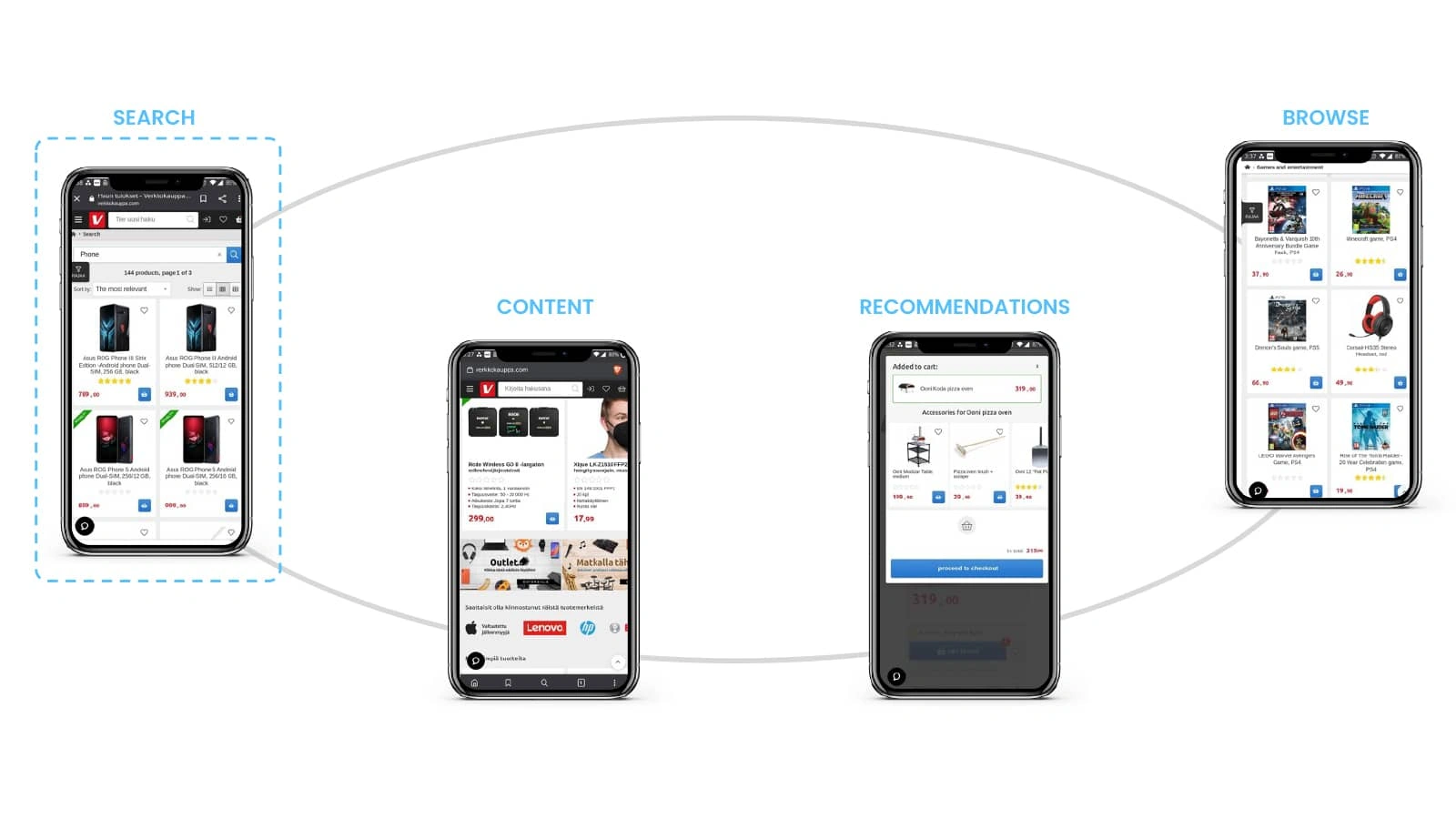
Most businesses think of eCommerce personalization only in terms of product recommendations. However, it’s equally important to personalize other key touchpoints in the online shopping journey — search, browse, and content. Doing so allows for a more holistic customer experience, which translates to increased conversions and revenue per visit. eCommerce search is increasingly becoming a key pillar of CX.

Fig 1. Touchpoints across the eCommerce shopping lifecycle

Why? For one, shoppers who search convert 3x more than those who don’t. This has to do with the fact that people who use search have an express intent of what they want to buy.

Personalization search ecommerce should kick in as a shopper types their search query — showing products that they are more likely to be interested in based on their individual behavior and known preferences. But before getting to personalized results, the basics need to be in place, and this requires effort and is not without its challenges.

Let’s look at some common challenges with traditional search engines through the eyes of one of our clients: Verkkokauppa.com. Verkkokauppa.com is Finland’s most-visited online retail store with 65,000 SKUs in 26 product categories.

Challenges with Traditional Search Engines

1 Inability to Handle Product Data Issues

Traditional search engines primarily rely on product metadata and descriptions to display results.

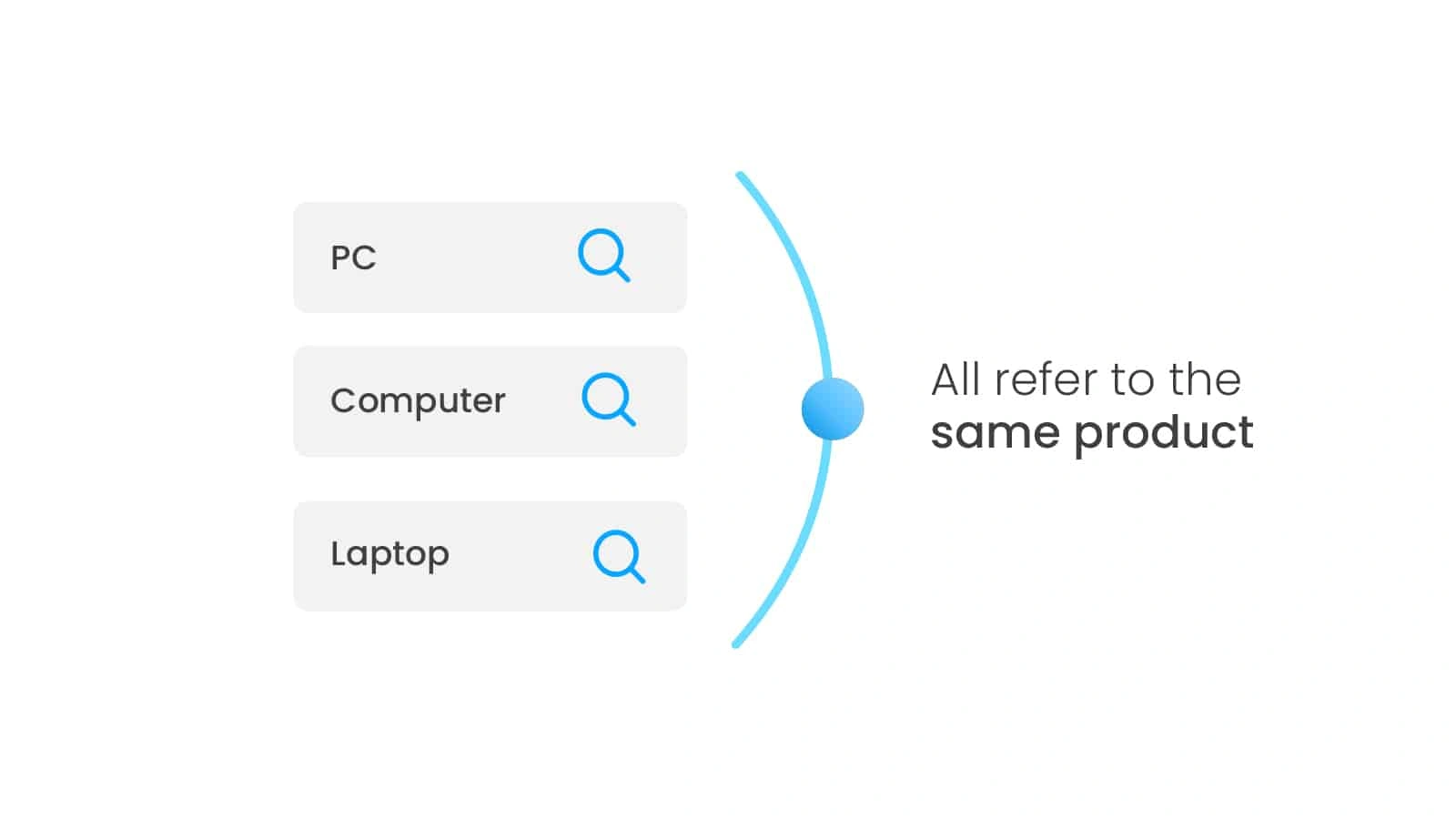
It is quite rare for a shopper to make precise, descriptive search queries. For example, a person might search for ‘computer’, which is an umbrella term that could refer to a PC or a laptop. Even ‘laptop’ is a rather broad search term, as there are various categories like Notebook, Ultrabook, Convertible, and Netbook. In such cases, the search engine needs to work with limited information and decide what to show the shopper.

Fig 2. An example of search queries that refer to the same product

To overcome this, developers need to create synonyms to match products to specific keywords. However, this is a very time-consuming approach, and sustaining it just isn’t practical.

2 Irrelevant Search Results

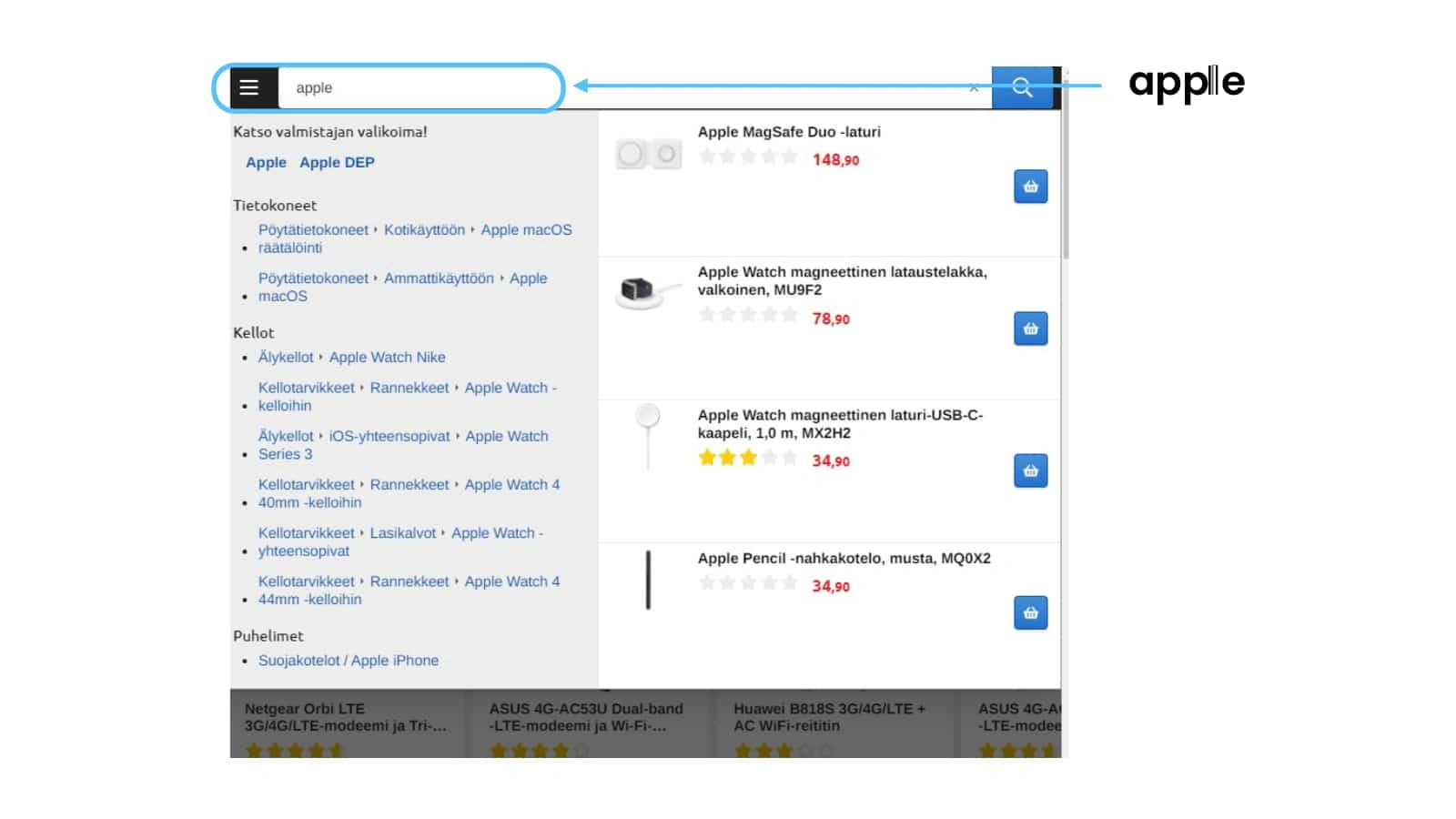
Our client also recalled an experience when he searched for ‘iPad’ because he was looking for, well, an iPad. But the initial results showed products like iPad sleeves and other accessories — items he didn’t need. He had to scroll further down to find the actual product. For a traditional best ecommerce search engine, these results are technically correct because their product metadata contains the word ‘iPad’, but the results are not relevant to the shopper’s current need.

Fig 3. Lack of relevance in search results

3 The No-results Page

Another common issue is shoppers mis-typing the product or model name, leading to bad search results. But what’s worse is the dreaded ‘No results’ page. When a shopper sees this page after a search query, they have basically hit a dead end. This is bad for business. It’s important to always show relevant alternatives even if the shopper’s desired product isn’t available.

Download Personalized Search Case Study

Época Cosmeticos Pivots to Individualized Shopper Experiences, Improves SEO with Personalized Search, Content and Recommendations.

Download Now

How Verkkokauppa.com Managed Product Data Issues and Improved Search Relevance

Let’s see how Verkkokauppa addressed the aforesaid data issues with self-learning, personalized search.

Anton Paasi, Head of eCommerce at Verkkokauppa.com, discusses the potential of eCommerce Search at ADA Global Personalization Summit 2021

Wisdom of the Crowd

When a shopper searches for ‘Apple’, the results could display every Apple product available. But is that relevant to the shopper? Perhaps not. One way of addressing this is to look at the collective behavior of shoppers after they searched for ‘Apple’ and tune the results accordingly. This is the essence of what’s known as Wisdom of the Crowd (WoC).

WoC uses a Machine Learning algorithm to learn from the entire shopper population, their queries, and what they view or purchase subsequently. And the results are, more often than not, accurate.

In a recent conversation, Verkkokauppa.com shared how leveraging WoC helped them bring relevance to the results when the search queries were as short as one word.

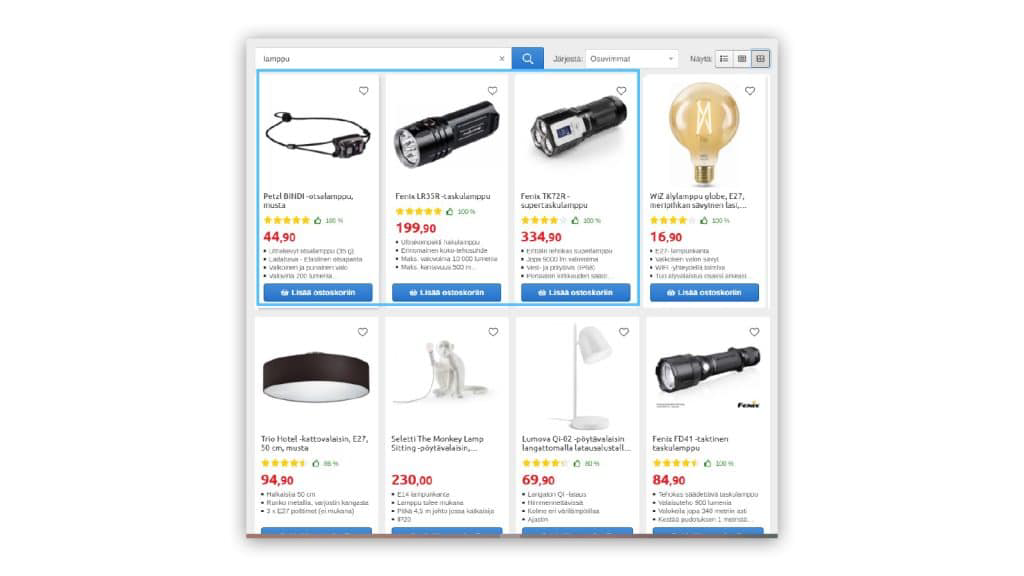
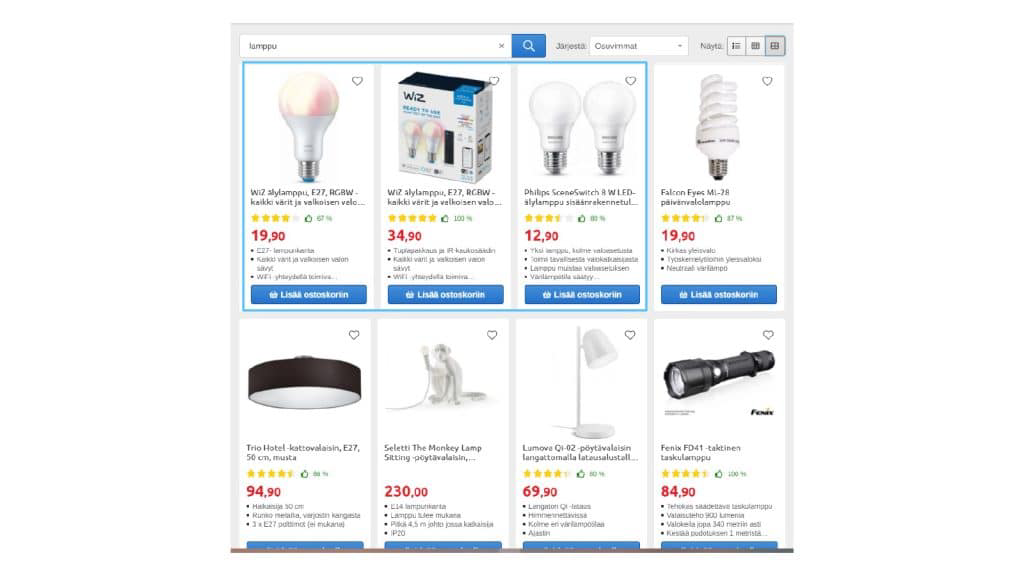
Take the example of the word ‘lamppu’, which is Finnish for a light bulb. The issue with the word ‘lamppu’ is that it’s also used as a compound word for several categories of lamps — such as ‘taskulamppu’ which means a torch, and ‘älylamppu’ which refers to a smart lamp.

Figure 4 below shows the search results for ‘lamppu’ before the application of WoC. The results show various types or categories of lamps because the product titles contain the word ‘lamppu’. While the results are technically correct, they aren’t relevant.

Fig 4. Search results for ‘lamppu’ before implementing WoC


Figure 5 shows WoC in action. The search engine now knows that people using the search query ‘lamppu’ are in fact looking for a light bulb. So it displays several options for a light bulb at the top of the results and pushes the other categories of lamps below.

Fig 5. Search results for ‘lamppu’ after implementing WoC


The WoC functionality, therefore, helps understand shopper terminology like a human would, and boosts relevant items, while eliminating the dependency on developers to build various rules.

Personalizing Search Results with Behavioral Data

Leveraging behavioral data to drive 1-to-1 personalization is now table stakes. Search personalization helps convert shoppers with clear purchase intent quicker.

Verkkokauppa experienced a 10-15% increase in conversions when they made the switch from one-size-fits-all search to personalized search.

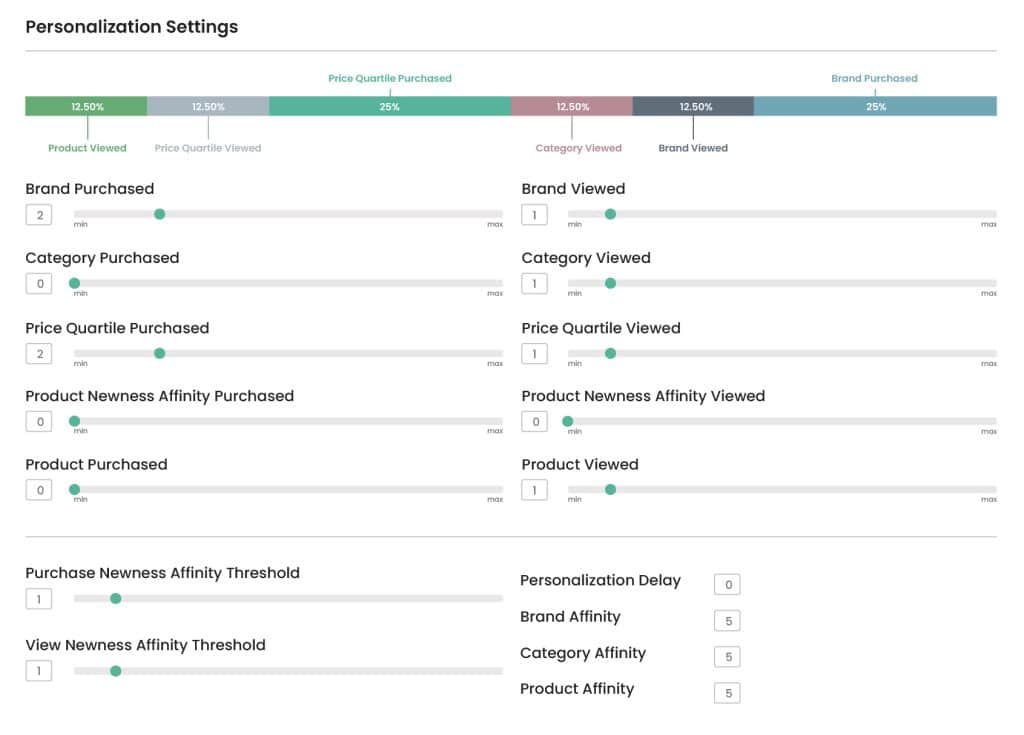
The retailer uses ADA Global Find™, an ecommerce personalization software that not only helps deliver richer personalization but also improves product discovery optimization, with the use of behavioral data. It leverages behavior attributes (see Fig. 6) to organize search results, as per the individual’s intent, in real time.

The personalization software allows for granular controls that help set weights and experiment with each of these attributes. This is as simple as moving sliders. The software, therefore, empowers business users to adjust personalization settings themselves as and when needed without any dependency on IT.

Fig 6. Personalization tool settings to adjust behavioral attributes

In a world where consumers interact with digital commerce even when the actual purchase is made in-store, it’s more important than ever for retailers and brands to invest in customer experience strategically, and across the entire shopper journey.

While devising an ecommerce search personalization strategy, retailers must think beyond product recommendations and recognize that search is no more just a developer tool, but a lever for business growth.

Table Of Contents
Lessons in eCommerce search from a major online retailer
Challenges with Traditional Search Engines
How Verkkokauppa.com Managed Product Data Issues and Improved Search Relevance
Wisdom of the Crowd
Personalizing Search Results with Behavioral Data
Verkkokauppa experienced a 10-15% increase in conversions when they made the switch from one-size-fits-all search to personalized search.